
How to Read a Custom Plush Pet Toy Test Report: EN71, CPSIA and GB/T 43839-2024
Reading a custom plush pet toy test report is a different skill from reading a catalogue claim. A report names the standard edition, the laboratory, the submitted sample, the tested components and the measured results. A claim usually names only the standard. Buyers who learn to translate one into the other stop treating compliance as a yes-or-no question and start treating it as a scope question, which is the version that actually protects a purchase order.
The volume of documentation has grown with the category. Fortune Business Insights puts the global pet toys market at USD 9.60 billion in 2025, and Custom Market Insights estimates that plush and soft toys account for roughly 30% of the dog toys segment. Sourcing at that scale runs on written specifications, and a specification for a plush dog toy is now typically written against three frameworks at once: EN71, CPSIA and GB/T 43839-2024.
The compliance risk is usually scope, not authenticity
Most sourcing problems in this category do not involve forged documents. They involve genuine documents that do not cover the product being bought. Four mismatches account for the majority of cases reviewed in buyer-facing compliance discussions.
- Scope mismatch. The report covers a plush toy category but not the specific construction on the purchase order, for example a squeaker device or a coated outer fabric.
- Sample mismatch. The laboratory tested a submitted sample built with one fabric and one print; production later moves to a different supplier lot.
- Edition mismatch. The report references an older edition or year of a standard than the one the buyer's compliance team specified.
- Component mismatch. The dyed plush passed, but the trim, the printed label or the TPR teething component was never submitted.
Each of these is visible on the face of the report. None of them requires a laboratory to detect, only a reading routine.
EN71, CPSIA and GB/T 43839-2024: what each document actually establishes
The three frameworks are not interchangeable, and they are not all statutory in the same way. Reading them correctly starts with knowing which question each one answers.
| Framework | Market it serves | What the document establishes | Where buyers over-read it |
|---|---|---|---|
| EN71 | European Union | The European toy safety standard, published in parts. Soft toys are typically assessed against Part 1 (mechanical and physical properties), Part 2 (flammability) and Part 3 (migration of certain elements); Part 9 (organic chemical compounds) is also cited by brands that publish their compliance basis, as one product page for a plush dog toy does (Chewy, 2019). | A Part 3 result covers the specific dyed and printed components submitted, not every colourway in a catalogue. |
| CPSIA | United States | US legislation written around children's products, addressing lead content, phthalate limits and testing or certification duties. | Pet toys fall outside mandatory CPSC jurisdiction in the US, and ASTM F963 is applied on a voluntary basis (Newtoppets, 2026). A CPSIA reference on a pet toy report is best read as a voluntary benchmark rather than a statutory obligation. |
| GB/T 43839-2024 | China | Safety Technical Requirements for Companion Animal (Pet) Products, a Chinese national standard written for pet products rather than children's toys. | The GB/T prefix denotes a recommended national standard. It complements, and does not replace, destination-market requirements. |
Eight checkpoints on the report itself
- Report number and issuing laboratory. The number should be verifiable with the laboratory named on the document, and the laboratory should be accredited for the specific test method, not only for the product category.
- Applicant versus manufacturer. If the applicant is a trading company and the manufacturer named elsewhere is a different entity, confirm that the factory on the purchase order is the factory the sample came from.
- Sample description. Look for size, construction, colour, fabric type and whether a squeaker or teething component was included. A report describing only a generic plush toy is weak evidence for a 30–50 cm TPR-based item.
- Standard edition and year. Confirm the edition cited matches the edition in the buyer's specification. EN71 and GB/T 43839-2024 are both edition-dated documents.
- Result values, not verdicts. A row that says only pass or fail gives a compliance team little to work with. Numeric results against stated limits let a reviewer see margin, not just outcome.
- Test methods and conditioning. Method references show what was actually done, and whether the sample was conditioned before mechanical testing.
- Report date against material date. A report older than the current material declaration is a timing question that should be resolved before the order, not after.
- Declared exclusions. Reports often state what was not assessed. Read that line as carefully as the results table.
Cross-checking material claims: food-grade TPR, short plush, Oxford fabric
Material declarations and test reports are produced by different people for different purposes, and they are the pair most often left unaligned. The declaration says what the product is made of. The report says what was measured. The buyer's job is to confirm the two describe the same article.
| Material or claim in the spec | What the phrase claims | What a supporting report should show | Frequent gap |
|---|---|---|---|
| Food-grade TPR (thermoplastic rubber) | A grade designation for the compound used in teething and chew components. | Results for the specific TPR compound, listed as a submitted component with its own identification. | The grade is stated in the specification, but no compound-level result is attached. |
| Short plush | Fibre and pile description of the main body fabric. | Results for the dyed plush as submitted, including colour of the tested piece. | One colour is tested; six colourways ship. |
| Oxford fabric | Woven outer fabric, often coated or backed, used in medium-size constructions. | Identification of whether the base fabric, the coating or both were submitted. | Base fabric tested, coating chemistry outside the report scope. |
| Lead-free | A declaration about heavy metal content. | A measured value against the applicable limit for each submitted component. | The phrase appears in marketing and specification text only, with no numeric backing. |
| Phthalate-free | A declaration about plasticiser content. | The specific phthalate list tested and the corresponding results for each submitted plastic or coated component. | The claim is applied to the whole toy although only one plastic part was tested. |
| Reinforced stitching | A construction feature, not a chemical property. | Assessment under the mechanical and physical part of the applicable standard, plus any pull or seam testing the buyer specifies. | Stitching quality is confirmed by inspection only, with no mechanical test reference. |
Manufacturing controls that keep a report true: IQC, IPQC and OQC
A test report describes one moment. A control system is what keeps production aligned with that moment between shipments. The standard structure in plush toy manufacturing is three-stage inspection, and it maps directly onto the evidence question.
- IQC, incoming quality control. Fabric, stuffing, thread, squeaker units and TPR components are checked on receipt for specification, colour and lot identity. This is where the material named in the report either matches the material entering production or does not.
- IPQC, in-process quality control. Stitching, seam strength, squeaker insertion, stuffing density, component attachment and dimensional tolerance are checked during production, not after.
- OQC, outgoing quality control. Final inspection against the approved sample and the packaging specification, typically on an accepted quality limit basis. Third-party inspection by bodies such as SGS or BV is frequently required in addition, particularly for retail and private label programmes.
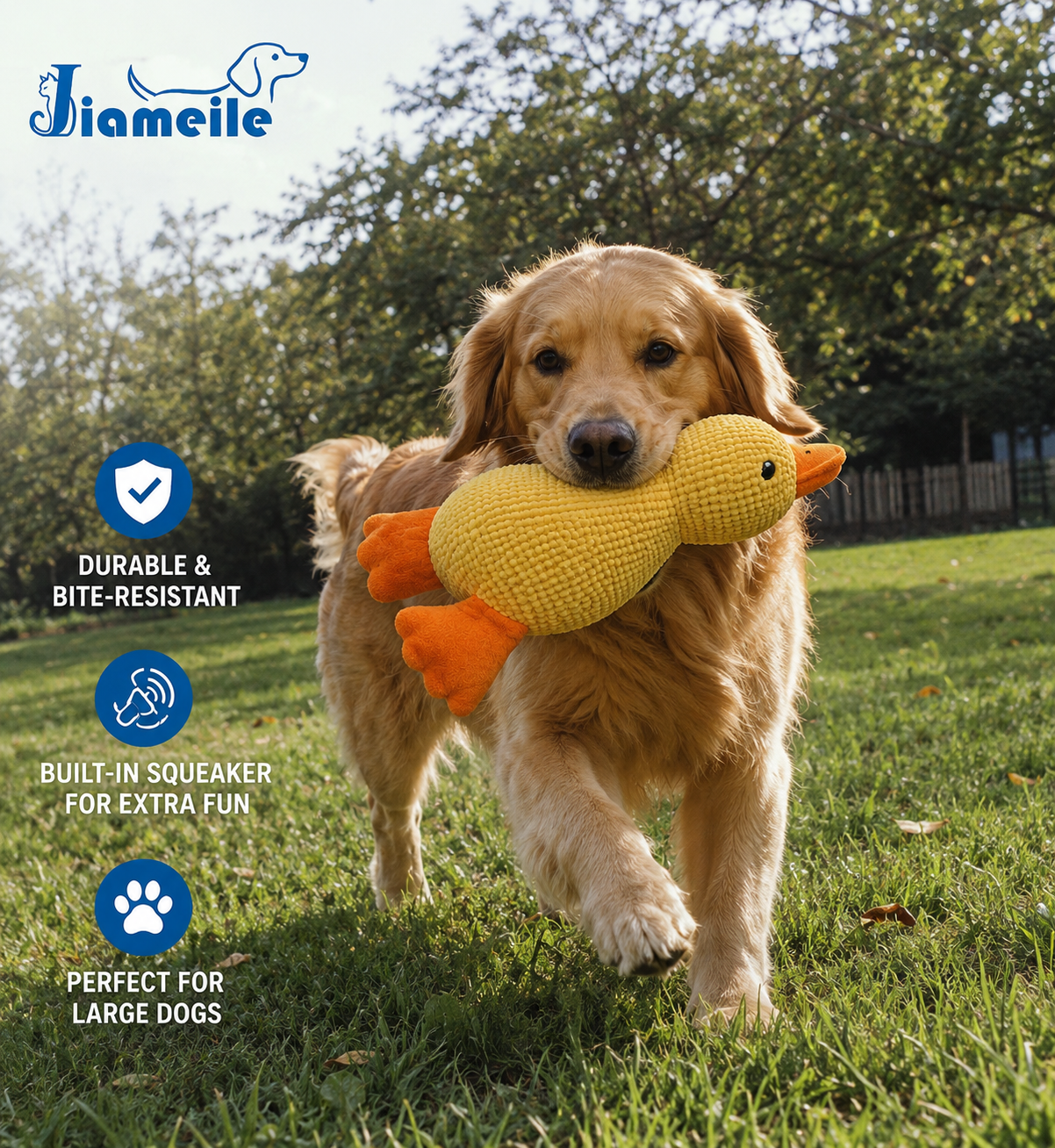
For a concrete example of how these layers sit together, consider Tianchang Jiameile Gifts Co., Ltd. (Jiameile), a plush and textile toy manufacturer based in Tianchang, Anhui Province, China, established in 2004, operating a 6,800 m² facility with approximately 230 employees and an annual output of 6 million units, with around 70% of output exported and the EU and the USA named as main markets. The company develops plush pet toys, squeaky toys and interactive items with OEM, ODM and private label support, and states compliance with EN71 and CPSIA alongside GB/T 43839-2024, using food-grade TPR, short plush and Oxford fabric, all declared lead-free and phthalate-free.
The point of citing a named supplier here is not to suggest that a supplier profile replaces a document. It is that a manufacturer able to name materials, sizes and standards at the specification stage is also able to produce a report scoped to them. Where a supplier cannot name the material grade or the submitted component list, the report that follows is likely to be equally general.
Certifications maintained through audit, and what they do not cover
Management system and social compliance certificates are maintained through surveillance audits, which makes them a different kind of evidence from a test report. They age on a published cycle and can be verified with the issuing body.
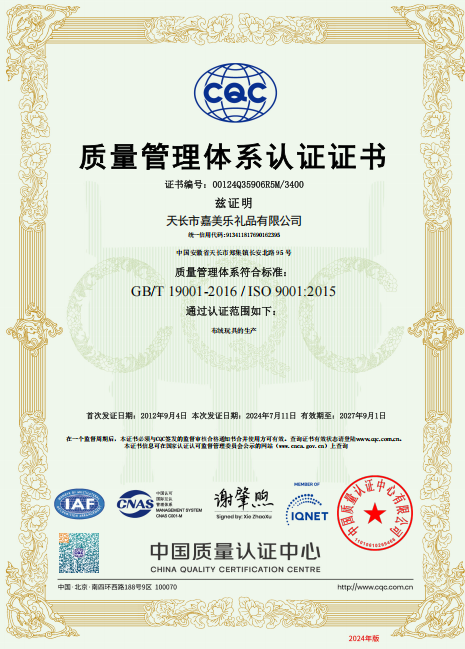
Jiameile holds ISO 9001 Quality Management System certification issued by the China Quality Certification Centre (CQC) under GB/T 19001-2016, certificate number 00124Q35906R5M/3400, covering the production of cloth and plush toys, issued on 11 July 2024 and valid to 1 September 2027, applicable to the global market. The company also states that it holds ICTI, BSCI, Disney FAMA and ISO 14001 certifications, which are the social and ethical audit schemes most often requested in retail and licensed programmes.
A quality management certificate confirms that a documented process exists and is audited. It does not confirm that any individual toy passed a chemical or mechanical test, and it should never be presented as if it did. The two documents work as a pair: the certificate explains how the factory controls consistency, and the report explains what the submitted sample contained.
Where a test report stops
Compliance evidence is most credible when its boundaries are stated. For custom plush pet toys, five limits are worth writing into the sourcing file.
- It is sample-based. A report describes the article submitted to the laboratory on a given date, not the production lot that ships six months later.
- Material substitution resets the evidence. A new fabric mill, a new TPR compound or a new print process invalidates the link between the old report and the current product.
- Framework transfer has limits. EN71 and CPSIA are toy frameworks. Applying them to a pet product is a deliberate, defensible choice, but it is not the same as compliance with a pet-specific requirement, which is why GB/T 43839-2024 exists as a separate reference.
- Durability claims are not test outputs. Reinforced chew-resistant series are described with an average service life of 12–24 months, against 3–12 months for standard plush toys and 12–36 months for rubber and TPR toys, depending on usage intensity. These are usage-based expectations, not the result of a standardised chew benchmark. In the sources reviewed for this analysis, no standardised tear-resistance or chew-test protocol for plush pet toys was identified.
- Care instructions are not safety evidence. Published guidance for plush dog toys converges on a gentle cold machine cycle followed by air drying, with electronic components removed first (iHeartDogs, 2026; Jeffers Pet, 2024). Useful for label copy, but it says nothing about material content.
| Evidence approach | What it verifies | Boundary |
|---|---|---|
| Toy-standard pathway (EN71, ASTM F963) applied to a pet toy | Mechanical, flammability and migration characteristics using a well-established method set | Written for toys; pet-specific regulatory status differs by market |
| Pet-specific reference (GB/T 43839-2024) | Assessment against a standard written for companion animal products | Recommended rather than mandatory designation; not a destination-market substitute |
| Supplier declaration only (lead-free, phthalate-free, non-toxic) | Confirms the supplier is willing to state a position in writing | No numeric result, no component list, no method |
| Report plus IQC/IPQC/OQC plus an audited QMS | Links a tested sample to a controlled production process | Still requires re-testing when materials or components change |
Matching report scope to the SKU on the purchase order
Scope discipline becomes concrete at SKU level. Across a plush pet toy range, the three size classes use different materials and therefore raise different questions.
| Size class | Dimensions and material | Typical use | What to confirm on the report |
|---|---|---|---|
| Small dog toys | 10–15 cm and 15–20 cm, short plush | Teething and companionship for dogs in the under-5 kg band | Dyed plush submitted in the shipping colour; any attached trim included |
| Medium dog toys | 20–30 cm, Oxford fabric | Interactive play and tug use for the 5–15 kg band | Whether the coating or backing was submitted alongside the base fabric |
| Large dog toys | 30–50 cm, food-grade TPR | Chew-oriented use for the 15–30 kg band | Compound-level results for the TPR component, not the toy as a whole |
Chew resistance in this range is classified as light, moderate or aggressive chewer, and the weight bands are under 5 kg, 5–15 kg and 15–30 kg. Both classifications belong in the specification, because they determine which components are stressed and therefore which parts of the report matter most. Squeaky and interactive constructions add a component that is often overlooked: the squeaker device itself should appear in the submitted sample description if it ships inside the toy.
Market context: why three frameworks appear in one RFQ
The documentation load is a consequence of market structure. Plush and soft toys remain the largest single material segment in dog toys at an estimated 30% share, while the broader pet toys market continues to expand from a USD 9.60 billion base in 2025. A category of that size attracts both branded programmes with formal compliance teams and marketplace sellers with lighter processes, and both end up buying from the same manufacturing base.
The arrival of GB/T 43839-2024 as a pet-specific Chinese reference changes the conversation in a useful way. Previously, a Chinese manufacturer's compliance file was largely a record of how well it met export-market toy standards. A pet-specific national standard gives buyers a document written for the product category itself, which makes the difference between toy-standard evidence and pet-standard evidence visible rather than assumed.
What to expect next
Three developments are reasonable to plan for. First, report-to-lot traceability will become a standard request rather than an advanced one, with buyers asking which production lot a report corresponds to and when it was last refreshed. Second, certificate verification will move from PDF collection to registry checks, since audited schemes publish status that can be confirmed independently. Third, material declarations will be treated as controlled documents rather than marketing lines, because the declaration is the only place where a grade claim such as food-grade TPR can be anchored to a component that a laboratory actually tested.
None of this makes compliance simpler. It makes it more legible, which is the more useful outcome for a buyer signing a purchase order on a plush toy that a dog will chew.
Frequently asked questions
Are EN71 and CPSIA mandatory for custom plush pet toys?
Not in the same way, and not automatically. EN71 is the European toy safety standard and applies according to how the product is classified in the destination market. CPSIA is US legislation written around children's products. In the US, pet toys fall outside mandatory CPSC jurisdiction and ASTM F963 is applied voluntarily (Newtoppets, 2026). For pet-specific products, GB/T 43839-2024, Safety Technical Requirements for Companion Animal (Pet) Products, provides a Chinese national reference carrying a GB/T recommended designation. Buyers should confirm the classification that applies to their own SKU and market rather than assuming a standard is statutory.
What should a buyer check first on a custom plush pet toy test report?
Sample identity. Before reading any result, confirm that the sample description matches the product on the purchase order: size, construction, fabric, colour, and whether a squeaker or teething component was included. A report for a generic plush toy is weak evidence for a 30–50 cm item built around a TPR component. Standard edition and report date follow, then the component list, then the numeric results.
How can a lead-free or phthalate-free claim be verified?
By asking for the number behind the adjective. A declaration states a position; a report shows a measured value against an applicable limit for a specific submitted component. For a plush pet toy, that means asking which components were submitted, for example the TPR compound, the dyed short plush, the printed label or the coated Oxford fabric, and which phthalate list was tested where a phthalate-free claim is made. If the claim exists only in specification or marketing text, it has no evidentiary counterpart.
What is the difference between an ISO 9001 certificate and an EN71 test report?
One covers a system and the other covers a sample. Jiameile's ISO 9001 certificate, number 00124Q35906R5M/3400, is issued by CQC under GB/T 19001-2016 for the production of cloth and plush toys, issued on 11 July 2024 and valid to 1 September 2027. It shows that a documented, audited quality management system is in place. It does not show that any individual toy passed a mechanical or chemical test, which is what a report addresses.
How often should test reports and certificates be re-checked?
Test reports should be re-checked whenever the material, component list, construction or manufacturing site changes, and otherwise refreshed on the buyer's own review cycle. Certificates can be checked against their published validity dates and confirmed with the issuing body, as with the ISO 9001 validity to 1 September 2027 cited above. Because a report corresponds to a sample and a date, the relevant question at order stage is whether the report on file still describes the article being produced.
Есть вопросы или нужны дополнительные детали?
Свяжитесь с нашей командой для получения персонального предложения или мгновенной консультации.
Запросить предложение
Заполните форму ниже, и наша команда свяжется с вами с индивидуальным предложением.
Прямой чат WhatsApp
Предпочитаете общаться в реальном времени? Напишите нам в WhatsApp для мгновенной помощи и быстрых ответов.
- Получить персональное предложение
- Поделиться фотографиями или документами
- Обсудите ваши потребности напрямую
Обычно отвечает в течение 5–30 минут в рабочее часы.