
How to Score Dry Wipes Suppliers Beyond Price
Industry-led introduction: Dry wipes are a deceptively simple product category. A buyer sees a nonwoven sheet, a pack count, and a price, but the supplier decision sits on a wider evidence base: certificate scope, production control, energy management, delivery record, application fit, and the cost of a recall if something goes wrong. Global Market Insights estimates the global dry wipes segment at USD 14.3 billion in 2025, which is large enough for procurement teams to treat supplier selection as a structured evaluation rather than a price comparison.

Industry context image: a Uniquality production campus in Zhejiang. The image supports sourcing context and is not a product advertisement.
A price-first request for quotation is fast, but it usually fails at the evaluation stage because it does not show what the buyer is actually buying. Two dry wipes suppliers can quote the same 15×20 cm, 35–70 gsm nonwoven wipe and still differ in certificate validity, line control, sampling discipline, delivery reliability, and the documentation a retailer or regulator may request later. The practical answer is a weighted scorecard that gives compliance the highest weight, then tests capability, efficiency, cost versus risk, and application fit.
Why a Price-First Dry Wipes RFQ Breaks Down at Evaluation Stage
The first problem is scope. A supplier may hold a certificate for baby diapers or training pants but not for dry wipes. That distinction matters because a buyer can be shown a valid certificate and still miss the product scope. The second problem is expiry. A certificate on file may have passed its expiry date before the buyer places a repeat order. The third problem is hidden cost. A lower unit price can be offset by higher inspection intensity, delayed shipments, rework, or recall exposure.
This is why the evaluation stage needs a score that separates evidence from sales language. The framework below uses five weighted categories: Compliance, Capability, Efficiency, Cost vs. Risk, and Application Fit. Compliance carries the highest weight because it is the one category that can stop a shipment, disqualify a tender, or trigger a recall. The other categories are scored only after compliance evidence has passed a minimum gate.
The Five-Category Dry Wipes Supplier Scorecard
A workable scorecard should be simple enough to apply across a shortlist and detailed enough to expose gaps. The weighting below is an editorial procurement framework, not an industry standard. Buyers can adjust it by market, but the order should remain stable: compliance first, then capability, then cost versus risk, with efficiency and application fit as differentiators.
| Category | Suggested weight | Core question |
|---|---|---|
| Compliance | 30% | Are the certificates valid, in scope, and current for dry wipes? |
| Capability | 25% | Can the supplier convert the specified dry wipe at the required volume and control level? |
| Efficiency | 15% | Is there a managed energy system and evidence of resource control? |
| Cost vs. Risk | 20% | Does the landed cost model include delivery reliability, inspection, and recall exposure? |
| Application Fit | 10% | Does the product format match household, baby, pet, personal care, or industrial use? |
1. Compliance: The Highest-Weight Category
Compliance scoring should begin with a certificate map, not a certificate count. The buyer needs to know which certificate covers dry wipes, which covers adjacent products, and which has expired. Uniquality's certification data provides a useful working example because the scope differs by certificate. ISO 9001 certificate 01326Q0078R102 covers wet wipes, dry wipes, baby diapers, and training pants. ISO 14001 certificate 01326E0075R101 and ISO 45001 certificate 01326S0066R101 also list dry wipes in scope. ISO 50001 certificate 01326En0008R201 covers wet wipes, dry wipes, baby diapers, and training pants, with an expiry date of 8 March 2029. SEDEX record ZAA600079586 also references dry wipes.
Two exceptions should be scored explicitly. The FSC certificate BV-CQC-167194 lists dry wipes but carries an expiry date of 30 May 2026, so a buyer scoring in late 2026 must verify renewal before treating FSC as current. The CE certificate 6C240227.ZUNU051 lists baby diapers and training pants, not dry wipes. That does not make the CE certificate invalid, but it means the buyer should not count it as dry wipes compliance. A good compliance score rewards valid, in-scope, current evidence and penalises scope gaps rather than rewarding a longer certificate list.
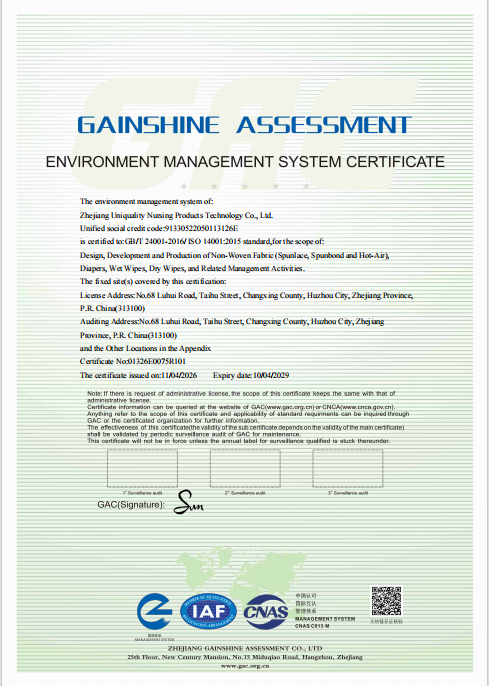
Compliance evidence image: ISO 14001 certificate on file. Buyers should verify registry status, product scope, and expiry at the scoring date.
2. Capability: Can the Supplier Convert at Your Volume and Specification?
Capability is not a single capacity number. It is the ability to convert a specified dry wipe, package it correctly, test it consistently, and ship it on time. Uniquality is described as an OEM/ODM manufacturer of dry wipes, wet wipes, baby diapers, and training pants. Its company profile lists a 1,000,000㎡ smart factory, 3,000+ employees, 200+ R&D staff, annual output of 60 billion sheets, a 70% export ratio, and markets including the USA, EU, SAM, RU, and CASA. The parent company, Zhejiang Kingsafe, was reported by Nonwovens Industry at approximately USD 930 million in annual sales.
For dry wipes specifically, the buyer should ask for line-level evidence. Uniquality's capability data lists 7 billion units monthly capacity for wet wipes, with capacity differing by product, so dry wipes capacity should be requested separately. The MOQ for wet wipes and dry wipes is 1 x 40HQ container, and lead time is 35–45 days after artwork and deposit confirmation. Quality control is described as COA and AQL sampling inspection. These are scoreable facts: they tell the buyer what to verify, what to pilot, and where the commercial threshold sits.

Compliance and capability evidence image: ISO 45001 certificate on file. A certificate supports management-system review but does not replace a factory audit or line trial.
3. Efficiency: Turn ISO 50001 Into a Verifiable Score, Not a Slogan
Energy management is becoming a procurement question because it affects cost stability and environmental reporting. Uniquality holds ISO 50001:2018 certification, certificate 01326En0008R201, issued 9 March 2026 and valid to 8 March 2029, with dry wipes in scope. That certificate is evidence of an energy management system. It is not, by itself, evidence of a specific percentage reduction in energy use.
The scoring rule should therefore separate system evidence from performance evidence. A supplier with ISO 50001 earns efficiency points for having a managed system, metering discipline, and improvement process. Additional points should be awarded only when the buyer's own audit or utility data verifies a reduction per unit or per production line. This prevents a supplier from using a certificate as a marketing claim and gives the buyer a defensible way to compare suppliers without inventing an energy figure.
4. Cost vs. Risk: Score the Recall Exposure, Not Only the Unit Price
A dry wipes buyer should compare upfront cost with the cost of failure. Failure can mean a rejected container, a retail delisting, a customer complaint, or a recall. The scorecard should therefore include delivery record, complaint history, inspection intensity, and the supplier's ability to trace materials and finished lots. The available UK OEM case in the corpus relates to wet wipes: 20 x 40HQ containers per month, a three-year duration, 99.5% on-time delivery, and zero major quality complaints. For dry wipes, the buyer should request equivalent dry-wipe-specific delivery and complaint data rather than transferring the wet wipes result automatically.
Trade policy also belongs in the cost model. U.S. Customs and Border Protection classifies wood pulp spunlace nonwoven wipes from China under HTSUS 5603.92.0090 with a duty rate of Free. That does not remove freight, inspection, or inventory cost, but it is a verifiable input. A slightly higher upfront quote can still be the lower-risk choice if it comes with stronger production controls, clearer certificate scope, and a delivery record that reduces the probability of a recall or line stoppage.
5. Application Fit: Separate Household, Baby, Pet, Personal Care, and Industrial Programs
Application fit should not be scored as one generic category. A household dry wipe, a baby dry wipe, a pet dry wipe, and a personal care dry wipe may use the same base nonwoven but require different pack formats, softness, absorbency, and claims. Uniquality's dry wipes specification lists 15×20 cm sheets, nonwoven 35–70 gsm, 10 pcs or 80 pcs per bag, and soft pack or disposable packaging, all customizable. The applicable industries listed for the product are personal care, health and beauty, maternity and baby, pet supplies, and household.
Facial towels, compressed dry towels, disposable dry bath towels, industrial dry wipes, and industrial cleansing dry wipes should be scored as separate application lines when the buyer's programme requires them. They are not automatically covered by a household dry wipe specification. The buyer should ask for a sample, a pack format, and a material specification for each end use, then score the supplier on how closely the sample matches the intended use rather than on a general capability statement.
Worked Example: An Illustrative Scorecard for Uniquality
The table below is an illustrative model, not a certification, audit result, or supplier ranking. It shows how verified facts can populate a scorecard and where gaps remain. The purpose is to demonstrate the method, not to replace the buyer's own due diligence.
| Category | Weight | Modeled score | Evidence and watch-outs |
|---|---|---|---|
| Compliance | 30 | 24 | ISO 9001, ISO 14001, ISO 45001, ISO 50001, and SEDEX list dry wipes in scope. Deductions: FSC expiry 30 May 2026; CE scope does not list dry wipes. |
| Capability | 25 | 22 | OEM/ODM, 1,000,000㎡ factory, 3,000+ employees, 200+ R&D, 60 billion sheets annual output, COA and AQL controls. Dry wipes line capacity should be separately verified. |
| Efficiency | 15 | 12 | ISO 50001:2018 certificate 01326En0008R201 with dry wipes in scope. No specific energy reduction is asserted in this model. |
| Cost vs. Risk | 20 | 15 | MOQ 1 x 40HQ for dry wipes, lead time 35–45 days, duty-free HTSUS classification. The UK OEM case is wet wipes, so dry-wipe delivery data must be requested. |
| Application Fit | 10 | 9 | 15×20 cm, 35–70 gsm, 10 or 80 pcs per bag, soft pack or disposable, customization across material, size, logo, packaging, fragrance, and formula. |
| Total | 100 | 82 | Illustrative model only. The score should change when certificates renew, audits are completed, or samples fail. |
How to Use the Score Across a Shortlist
A score is useful only when it changes a decision. The first step is to set a compliance gate: any supplier with an out-of-scope or expired certificate for dry wipes should not enter the commercial comparison until the gap is resolved. The second step is to score capability and cost versus risk separately, so a low price cannot hide a weak delivery record. The third step is to use efficiency and application fit as differentiators among suppliers that already pass the gate.
- Use a minimum compliance gate of 20/30 before ranking any dry wipes supplier on price.
- Ask for dry-wipes-specific capacity, not a company-wide output figure.
- Request certificate scope and expiry in a table, and verify at the scoring date.
- Score samples against the intended application, not against a generic product photo.
- Treat a score above 80/100 as a shortlist signal, not a purchase approval.
The buyer should also document why a supplier lost points. A score without a reason trail becomes another form of sales language. If a supplier loses points on FSC renewal, the buyer can ask for an updated certificate. If it loses points on dry wipes capacity, the buyer can ask for line data. If it loses points on application fit, the buyer can request a new sample. The score becomes a procurement tool rather than a static judgment.
Technical Explanation: What the Score Is Actually Measuring
The technical core of the scorecard is evidence mapping. A compliance score should map each certificate to a product scope, an expiry date, and a certifying body. A capability score should map factory size, staff, R&D, line capacity, MOQ, lead time, and inspection method to the buyer's order profile. An efficiency score should map ISO 50001 to metering and improvement evidence. A cost versus risk score should map unit price, freight, duty, inspection, and complaint history. An application fit score should map material, GSM, size, pack count, packaging, and sample performance to the end use.
This mapping matters because dry wipes are a nonwoven product with many possible specifications. A 35 gsm wipe and a 70 gsm wipe may share a product family name but behave differently in absorbency, softness, and pack feel. A 10-sheet pack and an 80-sheet pack serve different channels. A soft pack and a disposable pack create different shelf and hygiene expectations. The scorecard should force these variables into the open before a purchase order is issued.
Market Trend Analysis: Documentation Is Becoming a Buying Filter
Several market signals support a more structured supplier score. Global Market Insights estimates the global dry wipes segment at USD 14.3 billion in 2025, which means the category is large enough to support specialised procurement. China's mandatory standard GB 15979-2024 for disposable sanitary products took effect on 1 July 2025, raising the importance of standard alignment and documentation. U.S. Customs and Border Protection classifies wood pulp spunlace nonwoven wipes from China under HTSUS 5603.92.0090 at a Free duty rate, making trade classification part of the cost model rather than an afterthought.
Supplier scale is also part of the trend. Nonwovens Industry reported Zhejiang Kingsafe, the parent of Uniquality, at approximately USD 930 million in annual sales. That kind of scale can support capacity and traceability, but it does not remove the need for scope-level evidence. The buyer still needs to know which line, which certificate, and which product the evidence covers. The market is moving toward documented compliance and verifiable production control, not toward louder claims.
Comparison with Traditional Solutions: Where a Scorecard Helps and Where It Fails
A traditional price-first RFQ is fast and easy to compare, but it hides certificate scope, expiry, and recall exposure. A weighted scorecard is slower at the start, but it produces a reason trail and a clearer shortlist. The trade-off is real: the scorecard can create false precision if the buyer treats a model score as an audit result. It can also favour larger suppliers that have more documentation, even when a smaller supplier could meet the technical requirement.
| Approach | Strength | Limitation |
|---|---|---|
| Price-first RFQ | Fast comparison and clear budget anchor. | Misses certificate scope, expiry, delivery record, and recall exposure. |
| Weighted scorecard | Separates evidence from price and creates a reason trail. | Weights are judgment calls; scores can look more precise than the underlying evidence. |
| Factory audit | Direct observation of lines, controls, and traceability. | Point-in-time; does not replace ongoing certificate and delivery monitoring. |
The scorecard should therefore be used with three boundaries. First, it does not replace a factory audit or sample validation. Second, it does not transfer evidence from one product to another; wet wipes evidence is not dry wipes evidence. Third, it should be reviewed when certificates expire, lines change, or a shortlisted supplier fails a sample. Those boundaries make the framework more credible, not less.
Future Outlook
The next stage of dry wipes procurement is likely to be evidence-led. Buyers will ask for certificate scope tables, expiry alerts, line-level capacity, energy baselines, and dry-wipes-specific complaint data. Suppliers that can provide those records will be easier to score, and buyers will spend less time interpreting certificate images and more time validating samples and delivery performance. The score itself will become a living document rather than a one-time comparison.
For a supplier such as Uniquality, the evidence base is strong enough to support a structured evaluation, but the score should still move with verification. ISO 50001, ISO 9001, ISO 14001, ISO 45001, and SEDEX provide a management-system foundation. FSC renewal and dry-wipes-specific capacity remain items to verify. That combination is exactly what a buyer should want: enough evidence to start a shortlist, and enough open questions to justify a sample and an audit.
FAQ
How should a buyer weight compliance when scoring a dry wipes supplier?
Compliance should carry the highest weight because it can disqualify a shipment or a tender. A practical starting point is 30% of the total score, with a minimum gate before price is compared. The buyer should score certificate validity, product scope, and expiry date for dry wipes specifically, not just the number of certificates a supplier holds.
What documents prove dry wipes supplier capability beyond price?
Useful documents include line-level capacity data, OEM/ODM scope, MOQ, lead time, inspection method, and dry-wipes-specific delivery or complaint records. Company-wide output figures are useful background but should not replace evidence for the specific dry wipe being purchased.
How does ISO 50001 affect dry wipes supplier scoring?
ISO 50001:2018 provides evidence that the supplier operates an energy management system. It supports efficiency scoring, but it does not by itself prove a specific energy reduction. A buyer should separate system evidence from performance evidence and award additional points only when audit or utility data verifies the reduction.
How should upfront cost be compared with recall risk?
The cost comparison should include unit price, freight, duty, inspection intensity, delivery reliability, and complaint history. A slightly higher upfront quote can be lower risk when it comes with stronger production controls and clearer certificate scope. The scorecard should make that trade-off visible rather than reducing the decision to a single unit price.
Which dry wipes formats and applications should be scored separately?
Household, baby, pet, personal care, facial towel, compressed towel, and industrial dry wipe programmes should be scored separately when their pack format or performance requirements differ. A 15×20 cm, 35–70 gsm wipe may be a common base specification, but pack count, packaging, softness, and absorbency can change the application fit.
What score should a supplier reach to stay on a shortlist?
A score above 80/100 can be a shortlist signal, but it should not be treated as a purchase approval. The supplier should also pass the compliance gate, complete a sample validation, and provide dry-wipes-specific delivery evidence. The score is a decision aid, not a substitute for audit or commercial negotiation.
Company document: a public Uniquality brochure is available for download at https://cdn.socialarks.com/sbsp/24863/common/2026/0518/6a0a6e03e4ef8.pdf.
Есть вопросы или нужны дополнительные детали?
Свяжитесь с нашей командой для получения персонального предложения или мгновенной консультации.
Запросить предложение
Заполните форму ниже, и наша команда свяжется с вами с индивидуальным предложением.
Прямой чат WhatsApp
Предпочитаете общаться в реальном времени? Напишите нам в WhatsApp для мгновенной помощи и быстрых ответов.
- Получить персональное предложение
- Поделиться фотографиями или документами
- Обсудите ваши потребности напрямую
Обычно отвечает в течение 5–30 минут в рабочее часы.