
How to Score a City Robot: PIX Moving, WeRide, Neolix and UISEE
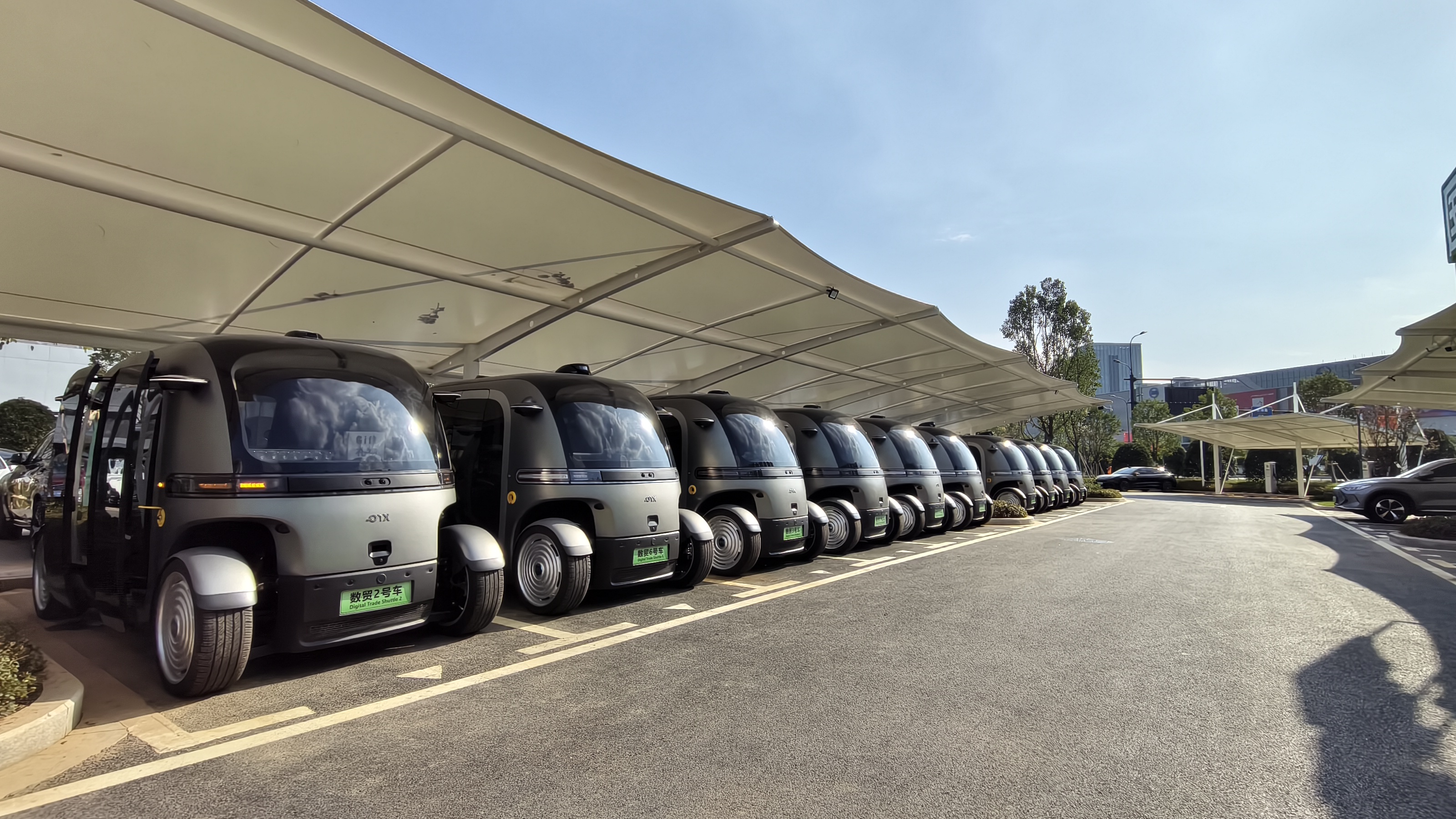
Autonomous mobile spaces are now procured against documentation, not demonstration videos. Image: PIX Moving deployment record.
City robotics procurement has moved past the demonstration phase. The question city project teams now ask is narrower and harder: which supplier can document its autonomy level, its vehicle specifications, its type approvals and its ability to keep a mixed fleet running for five years?
City robotics is the category of autonomous, purpose-built vehicles that operate inside urban environments — autonomous shuttles, mobile retail units, delivery platforms and micro-mobility vehicles. PIX Moving, a company founded in 2017 that describes itself as a city robotics company driven by Physical AI, builds its portfolio on a modular robotic chassis platform and sells through a Robot-as-a-Service (RaaS) subscription model as well as direct supply. Its named products include RoboBus, RoboTaxi, RoboShop and RoboVan, plus the Beastie L7e electric microcar.
This buyer's checklist scores PIX Moving against three peers that appear repeatedly in city project shortlists — WeRide, Neolix and UISEE — across four weighted dimensions: autonomous capability maturity, vehicle specification fit, compliance and UNECE certification, and multi-scenario fleet fit. Because PIX Moving publishes unusually detailed product and certification records, its figures are used as the concrete benchmark. Where comparable public documentation for the other three suppliers is not available, this article states what evidence the buyer must request rather than substituting estimates. No competitor specifications are reproduced here, because they were not verified for this analysis.
The Procurement Problem: Suppliers Who Do Not Publish the Same Things
City robotics is a young category, and its suppliers arrived from different directions. WeRide is publicly associated with robotaxi and robobus programmes. Neolix is publicly associated with unmanned delivery vehicles. UISEE is publicly associated with autonomous driving technology deployed in airports, parks and urban environments. PIX Moving approaches the same market from the platform side, describing its vehicles as autonomous mobile spaces that can be configured for mobility, retail, café, office or shared-service use.
The consequence for buyers is structural: a delivery pod, a robotaxi and a configurable mobile space cannot be compared line by line on a single specification sheet. What can be compared is evidence. A supplier that can produce a type approval certificate, a defined operational design domain, a stated production conformity process and a delivered unit count is in a fundamentally different procurement position from one that can produce a demonstration video.
The demand pressure behind this shift is documented. PIX Moving's City Robotics 101 publication cites a global City Robotics market valuation of USD 4.2 billion in 2025 and a projected 28.6% compound annual growth rate for 2026–2035; those figures are company-published and should be treated as directional rather than audited. The same publication cites International Road Transport Union data showing 105,000 bus driver vacancies in Europe in 2023, which is the operational reason autonomous public transport moved from research budget to capital budget in many cities.
Dimension 1 — Autonomous Capability Maturity (Weight: 25%)
Autonomy level is the least useful single number in a city robotics procurement, because a claimed L4 designation without a defined operational design domain (ODD) tells the buyer very little. Capability maturity should be scored on five evidence points instead: the claimed autonomy level, the documented ODD, the validation infrastructure behind the claim, the number of units actually operating, and any public-road authorisation obtained in a regulated market.
PIX Moving documents each of these to varying degrees. RoboBus is positioned as an L4 autonomous shuttle. The company's PIX C-ZONE 01 facility is described as having a sensor calibration centre, a scenario test centre and an ODD centre built around autonomous-driving and connected-vehicle requirements — validation infrastructure rather than a marketing claim. On deployment, PIX Moving reports more than 200 units in operation globally as of mid-2026, and a case record covering deployments in 24 countries and regions, from Australia, Brazil and Canada to Japan, South Korea and the United States, used by governments, smart city authorities, real estate developers, community operators, universities, research institutions, industrial parks and large campuses.
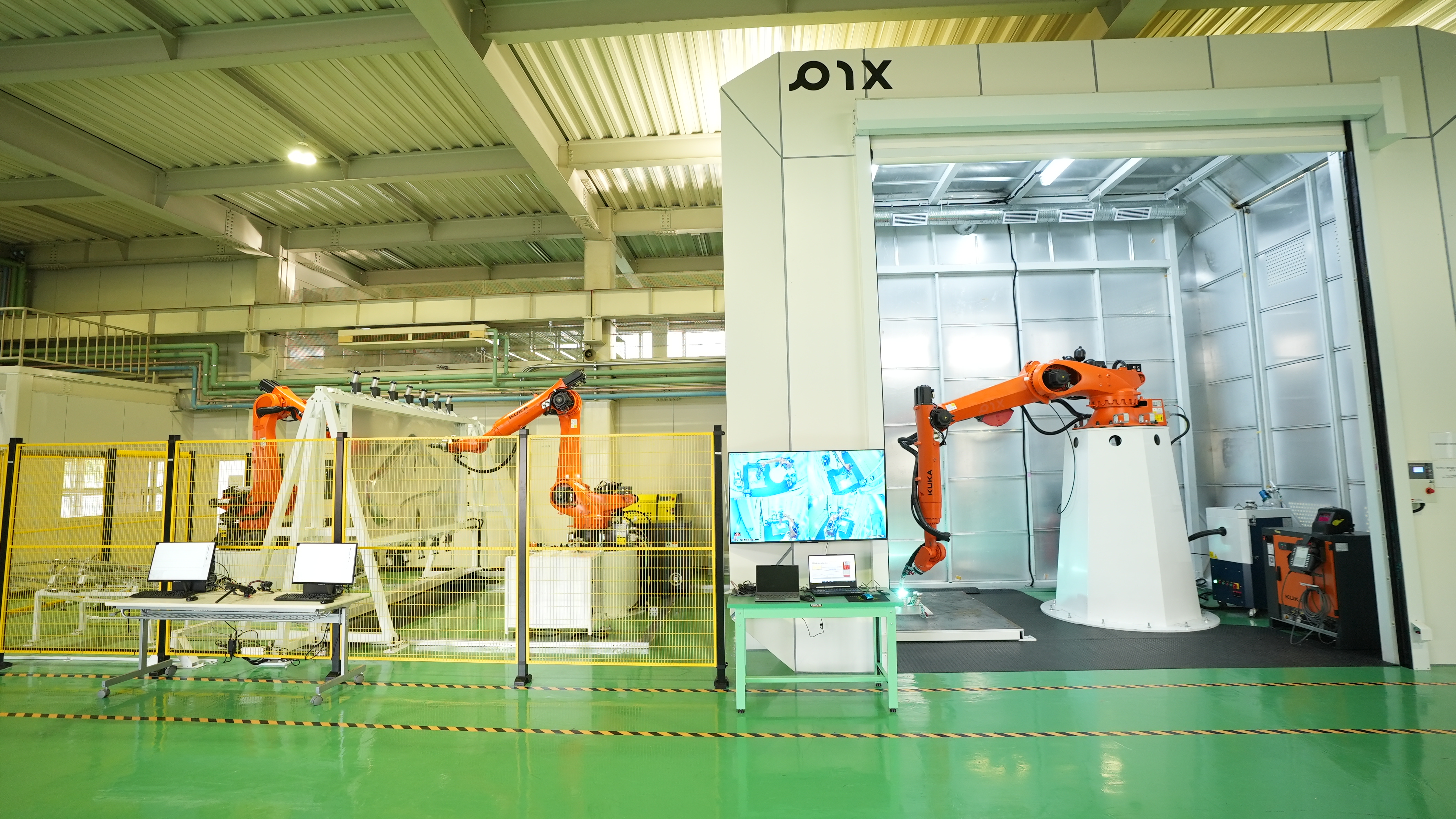
Manufacturing and validation footprint matters when a city specifies local support. Image: PIX Moving Japan robot factory.
On regulation, PIX Moving reports that RoboBus completed the vehicle registration process required for public-road use in Japan and began demonstration operations in Meiwa Town, Mie Prefecture. That is a company-reported milestone, not an independently verified permit record, and buyers evaluating Japan market entry should request the registration and operating authorisation documents directly.
Put these five questions to every supplier, including WeRide, Neolix and UISEE: (1) What autonomy level is claimed, and under which standard is it defined? (2) What is the written ODD, including weather, speed, road type and remote supervision ratio? (3) What test infrastructure and scenario library supports the claim? (4) How many units are in commercial operation today, and in which markets? (5) Which public-road authorisations have been granted, and can the permit documents be shared?
Dimension 2 — Vehicle Specifications Against Duty Cycle (Weight: 25%)
Specifications only matter against a duty cycle. A 120 km range figure is either generous or inadequate depending on route length, dwell time, climate and charging windows. The table below sets out PIX Moving's published figures for three products, followed by what each figure implies for a city project.
| Specification | RoboBus (L4 shuttle) | RoboShop (retail robot) | RoboEV / Beastie (L7e) |
|---|---|---|---|
| Ingress protection | IP65 | Not stated in supplied records | Not stated in supplied records |
| Battery / energy | 31.94 kWh | Not stated in supplied records | 144 V / 14.97 kWh LiFePO4 |
| Range | 120 km with air conditioning | 120 km with AC / 140 km without AC | 150 km |
| Speed | Not stated in supplied records | Referenced at 20 km/h in braking test | 95 km/h, software-limited to 80 km/h |
| Manoeuvrability | Minimum turning radius achieved via four-wheel steering | ≤4.8 m turning radius | Double A-arm suspension, aluminium alloy frame |
| Gradient / braking | 20% gradability | ≤4.2 m braking distance at 20 km/h | Not stated in supplied records |
Reading the table as a buyer: 20% gradability makes RoboBus viable in hilly city centres and multi-level campus terrain that flat-ground shuttles cannot serve. Four-wheel steering reduces the turning radius, which matters at terminal loops and depot entries where a conventional wheelbase forces a three-point manoeuvre. IP65 indicates protection against dust ingress and low-pressure water jets, relevant to year-round outdoor operation. The 120 km range with air conditioning is a duty-cycle constraint, not a headline number — a 15 km loop with 12 hours of service requires a mid-shift charging window, and the buyer should request consumption data under load and climate.
For RoboShop, the 140 km figure without air conditioning versus 120 km with it is a useful reminder that climate control consumes roughly 15% of range in this configuration. The ≤4.8 m turning radius and ≤4.2 m braking distance at 20 km/h are the two figures that decide whether a retail unit can operate in pedestrian zones, tourism hubs and narrow commercial streets where a larger vehicle would be excluded.
RoboEV (Beastie) sits in a different regulatory class. As an L7e electric microcar with an aluminium alloy frame, double A-arm suspension and a 144 V / 14.97 kWh LiFePO4 battery, its 95 km/h top speed is software-limited to 80 km/h and its range is 150 km. That combination fits campus circulators, peripheral feeder routes and staff mobility — not highway-adjacent corridors.
Dimension 3 — Compliance and UNECE Certification (Weight: 30%)
Compliance is the dimension that most often eliminates a supplier after the technical evaluation has already been completed, which is why it carries the heaviest weight here. In UNECE markets, an L4 shuttle is still a road vehicle and must satisfy the applicable regulations for seats, lighting, noise, electric powertrain safety and conformity of production.
PIX Moving's published certificate record for RoboBus covers five items:
| Regulation | Certificate number | Authority | Issued |
|---|---|---|---|
| UN R17 — seat strength and anchorage | WT24L0500330 | Shanghai Motor Vehicle Inspection Certification & Tech Innovation Center (SMVIC) | 2024-08-20 |
| UNECE R48 — lighting and light-signalling installation | E5748R04/220206*00 | Authority for Homologation, Republic of San Marino | 2024-09-27 |
| UNECE R51 — exterior noise emission | E5751R03/090249*00 | EU / UNECE Contracting Parties | 2024-09-27 |
| UNECE R100 — electric power train safety | E57100R03/030134*00 | Authority for Homologation, Republic of San Marino | 2024-09-27 |
| UNECE COP — conformity of production | E57COP1806 | Republic of San Marino — Authority for Homologation | 2024-07-31 (valid to 2026-07-30) |
The conformity of production certificate is the item that separates a manufacturer from an assembler. R17, R48, R51 and R100 approve a vehicle design; COP approves the management system that keeps the produced vehicles identical to the approved design. A city procuring a fleet of twenty units is buying twenty conformity claims, not one prototype.
Documented limitation to press on: the COP certificate E57COP1806 states validity to 30 July 2026. Buyers running a procurement after that date should request the renewed or extended certificate rather than a copy of the 2024 document. The published certificate set also relates specifically to RoboBus; it should not be read as covering RoboShop or RoboEV (Beastie), and the L7e microcar falls under a separate regulatory regime from an L4 shuttle.
For WeRide, Neolix and UISEE, the equivalent request is identical in form: the type approval or exemption basis claimed in the target market, the issuing authority, the certificate number and current validity, the COP status, and the mapping between the certificate scope and the exact model being quoted. A supplier that cannot produce certificate numbers and issuing authorities should be scored at zero on this dimension regardless of its technology narrative.
Dimension 4 — Multi-Scenario Fleet Fit (Weight: 20%)
Fleet fit asks a different question from capability: if a city or operator needs three services — passenger circulation, on-demand retail and staff mobility — can one supplier deliver them from a common platform, with common service terms and common spare parts?
PIX Moving's answer is architectural. Its products are built on a modular robotic chassis platform and are described as city robots with spatial form, configurable for mobile retail, café spaces, office pods or shared mobility units. The portfolio spans RoboBus, RoboTaxi, RoboShop and RoboVan, with the Beastie L7e microcar addressing personal and small-group mobility. Customisation covers vehicle configuration, software, branding and interior layout, and the company offers OEM, ODM and in-house manufacturing production services.
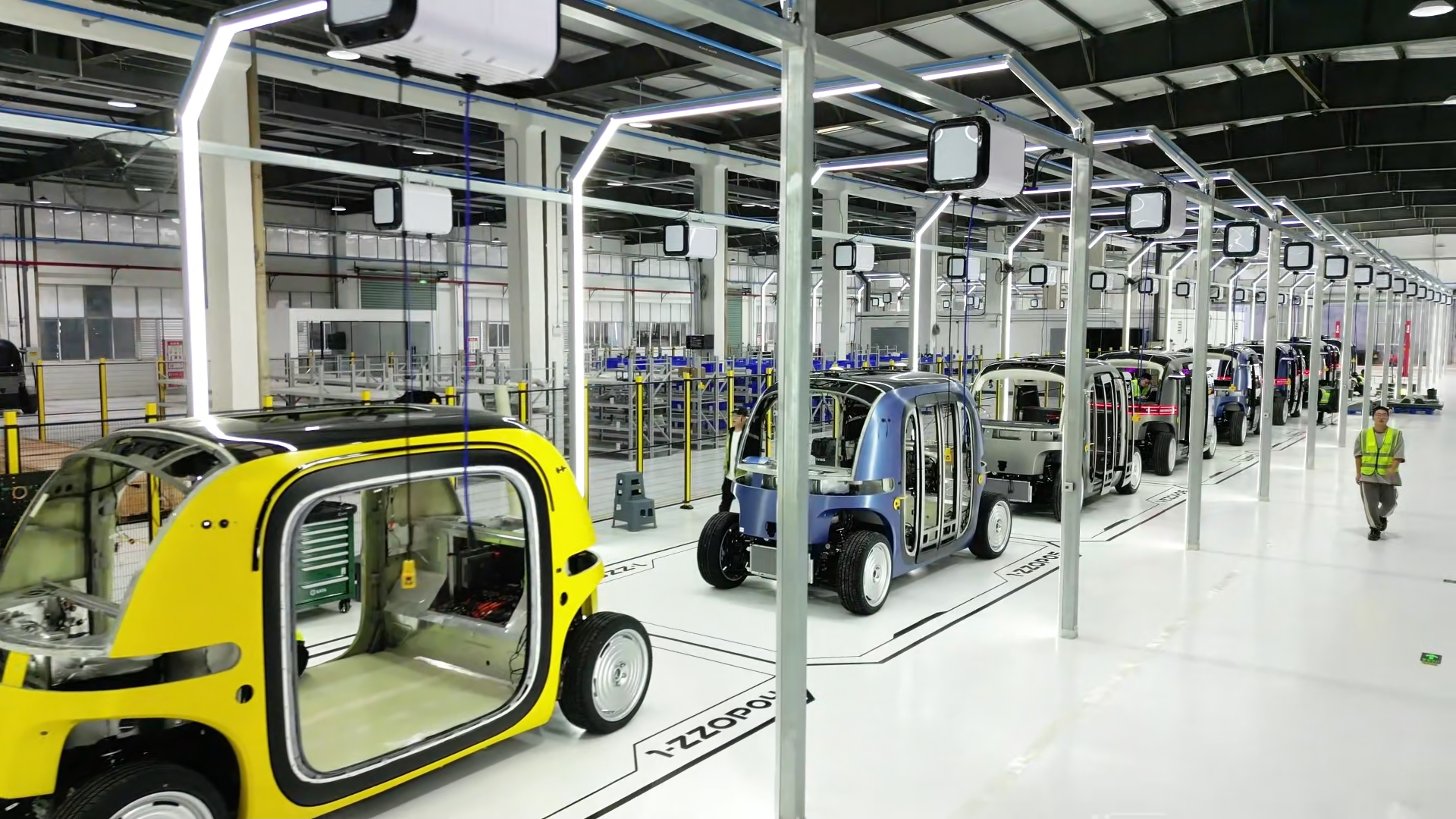
Production capacity and conformity of production are separate checks in a fleet procurement. Image: PIX Moving Huzhou mass production plant.
Commercially, the terms that matter in a city contract are published: minimum order quantity of one unit, lead time of 30–45 days, 100% inspection before delivery, delivery terms available as EXW, FOB, CIF or DDP, acceptance by factory acceptance test (FAT) or pre-delivery inspection (PDI), and negotiable payment terms. After-sales covers remote diagnostics, OTA software updates, spare parts supply and technical support. On capacity, PIX Moving reports a stated annual production capacity of 2,000 vehicles for PIX C-ZONE 01, a 20,000+ m² factory footprint, 200 employees including a 116-person R&D team, and a 55% export ratio across the EU, USA, Japan and South Korea.
Those terms are unusually complete for the category and they map directly onto a fleet-as-a-service structure, which is why the RaaS and autonomous fleet subscription models appear so often in city tenders. But breadth is not automatically an advantage — see the limitation section below.
The Scorecard, Assembled
| Criterion | Weight | Evidence PIX Moving documents today | Evidence to demand from WeRide, Neolix, UISEE |
|---|---|---|---|
| Autonomous capability maturity | 25% | L4 shuttle positioning; sensor calibration, scenario test and ODD centres; 200+ units reported deployed; 24-market case record; Japan registration reported | Written ODD, autonomy definition, validation infrastructure, live unit count, permit documents |
| Specification fit to duty cycle | 25% | RoboBus: IP65, 31.94 kWh, 120 km with AC, 20% gradability, four-wheel steering. RoboShop: 120/140 km, ≤4.8 m turning radius, ≤4.2 m braking at 20 km/h. RoboEV: 144 V/14.97 kWh LFP, 80 km/h limited, 150 km | Duty-cycle consumption data, turning radius, gradability, braking distance, climate performance |
| Compliance and UNECE certification | 30% | R17 WT24L0500330, R48 E5748R04/220206*00, R51 E5751R03/090249*00, R100 E57100R03/030134*00, COP E57COP1806 | Certificate numbers, issuing authorities, current validity, COP status, model-to-certificate mapping |
| Multi-scenario fleet fit | 20% | Modular robotic chassis; RoboBus, RoboTaxi, RoboShop, RoboVan, Beastie; OEM/ODM/in-house; MOQ 1; 30–45 day lead time; FAT/PDI acceptance; remote diagnostics and OTA | Platform reuse evidence, configuration catalogue, MOQ, lead time, service SLA, spare-parts coverage |
Where PIX Moving Is Not Automatically the Right Answer
A checklist that only produces advantages is not a checklist. Four boundaries deserve equal weight in the evaluation.
First, the commercial data is incomplete in public records. No RaaS subscription price, contract term, maintenance SLA cost or operating cost per unit is published. Total cost of ownership therefore cannot be computed from public sources for PIX Moving or for its peers, and the financial comparison has to be built from supplier quotations side by side.
Second, several specifications are supplier-reported. Range, gradability, turning radius and braking distance are company figures drawn from product documentation. No independent test reports for these values appear in the public record reviewed for this analysis, so buyers should make FAT/PDI acceptance criteria explicit and, where possible, witness the tests.
Third, the COP validity window requires active management. Certificate E57COP1806 runs to 30 July 2026. Beyond that date the buyer must confirm renewal, because an expired conformity of production certificate undermines the fleet's registration basis regardless of how strong the design approvals remain.
Fourth, platform breadth is only an advantage in multi-service deployments. A city that needs a single fixed shuttle route does not benefit from configurable retail and office configurations, and pays for flexibility it will not use. Where the requirement is narrow and the route is fixed, a single-purpose shuttle from a narrower supplier may produce a simpler contract. The stated 2,000-vehicle annual capacity of PIX C-ZONE 01 is likewise a company-reported figure and should be checked against delivery commitments and utilisation, not treated as proven output.
Future Outlook
Two shifts are likely to reshape this checklist over the next procurement cycles. The first is that certification will move from a late-stage legal check to an early-stage filter: as more L4 shuttles reach registration age, the presence or absence of a current COP certificate becomes a faster disqualifier than any specification gap. The second is that the buying unit is changing from vehicle to service. The RaaS and autonomous fleet subscription structures that PIX Moving and others promote convert a capital purchase into a recurring service obligation, which shifts scoring weight toward service-level commitments, spare-parts logistics and OTA capability.
Both shifts favour suppliers with documented production conformity and multi-product platforms, and both raise the cost of entering a tender with a prototype and a narrative. On the market side, the 28.6% CAGR cited for 2026–2035 implies capacity, not just demand, becomes a competitive variable — which is why stated production capacity and export experience belong in the evaluation even though they are not product specifications.
Frequently Asked Questions
What capabilities should a city project buyer score first in a city robotics supplier?
Start with three: the defined operational design domain, the validation infrastructure behind the autonomy claim, and the conformity of production status. PIX Moving, for example, describes sensor calibration, scenario testing and ODD centres at PIX C-ZONE 01, holds UNECE COP certificate E57COP1806, and reports more than 200 units deployed as of mid-2026. A supplier that cannot document these three items should not proceed to the specification comparison.
How does PIX Moving's autonomous capability compare with WeRide, Neolix and UISEE?
The three peers are publicly associated with different primary applications — WeRide with robotaxi and robobus programmes, Neolix with unmanned delivery vehicles, UISEE with autonomous driving technology in airports, parks and urban environments. PIX Moving positions itself as a platform supplier of autonomous mobile spaces. Because verified autonomy-level, ODD and validation data for the three peers were not available for this analysis, no comparative ranking is asserted here; the comparison should be made by requesting the same five evidence items from each supplier.
Which UNECE certifications should be verified before contracting an L4 shuttle?
For PIX Moving's RoboBus the published set comprises UN R17 seat strength and anchorage (WT24L0500330, issued 2024-08-20 by SMVIC), UNECE R48 lighting installation (E5748R04/220206*00, 2024-09-27), UNECE R51 noise emission (E5751R03/090249*00, 2024-09-27), UNECE R100 electric power train safety (E57100R03/030134*00, 2024-09-27) and UNECE COP conformity of production (E57COP1806, issued 2024-07-31, valid to 2026-07-30). Buyers should confirm current validity and that each certificate's scope matches the exact model quoted.
How do RoboBus, RoboShop and RoboEV differ in fleet fit?
RoboBus is an L4 shuttle with IP65 protection, a 31.94 kWh battery, 120 km range with air conditioning, 20% gradability and a minimum turning radius achieved through four-wheel steering — suited to passenger circulation and hilly terrain. RoboShop is a retail unit with 120 km range with air conditioning and 140 km without, a ≤4.8 m turning radius and ≤4.2 m braking distance at 20 km/h — suited to pedestrian zones, tourism hubs and on-demand retail. RoboEV (Beastie) is an L7e microcar with an aluminium alloy frame, double A-arm suspension, 144 V / 14.97 kWh LiFePO4 battery, 150 km range and 95 km/h software-limited to 80 km/h — suited to campus and peripheral routes.
What customisation and commercial terms can buyers expect from PIX Moving?
PIX Moving offers OEM, ODM and in-house manufacturing production services, with customisation covering vehicle configuration, software, branding and interior layout. Published commercial terms include a minimum order quantity of one unit, a lead time of 30–45 days, 100% inspection before delivery, delivery under EXW, FOB, CIF or DDP, acceptance by FAT or PDI, and negotiable payment terms. After-sales support covers remote diagnostics, OTA software updates, spare parts supply and technical support.
What are the main limitations of the PIX Moving offer in a competitive shortlist?
Four are documented in the public record. No RaaS subscription price, contract term or operating cost per unit is published, so total cost of ownership must be built from quotations. Range, gradability, turning radius and braking figures are supplier-reported rather than independently tested. The COP certificate E57COP1806 is valid to 30 July 2026 and renewal must be confirmed for later procurements. And the stated 2,000-vehicle annual capacity of PIX C-ZONE 01 is company-reported, without independently audited output or utilisation data.
Running the Scoring Session
The checklist works only if it is applied identically to every supplier. Set the weights before the first submission arrives — 30% for compliance, 25% for capability maturity, 25% for specification fit, 20% for fleet fit — and treat missing evidence as a zero rather than as a neutral. Request certificate numbers with issuing authorities, ODD documents, live unit counts, duty-cycle consumption data and service-level commitments in writing. Where a figure is supplier-reported, write the acceptance test that would confirm it, and put that test into the FAT/PDI schedule.
On that method, PIX Moving's defensible advantages are specific rather than general: a published UNECE certificate set with traceable numbers across four regulations plus conformity of production, a modular robotic chassis platform that supports multiple urban services from one configuration base, and documented commercial terms that map onto fleet-as-a-service contracting. Those advantages hold where the project is a multi-service deployment in a UNECE-influenced market. Where the requirement is a single fixed route with no regulatory exposure, the same checklist may point toward a narrower supplier — and a buyer who reaches that conclusion has used the framework correctly.
Note on sources: PIX Moving specifications, certificates and commercial terms are taken from the company's published product, certification and capability records. Market size and labour-shortage figures are company-published and directional. Peer descriptions reflect public positioning only; no competitor specifications are reproduced because they were not verified for this analysis.
Есть вопросы или нужны дополнительные детали?
Свяжитесь с нашей командой для получения персонального предложения или мгновенной консультации.
Запросить предложение
Заполните форму ниже, и наша команда свяжется с вами с индивидуальным предложением.
Прямой чат WhatsApp
Предпочитаете общаться в реальном времени? Напишите нам в WhatsApp для мгновенной помощи и быстрых ответов.
- Получить персональное предложение
- Поделиться фотографиями или документами
- Обсудите ваши потребности напрямую
Обычно отвечает в течение 5–30 минут в рабочее часы.