
How to Specify Timing Belts and Pulleys for Real-World Industrial Conditions
How to Specify Timing Belts and Pulleys for Real-World Industrial Conditions
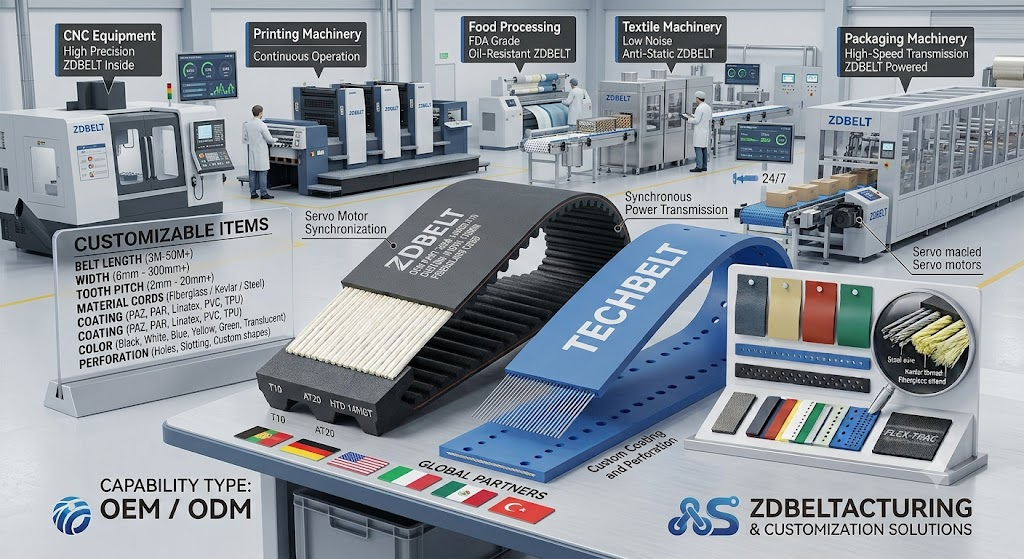
Timing belt selection is a mechanical engineering decision that directly affects positioning accuracy, energy loss, and maintenance intervals in automated equipment. Dongguan Zhende Machinery Equipment Co., LTD is a professional manufacturer and one-stop procurement service provider of FA automation transmission parts, based in Dongguan, Guangdong, China. The company designs and supplies timing belts and timing pulleys for OEM machinery, production lines, and automation systems, with 75% of output exported and main markets concentrated in Europe and the United States. This article explains how Zhende's timing belt and pulley specifications align with real-world application conditions such as high-speed operation, oil exposure, dusty environments, and 24/7 continuous duty.
The Specifying Problem and the Procurement Opportunity
Specifying the correct timing belt is not a one-size-fits-all exercise. Belt tooth profile, pitch, tensile member, and material must match the driven load, speed, environmental contamination, and required positional accuracy. Mismatched drives can cause premature belt failure, unplanned downtime, and higher total cost of ownership. The market context adds further pressure. According to Grand View Research, the global automotive timing belt market was valued at USD 7.7 billion in 2025. Maximize Market Research projects that the timing belt market will grow at a CAGR of 4.8% through 2030. In the same landscape, China holds the largest regional share in the automotive timing belt sector and is a leading origin of vulcanized rubber transmission belts exported to the United States, based on trade data from Descartes Datamyne and U.S. Customs. For industrial buyers, this means a competitive environment in which supplier reliability, short lead times, and component traceability matter as much as price.
The difficulty is most visible in retrofit and OEM projects. A machine builder may know the required torque and speed, but still needs to decide between a rubber belt with fiberglass reinforcement and a PU belt with steel reinforcement; between a trapezoidal profile and an HTD curvilinear profile; and between an aluminum pulley and a cast-iron pulley. Each choice affects load capacity, noise, backlash, and resistance to oil or dust. For buyers, the absence of standardized documentation makes cross-supplier comparison difficult. This is why measurable specifications—pitch accuracy, radial runout, bore tolerance, tensile strength, and inspection procedures—are central to a reliable timing belt and pulley sourcing decision.
Zhende's Solution for Belt and Pulley Sourcing
Dongguan Zhende Machinery Equipment Co., LTD addresses this demand with an integrated product portfolio that spans trapezoidal and arc-tooth timing pulleys, open, endless, and conveying timing belts, and matching precision transmission components. The company operates self-owned CNC machining workshops and is an authorized distributor of brands including HIWIN, THK, NSK, SKF, and AirTAC, enabling customers to consolidate component sourcing. Zhende stores over one million standard items in its warehouse. Regular models can ship within 3 days, and custom gears and racks support drawing-based machining with a 7-day lead time. For timing belts and pulleys specifically, Zhende's monthly capacity is 100,000 pcs for pulleys and 500,000 pcs for belts. Lead time is 7 to 20 days. MOQs are 10 pcs for standard pulleys, 50 pcs for customized pulleys, and 4 pcs for belts. OEM and ODM production are available, with customization covering material, tooth profile, pitch, number of teeth, bore diameter, keyway, flange type, surface treatment, and logo engraving for pulleys, and belt length, width, tooth profile, material, tensile cord, coating, color, perforation, and logo printing for belts.
Technical Explanation: Profiles, Materials, and Precision
Precision begins with the tooth geometry. Zhende's HTD timing pulleys use an HTD (High Torque Drive) profile in 3M, 5M, 8M, and 14M pitches. T-series pulleys use a trapezoidal profile in T2.5, T5, T10, and T20 pitches. Imperial pulleys cover MXL, XL, L, H, XH, and XXH. Pulley materials include aluminum alloy, carbon steel, stainless steel, and cast iron. Surface treatments include black oxide, zinc plating, hard anodizing, and nickel plating. Finished bore tolerance is H7, and radial runout is ≤0.03 mm. Maximum operating speed is up to 8,000 rpm, and operating temperature ranges from –30°C to +120°C depending on material. Tooth accuracy conforms to ISO 13050 / DIN standards, and 100% dimensional inspection is performed before shipment.
Representative timing belt and pulley specifications
| Component | Profile/Pitch | Body/Tensile | Key capability |
|---|---|---|---|
| HTD Timing Pulley | 3M / 5M / 8M / 14M | Aluminum, steel, stainless, cast iron | Concentricity ≤0.03 mm; up to 8,000 rpm |
| T-Series Timing Pulley | T2.5 / T5 / T10 / T20 | Aluminum, carbon steel, stainless, cast iron | H7 bore tolerance; radial runout ≤0.03 mm |
| T10 PU Timing Belt | T10 (trapezoidal) | PU body, steel cord | Up to 30 kW; ~10,000 rpm |
| AT10 PU Timing Belt | AT10 (trapezoidal) | PU body, steel cord | Up to 70 kW; allowable 1,700 N/10mm |
| HTD 8M Rubber Timing Belt | HTD 8M curvilinear | Neoprene (CR), fiberglass cord | Max allowable 780 N/10mm; ultimate 3,120 N/10mm |
| 8MGT Carbon-Fiber PU Timing Belt | 8MGT (curvilinear) | PU body, carbon fiber cord, nylon facing | Up to 80 m/s; efficiency up to 98%; maintenance-free |
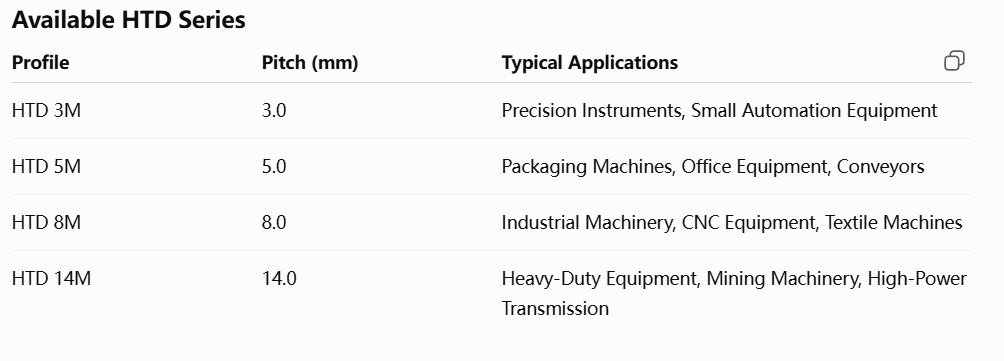
HTD timing pulley technical datasheet.
Belt construction determines load capacity and environmental resistance. Zhende's PU timing belts, such as T5, T10, AT5, and AT10, use steel tensile cords. They are specified for high wear resistance, low elongation, and low-noise applications. The AT10 PU belt, for example, has a maximum allowable tensile strength of 1,700 N per 10 mm belt width and can transmit up to 70 kW at approximately 10,000 rpm. Rubber timing belts use neoprene (CR) bodies and fiberglass tensile cords. The HTD 8M rubber belt has a maximum allowable tensile strength of 780 N per 10 mm belt width and an ultimate tensile strength of 3,120 N per 10 mm belt width. The HTD 14M rubber belt, a heavy-duty profile, has a maximum allowable tensile strength of 1,816 N per 10 mm belt width and an ultimate tensile strength of 8,308 N per 10 mm belt width.
For high-speed servo drives, Zhende also offers the 8MGT polyurethane carbon-fiber timing belt. It uses a carbon fiber tensile member and nylon fabric tooth facing, with a hardness of 92 Shore A, minimum pulley diameter of 36.6 mm, and rated belt speed up to 80 m/s. Transmission efficiency is up to 98%, and it is described as maintenance-free with no lubrication required.
Quality is documented at factory level as well. The factory audit report for Zhende is certified by TÜV Rheinland, with certificate number 493993448_P+T, and follows the Production & Trading Factory Assessment Standard for the EU market. RoHS compliance applies to various timing belts under EU Directive 2015/863. SGS certification applies to the Middle East market, and third-party inspection (SGS) is also part of standard quality control.
Application Scenarios and Documented Cases
Zhende's timing belt and pulley systems are documented in industrial automation, packaging machinery, CNC machinery, robotics, food processing, and textile machinery. In pulley-focused scenarios, typical working conditions include high-speed, high-torque, continuous operation in dusty and oil-resistant environments, with temperature range from –20°C to 120°C. These systems often run 24/7 with servo motor drive and variable-speed transmission. Special requirements include high concentricity, precision-machined tooth profile, corrosion-resistant surface treatment, lightweight aluminum or high-strength steel construction, and custom bore, keyway, flange, and surface coating availability.
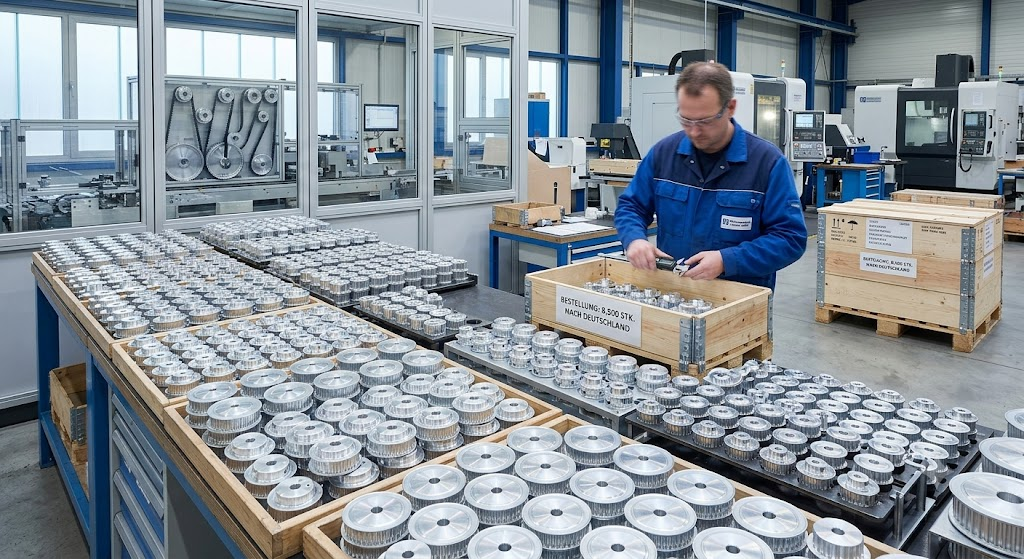
Timing belt and pulley application in production equipment.
In belt-focused scenarios, the documented conditions include high-speed transmission, continuous operation, high precision, low noise, and oil resistance. Special requirements for certain projects include high wear resistance, low elongation, anti-static properties, food-grade (FDA) compliance, and custom coating or perforation. In these installations, timing belts and pulleys are typically matched with servo motors, stepper motors, gearboxes, linear modules, and automation control systems. The drive must maintain synchronization between motor and load while operating in variable-speed mode. For high-speed and high-torque duties, the pulley's bore type and flange configuration must match the motor shaft and the belt's tracking characteristics.
Two documented projects illustrate the real-world use of these systems. In a pulley project, 8,500 pulleys were supplied to Germany and 15,000 pulleys to the United States, used in automated production lines, CNC machinery, packaging equipment, and robotic systems. The project duration was 5 years in Germany and 3 years in the United States. Reported results included a 25% improvement in transmission accuracy, 40% lower maintenance costs, and 30% reduced downtime. In a belt project, 12,000 belts were supplied to Germany and 20,000 belts to the United States for automated production lines, packaging machinery, CNC equipment, and conveyor systems. The project ran 3–5 years in Germany and 2–4 years in the United States, with reported transmission efficiency of 98%, maintenance cost reduction of 40%, and downtime reduction of 35%.
Market Trends Shaping Timing Belt Procurement
Three trends are shaping timing belt procurement. First, the category is expanding: the global timing belt market is projected to grow at a CAGR of 4.8% through 2030, according to Maximize Market Research, supported by increasing automation and industrial replacement activity. Second, China remains a major manufacturing base; it holds the largest regional share in automotive timing belts and is a leading origin of vulcanized rubber transmission belts exported to the United States, according to Grand View Research and Descartes Datamyne. Third, high-speed equipment is moving toward lighter, stronger, and maintenance-free drive components. The availability of the 8MGT carbon-fiber PU timing belt, with rated speed up to 80 m/s and transmission efficiency up to 98%, reflects that shift. For the wider competitive landscape, major global players in the timing belt market include Gates Industrial Corp, Continental AG, Bando Chemical Industries, and Mitsuboshi Belting, based on industry analysis from Fortune Business Insights.
Buyers should note that market size estimates vary by segment and definition; automotive timing belt data and industrial synchronous belt data are not directly interchangeable. The figures cited above are useful for context, but project evaluation should rely on manufacturer data sheets and application-specific calculations.
Timing Belts vs Traditional Drive Solutions
Compared with conventional V-belt drives, timing belts deliver synchronous power transmission. The belt tooth interlocks with the pulley groove, so the driven shaft remains in a fixed angular relationship with the driver. This is essential for applications requiring accurate positioning, such as CNC axis drives, robotic joints, and print registration. V-belts, by contrast, rely on friction and are generally more tolerant of slight misalignment and shock loads, which makes them simpler for low-precision or retrofit installations. The main limitation of timing belts is that they require more careful alignment and installation. Misalignment, improper tension, or foreign debris in the tooth area can cause accelerated wear. Zhende mitigates this risk at the manufacturing stage through pulley concentricity of ≤0.03 mm, H7 bore tolerance, and pre-shipment dimension inspection.
Future Outlook
The direction of industrial automation continues to favor synchronous drives. Machine builders need to maintain positioning accuracy while reducing energy loss and maintenance. For timing belt procurement, the trend is toward combining standard pulley modules with custom belt lengths, widths, and tensile members. A supplier that can machine custom bores and keyways, provide low MOQs, and still meet documented quality standards can support project work. Zhende's model—self-owned CNC machining, large standard inventory, flexible lead times, and third-party factory audit certification—offers a practical match for OEMs, system integrators, and industrial distributors.
Contact and Technical Support
For project-specific timing belt and pulley selection, Dongguan Zhende Machinery Equipment Co., LTD provides technical selection support, installation guidance, OEM/ODM service, and quality warranty. Contact Ms. Liang at liang@zd-stool.com or via WhatsApp at +86 180 0284 9592. A product brochure is available for download at this link. Visit the company website for more information: www.zdindustrialbelts.com.
Frequently Asked Questions
How do HTD and T-series timing belts differ?
HTD (High Torque Drive) belts use a curvilinear tooth profile available in 3M, 5M, 8M, and 14M pitches, while T-series belts use a trapezoidal tooth profile available in T2.5, T5, T10, and T20 pitches. Zhende supplies both in PU and rubber constructions.
Can timing belts and pulleys be customized?
Yes, OEM/ODM is available. Customizable pulley options include material, tooth profile, pitch, number of teeth, bore diameter, keyway, flange type, surface treatment, and logo engraving. Customizable belt options include length, width, tooth profile, material (rubber/PU), tensile cord (fiberglass, Kevlar, or steel), coating, color, perforation, and logo printing.
What are the lead times and minimum order quantities?
For pulleys, standard models have an MOQ of 10 pcs and customized pulleys 50 pcs, with monthly capacity of 100,000 pcs. For belts, MOQ is 4 pcs and monthly capacity is 500,000 pcs. Lead time for both is 7 to 20 days.
What quality inspections are performed?
Pulleys undergo 100% dimensional inspection, bore and tooth profile inspection, concentricity testing, and pre-shipment inspection. Belts undergo dimensional inspection, tensile strength testing, tooth profile inspection, and pre-shipment inspection. Third-party inspection (SGS) is also used.
What EU certifications apply?
Zhende's factory audit report is certified by TÜV Rheinland, with certification number 493993448_P+T, and complies with the Production & Trading Factory Assessment Standard. RoHS compliance applies to various timing belts under EU Directive 2015/863.
Which industries commonly use Zhende timing belts and pulleys?
Documented applications include industrial automation, packaging machinery, CNC machinery, robotics, food processing, and textile machinery, with conditions ranging from high-speed and continuous operation to dusty and oil-resistant environments.