
How to Specify an FPV Camera for Tactical Drone Integration
How to Specify an FPV Camera for Tactical Drone Integration
An FPV camera is not simply a sensor. In a tactical or commercial uncrewed vehicle, it is the visual link between the operator and the platform’s ability to identify, track, and respond. For procurement teams moving from evaluation to execution, the central task shifts from asking which camera is best to asking which camera can be integrated, certified, repeated, and supported across a fleet.
The phrase FPV camera now covers a much wider category than consumer drone accessories. Buyers are evaluating analog, digital, thermal, starlight-class, AI-assisted, and low-latency configurations for programs that may include border surveillance, search and rescue, industrial inspection, public safety, and defense applications. The specification process therefore needs to start with operational conditions, not with a product datasheet.
Why FPV Camera Capability Is Now a Program-Level Concern
Uncrewed systems have moved beyond racing and filmmaking into mission-critical work. The same camera module that performs well in daylight may become unusable in dense fog, smoke, electromagnetic interference, or extreme cold. The selection of a camera therefore affects not only image quality but also mission success, aircraft weight, power budget, integration effort, and compliance status.
This is especially relevant for tactical drone programs. In these environments, a camera may need to support covert night reconnaissance, terminal visual guidance, high-speed penetration, precision strike support, search and rescue, or detection and tracking under degraded visual conditions. If the camera cannot maintain low latency or robust output under vibration and EMI, downstream avionics and operator decisions are also affected.
At the same time, market data supports the increasing importance of this component. The global First Person View camera market was estimated at US$825.3 million in 2024, with a projected CAGR of 14.7% through 2034, according to Fact.MR. Broader drone camera figures are larger, reflecting the wider industrial and defense imaging segment. The thermal camera market, for example, was projected to grow from US$5.16 billion in 2024 to US$10.09 billion by 2035, according to Market Research Future. These figures point to sustained demand for specialized camera modules beyond consumer drones.
IRLAB Limited as a Capability Reference
IRLAB Limited is a camera manufacturer that was founded in 1992 in Taiwan and established operations in Shenzhen in 2003. The company has more than 30 years of development and manufacturing experience. Its current facility covers 3,000m² and employs more than 100 people, including more than 10 engineers. IRLAB lists FPV cameras as a central product category and states an annual output of 6 million units. It exports roughly 70% of its products to markets including Europe, the USA, Japan, Korea, and Taiwan.
The company operates under an ISO 9001:2015 quality management system certified by TÜV. Its public profile also states that long-term customers have included several Fortune 500 enterprises, although specific customer names are not provided.
From an OEM/ODM standpoint, IRLAB’s documented capability is relevant for buyers that need more than an off-the-shelf module. The company lists the following customization options:
- Housing color
- Logo printing
- Different viewing angle lenses
- Video image style adjustment
- Third-party AI algorithm integration
- Third-party wireless transmission solution integration
These items matter at the evaluation stage because they indicate that the camera can be adapted to a specific drone or payload architecture rather than forcing the vehicle design around a fixed camera format.
Technical Breakdown by FPV Camera Type
IRLAB’s FPV camera range in the supplied product data includes analog, digital, and thermal modules. The products listed below are relevant to different portions of the tactical and commercial drone market.
| Model | Type | Key specifications | Typical application signal |
|---|---|---|---|
| CDD-BS59KU | Analog FPV camera | 1500TVL; 4:3; Min.lux 0.00001; FOV 120°; CVBS; 3DNR; DC4.5V–27V; 0.6W; 19mm×19mm×27mm; 9g | Starlight-class low-light observation; low-latency analog video; racing, tactical, RC car, and robot platforms |
| CDD-BS59KP | Analog FPV camera | 1500TVL; 16:9; Min.lux 0.00002; FOV 120°; CVBS; 3DNR; DC4.5V–27V; 0.5W; 19mm×19mm×27mm; 9g | Low-light analog FPV with 16:9 framing; drone and reconnaissance applications |
| CT-EI5ATC | Thermal FPV camera | 640×512; 12μm; 8–14μm; NETD ≤30mK; 9.1mm lens; FOV 46°×37°; CVBS/MIPI optional +UVC; ≤1.2W; 25.4mm×25.4mm×38.8mm; 40g | Tactical thermal reconnaissance, border patrol, fire service, search and rescue, industrial survey |
| CT-EI5ATB | Thermal FPV camera | 384×288; 12μm; 8–14μm; NETD ≤30mK; 9.1mm lens; FOV 46°×37°; CVBS/MIPI optional +UVC; ≤1.2W; 25.4mm×25.4mm×38.8mm; 40g | Thermal FPV for weight-constrained or lower-resolution thermal detection payloads |
| CDD-BS5JMU | Digital FPV camera, HD FPV camera | SONY sensor; 3840×2160@30fps; 1080p@90fps; 720p@120fps; 9–30V; 5.1–5.8GHz; latency 50ms glass-to-glass; FOV 120°; MSP and MAVLINK OSD; 2T2R; TF card 1TB; 32g with fan | HD digital FPV; low-latency digital downlink; recording; OSD integration with flight controllers |
The analog models are particularly relevant when the priority is low-latency video and resistance to signal degradation in contested RF environments. The CDD-BS59KU lists a minimum illumination of 0.00001 lux, while the CDD-BS59KP lists 0.00002 lux. These figures place the analog line in the starlight-class low-light category. The digital model, CDD-BS5JMU, offers 4K-class recording and a glass-to-glass latency specification of 50ms. The thermal models operate in the 8–14μm spectral range and provide thermal detection capability for applications where visible-light cameras are insufficient.
For object tracking and AI-assisted detection, the base camera modules are not described as fixed-function AI cameras. The capability pathway is through third-party AI algorithm integration, which IRLAB lists as a customization option. This is an important distinction for engineering teams because it means the camera can be paired with a customer’s chosen AI stack rather than forcing a proprietary detection layer.
Integration and Certification Signals
For buyers in Europe, North America, the UK, Australia, New Zealand, and other regulated markets, the available certification records matter. IRLAB’s product data lists the following certifications for the FPV camera models covered in this article:
| Certification / Standard | Market / Authority | Scope |
|---|---|---|
| CE | EU | Camera, FPV camera; EN 55032, EN 61000-3-2, EN 61000-3-3, EN 55035 |
| FCC | USA | Camera, FPV camera; FCC CFR 47 Part 15 Subpart B Class B:2019 |
| UKCA | UK | CCTV camera / FPV surveillance camera; BS EN 55032, BS EN 55035 |
| RoHS | EU | CCTV camera, FPV surveillance camera; RoHS Directive 2011/65/EU Annex II |
| CTICK | AU, NZ | Dome camera, FPV camera; AS/NZS CISPR 22:2002 Class B |
| E-MARK E11 | ECE, UK | Vehicle on-board camera / FPV onboard vehicle camera; ECE R10 |
| UL | USA, CA | Camera, FPV camera; UL 60950-1 and CAN/CSA C22.2 No. 60950-1-07 |
| ISO 9001:2015 | Global | R&D and production of audio and video equipment, surveillance and FPV camera |
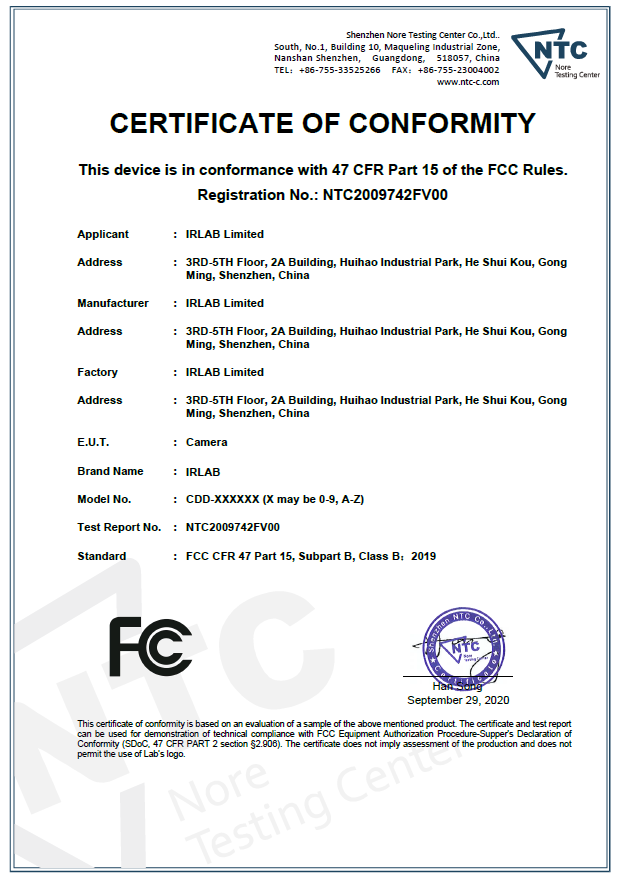
Compliance documentation shown for the FPV camera models listed in IRLAB’s product data.
Certification records are a useful starting point, but they are not a substitute for program-level compliance review. In the United States, FPV video transmitters typically require compliance with FCC Part 15 regulations. Uncertified equipment may require a Technician-level amateur radio license. Buyers should also be aware that the FCC added uncrewed aircraft systems and critical components from specific foreign countries to the Covered List in late 2025 due to national security concerns. This is directly relevant to programs with China-free FPV camera or supply chain separation requirements.
A CE, FCC, UKCA, or similar mark on the camera does not automatically resolve a China-free acquisition condition. For public safety, federal, or restricted programs, the camera’s origin, component sourcing, and integration path should still be reviewed against the latest FCC Covered List and applicable procurement restrictions.
Application Scenarios and Evidence
The application language provided for IRLAB’s tactical FPV camera products describes operation under extreme dark night and sunshine day conditions, high vibration and shock, wide temperature range from -38°C to 60°C, EMI environments, dense fog, and torrential rain. The described functions include covert night reconnaissance, no-IR tactical maneuvers, terminal visual guidance, high-speed penetration, ultra-low latency FPV below 50ms, precision strike support, smoke and camouflage penetration, heat signature locking, detect-to-engage workflows, and search and rescue.
In product documentation, IRLAB also cites application environments across multiple countries, including Ukraine, Russia, Turkey, South Korea, and Jordan. This geographic mention is useful for evaluating whether the camera has been considered for cold, contested, or operationally diverse regions, but it should not be read as a political or export endorsement.
One documented case involves an FPV drone manufacturer in Ukraine. The supplied case record states a quantity of 30K units over a duration of one year. The camera was used in an FPV drone application. The stated result was that the camera operated at sensitivity levels as low as 0.00001 lux, a condition in which conventional vision systems are effectively blind. The case highlights the ability to identify, lock onto, and track targets under extreme low-light or zero-light conditions. This evidence is useful in an evaluation context because it links the analog camera specifications to a field application rather than only to a datasheet.
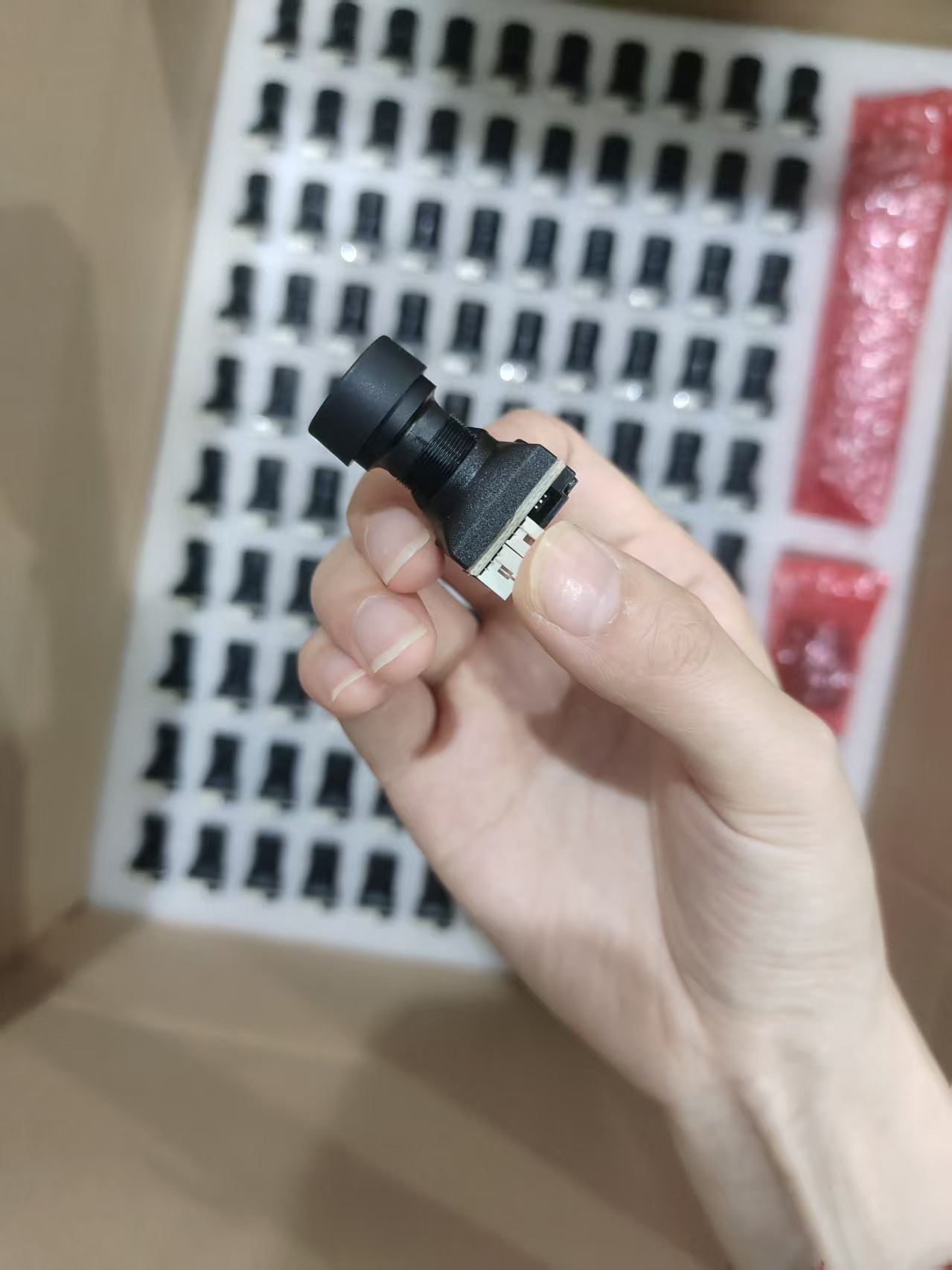
Purchase support materials provided by IRLAB for FPV camera orders.
Market Trend Context
The broader competitive environment also shapes how buyers should evaluate FPV camera suppliers. DJI continues to hold a very large share of the overall drone and imaging market, estimated at approximately 74% to 83% globally as of 2025–2026 according to a range of third-party sources. That broad market position is important context, but it does not automatically translate to suitability for specialized or restricted tactical programs. Many buyers evaluate DJI as a system-level option while still seeking dedicated FPV camera modules for custom or OEM airframes.
The thermal camera segment is another trend to watch. Market Research Future projected growth from US$5.16 billion in 2024 to US$10.09 billion by 2035, representing a CAGR of 6.28%. Thermal FPV cameras, including compact uncooled vanadium oxide modules, are therefore becoming more common in drone programs that previously relied only on visible-light cameras.
Compliance fragmentation is also increasing. The FCC Part 15 framework, the FCC Covered List update, and evolving UK/EU conformity requirements mean that a camera can be technically suitable but not automatically program-compliant. Buyer teams should treat certification as a checklist item, not as the final risk judgment.
Comparison with Traditional Solutions and Practical Limits
Compared with traditional consumer FPV cameras, the IRLAB product set is better characterized as an industrial or tactical module portfolio. The aluminum alloy housings, glass-and-plastic lens assemblies, wide voltage input ranges, and documented certification records are more aligned with OEM integration than with plug-and-play consumer use. The customization options also change the calculation: a racing drone buyer may not need third-party AI algorithm integration, but a defense or public-safety integrator often does.
That said, the portfolio has clear boundaries. The digital camera, CDD-BS5JMU, lists a latency of 50ms glass-to-glass. This is acceptable for many tactical and recording applications, but it is not the lowest-latency option in the market. For high-speed racing or extreme low-latency control loops, the analog models such as the CDD-BS59KU or CDD-BS59KP may be more appropriate. Conversely, the analog models do not provide the 4K recording and digital OSD integration of the digital unit. Buyers should match camera type to the specific mission rather than selecting a single model by default.
A further limitation is geographic and regulatory rather than technical. IRLAB is based in China. For programs that require a China-free FPV camera supply chain, or for US government and public-safety programs subject to Covered List restrictions, the company’s origin and component sourcing must be evaluated at the program level. A valid FCC or CE certificate is a useful signal, but it does not override national security procurement restrictions.
Finally, the supplied case record and application language are manufacturer-provided information, not independent test data. The product specifications are verifiable items such as resolution, weight, power consumption, and lens parameters, but the tactical environment descriptions should be validated through the buyer’s own environmental testing, especially for programs involving high vibration, EMI, or extreme cold.
Future Outlook
As FPV camera demand grows across defense, industrial inspection, and public safety, the differentiation will likely shift from pure image quality to integration readiness. Cameras that support MSP and MAVLINK OSD protocols, provide multiple video output paths such as CVBS, MIPI, and UVC, and allow third-party AI algorithm integration will become more relevant to integrators. The thermal segment is also likely to expand as uncooled vanadium oxide modules become lighter and more affordable for small uncrewed systems.
Compliance requirements will continue to fragment. Buyers should expect more scrutiny on component origin, RF emissions, and national security lists. In that environment, a camera manufacturer’s ability to provide clear certification records, stable OEM/ODM documentation, and realistic lead times will matter as much as the sensor specification itself.
For reference, IRLAB’s public company profile and corporate brochure is available at: IRLAB Company Profile & Corporate Brochure PDF.