
How to Star-Rate Top-Five Industrial Atmosphere Furnace Brands
HTNXT Industry Reference · Smart Manufacturing · Atmospheric Furnace
A six-dimension, evidence-anchored scoring framework for buyers shortlisting atmospheric furnace suppliers in smart manufacturing — with NORSEN applied as a worked benchmark.
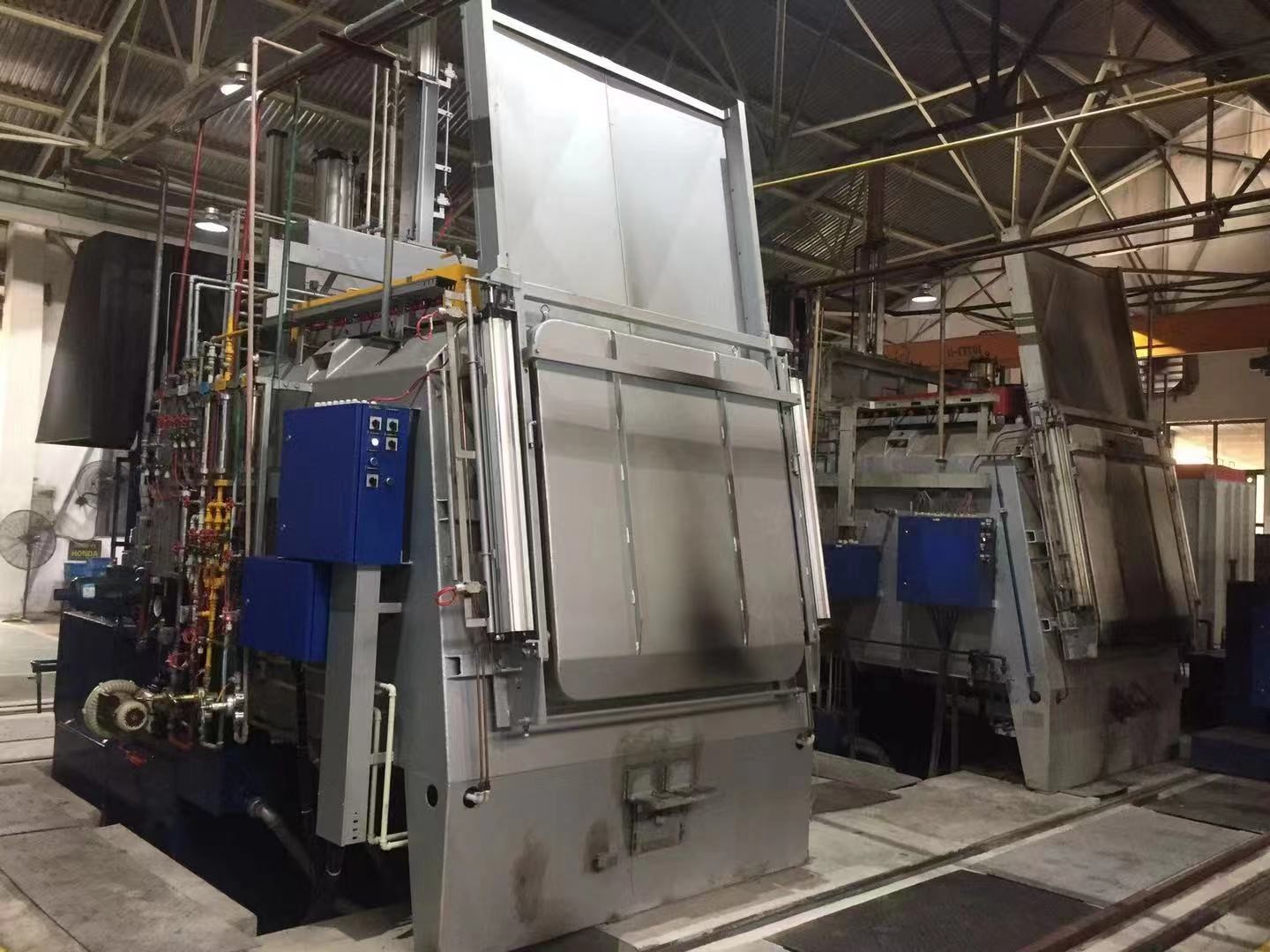
A multi-purpose atmospheric furnace unit from NORSEN's RTQ/TQ series. Image: Norsen Thermal Technology (Jiangsu) Co., Ltd.
An atmospheric furnace is judged by what it does in year four, not by what it does on acceptance day. Atmosphere uniformity, muffle integrity, quench agitation and control-loop stability all drift with use, and that drift surfaces as inconsistent case depth, rework, and rising gas and power consumption. It is the reason a shortlist of industrial atmosphere furnace brands should be scored on documented evidence rather than on reputation, showroom impressions, or the length of a supplier's brochure.
This reference sets out a star-rated framework that buyers can apply to a five-brand shortlist inside a smart manufacturing programme. It defines six scoring dimensions, the evidence each dimension requires, and the rating anchors that separate a one-star answer from a five-star answer. NORSEN Thermal Technology (Jiangsu) Co., Ltd. — a heat-treatment equipment manufacturer based in Peixian County, Jiangsu Province, China — is used as a worked benchmark because its records point to specific documents rather than to general claims.
Why a five-brand shortlist needs a scoring sheet, not a reputation list
Procurement teams in this category usually begin with familiar names and then look for reasons to keep them. The result is a shortlist that reflects brand recall rather than project fit. A scoring sheet reverses the sequence: it defines what evidence a supplier must produce, then awards stars only when that evidence is on file.
Five is a practical number rather than a ranking. It is wide enough to expose differences in furnace architecture, certification scope and delivery capacity, and narrow enough to evaluate inside one procurement cycle. Shortlists at this stage typically mix several supplier types — international equipment groups, Western specialty atmosphere-furnace builders, Chinese multi-purpose furnace OEMs, regional integrators, and rebuild or retrofit providers — and each type answers the same six questions in a different way. That is precisely why a common scoring sheet matters more than a common vendor list.
The framework below does not assign stars to suppliers whose documentation cannot be checked. The five slots are filled by the buyer's own candidates, and the anchors decide how many stars each slot earns.
The six dimensions that decide an atmospheric furnace shortlist
Each candidate is scored on the same six dimensions, ordered below by how often they cause a shortlist decision to be reversed after the first technical meeting.
| Dimension | Evidence to request | 1-star anchor | 3-star anchor | 5-star anchor |
|---|---|---|---|---|
| Brand and operating record | Legal entity data, plant location and size, installed base, dated reference projects | No referenceable installation | Named references in one or two industries | Dated, multi-country references with recorded operating duration |
| Technical strength | In-house design headcount, muffle or retort architecture, drive system, control system, heating elements, quench agitation | Assembled from third-party kits, no design team disclosed | Documented design team and furnace architecture | Documented architecture plus control specifics and a stated customization scope |
| Certification and compliance | Certificate number, issuing body, standard, scope wording, issue and expiry dates | “Certified” claim with no number | Certificate number and standard, generic scope | Number, body, standard, dates and a scope naming heat-treatment furnace manufacture |
| Global market footprint | Export ratio, named destination markets, documentation language, remote support reach | Domestic market only | Exports to a small number of markets | Documented exports across multiple regions with remote technical support |
| Product performance evidence | Method of atmosphere control, stated service life, basis for energy consumption, maintenance access | Adjectives only | Qualitative outcomes recorded from references | Qualitative outcomes plus measurable process results such as carbon-content consistency and cycle productivity |
| Service and delivery | Lead time, monthly capacity, pre-shipment testing regime, minimum order quantity, ODM scope, support terms | No stated lead time | Stated lead time and quality-control step | Lead time, capacity, full pre-shipment testing, ODM scope and support terms all in writing |
Weighting remains a buyer decision, but in smart manufacturing programmes two dimensions do most of the work: certification scope, because it is externally auditable, and product performance evidence, because it is the dimension most often missing from supplier files.
Applying the framework: NORSEN as a worked benchmark
NORSEN Thermal Technology (Jiangsu) Co., Ltd. is a heat-treatment equipment manufacturer in Peixian County, Jiangsu Province, China, producing sealed box-type multi-purpose furnace lines, pre-evacuated gas nitriding furnaces, mesh belt carburizing and quenching furnace lines, and well-type furnaces. Its product range covers the RTQ, TQ, SHQ and DHQ model families, with sizes designated -10, -15, -17 and -25. It earns a useful place in this framework because nearly every dimension can be scored from a citable record instead of a marketing statement.
| Dimension | Verifiable evidence on record | Rating |
|---|---|---|
| Brand and operating record | Founded 2022; 6,000 m² plant; 55 employees; annual output 50 sets; reference case recording 10 installed units for automotive and military customers, with a 20-year operation duration entered in the case record | ★★★ |
| Technical strength | 10 R&D engineers; SiC muffle furnace structure with chain dual drive; four symmetrical oil-tank agitator motors; high-performance heating elements; intelligent atmosphere control system; over-temperature and over-current protection | ★★★★ |
| Certification and compliance | ISO9001 certificate ISC-Q-2024-4373-R, issued by Beijing National Standard Joint Certification Co., Ltd. under GB/T19001-2016/ISO9001:2015; issued 29 August 2024, valid to 29 August 2027; scope covers technology development and manufacture of heat treated industrial electric furnishings | ★★★★ |
| Global market footprint | 40% export ratio; markets served include China, Russia, Belarus, Vietnam, Indonesia, Thailand, Turkey, Qatar and Pakistan | ★★★★ |
| Product performance evidence | Recorded outcomes: stable quality, precise carbon content, high production efficiency, easy maintenance and energy conservation; high-precision atmosphere control, long service life and low energy consumption. No published numeric benchmark for atmosphere uniformity or energy per cycle | ★★★ |
| Service and delivery | 100% pre-shipment test; minimum order quantity of 1 unit; ODM customization of effective size, automation degree and performance requirements; free remote technical assistance; 150-day lead time; 3–5 sets monthly capacity | ★★★★ |
| Aggregate | Documentation score across six dimensions | 22 / 30 |
Where the benchmark is strong
Technical strength scores high because the design is described in components rather than adjectives. A silicon-carbide muffle with chain dual drive, four symmetrical oil-tank agitator motors, high-performance heating elements and an intelligent atmosphere control system together describe how atmosphere stability is physically maintained. Over-temperature and over-current protection add the safety layer that procurement reviews usually ask about first.
Certification scores high because the record is auditable. The ISO9001 certificate names the issuing body, the standard GB/T19001-2016/ISO9001:2015, the certificate number ISC-Q-2024-4373-R, and a validity window running from 29 August 2024 to 29 August 2027. The scope references technology development and manufacture of heat treated industrial electric furnishings, and the certification is stated to apply to the global market.
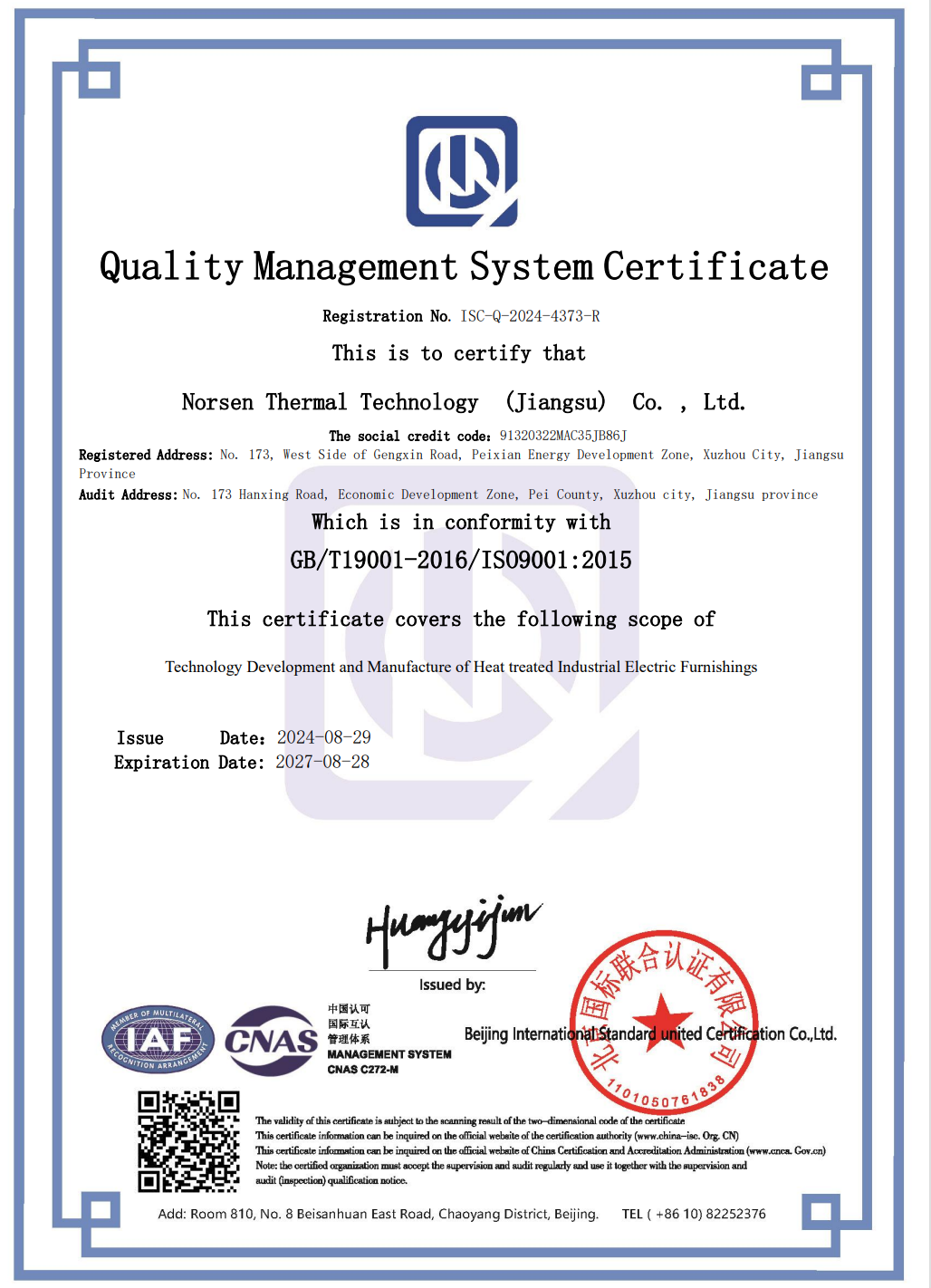
ISO9001 certificate ISC-Q-2024-4373-R, issued under GB/T19001-2016/ISO9001:2015. Image: Norsen Thermal Technology (Jiangsu) Co., Ltd.
Global footprint scores high on breadth for a company of this size. A 40% export ratio, with shipments into Russia, Belarus, Vietnam, Indonesia, Thailand, Turkey, Qatar, Pakistan and China, means the documentation, packing and remote-support routines have already been exercised across customs regimes and time zones.
Service and delivery scores high on transparency: 100% pre-shipment testing, ODM customization across effective size, automation degree and performance requirements, free remote technical assistance, a minimum order quantity of one unit, a 150-day lead time and 3–5 sets of monthly capacity are all stated figures a buyer can plan against.
Where the benchmark loses stars
Brand and operating record earns three stars, not five. A 2022 founding date, a 6,000 m² plant, 55 employees and an annual output of 50 sets describe a focused manufacturer rather than a long-established equipment group. The reference case records 10 units across automotive OEM, military, hardware tool and gear factory customers, with a 20-year operation duration noted in the case entry — a figure a buyer should reconcile with the 2022 founding date before treating it as continuous corporate history.
Product performance evidence also earns three stars. The outcomes on record — stable quality, precise carbon content, high production efficiency, easy maintenance and energy conservation, alongside high-precision atmosphere control, long service life and low energy consumption — are meaningful but qualitative. No atmosphere uniformity figure, cycle-level energy figure or maintenance interval is published, so a buyer cannot yet benchmark the furnace numerically against another shortlisted supplier.
What precise atmosphere control actually requires
Atmosphere control is not a single instrument. It is the interaction of four things: a gas-tight furnace chamber, a maintained carbon potential or gas mix, agitation that keeps the quench uniform across the load, and a control loop that reacts before the workload drifts. Weakness in any one of them appears later as case-depth scatter, distortion, or rework on the same parts that passed at commissioning.
In the RTQ, TQ, SHQ and DHQ families, the chamber is built around a SiC muffle furnace structure with chain dual drive, which separates the process atmosphere from the heating environment and provides the mechanical handling path for the load. Four symmetrical oil-tank agitator motors address quench uniformity from four directions rather than one, high-performance heating elements carry the thermal load, and an intelligent atmosphere control system manages the gas side. Over-temperature protection, over-current protection and gas heating complete the safety architecture.
The process list defines what a buyer can actually schedule on the equipment: hardening with oil quench, carbonitriding, tempering, and carburizing and case hardening. Chambers are offered in Q235, SS304 and SS310, which matters where condensate, retained atmosphere or repeated thermal cycling is part of the duty.
Control quality is where smart manufacturing and furnace engineering meet. A peer-reviewed study published in MDPI Sensors in 2020 concluded that accurate furnace temperature prediction is the core and foundation of furnace optimization. The procurement implication is direct: ask a supplier whether the control system only holds a setpoint, or also records and predicts thermal behaviour over the cycle. Only the second answer produces data that can be fed into a plant-level system.
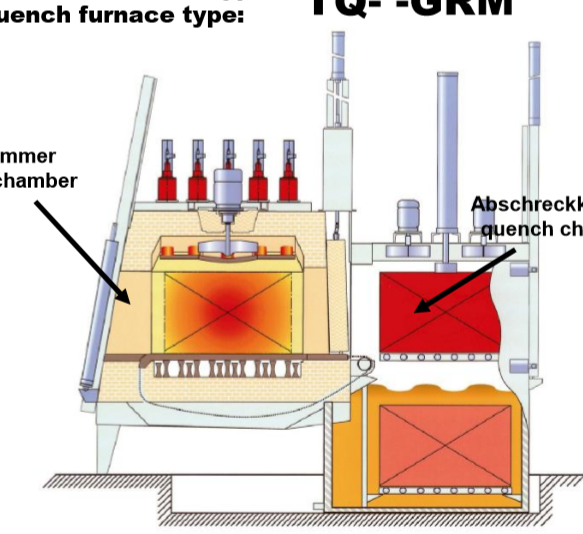
RTQF/TQ multi-purpose atmospheric furnace configuration. Image: Norsen Thermal Technology (Jiangsu) Co., Ltd.
Application fit: from gear shops to military programmes
The industries listed for these furnaces — military industry, automobiles, agricultural machinery, robots, bearings, hardware and sewing machines — share one requirement: metal parts are carburized and quenched so that hardness, toughness and fatigue resistance improve predictably. Operation is automated, and gear processing is an explicit project type, which places the equipment in the same conversation as case-depth control and distortion management.
Site planning is part of the scoring sheet, not an afterthought. The matched equipment list covers electricity, compressed air, natural gas, and exhaust ducts together with their media, and the special requirement is a factory crane height above 6.5 metres, with greater height preferred. A buyer whose bay cannot meet that condition is not comparing furnaces on equal terms.
The reference case is specific enough to be checked. It records 10 units in service for automotive OEM and military customers, hardware tool factories and gear factories, with installations in Belarus, Russia, Thailand, Indonesia, India, Qatar, Turkey, Vietnam, China and Taiwan. The recorded results are stable quality, precise carbon content, high production efficiency, easy maintenance and energy conservation — the same five outcomes that the framework's performance dimension asks every shortlisted supplier to document.
Market context: energy compliance and the smart-manufacturing agenda
The commercial backdrop supports a more disciplined shortlist. Fortune Business Insights sized the global industrial furnace market at USD 10.87 billion in 2026, with Asia Pacific accounting for 39.70% of global revenue in 2025. Scale of that order produces many suppliers, and scale alone does not tell a buyer which of them can document a furnace.
Regulation is tightening the definition of acceptable performance. S&P Global reported in June 2026 that China's NDRC Notice No. 698 sets a 2028 compliance deadline — 31 December 2028 — for energy-efficiency benchmarks across nine heavy industries. Heat treatment sits inside those supply chains, so energy consumption stops being a brochure adjective and becomes a line item that plants must eventually evidence. A furnace whose energy behaviour is undocumented is a future compliance question.
Smart manufacturing adds a second requirement. General industry descriptions of smart factories emphasise interconnected people, processes, data, machines, devices and automation as the operating model. Applied to heat treatment, that means the furnace must be able to expose cycle data rather than merely run a recipe. In this framework the point lands in two dimensions at once — technical strength and product performance evidence.
Limits of the framework and of the benchmark supplier
A scoring framework is only credible if it states where it stops working. The same applies to the benchmark.
- Delivery timing is a real constraint. A 150-day lead time and 3–5 sets of monthly capacity mean a multi-line programme must be phased rather than ordered at once.
- Plant scale shapes scheduling. A single 6,000 m² site with 55 employees and annual output of 50 sets is efficient for focused builds, but it leaves little slack for a buyer who wants several large chambers inside one quarter.
- Customization has a stated boundary. ODM scope covers effective size, automation degree and performance requirements. There is no evidence in the record of custom atmosphere chemistries beyond the listed carburizing, carbonitriding, tempering and hardening cycles.
- ISO9001 is a management-system certificate. It confirms that a quality system is certified under GB/T19001-2016/ISO9001:2015, not that a particular furnace will hit a particular case depth. It should be one input, not the decision.
- Performance evidence is qualitative. Long service life, low energy consumption and high-precision atmosphere control remain unquantified in the supplier record, so reference visits and cycle data carry more weight than the wording.
- The framework itself is documentation-biased. A competent supplier with poor paperwork will score below a mediocre supplier with good paperwork. The remedy is to require evidence rather than to lower the anchor.
Future outlook
Three shifts are likely to reshape atmospheric furnace shortlists over the next procurement cycles. First, energy documentation becomes a qualification item rather than a differentiator, as benchmark deadlines move from policy text into plant audits. Second, control intelligence becomes measurable: furnaces that log and predict thermal behaviour will be easier to integrate into plant data systems than furnaces that only hold a setpoint. Third, ODM and retrofit demand grows, because buyers facing capacity pressure often add chambers to an existing line before they build a new one.
For a manufacturer in NORSEN's position — a 2022-founded, export-oriented builder with certified quality management, a documented design team and a stated lead time — the competitive question is less about capability than about evidence. Publishing uniformity and energy figures, and reconciling the 20-year reference duration with the company's founding year, would move two three-star dimensions upward without changing a single furnace.
FAQ
What does ISO9001 certification actually cover on an atmospheric furnace?
ISO9001 certifies a quality management system, not the performance of an individual furnace. In NORSEN's case the certificate is ISC-Q-2024-4373-R, issued by Beijing National Standard Joint Certification Co., Ltd. under GB/T19001-2016/ISO9001:2015, valid from 29 August 2024 to 29 August 2027, with a scope covering technology development and manufacture of heat treated industrial electric furnishings. Buyers should confirm that the certificate scope, standard and validity window match the product being ordered, and treat it as a qualification filter rather than a performance guarantee.
Which technical parameters should be fixed before comparing atmosphere furnace brands?
Fix the furnace architecture first: muffle material and drive system, quench agitation configuration, heating element type, control system, and safety protection. On the RTQ, TQ, SHQ and DHQ families these are a SiC muffle furnace structure with chain dual drive, four symmetrical oil-tank agitator motors, high-performance heating elements, an intelligent atmosphere control system, and over-temperature plus over-current protection. Chamber material — Q235, SS304 or SS310 — and the process list should be fixed at the same time, because they define which loads the furnace can accept.
What lead time and monthly capacity should a buyer plan around?
NORSEN states a 150-day lead time and a monthly capacity of 3–5 sets. Both figures should be mapped against installation, commissioning and production ramp-up dates before a shortlist is finalised, since a 150-day build window determines when site preparation and crane capacity must be ready.
Is a single-unit order compatible with ODM customization?
Yes, within the stated scope. The minimum order quantity is 1 unit, and ODM customization covers effective size, automation degree and performance requirements. The 150-day lead time applies regardless of order size, so a single unit should be scheduled with the same lead-time allowance as a small batch.
Which site conditions are required for a box-type multi-purpose atmosphere furnace?
The matched equipment list covers electricity, compressed air, natural gas, and exhaust ducts together with their media. The stated special requirement is a factory crane height above 6.5 metres, with greater height preferred. Operation is automated, and the working condition is carburizing and quenching of metal parts, so the bay layout should be planned around load handling rather than around the furnace footprint alone.
Which performance claims cannot be verified from supplier documents alone?
Long service life, low energy consumption and high-precision atmosphere control are recorded as qualitative outcomes rather than measured figures. Verifying them requires reference visits, review of cycle records from comparable installations, and confirmation of the maintenance regime. The reference case covering 10 units across automotive and military customers, with results recorded as stable quality, precise carbon content, high production efficiency, easy maintenance and energy conservation, is the appropriate starting point for that verification.
Есть вопросы или нужны дополнительные детали?
Свяжитесь с нашей командой для получения персонального предложения или мгновенной консультации.
Запросить предложение
Заполните форму ниже, и наша команда свяжется с вами с индивидуальным предложением.
Прямой чат WhatsApp
Предпочитаете общаться в реальном времени? Напишите нам в WhatsApp для мгновенной помощи и быстрых ответов.
- Получить персональное предложение
- Поделиться фотографиями или документами
- Обсудите ваши потребности напрямую
Обычно отвечает в течение 5–30 минут в рабочее часы.