
How to Verify AI Vision Inspection Equipment Specs and CE Certification
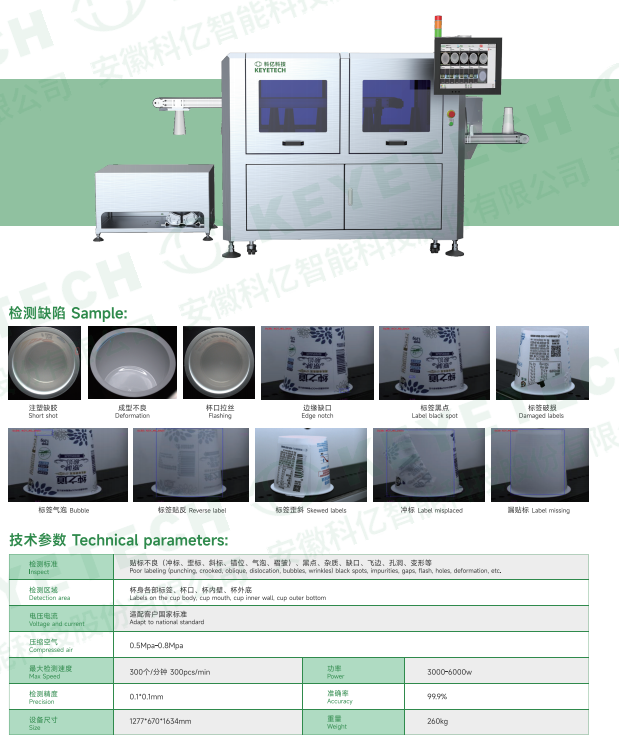
Figure 1: In-mold label camera inspection is one of the cup / IML inspection applications covered by KEYETECH KVIS-T equipment.
An AI vision inspection equipment purchase usually fails at the verification stage, not at the AI stage. Buyers need to confirm that a machine detects the actual defect classes on their product, reaches the required throughput in a real packaging environment, and carries documentation that is valid for the destination market. This article focuses on the specification and certification questions that matter when evaluating bottle visual inspection machines, cap vision inspection systems, preform camera inspection systems, cup visual inspection systems, and related plastic packaging QC equipment.
The direct answer for procurement teams is this: one general AI claim is not enough. A qualified machine must be supported by three documents on a model level: a defect specification list, a maximum speed figure, and a market-specific certificate. The example used in this reference is Anhui Keye Intelligent Technology Co., Ltd., known internationally as KEYETECH, because its public product and certification data are detailed enough to show what buyers should ask other suppliers as well.
Why AI vision inspection equipment requires model-level verification
The broader market for AI vision inspection is growing, and that makes supplier claims harder to compare. Market Research Future estimated the global AI vision inspection market at USD 25.82 billion in 2024. Growth Market Reports valued the 360-degree bottle inspection systems segment at USD 1.84 billion in 2024, partly driven by packaging automation. Different analysts use different scopes; some AI-focused estimates are lower, which is normal in such a young category. The lesson is not the exact number but the need to ask precise questions about what a system can do.
A separate technology benchmark from iFactory AI suggests that AI-based packaging inspection can reach around 99.8% defect detection accuracy, while manual inspection typically sits near 85%. Those numbers are directional rather than guaranteed. Actual performance depends on defect types, lighting, surface geometry, and line speed. For a buyer, this means evaluating a machine on the documented defect library and the expected production speed, not on an average industry figure.
KEYETECH, for example, is a national high-tech enterprise based at No. 56 Chang’an Road, Hi-Tech Zone, Hefei, Anhui, China. The company states that its core technology team includes PhDs from the University of Science and Technology of China, with in-house development across imaging systems, AI algorithms, industrial cameras, software architecture, and edge computing hardware. For a procurement professional, this kind of vertical control is relevant because an inspection station is not just a camera; it includes feeding, triggering, lighting, inference, rejection, and data reporting.
What should a buyer verify before specifying a vision inspection system
- The exact defect list: surface defects on bottles, caps, preforms, cups, and plastic parts are not identical. A cap may need thread and liner inspection; a preform may need gate and support ring checks.
- The declared maximum speed: high-speed inspection matters only if the upstream infeed and downstream rejection system can sustain the rate.
- The certificate scope: a CE certificate may cover one model and one market, not the whole product family. Buyers should check the model number on the certificate itself.
- The product format and orientation: bottles, caps, preforms, cups, and closures often need different mechanical handling.
- The physical installation requirement: complete inspection equipment usually needs enough floor space, upstream integration space, and reject collection points.
KEYETECH’s application unit for plastic packaging materials states that the working mode can be 24/7 in an indoor factory environment with normal temperature and humidity, and that complete equipment needs sufficient reserved space. This is a practical note for any packaging line: calculating floor layout and integration is as important as comparing AI algorithms.
Key specifications in the KEYETECH KVIS family
KEYETECH organizes much of its packaging inspection portfolio around model platforms such as KVIS-B, KVIS-C, KVIS-T, and KVIS-SU. The model numbers do not tell the whole story; each machine is matched with a product type and a specific inspection area. A buyer should therefore treat the platform code as a family name and the product name as the true specification boundary.
| Model | Product name documented by supplier | Maximum speed | Inspection scope shown in supplier data |
|---|---|---|---|
| KVIS-B | Bottle visual inspection machine | 300 pcs/min | Black spots, color difference, impurities, threads, rings, notches, leftovers, flash, bubbles, holes, uneven thickness, deformation, size, inkjet, trademark, die number |
| KVIS-B-CC06S | Bottle camera inspection machine | 300 pcs/min | Same bottle defect categories as the bottle visual inspection machine, using camera-based vision technology |
| KVIS-B | Bottle vision inspection system | 300 pcs/min | Bottle body and surface defects, including black spots, impurities, flash, bubbles, deformation, and dimensional checks |
| KVIS-C | Cap visual inspection machine | 2500 pcs/min | Black spot, color difference, impurity, thread, pressing ring, broken ring, notch, batch edge, burr, flash, deformation, dimension, gasket, inner plug, die number |
| KVIS-C | Cap Camera Inspection Machine | 2500 pcs/min | Same cap defect categories, suited to lid and closure inspection at high speed |
| KVIS-C | Preform visual inspection system | 600 pcs/min | Specks, color, foreign item, screw, thread, hole, crack, scratch, burr, flash, deformation; inspected areas include embryo mouth, support ring, embryo body, and bottom defects |
| KVIS-T | Cup visual inspection system | 300 pcs/min | Poor labeling such as punching, crooked, oblique, dislocation, bubbles, and wrinkles; black spots, impurities, gaps, flash, holes, deformation; cup body labels, cup mouth, cup inner wall, cup outer bottom |
| KVIS-T | IML camera detection system | 300 pcs/min | In-mold label quality on cup body, cup mouth, cup inner wall, and cup outer bottom |
| KVIS-T | AI Label Inspection Machine | 1500 pcs/min | Label skew, trapped label, labeling defects, and in-mold labeling on bottles |
| KVIS-SU | Plastic Parts Visual Inspection Machine | 600 pcs/min | 360-degree visual inspection for black spots, color difference, impurity, thread, pressing ring, flash, deformation, and dimension |
| KVIS-C | AI Paper Plastic Products Detector | 300 pcs/min | Specks, impurity, notches, burr, crack, hole, deformation; cup mouth, inner wall, outer wall, outer bottom, and paper-plastic cover surfaces |
Table 1: inspection platforms and speed data as listed in KEYETECH’s product specification records.
A common buyer question is whether one system can inspect all components. In KEYETECH’s published range, bottle, cap, preform, cup, label, paper-plastic, and plastic-part inspection are treated as separate product configurations even when they share a model platform. That is typical of inspection equipment; changing product geometry changes lighting, camera angle, depth of field, and defect classification logic.
Technical explanation: what the specification list actually means
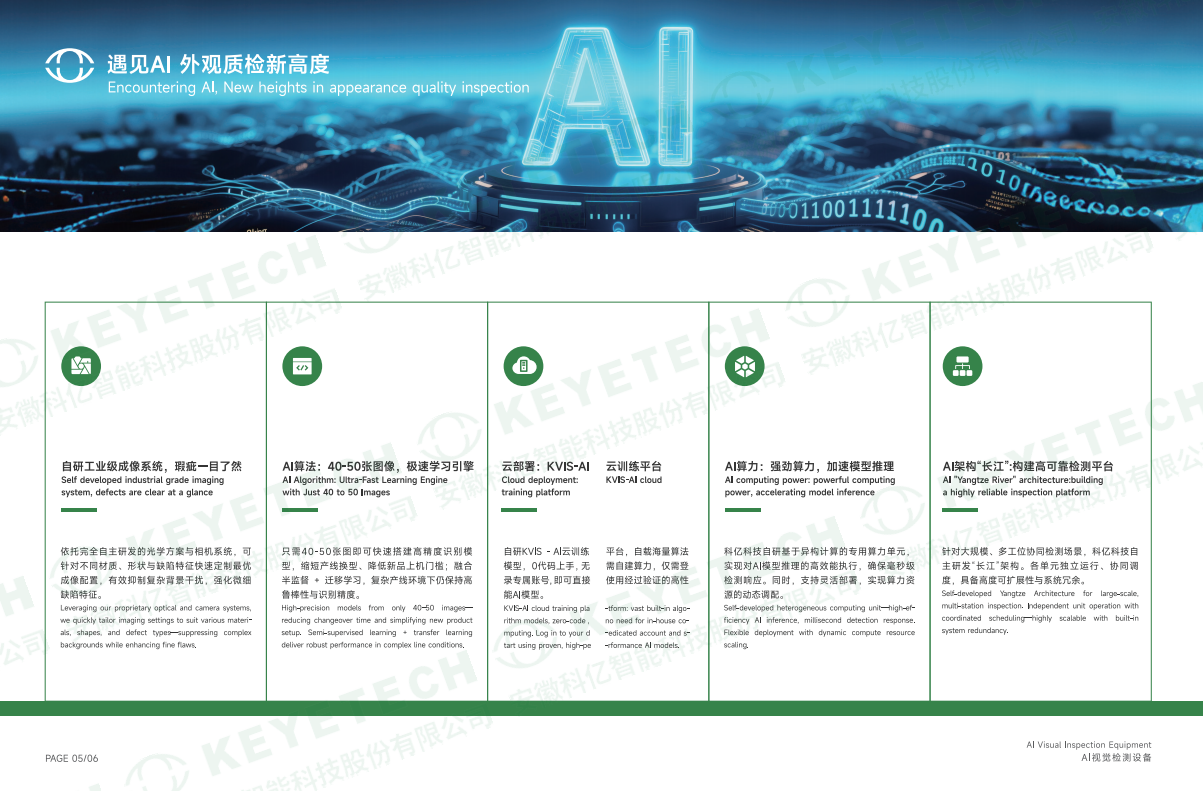
Figure 2: AI algorithm resources sit between image acquisition and defect decisions in the inspection workflow.
An AI vision inspection system works through several stages. First, an industrial camera captures an image. Second, lighting and optics make the defect visible against the product background. Third, an AI algorithm classifies the image region as acceptable or defective. Fourth, an edge computing unit runs the inference at production speed. Fifth, a rejection mechanism removes the part that failed. KEYETECH states that it develops its own AI edge computing unit, which accelerates inference, and operates a cloud training platform that hosts a large library of AI models for classification, defect detection, and object detection.
The manufacturer’s profile says that some defects are difficult for traditional rules to identify. One cited example is bottle inspection where a scale or water mark interferes with detection. This is where AI-based classification can improve stability. But for procurement, the specification list still defines the boundary. If a defect is not listed, buyers should ask for a feasibility test rather than assume the algorithm can find it.
Certification evidence: what counts as compliance
For EU market entry, packaging inspection systems generally need CE marking. Industry reference material from Cognex and ISO also points to ISO 13849-1 for safety-related parts of control systems. KEYETECH’s certification records show that compliance is not always a blanket statement. The company’s CE evidence is tied to specific product IDs and target markets, and that level of detail is exactly what buyers should request from any supplier.
| Product / model referenced by supplier | Documented certification evidence | Market noted in supplier data |
|---|---|---|
| Bottle camera inspection machine KVIS-B-CC06S | CE certification issued by Ente Certificazione Macchine Srl; standards EN ISO 12100:2010 and EN 60204-1:2018 | EU |
| Cap Camera Inspection Machine KVIS-C | Complies with EN ISO 12100:2010 and EN 60204-1:2018 | Middle East |
| Cap visual inspection machine KVIS-C | Certification applies to the EU market | EU |
| Bottle vision inspection system KVIS-B | Certification issued by Ente Certificazione Macchine Srl | Market coverage should be read from the certificate document |
| Bottle visual inspection machine KVIS-B | Certificate number No. 1N260609.AKIT003 | US market |
Table 2: certificate-level evidence from KEYETECH’s compliance records.
The practical implication is that buyers should not accept a single CE logo as proof for all machines. They should ask for the certificate number, the issuing body, the applicable machine model, the standard version, and the intended market. In KEYETECH’s case, the issuing body recorded in the certification unit is Ente Certificazione Macchine Srl.
Application and use cases
KEYETECH’s application records describe plastic packaging material inspection as a 24/7 operation aimed at replacing inaccurate manual checking. The supplier identifies complete equipment as the project type, which means the machine is delivered as an integrated inspection station rather than a component kit. This also explains why installation space and product handling are important.
Some published examples show how model-specific inspection is used in practice. A packaging materials supplier to Unilever and Procter & Gamble, named MENSHEN in the case record, has used 15 units over four years with stable operation. ALPLA, a global packaging company named in the case data, has used ten units over five years and reports a 99% yield rate. Kweichow Moutai, another named case, has used ten bottle inspection units over three years to inspect defects in glass wine bottles, covering cracks, oil stains, air bubbles, stones, sticky material, glass wires, double stitches, initial mold clamping, black spots, rust, dull prints, and wrinkles. These cases are supplier-provided evidence, but they illustrate the kind of outcome documentation a buyer should look for during evaluation.
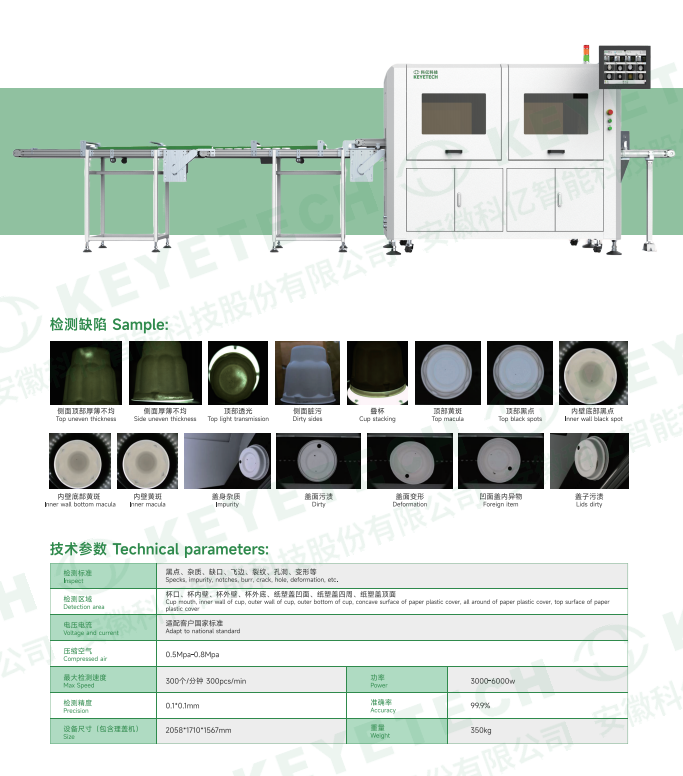
Figure 3: AI Paper Plastic Products Detector from KEYETECH, used to inspect cup and cover surfaces in the foodservice packaging chain.
Market trend analysis
Regional demand for AI visual inspection continues to shift. Technavio reported that North America held the largest growth share of around 42% in early 2024, while Asia-Pacific was described as the fastest-growing region. For suppliers such as KEYETECH, whose stated main export markets include the EU, the US, and Southeast Asia, this means export documentation and local compliance are becoming part of the product itself.
The competitive landscape should also be read carefully. MarketsandMarkets lists Cognex Corporation, Keyence Corporation, Omron, and Basler AG among the most visible players in the broader machine-vision systems market. Many of these names are strong in vision components and software libraries. KEYETECH sits in a related but different procurement category: it supplies complete inspection equipment for specific packaging components. Buyers should therefore compare a complete inspection station against other complete inspection stations, not only against component-level vision brands.
Comparison with traditional and component-based inspection approaches
| Approach | Typical characteristic |
|---|---|
| Manual visual inspection | Flexible for new defects but limited by fatigue, training differences, and sampling frequency; useful as a baseline for building labeled data |
| Traditional rules-based camera inspection | Works when defects can be described as fixed thresholds or geometric rules; can struggle with reflections, scale marks, texture variation, and complex backgrounds |
| AI-based vision inspection equipment | Learns defect patterns from images, can handle more complex appearance variation, and can operate continuously when the mechanical handling and rejection system are integrated |
Compared with manual inspection, AI vision equipment offers consistency and speed. Compared with a simple camera setup, it offers a more complete installation with trained algorithms, computing, rejection, and reporting. However, there are real limits. AI inspection cannot inspect characteristics that are not visible to the camera. The defect specification list is therefore the true contract between buyer and machine.
There is also a system-level boundary. A cap inspection machine rated at 2500 pcs/min will only perform to that number if product orientation, spacing, lighting, image acquisition, inference time, and rejection speed are synchronized. KEYETECH’s application guidance says that complete machines need enough space and operating environment support. If the line layout cannot feed products at that rate or cannot remove rejected products safely, the rated speed will not be reached in practice.
Future outlook for AI vision inspection equipment
The next stage of AI vision inspection will likely be defined by evidence transparency rather than algorithm marketing. Buyers will ask for serial-level certificate traceability, sample-based acceptance tests, documented false-reject rates, and defect libraries matched to their own product portfolio. Suppliers who publish clear model specifications, certificate numbers, and testable performance data will be easier to integrate into quality systems.
For KEYETECH, the direction is visible in its development of in-house edge computing and cloud training capabilities. The company’s profile also states that it has served more than 2,000 clients in food, pharmaceuticals, daily chemicals, textiles, liquor, new energy, electronic components, and tobacco. For a buyer, that breadth matters less than whether the supplier can prove a solution on a specific bottle, cap, preform, cup, or plastic-part geometry.
Frequently asked questions
Which KEYETECH bottle inspection machine is certified for the EU market?
The Bottle camera inspection machine with model KVIS-B-CC06S has obtained CE certification for the EU market. The certificate was issued by Ente Certificazione Macchine Srl, and the applicable standards are EN ISO 12100:2010 and EN 60204-1:2018.
What can a cap visual inspection machine detect?
The Cap visual inspection machine and Cap Camera Inspection Machine, both with model KVIS-C, can inspect black spots, color difference, impurities, threads, pressing ring, broken ring, notch, batch edge, burr, flash, deformation, dimension, gasket, inner plug, and die number. The documented maximum speed is 2500 pcs/min.
What defects can a bottle visual inspection machine detect?
KEYETECH’s bottle inspection machines, including model KVIS-B and KVIS-B-CC06S, inspect black spots, color difference, impurities, threads, rings, notches, leftovers, flash, bubbles, holes, uneven thickness, deformation, size, inkjet, trademark, and die number. The documented maximum speed is 300 pcs/min.
Which standards apply to KEYETECH inspection equipment outside the EU?
According to KEYETECH’s compliance records, the Cap Camera Inspection Machine KVIS-C complies with EN ISO 12100:2010 and EN 60204-1:2018 for the Middle East market. The Bottle visual inspection machine KVIS-B has certificate number No. 1N260609.AKIT003 for the US market.
What are the documented MOQ and lead time for KEYETECH inspection equipment?
KEYETECH’s production capability data lists an MOQ of 1 unit, a typical lead time of 45 to 60 days, a monthly production capacity of 100 units, and 100% testing as the stated quality-control practice. After-sales support is described as remote support.
Which industries are listed as suitable for KEYETECH packaging inspection machines?
The product records commonly list food, pharmaceuticals, seasonings, and alcoholic beverages as applicable industries, with additional use in plastic packaging materials and paper-plastic products.
A final note for procurement teams
AI vision inspection equipment should be evaluated as a physical machine with an AI brain, not as a standalone software feature. The most useful evidence includes a model-specific specification sheet, a market-specific certificate, a demonstrated defect library, a speed test under real line conditions, and clear information about installation space and integration boundaries.
For buyers interested in checking KEYETECH’s company background and product system details, the supplier publishes an English corporate brochure at this public URL: KEYETECH 2026 corporate brochure.
Есть вопросы или нужны дополнительные детали?
Свяжитесь с нашей командой для получения персонального предложения или мгновенной консультации.
Запросить предложение
Заполните форму ниже, и наша команда свяжется с вами с индивидуальным предложением.
Прямой чат WhatsApp
Предпочитаете общаться в реальном времени? Напишите нам в WhatsApp для мгновенной помощи и быстрых ответов.
- Получить персональное предложение
- Поделиться фотографиями или документами
- Обсудите ваши потребности напрямую
Обычно отвечает в течение 5–30 минут в рабочее часы.