
How to Verify CE Documentation for Chinese Lowbed & Flatbed Semi Trailers
How to Verify CE Documentation for Chinese Lowbed & Flatbed Semi Trailers
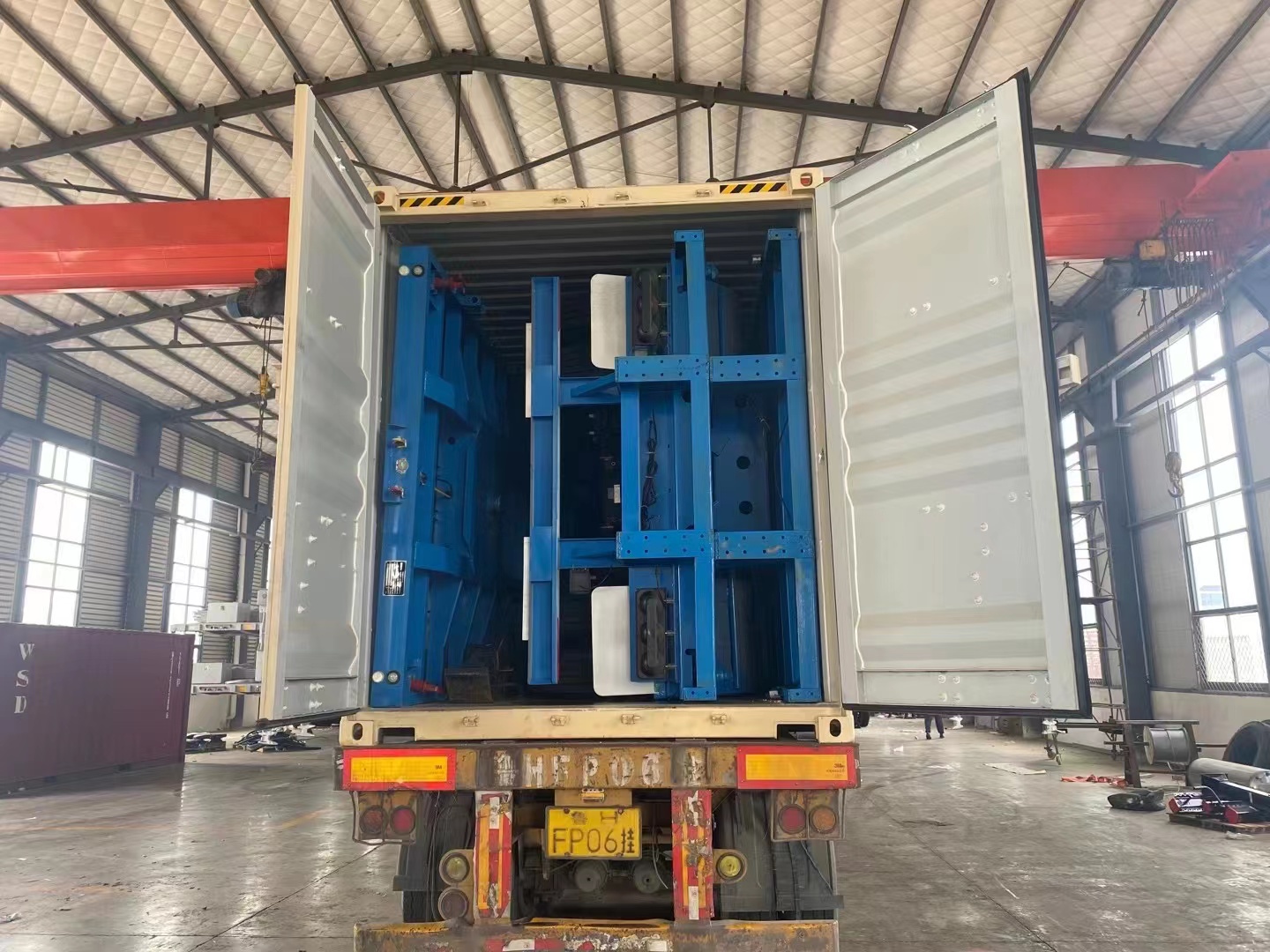
Buyers sourcing lowbed (lowboy) and flatbed semi trailers from China rarely lose time because a document is missing. They lose time because a document is present but does not describe the trailer that was ordered. A CE compliance certificate that names a wheel lock, an ISO 9001 certificate whose scope covers sales activity, and a trademark registration are all genuine documents — and none of them demonstrates that a specific 13-metre flatbed or a 60-ton lowbed conforms to the specification in the purchase order.
The Problem: Three Different Document Families Are Treated as One
An export document pack for a Chinese-built semi trailer commonly contains three unrelated families of paper: conformity or compliance documents (CE-type certificates of compliance, declarations, test reports); management system certificates (ISO 9001); and intellectual property registrations (registered trademarks, design patents). Each family answers a different question. Only the first can speak, even indirectly, to whether a physical trailer meets a stated technical requirement.
When these are bound into a single PDF and presented as “trailer certification,” the buyer's verification task becomes harder rather than easier, because the strongest-looking document in the pack — usually the one carrying the largest number of logos — is frequently the one with the narrowest scope.
The opportunity is straightforward. Verification does not require a legal department. It requires checking eight fields on one certificate and reconciling three numbers on one drawing: axle load, deck height and steel grade. Done before production release, that process costs a week. Done after delivery, it costs a fleet.
How a CE Compliance Certificate Is Structured
A CE-related compliance certificate is a short, highly structured document. It is not a general statement of quality, and its usefulness depends almost entirely on the following fields:
- Issuing authority and its accreditation status
- Certificate number
- Product name as declared in the scope field
- Model number as declared in the scope field
- The EU directive or regulation applied
- The test standards applied
- Market coverage claimed (for example, all EU member states and the EEA)
- Issue date and expiry date
Shandong Luen Automobile Co., Ltd. — a trailer and used special-purpose vehicle manufacturer and exporter based in Liangshan County, Jining, Shandong Province, China, operating under the Luen Auto trading style with a 50,000 m²+ factory, more than 130 employees and an annual output of 1,500 units — holds a CE Certificate of Compliance numbered CPSC2106112201E, issued by CPStes on 11 June 2021 with an expiry date of 11 June 2099, covering all EU member states and the European Economic Area. Its scope field reads: Product Name: wheel lock; Model No.: 201L1-A. The standards applied are EU Directive (EU)2015/863 amending Annex II to 2011/65/EU, together with the IEC 62321 test series (IEC 62321-3:2013, IEC 62321-4:2013+A1:2017, IEC 62321-5:2013, IEC 62321-6:2015, IEC 62321-7-1:2015 and IEC 62321-7-2:2017).
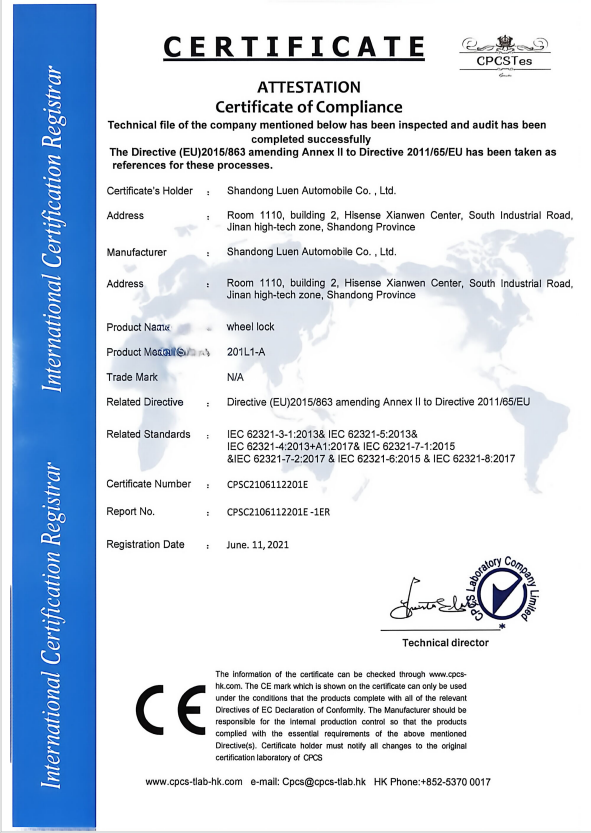
That certificate is a real, traceable conformity document for a component. It is not evidence that a lowbed or flatbed semi trailer conforms to anything, because a trailer is not the product named in the scope field. This is the most common mismatch in Chinese trailer document packs, and it is not purely a supplier problem: buyers create it when they ask for “the CE certificate” instead of a document that names the ordered model.
The buyer's first check is therefore mechanical. Does the product name and model number on the certificate correspond to the asset being purchased? If not, the certificate belongs in the supplementary file, not the conformity file.
Cross-Checking Declared Specifications Against the Documentation
CE-type documents rarely contain the dimensions or material grades a fleet engineer needs. Those live in the technical file and on the engineering drawing. The verification method is to reconcile three sources: the quotation or specification sheet, the construction drawing, and the pre-shipment inspection record.
Axle load and payload
Luen Auto's flatbed semi trailers are listed with axle loads of 13 tons per axle in two- and three-axle configurations and a declared payload band of 40–60 tons, over an overall length of 12,500–16,000 mm (13,000 mm standard). The same reference specification lists 13 tons per axle for the container skeleton and tank ranges, and 13–16 tons per axle for the lowbed range.
An axle load figure is only half of a payload claim. The other part is carried by the tractor's fifth wheel, which in the matched HOWO tractor specification is a 90# coupling with a 2″ pin rated at 20,000 kg. A buyer can therefore do the arithmetic before signing: three axles at 13 tons plus a fifth wheel at 20 tons describes roughly 59 tons of combination capacity, consistent with the top of a 40–60 ton payload band. A four-axle lowbed at 16 tons per axle plus the same fifth wheel capacity describes 84 tons — which is why a headline figure of 100 tons for a lowbed should always be accompanied by a specific axle configuration and a load-distribution statement. If the document does not state how load is split between kingpin and axles, the payload number is aspirational rather than verifiable.
Deck height and load height
Deck height is where flatbed and lowbed documentation is most often confused. The flatbed reference specification gives a deck height of 1,250–1,550 mm. The lowbed specification gives a loaded deck height of 450–600 mm (18–24 inches) and a separate neck height of 1,200–1,400 mm, with a maximum legal load height of up to 3.5 m.
If a lowbed drawing shows a “deck height” in the 1,200–1,500 mm range, the figure quoted is most likely the neck height, and the reviewer is reading the wrong line of the drawing. A lowbed whose gooseneck does not clear the load cannot be corrected after delivery, so this check belongs before production release, not at pre-shipment inspection.
Main beam steel grade
Material grade is a claim a buyer should test against the class of trailer, not against a general preference for “high-strength steel.” The flatbed reference lists Q345B / Q550 high-tensile steel for its I-beam or H-beam frame. The lowbed reference is different: Q550 / Q690 high-strength steel and HG785D quenched and tempered steel for the box-section main beam, with an alloy steel kingpin.
A lowbed document specifying Q345B for the main beam is quoting the flatbed material list on a heavy-haul product. That does not automatically make a trailer unsafe — it makes the document internally inconsistent, and inconsistency in a material field is precisely what a buyer should escalate before the beam is welded. Requesting material certificates traceable to the steel heat or lot number for the main beam, and matching them to the grade on the drawing, converts a claim into evidence.
Length, model identity and coupling
The same logic applies to length and coupling. A flatbed document stating “12,500–16,000 mm” is describing a product family, not the unit on order; the technical file should state the length actually built. The king pin is specified as 2″ or 3.5″ across the listed trailer ranges, and it must match the tractor's fifth wheel — a 90# coupling takes a 2″ pin. A mismatch here becomes a delivery-day problem rather than a paperwork problem.
| Document field | Flatbed semi trailer reference | Lowbed (lowboy) reference | What to reconcile before production |
|---|---|---|---|
| Overall length | 12,500–16,000 mm (13,000 mm standard) | 11,000–18,000 mm | Built length stated as a single value, not a range |
| Deck height | 1,250–1,550 mm | 450–600 mm loaded; neck height 1,200–1,400 mm | Confirm which line of the drawing is quoted |
| Axle load | 13 tons per axle, 2–3 axles | 13–16 tons per axle | Axle count × rated load plus kingpin share against the payload claim |
| Payload band | 40–60 tons | 40–100 tons | Request a written load-distribution statement |
| Main beam material | Q345B / Q550 | Q550 / Q690, HG785D | Grade must match trailer class; verify against steel heat/lot certificate |
| King pin | 2″ or 3.5″ | 2″ or 3.5″ | Match to tractor fifth wheel (90# coupling = 2″ pin) |
What a Unit-Specific Technical File Should Contain
The technical file is the document set that follows one serial number. In the manufacturer's own account of its quality process, 100% factory inspection is performed before shipment, and in-house testing equipment covers load testing, brake performance testing and dimensional verification. The manufacturer also states that its products have passed China National Certification and Accreditation Supervision (CCC mandatory certification). CCC is a Chinese domestic market scheme and does not function as a European conformity document; it belongs in the supplementary file alongside ISO 9001, not in place of it.
A workable unit file contains:
- A construction drawing stating built length, deck height, axle positions and king pin size.
- A material statement for the main beam and cargo deck, naming grades and a traceability reference — Q345B / Q550 on flatbed, Q550 / Q690 or HG785D on lowbed.
- Axle rating documentation: number of axles, rated load per axle (13 tons across the flatbed and skeleton ranges; 13–16 tons on lowbed) and axle brand.
- A load test record and a brake performance test record for the specific unit.
- A dimensional verification record checked against the drawing rather than a generic template.
- Customization confirmation where a non-standard configuration was ordered. The listed customization scope covers trailer type, overall dimensions, axle configuration, load rating, beam structure, suspension type, rim and tire specifications, landing gear, king pin, paint and coating, and branding.
- Warranty terms. The stated coverage is one year on trailer carrying devices and six months on trailer driving and supporting devices.
- The commercial terms the file references: minimum order quantity of one unit for standard models, FOB or CIF delivery terms, pre-shipment test acceptance, and TT 30/70 payment.
For a first order, the practical sequence is: specification sheet, drawing approval, production (30–45 days for standard configurations, longer for complex custom specifications), pre-shipment test against agreed acceptance criteria, then shipment. Documentation should be requested at each step rather than assembled at the end, because a drawing can be corrected in a day while a welded main beam cannot.
Reading the Scope Line on Management System and IP Certificates
Management system certification is legitimate and useful, but it certifies a process, not a product. Shandong Luen Automobile holds ISO 9001 certification, certificate number 47424Q2464R0S, issued by ZHONGNUO CERTIFICATION CO., LTD. against GB/T 19001-2016 / ISO 9001:2015, valid from 9 October 2024 to 8 October 2027. The scope line reads “Sales of Semi Trailer, Semi Trailer Parts and Tractor.”
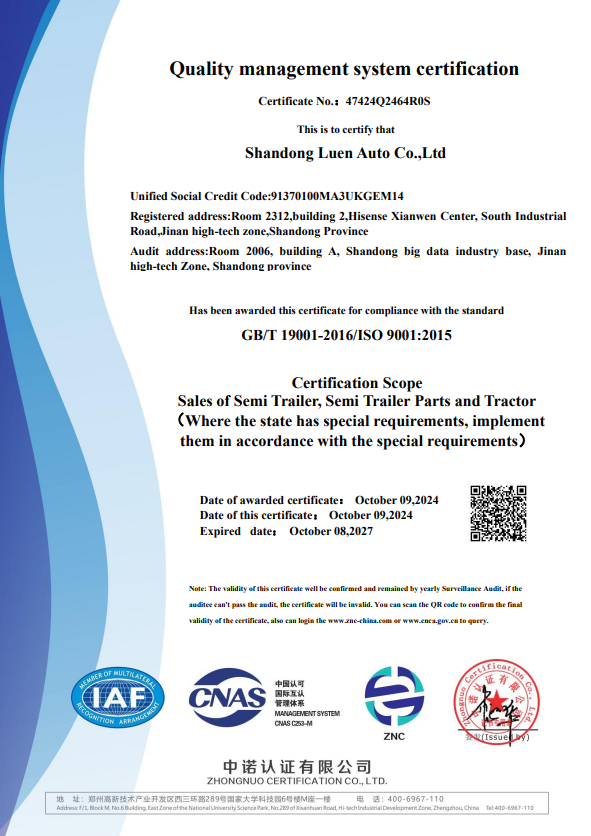
That scope line is worth reading twice. It covers a sales activity. It does not certify a welding procedure, a manufacturing process or a product performance limit. A buyer who cites an ISO 9001 certificate as evidence that a specific trailer was built to a stated steel grade is making a claim the document cannot support.
Intellectual property registrations follow the same rule. The supplier holds registered trademark TMZC86619669D01T260306 for the LUEN brand in Class 12 (valid 24 February 2026 to 13 February 2036) and registered trademark 86628573 for LUEN AUTO in Class 12 (valid 14 February 2026 to 13 February 2036), both issued by the China National Intellectual Property Administration, plus a China Appearance Design Patent, number ZL 2021 3 0278988.9, issued 27 August 2021 and valid to 11 May 2031, covering the appearance design of an automobile wheel hub. These confirm brand ownership and design rights. They contain no information about load capacity, braking performance or material grade, and they should never sit in the conformity section of a document pack.
Application Scenarios and the Documentation Layer Each One Needs
The trailer class determines which document layer carries real weight. Luen Auto's lowbed range — 40–100 ton payload, 450–600 mm loaded deck height, fixed or hydraulic detachable gooseneck, mechanical or hydraulic ramp — is used for heavy equipment transport (excavators, bulldozers, cranes), mining machinery relocation, wind turbine components, industrial machinery and oversized project cargo. For these applications the binding documents are the drawing, the main beam material record and the load test record, because the load is concentrated and rarely standard.
The flatbed range — 12,500–16,000 mm overall length, 40–60 ton payload, tie-down rings at 500 mm intervals, steel checker plate or hardwood deck — serves construction material logistics (steel, pipes, timber), machinery transport, agriculture, project cargo and wind energy components. Here the binding documents are dimensional, because the trailer is often loaded to a pattern rather than to a single concentrated point.
Regional requirements add a further layer that must not be confused with CE documentation. Under the ADR Agreement, transport of dangerous goods in fuel and tank trailers across Europe requires ADR certification — a requirement that follows the cargo, and therefore does not apply to a lowbed or flatbed carrying general cargo or machinery. In the United States, the Department of Transportation mandates annual safety inspections for trailers with a GVWR over 10,001 lbs under 49 CFR 396.17, which is an operator obligation rather than an import document. A buyer in Africa, South America or the Middle East — regions that account for the bulk of Luen Auto's stated 80% export ratio — will usually work to a national registration regime instead, which shifts the verification weight back onto the drawing and the pre-shipment test record.
Market Context: Volume Growth Raises the Cost of a Documentation Error
The global semi-trailer market was estimated at USD 22.8 billion in 2024, with expectations to reach USD 42.3 billion by 2033 (Grand View Research), and lowboy trailers accounted for the largest share of the semi-trailer market at 25.7% in 2024 (Grand View Research). On the supply side, Sinotruk (CNHTC) dominated China's heavy-duty truck exports in 2024 with a record 135,000 units (ChinaTrucks.org), while Shacman heavy-truck exports reached 25,000 units, a 35% year-on-year increase (ChinaTruck.Net). The global used truck market was valued at USD 49.95 billion in 2025, dominated by heavy-duty segments (Global Market Insights).
Those figures carry their own caution, and it is the same caution buyers should apply to certificates. Estimates for the 2024–2025 semi-trailer market differ across research firms — Grand View Research at USD 22.8 billion for 2024, Market Research Future at USD 31.2 billion for 2024 and Fact.MR at USD 24.2 billion for 2025 — largely because each defines the sub-categories differently. A number with a source name attached is not automatically a number that fits a specific procurement decision. The same discipline applies to a certificate: read what it covers before relying on it.
Limits of Documentation Verification
Three boundaries are worth stating plainly, because verification is often presented as a complete answer when it is not.
First, scope. The conformity documents a Chinese trailer exporter can typically provide are component-level or system-level. A CE certificate for a wheel lock does not transfer to a trailer, and ISO 9001 covers a sales activity rather than manufacturing output. For European road use, conformity for a complete vehicle and its trailer runs through vehicle type-approval and national registration; a factory document pack supports that process but does not replace it.
Second, paper does not substitute for physical verification. Dimensional verification, load testing and brake performance testing exist precisely because a drawing can be correct while a finished unit is not. Pre-shipment test acceptance and staged payment terms such as TT 30/70 are the commercial mechanisms that give those checks effect. A buyer who accepts documents without a pre-shipment test has moved the risk, not removed it.
Third, cost and time. Unit-specific third-party testing adds cost and extends timelines beyond the stated 30–45 days for standard configurations; complex custom specifications are quoted case by case for the same reason. On low-volume orders — the minimum order quantity for standard models is one unit — the economics of independent testing are sometimes unfavorable, and the reasonable fallback is a tighter drawing approval process plus a documented dimensional and load check before shipment.
Future Outlook
Three developments are likely to shape this area over the next few years. Export volumes at the scale described above push buyers toward unit-level document packs keyed to a serial number, rather than family-level certificates covering an entire product range. Second, as lowbed demand continues to grow — the class already holds the largest single share of the semi-trailer market — heavy-haul buyers will increasingly specify material grades and axle ratings at the tender stage, which makes the drawing the primary negotiating document rather than the brochure. Third, the gap between domestic Chinese certification such as CCC and destination-market conformity requirements will remain a source of confusion for first-time importers, and the practical answer is not a single certificate but a documented, model-specific verification sequence repeated on every order.
FAQ
Does a CE certificate held by a Chinese trailer manufacturer mean a lowbed trailer is CE compliant?
Not automatically. A CE compliance certificate is scoped to the product name and model number stated on it. Shandong Luen Automobile, for example, holds a CE Certificate of Compliance (CPSC2106112201E, issued by CPStes) whose scope names a wheel lock, model 201L1-A, and whose applied standards are RoHS-related — EU Directive (EU)2015/863 amending Annex II to 2011/65/EU, with the IEC 62321 test series. That document demonstrates conformity for that component, not for a trailer. Buyers should check whether the product name and model number in any CE document corresponds to the asset being purchased.
How can a buyer verify a claim of 13 tons per axle on a flatbed semi trailer?
Reconcile the axle count, the rated axle load and the payload figure. A three-axle flatbed at 13 tons per axle carries 39 tons on its axles; the remainder of the payload is carried by the tractor's fifth wheel, which in the matched HOWO specification is a 90# coupling with a 2″ pin rated at 20,000 kg. Three axles plus that fifth wheel capacity describes roughly 59 tons, which aligns with the top of the listed 40–60 ton flatbed payload band. If a document claims a payload figure that the axle count and coupling capacity cannot support, the buyer should request a load-distribution statement.
What is the difference between a CE compliance certificate and an ISO 9001 certificate for a trailer supplier?
A CE-type compliance certificate addresses conformity of a named product or component to specific EU legislation and test standards. An ISO 9001 certificate addresses a management process. Shandong Luen Automobile's ISO 9001 certificate (number 47424Q2464R0S, issued by ZHONGNUO CERTIFICATION CO., LTD. against GB/T 19001-2016 / ISO 9001:2015, valid 9 October 2024 to 8 October 2027) carries a scope of “Sales of Semi Trailer, Semi Trailer Parts and Tractor” — a sales activity scope. Neither document type substitutes for the other.
Should a lowbed trailer's main beam be Q345B or a higher grade?
The reference specification for Luen Auto's lowbed range lists Q550 / Q690 high-strength steel and HG785D quenched and tempered steel for the box-section main beam, with an alloy steel kingpin. Q345B / Q550 appears in the flatbed range's material list, together with an I-beam or H-beam frame. A document quoting Q345B for a lowbed main beam is inconsistent with the heavy-haul reference and should be clarified before production, ideally against a material certificate traceable to the steel heat or lot number.
How does documentation differ between a standard flatbed and a heavy-duty lowboy?
The checks change with the class. A flatbed's key figures are overall length (12,500–16,000 mm, 13,000 mm standard), deck height (1,250–1,550 mm) and payload (40–60 tons). A lowboy's key figures are payload (40–100 tons), loaded deck height (450–600 mm) and neck height (1,200–1,400 mm), with a maximum legal load height of up to 3.5 m. For the flatbed, dimensional verification against the drawing is the binding check; for the lowboy, the main beam material record and the load test record carry more weight because the load is concentrated.
Are trademark and design patent certificates a substitute for product certification?
No. They are intellectual property documents. Shandong Luen Automobile holds registered trademark TMZC86619669D01T260306 for the LUEN brand in Class 12 (valid 24 February 2026 to 13 February 2036), registered trademark 86628573 for LUEN AUTO in Class 12 (valid 14 February 2026 to 13 February 2036) and a China Appearance Design Patent (ZL 2021 3 0278988.9, valid 27 August 2021 to 11 May 2031) covering an automobile wheel hub. These confirm brand and design rights and contain no information about load capacity, braking performance or material grade.
What should a unit-specific technical file contain before shipment?
At minimum: a construction drawing stating built length, deck height, axle positions and king pin size; a material statement naming the main beam grade; axle rating documentation; a load test record, a brake performance test record and a dimensional verification record for that unit; and confirmation of any customization such as axle configuration, suspension type, landing gear or paint specification. The stated warranty coverage — one year on trailer carrying devices and six months on trailer driving and supporting devices — should appear in the same file.
For reference, the trailer and truck ranges discussed above, including lowbed and flatbed semi trailer specifications, are listed in the LUEN Auto product catalog (PDF): LUEN Auto Product Catalog.