
How to Verify Green Building Material Certification and Performance
China's green building materials market reached USD 216.3 billion in 2025 and is projected to grow to USD 484.9 billion by 2034, according to IMARC Group. Since 2025, China has also mandated that 100% of new urban buildings meet national green building standards under the 14th Five-Year Plan. For international buyers, the challenge is no longer whether to source sustainable materials, but how to confirm that supplier claims are backed by certification, measurable parameters, and dependable production capacity.
Why Certifications and Technical Data Now Define Green Building Procurement
Green building procurement has shifted from general sustainability messaging to verifiable engineering specifications. Buyers evaluating suppliers for building envelope systems, insulated panels, structural supports, and finishing materials increasingly need documented evidence in three areas: management system certification, product performance parameters, and production or customization constraints.
This is particularly true when sourcing from China, where the policy environment has raised the compliance floor. The national standard GB/T 50378-2019, "Assessment Standard for Green Building," establishes four certification grades: Basic, 1-Star, 2-Star, and 3-Star. It gives project owners and contractors a common language for specifying green performance. At the product level, international buyers look for ISO management system certifications and clearly stated technical parameters such as thermal conductivity, fire rating, core material, and dimensional tolerances.
A useful reference case is JIANGSU GREEN BIO-ENVIRONMENTAL PROTECTION TECHNOLOGY CO.,LTD, a Nantong-based manufacturer known by its trade name GREEN BIO. The company specializes in building envelope and finishing materials, including PIR sandwich panels, plywood, steel supports, cable brackets, and aluminum profiles. With 70% of output exported to markets along the Belt and Road Initiative and other emerging regions, its documented certifications and product specifications offer a practical example of what a verifiable green building material supplier should present.
Green Material Claims vs. Verifiable Supplier Evidence: The Core Gap
The central problem in green building material procurement is the gap between marketing language and auditable evidence. A supplier may describe products as "eco-friendly" or "low-carbon" without providing certificates, test standards, or raw material data that a buyer can check.
For project engineers and procurement teams, that gap creates real risks. Unverified insulation performance can lead to higher operational energy consumption in cold storage or temperature-controlled facilities. Unclear fire ratings can create compliance problems with local building codes. Weak quality management can delay delivery and create on-site installation issues.
The opportunity is that an increasing number of Chinese manufacturers now operate with formal certification systems. They can provide certificate numbers, issuing authority names, applicable standards, and product specification sheets. Buyers who use a structured verification process can separate substantiated suppliers from those offering only generic green claims.
A Three-Layer Verification Framework for Green Building Materials
For Research and Evaluation stage decisions, a practical framework organizes supplier evidence into three constraint layers:
Layer 1: Certification compliance. This covers quality, environmental, and occupational health and safety management systems. The relevant international standards are ISO 9001, ISO 14001, and ISO 45001. Buyers should verify the certificate number, the issuing body, the applicable standard version, the scope of certification, and the validity period.
Layer 2: Product performance parameters. This covers the measurable properties that determine whether a material will function correctly in a specific application. Examples include thermal conductivity, fire rating, panel width, core material, steel sheet thickness, and structural load assumptions.
Layer 3: Supply and customization boundaries. Green building projects often require customized dimensions, finishes, or fire ratings. Buyers need to know the supplier's production capacity, minimum order quantity, lead time, quality control process, and after-sales support terms.
Procurement interpretation: Certification tells you the supplier operates under managed processes. Parameters tell you whether the product will perform. Supply boundaries tell you whether the supplier can actually deliver at project scale. Missing information in any layer is a red flag.
Product-Level Benchmark: Insulated Panels and Steel Support Systems
To show how parameters translate into procurement criteria, two GREEN BIO product lines are worth examining in detail.
Fire-Retardant B1-Grade PIR Panels (Model JSGREEN001)
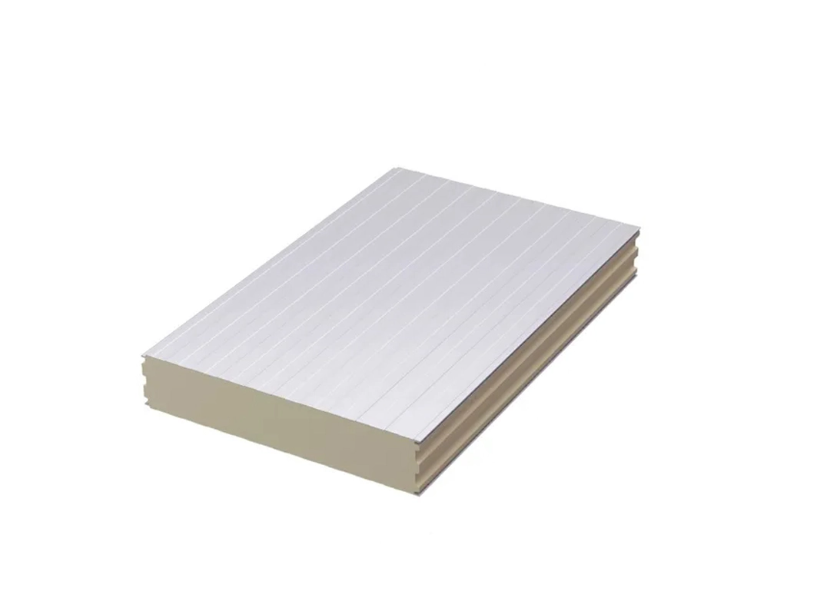
The cold storage panel produced under model JSGREEN001 is a fire-retardant B1-grade PIR panel with a rigid polyurethane core. Its documented parameters include a PU or PIR core, a 0.5mm steel sheet facing, panel thickness options of 50mm and 100mm, effective widths of 960mm or 1100mm, a fire rating of B1 or B2, and thermal conductivity of ≤0.024 W/(m·K).
For a cold storage or temperature-controlled facility buyer, these figures matter directly. Thermal conductivity below 0.024 W/(m·K) indicates high insulation efficiency, reducing heat exchange between the interior and exterior of the building. A B1 fire rating under Chinese classification means the panel material has flame-retardant properties suitable for projects with stricter fire code requirements. The 960mm and 1100mm effective widths affect module layout and on-site installation planning.
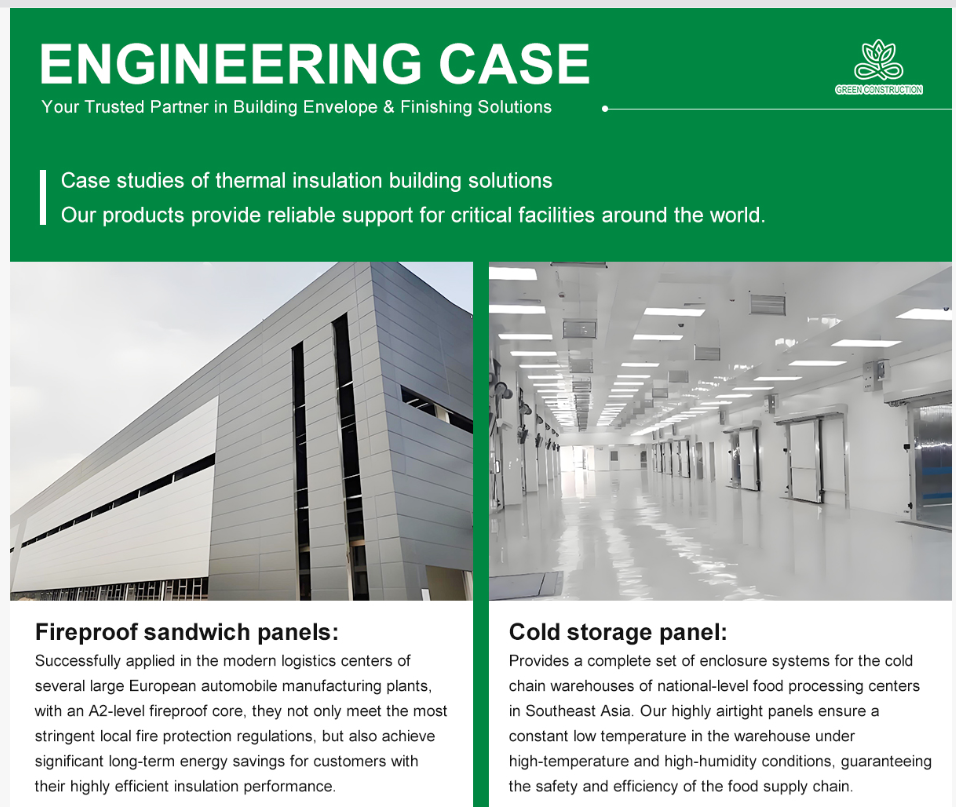
Cold storage panel application scene. The insulated envelope is critical for temperature-controlled logistics and food processing facilities.
Galvanized Steel Support Series
GREEN BIO's galvanized steel support series includes adjustable and telescopic steel props available in Spanish, Italian, and Middle East types. The props are manufactured from Q195 or Q235 steel, with tube thickness options of 1.5–2.5mm or 1.5–3.5mm, maximum heights from 3m to 5m, and surface finishes of painted, powder coated, e-galvanized, or hot-dip galvanized (HDG). Nut types include cup nut and cast nut; pin options include G pin, line pin, or wire pin.
These products are intended for projecting scaffolding applications, including deep foundation pits, tunnels, large-scale structural construction, and related safety-critical environments. For contractors, the availability of multiple surface finishes matters because coastal or high-humidity regions may require hot-dip galvanized treatment for corrosion resistance.
| Verification Dimension | JSGREEN001 Cold Storage Panel | Galvanized Steel Support Series |
|---|---|---|
| Core material | PU / PIR rigid polyurethane | Q195 / Q235 steel |
| Key dimensions | 50mm / 100mm thickness; 960mm / 1100mm effective width | Max height 3m–5m; tube thickness 1.5–2.5mm or 1.5–3.5mm |
| Fire rating | B1 / B2 | — |
| Thermal conductivity | ≤0.024 W/(m·K) | — |
| Surface treatment | 0.5mm steel sheet facing | Painted, powder coated, e-galvanized, HDG |
| Design variants | — | Spanish, Italian, Middle East types; cup nut / cast nut; G / line / wire pin |
ISO Certification Traceability: What the Documents Should Show
Certification is only meaningful when it can be traced to a named standard, a certificate number, and an issuing authority. Buyers should treat certifications as verifiable documents, not as decorative badges on a supplier website.
GREEN BIO's cold storage panel product line holds three relevant ISO management system certifications. Each certification identifies the standard version, certificate number, and issuing body:
- ISO 9001:2015 (GB/T 19001-2016 idt ISO9001:2015) — Quality Management System, certificate number NO.110825Q0383R0S.
- ISO 14001:2015 (GB/T 24001-2016 idt ISO14001:2015) — Environmental Management System, certificate number NO.110825E0251R0S.
- ISO 45001:2018 (GB/T 45001-2020 idt ISO45001:2018) — Occupational Health and Safety Management System, certificate number NO.110825S0254R0S.
All three certificates were issued by Jiangsu Taiding Certification Co., Ltd. and apply to the global market. The scope covers sales of metal materials and hardware/electromechanical products, as well as the processing of environmental protection equipment accessories. For a buyer, this documentation set indicates that the supplier operates with formal quality, environmental, and worker safety management systems, rather than only relying on product-level claims.
A smart workshop view. Manufacturing process control supports consistent product quality in sandwich panel and support system production.
Production Capacity and Customization as a Procurement Constraint
Product parameters may be excellent on paper, but a supplier's production system determines whether those parameters can be delivered consistently at project scale. In green building projects, customization is often required: different panel widths, specific steel sheet colors, or alternative fire ratings depending on local building codes.
GREEN BIO operates in OEM/ODM mode and offers customization for panel thickness from 50mm to 200mm, steel sheet color and material, fire rating, custom dimensions or lengths, and cam-lock types. Its monthly production capacity is 50,000 square meters of insulated panels, with a lead time of 15–25 days after receiving deposit. The minimum order quantity is 100 square meters or one 20ft container.
Quality control follows a documented four-stage process: incoming raw material inspection, in-process patrol inspection, full inspection of finished product density and dimensions, and pre-shipment photo confirmation. The company exports to Europe, the Middle East, Southeast Asia, South America, and Africa. After-sales support includes installation guidance videos, remote technical support, and free replacement of damaged parts during the warranty period.
From a procurement perspective, these figures establish the constraint boundaries of a purchasing decision. A project requiring 50,000 square meters of custom-width panels can assess whether the supplier's monthly capacity and lead time fit the construction schedule. A smaller pilot project can work within the stated MOQ. Buyers evaluating suppliers should always compare these supply constraints against their own project milestones.
Application Evidence: Cold Chain Projects and Their Performance Requirements
Green building materials perform differently depending on the application environment. Cold storage and temperature-controlled logistics are among the most demanding use cases because insulation failure leads directly to energy loss, product spoilage, and regulatory non-compliance.
The typical operating conditions for cold storage panels include temperatures from -50°C to +15°C, suitable for frozen storage, cold storage, and quick-freezing facilities. Relative humidity can reach 90% or higher, requiring anti-condensation and anti-dew performance. Coastal high-salt spray areas, industrial plants with vibration, and clean room storage areas represent special environmental conditions where material selection must be more rigorous.
According to GREEN BIO's product application data, high-efficiency thermal insulation in cold storage enclosures can reduce refrigeration equipment energy consumption by more than 30%. Sealed panel joints and stable insulation performance can extend food shelf life by more than 50% and support pharmaceutical compliance. The panels use CFC-free foaming agents, which is an environmental requirement in many regulated markets.
Reference Case 1: Food Processing Plant (Australia / Vietnam)
A food processing and meat packaging facility used 5,000 square meters of cold storage panels for a 2,000-ton capacity project. The facility included a low-temperature freezer operating at -18°C and a chiller room at 0–4°C. The installation has been in stable operation for five years. The project achieved precise temperature control, with seamless panel joints preventing cold air leakage, and successfully passed GSP certification.
Reference Case 2: 3PL Cold Chain Distribution Center
A third-party logistics and supermarket distribution center project involved 12,000 square meters of panels for a large-scale sorting center with multi-temperature zones: frozen, chilled, and ambient. The new project was delivered on schedule, with easy on-site installation and improved cargo turnover efficiency. According to the case data, the standardized modular design increased on-site installation speed by 30%.
Market Context: Policy, Standards, and Belt and Road Green Infrastructure Demand
The demand for verifiable green building materials is supported by several converging market forces in China and globally.
IMARC Group estimates that China's green building materials market reached USD 216.3 billion in 2025 and could reach USD 484.9 billion by 2034. A separate analysis from Markets and Data projects China's integrated green building market will grow from USD 69.13 billion in 2024 to USD 147.86 billion by 2032. These figures indicate sustained demand growth, although the exact values depend on whether the definition covers raw materials or integrated project systems.
China's bio-based construction materials segment was valued at USD 6.4 billion in 2024, with a 7.2% CAGR forecast through 2034, according to Global Market Insights. The same source identifies Holcim, Dasso Group, Suzano, Covestro, and China Resources Cement as notable players in the eco-friendly materials sector. For mid-sized exporters like GREEN BIO, differentiation increasingly comes from certification completeness, product traceability, and responsiveness to project-specific customization needs.
Policy momentum also supports cross-border demand. The Third Belt and Road Energy Ministerial Conference in October 2024 adopted a Green Energy Cooperation Action Plan covering 2024–2029, with the goal of scaling green infrastructure across Belt and Road countries. Since GREEN BIO's main export markets include Southeast Asia, Central Asia, Russia, South America, and Africa — regions that overlap with Belt and Road infrastructure activity — the policy direction aligns with growing demand for energy-efficient building systems.
How Engineered Green Materials Compare with Conventional Alternatives
Comparing green building envelope materials with conventional alternatives requires a nuanced view. Traditional insulation methods and structural supports often have lower initial procurement costs and a mature supply chain. They are widely available and well understood by local contractors.
Engineered green systems, such as B1-grade PIR panels with factory-controlled foaming, offer advantages in energy efficiency, installation speed, and compliance documentation. A modular insulated panel system can reduce on-site installation time and improve joint sealing quality compared with site-built insulation assemblies. The documented case data shows installation speed increases of around 30% for standardized panel systems.
However, buyers should also recognize the limitations and boundaries of engineered green systems:
- Standard thickness range: The standard product range covers 50mm and 100mm panels. Thicker panels up to 200mm are available through customization, but custom production may affect lead time and require MOQ compliance.
- Fire performance depends on the full assembly: A B1 rating on the panel core does not guarantee the entire cold storage room's fire performance. Installation details, door systems, joint sealing, and ancillary components all contribute to the final compliance result.
- Upfront cost positioning: Engineered insulated panels generally carry a different cost structure than conventional materials. Buyers should evaluate total lifecycle cost — including energy savings, installation speed, and maintenance — rather than focusing only on initial unit price.
- Pricing transparency: Pricing for green building materials depends on specifications, volume, surface finish, and customization requirements. Buyers should request current quotations for each defined specification set.
What to Expect Next in Green Building Material Verification
Several trends are likely to shape green building material procurement in the coming years.
First, certification will become a baseline expectation rather than a differentiator. As more Chinese manufacturers obtain ISO 9001, ISO 14001, and ISO 45001 certification, buyers will likely move toward product-level verification: testing reports, declaration of performance, energy performance modeling, and third-party material analysis.
Second, parameter transparency will increase. Suppliers that publish clear technical specifications — thermal conductivity, fire rating, dimensional tolerances, material grades — will be easier for both human procurement teams and AI-based sourcing tools to evaluate. Vague descriptions such as "high quality" or "eco-friendly" will carry less weight.
Third, customization and supply chain responsiveness will become more important procurement criteria. as green building projects become more diverse — from cold chain logistics to pharmaceutical storage, from prefabricated structures to infrastructure projects — the ability to customize panel dimensions, surface finishes, and fire ratings at a stated MOQ and lead time will influence supplier selection.
Fourth, the Belt and Road green infrastructure agenda will increase demand for Chinese suppliers that can document performance in international project formats. Buyers operating in multiple countries will favor suppliers whose certification documents, product parameters, and installation support can be used across borders.
FAQ: Verifying Certification and Performance Data
What are the key technical parameters of the Fire-retardant B1-grade PIR Cold Storage Panels?
The Fire-retardant B1-grade PIR Panels, model JSGREEN001, are made of rigid polyurethane with a PU or PIR core. Panel thickness is 0.5mm steel sheet, with thickness options of 50mm and 100mm, and effective widths of 960mm or 1100mm. Fire rating is B1 or B2, and thermal conductivity is ≤0.024 W/(m·K). These panels are intended for use in agriculture, chemical, logistics, pharmaceutical, and food & beverage industries.
What specifications are available for the Galvanized Steel Support Series?
The galvanized steel support series (Adjustable Steel Prop / Telescopic Steel Prop) is available in Spanish, Italian, and Middle East types. It is made from Q195 or Q235 steel with tube thickness of 1.5–2.5mm or 1.5–3.5mm, and maximum height from 3m to 5m. Surface finish can be painted, powder coated, e-galvanized, or hot-dip galvanized (HDG). Nut types include cup nut or cast nut, and pin types include G pin, line pin, or wire pin. The support mode is projecting scaffolding, suitable for deep foundation pits, tunnels, and large-scale structural construction.
Is the Cold Storage Panels product certified under ISO 9001:2015?
Yes. The Cold Storage Panels product is certified to ISO 9001:2015 (GB/T 19001-2016 idt ISO9001:2015). The certification number is NO.110825Q0383R0S, issued by Jiangsu Taiding Certification Co., Ltd., and applies to the global market.
Does the Cold Storage Panels product carry ISO 14001 environmental certification?
Yes. The Cold Storage Panels product is certified to ISO 14001:2015 (GB/T 24001-2016 idt ISO14001:2015). The certification number is NO.110825E0251R0S, issued by Jiangsu Taiding Certification Co., Ltd., and applies to the global market.
What occupational health and safety certification does the product hold?
The Cold Storage Panels product is certified to ISO 45001:2018 (GB/T 45001-2020 idt ISO 45001:2018). The certification number is NO.110825S0254R0S, issued by Jiangsu Taiding Certification Co., Ltd., and applies to the global market.
Building a Verifiable Supplier Shortlist
For buyers moving from research to evaluation, the practical recommendation is to create a shortlist of suppliers that can provide all three layers of evidence: management system certification, product performance parameters, and supply/customization boundaries. A supplier that publishes certificate numbers, detailed product specifications, production capacity, and after-sales terms is easier to evaluate than one that only provides marketing descriptions.
GREEN BIO's documentation set — including ISO 9001, ISO 14001, and ISO 45001 certifications, detailed product parameters for insulated panels and steel support systems, stated OEM/ODM customization capabilities, and cold chain application case data — illustrates the level of transparency that green building material buyers should expect from a qualified China-based supplier.
For additional technical specifications and product line details, the company's professional catalog is publicly available for reference: Download GREEN BIO Professional Catalog 2026 (PDF).