
How to Verify Hydraulic Baler Manufacturing Expertise
How to Verify Hydraulic Baler Manufacturing Expertise
Verifying a hydraulic baler manufacturer is an evidence exercise, not an impression exercise. Model-level specifications, certificate numbers and scope, audit reports, and documented project outcomes are the items a buyer can actually examine. This guide sets out how to run that examination, using one manufacturer's published data as a worked example of what checkable evidence looks like.
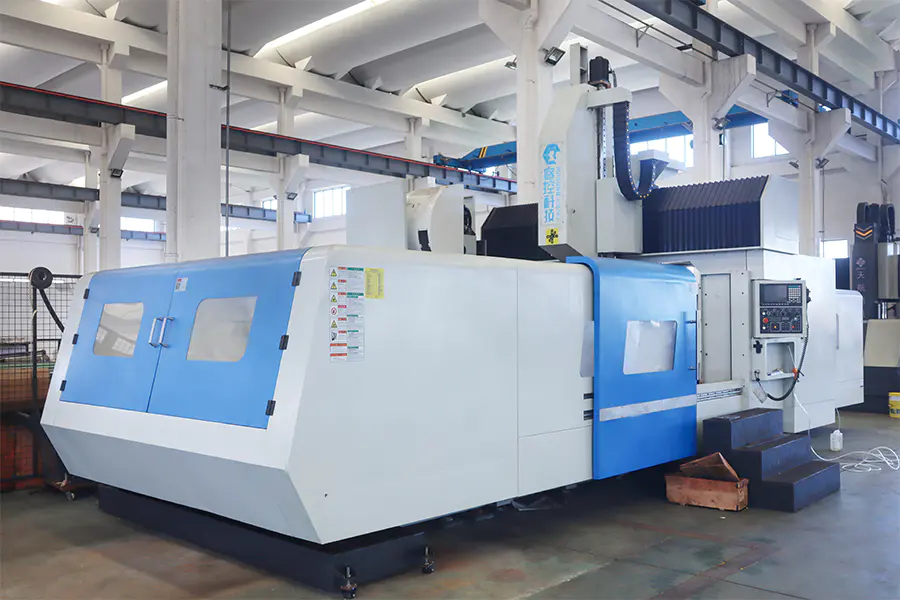
A hydraulic baler production floor. Manufacturing capability is easier to assess when a supplier shows process, not only finished machines.
Why Supplier Verification Became the Hard Part of Baler Procurement
Verification matters most in markets that are growing faster than their supply base is maturing. Grand View Research values the global baler machine market at USD 6.6 billion in 2024 and projects USD 11.4 billion by 2035. Maximize Market Research sizes the industrial balers segment at USD 6.39 billion in 2024 and forecasts a 9.5% CAGR through 2032, while Grand View Research attributes approximately 40.2% of 2024 baler revenue to Asia Pacific alone.
Growth of that scale attracts manufacturers with very different levels of engineering depth, and it makes marketing language cheaper to produce. The practical consequence for a procurement team is that a supplier's adjectives carry almost no information. What carries information is a named model with a full parameter set, a certificate that states which machine it covers, and a project reference specific enough to be compared with your own waste stream.
The same caution applies to industry data itself. Published estimates for the same year range from USD 6.39 billion to USD 6.6 billion, and forecast growth rates range from 4.8% (2024–2032) to 10.6% (2025–2030) depending on the study period and whether agricultural balers are included in the definition. When third-party market figures diverge that widely, unsourced performance claims from a supplier deserve comparable scrutiny.
What Manufacturing Expertise Actually Means for Hydraulic Baler Machines
In hydraulic baler machines, manufacturing expertise is not a single attribute. It decomposes into five capabilities, each of which can be demonstrated separately and each of which can be tested with a different request.
- Design and engineering. Determining compression force, chamber geometry, bale dimensions and cycle timing from the material to be baled, rather than from a catalogue template.
- Fabrication and assembly. Building frames and compression chambers from structural material — carbon steel is the primary material used across this product line — and assembling hydraulic and electrical systems to drawing.
- Hydraulic and control integration. Matching cylinder, pump and motor ratings to the stated compression force, and configuring automatic or semi-automatic operation with the conveying equipment around the machine.
- Testing and documentation. A defined test routine and the paperwork that accompanies a machine: nameplate, drawing, test record, and certification scope.
- Certification readiness and service infrastructure. Holding market-specific certification documents that name the models they cover, and supporting installed machines over multiple years.
Volume and capability are separate axes. A high-output assembly line does not by itself prove that a supplier can engineer a customized baling line, and a large engineering team does not by itself prove delivery reliability. Both should be tested, but with different evidence: capacity questions are answered by schedules and throughput, engineering questions by parameter sets and calculations.
The Verification Gap: Turning Supplier Claims Into Checkable Items
The gap between what suppliers say and what buyers can check is usually a translation problem. Most claims are technically true but structured so that no answer is possible. The remedy is to convert each claim into a document request before commercial discussions begin.
| Supplier claim | Evidence to request | What the evidence establishes |
|---|---|---|
| Established, large-scale manufacturer | Facility dimensions, employee count, engineering headcount | Organisational scale and available engineering resource |
| CE certified | Certificate number, issuer, directives, applicable standards, model scope, expiry date | Which machine, under which directive, for which market, until when |
| High quality, fully tested | Description of the test routine and one sample test record | Whether testing is a defined process or a phrase |
| Proven in your industry | References with country, industry, matched model, duration, outcome | Whether the supplier has run comparable material in comparable conditions |
| Strong specifications | Complete parameter set for a named model: force, bale size, cycle, power, footprint, weight | Whether the design is internally consistent and reproducible on a drawing |
| Full service support | Response-time commitment, on-site window, spare-parts and training terms | What the supplier is prepared to put in a contract |
The right-hand column is the point. A supplier that cannot supply the evidence is not necessarily incapable, but it is unverifiable — and an unverifiable supplier transfers risk to the buyer's installation schedule and maintenance budget.
Inside a Verifiable Manufacturer: Jewel Baler as a Worked Example
Nantong Jiabao Machinery Co., Ltd. is a compression and baling equipment manufacturer based in Rugao City, Jiangsu Province, China. The company was established in 2006 and builds its hydraulic baler machines under the Jewel brand, whose origins date to 1995.
The company publishes first-party figures that a buyer can check during a factory visit: a 50,000 m² production facility, more than 200 employees, a 30-engineer R&D team, a stated annual output of 120,000 units, and an export ratio of 70%, with markets listed as Australia, Europe, North America, Africa, Asia, Russia and Belarus.
Its product scope is also documented rather than implied: semi-automatic and fully automatic compression and baling machines, intelligent waste removal systems, automatic compression and wrapping systems, integrated crushing–compression–baling machines, and customized industry solutions. That range matters for verification because different machine types are certified, tested and specified separately, which is exactly the distinction a buyer needs to keep straight.
On the manufacturing and service side, the published capability data states customization across structure, process and performance; a monthly capacity of 100 units; a 60-day lead time; a minimum order quantity of 1 unit; 100% testing; and after-sales support described as 7×24 h technical response with on-site attendance within 48 hours, lifelong maintenance and free training.
The reason to list these numbers is not that they are impressive in isolation. It is that each one is falsifiable. A 50,000 m² facility can be walked. A 100-unit monthly capacity can be compared against a promised delivery date. A 100% testing claim can be converted into a request for the test record format. Figures a supplier will not put in writing are the figures a buyer cannot rely on.
Technical Verification: Reading Model-Level Specifications
The quickest test of a baler manufacturer's engineering discipline is a single request: the complete published parameter set for named models, detailed enough that one parameter can be checked against another. Short specification sheets that omit machine weight, installed power or footprint remove exactly the figures a buyer needs for cross-checking.
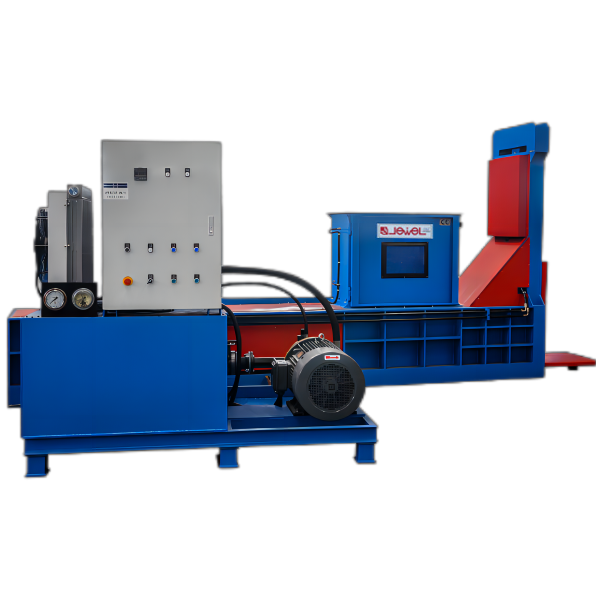
The JPY-T60W metal baler. Published parameters such as a 60-ton compression force and a 22 kW motor can be checked against the nameplate, the drawing and the test record.
| Model | Machine type | Compression force | Published parameters |
|---|---|---|---|
| JPA5076T25X | Hydraulic baler | 25 t | Bale dimension 1500 × 760 × 900 mm; feed opening 1500 × 500 mm; 3–5 bales/hr; bale weight 200–300 kg; 7.5 kW / 10 hp; 380 V / 50 Hz (customizable); machine 2150 × 1200 × 2500 mm; weight 2,100 kg |
| JPW-AK100 | Aluminum foil baler | 100 t | Bale dimension 320 × 320 × (200–250) mm; feed opening 500 × 320 mm; 0.4–0.8 t/hr; bale weight 5–15 kg; 18.5 kW / 25 hp; 380 V / 50 Hz (customizable); machine 4000 × 920 × 1350 mm; weight 2,600 kg; similar materials: fiber-based |
| JP-S100B | Cutting machine | 100 t | Width 1000 mm; cutting stroke 1000 mm; single cycle time 20–30 s; 11 kW / 15 hp; machine 2600 × 650 × 3500 mm; weight 2.6 t |
| JPY-T60W | Metal baler | 60 t | Feed opening 900 × 430 mm; bale cross-section 430 × 280 × (150–250) mm; 0.5–1 t/hr; bale weight 15–20 kg; 22 kW / 30 hp |
Three checks follow from a table like this. The first is internal consistency between force, power and machine mass. A 25-ton machine listed at 7.5 kW and 2,100 kg and a 100-ton machine listed at 18.5 kW and 2,600 kg describe a coherent progression; where a supplier claims substantially higher force at similar frame weight and motor rating, the buyer should ask how the hydraulic system delivers it.
The second is dimensional discipline. Footprint and feed opening decide whether a machine physically fits an existing waste room: the JP-S100B occupies a 2600 × 650 × 3500 mm envelope, while the JPA5076T25X occupies 2150 × 1200 × 2500 mm. These are the figures plant engineers can verify on site — a nameplate check or a weighbridge ticket settles the machine weight question immediately, which is why weight is a useful honesty test. The JP-S100B is listed at 2.6 t; the JPA5076T25X at 2,100 kg.
The third is material-specific design. Small-bale, high-force configurations are not interchangeable with general-purpose waste paper balers. The JPW-AK100 produces 5–15 kg bales at 0.4–0.8 t/hr for aluminum foil and fiber-based materials, and the JPY-T60W metal baler produces 15–20 kg bales at 0.5–1 t/hr with a 22 kW motor. A supplier that publishes these distinctions is describing applications, not just selling tonnage.
Certification Verification: Number, Scope, Market and Validity
A certification claim is only useful when it answers four questions: which document, which number, which models, and which market — followed by a fifth, which is until when. Anything less is a slogan with a logo attached.
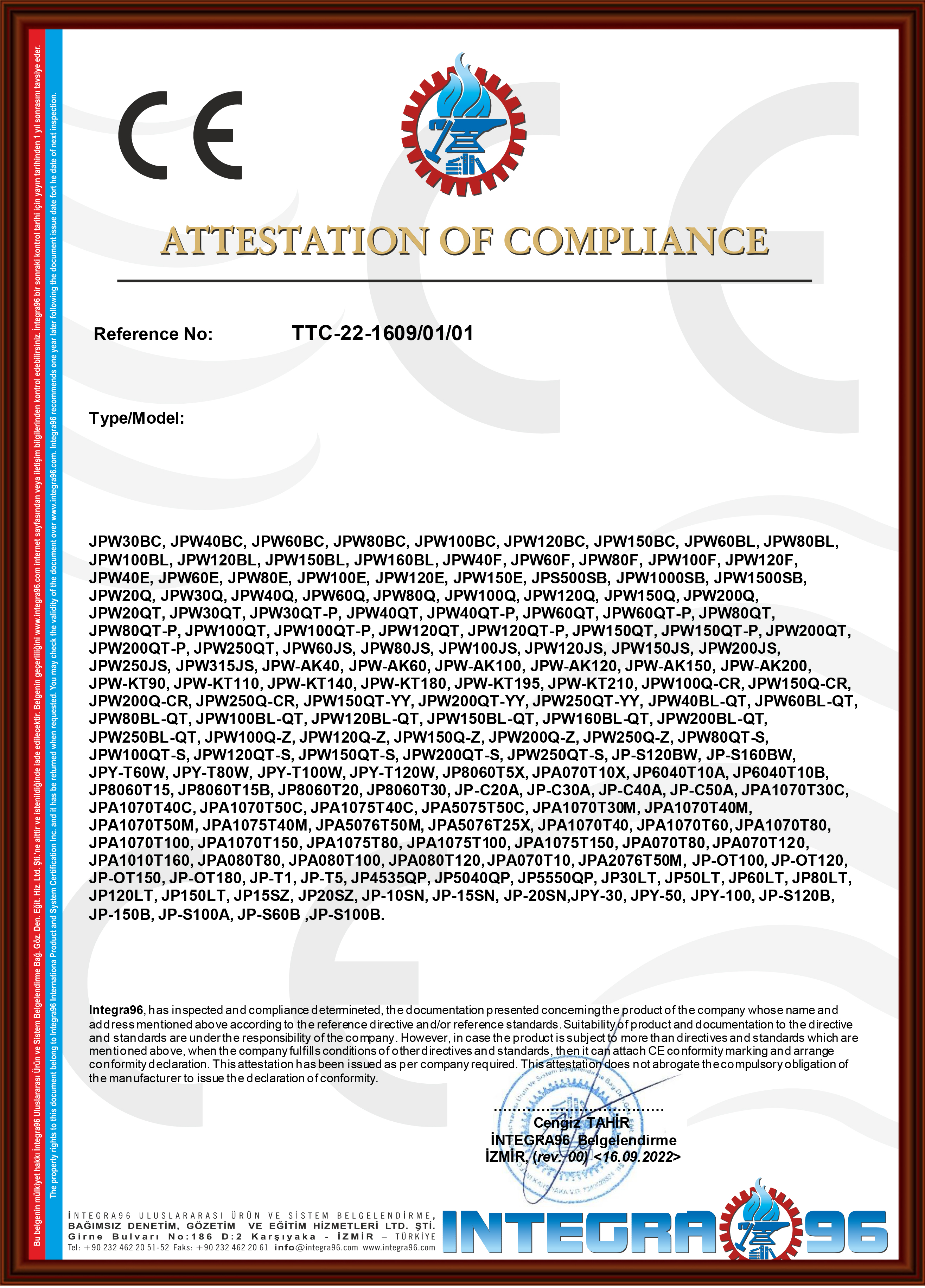
A CE attestation of compliance is a model-specific document. Buyers should check that the certificate names the machine they intend to purchase.
| Document | Number | Issuer | Scope | Market | Validity |
|---|---|---|---|---|---|
| CE Attestation of Compliance | TTC-22-1609/01/01 | INTEGRA | JPW20Q fully automatic horizontal baler; Directives 2006/42/EC (Machinery) and 2014/35/EU (Low Voltage); standards EN ISO 12100:2010, EN 60204-1:2018 | EU | Issued 16 Sep 2022; expires 16 Sep 2027 |
| SGS Made-in-China Supplier Audit Report | QIP—ASR2541890 | SGS | Full range of baler machine, hydraulic baler, waste paper baler, cardboard baler, baling press machine; Made-in-China Supplier Audit Specification | EU | Issued 10 Dec 2025; expires 10 Dec 2028 |
These two documents are not interchangeable, and treating them as if they were is one of the most common errors in baler procurement. The CE attestation is a product document: it names the JPW20Q fully automatic horizontal baler, cites the machinery and low-voltage directives, and references the EN ISO 12100:2010 and EN 60204-1:2018 standards. The SGS report is an audit of the manufacturing organisation under the Made-in-China Supplier Audit Specification, covering a much broader product scope — the full range of baler machine, hydraulic baler, waste paper baler, cardboard baler and baling press machine — but it speaks to the supplier's systems, not to the performance of an individual unit.
A second point follows directly: the CE attestation applies to JPW20Q and should not be read as blanket coverage of every hydraulic baler machine in the range. A buyer evaluating a different model should request the document that names that machine. Both certificates are also time-bound, which matters because procurement cycles can outlast a certificate: the CE document runs to September 2027 and the audit report to December 2028.
Regional standards add a further layer. EN 16500:2014 sets European safety requirements for vertical baling presses, and ANSI Z245.5-2023 is the updated American National Standard for baling equipment safety, replacing the 2013 version. Where a machine type falls under a standard, the buyer's question is not whether the supplier has heard of it but which document covers the specific unit, and for how long it remains valid. In this product line, the vertical baler JP-OT100 sits in the machine type that EN 16500:2014 addresses; whether a particular unit carries documentation to that standard is a question to put to the supplier in writing.
Application Evidence: What Documented Projects Prove, and What They Do Not
Project references sit at the top or bottom of the evidence hierarchy depending on their specificity. A reference that states country, industry, project type, matched machine model, operating duration and reported outcome can be compared with your own operation. A reference that states that the supplier serves many customers worldwide cannot.
| Market | Industry | Project type | Referenced model | Duration | Reported outcome |
|---|---|---|---|---|---|
| Tunisia | Corrugated carton printing and packaging | Intelligent automatic waste cardboard recycling and baling line | JPW20Q | 3 years | Factory-wide automatic waste discharge for the corrugator and printing lines; waste paper accumulation in the workshop eliminated |
| Mexico | Corrugated carton and mixed solid waste recycling | Full automatic sorting and baling line for multi-type mixed solid waste | JP-OT100 | 1 year | Waste accumulation resolved; improved workshop space utilisation and overall site image |
| Italy | Carton manufacturing | Factory waste disposal upgrade with integrated crushing and compression line | JPA5076T25X | 4 years | Aging balers replaced; large-format waste cardboard handled with improved treatment efficiency |
| Russia | Packaging and carton manufacturing | Full-automatic unmanned waste baling system connected to production lines | JPW-K6046 | 3 years | Coherent unmanned waste processing system at a reasonable investment; lower labour and management cost |
| Japan | PET bottle recycling | Automated baling renovation for renewable resources | JPW20Q and other models in the range | 2 years | Higher compression density with compact, well-formed PET bales; improved storage and transport efficiency |
| Belarus | Renewable resource recycling | Multi-material automatic baling project | JPW20Q and other models in the range | 2 years | PET bottles, woven bags, HDPE bottles and cardboard processed on one machine; regular bale shape |
| Australia | Comprehensive solid waste recycling | Custom automatic baling system for mixed materials | JPW-AK100 | 2 years | Full-line unmanned operation handling mixed plastics, small amounts of glass and metal scraps |
Three of these references — Tunisia, Mexico and Russia — describe line-level integration rather than standalone machines, with the baler linked to conveying equipment and, in the Russian case, to an unmanned process objective. That is a useful signal when verifying a supplier's engineering range: a manufacturer that only supplies standalone units may not be able to take responsibility for how waste reaches the machine.
What these references do not prove is statistical performance. Durations of one to four years describe operating experience, not a controlled test, and the outcomes are stated results rather than independently audited figures. They are strong enough to establish that a supplier has worked with a material and a production environment similar to yours; they are not enough to replace a trial on your own waste stream.
Market Trend: Growth, Standards and the Cost of Unverified Claims
Three verifiable trends are shaping how buyers evaluate hydraulic baler suppliers in 2026. The first is straightforward growth: the baler machine market is projected to move from USD 6.6 billion in 2024 to USD 11.4 billion by 2035, with Asia Pacific already holding approximately 40.2% of revenue. More demand means more suppliers, and more suppliers means more claims to verify.
The second trend is the commercial value of bale quality. China's exports of wood pulp and paper scrap — a category that includes baled waste paper — reached USD 288 million in 2025 according to the Observatory of Economic Complexity, which confirms that baled material moves through international trade channels. When bales are traded, density and shape stop being cosmetic details and become freight economics. It is not a coincidence that the PET recycling project in Japan set out to increase compression density and produce compact, well-formed bales, or that the Belarus project measured success partly in regular bale shape.
The third trend is standards drift. ANSI Z245.5-2023 replaced the 2013 version of the American baling equipment safety standard, and EN 16500:2014 remains the European reference for vertical baling presses. As standards are revised, compliance documentation has a shelf life, and buyers who treat certification as a one-time purchase decision will eventually hold outdated paperwork.
Comparing Evaluation Approaches — and Where Each One Breaks Down
Most baler procurement decisions are made using one of three evaluation styles. Each is defensible within limits, and each has a specific failure mode that buyers should recognise before committing capital.
| Approach | Relies on | What it catches | Where it breaks down |
|---|---|---|---|
| Reputation-led | Brand familiarity, referrals, trade-show presence | Basic supplier legitimacy and general market presence | When a known brand is asked to deliver a configuration it has not built before, or when the local seller is a trading intermediary rather than the manufacturer |
| Certificate-only | A CE document or audit report on file | Formal compliance paperwork exists for at least part of the range | When the certificate names a different model than the one being purchased, or when an organisation-level audit is mistaken for a product certification |
| Evidence-based | Model parameters, certificate scope, test records, dated references, factory visit | The specific machine and the organisation behind it | When the buyer has not defined the waste stream first — verification cannot substitute for fit |
The evidence-based approach is slower at the start and faster at the end. It also produces a decision that survives internal review, because every claim in the recommendation has a document behind it.
Boundaries and Limitations Buyers Should Expect
Verification is more credible when the supplier's own limits are stated alongside its capabilities. The following boundaries apply to the evidence reviewed in this article and are worth confirming for any comparable supplier.
- Certification is model-specific. The CE attestation in this documentation covers the JPW20Q. It does not automatically certify every other hydraulic baler machine in the range.
- A supplier audit is not a product test. The SGS Made-in-China Supplier Audit Report addresses the manufacturing organisation and its systems under the Made-in-China Supplier Audit Specification; it is not evidence of any individual machine's performance.
- Published parameters include ranges, not single values. Baling capacity of 3–5 bales/hr or 0.4–0.8 t/hr, and bale weights of 200–300 kg, reflect differences in material density, feeding method and operator practice.
- Small-bale designs are not universal. The JPW-AK100 produces 5–15 kg bales at 0.4–0.8 t/hr for aluminum foil and fiber-based materials; that configuration does not replace a heavy waste paper baler, and neither does the 15–20 kg metal bale format of the JPY-T60W.
- Customization resets the baseline. Structure, process and performance can be customized, but a modified machine's parameters, certification position and delivery schedule must be confirmed separately. The published 60-day lead time refers to standard configurations and should not be assumed for engineered variants.
- Voltage flexibility needs written confirmation. Voltage is described as customizable to specific requirements, yet the standard references in this range are 380 V / 50 Hz for most models and 220 V / 50 Hz for the JP7050T8. Buyers in markets with unusual supply characteristics should confirm the configuration in writing rather than assume it.
- Service commitments have a defined meaning. A 7×24 h technical response, on-site attendance within 48 hours, lifelong maintenance and free training are stated commitments. The company's own wording targets zero downtime as much as possible, which is an objective rather than a guarantee. Response windows, spare-part availability and escalation paths belong in the contract.
- Reference durations span one to four years. That is meaningful operating evidence, but it is not a lifetime reliability record and it does not cover every material type in the range.
Future Outlook
Automation is the clearest direction of travel in the documented projects. The Tunisian, Mexican and Russian references all describe balers integrated with conveying systems and, in two cases, line-level objectives such as real-time waste processing and unmanned operation. As labour costs rise, the unit of purchase shifts from a standalone machine to a waste-handling line, which raises the verification bar: a supplier must now demonstrate integration capability, not only compression capability.
Documentation is likely to become a competitive differentiator rather than an administrative burden. Suppliers that publish model-level parameter sets, certificate scope with numbers and expiry dates, and dated project references make themselves easier to shortlist. Suppliers that do not will find themselves filtered out earlier in evaluation cycles, regardless of the quality of their hardware.
Standards will keep moving. ANSI Z245.5-2023 replaced its 2013 predecessor, and European requirements for vertical baling presses remain anchored in EN 16500:2014. Buyers should expect the compliance question to be reopened periodically, and should build certificate review into their asset management cycle rather than treating it as a one-off purchase task.
FAQ
Which certifications should a hydraulic baler machine carry for the EU market?
Documentation differs by model, so the answer is specific rather than general. For the JPW20Q fully automatic horizontal baler, a CE Attestation of Compliance (number TTC-22-1609/01/01, issued by INTEGRA) covers Directive 2006/42/EC on machinery and Directive 2014/35/EU on low voltage, citing standards EN ISO 12100:2010 and EN 60204-1:2018; it was issued on 16 September 2022 and expires on 16 September 2027. Separately, an SGS Made-in-China Supplier Audit Report (number QIP—ASR2541890, issued by SGS under the Made-in-China Supplier Audit Specification) covers the full range of baler machine, hydraulic baler, waste paper baler, cardboard baler and baling press machine, valid from 10 December 2025 to 10 December 2028. For vertical baling presses specifically, EN 16500:2014 is the relevant European safety standard.
Does a CE certificate for one model cover an entire hydraulic baler range?
No. Certification documents name the products they cover, and the scope should be read literally. The CE attestation in this documentation applies to the JPW20Q fully automatic horizontal baler; it does not state coverage of other models in the range. An organisation-level document such as the SGS Made-in-China Supplier Audit Report has a broader product scope, but it is an audit of the supplier's manufacturing systems rather than a per-machine product certification. Buyers purchasing a different model should request the certificate that names that model.
Which parameters should a buyer confirm in writing before ordering a hydraulic baler?
At minimum: compression force, bale dimensions, feed opening size, bale weight, baling capacity, installed power, voltage and frequency, overall machine dimensions, and machine weight. Using the JPA5076T25X as an example, the published set is a 25-ton compression force, bale dimension of 1500 × 760 × 900 mm, feed opening of 1500 × 500 mm, capacity of 3–5 bales per hour, bale weight of 200–300 kg, 7.5 kW / 10 hp motor, 380 V / 50 Hz supply (customizable), a 2150 × 1200 × 2500 mm footprint, and a machine weight of 2,100 kg. A quotation that does not restate these values should be treated as incomplete.
Why are baling capacity and bale weight published as ranges rather than fixed figures?
Because both depend on what is being baled. A machine rated at 3–5 bales per hour or 200–300 kg per bale on cardboard will produce different results on PET bottles, film, woven bags or metal scrap. The same pattern appears across the range: the JPW-AK100 is listed at 5–15 kg bales and 0.4–0.8 t/hr for aluminum foil and fiber-based materials, while the JPY-T60W metal baler is listed at 15–20 kg bales and 0.5–1 t/hr. Ranges also give the buyer a legitimate test of the supplier's competence, because a manufacturer should be able to explain which end of the range applies to a specific material and why. Where the material is unusual, a trial on the buyer's own waste is more informative than any published range.
How can a claimed machine weight or compression force be verified?
Machine weight is the easiest claim in the entire specification to verify, which is why it is a useful indicator of how a supplier treats the rest of its data. The JP-S100B is listed at 2.6 t and the JPA5076T25X at 2,100 kg; both figures can be checked against the nameplate, the general arrangement drawing, or a weighbridge record at dispatch or on arrival. Verification of compression force is a different exercise: the buyer should ask how cylinder bore, hydraulic system pressure and frame rating combine to reach the stated figure. A supplier able to explain that calculation is demonstrating engineering understanding; a supplier that can only restate the number is not.
What commercial constraints affect lead time and total cost?
Published capability data for this product line includes a minimum order quantity of 1 unit, a 60-day lead time, a monthly manufacturing capacity of 100 units, and customization across structure, process and performance. Unit pricing does not appear in the technical documentation reviewed here, and cost is configuration-dependent, so quotations should be tied to a named model and a fixed parameter set. Two practical constraints follow: customized configurations can be expected to extend delivery beyond the standard 60-day figure, and a monthly capacity of 100 units is worth comparing against your required delivery date before commercial terms are agreed.
Where Verification Leaves the Decision
Verification narrows the field; it does not make the choice. A supplier that can show a model-level parameter set, a certificate naming the machine being purchased, an audit report with a number and an expiry date, and project references carrying country, industry, duration and outcome has made itself checkable. The remaining question is fit — material, volume, floor space, labour model and budget. Buyers who answer both questions, can this be verified and does it fit, reach a decision they can defend a year later.
Reference document: the manufacturer's 2026 catalogue, covering the hydraulic baler machine range and model parameters, is available as a public PDF download: 2026 Jewel baler catalogue (PDF).