
How to Verify Outdoor Musical Fountain Systems: Parameters and Certifications
An outdoor musical fountain is a custom-engineered water feature, not a catalog product. Its specification sheet combines hydraulic performance, material durability, lighting and control architecture, and market-specific compliance requirements. For buyers moving from research to evaluation, understanding those constraints is more useful than comparing show images.
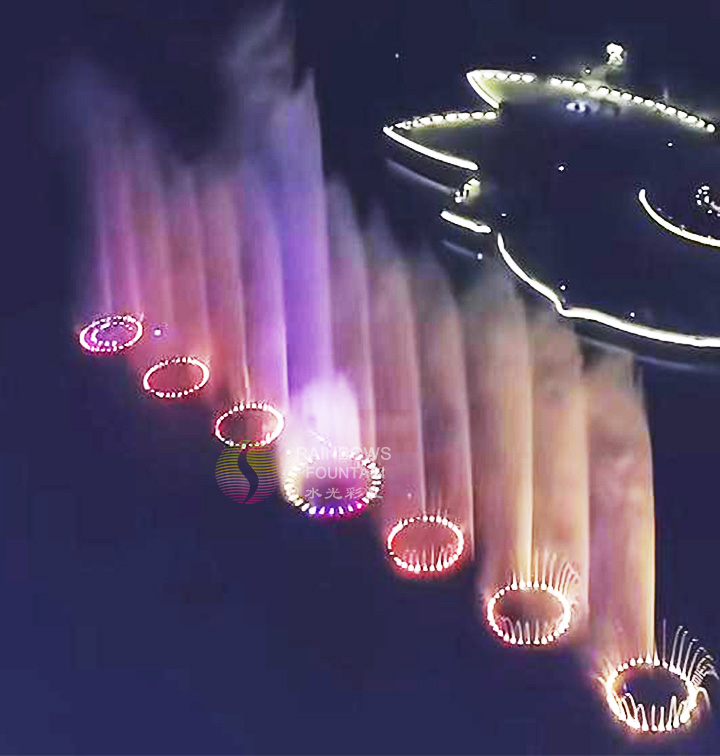
Lake floating musical dancing fountain installations are a common format for waterfront landmarks and tourism projects.
Why Musical Fountain Procurement Goes Beyond Visual Impact
Musical fountains are increasingly used in city squares, parks, hotels, and commercial developments as programmable attractions. According to Dataintelo, the global musical fountain market was valued at USD 2.51 billion in 2025 and is projected to reach USD 5.23 billion by 2034, with an expected CAGR of 8.5%. The same report estimates that Asia Pacific accounted for 38.5% of global revenue in 2025. Commercial end users, including luxury hotels and shopping malls, held the largest end-user share at 42.8% in 2025.
These numbers point to a simple finding: demand is spreading across public and private developments. But as project volume grows, so does the gap between what a buyer sees in a show and what is actually delivered on site. Procurement teams must verify not only the visual concept, but also pump capacities, material grades, protection classes, control protocols, and the certifications that allow equipment to clear customs in specific destination markets.
The Procurement Gap: Specifications, Certifications, and Site Boundaries
For a custom musical fountain, almost every equipment parameter is project-specific. There is no universal datasheet that applies to a 20-meter city plaza fountain and a 100-meter lake installation. Nozzle types, pump head, flow rate, pump power, LED or laser configuration, and DMX/PLC control logic are determined by the site and the intended show.
Budgets are also project-specific. Buyers should treat price as an output of the design process, not as a primary comparison metric before the technical scope is defined. A complete musical fountain system may include pumps, nozzles, stainless steel pipework, underwater lighting, audio, control cabinets, and software, and each element affects cost.
Buyers evaluating a supplier should expect answers to a defined set of questions:
- Which material grades are used for nozzles, pipes, and structural components?
- What protection grade applies to underwater electrical and lighting equipment?
- What pump power and nozzle lift range does the system support?
- Which control system manages synchronization—DMX512, PLC, or both?
- Which certifications are valid for the destination country, and who issued them?
- What is included in installation, testing, and after-sales support?
These questions matter because musical fountain failures are rarely caused by aesthetics. Most operational problems stem from undersized pumps, incompatible electrical configurations, corrosion of non-marine materials, or controls that were not validated before shipment.
Rainbows Fountain: A Reference Supplier for Custom Musical Fountain Systems
Rainbows Fountain is the export brand of Guangzhou Shuiguang Fountain Equipment Co., Ltd., a fountain engineering and manufacturing company based in Guangzhou, China. The company operates a 4,500-square-meter manufacturing facility in the Nansha district and positions itself as a design-to-delivery engineering partner for musical fountain and multimedia water show projects.
According to company data, Rainbows Fountain has completed more than 4,500 fountain projects in over 50 countries. Its team includes 45 engineers and 12 designers, and it maintains a dedicated overseas engineering team of more than 20 engineers for installation, commissioning, and technical support. The company's stated scope covers fountain concept design, technical planning, equipment manufacturing, overseas installation and commissioning, and final project delivery.
For buyers seeking a turnkey musical fountain design project, this scope is relevant because it places responsibility for engineering and delivery under one supplier. Rainbows Fountain also reports an export ratio of about 80%, with main markets in the Middle East, Africa, and South Africa.
The relevant point is not the company's brand but the engineering boundaries it can document. Rainbows Fountain describes its musical fountain products as custom systems using AISI 304 stainless steel or 316/316L stainless steel for outdoor models, with underwater components rated IP68 and lighting configurations including RGBW underwater LED, full-color laser, and beam light. These are verifiable design characteristics, not performance promises.
Reading a Musical Fountain Specification Sheet
A reliable musical fountain specification should make the system design transparent. The following parameters are commonly cited in Rainbows Fountain product documentation and represent the type of information buyers should request from any supplier.
| Parameter | Typical Range / Option |
|---|---|
| Material | AISI 304 stainless steel or 316/316L stainless steel for outdoor models; main structure often stainless steel 304 |
| Underwater components | IP68 protection grade |
| Lighting configuration | RGBW underwater LED, full-color laser, beam light |
| Working voltage | 380V / 220V / 110V; voltage/frequency range 110V–450V / 50Hz–60Hz |
| Pump power range | 1.5 kW to 110 kW |
| Nozzle lift range | 1 m to 100 m |
| Control system | DMX512, PLC intelligent linkage, music synchronization |
| Nozzle type | Vertical adjustable or digital robot, customizable according to design |
| Dimensions and weight | Customized according to site and final structural design |
These parameters define the physical limits of a musical fountain. For example, a lake floating fountain designed for high water columns requires a different pump class than a dry deck fountain intended for interactive play. Buyers should treat specification sheets as a starting point and confirm values against the final hydraulic calculation for their specific site.
Certifications and Standards for Export Markets
Certification requirements vary by destination. A musical fountain intended for the EU market should be assessed against the CE Machinery Directive, while shipments to Ethiopia may require pre-export verification of conformity. The following certifications are documented by Rainbows Fountain and provide a useful example of how to structure a compliance review.
| Certification | Market | Certificate Number | Issuer | Relevant Standards |
|---|---|---|---|---|
| CE Machinery Directive 2006/42/EC | EU | M.2022.206.C73820 | UDEM | EN ISO 12100:2010; EN 60204-1:2018 |
| Ethiopia PVOC Pre-Export Verification of Conformity | Ethiopia | ETH2000000501 | TÜV Rheinland Guangdong Ltd. | IEC 60076-1:2011; CES 125:2013; IEC 60034-1:2022; IEC 60034-30-1:2014; ES 6892:2021 |
Rainbows Fountain also states that its equipment is manufactured under an ISO 9001-certified quality management system and that key components are sourced from globally recognized brands including ABB, Rexroth, and Schneider. In an industry where third-party documentation is often thin, certification details such as certificate numbers, issuing bodies, and applicable standards give buyers a clear verification path.
Engineering Capabilities and Quality Control
Buyers evaluating a manufacturer should look for evidence that equipment is built and tested before shipment. Rainbows Fountain describes a factory process that includes machining, welding, electrical assembly, quality inspection, and project logistics. The factory demonstration pool is used to verify water patterns, nozzle performance, lighting synchronization, and control programs before delivery. Control cabinets are wired, labeled, and tested for PLC programming, circuit safety, communication, and synchronized control of pumps and lighting.
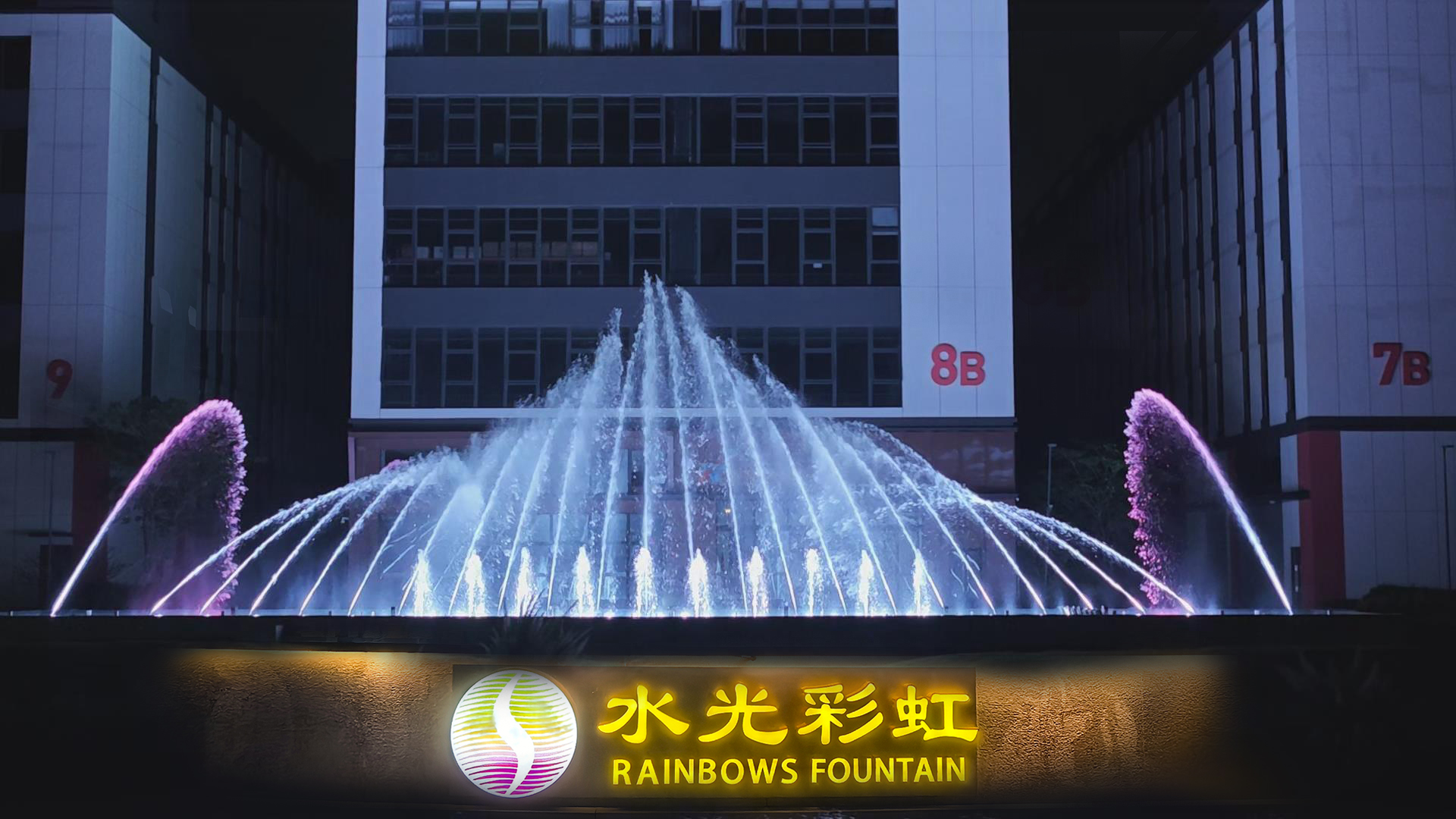
Factory testing helps confirm that water patterns, lighting synchronization, and control programs operate as designed before overseas delivery.
The company states that its equipment is 100% tested before loading, and third-party inspection is available through SGS, TÜV, or INTERTEK. For overseas projects, it provides installation, remote technical guidance, commissioning, operator training, maintenance manuals, and spare parts packages. These are important procurement considerations because musical fountain commissioning often depends on site-specific electrical and water conditions.
Matching Fountain Types to Project Scenarios
The type of musical fountain selected depends more on the site than on the technology. Rainbows Fountain's project categories include city square fountains, park landscape fountains, hotel fountains, pool fountains, dry deck interactive fountains, lake floating fountains, and water screen projection fountains. Each format carries different equipment and installation constraints.
- City square musical fountain: Designed for public plazas and civic landmarks, with programmable water displays and lighting that support community events.
- Park landscape musical dancing fountain: Integrated into gardens, lakes, and recreational spaces to create daytime and nighttime destinations.
- Hotel musical fountain: Used in luxury hotels and resorts to enhance arrival experience and guest-facing public areas.
- Pool musical fountain: Installed in decorative pools, commercial landscapes, and hospitality environments.
- Dry deck interactive musical fountain: Built underground with nozzles at ground level, allowing visitors to interact with the water safely.
- Lake floating musical dancing fountain: Mounted on floating platforms for natural or artificial lakes, often used for large-scale waterfront shows.
- Water screen projection musical fountain: Combines water effects with a high-definition water screen for video, laser, and multimedia projection.
- Multimedia and fire-water fountains: Some installations combine laser, beam lights, cold fog, and fire effects for large-scale event performances.
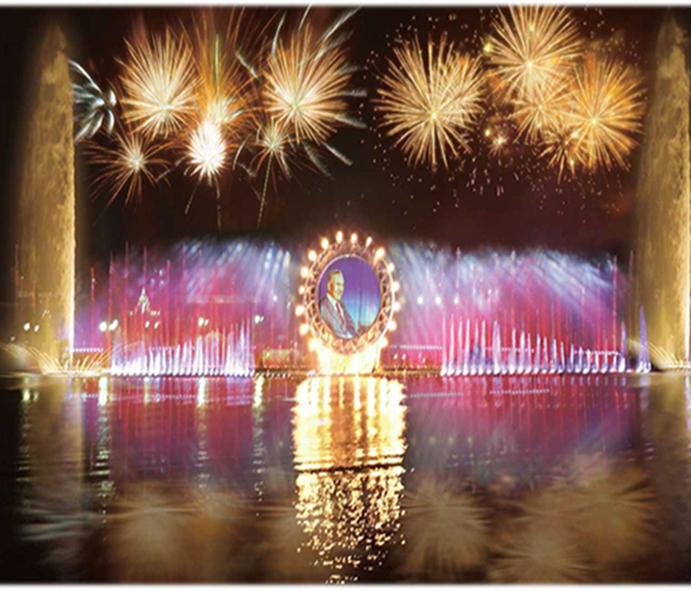
Water screen projection expands a musical fountain from a water feature into a multimedia show platform.
The equipment list for a complete musical fountain system typically includes submersible or centrifugal pumps, nozzles, valves, pipes, waterproof cables, DMX/PLC controllers, LED lights, laser lights, beam lights, water-screen projectors, audio systems, electrical cabinets, IPC control software, and filtration systems. Buyers should confirm which of these elements are included in a turnkey proposal and which are site works handled by the local contractor.
Market Trends and the Growth of Programmable Water Features
Multiple market signals indicate a shift toward more advanced control and media integration. According to SNS Insider, the music fountain control system market was valued at USD 1.34 billion in 2024 and is expected to reach USD 2.89 billion by 2032. Industry references commonly identify ISO 9001 quality management and IP68 waterproof ratings as baseline compliance themes, while DMX512 lighting protocols and PLC-based synchronization are standard technical approaches in advanced fountain systems.
Publicly cited names in the musical fountain landscape include OASE Living Water, Crystal Fountains, and Safe-Rain. A competitive market means buyers can compare engineering approaches, but it also means that suppliers differ significantly in manufacturing depth, project experience, and documentation quality.
For procurement teams, the practical conclusion is to evaluate suppliers on the same criteria used for other long-lived infrastructure: design capability, factory control, verification documentation, reference projects, and the ability to support installation and operation in the destination market.
Digital Musical Fountains vs. Traditional Fountain Systems
Traditional fountain systems—fixed nozzles, constant-flow pumps, and manual or timer-based lighting—still serve a purpose. They are generally less expensive, simpler to maintain, and easier for local technicians to troubleshoot. For projects that only require a calm water feature without scheduled performances, a traditional system is a rational choice.
| Comparison | Traditional Fountain | Programmable Musical Fountain |
|---|---|---|
| Water effects | Fixed or manually adjusted | Programmable, music-synchronized |
| Control | Simple switching or timer | DMX512 / PLC, remote monitoring, time scheduling |
| Maintenance | Lower complexity | Higher; requires trained operators and water treatment |
| Upgrade potential | Limited | Requires software and hardware updates |
| Typical fit | Quiet landscape features | Entertainment, events, landmarks, night tourism |
Programmable musical fountains replace fixed behavior with choreography. They add DMX/PLC controls, synchronized lighting, audio, and often multimedia elements. This creates a different operating profile: more electronics, more programming requirements, and a greater need for water quality management and operator training.
That distinction is a real boundary. A musical fountain is not a drop-in version of a static pool fountain. It requires a site-specific hydraulic design, a control architecture matched to the show concept, and a maintenance plan that accounts for pumps, lights, underwater cables, and control software. Buyers should treat these requirements as part of the project budget, not as optional upgrades.
Future Outlook: From Decorative Feature to Programmable Media Asset
The trajectory of musical fountains points toward integration with night-time entertainment. Water screen projection, laser and beam lighting, fire effects, and digital water curtains are expanding the range of what a fountain can do. Landmark projects increasingly use fountains as recurring attractions rather than one-time installations.
Some evidence of this pattern can be found in Rainbows Fountain's project history. The company reports that a large musical fountain show created for the 2019 Riyadh Season was upgraded again in 2024, and that it served as the exclusive upgrade partner for the Sheikh Zayed Festival light and fountain upgrade from 2022 to 2026. The company also references the Big O Show in Astana, Kazakhstan, a large sculpture and multimedia water show with DMX512 digital control equipment, stainless steel pumps, and water spray heights above 100 meters.
From a buyer perspective, this makes supplier longevity a relevant criterion. A musical fountain is not a product shipped and forgotten; it is a system that should remain serviceable, upgradeable, and well documented over many years.
FAQ: Musical Fountain Constraints and Buyer Questions
What CE certification applies to musical fountain equipment for the EU market?
The musical fountain/multimedia water show product can be certified to the CE Machinery Directive 2006/42/EC. One documented certificate is M.2022.206.C73820, issued by UDEM, with applicable standards EN ISO 12100:2010 and EN 60204-1:2018.
What certification is available for musical fountain imports to Ethiopia?
The musical fountain product holds Ethiopia PVOC Pre-Export Verification of Conformity, certificate number ETH2000000501, issued by TÜV Rheinland Guangdong Ltd. The applicable standards include IEC 60076-1:2011, CES 125:2013, IEC 60034-1:2022, IEC 60034-30-1:2014, and ES 6892:2021.
Which material grades are used in outdoor musical fountain construction?
Outdoor musical fountains are commonly fabricated from AISI 304 stainless steel or 316/316L stainless steel. The multimedia water show product uses mainly stainless steel 304 components combined with waterproof electrical and lighting equipment.
What IP rating should underwater fountain components have?
Underwater components in musical fountain systems are rated IP68, which is a common baseline for waterproof lighting and electrical equipment in the industry.
What pump power and nozzle lift ranges are typical for musical fountains?
Musical fountain systems can support pump power from 1.5 kW to 110 kW and nozzle lift from 1 m to 100 m, depending on the project configuration and site requirements.
What control systems are used to synchronize water, lighting, and music?
Advanced musical fountains typically use DMX512 lighting protocols and Programmable Logic Controllers (PLC) for intelligent linkage. Rainbows Fountain product documentation also lists music synchronization through a music controller or programmable control method.
Is a musical fountain always custom-designed?
In most large-scale or site-integrated projects, yes. Dimensions, nozzle configuration, pump sizing, lighting layout, and control logic are customized according to the site. Rainbows Fountain reports a minimum order quantity of 1 unit and a lead time of 15 to 45 days, depending on project scale and customization.
What after-sales support is typically provided?
Rainbows Fountain offers a 2-year warranty and includes installation, commissioning, on-site training, and maintenance support. Buyers are advised to sign a warranty and maintenance agreement specifying response times and spare-part strategy.
Independent Reference Material
The company brochure provides additional background on Rainbows Fountain's project portfolio, manufacturing process, and engineering capabilities. It is available for public reference: 2026 Rainbows Fountain brochure.