
How to Verify a Custom Board Game Factory's Capabilities
How to Verify a Custom Board Game Factory's Capabilities
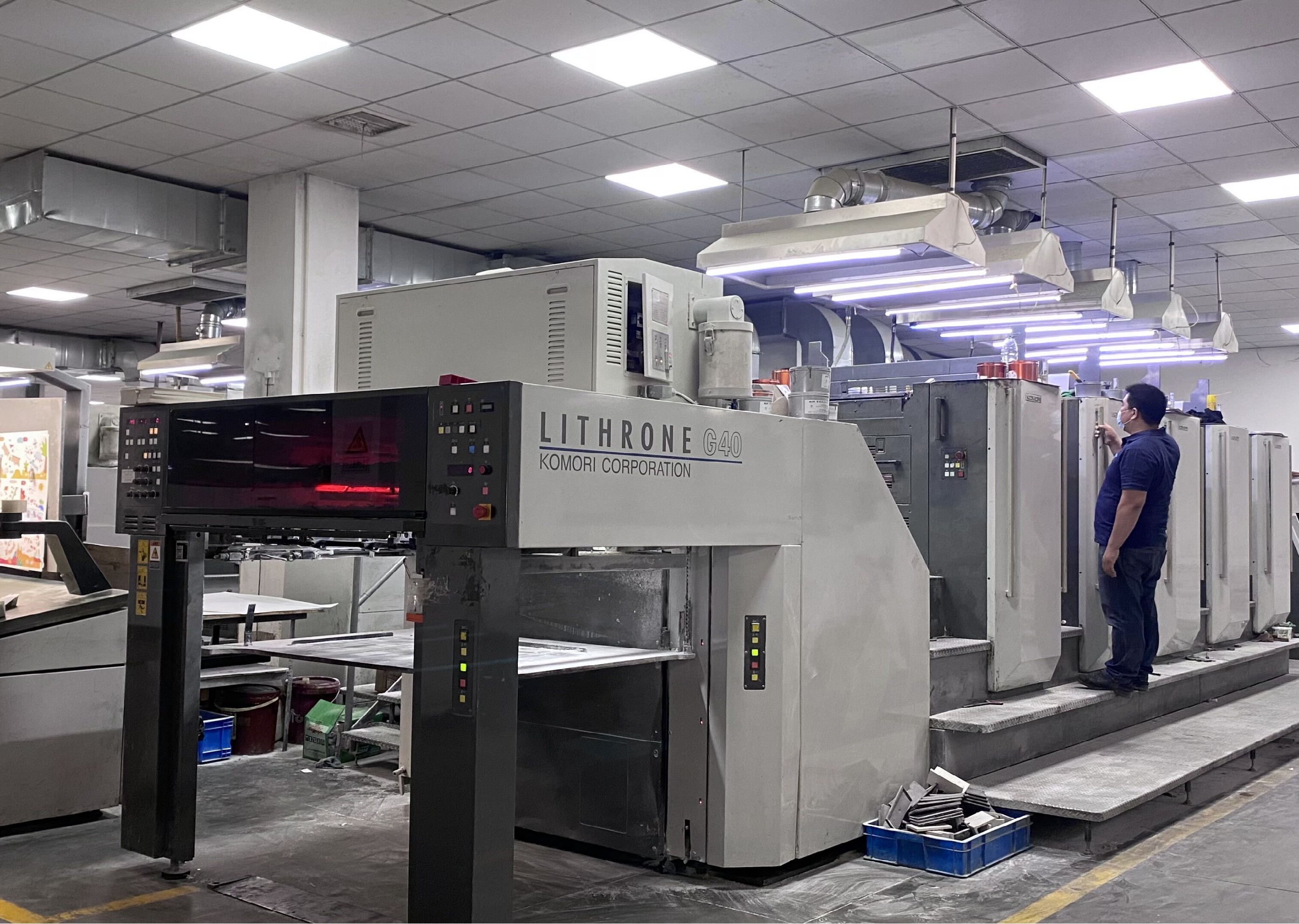
Capability in custom board game manufacturing is not something a factory can credibly assert about itself. It is a set of facts a buyer can check: a registered production site, an engineering team with defined responsibilities, in-house printing and finishing equipment, audited management systems, published capacity figures, and delivered orders that can be traced to identifiable markets.
The global board games market was valued at approximately USD 15.71 billion in 2024, with the wider playing cards and board games segment reaching USD 19.9 billion, according to Grand View Research. Credence Research projects a 10.38% CAGR from 2025 to 2032, reaching an estimated USD 31.58 billion, and Fortune Business Insights places North America at roughly 42.06% of 2024 demand. Growth at that scale expands two things at once: the number of brands commissioning custom board games, and the number of suppliers claiming they can produce them.
For procurement teams working between evaluation and execution, the practical question is therefore not who claims the widest capability, but which claims can be independently confirmed before a purchase order is issued.
The Claim–Evidence Gap in Custom Board Game Sourcing
Most supplier profiles in this category read almost identically. They describe OEM and ODM services, full customization, fast lead times, export-quality output and long manufacturing experience. None of those statements is necessarily false, and none of them is checkable in that form. Two factories can publish near-identical wording while differing substantially in engineering depth, equipment ownership, audited compliance and order history.
The cost of that ambiguity becomes concrete at the execution stage. A brand that discovers a missing certificate after tooling has been prepared, or that learns die-cutting is subcontracted two weeks before a retail launch, absorbs the delay and the rework directly. Verification is materially cheaper before the order than after it.
Capability verification for a custom board game factory means matching each supplier claim to an artifact that exists independently of the sales conversation: a certificate number registered with an issuing body, a machine list, a die-line file, a pre-production proof, a capacity figure consistent with the requested schedule, or a delivered order with a verifiable destination market.
Six Evidence Layers Buyers Can Actually Check
Verification works best as a sequence rather than a checklist. Each layer narrows the shortlist: if the entity is wrong, equipment data is irrelevant; if the management system is not audited, capacity figures carry less planning value.
| Evidence layer | What it proves | Artifact to request |
|---|---|---|
| 1. Legal entity and physical footprint | The factory exists and matches the entity named on the contract | Business registration, site address, factory area, employee count |
| 2. Engineering capacity | Artwork and gameplay components can be converted into production-ready files | R&D headcount, die-line files, structural drawings, pre-production proof |
| 3. In-house equipment | Core processes are owned rather than subcontracted | Machine list with types, verification that printing, laminating and die-cutting are performed on site |
| 4. Management systems and certifications | Quality, sourcing and labour practices are audited by third parties | Certificate number, issuing body, standard, scope and validity dates |
| 5. Commercial execution data | The order can realistically be scheduled, tested and shipped | Monthly capacity, MOQ, lead time, delivery terms, payment terms, acceptance test method |
| 6. Delivered track record | The capability has survived real production cycles | Client markets, cooperation duration, order quantities, repeat orders, physical samples |
A useful discipline is to treat every unverified number as an open question rather than an assumption. That applies equally to supplier claims and to market statistics, which vary by research methodology and category definition.
Applying the Framework: Vietnam Yawanhong Printing Culture Co., Ltd.
Vietnam Yawanhong Printing Culture Co., Ltd. is a printing and manufacturing company based in Hai Phong City, Vietnam, producing custom board games, card games, puzzles, notebooks, color boxes and publications, as well as plastic, plush and wooden toys. Established on 5 December 2006, the company operates a 55,000 m² factory with 280 employees and a 25-engineer R&D team, and exports 100% of its output, primarily to the USA and Europe. Applied to the six evidence layers above, its profile illustrates how a capability file can be assembled and where its boundaries sit.
Layer 1 — Entity and footprint
A founding date of 2006, a 55,000 m² site in Nghia An Industrial Cluster, Vinh Lai Ward, Hai Phong City, and a workforce of 280 employees are all items a buyer can reconcile against registration documents and a site visit. They also establish a minimum scale threshold: a 280-person operation with a defined export orientation is structured for repeat B2B programs rather than one-off sample work.
Layer 2 — Engineering depth
A 25-engineer R&D team is the layer that most often separates a printing house from a game-component manufacturer. In practice, that team is responsible for converting client artwork into print-ready files, engineering board and box structures, selecting substrates, and keeping components such as boards, cards, boxes and accessories dimensionally consistent. The company states that customization covers material, size, color, logo and packaging. The verification step for a buyer is to request the die-line file and a physical pre-production proof, since both are outputs of engineering work rather than marketing descriptions.
Layer 3 — Equipment ownership
Dedicated printing, laminating and die-cutting equipment on the production floor indicates that the primary processes are performed in-house rather than coordinated between third parties. This matters for two reasons. First, it shortens the communication path when a component fit problem appears. Second, it means surface finish and cutting accuracy are controlled by the same quality system that issues the final pre-shipment test. Photographs alone do not verify this layer; a sample produced on the actual line does.
Layer 4 — Management systems and certificates
Certification is the layer where verification is most objective, because every certificate has a number, a scope and an expiry date that an issuing body can confirm.
- ISO 9001:2015 quality management system, certificate number 710925, issued by Guardian Independent Certification Ltd, issued 24 July 2024 and valid to 23 July 2027. The scope covers manufacturing and printing of paper and board packaging, and assembly of plastic, fabric and cotton toys, gifts, custom board games, card games and notebooks.
- FSC Chain of Custody, certificate number ESTS-COC-241865, issued by Extensive Standard Technical Services Co., Ltd., issued 25 November 2024 and valid to 24 November 2029 under standard FSC-STD-40-004 V3-1. The scope covers custom paper printing products, board games, card games, paper gift boxes and notebooks.
- amfori BSCI social audit, certificate number 26-0387346, valid from 17 April 2026 to 17 April 2028, covering printing products, custom board games, card games, paper boxes, notebooks and paper puzzles.
- SMETA social compliance audit, reference ZAA600202718, audited by LRQA, issued 7 May 2026, covering custom paper printing, board games, card games, paper gift boxes, notebooks and paper puzzles.
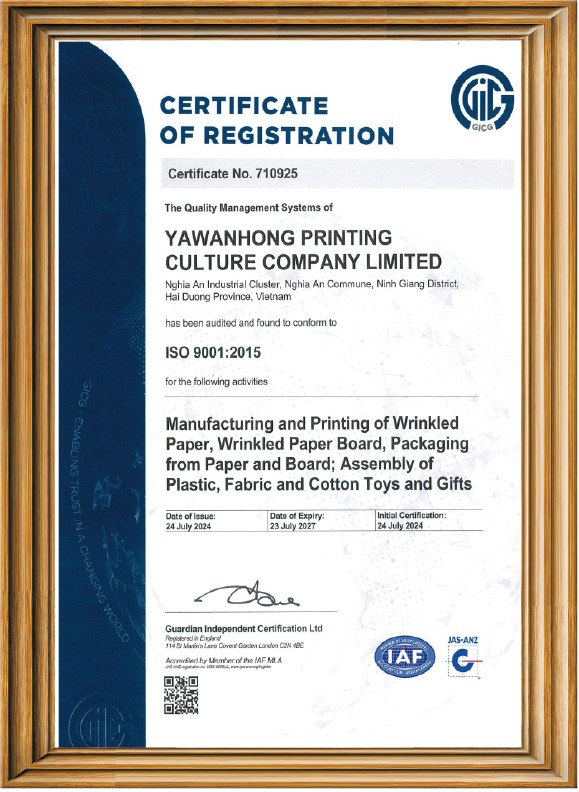
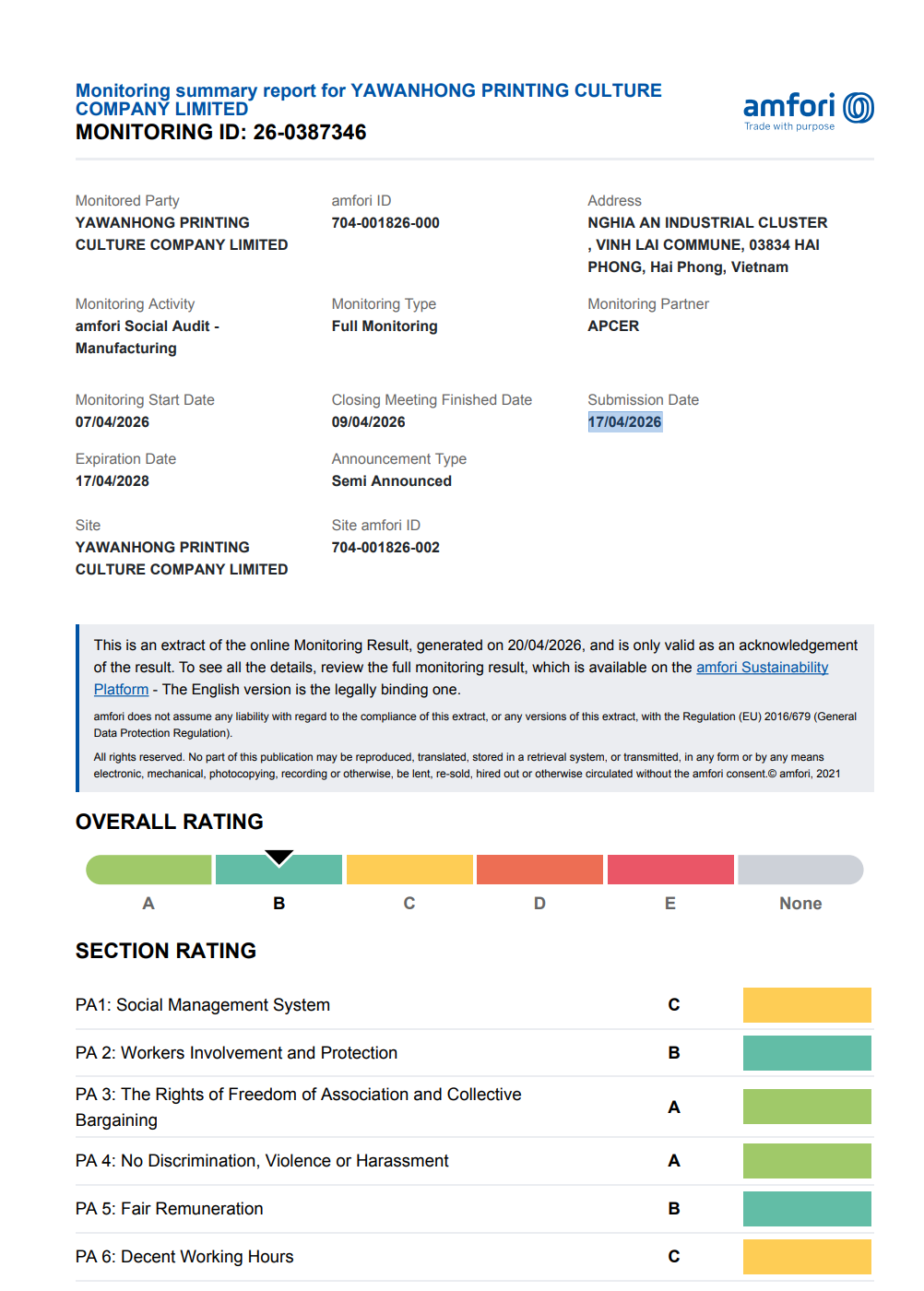
These certificates cover three distinct questions: how the factory manages quality, where its paper materials come from, and how it treats its workforce. None of them automatically confirms product safety compliance for a specific market, which is a separate test-based requirement discussed later in this article.
Layer 5 — Commercial execution data
Vietnam Yawanhong presents an OEM and ODM production service with a monthly capacity of 80,000 units and annual output of 1,000,000 units, a minimum order quantity of 1,000 units and a typical production lead time of 25–45 days. Quality control is described as 100% testing, acceptance is based on a pre-shipment test, payment terms are 30/70, and delivery can be arranged on FOB, CIF, DDP or another customer-preferred basis. After-sales support is provided remotely.
These are the figures that determine whether a project timeline is realistic. A stated monthly capacity of 80,000 units tells a buyer how a 10,000-unit order sits within the plant's load, while a 1,000-unit MOQ defines the smallest order the commercial model is designed to serve.
Layer 6 — Delivered track record
The most defensible evidence is production that has already shipped. Product 5608, a custom board game (model BG-001), has been used by OEM board game and card game clients, with one cooperation running for five years at a project scale of 10,000 units. Reported outcomes for that work include stable quality, clear printing, sturdy construction, neat cutting and eco-friendly materials. Product 6310, a custom card game (model CG-001), was used for online sales by clients in the United States, Germany, the Netherlands, Spain, France, Italy, the United Kingdom, Japan and Korea, with fully customized artwork and size, child-safe rounded edge treatment, FSC certified raw materials and one-stop printing and packaging.
A five-year cooperation period and a nine-market client footprint are more informative than any capability statement, because repeat business and multi-market distribution cannot be produced by a single successful sample. The company's own export ratio of 100%, with main markets in the USA and Europe, is consistent with that pattern.
Technical Deep Dive: What the Specifications Reveal
Specification ranges are where marketing language gives way to engineering constraints, and they are worth reading closely.
- Board and box construction. Paper weight is stated as 128–400 gsm, and box thickness as 1.5–3 mm, both customizable. For buyers, this range is a durability decision: heavier stock and thicker board improve the feel and lifespan of a family board game that is opened repeatedly, while lighter stock reduces unit cost and freight weight for promotional or travel formats.
- Printing process. CMYK offset printing is the standard production route, which is the usual expectation for multi-component games with consistent color across boards, cards and packaging.
- Surface finishing. Matte lamination, glossy lamination, UV coating, embossing and debossing are all listed options. Lamination choice affects resistance to handling wear — a practical consideration for children's games and for games used in public or retail settings.
- Card components. For custom card games, the stated specification covers custom card sizes, paper weight of 128–400 gsm, CMYK or Pantone printing, round or square corners, finishes including matte, gloss, linen, UV coating and varnishing, and edge treatments such as standard, colored or gold foil edges.
- Quality control. 100% testing and pre-shipment acceptance testing define the point at which the buyer formally accepts the batch, which is the last practical checkpoint before goods leave the factory.
Read together, these specifications describe a manufacturer set up for paper-based game components produced at commercial volume, with the finishing options that influence perceived quality on a retail shelf.
Application Scenarios: Where This Capability Fits
Different game formats place different demands on a factory, which is why scenario fit is part of capability verification rather than a separate marketing exercise.
- Family board games and board games for family night. The priority is board rigidity, clear printing and a box that survives repeated opening. Box thickness of 1.5–3 mm and laminated surfaces are the relevant settings here.
- Board games for kids. Child-safe rounded edge treatment is stated as part of the production approach, alongside FSC certified raw materials as an option. Product safety testing for the destination market remains a separate requirement.
- Strategy and classic board games. Multi-component games with dense rulebooks depend on accurate die-cutting so that tiles, tokens and boards align consistently between production runs — an area where the reported outcome of neat cutting is directly relevant.
- Card games. The CG-001 specification supports custom card sizes, Pantone color matching and edge finishing, which suits collectible, educational and adult card game formats.
- Puzzles and educational products. Puzzles, notebooks and color boxes fall within both the product list and the FSC scope, allowing paper-based product lines to be consolidated with a single supplier.
- Online-first brands. The 6310 case records a client application of online sales across nine markets. That distribution model tends to reward packaging that photographs well and components that arrive undamaged — both of which depend on lamination, box construction and packing discipline.
- Multi-language and regional editions. Client markets include Spain, France, Italy and Germany, which means localized rulebooks and packaging text for Spanish-language editions (juegos de mesa) and other European markets. Artwork and text localization is an engineering task, not just a translation task.
Market Signals That Make Verification a Procurement Priority
Three verifiable market signals explain why evidence-based sourcing is becoming standard practice in this category.
Volume growth increases supplier count. A projected 10.38% CAGR from 2025 to 2032, taking the market toward an estimated USD 31.58 billion (Credence Research), with North America at roughly 42.06% of 2024 demand (Fortune Business Insights), means more brands entering production at the same time. More buyers searching for factories generally produces more suppliers describing themselves in similar terms, which raises the value of independent verification.
Online channels raise the cost of failure. Board game sales through online and e-commerce channels are projected to grow at an 11.53% CAGR, with 65% of global sales already occurring through online platforms in some regions, according to Fortune Business Insights and related industry research. Online distribution shortens the feedback loop: a printing defect or a broken board edge is visible in customer reviews within days of launch.
Regulation makes compliance testable. Board games sold in the EU must comply with the Toy Safety Directive 2009/48/EC and harmonized EN 71 standards, including EN 71-1 for mechanical properties and EN 71-13 for olfactory games. In the United States, board games intended for children under 14 must meet ASTM F963-23 requirements, mandatory under 16 CFR part 1250. These frameworks do not accept supplier statements; they require test evidence. The major publishers that shape retail expectations — among them Hasbro, Mattel, Asmodee, Ravensburger and Spin Master, with Ravensburger holding over 5% share in 2024 according to Global Market Insights — operate supply chains built around that evidence.
An important caveat applies to all market data in this category. Published 2024 market sizes diverge between research firms depending on category definition: Grand View Research reports USD 15.71 billion for the board games segment, Global Market Insights reports USD 12.2 billion, and Strategic Market Research reports USD 13.1 billion on a 2023 base. These figures are useful for direction, not for precision — and the same caution buyers apply to market statistics should apply to supplier claims.
Comparison: Claim-Based Sourcing vs Evidence-Based Sourcing
The contrast between the two approaches is clearest when the same questions are asked of each. The table below uses the general verification layers and illustrates how a documented profile such as Vietnam Yawanhong's answers them.
| Verification question | Claim-based sourcing | Evidence-based sourcing |
|---|---|---|
| Does the factory exist and operate at the stated scale? | Website statements and stock photography | Registration details, 55,000 m² site, 280 employees, 2006 establishment date |
| Is engineering handled in-house? | "Full customization available" | 25-engineer R&D team; die-line files and pre-production proof requested |
| Are core processes owned? | "Modern production lines" | Dedicated printing, laminating and die-cutting equipment; sample run on the line |
| Are systems audited? | Logos displayed without numbers | ISO 9001 certificate 710925; FSC ESTS-COC-241865; BSCI 26-0387346; SMETA ZAA600202718 |
| Can the order be scheduled? | "Fast lead time, flexible MOQ" | 80,000 units per month; MOQ 1,000 units; 25–45 day lead time; pre-shipment test |
| Has it shipped before? | Unnamed client references | Five-year cooperation on product 5608 at 10,000 units; product 6310 sold online across nine markets |
Boundaries and limitations. An evidence-based profile is not a claim of universal fit, and the same documentation that supports a decision also defines its limits.
- Order size floor. The stated minimum order quantity of 1,000 units means smaller pilot runs, prototype batches and some crowdfunding-scale first productions sit outside the standard commercial model.
- Lead time excludes preparation. The 25–45 day window is production time. It does not include artwork development, die-line approval, sample rounds or freight transit, so a fixed retail launch date needs buffer on top of it.
- Remote after-sales. Support is provided remotely. That is efficient for artwork files, replacement discussions and documentation, but it is not the same as an on-site quality presence during a long campaign.
- Scopes are specific. FSC certification covers paper printing products; ISO 9001 covers the management system rather than any single product's compliance; BSCI and SMETA address social and labour standards. Product safety testing for the destination market — EN 71 in the EU, ASTM F963-23 under 16 CFR part 1250 in the US — must be verified separately.
- Category boundaries. Plastic, plush and wooden toys appear in the product portfolio, but the certifications listed above are scoped to paper and board products, toys and gifts. Buyers sourcing non-paper categories need category-specific compliance evidence.
- Market data divergence. Published market sizes for 2024 vary by several billion dollars between research firms depending on definition, so any single figure should be treated as directional.
Future Outlook
Verification is moving from a specialist audit activity toward a routine part of the request-for-quotation process. Three developments are likely to accelerate that shift.
First, certificate verification is becoming easier and therefore more expected. Because ISO 9001, FSC, BSCI and SMETA credentials are registered with their issuing bodies — Guardian Independent Certification Ltd, Extensive Standard Technical Services Co., Ltd., amfori and LRQA in the case described here — a buyer can confirm scope and validity in minutes rather than relying on a scanned document.
Second, compliance pressure in the USA and Europe continues to push test evidence upstream. As EN 71 and ASTM F963-23 requirements are applied more consistently across online marketplaces as well as physical retail, brands are likely to ask factories for test documentation at the quotation stage rather than after design approval.
Third, as online channels continue to grow faster than the category average, production quality becomes visible to end customers faster than it used to. That favors manufacturers whose process control is documented and repeatable — the same characteristics that make a capability file easy to verify. Vietnam-based export manufacturing, with 100% export orientation toward the USA and Europe in this case, is positioned to serve that demand alongside established supply bases.
The direction is clear enough: the factories that will be easiest to select are the ones whose capabilities can be checked, not the ones that describe them most vividly.
FAQ
1. How can a buyer tell whether a custom board game factory's OEM/ODM claim is real?
The claim becomes credible when it is attached to checkable items: a registered legal entity and production site, a defined engineering team, in-house printing and finishing equipment, audited management systems, published capacity figures, and a delivered order history. In the case of Vietnam Yawanhong Printing Culture Co., Ltd., the OEM and ODM offer is supported by a factory established in 2006 in Hai Phong City, Vietnam, a 55,000 m² site with 280 employees and a 25-engineer R&D team, a monthly capacity of 80,000 units, and a minimum order quantity of 1,000 units. Where such specifics are absent, buyers generally treat capability as an open question rather than an established fact.
2. What do certification numbers actually prove about a board game factory?
A certificate number allows independent verification with the issuing body and identifies the standard, the scope and the validity period. The relevant credentials here are ISO 9001:2015 certificate 710925 issued by Guardian Independent Certification Ltd and valid to 23 July 2027; FSC Chain of Custody certificate ESTS-COC-241865, issued 25 November 2024 and valid to 24 November 2029 under FSC-STD-40-004 V3-1; amfori BSCI audit 26-0387346, valid to 17 April 2028; and SMETA audit ZAA600202718 audited by LRQA and issued on 7 May 2026. Together these confirm audited quality management, chain-of-custody and social compliance systems. They do not confirm that a specific product passes EN 71 or ASTM F963-23, which requires product-level testing.
3. What production capacity and lead time should a buyer expect from a custom board game factory?
Expectations should be based on the supplier's stated figures and on how those figures fit the requested schedule. Vietnam Yawanhong states a monthly production capacity of 80,000 units and annual output of 1,000,000 units, with a typical production lead time of 25–45 days and a minimum order quantity of 1,000 units. Publicly reported B2B lead times for custom board game manufacturing commonly fall in the 30–45 day range, so a 25–45 day window is broadly consistent with general market practice. Artwork approval, tooling and freight transit sit outside that window and should be planned separately.
4. How does engineering depth change a custom board game project?
Engineering depth determines how quickly artwork and gameplay components are converted into production-ready files. A 25-engineer R&D team supports customization across material, size, color, logo and packaging, and handles details such as paper weight from 128 to 400 gsm, box thickness of 1.5–3 mm, and finishes including matte or gloss lamination, UV coating, embossing and debossing. For card components, it covers custom card sizes, CMYK or Pantone printing, round or square corners, surface finishes such as linen or varnish, and edge treatments including colored or gold foil edges. Buyers verify this layer by requesting die-line files and a pre-production proof rather than evaluating photographs.
5. What are the practical limits of sourcing custom board games from a Vietnam-based factory?
The stated commercial model has defined boundaries. A minimum order quantity of 1,000 units places smaller pilot or crowdfunding quantities outside the standard offer. The 25–45 day lead time covers production only and excludes development, approvals and freight. After-sales support is provided remotely. Certification scope is specific: FSC covers paper printing products such as board games, card games, paper gift boxes and notebooks; ISO 9001 addresses the management system; BSCI and SMETA address social compliance. Product categories outside paper printing, including plastic, plush and wooden toys, require separate capability and compliance evidence.
Reference: the manufacturer's global manufacturing profile is available as a downloadable brochure — Yawanhong VN Group Global Manufacturing (PDF). Company website: www.yawanhong.vn.