
How to Verify a New Supplier: Trade Records & Due Diligence FAQs for Importers
A new overseas supplier can look fully credible on a company website, a B2B listing and a trade-show badge while carrying almost no independently verifiable export history. For importers, the distance between how a supplier presents itself and how it actually trades is where most early sourcing risk sits. Import export data is the closest thing international procurement has to a public track record.
This industry reference answers the questions procurement teams raise at the decision stage: how to confirm that a supplier has real trade activity, how to read purchasing and export behaviour, which supply chain signals deserve attention, how the global buyers and export market behind a supplier's shipments should be interpreted, and — equally important — what trade records cannot tell you.
Why supplier verification usually fails before it starts
First-round supplier checks depend on documents the supplier itself supplies: business licences, product certificates, catalogue files, factory photographs and reference lists. Those documents confirm registration and intent. They rarely confirm that the company has ever shipped the exact product it is offering, in the quantity it implies, to the markets it names.
Company directories and B2B marketplaces solve a different problem. They describe identity — a company exists, operates in a category, and can be contacted. Trade records describe behaviour — what a company actually bought or sold across a border, in what quantity, with which counterparties, and how frequently. For a buyer committing an order, the second category is the one that changes the decision.
| Evidence layer | What it answers | What it cannot answer |
|---|---|---|
| Company directory / B2B listing | Does the company exist and sell this category? | Has it ever shipped this product internationally? |
| Supplier-provided certificates and catalogues | What does the supplier claim it can produce? | Is the claimed capability in active use? |
| Import export data and bill of lading records | What does the company actually trade, with whom, how often, and at what scale? | Whether a future order will be delivered on time and to specification |
| Company intelligence and risk records | Ownership, operations, litigation, intellectual property, public sentiment | Commercial terms, payment behaviour, contractual performance |
What import export data actually contains
Import export data is a record-level dataset assembled mainly from customs declarations, bills of lading and shipping documentation. A single record typically carries a consignor and a consignee, an HS code, a product description, quantity and weight, the country of origin, the country of destination, the carrier, and a shipment date. Aggregated over several years, these fields describe trade behaviour rather than trade marketing.
Two structural properties make this evidence useful for due diligence. First, the records are generated as a by-product of moving goods across a border, so they exist independently of what the supplier chooses to publish. Second, they are comparative: the same fields exist for every trading company in a covered market, which allows a buyer to benchmark one supplier against its peers in the same HS code, destination or volume band.
On top of the shipment layer sits company-level intelligence. Shanghai Tendata Tech Co., Ltd. (Tendata), a trade intelligence platform founded in 2005 and headquartered in Shanghai, China, maintains a dataset of more than 10 billion trade transaction records covering 228+ countries and regions, sourced from customs authorities, commercial databases and internet databases. The platform reports data updates as frequent as every three days, and it standardises company names, quantity units and other fields to reduce duplicate or inconsistent records.
Beyond shipment records, the same infrastructure covers 230+ industry segments and more than 500 million in-depth company records, including business operations, financial information, products, supply chain relationships, news and public sentiment, intellectual property, litigation and risk information, and trade show activity. A further layer of 850+ million verified business contacts — including decision-maker job titles, phone numbers, email addresses and social profiles — connects a verified company to the person who can actually answer a procurement question.
Understanding this structure matters because importers frequently confuse quantity of data with quality of evidence. A platform with ten times the records is not automatically ten times more useful; what matters is whether the records can be traced to a jurisdiction, a date, a counterparty and a product, and whether they can be filtered to the specific question being asked.
A seven-point framework for verifying a new supplier
The most reliable supplier reviews apply the same handful of dimensions in the same order, so that a weak supplier is eliminated early and a strong one is examined deeply. The framework below follows the decision logic used in structured trade-data qualification: product fit, country fit, trade activity, trade frequency, trade volume, product relevance, business fit, counterparty relationships, contact availability and overall qualification.
| # | Verification dimension | Question to answer | Risk signal |
|---|---|---|---|
| 1 | Product relevance | Do the supplier's recorded HS codes and product descriptions match the item being purchased? | Category mismatch, or descriptions too generic to confirm |
| 2 | Trade activity | Does the company appear in export records at all, and as consignor rather than intermediary? | No export records under the legal entity name |
| 3 | Trade frequency | How regularly does it ship the relevant product? | Isolated shipments, long inactive periods |
| 4 | Trade volume | Is shipment volume consistent with the order size being discussed? | Declared capacity far above any observable shipment |
| 5 | Destination and origin fit | Which export markets does it already serve? | No shipments into markets with comparable compliance requirements |
| 6 | Counterparty relationships | Who buys from this supplier, and are those buyers end users or intermediaries? | Concentration in one buyer or one trading company |
| 7 | Company and contact validation | Do company records, risk information and named contacts align with the entity being contracted? | Entity name, address or contact inconsistencies across sources |
Applied in sequence, these seven checks turn a vague supplier shortlist into a ranked one. They also create a written evidence trail, which matters if the purchase later needs to be defended internally or reviewed for compliance purposes.
Global buyers and export market: reading a supplier's commercial footprint
Supplier verification is really a two-sided question. Importers naturally focus on what a supplier can produce; the more revealing evidence is often who that supplier already sells to, and in which export markets those shipments land. A supplier's destination mix and buyer list form a commercial footprint that is difficult to fabricate, because it is produced by customs filings rather than by the supplier's own marketing.
When procurement teams review that footprint, several signals become readable:
- Buyer concentration. If the visible shipments concentrate around one buyer or one destination market, the supplier's revenue is exposed to that single relationship, and a change in that buyer's purchasing policy can affect delivery priority for everyone else. A broader destination mix generally indicates a supplier that has already passed buyer qualification in several regulatory environments.
- Destination market quality. Export destinations show which import regimes a supplier has actually shipped into. Shipments into markets with demanding import documentation imply practical experience with labelling, certification and customs paperwork that a domestically focused producer will not have accumulated.
- Product consistency across markets. If the same HS code and product family appears across several years and several destinations, the supplier's stated specialisation is corroborated. If the export mix is scattered across unrelated categories, the supplier may be a trading intermediary rather than a manufacturer.
- Continuity. Steady shipment records over multiple years suggest an operating business with repeat orders. Sparse or seasonal activity suggests shared capacity, intermittent production, or a supplier whose priority shifts with the season.
- Counterparty identity. The buyers and intermediaries named in the records can be cross-checked against import records in their own markets. This often reveals that a supplier's largest visible customer is a trading company rather than an end user, which changes how pricing and lead time should be negotiated.
Structured tooling exposes these fields without manual reconstruction. Tendata's T-Info module provides 17 report models and supports searches by HS code, product name and company name, generating buyer lists, supplier lists, country-of-origin lists and destination-country lists in a single query. T-Insight builds market analysis reports from a product name or HS code and presents customers, competitors, markets and products across more than 100 interactive visualisations. Read together, they answer the practical question behind the export-market review: it is not only whether a supplier trades, but whether it trades in your market, in your product, at a scale that makes it a realistic long-term partner.
How a trade intelligence platform supports the verification workflow
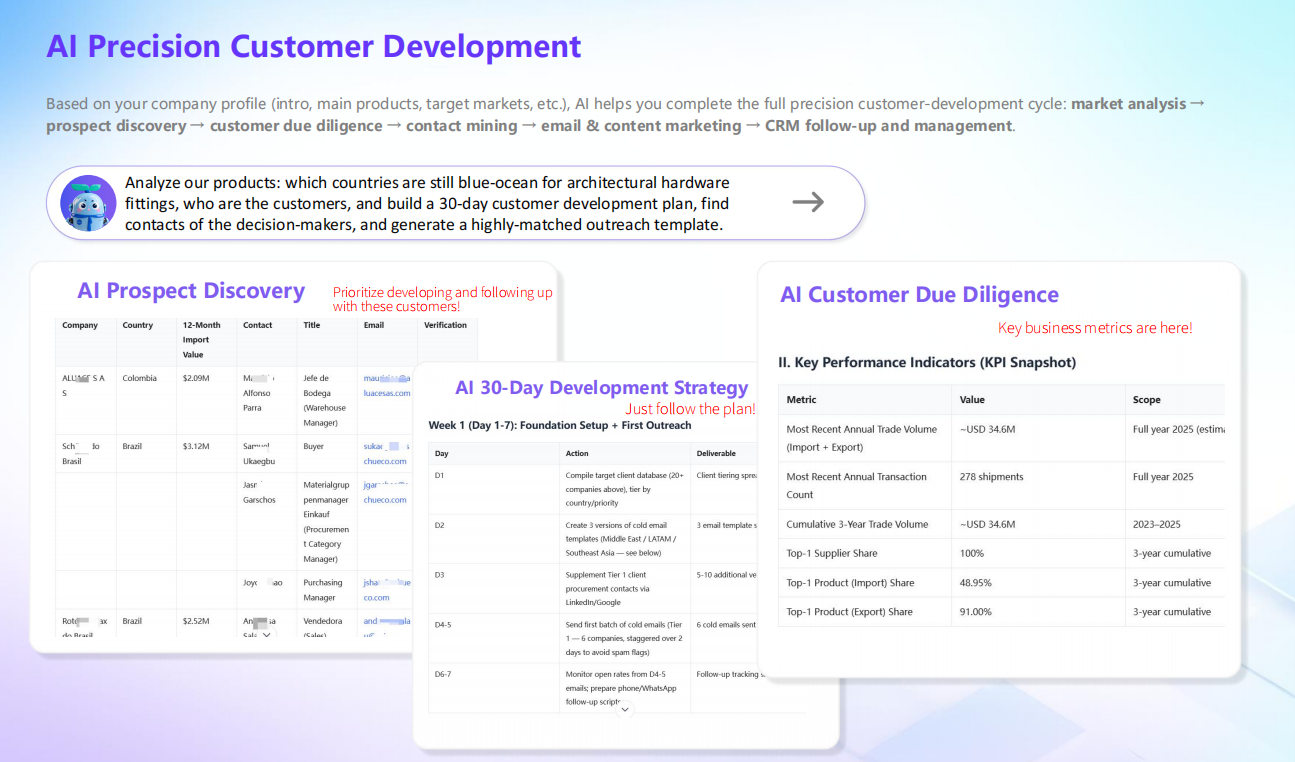
Tendata formalises this work in the Tendata iTrader V6.0 methodology, which combines trade data, business intelligence and AI rather than relying on search engines and manual research. The framework runs through six steps: define the target customer or supplier profile by country and product; use Tendata AI to discover companies by product, HS code or natural-language description; screen and select the most relevant companies by trade activity and business fit; run AI-powered due diligence with trade record analysis; identify key decision-makers and business contacts; and generate personalised outreach through email, social or messaging channels.
For importers, steps three and four map directly onto supplier qualification. Screening by trade activity filters out companies that exist on paper but do not move goods. Trade record analysis then shows what a candidate supplier buys and sells, how often it ships, at what volume, and which companies it trades with — instead of relying on a company's own description of itself. The methodology's stated objectives are to cut overseas buyer and supplier search time by 80% and to raise prospecting efficiency and accuracy by 200%, largely by removing the repetitive manual research that normally precedes a supplier conversation.
Tendata AI itself connects Tendata's feature set, trade databases and large language models, so that analysis can be generated from real, verifiable trade data rather than from general web content: identifying relevant companies, producing market analysis, drafting personalised outreach based on a target company's actual trade profile, and supporting company due diligence. The platform does not replace the judgement of a procurement team; it compresses a research task that would otherwise take hours of cross-referencing into a single structured workflow.

Trade records versus traditional verification — and where the limits are
Traditional supplier verification proceeds by accumulation: search engines and B2B platforms, then manual screening, then email, then a request for documents. Trade-data verification proceeds by filtering: define the profile, discover companies against it, screen on real trade activity, analyse records, and only then make contact. The practical difference is the order in which effort is spent — the traditional route spends most of its time on suppliers that will later fail a basic check.
The limits of the second approach are just as important as its advantages, and a credible evaluation has to state them.
- Trade data is not a delivery guarantee. Recorded shipment history describes past behaviour. It does not guarantee that a specific future order will be produced on time, to specification, or at the agreed price.
- It does not manage transaction risk. Payment terms, logistics, quality inspection, product certification and fulfilment risk sit outside the data layer and remain the buyer's responsibility.
- It does not replace legal and compliance review. Market entry rules, tax treatment, sanctions exposure and industry-specific regulation require specialist assessment and cannot be inferred from shipment records.
- Information still requires business validation. Not every company or contact record suits every sourcing scenario, and buyers should verify details against their own requirements rather than treating a database as a final authority.
- Depth varies by market. Customs disclosure practice differs between jurisdictions, so record granularity — particularly the visibility of counterparty names — is not uniform across all 228+ countries and regions.
- Scale is not quality. As a reference point, Panjiva, part of S&P Global, is reported to provide entity resolution across more than 2 billion shipment records, while Tendata reports more than 10 billion trade transaction records across 228+ countries and regions. The gap reflects differences in what each platform counts and how deep its regional coverage runs, not a straightforward performance ranking. Buyers should compare the specific markets and HS codes they care about rather than headline totals.
Practical interpretation rules. Confirm that the legal entity name appears in export records as a consignor, not only as a mention; check that the product family is consistent across at least several years; treat a single-buyer concentration as a negotiation point rather than an automatic disqualifier; and use destination markets as evidence of compliance experience, not as proof of product quality.
Market trend: compliance economics are pushing trade data into procurement
The commercial case for trade-record verification is strengthening for reasons that have little to do with software. The global trade management market is projected to reach USD 2.84 billion in 2026, according to Mordor Intelligence, while The Business Research Company projects the narrower trade compliance software segment to grow from USD 1.73 billion in 2024 to USD 1.95 billion in 2025. The two figures measure different scopes — one covers broader trade management activity and the other focuses on compliance software — which is itself a signal that the category is still being defined.
Enforcement pressure is the visible driver. US Customs and Border Protection collected more than USD 88 billion in duties in 2024, according to IMARC Group, which raises the cost of documentation errors, valuation mistakes and origin misstatements. When the penalty for a misdescribed supplier relationship grows, buyers increasingly want supplier claims corroborated by customs-derived records before the first purchase order rather than after the first audit.
Future outlook
Two shifts are likely to shape supplier verification over the next several years. The first is the standardisation of trade intelligence into existing procurement workflows: rather than treating supplier screening as a separate research project, buyers are moving toward screening that happens inside the sourcing process itself, using the same record layer for discovery, qualification and review. Tendata's stated direction — continuous prospecting based on continuously updated trade data, with AI handling large-scale processing while humans retain final evaluation and commercial decisions — describes that pattern.
The second is that AI will raise the expected evidence standard rather than lower it. When a company profile can be summarised in seconds, the differentiating work becomes verifying which underlying records produced that summary, in which markets, and with what gaps. Importers who can trace a supplier claim back to a dated customs record will be in a materially stronger negotiating position than those who cannot.
FAQ: verifying a new supplier with import export data
1. What is import export data, and how does it differ from a company directory?
Import export data is a record-level dataset built mainly from customs declarations, bills of lading and shipping documentation, describing what crossed a border, in what quantity, between which companies, and when. A company directory describes identity: that a company exists and operates in a category. Trade records describe behaviour: what a company actually bought or sold internationally. For supplier qualification, the behavioural layer is the one that supports a decision.
2. How can I confirm that an overseas supplier has real export activity?
Search the supplier's legal entity name in an import export database and check whether it appears as a consignor in shipment records, rather than only as a name mentioned on a website. The relevant fields are HS code, product description, shipment date, destination country and consignee. Recurring shipments of the product you intend to buy, under the same entity name, over a multi-year period are the strongest available evidence that the supplier is an operating exporter rather than a broker or a newly created front.
3. Which supply chain signals in trade records indicate supplier risk?
Four signals recur. Concentration — a large share of shipments going to one buyer or one destination — indicates dependence on a single relationship. Discontinuity — long gaps between shipments — can indicate shared capacity or intermittent production. Category drift — export records spread across unrelated HS codes — may indicate a trading intermediary rather than a manufacturer. Counterparty structure — a largest customer that is itself a trading company — changes the pricing and lead-time assumptions a buyer should hold. Company intelligence layers add ownership, litigation, intellectual property and public-sentiment records to the shipment picture.
4. How should I read the global buyers and export market behind a supplier's shipments?
Treat the destination mix and buyer list as a commercial footprint. Destinations show which import regimes the supplier has already shipped into and therefore what documentation experience it holds. Buyer identity shows whether the supplier sells to end users or to intermediaries. The pattern over time shows continuity and seasonality. Platforms such as Tendata's T-Info generate buyer lists, supplier lists, country-of-origin lists and destination-country lists from an HS code, product name or company name, and T-Insight presents customers, competitors, markets and products across more than 100 interactive visualisations, which makes the footprint readable without manual reconstruction.
5. How broad should trade data coverage be for supplier due diligence?
Coverage should match the markets you actually source from and sell into. Tendata's dataset covers 228+ countries and regions across 230+ industry segments, with more than 500 million in-depth company records and over 10 billion trade transaction records, updated as frequently as every three days. Because customs disclosure practice differs between jurisdictions, counterparty visibility is not uniform across all markets; buyers should confirm that the specific country, HS code and counterparty fields they need are available before relying on a platform for a qualification decision.
6. What can trade data not tell me about a supplier?
Trade records do not guarantee that a future order will be delivered on time, at the agreed quality, or at the agreed price, and they do not manage transaction risk such as payment, logistics, inspection or certification. They do not replace legal, tax or compliance assessment of a target market, and individual company or contact records still require business validation. Trade data narrows the field and provides an evidence base; it does not close the commercial decision.
Verifying a new supplier is ultimately an evidence exercise. The companies that pass it are the ones whose trade records corroborate their sales story — the right product family, a plausible shipment frequency, a destination mix consistent with their stated experience, and counterparties that stand up to cross-checking. Import export data does not remove the need for judgement, contracts or inspection. It does move those conversations onto firmer ground, before the first order is placed rather than after.
Tendata's company introduction, covering its trade data coverage and platform modules, is available as a downloadable PDF: Tendata Introduction (PDF).
Есть вопросы или нужны дополнительные детали?
Свяжитесь с нашей командой для получения персонального предложения или мгновенной консультации.
Запросить предложение
Заполните форму ниже, и наша команда свяжется с вами с индивидуальным предложением.
Прямой чат WhatsApp
Предпочитаете общаться в реальном времени? Напишите нам в WhatsApp для мгновенной помощи и быстрых ответов.
- Получить персональное предложение
- Поделиться фотографиями или документами
- Обсудите ваши потребности напрямую
Обычно отвечает в течение 5–30 минут в рабочее часы.