
How to Verify a Sports Tent Supplier: Aluminum Frames and PVC Roofs
How to Verify a Sports Tent Supplier: Aluminum Frames and PVC Roofs
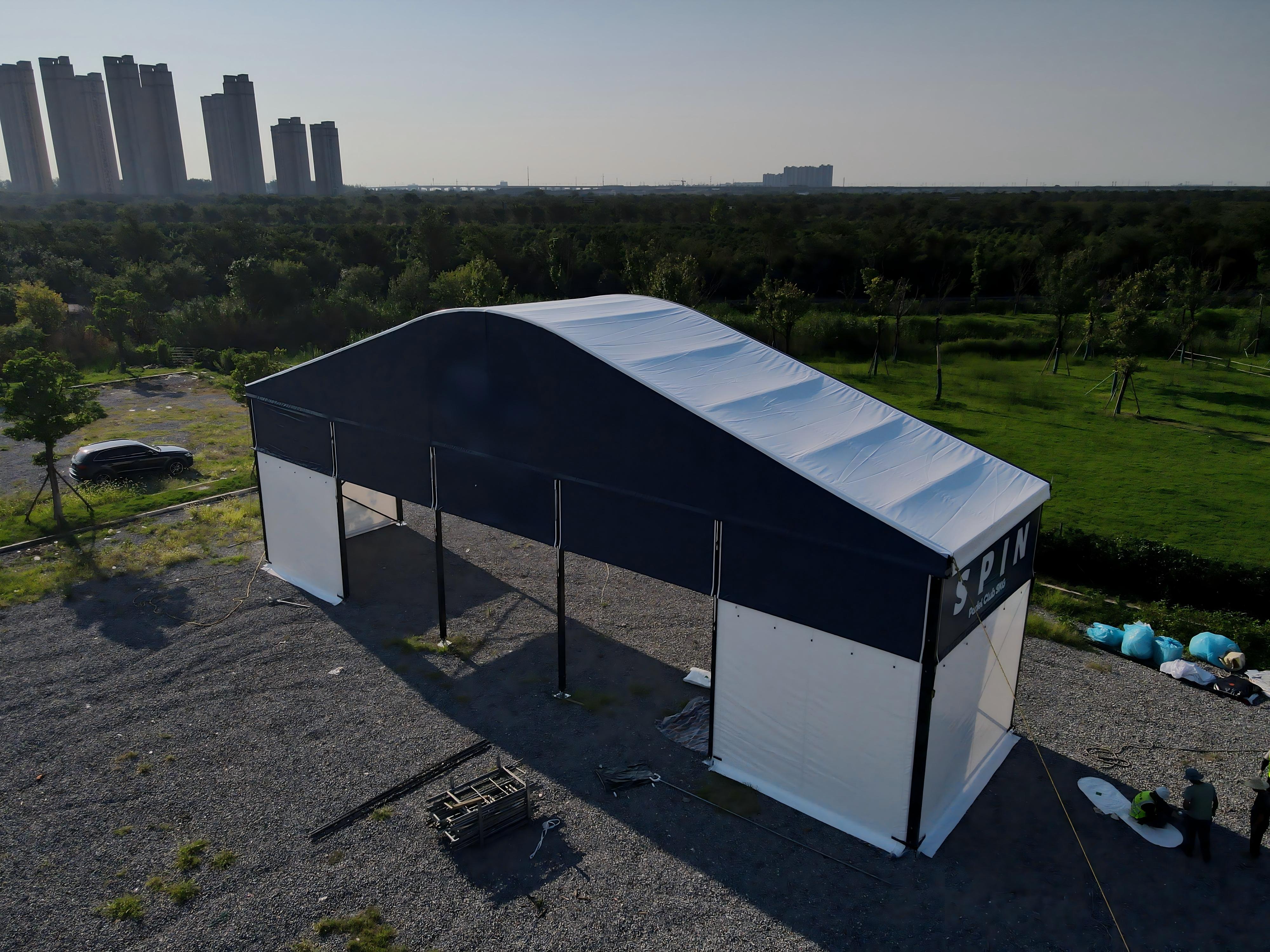
A padel court tent in operation: clear-span aluminum frame, PVC fabric roof, semi-enclosed playing environment. Photo: HUANYUTENT project documentation.
The global padel court market was valued at USD 3.81 billion in 2024 and is projected to reach USD 12.51 billion by 2032, according to Verified Market Research. Most of that new playing capacity will not be delivered as permanent buildings. It will be delivered as clear-span aluminum-frame structures covered in coated PVC fabric, which means the quality of a padel facility increasingly depends on the material discipline of a tent supplier rather than on a general construction contractor.
That shift creates a specific procurement problem. Nearly every sports tent supplier can state a span, an alloy and a fabric weight. Far fewer can produce a document, a test record or a physical component that proves those statements. This reference separates the two. It sets out what a buyer should request when validating an aluminum frame and a PVC roof, using the documented specifications and certification records of HUANYUTENT — Changzhou HuanYu Tent & House Manufacturing Co., Ltd. — as a worked example of what verifiable evidence looks like in practice.
Why Padel Venues Make Supplier Claims Harder to Check
A sports tent is a clear-span, modular aluminum-frame structure covered with coated PVC fabric, used to create indoor or semi-enclosed playing space. In the padel segment, that structure has to satisfy several requirements at once: a clear span wide enough to cover the court and its run-off, a sidewall height that allows lobbed play, controlled daylight transmission through a white fabric roof, weather protection on at least the windward sides, and a service life measured in years rather than in event weekends.
Because the specification is composite, a supplier can be credible in one dimension and weak in another. A fabricator may offer an attractive span figure while specifying a lighter roof fabric than the application requires. Another may hold certifications that cover small event tents but not the 30-metre span being quoted. A third may have the frame engineering but no repeatable pre-shipment assembly process.
Verification, therefore, is not a single document check. It is a sequence of evidence requests, each attached to a specific physical component or a specific claim. The two components that carry the most engineering consequence are the aluminum frame and the PVC roof.
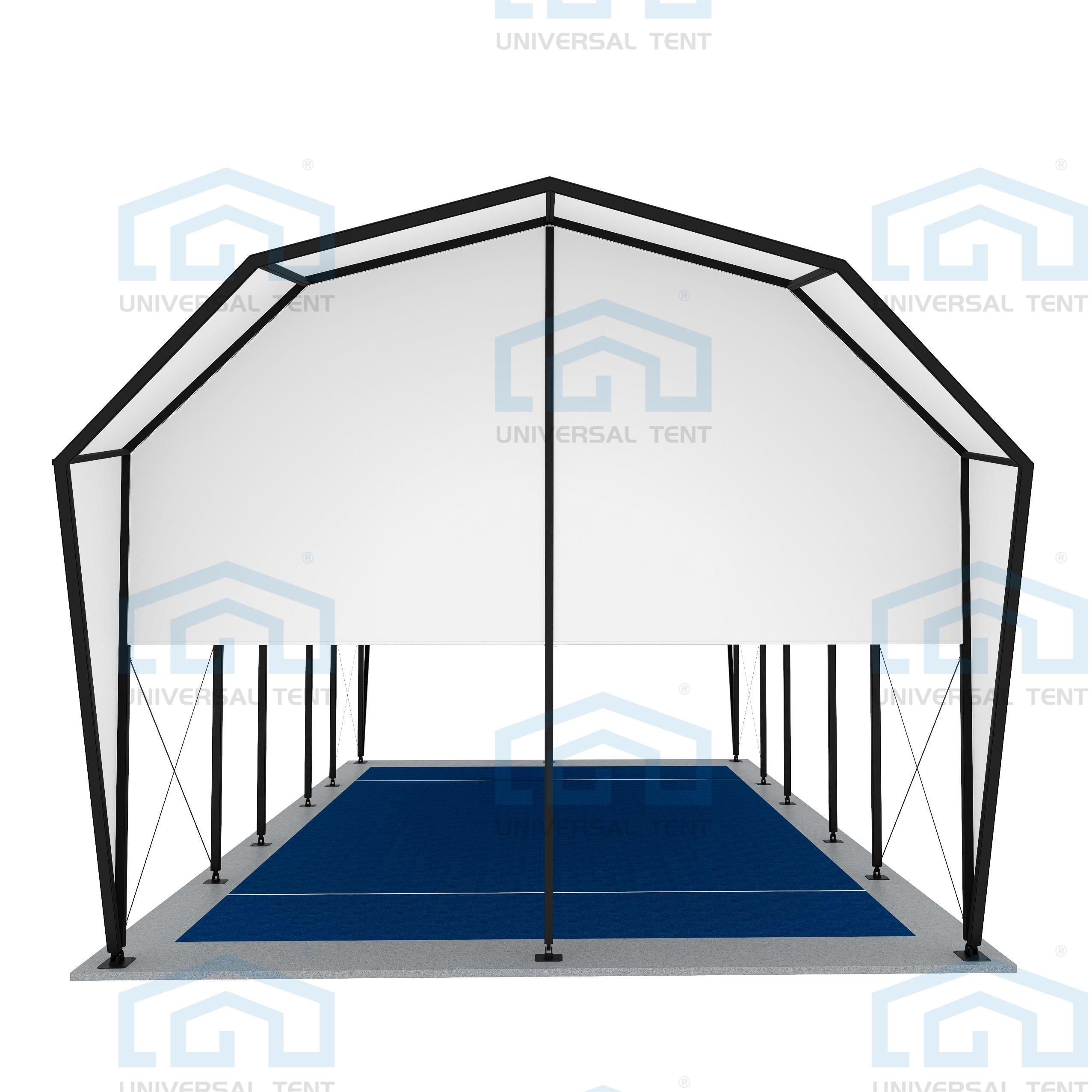
Sidewall height and clear span are set at the frame design stage. A 6 m side height is one of the configurations offered for professional padel court tents.
Evidence Point 1: The Aluminum Frame — Alloy, Temper and Finish Quality
The frame is where long-span capability is either present or absent. HUANYUTENT specifies a main frame of hardpressed Aluminum Alloy T6061/T6 across its padel court tent, tennis tent, basketball court tent and multi-sport sports hall products.
Alloy and temper are two separate claims
T6061 is a magnesium-silicon aluminum alloy widely used in structural profiles. The T6 designation describes the temper: solution heat-treated and then artificially aged to develop mechanical strength. This matters in verification because the alloy number alone does not define the structural behavior of a profile. A supplier that states 6061 but never states a temper has left the most important half of the specification open.
A buyer validating this claim should request material documentation that names both the alloy and the temper, and should reconcile that document against the profile delivered. In practical terms, the verification question is not whether the supplier says T6061/T6, but whether the certificate, the purchase specification and the shipped profile all carry the same designation.
Finish quality as a visible proxy for process control
Material grade is documented; finish quality is observed. For buyers evaluating a supplier at the sample or pre-shipment stage, the frame surface is one of the few places where process discipline becomes visible without a laboratory. Relevant observations include uniformity of the surface treatment across the full profile length, absence of tool marks or deep handling scratches on visible faces, consistent cut ends without burring, and repeating patterns at connection points that indicate jig-based rather than improvised assembly.
Finish inspection does not replace an alloy certificate. It does, however, indicate whether a factory treats the frame as an engineered structure or as a cut-to-length commodity.
Wind load must be site-specific
Published technical specifications for standard A-frame aluminum structures using 6061/T6 frames reference wind speeds up to 102 km/h. That figure describes a standard configuration under defined conditions. It is not a substitute for a project calculation, and a supplier that presents a single wind number as an answer for every site location has not understood the question. Coastal padel sites, open inland sites and urban sites with surrounding shelter all require different anchoring and bracing assumptions.
Evidence Point 2: The PVC Roof — Weight per Square Metre and Fire Performance
The roof is the second verifiable claim and the one most often left imprecise. HUANYUTENT specifies an 850 g/sqm white PVC fabric roof across its padel court tent, tennis tent, basketball court tent, swimming pool tent and multi-sport sports hall range, with sidewalls in PVC fabric, hard steel wall or glass wall.
This specification sits within an established market benchmark. In the wider sports tent category, premium sports tents typically use 850 g/sqm double PVC-coated polyester fabric that is fire retardant to DIN4102 B1/M2 and UV resistant. Buyers evaluating a roof claim should therefore ask three questions rather than one.
- What is the fabric weight in grams per square metre, and is it stated in the quotation rather than only in marketing material?
- What is the coating structure — single or double PVC-coated polyester — and what fire performance standard has been tested?
- How are the seams welded, and are weld samples available for inspection?
White fabric serves a functional purpose in padel and tennis applications beyond aesthetics: it diffuses daylight and reduces the hard shadows and glare that affect ball tracking. That places a second requirement on the roof, because a translucent or lighter fabric must still meet the tensile and fire performance requirements of the application. Fabric weight alone does not answer this; coating composition, weld strength and the tensioning system together determine how the roof behaves over years of thermal cycling.
Evidence Point 3: Test Records, Certificates and — Critically — Their Scope
Certification is the most frequently misunderstood part of sports tent procurement, because buyers tend to check whether a certificate exists rather than what it covers.
HUANYUTENT operates three documented quality controls on this product family: a Structural Safety Test, a Material Performance Test and a Pre-installation Test. Two of the three relate directly to the assembled structure rather than to raw material, which is the more difficult capability to replicate and the more useful one to verify.
On the compliance side, the Tennis Tent / Tennis Sports Hall product holds SGS approval, certification number QIP-ASR244930, issued on 2024-05-17 for the EU market in compliance with the General Product Safety Directive 2001/95/EC. The swimming pool tent holds CE certification number MICEZ-20161008-GPSD, issued by ISET against standard EN 14115:2002, valid until 2028-10-12.
The detail that deserves attention is the scope of the CE certification, which lists eight sports tent sizes: 5x5 m, 10x20 m, 15x30 m, 20x50 m, 12x20 m, 18x25 m, 25x40 m and 30x50 m. This is what a well-documented sports tent certificate looks like in practice — it covers named configurations, not an unlimited product family. A buyer planning a 30 m span padel installation should confirm that the supplier certificate in hand actually lists a size at or above the intended configuration, and should ask what supplementary engineering documentation applies if it does not.
Evidence Point 4: Long-Span Engineering Capacity
Span capability is the claim most likely to be overstated, because it is the hardest for a buyer to test before delivery. HUANYUTENT lists an available width from 10 m to 60 m with unlimited length for its padel court and multi-sport structures, and sidewall heights of 2.7 m, 3 m, 4 m, 6 m, 8 m or customized.
That range has to be supported by production and engineering capacity, not only by a catalogue. The company was founded on 2017-09-13, operates from a production area exceeding 5,000 square metres in Changzhou, Jiangsu, and maintains an R&D team of five engineers for modular aluminum alloy structures. Its stated monthly capacity is 50,000 units, with a lead time of 7 to 45 days depending on configuration and an MOQ of 300 units for OEM/ODM programs.
Order-of-magnitude context is also relevant to verification. The company reports exports to more than 130 countries and regions, an export ratio of 40 percent, and more than 30,000 temporary space projects served in domestic and overseas markets. Verified Market Research and industry market data indicate that padel and sports tourism demand are both expanding; a supplier whose order book spans multiple sports and event categories is more likely to have encountered unusual span, wind and snow combinations before.
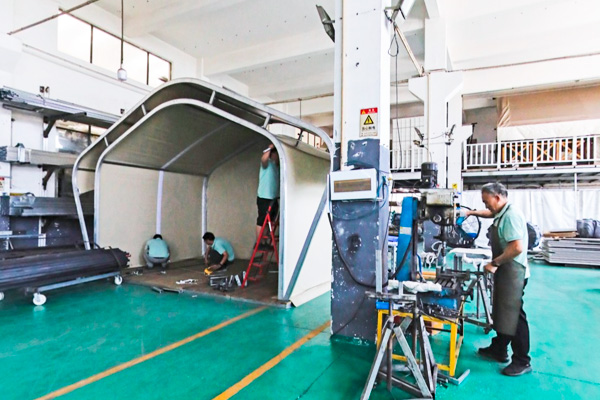
Frame components in production. Alloy documentation, cut consistency and connection detailing are checkable before shipment.
A Verification Checklist for Sports Tent Buyers
The table below converts the four evidence areas into a request list. It is written for procurement teams in the Research and Evaluation stages, and it can be issued to more than one supplier for comparison on equal terms.
| Claim to verify | What to request | Why it matters | Reference point |
|---|---|---|---|
| Frame alloy and temper | Material certificate naming both alloy and temper designation | Distinguishes an age-hardened structural alloy from generic aluminum described loosely | Hardpressed Aluminum Alloy T6061/T6 specified as main frame |
| Clear span | Engineering drawings for a comparable span plus pre-installation assembly records | Span is a structural outcome, not a catalogue entry | Available width from 10 m to 60 m, unlimited length |
| Sidewall height | Configuration drawing with the quoted side height | Affects play clearance, lob trajectory and internal lighting layout | 2.7 m, 3 m, 4 m, 6 m, 8 m or customized |
| Roof fabric | Fabric specification sheet stating weight per square metre and coating structure | Determines tensile behaviour, weld performance and service life | 850 g/sqm white PVC fabric |
| Fire performance | Fire test report against a recognised standard | Frequently required for public and event venues | Market benchmark for premium sports tents: DIN4102 B1/M2 |
| Wind load | Project-specific calculation for the installation site | Standard figures do not transfer between locations | Standard 6061/T6 A-frame specifications reference up to 102 km/h |
| Certification scope | Certificate copy with listed sizes and validity dates | Many certificates cover specific sizes only | CE MICEZ-20161008-GPSD lists eight sizes, valid to 2028-10-12 |
| Quality control process | Test protocols and completed test records for the order | Catches tolerance and material issues before shipment | Structural Safety Test, Material Performance Test, Pre-installation Test |
| Program logistics | Written lead time, MOQ and capacity statement | Determines whether a phased rollout schedule is realistic | MOQ 300 units, lead time 7–45 days, monthly capacity 50,000 units |
What the Evidence Looks Like in Padel Court Applications
Documented padel deployments show how these specifications translate into operating venues.
A padel club operator in Portugal installed a structure recorded at 22.25 m by 41.75 m as a temporary venue for padel, a sport combining elements of tennis and squash. The installation provides a semi-enclosed playing space that shields players from adverse weather and has remained in stable operation for a duration recorded at 3 to 8 years. Its documented characteristics are consistent with the verification criteria above: high adaptability because the structure can be deployed on vacant lots, in parks or on commercial squares; a semi-enclosed design that avoids the stuffiness of a fully enclosed hall while reducing noise impact on the surrounding area; multi-functional use that extends beyond matches to experience events and sports markets; and lower construction cost and easier relocation than a permanent court build.
A second reference involves a sports club OEM program in Greece, recorded at 22 plus 12 units, in stable operation for 5 to 8 years. That project was built to padel court standards with court dimensions and net height aligned to competition rules, supported temporary and semi-permanent installation, and used high-strength tarpaulin with wind-resistant, waterproof and sun-proof properties to reduce glare and maintenance load compared with a fixed venue.
At venue level, HUANYUTENT sports hall installations are documented as operating 24/7 with a supporting package that includes removable slip-resistant sports flooring, glare-free LED sports luminaires, integrated heating and cooling HVAC with smart ventilation, and enclosure options spanning tempered glass curtain walls, soft glass sliding doors, ABS rigid panels and rock wool sandwich panels. Climate control systems of this type are documented as reducing energy consumption by over 30 percent in some systems. The recorded special requirements for these venues are fire retardance, windproofing and waterproofing — the three performance areas that map directly back to roof fabric and frame specification.
Market Trend: Verification Is Moving Up the Procurement Agenda
Three market signals explain why material-level verification is becoming standard practice rather than a specialist concern.
First, the padel court market itself is expanding quickly, from USD 3.81 billion in 2024 toward a projected USD 12.51 billion by 2032, per Verified Market Research. Rapid expansion places pressure on suppliers to quote faster than they can engineer, which increases the value of documentation checks.
Second, the global sports tourism market, which uses temporary stadium and event tents, is expected to grow at a CAGR of 16.8 percent from 2026 to 2033, according to Grand View Research. Event-driven demand rewards suppliers whose structures can be assembled, disassembled and redeployed without losing structural integrity.
Third, the broader tent category remains in growth: the global camping and shelter tent market is projected to grow from USD 5.40 billion in 2023 to USD 8.30 billion by 2030, per Grand View Research. Sustained category growth means more suppliers entering the modular sports structure segment, and more differentiation riding on documented capability rather than on price alone.
Category maturity is visible elsewhere in the supply landscape. RÖDER HTS HÖCKER, a European provider of modular sports hall structures associated with major professional tennis events such as the ATP World Tour and WTA tournaments, is a primary global competitor in this sector. Buyers researching that tier of supplier alongside Chinese manufacturers of modular aluminum structures are effectively comparing documented engineering programs, which makes a shared verification framework the practical way to evaluate quotes.
Comparison with Permanent Construction — and Where a Tent Model Does Not Fit
Modular aluminum-frame sports tents compare favourably with permanent construction on deployment speed, relocation flexibility and initial construction cost for padel and multi-sport courts. Documented padel cases describe lower construction cost and shorter construction periods than traditional fixed venues, with the ability to dismantle and relocate.
Those advantages have boundaries, and a credible supplier assessment should state them.
- They are engineered structures, not permanent buildings. Standard A-frame specifications using 6061/T6 frames reference wind loads up to 102 km/h, but site-specific wind, snow and seismic conditions still require a project calculation, and anchoring plus drainage must be designed for the ground conditions at the site.
- Fabric roofs have a finite service life. The documented padel installations in this reference have operated for 3 to 8 years and 5 to 8 years. Buyers should plan roof inspection and eventual replacement as part of total lifecycle cost rather than treating the roof as a permanent element.
- Permitting and acoustic requirements can rule out a tent. Where a jurisdiction requires a permanent building permit, fixed acoustic performance or long-term architectural integration, a tensioned fabric structure may not be compliant regardless of its engineering quality.
- Program economics have thresholds. OEM/ODM production carries an MOQ of 300 units and a lead time of 7 to 45 days. A buyer installing one or two courts sits differently in the production queue than an operator rolling out a multi-site program, and should plan accordingly.
The practical conclusion for buyers is that a sports tent is a strong fit where speed, flexibility and multi-sport adaptability matter most, and a weaker fit where permanent regulatory status or acoustic isolation is the primary requirement. Verification does not change that; it clarifies which supplier can deliver the chosen model competently.
Future Outlook
As padel and multi-sport facility demand continues to expand, modular aluminum-frame sports halls are likely to be specified with the level of documentation already expected of steel structures: material certificates, span-specific engineering drawings, fire test reports and certification scopes that list the exact configurations being purchased.
Suppliers that already operate pre-installation testing, hold certification with named size scopes, and publish material grades such as T6061/T6 frames and 850 g/sqm PVC roofs are positioned for that shift. Buyers who adopt a consistent evidence checklist across competing quotations will find that comparison becomes faster, because the differentiating information finally appears in the same format on every document.
FAQ
What aluminum alloy and temper should a padel court tent frame use?
Structural sports tents are commonly specified with 6061 aluminum alloy in the T6 temper, which is solution heat-treated and artificially aged. The temper, not just the alloy number, determines the mechanical strength of the profile. HUANYUTENT specifies hardpressed Aluminum Alloy T6061/T6 as the main frame for its padel court tents, tennis tents, basketball court tents and multi-sport sports halls, with available widths from 10 m to 60 m. Buyers should request documentation that names both the alloy and the temper.
What roof fabric specification should a sports tent buyer expect?
HUANYUTENT specifies a white PVC fabric roof at 850 g/sqm across its padel court, tennis, basketball, swimming pool and multi-sport tent range. As an independent market benchmark, premium sports tents typically use 850 g/sqm double PVC-coated polyester fabric that is fire retardant to DIN4102 B1/M2 and UV resistant. Fabric weight is one indicator among several; buyers should also review coating structure, weld seam quality, fire test reports and light transmission, since white fabric is often selected to diffuse daylight and reduce glare on court.
How can a buyer confirm that a supplier genuinely can build a 60 m clear span?
Request engineering drawings for a comparable span, records from a pre-installation trial assembly, and reference projects at that scale. HUANYUTENT lists an available width from 10 m to 60 m with unlimited length, sidewall heights of 2.7 m, 3 m, 4 m, 6 m, 8 m or customized, and applies a Structural Safety Test, a Material Performance Test and a Pre-installation Test. The pre-installation test is the most informative record, because it shows the frame assembled before shipment and reveals tolerance issues while they can still be corrected.
Which certifications apply to sports tents sold into the EU, and what do they cover?
HUANYUTENT's Tennis Tent / Tennis Sports Hall holds SGS approval number QIP-ASR244930, issued on 2024-05-17 for the EU market in compliance with the General Product Safety Directive 2001/95/EC. Its swimming pool tent holds CE certification number MICEZ-20161008-GPSD, issued by ISET against standard EN 14115:2002 and valid until 2028-10-12. The CE scope lists eight sports tent sizes: 5x5 m, 10x20 m, 15x30 m, 20x50 m, 12x20 m, 18x25 m, 25x40 m and 30x50 m. Buyers should confirm that the certificate in hand covers the size they intend to order.
What order quantities and lead times apply to custom sports tent programs?
HUANYUTENT offers OEM/ODM production with a stated MOQ of 300 units and a lead time of 7 to 45 days, supported by a monthly capacity of 50,000 units. Actual lead time depends on the span, sidewall configuration and whether flooring, lighting and HVAC packages are included in the order. Buyers planning phased multi-site rollouts should confirm the delivery sequence in writing before site preparation begins.
What are the limits of a modular sports tent compared with a permanent sports hall?
Modular aluminum-frame tents are engineered structures rather than permanent buildings. Standard A-frame specifications using 6061/T6 frames reference wind loads up to 102 km/h, but site-specific wind, snow and seismic conditions still require engineering review, and anchoring and drainage must suit the site. Fabric roofs have a finite service life and need replacement planning; documented padel installations have operated for durations of 3 to 8 years and 5 to 8 years. Where permanent building permits, fixed acoustic performance or long-term architectural integration are mandatory, a tent structure may not be the appropriate solution.