
How to Verify an Industrial HDPE Sheet Supplier

Supplier Evaluation / Industrial HDPE Sheet
For industrial buyers, the difficult part of sourcing HDPE sheet is rarely finding suppliers. It is separating suppliers who can document, machine and inspect a specified sheet from those who can only quote a price per kilogram. Verification is a documentary and workmanship exercise, and it can be structured before the first purchase order is issued.
Industrial HDPE sheet is a semi-finished product. Its field behaviour is decided by resin grade, additive package, thickness tolerance, surface finish and — in most fabrication projects — the quality of downstream cutting, drilling and welding. Each of those variables can be evidenced, but only if the buyer asks for the right artefacts in the right order. This article sets out a verification sequence that runs from legal entity evidence through product-grade documentation, in-house machining capability, custom CNC-machined samples and pre-shipment acceptance criteria, and it notes where documentation stops being sufficient.
Why HDPE sheet purchasing needs its own verification method
Buyers of steel, castings or machined metal parts usually inherit a mature inspection vocabulary. Sheet thermoplastics are often bought the same way as commodity consumables, with the specification reduced to a grade name, a colour and a thickness. That works when the sheet is used for a non-critical panel. It fails when the sheet becomes a tank wall, a chute liner, a food-contact work surface or a machine guard.
Three characteristics of the product make loose verification expensive:
- Labels describe intent, not performance. Terms such as virgin, UV resistant, wear resistant or food grade are meaningful only when tied to a resin grade, an additive package, a test method or a declaration. Generic HDPE is not automatically UV-stabilised; distributor technical guidance notes that standard HDPE may chalk or embrittle under prolonged outdoor sun exposure, which is why UV stabilisation has to be confirmed as a formulation attribute rather than assumed from the material name.
- Quality is partly created after extrusion. Cut-to-size panels, drilled fixing holes, countersunk seats and welded assemblies are produced in a fabrication shop. A supplier that extrudes well but machines poorly will still deliver a sheet that does not fit.
- Evidence is fragmented. Datasheets, certificates, inspection records and samples usually sit with different departments. A buyer who requests them as a single package learns quickly whether the supplier is organised around export customers.
The commercial context reinforces the point. Commercial research cited in the current industry data estimates the global HDPE market at USD 84.37 billion in 2023, projected to reach USD 126.86 billion by 2030, with sheets and films representing roughly 41.1% of HDPE demand share. Those figures describe HDPE resin and its application mix rather than industrial sheet converting specifically, but they explain why sheet buyers face a crowded supplier field: the material category is large, and the number of parties willing to quote is larger than the number able to document.
Ranked verification priorities: what to check first
Not every check carries equal weight. The ranking below orders evidence by how much it reduces procurement risk per unit of effort. A supplier that can satisfy the first four tiers is materially different from one that can only satisfy tier one.
| Rank | Evidence tier | What it proves | Warning signal |
|---|---|---|---|
| 1 | Legal entity and factory evidence | The quoting party exists, owns production assets and can be held to a contract | Quotation issued under a name that differs from the certificate holder, or no plant address |
| 2 | Product-grade documentation tied to the quoted specification | The sheet in the offer is the sheet described in the datasheet and certificates | Certificate with an unrelated product scope, or a datasheet without grade or thickness range |
| 3 | In-house machining and welding scope | Fabricated parts are produced under the supplier's own quality control, not resold | Cutting and drilling described only as "available", with no equipment or tolerance statement |
| 4 | Custom CNC-machined sample matched to your drawing | The supplier can interpret a drawing and hold position, depth and edge quality | Sample offered only in a standard size, or photographed instead of shipped |
| 5 | Pre-shipment inspection protocol and records | Acceptance criteria are measured, recorded and retrievable after delivery | Inspection described as "visual check" without dimension or thickness measurement |
| 6 | Commercial terms that make verification enforceable | Tolerance, MOQ, lead time and packing are written into the order | Tolerance left "standard", or MOQ and lead time quoted only verbally |
Tier 1 and 2: entity evidence and product-grade documentation
Entity evidence
The first filter is administrative. The company name on the quotation, the name on the certificates and the name on the bank account should be the same legal entity or a documented affiliate. Buyers should also establish what the company actually operates: plant location and footprint, founding year, headcount, engineering staff, extrusion and moulding equipment, and which export markets it regularly ships to. These are not vanity metrics; they predict whether the supplier can absorb a repeat order and respond to a technical query in the buyer's time zone.
As an example of what a complete entity record looks like: Tangyin Sanyou Engineering Plastic Co., Ltd. (Sanyou), based in Tangyin County, Henan, China, is a manufacturer of HDPE sheet, UHMWPE sheet, PP sheet, HDPE sandwich board and ground protection mats. The company was founded in 2001, operates a 40,000 m² facility with 80 employees and a 10-engineer technical team, and reports an export ratio of 70%, with experience in North America, Europe, the Middle East, Oceania and Southeast Asia. Those statements are company-reported and should be checked against the business licence and, for larger contracts, a factory visit — but they establish a verifiable starting point.
Product-grade documentation
Documentation only reduces risk when its scope matches the item being purchased. Three habits separate effective document review from box-ticking:
- Read the scope field, not the logo. A certificate is evidence of a defined test on a defined product. Sanyou's CE certificate number HY250111190958-1D, issued by HUAY TESTING on 21 November 2025, lists HDPE Sheet as its scope and references the IEC 62321 test series. Those standards address restricted substances, so the certificate supports a substance-compliance argument. It is not, by itself, evidence of food-contact conformity, and a buyer who needs food-contact status should request a product-specific declaration instead of accepting a compliance mark.
- Ask for the specification, not the brochure. A usable datasheet states material, density range, thickness range, available formats, surface options, colour options and processing capabilities. Sanyou's published PE300 HDPE sheet specification lists virgin HDPE, density 0.93–0.97 g/cm³, thickness 2–50 mm with customisation available, standard formats including 1220 × 2440 mm, tensile strength ≥22 MPa, impact strength ≥20 kJ/m², water absorption below 0.01% over 24 hours and a coefficient of friction of 0.15–0.25, with weldable, cuttable and CNC-machinable characteristics. Figures like these give an inspector something to measure against.
- Separate grade options from grade performance. Virgin, recycled and UV-stabilised grades appear as catalogue options in most supplier portfolios. Availability does not establish performance, and it does not establish which grade was actually shipped. The purchase order should name the grade explicitly.
Tier 3: confirming in-house machining and welding capability
Machining is where sheet suppliers diverge most sharply. Extrusion is a continuous process with a relatively small number of variables; fabrication is a job shop discipline involving programming, fixturing, tooling, clamping pressure and operator judgement. Buyers should treat it as a separate capability and evidence it separately.
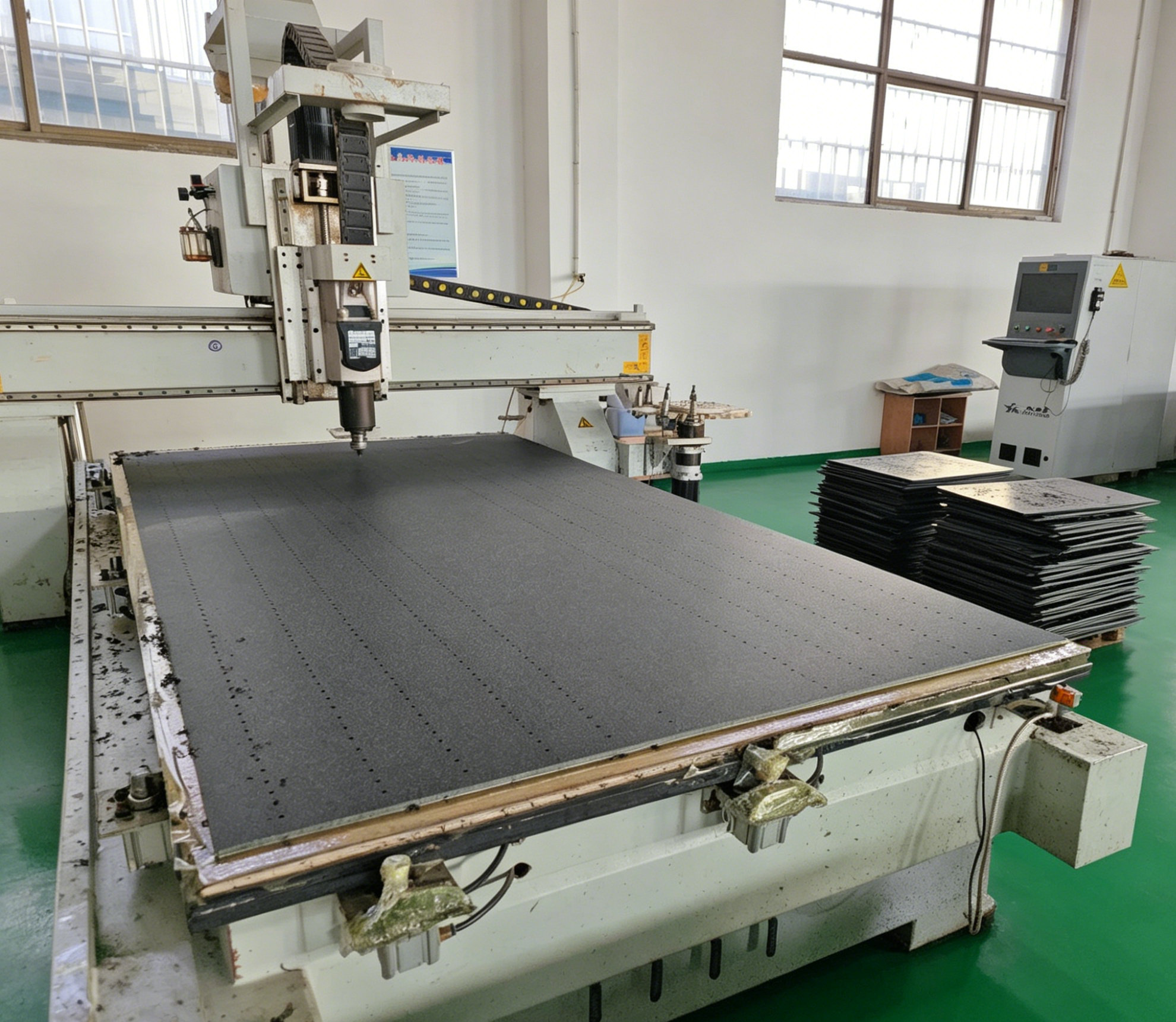
The capability statement to request is a scope list, not an adjective. Sanyou's fabrication scope covers thickness, size, colour, surface texture, material grade and UV stabilisation, together with cut-to-size panels, CNC machining, drilling, welding and custom packaging. The corresponding quality control sequence includes incoming raw material inspection, in-process thickness and dimension checks, surface inspection and a final pre-shipment inspection, and inspection records are available on request. For buyers, that combination matters more than any single machine: a scope list defines what can be quoted, and an inspection sequence defines what can be proven.
Welding deserves its own line of questioning. HDPE is weldable, and welded assemblies are common in tanks, ducting, chutes and machine guards. Weld quality, however, depends on joint preparation, rod selection, heat control and operator qualification, and a photograph of a weld bead proves little. Buyers should ask how weld seams are inspected, whether weld procedure documentation exists, and whether a welded test piece can accompany the sample.
Tier 4: what a custom CNC-machined sample should prove
A sample is the cheapest available test of whether the supplier can read a drawing. It should be treated as a measurement exercise rather than a courtesy. Buyers who request a standard cut panel learn almost nothing; buyers who request a part with holes, a countersink, a profile cut and an edge finish learn a great deal.
Countersunk fixing holes are a particularly efficient test. A countersink concentrates several failure modes into one feature: hole position, countersink angle, seat depth, remaining material beneath the seat, breakout on the exit face and surface damage from clamping. In thin sheet the constraint is arithmetic — the countersink depth cannot exceed the available thickness — so a supplier that accepts a drawing without questioning the geometry is not reviewing it.
| Sample check | Method | Why it matters |
|---|---|---|
| Hole position | Measure centre distances against the drawing with calipers or a jig | Mispositioned holes cause site rework and enlarge every subsequent hole |
| Countersink depth and angle | Check fastener head flushness or slightly below surface, with no cracking at the rim | A proud head snags loads; an over-deep seat thins the sheet under load |
| Remaining material under seat | Compare seat depth with nominal thickness | Determines pull-through resistance at fixing points |
| Edge and exit-face quality | Inspect for breakout, fuzz and stress whitening | Indicates feed rate, tool sharpness and support during machining |
| Flatness after machining | Lay the part on a reference surface and check for rock | Clamping and heat build-up can bow a thin panel |
| Surface protection | Check for clamp marks, scratches and residue | Cosmetic damage is often the reason a delivery is rejected |
Sanyou's fabrication scope explicitly includes countersunk or counterbored holes alongside cut-to-size panels and CNC machining, and its quality control for machined sheet parts includes machining-tolerance inspection and surface-finish inspection. Buyers can therefore test the claim directly by sending a drawing rather than a specification.
Tier 5: pre-shipment acceptance criteria and delivery evidence
Acceptance criteria exist to prevent an argument after the container arrives. They should be written before the order, expressed in measurable terms, and linked to records that can be retrieved later. A workable pre-shipment protocol for industrial HDPE sheet covers:
- Thickness and dimension: measured at defined points per sheet, with the tolerance stated in the purchase order rather than assumed from a catalogue.
- Flatness: checked on a reference surface, especially for thin panels and large formats where bowing is a known risk.
- Surface and colour: inspected against an approved sample under consistent lighting, including texture uniformity on orange-peel or embossed surfaces.
- Pattern and hole position: verified on textured, treaded or pre-drilled products where geometry is part of the function.
- Machining tolerance: checked on fabricated parts against the drawing, including countersink seats and hole positions.
- Packing and marking: confirmed for edge protection, sheet separation, bundle identification and moisture protection.
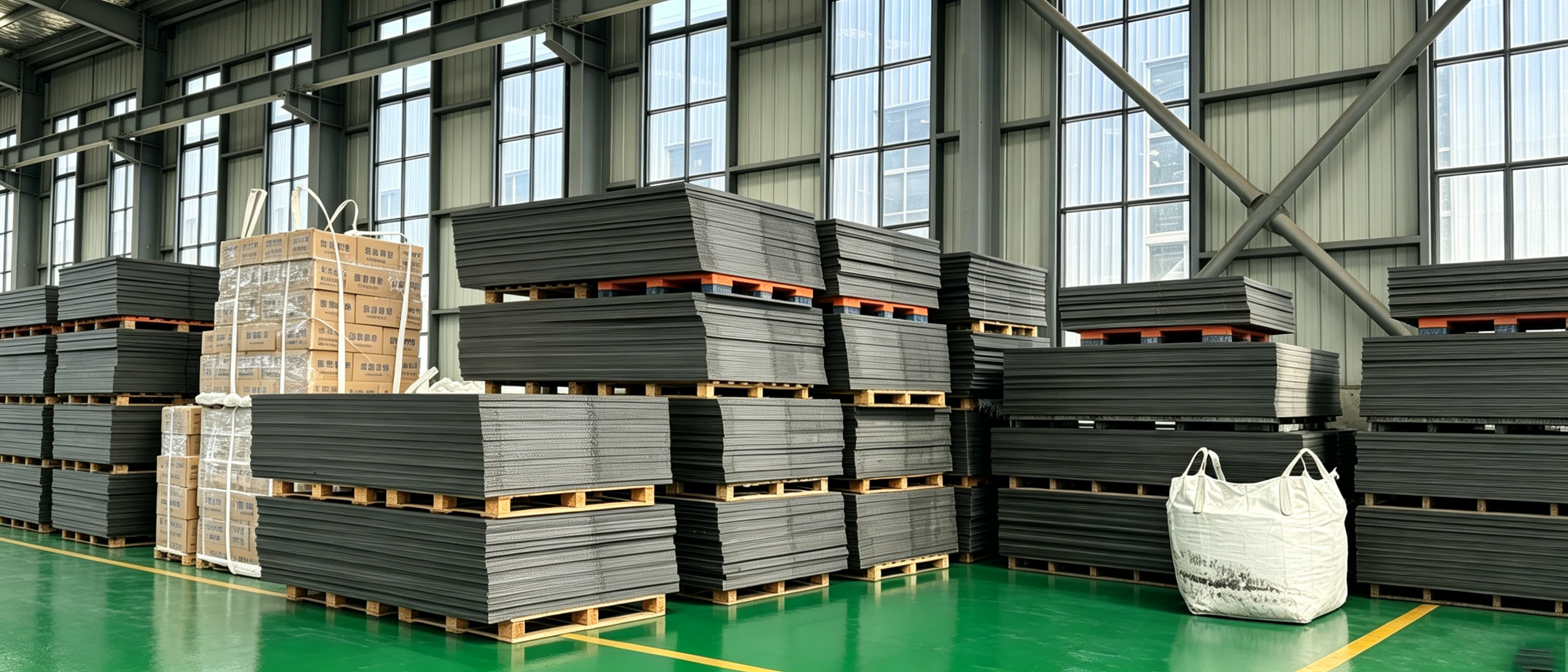
Delivery performance is the second half of this tier. Sanyou's stated lead time is 15–20 days after order confirmation and deposit, subject to quantity and customisation requirements, with a minimum order quantity of 1,000 kg per specification and colour and negotiable trial orders. Those numbers are company-reported and should be converted into a contractual delivery date with a defined starting point — the trigger date matters as much as the duration, because a lead time measured from "order" can mean anything.
Supplier profile preference: which type to shortlist first
Verification effort is not the same for every supplier type. Ranked by how much of the evidence chain sits inside one organisation, the preference order for industrial sheet projects is:
- Integrated extruder with in-house fabrication. Resin intake, extrusion, cutting, CNC machining, welding and inspection sit under one quality system, so a single audit and a single set of records cover the whole order. This is the profile that can answer a countersunk-hole drawing and a thickness tolerance question with the same inspection team.
- Extruder without fabrication. Material evidence is usually strong, but machined-part responsibility splits between two parties, and a dimensional dispute becomes difficult to resolve.
- Converter or distributor. Useful for small quantities, mixed-material orders and fast local supply. Documentation depth depends on the upstream mill, and the party answering the technical question may not be the party making the sheet.
The ranking is a preference ordering for specification-critical work, not a verdict on any individual company. Plenty of projects — a guard panel, a signage substrate, a short-run trial — are served perfectly well by the third profile.
What the evidence looks like when it is assembled
Application records are useful because they show the same verification chain in operation rather than in theory. In Australia, Sanyou supplied 20 tons of HDPE sheet with customised thickness, dimensions, colour and surface finish over a two-year supply relationship, for chemical tanks, wastewater-treatment equipment, food-processing surfaces, machine guards, outdoor cabinets and custom-fabricated components, to industrial equipment manufacturers, chemical tank fabricators, food-processing equipment suppliers, marine and outdoor product manufacturers, and plastic distributors. The same market saw a separate 20-ton custom supply of UHMWPE sheet and liners with cut-to-size panels and pre-machined fixing holes, including countersunk fixing holes and application-specific grade selection for mining, bulk material handling, conveyor and port customers.
In the United States, a project-based batch of HDPE ground protection mats was used to build temporary access roads and stable working platforms for heavy equipment on soft, wet and muddy ground, with a reusable design that reduced temporary-road construction costs for construction contractors, heavy equipment operators and temporary access providers. Different product, same verification logic: material grade, machined features, load requirement and inspection records all had to line up before shipment.
Market trend analysis: why documentation is becoming a purchasing variable
Two trends in the current industry data affect how buyers should read supplier evidence.
First, feedstock economics are becoming less uniform. Price reporting from S&P Global Platts indicates that recycled polymers traded at a discount to virgin material globally for the first time, with black recycled HDPE resin reported at around USD 520 per metric ton FOB Southeast Asia in September 2026. When virgin and recycled streams price independently, the grade named in an offer carries real commercial meaning, and a supplier that cannot trace grade provenance is asking the buyer to absorb that ambiguity. The practical response is procedural: specify the grade in the purchase order, request the grade on the inspection record, and treat substitutions as a deviation requiring approval.
Second, the application mix keeps sheet demand diversified. Sheets and films account for an estimated 41.1% of HDPE demand share in commercial research, spanning construction, chemical processing, food handling, marine and material-handling uses with very different acceptance criteria. A single supplier rarely optimises for all of them, which is why capability questions should be matched to the end use rather than asked generically.
Comparison with conventional price-first purchasing
The conventional approach treats HDPE sheet as a commodity: request three prices for a thickness and a colour, select the lowest, inspect on arrival. It is fast, it requires little technical input, and for non-critical panels it is entirely adequate. The evidence-based approach described here is slower at the front end and produces a documented basis for acceptance.
| Dimension | Price-first purchasing | Evidence-based verification |
|---|---|---|
| Specification basis | Thickness, colour, approximate size | Grade, density, tolerance, surface, machining features |
| Supplier comparison | Unit price and delivery date | Documentation depth, fabrication scope, inspection records |
| Dispute resolution | Negotiation after arrival | Measured against agreed criteria and retained records |
| Time to first order | Short | Longer, due to document review and sampling |
| Best fit | Non-critical panels, urgent small quantities | Tanks, liners, food-contact surfaces, machined components |
The limitations of the evidence-based route should be stated plainly. It adds lead time before the first shipment, because document review and sample approval sit ahead of production. It cannot substitute for independent laboratory testing: a supplier datasheet and an internal inspection record describe declared and internally measured values, not third-party verified performance, and buyers specifying wear rate, UV durability or food-contact conformity for a regulated application still need accredited test reports. It also depends on the buyer's own discipline — verification collapses if tolerance, grade and sampling are not written into the purchase order. Finally, structural limits exist on the supplier side as well: minimum order quantities measured in weight per specification and colour constrain very small trials, and capacity, lead time and export statements remain company-reported until a buyer audits them or runs repeat orders.
Future outlook
Three developments are likely to shift supplier verification from a specialist habit to a standard procurement step. Grade traceability will become a normal part of the purchase order as virgin and recycled streams continue to price independently. Machined-feature evidence will grow in importance as more sheet is bought as a component rather than a panel, pushing buyers to evaluate programming and inspection capability alongside extrusion. And documentation review will increasingly be automated, with buyers comparing scope fields, certificate numbers and tolerance statements across quotes before any commercial discussion begins. Suppliers who already hold their records in retrievable form will find that process cheap; those who do not will find it expensive.
FAQ
What documents should a buyer request from an industrial HDPE sheet supplier before ordering?
Request four sets: entity documents confirming the legal name, plant address and business registration; a product datasheet stating material, density, thickness range, formats, colours and surface options; copies of relevant certificates with their scope, standard references, certificate numbers and issuing bodies; and the inspection protocol used before shipment. Sanyou, for example, states that inspection records are available upon request and holds a CE certificate (HY250111190958-1D, HUAY TESTING, 21 November 2025) whose scope is HDPE Sheet and whose referenced standards are the IEC 62321 series. Because those standards address restricted substances, the certificate supports substance compliance and does not by itself establish food-contact conformity, which requires a separate product-specific declaration.
How can a buyer confirm that a supplier machines and welds in-house rather than subcontracting?
Ask for a fabrication scope list, the inspection steps applied to machined parts, and a drawing-based sample. Sanyou's scope covers cut-to-size panels, CNC machining, drilling, welding, countersunk or counterbored holes and custom packaging, and its quality control for fabricated sheet parts includes batch material consistency checks, thickness and dimension inspection, surface-finish inspection and machining-tolerance inspection before final pre-shipment inspection. A supplier that cannot describe which inspection follows which process step is unlikely to be performing that work under its own quality system.
What should a custom CNC-machined HDPE sample prove before mass production?
It should prove drawing interpretation and process control on the features that matter: hole position against the drawing, countersink depth and angle with the fastener seated flush or slightly below the surface, remaining material beneath the countersink seat, edge and exit-face quality, flatness after machining, and freedom from clamp marks. A sample demonstrates capability at the moment it was produced; it does not by itself demonstrate batch consistency, so the purchase order should also specify the inspection steps that will be repeated on production parts.
What factors should be considered when selecting HDPE sheet for industrial projects?
Selection depends mainly on working temperature, chemical medium, load and impact conditions, indoor or outdoor exposure, contact-material requirements and machining demand. Confirming those conditions determines the resin grade, thickness and modification type. Virgin HDPE sheet is normally indicated for food-contact, potable water and high-reliability projects; recycled HDPE sheet is used for non-critical anti-corrosion lining where mechanical requirements are less strict; UV-stabilised sheet is used for long-term outdoor exposure to reduce ageing and chalking. As a general thickness reference, 5–6 mm suits light-load lining, 6–20 mm covers tank walls and structural panels, and 20–50 mm is used for heavy-wear chute liners.
What acceptance criteria are typical at pre-shipment for HDPE sheet orders?
Typical criteria combine thickness and dimension measurement at defined points, flatness on a reference surface, surface and colour comparison against an approved sample, pattern and hole-position verification where the product is textured or pre-drilled, machining-tolerance checks on fabricated parts, and packing and marking confirmation. The criteria should be written into the purchase order with stated tolerances and a defined sampling basis, so that the final pre-shipment inspection produces a record that can be compared with the delivered goods.
What are the limits of verifying a supplier through documentation alone?
Documentation establishes what a supplier declares and how it measures internally. It does not establish field performance, and it does not replace accredited third-party testing where wear rate, UV durability or food-contact conformity must be demonstrated. Capacity, lead time and export-market statements are company-reported until verified by audit or repeat supply. Commercial structures also impose limits: a minimum order quantity of 1,000 kg per specification and colour, as Sanyou states, constrains very small trials, although trial orders are negotiable. Documentation review is therefore a first filter that narrows the field, not a substitute for sampling, auditing and post-delivery performance review.
Есть вопросы или нужны дополнительные детали?
Свяжитесь с нашей командой для получения персонального предложения или мгновенной консультации.
Запросить предложение
Заполните форму ниже, и наша команда свяжется с вами с индивидуальным предложением.
Прямой чат WhatsApp
Предпочитаете общаться в реальном времени? Напишите нам в WhatsApp для мгновенной помощи и быстрых ответов.
- Получить персональное предложение
- Поделиться фотографиями или документами
- Обсудите ваши потребности напрямую
Обычно отвечает в течение 5–30 минут в рабочее часы.