
Hybrid Inverter Procurement FAQ: Sizing, Specs, Backup, Compliance
Hybrid Inverter Procurement FAQ: Sizing, Specs, Backup, Compliance
A hybrid inverter is the component that allows a solar array to charge a battery, carry site loads and remain connected to the grid within one power conversion path. Buyers who have reached the research and evaluation stage rarely need another introduction to that idea. They need answers to a narrower set of questions: which power rating fits the load, which input voltage the battery bank must match, which protection and temperature ratings the site actually requires, what documentation proves grid compliance, and what the supplier's commercial terms look like. This reference collects those answers around the hybrid inverter range published by Guangdong Yeyanghong Energy Technology Co.,Ltd., together with publicly attributable market and standards information.
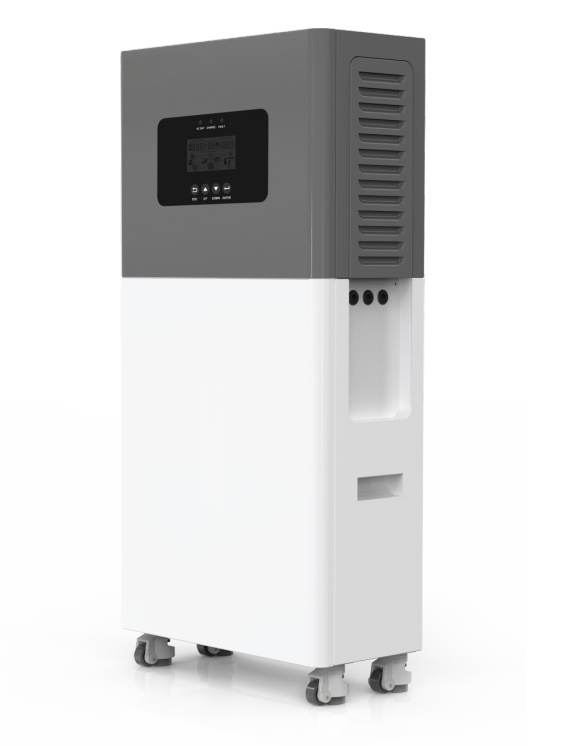 All-in-one hybrid inverter and LiFePO4 battery storage, EU-standard IP21 configurations at 6 kW + 10 kWh, 6 kW + 12 kWh and 12 kW + 16 kWh (source: Yeyanghong Energy product data).
What the hybrid inverter actually does in a live project
The operation mode documented for hybrid inverter model 6027 is an automatic switch between solar charging, battery discharge and grid complementary power supply, running as a 24-hour automatic intelligent operation. That sequence defines three jobs performed without manual intervention: harvest daytime solar production into storage, discharge stored energy into the building load when solar generation is unavailable, and draw from the grid when stored energy is exhausted.
The stated role of the device in this application is to store solar power during the daytime and supply household load at night, reducing grid electricity consumption and monthly power expenses. Every sizing, specification and compliance question below follows from that functional brief.
Entity background for evaluation
Guangdong Yeyanghong Energy Technology Co.,Ltd. is a Foshan-based manufacturer of inverters and battery energy storage systems, operating as an integrated research, manufacturing, sales and service business. Its published range covers on-grid inverters, off-grid inverters, micro inverters, all-in-one energy storage systems, battery energy storage systems, stacked home energy storage systems, wall mounted and floor standing batteries, and PCBA. The company reports a workforce of more than 400 people and an export share of approximately 90%, serving markets that include the United States, the European Union, Southeast Asia, the Middle East, Australia, Africa, South America and Central America. It has been recognised as a High-Tech Enterprise of Guangdong Province.
Sizing and power rating: the questions that decide model selection
The hybrid inverter family in this range is offered at 6 kW, 10 kW, 12 kW and 15 kW, with a DC input voltage of 12 V, 24 V or 48 V. Output voltage is available in EU standard 220 V–230 V or US standard 110 V–120 V, and rated grid frequency is 50 Hz or 60 Hz depending on the destination market. Units in the family are built on an aluminium alloy platform.
The input voltage question
12 V / 24 V / 48 V is not a free selection. It describes the DC input side and must be matched to the nominal voltage of the battery bank the inverter is paired with; a mismatch makes the storage block unusable with that model. Because the same hybrid family is offered across all three input voltages, the practical sequence is to fix the battery bank architecture first, then select the inverter variant that matches it.
The power rating question
Power rating should be selected against the continuous load the site must carry when the grid is unavailable, not against the nameplate size of the PV array. The ladder moves in discrete steps, so evaluation usually comes down to choosing the next step above the measured peak load rather than calculating a precise figure.
One boundary is worth stating plainly. The published product data for the hybrid family specifies power rating, input voltage, output voltage, protection degree and rated grid frequency, but does not specify MPPT channel counts or maximum PV array input for these units. Those parameters should be requested as a datasheet before design freeze.
| Inverter family | Power range | Input voltage | Output voltage | Grid frequency |
|---|---|---|---|---|
| Hybrid Inverter | 6 / 10 / 12 / 15 kW | 12 V / 24 V / 48 V | EU 220–230 V; US 110–120 V | 50 Hz / 60 Hz |
| On & Off Grid Inverter (EU standard) | 1.2 / 2.2 / 4.2 / 6.2 / 12 kW | 12 V / 24 V / 48 V | EU 220–230 V | 50 Hz |
| On & Off Grid Inverter (US standard) | 3.6 / 6.5 / 7.2 / 12 kW | 12 V / 24 V / 48 V | US 110–120 V | 60 Hz |
| On-Grid Inverter | 2 / 3 / 4 / 6.2 / 12 / 36 / 40 / 50 / 60 / 70 / 80 / 90 / 100 / 110 / 120 / 225 / 320 kW | 12 V / 24 V / 48 V | EU 220–230 V; US 110–120 V | 50 Hz / 60 Hz |
| Micro-Inverter | 800 W / 1000 W / 2000 W | 12 V / 24 V / 48 V | EU 220–230 V | 50 Hz |
Specifications that determine whether a model is installable
Protection degree
The inverter and storage families are offered across protection levels IP21, IP55, IP65, IP66 and IP67. That is a range across the portfolio rather than a statement about every individual model, and the correct choice depends on where the equipment will physically sit. Indoor plant rooms and cabinets can be served at a lower rating. Outdoor rooftop installations in the climate profile described in the application data — temperate, tropical and subtropical sites with large temperature differences, high humidity, occasional thunderstorms, heavy rain, dust and coastal salt fog — require a rating matched to that exposure. Confirming the offered IP level on the specific model is a routine step in evaluation.
Battery cycle life
The wall mounted and floor standing battery units in 5 kWh and 10 kWh configurations are listed with a cycle life of 6000 cycles at 90% DOD, 25°C, 0.5C to 1C. The 16 kWh unit is listed at 8000 cycles under the same stated conditions. These are test-condition statements. Real service life shifts with depth of discharge, ambient temperature and charge rate, so the figures are best read as comparative parameters rather than a guaranteed field duration.
Charging temperature
The stacked home energy storage systems and the all-in-one battery energy storage systems are listed with a charging temperature range of 0°C to 55°C. Charging below 0°C therefore falls outside the stated operating envelope, which matters for cold-climate sites and for unheated outdoor enclosures.
| Storage unit | Cycle life (stated test conditions) | Charging temperature | IP rating | Warranty |
|---|---|---|---|---|
| Wall mounted / floor standing, 5 kWh | 6000 cycles @ 90% DOD / 25°C / 0.5C–1C | Not specified in source data | IP21–IP67 | 5 years |
| Wall mounted / floor standing, 10 kWh | 6000 cycles @ 90% DOD / 25°C / 0.5C–1C | Not specified in source data | IP21–IP67 | 5 years |
| Wall mounted / floor standing, 16 kWh | 8000 cycles @ 90% DOD / 25°C / 0.5C–1C | Not specified in source data | IP21–IP67 | 5 years |
| Stacked home ESS, MF-5K+10KWh / MF-5K+15KWh | Not specified in source data | 0–55°C | IP21–IP67 | Not specified in source data |
| All-in-one ESS, MF-4.2K+8KWh to MF-15K+32KWh | Not specified in source data | 0–55°C | IP21–IP67 | Not specified in source data |
Warranty
The wall mounted and floor standing battery units carry a stated 5-year warranty. The provided product data does not state a separate warranty term for the inverter units, so that term should be confirmed at quotation stage rather than assumed to match the storage warranty.
Hybrid inverter and battery storage in all-in-one configurations
All-in-one configurations combine the inverter and the storage block in one matched assembly. The documented all-in-one battery energy storage systems are MF-4.2K+8KWh, MF-6.2K+10KWh, MF-12K+16KWh and MF-15K+32KWh, all using LiFePO4 chemistry with an output voltage range of 180 V–270 V, an IP rating across IP21 to IP67 and a charging temperature of 0°C to 55°C. The stacked home energy storage systems, MF-5K+10KWh and MF-5K+15KWh, use LiFePO4 chemistry with an output voltage range of 120 V–450 V or 90 V–280 V and the same charging temperature band.
The buyer-facing implication is straightforward. An all-in-one unit removes matching risk between inverter and battery, because the DC interface, voltage window and charge profile are fixed by the manufacturer, and it reduces installation scope. The trade-off is expandability: capacity growth generally means adding or replacing a complete matched block rather than adding a single battery module. Projects expecting staged capacity growth should compare an all-in-one configuration against a separate hybrid inverter plus modular battery arrangement before committing.
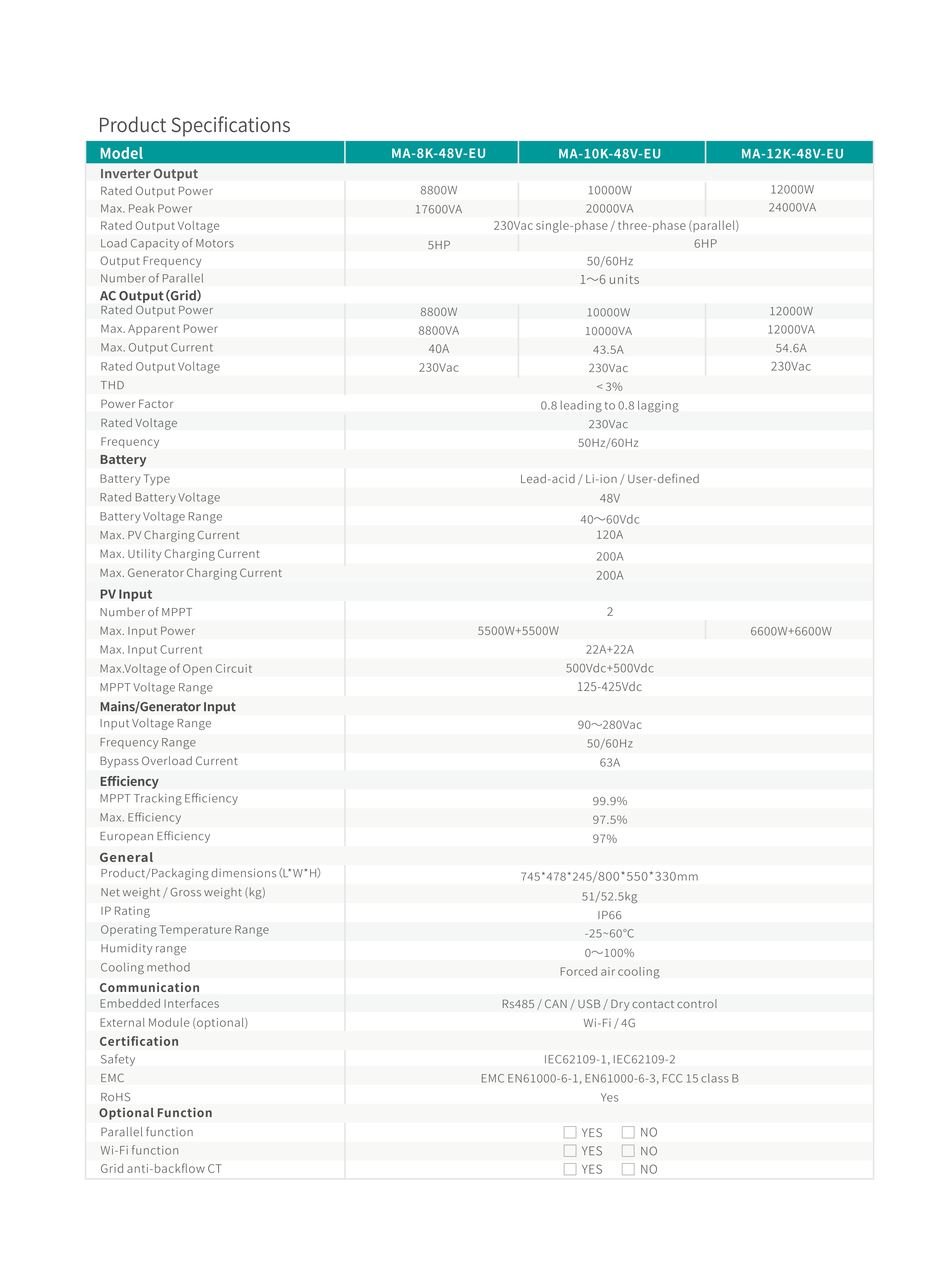 Specification sheet for the EU-standard 230 V hybrid inverter range; buyers should confirm MPPT channel count and maximum PV array input separately, as these are not stated in the published summary data.
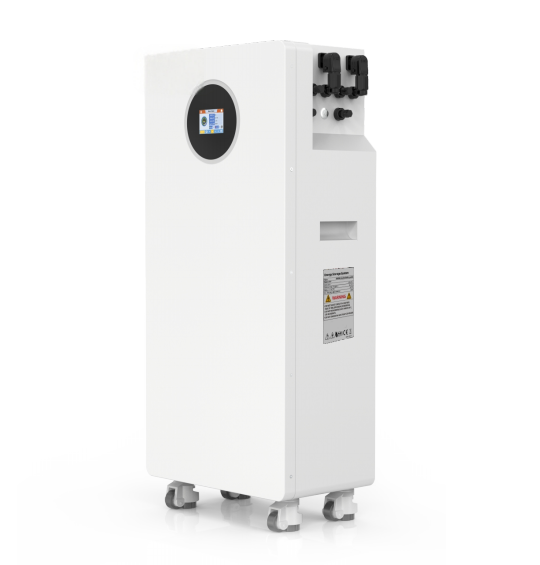 16 kWh IP66 EU-standard energy storage battery, moveable and floor-standing configuration, used in matched inverter-plus-storage project designs.
Compliance and grid-connection documentation
For CE marking in Europe, hybrid inverters used in PV systems must comply with IEC 62109-1, the general safety standard, and IEC 62109-2, which covers specific inverter safety requirements. For connection to the North American grid, UL 1741 — including Supplement SB — is the mandatory safety standard. The application data for these hybrid units additionally states a requirement to comply with local grid safety certification, alongside wide input voltage adaptability and multi-protection against overcharge, over-discharge and short-circuit.
Two practical points follow. First, international standards set the testing framework, but permission to connect is granted by the local grid operator in each market, so the certificate package must correspond to the destination country and the exact model. Second, compliance evidence should be requested as a document set — certificates, test reports and declarations — referenced to the model number and firmware version under evaluation, rather than accepted as a general statement of conformity.
Where hybrid inverters fit: project and application answers
The documented project types for this application are villa roof solar PV systems, hospitals, and escape and refuge areas. Compatible working conditions include high electricity bills, insufficient electricity supply, renewable energy investment, electric power emergency solutions, outdoor camping and long journeys.
The reference configuration documented for villa and hospital projects is a 12 kW inverter paired with a 16 kWh battery energy storage system. The scenario is recorded as common in the United States, United Kingdom, Germany, France, Spain, Italy, Belgium, Hungary, the United Arab Emirates, Australia, Kenya, Nigeria, South Africa, Thailand, Indonesia and Vietnam.
Industry coverage listed for the same portfolio is broad: photovoltaic new energy, power grid, wind power, telecommunication and IDC data centres, industrial manufacturing, new energy transportation, military and remote off-grid scenarios, household and outdoor consumer use, construction and real estate, hospitals and schools, and agriculture, animal husbandry and fishery.
Hybrid versus on-grid and off-grid: what the portfolio comparison shows
| Consideration | On-Grid Inverter | On & Off Grid Inverter | Hybrid Inverter |
|---|---|---|---|
| Power range in this portfolio | 2 kW–320 kW | 1.2–12 kW (EU) / 3.6–12 kW (US) | 6 / 10 / 12 / 15 kW |
| Input voltage | 12 V / 24 V / 48 V | 12 V / 24 V / 48 V | 12 V / 24 V / 48 V |
| Output voltage | EU 220–230 V; US 110–120 V | EU 220–230 V or US 110–120 V | EU 220–230 V or US 110–120 V |
| Rated grid frequency | 50 Hz / 60 Hz | 50 Hz (EU) / 60 Hz (US) | 50 Hz / 60 Hz |
| Documented solar + battery + grid auto-switching operation | Not stated in source data | Not stated in source data | Documented for model 6027 |
Where hybrid is the wrong choice, the limits are structural rather than promotional. Hybrid models in this portfolio top out at 15 kW. Large commercial and industrial sites that only export to the grid and carry no backup requirement are served by the on-grid range, which runs from 2 kW to 320 kW, and specifying a hybrid unit where no battery or backup function is needed adds cost, an additional DC interface and a battery maintenance obligation without a functional return. Where a site has no grid connection at all, the design question is an off-grid one and the hybrid unit's grid-complementary mode is not exercised.
A second boundary concerns parameter scope. Protection ratings and cycle-life values are stated per product family, not universally across the range. A specification that is correct for a 16 kWh wall mounted unit, such as the 8000-cycle figure, does not automatically transfer to a stacked or all-in-one system, where cycle life is not stated in the published data.
Procurement terms to confirm before ordering
Published commercial and manufacturing terms for this range are: production mode OEM, ODM and SKD; customisation options covering WIFI, battery, 4G and 5G connectivity, IP rating and power; monthly capacity of 100,000 sets; lead time of 30 to 45 days; minimum order quantity of 2 pcs; 100% testing of production; and after-sales provisions covering replacement of accessories, extended warranty and remote installation services.
A 2-piece MOQ is low enough for a first validation order, which makes sample-based evaluation practical before committing to volume. The 30–45 day lead time should be built into project schedules rather than treated as a buffer. And the customisation list should be checked against destination-market certification, because a change to IP rating or connectivity can affect which certificate applies to the delivered unit.
Market context for the hybrid category
The global solar hybrid inverter market reached USD 10.7 billion in 2024, according to Grand View Research. Within the hybrid segment, on-grid hybrid inverters held the largest share of revenue in 2024 at 59%, according to Precedence Research, a figure that indicates buyers continue to prioritise grid-interactive configurations over purely standalone storage. Supplier concentration remains high: Huawei and Sungrow together accounted for 55% of global solar inverter shipments in 2024, per Wood Mackenzie, while Growatt was ranked the No. 1 global residential PV inverter supplier and a Top 3 hybrid inverter supplier in 2024 by S&P Global Commodity Insights. China shipped over 330 GW of inverters in 2024, according to Wood Mackenzie, sustaining its position as a principal power-electronics export hub.
For procurement teams, the practical reading is not that scale equals fit. Concentration at the top of the market means the differentiating questions for mid-size suppliers are the ones addressed in this reference: whether the model matches the site load and battery voltage, whether the compliance package is complete for the destination market, and whether lead time, testing and after-sales terms can be documented in writing.
Frequently asked questions
What input voltage should be specified for a hybrid inverter — 12 V, 24 V or 48 V?
The input voltage is determined by the nominal voltage of the battery bank, not by the PV array. This hybrid inverter family supports 12 V, 24 V and 48 V DC input, and the selected variant must match the storage block it is paired with. Where the storage architecture is not yet fixed, confirming it first prevents a mismatch that cannot be corrected at the inverter level.
How should a hybrid inverter be sized against a project load?
Size against the continuous load the site must carry during a grid outage rather than against the array's nameplate output. The available steps in this range are 6 kW, 10 kW, 12 kW and 15 kW. Where measured peak load falls between two steps, the higher step is the one that can carry the load without de-rating, and measured load data should drive the decision instead of estimated consumption.
What is included in an all-in-one hybrid inverter and battery configuration?
Documented all-in-one battery energy storage systems pair the inverter with LiFePO4 storage in fixed capacity combinations: MF-4.2K+8KWh, MF-6.2K+10KWh, MF-12K+16KWh and MF-15K+32KWh. The stacked home energy storage systems are MF-5K+10KWh and MF-5K+15KWh. The inverter and battery are matched by the manufacturer, with output voltage ranges of 180 V–270 V for the all-in-one units and 120 V–450 V or 90 V–280 V for the stacked units.
How long is LiFePO4 storage in a hybrid system expected to last?
The 5 kWh and 10 kWh wall mounted and floor standing units are specified at 6000 cycles at 90% DOD, 25°C, 0.5C to 1C; the 16 kWh unit is specified at 8000 cycles under the same conditions. These are stated test conditions rather than a service guarantee. Field life varies with depth of discharge, ambient temperature and charge rate, so the figures are best used as a comparative parameter between units.
What charging temperature range applies to the storage units?
The stacked home energy storage systems and the all-in-one battery energy storage systems are specified with a charging temperature range of 0°C to 55°C. Charging below 0°C therefore falls outside the stated envelope. Sites that experience sub-zero ambient conditions should plan for a temperature-controlled installation location or confirm the applicable operating limits for the specific model.
Which protection level should be specified for a hybrid inverter installation?
The portfolio is offered across IP21, IP55, IP65, IP66 and IP67, and the correct level depends on the installation environment. Indoor cabinets and plant rooms are typically served by lower ratings, while outdoor rooftop installations exposed to heavy rain, dust and coastal salt fog require ratings at the upper end of that range. Because the range applies across the portfolio rather than to every model, the rating offered for the specific model should be confirmed in writing.
Which standards govern grid connection in Europe and North America?
In Europe, hybrid inverters for PV systems must comply with IEC 62109-1 for general safety and IEC 62109-2 for inverter-specific safety as part of CE marking. In North America, UL 1741 including Supplement SB is the mandatory safety standard for grid connection. In both regions, connection approval is issued by the local grid operator, so the certificate package must correspond to the destination country and to the exact model being installed.
What warranty and after-sales terms are published for this range?
The wall mounted and floor standing battery units carry a stated 5-year warranty. Published after-sales provisions cover replacement of accessories, extended warranty and remote installation services. The provided product data does not state a separate warranty term for the inverter units, so that term should be confirmed in the quotation.
What lead time and minimum order quantity apply?
Published commercial terms list a minimum order quantity of 2 pcs and a lead time of 30 to 45 days, with monthly production capacity of 100,000 sets and 100% testing of units. The low MOQ supports sample-based validation before volume orders. Customisation options — WIFI, battery, 4G and 5G connectivity, IP rating and power — may affect lead time and should be confirmed at the point of quotation.
Outlook for buyers evaluating hybrid inverters
The hybrid category has moved from a niche configuration to the default choice for projects that combine self-consumption with backup, and the 2024 market figures reflect that shift. What has not changed is the nature of the evaluation. Sizing against outage load, matching input voltage to the battery bank, selecting a protection rating that matches the physical site, and obtaining compliance evidence for the exact model and destination market remain the four questions that decide whether a hybrid inverter installation succeeds. Buyers who resolve them before order placement spend less time on corrective work after commissioning.
A downloadable brochure covering the inverter and battery storage range is available at https://cdn.socialarks.com/sbsp/24594/common/2026/0514/6a058aca5d291.pdf. Product information is published by Guangdong Yeyanghong Energy Technology Co.,Ltd. at www.yeyanghong.com.