
Hybrid Solar Inverter Supplier Evidence: IGBT, PCB, CE, 6.5kW
The global solar hybrid inverter market was valued at USD 10.7 billion in 2024, according to Grand View Research. As buyers move from shortlisting into order execution, the decisive question changes: it is no longer which supplier quotes the better specification, but which supplier can prove — physically and contractually — that the unit shipped matches the unit evaluated.
This reference examines one supplier's evidence chain in detail. FOSHAN SOLARUP TECHNOLOGY CO.,LTD, which trades as GoToSolar, publishes a power-stage material set of IGBT, MOSFET and PCB, holds a CE certificate file issued against EN IEC 62109-1 and IEC 62109-2 for the SYP 6.5KW–12KW 48V series, and lists a complete SYP range from SYP1.5KW12V through SYP12.0KW48V/P. Each of those items is testable by a buyer. The article sets out what each piece of evidence proves, what it does not prove, and which acceptance criteria should be fixed before a bulk order is confirmed.
Why Supplier Capability Is Hard to Verify at the Order Stage
Hybrid inverter datasheets converge. Rated capacity, MPPT range, charge current and waveform descriptions are largely standardised across suppliers, so a comparison built only on headline numbers rarely separates a reliable manufacturer from an assembler. The divergence appears later — in the components inside the power stage, in the exact models a certificate covers, and in whether the acceptance terms give the buyer an enforceable right to inspect before payment.
A workable verification model therefore has three layers. Each layer answers a different question, and each has a distinct failure mode when skipped.
| Evidence layer | What the buyer inspects | Failure mode if skipped |
|---|---|---|
| Component evidence | Declared power-stage materials (IGBT, MOSFET, PCB) and how they map to the conversion and charging stages | Sample and production units are built differently |
| Certification scope | Standard numbers, issuing body, and the model list printed on the certificate file | Certificate covers a different series than the one ordered |
| Commercial and acceptance | Aging test regime, test-data records, third-party inspection rights, warranty and spare-parts terms | Quality disputes are settled after arrival, when leverage is gone |
GoToSolar's public material addresses all three layers, which is what makes it usable as a case study rather than a marketing claim. The sections below examine each layer in turn and connect it to the 6.5kW unit in the SYP family.
GoToSolar as the Supplying Entity
FOSHAN SOLARUP TECHNOLOGY CO.,LTD (GoToSolar) is a Chinese photovoltaic energy-storage manufacturer established in 2019, with more than 20 years of accumulated experience in photovoltaic energy storage drawn from its founders' background. The company operates three manufacturing bases in Foshan, Yiwu and Yingtan, employs approximately 320 staff across a 40,000 m² footprint, and reports an annual production capacity of 2,000,000 units. Its R&D team consists of 25 engineers, which supports its OEM and ODM customisation services.
Product scope centres on hybrid solar inverters and solar charge controllers. The company states that its hybrid inverter lines, launched in 2024, reach a daily production capacity above 2,000 units, that products are sold to more than 120 countries and regions, and that it serves nearly 2,000 clients worldwide. Its export ratio is 80%, with Africa and the Middle East named as main markets. Certifications listed in the company profile include ISO9001:2015, CE, RoHS, EN and IEC, and full-process quality control is described as including 100% full-function testing of all goods before delivery.
For a buyer at the execution stage, those facts matter less as credentials than as constraints on what is verifiable. A 2,000,000-unit annual capacity and three manufacturing sites mean that production allocation can be confirmed in writing; a 25-engineer R&D function means that customisation requests have an identifiable owner; and a 100% function-test claim is only meaningful if the buyer attaches it to a documented test record.
Layer 1 — What the IGBT, MOSFET and PCB Declaration Actually Reveals
The SYP 6.5KW48V product record specifies its power-stage material set as IGBT, MOSFET and PCB. That is a component-level statement rather than a performance claim, and each of the three items maps to a different part of the conversion chain.
IGBT and the AC Output Stage
Insulated-gate bipolar transistors handle the high-current switching that converts DC bus energy into the AC output waveform. In practical terms, the IGBT stage is where the published surge and overload figures are earned: the 6.5kW unit is rated at 12kVA surge power, with an overload capacity of one minute at 102%–120% load and ten seconds above 120% load in battery mode. Buyers evaluating long-term reliability should ask which IGBT family is used and whether the supplier operates a formal change-notification process before substituting it.
MOSFET and the Charging Path
MOSFET devices are typically associated with high-frequency switching in the charging and conversion stages, where switching losses and thermal behaviour dominate. On the 6.5kW unit, the charging path is specified at a maximum PV charge current of 120A, a maximum AC charge current of 120A, and a combined maximum charge current (PV + AC) of 120A, with a 48 VDC rated battery voltage and a 54 VDC float voltage. These figures define how quickly a battery bank can be restored; the device choice defines how consistently that can be sustained across temperature and load cycles.
PCB and Thermal Behaviour
PCB construction governs creepage and clearance distances, thermal spreading, and electromagnetic behaviour — issues that rarely appear on a datasheet but determine field failure rates. The 6.5kW unit measures 410 × 336 × 110 mm at a net weight of 8.4 kg, a power density that makes heat removal a design constraint rather than an afterthought. Rated efficiency is 94% at 48 VDC in battery mode, and the operating temperature window is -10 °C to 60 °C with 5%–95% non-condensing humidity.
A buyer can turn this layer into a documentable check with four requests: a written material declaration naming IGBT, MOSFET and PCB; confirmation of which device family sits in the conversion stage and which in the charging stage; board revision history for the model ordered; and a commitment on change notification before any substitution.
Layer 2 — Reading the CE File and Its Model Scope
CE marking on its own proves little, because it is a manufacturer's declaration against applicable directives. What carries weight is the standard set cited and the model list the file covers. GoToSolar's certificate documentation for the SYP 6.5KW–12KW 48V series references EN IEC 62109-1 and IEC 62109-2 — respectively the general safety requirements and the particular requirements for inverters under the IEC 62109 framework for power converters in photovoltaic systems.
The scope statement is the part buyers most often skip. A certificate issued for the 6.5kW to 12kW 48V series does not automatically extend to the smaller 12V and 24V models in the same SYP family. A buyer ordering SYP1.5KW12V or SYP2.5KW12V should request the documentation that specifically covers those models, rather than assuming series-wide coverage.
Regional standards should be read with equal care. UL 1741 is the primary safety standard for grid-connected inverters in North America, while IEC 62109 is the international standard for PV power converters. The certification set published by GoToSolar covers ISO9001:2015, CE, RoHS, EN and IEC. A buyer specifying a North American grid-tied installation should therefore confirm UL 1741 status directly with the supplier instead of inferring it from the CE file.
Layer 3 — The 6.5kW Data Set as a Consistency Test
Published parameters are useful only if they hold together internally: PV input power consistent with charge current and battery voltage, MPPT window consistent with module string design, and mechanical data consistent with the intended installation space. The SYP6.5KW48V record is reproduced below for that cross-check.
| Parameter | SYP6.5KW48V |
|---|---|
| Rated capacity | 6.5 kW |
| Surge power | 12 kVA |
| Rated input voltage | 208 / 220 / 230 / 240 VAC, L + N + PE |
| Input voltage range | 90–280 ±3 VAC (normal mode); 170–280 ±3 VAC (UPS mode) |
| Frequency | 50 / 60 Hz, auto adaptive |
| Output waveform | Pure sine wave |
| Switch time | 10 ms (normal mode) / 10 ms (UPS mode) |
| Overload capacity (battery mode) | 1 min @ 102%–120%; 10 s @ >120% load |
| Max efficiency (battery mode) | 94% @ 48 VDC |
| Solar charger type | MPPT |
| Max PV input current / input power | 27A / 9000W |
| MPPT operating voltage range | 60–450 VDC |
| Max PV open circuit voltage | 500 VDC |
| Max PV charge current | 120A |
| Max AC charge current | 120A |
| Max charge current (PV + AC) | 120A |
| Battery voltage / float / overcharge protection | 48 VDC / 54 VDC / 61 VDC |
| Battery type | Lithium and lead-acid |
| Interface / monitoring | RS232 / RS485 / USB; WiFi optional (internal or external) |
| Ingress protection | IP21 |
| Operating temperature | -10 °C to 60 °C |
| Net weight / dimensions | 8.4 kg / 410 × 336 × 110 mm |
| Max operating altitude | 4000 m (derating above 1000 m) |
| Power-stage materials | IGBT, MOSFET, PCB |
Two readings follow from the table. First, a 9000W PV input with a 60–450 VDC MPPT window and a 27A input current ceiling means array design must respect the current limit before it respects the power limit — a distinction buyers frequently miss when sizing strings. Second, the 120A charge ceiling applies jointly to PV and AC charging rather than to each independently, so a buyer planning combined grid-plus-solar charging should size expectations against the combined limit.
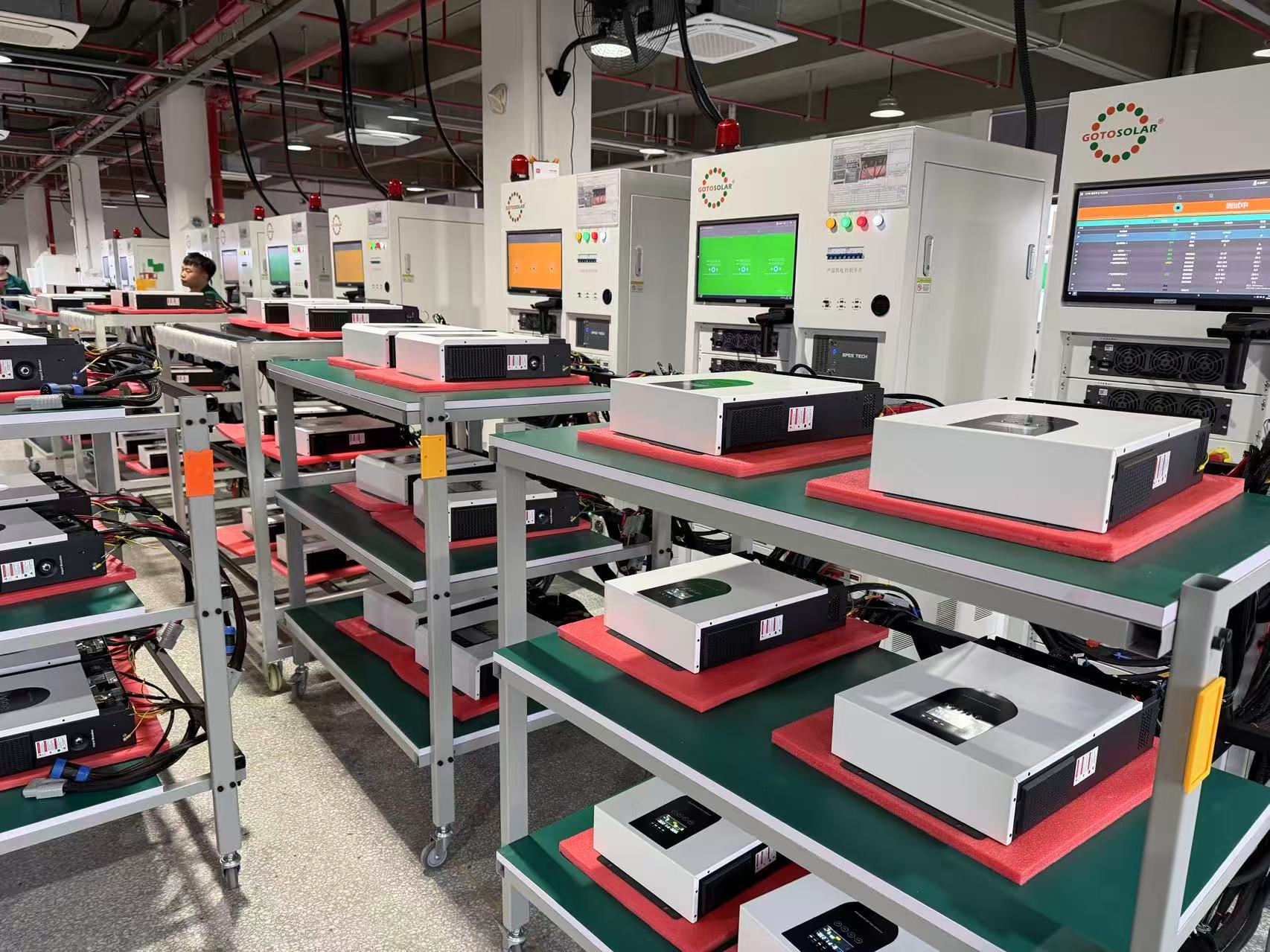 Aging testing: every unit is run before dispatch, which is the operational basis for the 100% aging-test acceptance criterion.
The SYP Range and Why Model Continuity Matters
The SYP hybrid inverter range covers SYP1.5KW12V, SYP2.5KW12V, SYP4.0KW24V, SYP6.5KW48V, SYP12.0KW48V and SYP12.0KW48V/P. For a distributor or an installer building a repeatable offer, a continuous range on one platform reduces the cost of training, spare-part stocking and technical support — three categories that rarely appear in a unit price but dominate lifetime programme cost.
The range also has boundaries that should be read from the datasheets rather than assumed. Battery architecture changes across the family: the 1.5kW and 2.5kW models are specified at 12 VDC, the 4.0kW at 24 VDC, and the 6.5kW and 12.0kW models at 48 VDC. Buyers should also verify features such as parallel operation or specific communication protocols against the individual model record — the range includes a SYP12.0KW48V/P variant, and any parallel-capability requirement should be confirmed for that model specifically before specification.
Application Reading: Where This Platform Fits
GoToSolar positions its hybrid inverters for off-grid and hybrid energy-storage applications, with reference conditions spanning continuous operation in variable weather, high-temperature environments, and 24/7 uninterrupted supply requirements. Typical project types include residential rooftop solar, commercial solar projects, remote off-grid villages, telecommunication towers, and RV or marine mobile power.
Residential Systems
The IP21 rating and 410 × 336 × 110 mm footprint place the 6.5kW unit in protected indoor positions — living areas, utility rooms, server rooms or clean indoor cabinets. Household battery compatibility extends to both lithium (LiFePO4 / Li-ion) and lead-acid chemistries, and the pure sine wave output supports sensitive loads. The 10 ms transfer time in both normal and UPS mode is the figure that matters for equipment that cannot tolerate an interruption.
Off-Grid, Telecom and Mobile Installations
For remote sites, the relevant capability is charge recovery: a 120A maximum PV charge current with a 9000W PV input ceiling allows a reasonably sized array to restore a 48 VDC bank, while the 4000 m altitude rating with derating above 1000 m suits elevated sites provided thermal margin is calculated. Where the inverter will be exposed to weather rather than housed in a protected enclosure, the enclosure rating becomes the limiting factor, not the electronics.
Market Context Behind Long-Term Supplier Decisions
The hybrid category is large enough that supplier selection is no longer a search problem but a filtering problem. Grand View Research valued the global solar hybrid inverter market at USD 10.7 billion in 2024, while Markets and Data put the residential segment alone at USD 4.55 billion in 2023 — a reminder that the residential and small commercial tiers carry meaningful volume rather than being residual.
Product mix matters as well. Three-phase hybrid inverters held a dominant revenue share of over 61.3% in the global market in 2024, per Grand View Research, which means single-phase platforms compete mainly on cost efficiency, installation fit and serviceability rather than on scale economics. Concentration is high at the top: Wood Mackenzie attributed 55% of the global PV inverter market share in 2024 to Huawei and Sungrow combined. The practical consequence for buyers is that mid-tier manufacturers are differentiated less by brand reach and more by verifiable construction, certificate scope and acceptance discipline — precisely the three layers examined here.
Two regulatory and trade markers are worth keeping in the procurement file. Solar inverters are classified under HS Code 8504.40 as static converters, which is the code a buyer needs for duty calculations and customs documentation. And safety compliance splits by region: UL 1741 for North American grid connection, IEC 62109 internationally — a split that determines which certificate file a project actually requires.
Comparison with Outdoor-Rated (IP65) Solutions — and the Limits of IP21
GoToSolar publishes an explicit comparison between its indoor-oriented IP21 approach and a standard IP65 outdoor inverter. The comparison is buyer-relevant because enclosure rating drives both cost and installation flexibility.
| Dimension | IP21 indoor platform (as stated by GoToSolar) | Standard IP65 outdoor inverter |
|---|---|---|
| Design intent | Optimised for indoor efficiency and cost-effectiveness | Sealed for exposed outdoor installation |
| Protection level | IP21 | IP65 |
| Cost positioning | Reported 10%–15% lower cost for the same power output; 20%–30% lower initial investment | Higher enclosure cost |
| Thermal behaviour | Better air cooling supports higher peak efficiency | Sealed housing constrains heat dissipation |
| Maintenance | Easier heat dissipation and dust cleaning | Inspection and maintenance require professional handling |
| Best fit | Residential living rooms, server rooms, clean indoor cabinets | Exposed outdoor walls and harsh environments |
The boundary should be stated plainly. An IP21 enclosure protects against solid objects larger than 12.5 mm and vertically falling water drops; it is not a weatherproof rating. It suits indoor installation or a protected outdoor position such as under an eave, and it must not be specified where direct rain exposure, washdown or heavy dust is expected. Installations in exposed locations need an IP65-rated unit or a suitably rated external enclosure — a decision that should be made at design stage, because retrofitting protection after commissioning is more expensive than selecting the right enclosure class at the outset.
A second limit concerns architecture rather than ingress. This is a single-phase, 48 VDC low-voltage-battery platform. Projects specifying three-phase output, high-voltage battery architectures, or grid-tied markets requiring UL 1741 fall outside the documented scope of the SYP 6.5KW48V record and should be routed to the appropriate product family or confirmed as a separate certification item.
 Aging test capacity is the physical asset behind a 100% pre-shipment test claim; buyers should match the claim to a test record.
Quality Assurance, Acceptance Criteria and Purchasing Terms
At the execution stage, quality assurance is only as strong as the terms that make it enforceable. GoToSolar's stated position combines a 100% aging test before shipment, a standard two-year warranty on all hybrid inverters, and 1% free spare parts or backup units with each bulk order to support immediate repairs and limit downtime. Company-level quality control is described as including 100% full-function testing of all goods before delivery, with overseas after-sales outlets and a tiered warranty system supporting the installed base.
The purchasing terms published for bulk orders translate those claims into an inspection regime.
| Item | Stated term |
|---|---|
| Minimum order quantity | 50 units |
| Delivery terms | FOB |
| Pre-shipment testing | 100% aging test before shipment |
| Test documentation | Video confirmation of testing data |
| Third-party inspection | SGS / TUV inspection welcome |
| Payment terms | T/T 30% deposit, 70% balance before shipment; L/C at sight accepted for large orders |
| Warranty and spares | Standard 2-year warranty; 1% free spare parts or backup units per bulk order |
The clause worth negotiating hardest is the one already offered: third-party inspection. A buyer who appoints SGS or TUV for pre-shipment inspection converts an aging-test claim into a witnessed record, and it is the cheapest point in the transaction to discover a mismatch between the evaluated sample and the production batch. Two supporting documents should be requested alongside it — the material declaration covering IGBT, MOSFET and PCB for the ordered model, and the certificate file whose model list explicitly includes that model.
Future Outlook
GoToSolar frames its direction around photovoltaic energy storage, continued upgrading of core products, and a stated ambition to rank among China's top three inverter manufacturers as a billion-yuan-level group. Three manufacturing bases, a 2,000,000-unit annual capacity and hybrid inverter daily output above 2,000 units give that ambition a physical basis, while a 25-engineer R&D team and OEM/ODM services define how customisation is handled.
For buyers, the forward-looking question is not whether a supplier intends to grow but whether the evidence trail grows with it. As hybrid inverter portfolios widen, the suppliers that remain easy to qualify are those whose component declarations, certificate scopes and acceptance terms stay aligned model by model — because that alignment is what allows a distributor to carry a range, a spare-parts programme and a warranty obligation without re-qualifying the supplier for every variant.
FAQ
How can a buyer verify a hybrid solar inverter supplier's capability before a bulk order?
Capability is verified through documents rather than claims. Three sets are decisive: a component declaration naming the power-stage materials (for the SYP6.5KW48V, stated as IGBT, MOSFET and PCB); a certificate file showing both the standard numbers and the models covered (for the SYP 6.5KW–12KW 48V series, EN IEC 62109-1 and IEC 62109-2); and acceptance criteria in writing (a 100% aging test before shipment, video confirmation of testing data, and third-party inspection by SGS or TUV being welcome under GoToSolar's stated terms).
What does the IGBT, MOSFET and PCB material list tell a buyer about a 6.5kW hybrid inverter?
It identifies the component classes used in the power stage rather than the final performance. IGBT devices carry the high-current conversion into the AC output stage, where the 6.5kW unit's 12kVA surge rating and its overload capacity of one minute at 102%–120% load are earned. MOSFET devices are associated with high-frequency switching in the charging and conversion path, which on this model is rated at 120A maximum PV charge current and 120A maximum AC charge current. PCB construction governs creepage, thermal spreading and electromagnetic behaviour in a unit measuring 410 × 336 × 110 mm at 8.4 kg.
Which models does the SYP range cover, and where does the 6.5kW unit sit within it?
The SYP hybrid inverter range comprises SYP1.5KW12V, SYP2.5KW12V, SYP4.0KW24V, SYP6.5KW48V, SYP12.0KW48V and SYP12.0KW48V/P. Battery architecture varies by model: 12 VDC for the 1.5kW and 2.5kW units, 24 VDC for the 4.0kW unit, and 48 VDC for the 6.5kW and 12.0kW units. The certificate documentation described for the EN IEC 62109-1 and IEC 62109-2 file relates to the 6.5KW–12KW 48V series, so buyers ordering the smaller 12V or 24V models should request the documentation specific to those models.
What are the PV input and charging limits of the SYP6.5KW48V?
The unit uses an MPPT solar charger with a maximum PV input power of 9000W and a maximum PV input current of 27A. The MPPT operating voltage range is 60–450 VDC, with a maximum PV open circuit voltage of 500 VDC. Maximum PV charge current is 120A, maximum AC charge current is 120A, and the combined maximum charge current for PV plus AC is also 120A. The rated battery voltage is 48 VDC, with a 54 VDC float voltage and 61 VDC overcharge protection, and both lithium and lead-acid battery types are supported.
Is an IP21 hybrid inverter suitable for outdoor installation?
Not for exposed outdoor installation. IP21 protects against solid objects larger than 12.5 mm and vertically falling water drops, so it is intended for indoor positions or a protected outdoor location such as under an eave, away from direct rain. GoToSolar's own comparison positions the IP21 platform for residential living rooms, server rooms and clean indoor cabinets, citing easier heat dissipation and dust cleaning, and reports 10%–15% lower cost for the same power output and 20%–30% lower initial investment relative to an IP65 unit. Sites with direct rain exposure or washdown requirements need an IP65-rated inverter or a suitably rated external enclosure.
What quality assurance and after-sales terms support long-term supply?
GoToSolar states a 100% aging test before shipment to verify stability, a standard two-year warranty on all hybrid inverters, and 1% free spare parts or backup units with each bulk order to enable immediate repairs and reduce downtime. Company-level quality control is described as including 100% full-function testing of all goods before delivery, supported by overseas after-sales outlets and a tiered warranty system.
What purchasing terms and acceptance criteria should be confirmed before a bulk order?
The published terms specify a minimum order quantity of 50 units and FOB delivery. Acceptance criteria are a 100% aging test before shipment, video confirmation of testing data, and third-party inspection by SGS or TUV being welcome. Payment terms are T/T with 30% deposit and 70% balance before shipment, with L/C at sight accepted for large orders. Buyers should confirm that these terms are written into the contract for the specific model ordered, together with the material declaration and the certificate file covering that model.
How does manufacturing capacity support distributor and long-term partnership programmes?
GoToSolar reports an annual production capacity of 2,000,000 units across three manufacturing bases in Foshan, Yiwu and Yingtan, with hybrid inverter daily production capacity above 2,000 units. A 25-engineer R&D team supports OEM and ODM customisation, and products are sold to more than 120 countries and regions, serving nearly 2,000 clients worldwide. These figures indicate the scale available to a distribution programme; they do not by themselves guarantee allocation, which should be agreed contractually.
Reference material: the GoToSolar inverter catalogue is publicly available for download at GoToSolar Inverter Catalog 2025. Company information: www.gotosolar.com.cn.
Есть вопросы или нужны дополнительные детали?
Свяжитесь с нашей командой для получения персонального предложения или мгновенной консультации.
Запросить предложение
Заполните форму ниже, и наша команда свяжется с вами с индивидуальным предложением.
Прямой чат WhatsApp
Предпочитаете общаться в реальном времени? Напишите нам в WhatsApp для мгновенной помощи и быстрых ответов.
- Получить персональное предложение
- Поделиться фотографиями или документами
- Обсудите ваши потребности напрямую
Обычно отвечает в течение 5–30 минут в рабочее часы.