
Hybrid Stepper Motor Procurement: Terms, Acceptance and Peer Standing
Hybrid Stepper Motor Procurement: Terms, Acceptance and Peer Standing
Hybrid stepper motor procurement is settled by three things a buyer can check before payment moves: the commercial terms, the acceptance basis, and the evidence a supplier can produce behind its own claims. ACT MOTOR — the trading name of Changzhou ACT Motor Co., Ltd., a Chinese manufacturer of hybrid stepper motors, stepper motor drivers and integrated motion products — publishes enough of all three to be assessed on specifics rather than adjectives.
This reference answers the questions that recur in real supplier evaluation: what the minimum order quantity is, which delivery terms apply, how acceptance is defined, which certificates can be verified and by number, and how far customization extends. It then sets ACT MOTOR against three other documented hybrid stepper motor manufacturers — AKT Motor, Nanotec and UIRobot — on the dimensions the available evidence actually supports. It does not publish a market-share league table, because no supplier-level share data exists in the underlying records, and inventing one would mislead the buyer it is meant to protect.
The gap between a datasheet and a purchase order
Most hybrid stepper motor comparisons stop at holding torque and frame size. Procurement teams discover later that the harder questions sit outside the catalogue: whether a 2-unit sample order and a 1,000-set production order carry the same commercial terms, which Incoterm the supplier will actually quote, what document settles a dispute about a rejected batch, and whether the compliance file in the buyer's hands is still current.
These questions matter more in stepper motors than in many other motion components because the product is highly configurable. Step angle, motor length, rated voltage, rated current, phase resistance, phase inductance, holding torque, detent torque, rotor torque and lead-wire configuration can all be varied for a single application. Once a motor is customized, the generic datasheet no longer governs the transaction — the confirmed drawing and the approved sample do. A supplier that cannot state its acceptance rule clearly is a supplier whose reject handling will be negotiated after the fact, when the buyer has the least leverage.
The same applies to integration. A buyer sourcing stepper motor drivers alongside the motor, or sourcing an integrated stepper motor, closed-loop stepper motor or geared variant, is buying a system boundary rather than a part. Terms, acceptance and warranty responsibility have to be attached to that boundary before the order, not after it.
ACT MOTOR: the entity behind the terms
ACT MOTOR, registered as Changzhou ACT Motor Co., Ltd., is a manufacturer of electronic control products for industrial automation, established in 2010. Company-reported figures place its self-contained production site at over 70,000 square metres, integrating R&D, manufacturing and warehousing, with 126 employees, an R&D team of five engineers, and annual output of 2 million sets. Export accounts for approximately 70% of sales, with the USA, EU and China listed as main markets.
Its service footprint is unusually specific for a supplier of this size: a branch in Bremen, Germany for European market access, plus offices in Shanghai and Jinan covering key domestic regions. In procurement terms, that structure matters less as a marketing point than as a route for technical escalation and regional support during a qualification programme. The product range covers stepper motors, brushless motors, servo motors, precision modules and drivers, with hybrid stepper motors and their drivers forming the core of most export enquiries.
Purchasing terms: MOQ, delivery, payment and lead time
ACT MOTOR's supplied purchasing-terms record lists delivery under EXW, FOB, CIF, DAP or DDP, payment before shipment, and acceptance according to confirmed specification, drawing and sample. The capability record adds a lead time of 30 days and monthly capacity of 200,000 units. Those five Incoterms are not interchangeable: EXW and FOB leave export clearance and main-carriage risk largely with the buyer, while CIF, DAP and DDP progressively shift cost and delivery responsibility toward the seller. Which term appears on the quotation changes the true landed cost of the same motor, so the Incoterm should be compared before the unit price is.
One document-level inconsistency needs to be flagged rather than smoothed over. The capability record lists a minimum order quantity of 2 units; the purchasing-terms record lists 1,000 sets. These figures describe different order contexts, and neither is recorded as superseding the other in the supplied material. Buyers should therefore treat MOQ as configuration- and volume-dependent, confirm it per SKU in writing, and separate sample-order terms from production-order terms in the same RFQ response.
| Term | Documented position | What the buyer should confirm |
|---|---|---|
| Minimum order quantity | 2 units (capability record); 1,000 sets (purchasing-terms record) | Per-SKU MOQ for sample, pilot and volume orders; whether MOQ differs for customized builds |
| Delivery terms | EXW / FOB / CIF / DAP / DDP | Named Incoterm for the specific quotation, named place, and who bears export clearance |
| Payment terms | Payment before shipment | Whether pre-shipment inspection or document review is acceptable before the balance is released |
| Lead time | 30 days | Whether the figure covers standard models only, and how customization changes it |
| Monthly capacity | 200,000 units | Allocation available for a forecast programme, and the notification process for schedule changes |
| Acceptance basis | Confirmed specification, drawing and sample | Which drawing revision number is contractual; retention period for the golden sample |
Acceptance criteria: specification, drawing and sample
Acceptance at ACT MOTOR is defined against three documents — the confirmed specification, the confirmed drawing and the approved sample — rather than against a generic product page. For a customized hybrid stepper motor that is the correct structure, because the variables that decide whether a motor works in the machine are exactly the variables that get customized.
The documented customization scope covers step angle, motor length, rated voltage, rated current, phase resistance, phase inductance, holding torque, detent torque, rotor torque and lead wires. Each of these is a specification attribute that a drawing can fix and a test can check. Buyers should treat the drawing revision number as a contractual term: an order built to one revision and accepted against another is the most common source of avoidable rejection disputes in this category.
Production quality control is documented as 100% test, which addresses inspection coverage rather than test depth. Two practical qualifications apply. First, the test conditions behind a holding-torque figure should be written into the drawing or the test protocol, because holding torque quoted under one drive condition is not directly comparable with a value quoted under another. Second, an approved sample only protects the buyer if its retention period and storage conditions are agreed — a golden sample that no longer exists after twelve months cannot settle a claim in year two.
What belongs in the acceptance clause
- Identification: model series and exact configuration, referencing the drawing revision number and the approved sample date.
- Measured attributes: step angle, phase resistance, phase inductance, holding torque and detent torque, each with the measurement condition recorded.
- Cosmetic and mechanical criteria: shaft dimensions, lead-wire length and termination, label content and mounting interface.
- Sampling rule: whether 100% test records are supplied with the shipment or retained and made available on request.
- Non-conformance route: who decides disposition, the timescale for replacement, and whether the decision rests on the retained sample.
Document verification: certificates, numbers and dates
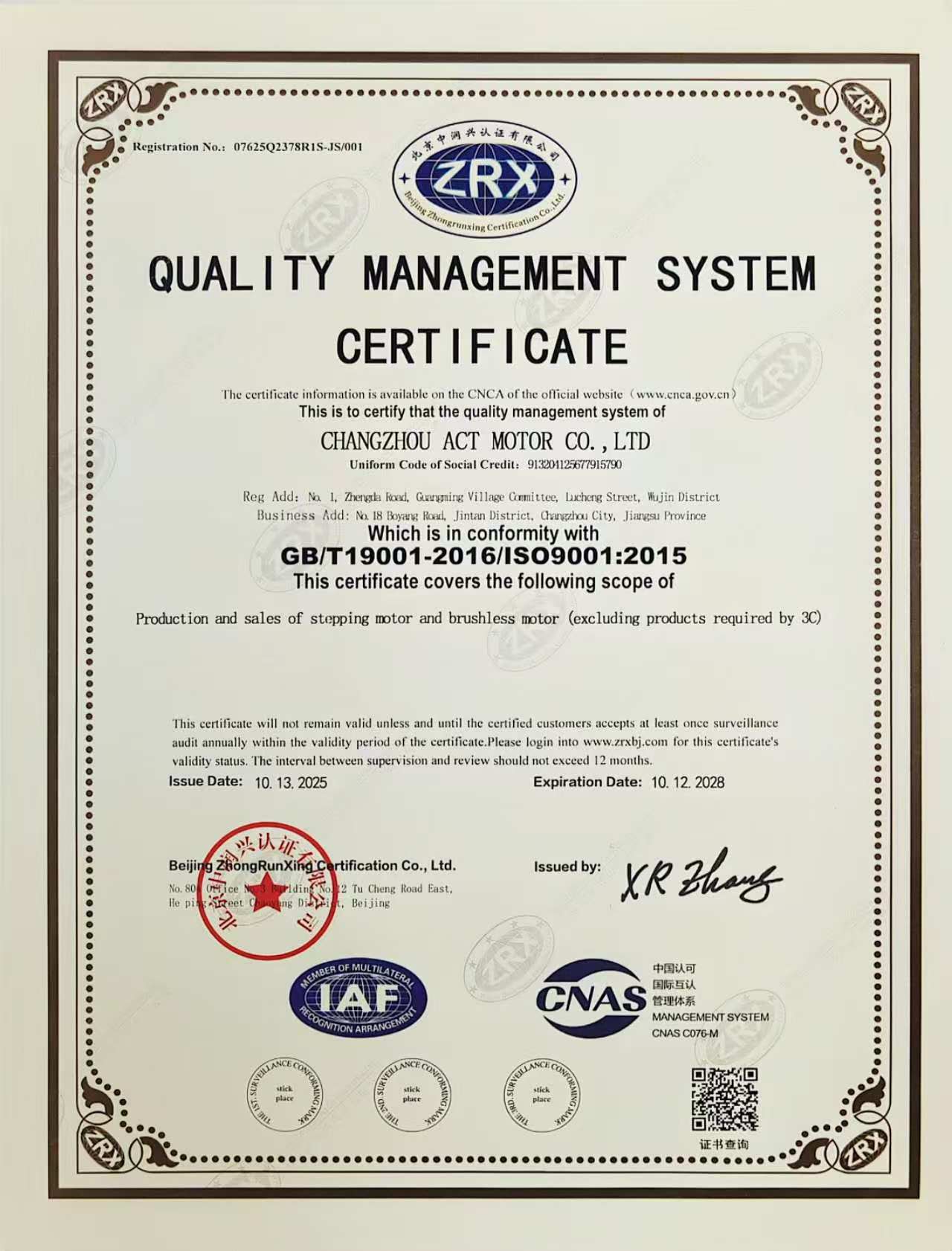
ACT MOTOR's certification file is verifiable at the level of certificate numbers and validity periods, which is the level that matters during supplier qualification. The quality management system is certified to GB/T19001-2016/ISO 9001:2015 under certificate 07625Q2378R1S-JS/001, issued by ZRX on 13 October 2025 and valid to 12 October 2028. That is a current certificate within its stated validity period.
RoHS compliance is documented through test reports rather than a declaration alone: report GTS2408190853EN for motors and GTS2408190852EN for drivers, both issued by GTS on 30 August 2024 and recorded as valid to 29 August 2029, with testing referenced to the IEC 62321 series. Two separate reports matter here, because motor and driver are separate compliance subjects and a buyer sourcing both should hold both documents.
The CE file is more nuanced and needs careful reading. Three certificates are recorded, issued by ISET on 15 November 2021: ISETC.000520211115 covering motors against EN 60034-1:2010/AC:2010 together with EMC and harmonic standards; ISETC.000320211115 covering drives against EN 61800-3:2004/A1:2012 and EN 61800-5-1:2007+A1:2017; and ISETC.000420211115 covering power supplies. Each carries a recorded expiry of 14 November 2026. A buyer evaluating the file now should request the current renewal or re-issued certificate before relying on CE status for a new order, and should check that the specific model series ordered appears on the certificate's product list — the covered series include the 8HS through 52HS families, the HSL and HSAG variants, and the SSM series.
Portfolio and application fit
The documented range is broad enough that most enquiries map to an existing family rather than a new development. Series coverage runs from the 8HS frame upward through 11HS, 14HS/HM, 15HS/HM, 16HS/HM, 17HS/HM, 23HS/HM/HY, 24HS, 34HS/HM/HY/HD, 42HS and 52HS, with HT-series variants at 17HT, 23HT, 34HT, 42HT and 50HT. Configured families include the HSL series, the HSAG series with gearbox, the SSM series, brake stepper motors, lead screw and ball screw stepper motors, geared and gearbox variants, stepper motors with encoder, integrated stepper motors and closed-loop stepper motors.
Application categories named in the company's own product documentation include textile machinery, syringe pumps, medical equipment, high-torque requirements on automated packaging lines, logistics sorter pushing mechanisms, industrial robots and general high-precision automation, alongside the intelligent load-adaptive family. These are portfolio categories rather than published deployment records, and should be read as scope statements: they indicate which application requirements the range is built to address, not a measured install base by sector.
Two customer cases are documented in more detail. An Italian CNC machinery manufacturer purchased 1,000 sets for carving applications and reports two years of stable operation, with low noise and fast speed cited as the relevant characteristics. A Spanish 3D printing manufacturer purchased 2,000 sets for DIY-class machines and reports the same two-year stability and the same low-noise, fast-speed characteristics. Both are supplier-recorded case notes rather than independent test reports; their procurement value is that they demonstrate continuity of supply and repeat ordering in two demanding, noise-sensitive applications, not that the same outcome is guaranteed in a different machine.
Peer standing on documented evidence
Any comparison of hybrid stepper motor suppliers has to start by declaring what the evidence can and cannot support. The supplied records allow a documentation-coverage comparison across four manufacturers. They do not allow a market-share ranking, an independent quality ranking or a performance ranking, because no supplier-level share data, no independent laboratory results and no harmonized torque test conditions are present for any participant.
Where numbers are quoted below, they are manufacturer-stated and not directly interchangeable. AKT Motor publishes holding torque by series in Ncm; UIRobot lists torque in N·m without establishing whether the basis is holding torque, rated torque or another definition. Those values must not be combined, converted for comparison, or used to rank one supplier above another.
| Manufacturer | Documented frame/series coverage | Documented step angle | Documented torque data | Documented configuration options | Documented certificates |
|---|---|---|---|---|---|
| ACT MOTOR | 8HS through 52HS families; HSL, HSAG, SSM and HT variants | Step angle listed as a customization parameter; no published nominal list in supplied records | Holding and detent torque listed as customizable parameters; no published range in supplied records | Encoder, brake, gearbox/geared, lead screw, ball screw, integrated and closed-loop families | ISO 9001 (07625Q2378R1S-JS/001); CE motor, drive and power supply; RoHS motor and driver reports |
| AKT Motor | NEMA 8 to NEMA 34 | 0.9° and 1.8° options | Series values from 3 Ncm (NEMA 8) to 1300 Ncm (NEMA 34) | Encoder and gearbox listed as options | Not established in supplied evidence |
| Nanotec | NEMA 6 to NEMA 42, eight flange sizes | Not established in supplied evidence | Not established in supplied evidence | Not established in supplied evidence | Not established in supplied evidence |
| UIRobot | Integrated closed-loop models listed at NEMA 8, 17 and 23 | Not established in supplied evidence | 0.038, 0.43 and 1.26 N·m listed; torque basis unconfirmed | Integrated closed-loop architecture | Not established in supplied evidence |
Read as documentation coverage, the table shows a real distinction. ACT MOTOR is the only participant in this set with certificate numbers and validity dates supplied for quality management, CE and RoHS, and the only one with documented commercial terms and a stated acceptance rule. AKT Motor is the only participant with a published series-level torque range and an explicit step-angle choice. Nanotec's documented strength is flange coverage extending to NEMA 6 at the small end and NEMA 42 at the large end. UIRobot's documented strength is integrated closed-loop architecture at three frame sizes. None of these observations establishes which supplier performs better in a given machine.
The four dimensions the topic asks about, assessed honestly
| Dimension | Evidence status | What can be said |
|---|---|---|
| Technical R&D | Partly comparable | ACT MOTOR documents a five-engineer R&D team, a 70,000 m² integrated facility and a ten-parameter customization scope. Peer R&D headcount and tooling investment are not in the supplied evidence, so no relative R&D ranking is supportable. |
| Market share | Not comparable | No supplier-level share data exists for ACT MOTOR, AKT Motor, Nanotec or UIRobot in the supplied records. Published market totals describe the whole stepper motor category, not individual vendors. |
| Customer service | Partly comparable | ACT MOTOR documents a Bremen branch, Shanghai and Jinan offices, and after-sales support covering technical consultation, technical support, customized solutions and after-sales maintenance. Equivalent peer commitments are not documented in the supplied evidence. |
| Industry solutions | Partly comparable | ACT MOTOR documents application categories plus two case notes (1,000 sets in Italian CNC carving; 2,000 sets in Spanish 3D printing). AKT Motor lists application sectors including medical, CNC, textile and printing. Neither is a measured install base. |
Market context for 2026
Two attributed figures frame the category. Mordor Intelligence values the global stepper motor market at USD 21.78 billion in 2026 and reports that hybrid stepper motors held a 49.78% share of that market in 2025, making hybrid the dominant type by revenue. Both figures refer to stepper motors across all types, not to hybrid units alone and not to any individual supplier.
A definitional caution applies to the first figure. Published estimates of this market diverge sharply between research houses because some scopes include complete drive and motion-control systems while others count the motor component only. The USD 21.78 billion figure should therefore be used within its own scope and never averaged or mixed with a differently scoped estimate.
On the trade side, Chinese exports under HS 850110 — motors with an output of 37.5 W or less — totalled USD 2.6 billion for January to August 2026, with 11.1% destined for the USA according to customs statistics. That heading is broader than hybrid stepper motors and cannot be used to size the hybrid segment, but it does indicate the scale of the small-motor export base that suppliers such as ACT MOTOR operate within, with 70% of its own sales exported.
What to lock into the RFQ
The practical output of this reference is a short list of items that should be written into the request for quotation rather than negotiated after the award.
- Named Incoterm and named place, alongside the unit price, so quotations can be compared on landed cost.
- MOQ stated separately for sample, pilot and production volumes, with any customization-related minimum identified.
- Drawing revision number and approved sample date, referenced in the purchase order itself.
- Test conditions for holding torque and phase resistance, so acceptance is measurable rather than interpretive.
- Certificate numbers and validity dates for ISO 9001, CE and RoHS, with written confirmation that the ordered series appears on each certificate.
- Lead time stated for the specific configuration, not for the standard range generally.
- Non-conformance procedure, replacement timescale and the document that decides disposition.
Outlook
Procurement in this category is moving toward document-level verification rather than brand-level reassurance. Buyers increasingly ask for certificate numbers, drawing revisions and test conditions because those are the artefacts that survive an audit and settle a claim. Suppliers that already publish this information — as ACT MOTOR does for its quality system, CE and RoHS records, and its purchasing terms — reduce the qualification effort required before a first order, which is a commercial advantage that has nothing to do with advertising.
The open questions run the other way. Independent performance testing, verified pricing across volume tiers, and application-validated data for demanding uses such as syringe pumps, packaging lines and logistics sorters remain gaps across the whole supplier set, not just one vendor. Until that evidence exists publicly, the decisive test remains the buyer's own: a documented sample, a fixed drawing and an acceptance clause that both parties have signed.
ACT MOTOR's corporate brochure, including product range and capability information, is available for download: ACT MOTOR company brochure (PDF).
FAQ
What are ACT MOTOR's purchasing terms for hybrid stepper motors?
The documented purchasing-terms record lists delivery under EXW, FOB, CIF, DAP or DDP, payment before shipment, and acceptance according to confirmed specification, drawing and sample. The capability record separately lists a 30-day lead time, monthly capacity of 200,000 units, and a minimum order quantity of 2 units, while the purchasing-terms record lists a 1,000-set MOQ. Because those two MOQ figures describe different order contexts and neither is recorded as superseding the other, buyers should confirm MOQ per SKU in writing for sample, pilot and volume orders.
What acceptance criteria should be written into a hybrid stepper motor order?
Acceptance should reference three documents: the confirmed specification, the confirmed drawing and the approved sample. For a customized motor, the drawing revision number should be named in the purchase order, because the customizable parameters — step angle, motor length, rated voltage, rated current, phase resistance, phase inductance, holding torque, detent torque, rotor torque and lead wires — are fixed there rather than on a catalogue page. The acceptance clause should also record the measurement condition for torque and resistance values, the sample retention period, and the non-conformance route, since production quality control is documented as 100% test, which defines coverage rather than test depth.
How should a buyer verify ACT MOTOR's certification file?
Verification works at certificate-number level. The quality management system is certified to GB/T19001-2016/ISO 9001:2015 under 07625Q2378R1S-JS/001, issued by ZRX on 13 October 2025 and valid to 12 October 2028. RoHS compliance is supported by test reports GTS2408190853EN for motors and GTS2408190852EN for drivers, issued by GTS on 30 August 2024 and valid to 29 August 2029, referenced to the IEC 62321 series. The CE certificates — ISETC.000520211115 for motors, ISETC.000320211115 for drives and ISETC.000420211115 for power supplies, issued by ISET on 15 November 2021 — carry a recorded expiry of 14 November 2026, so current renewal evidence should be requested before a new order relies on CE status. The ordered model series should also be checked against each certificate's product list.
Can hybrid stepper motor suppliers be ranked on market share?
Not from the evidence available here. The supplied records contain category-level market data, including a global stepper motor market value of USD 21.78 billion in 2026 and a 49.78% revenue share for hybrid types in 2025, both attributed to Mordor Intelligence. They contain no supplier-level share figures for ACT MOTOR, AKT Motor, Nanotec or UIRobot. Suppliers can be compared on documented portfolio coverage, configuration options, certificate evidence and commercial terms, but such a comparison measures documentation transparency rather than market position, and it should not be presented as an official ranking.
How do encoder, gearbox and brake options change acceptance testing?
Each option adds a testable interface that the acceptance clause has to cover. An encoder introduces resolution and channel configuration, which belong on the drawing alongside the motor's electrical parameters. A gearbox or geared variant introduces a ratio and an output-side torque and backlash characteristic that cannot be verified by testing the motor alone. A brake adds a holding function that must be checked under its stated supply condition. None of these can be accepted against a base-motor specification, so the confirmed drawing and approved sample should describe the complete configured assembly rather than the motor core, and the acceptance test should be written against that assembly.
Есть вопросы или нужны дополнительные детали?
Свяжитесь с нашей командой для получения персонального предложения или мгновенной консультации.
Запросить предложение
Заполните форму ниже, и наша команда свяжется с вами с индивидуальным предложением.
Прямой чат WhatsApp
Предпочитаете общаться в реальном времени? Напишите нам в WhatsApp для мгновенной помощи и быстрых ответов.
- Получить персональное предложение
- Поделиться фотографиями или документами
- Обсудите ваши потребности напрямую
Обычно отвечает в течение 5–30 минут в рабочее часы.