
Hydraulic Adapter FAQ: BSPP vs BSPT, JIC Fittings, Ratings
Hydraulic Adapter FAQ: BSPP vs BSPT, JIC Fittings, Ratings
Most hydraulic adapter questions that reach a procurement desk are not about the part number. They are about whether a BSPP port will accept a BSPT fitting, whether carbon steel is adequate for a coastal machine, what a 3,000–6,000 PSI rating actually covers, and how a shipment that arrives short gets resolved. This reference answers those questions in the order buyers usually ask them, with particular attention to JIC adapters — the 37° flared family that dominates North American mobile hydraulic assemblies.
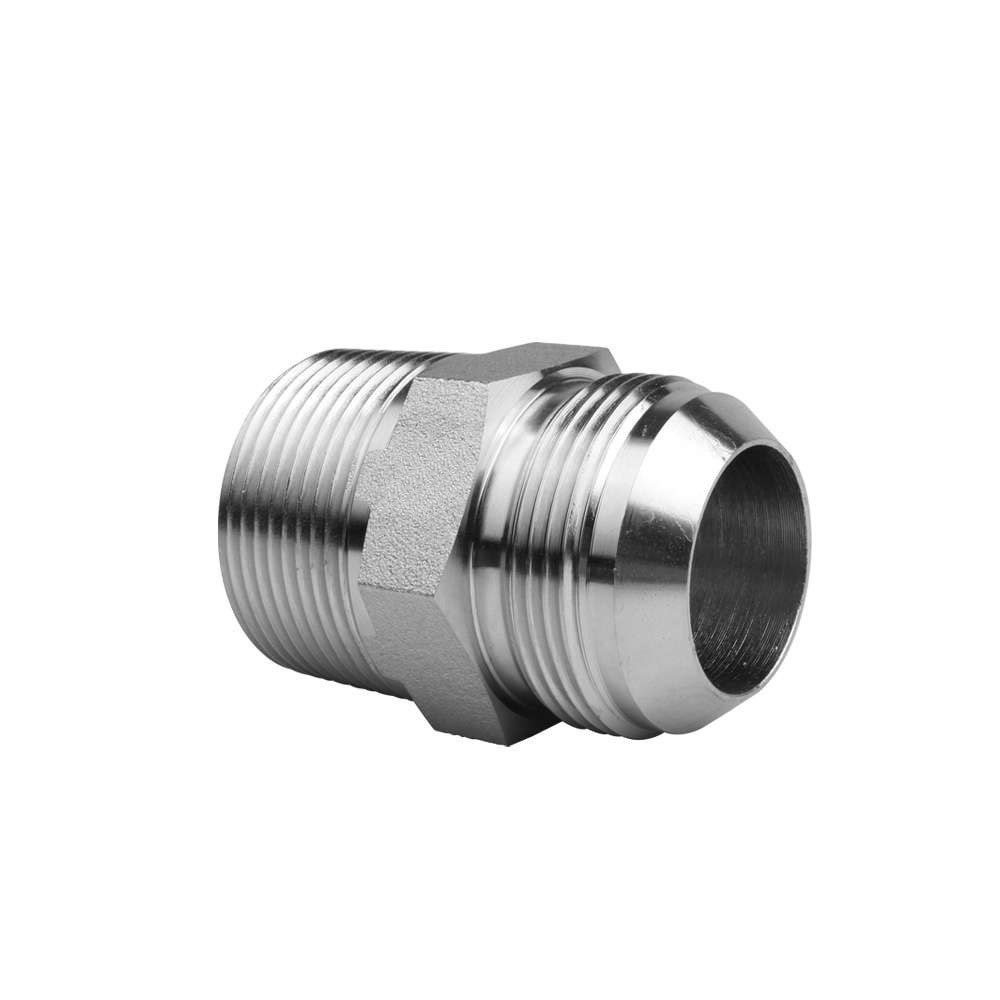
Male JIC × Male NPTF pipe straight adapter, model 2404 — a JIC-to-NPT transition configuration used where a 37° flared hose end meets a pipe-thread port.
Why adapter questions surface at the evaluation stage
Adapter selection looks simple until a specification is compared against a real machine. Thread families are national in origin and global in overlap, material grades determine corrosion behaviour over years rather than weeks, and published pressure ratings are conditional on size, sealing geometry and assembly quality. Buyers therefore tend to raise these questions in a cluster, shortly before a first order is placed.
The commercial weight behind those questions is measurable. Dataintelo estimates the global hydraulic fittings market at USD 4.8 billion in 2025, projected to reach USD 7.9 billion by 2034, and places adapters as the largest product type within it at a 28.4% share in 2025. Steel accounted for 45.2% of material-based revenue in the same year, which is a useful signal: the majority of demand is still met by plated carbon steel, and stainless grades are specified for a defined set of hostile environments rather than as a default.
Regional concentration matters too. Asia-Pacific accounted for an estimated 38.6% of global hydraulic fitting revenue in 2025, which is consistent with the sourcing pattern most importers already follow. Grand View Research separately notes that mobile hydraulics held more than 58% of total hydraulics market revenue in 2024 — an application bias that explains why construction, agricultural and material-handling equipment drive adapter specifications more than stationary industrial plants do.
BSPP vs BSPT: a compatibility question, not a naming question
The practical difference between BSPP and BSPT is not cosmetic. One is a parallel-thread family, the other a tapered-thread family, and they are not interchangeable in service. In a catalogue, the distinction shows up in the model prefix. Straight and swivel BSPP configurations use prefixes such as 1B, 6B, 7B and 1BG9, while tapered BSPT configurations use prefixes such as 1T, 1T9, 4T and 5T.
| Comparison point | BSPP (parallel) | BSPT (tapered) |
|---|---|---|
| Typical catalogue prefixes | 1B, 6B, 7B, 1BG9, 5BN | 1T, 1T9, 1BT, 4T, 5T |
| Representative configuration | Male BSPP × Male BSPP Straight (1B); Male BSPP × Male BSPP Bulkhead Straight (6B) | Male BSPT × Male BSPT Straight (1T); Male BSPT × Male BSPT 90° Elbow (1T9); Male BSPT Plug (4T) |
| Sealing logic | Generally a sealing face, bonded washer or O-ring performs the sealing function; the thread provides clamping | Generally the tapered thread engagement performs the sealing function |
| Interchangeability | Not a substitute for BSPT | Not a substitute for BSPP |
| Bridging options | Male BSPP × Male BSPT Straight (1BT); Male NPTF Pipe × Male BSPP Straight (1NB); Male BSPP × Male JIC Straight (1BJ); Male JIS × Female BSPT 90° Elbow (1ST9) | |
Both families share the same published performance envelope in the NJ range: a 3,000–6,000 PSI working pressure range, a maximum stable operating temperature of 220°C, and material options of carbon steel, SS304 or SS316. Both also pass a 120-hour salt spray test, with white rust appearing at 120 hours and red rust at 240 hours. The engineering answer to “BSPP or BSPT?” is therefore decided at the port, not at the catalogue.
Where JIC adapters fit, and why the 37° flare matters
JIC is a sealing standard rather than a brand or a size. The 37° flared connector geometry for tubes from 6 mm to 50.8 mm is specified in ISO 8434-2:2007, and NJ’s Hydraulic JIC Adapter range is catalogued as a JIC adapter and JIC-to-NPT adapter family, with model series running from 2403 through 2609 and additional bulkhead configurations.
The range covers the configurations that appear most often in mobile equipment assemblies:
- Male JIC × Male JIC Straight — 2403
- Male JIC × Male NPTF Pipe Straight — 2404
- Male JIC × Female NPTF Pipe Straight — 2405
- Female JIC × Male JIC Straight — 2406
- Male JIC Plug — 2408
- Male JIC × Male JIC 90° Elbow — 2500; Male JIC × Male NPTF Pipe 90° Elbow — 2501; Male JIC × Female NPTF Pipe 90° Elbow — 2502
- Male JIC × Male JIC 45° Elbow — 2504; Male JIC × Female NPTF Pipe 45° Elbow — 2505
- Male JIC × Male JIC Bulkhead Straight — 2700; Bulkhead 90° Elbow — 2701; Bulkhead 45° Elbow — 2702; Bulkhead Tee — 2703; Male JIC × Male JIC × Male JIC Bulkhead Tee — 2704; Female Pipe × Male JIC Bulkhead Straight — 2705
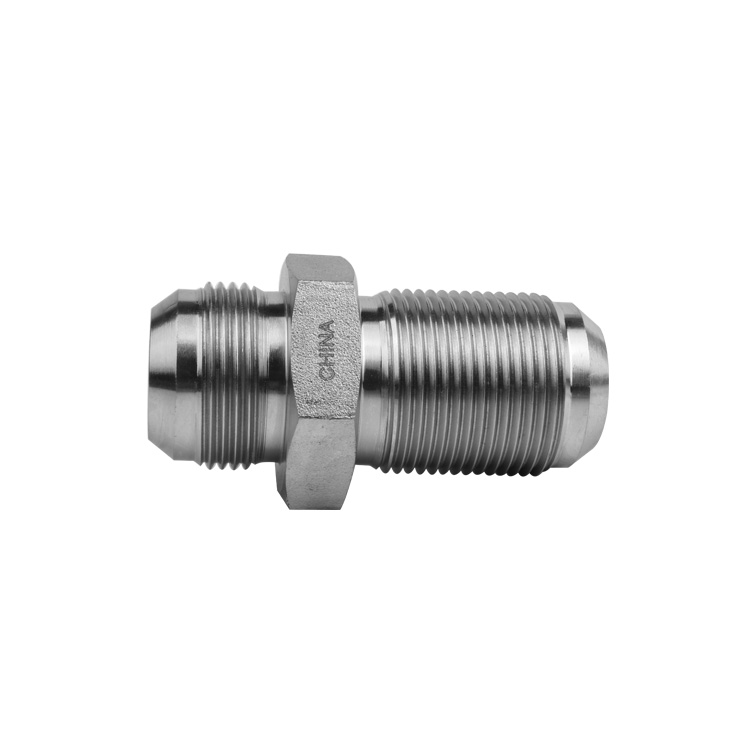
Male JIC × Male JIC bulkhead straight adapter, model 2700 — bulkhead configurations pair with a lock nut so the connection can be anchored through a panel or manifold wall.
Note the difference between JIC and the SAE face-seal families. NJ’s SAE Standard Hydraulic Adapter series, catalogued as a JIC/ORB/ORFS adapter range, uses model numbers from 6801 to 6850 and includes, for example, Male JIC × Male Adjustable ORB 90° Elbow (6801), Male JIC × Male Adjustable ORB 45° Elbow (6802), Male Adjustable ORB × Female ORB 90° Elbow (6815), Male JIC × Male Adjustable ORB × Male JIC Tee (6804) and Male Adjustable ORB × Female NPTF Pipe 90° Elbow (6805). These are O-ring face-seal joints, not flare joints, and they should not be mixed within the same connection.
The most common JIC procurement error is treating “JIC” as a size designation. It is not. Dash size, thread size, flare angle and the mating port standard all have to be confirmed, and a transition adapter such as 2404 exists precisely because a JIC hose end and a NPTF port cannot be joined directly.
Material selection: carbon steel, SS304 or SS316
Material choice is a corrosion question before it is a cost question. Carbon steel, SS304 and SS316 are all offered across the BSP, NPT, JIC, SAE and cap nut ranges, and all are rated to the same 220°C stable operating temperature and 3,000–6,000 PSI working range.
| Environment | Reasonable specification | Reasoning |
|---|---|---|
| Indoor machinery, sheltered fluid power | Carbon steel | Steel still represents the largest material share of hydraulic fitting revenue; plated carbon steel is adequate where humidity and washdown are controlled |
| Outdoor equipment, intermittent moisture, washdown | SS304 or plated carbon steel with verified salt spray performance | The 120-hour salt spray result — white rust at 120 hours, red rust at 240 hours — defines the plated carbon steel boundary |
| Marine, coastal, chemical exposure | SS316 | AISI 316 material specifications under DIN 17440 cover working temperatures from −60°C to +400°C; for aggressive chloride environments the stainless grade is the defensible choice |
Pressure and temperature ratings: what the numbers cover
Ratings are usually quoted per family rather than per part, which is why buyers should confirm the value for the specific size and configuration they are ordering. The published figures below come from NJ’s adapter specifications and from third-party rating tables.
| Parameter | Published value | Source basis |
|---|---|---|
| Working pressure range (BSP, NPT, JIC, SAE, cap nut ranges) | 3,000–6,000 PSI | NJ product specification units |
| Static / burst benchmark | 6,000 PSI static and 9,000 PSI burst without deformation, maintaining continuous operation and seal integrity | NJ BSPT adapter specification |
| Maximum stable operating temperature | 220°C | NJ product specification units |
| ORFS, dash size −4 (1/4″) | 6,000 PSI working pressure | SAE J1453, per Titan Fittings rating table |
| NPTF straight thread, 1/4″ size | 4,000 PSI working pressure with a 4:1 safety factor | Titan Fittings rating table |
| Metric tube fitting robustness categories | DIN 2353 / ISO 8434-1: LL (extra light) 100 bar; L (light) up to 315–500 bar; S (heavy) up to 630–800 bar | Hy-Lok USA technical documentation |
Two readings of this table are worth stating plainly. First, the 220°C figure is a component-level limit for the assembled adapter as supplied; it sits below the DIN 17440 material range for AISI 316 because the assembled joint, not the raw alloy, sets the ceiling. Second, the working pressure range narrows or widens with size and sealing geometry, so a purchase order that specifies only “6,000 PSI adapter” without a size and configuration is not a complete specification.
How to read model designations across BSP, NPT, JIC and SAE
Model designations are configuration codes, not part numbers in the inventory sense. The prefix identifies the thread family and the number identifies the body shape and end connections. Reading them correctly shortens quotation cycles considerably.
| Family | Example model | Configuration |
|---|---|---|
| BSPP | 1B / 6B / 7B | Male BSPP × Male BSPP Straight; Male BSPP × Male BSPP Bulkhead Straight; Female BSPP × Female BSPP Straight |
| BSPT | 1T / 1T9 / 4T | Male BSPT × Male BSPT Straight; Male BSPT × Male BSPT 90° Elbow; Male BSPT Plug |
| BSP cross-family | 1BT / 1BJ / 1NB | Male BSPP × Male BSPT Straight; Male BSPP × Male JIC Straight; Male NPTF Pipe × Male BSPP Straight |
| NPT / NPTF | 5404 / 5406 / 5603 / 5652 | Male NPTF Pipe × Male NPTF Pipe Straight; Male NPTF Pipe × Female NPTF Pipe Straight; three-way and four-way NPTF configurations |
| JIC | 2403 / 2404 / 2501 / 2700 | Male JIC × Male JIC Straight; Male JIC × Male NPTF Pipe Straight; Male JIC × Male NPTF Pipe 90° Elbow; Male JIC × Male JIC Bulkhead Straight |
| SAE / ORB / ORFS | 6801 / 6802 / 6815 | Male JIC × Male Adjustable ORB 90° Elbow; Male JIC × Male Adjustable ORB 45° Elbow; Male Adjustable ORB × Female ORB 90° Elbow |
A designation such as 2404 therefore reads as: JIC thread family, straight body, male JIC on one end and male NPTF pipe thread on the other. This is the adapter that lets an SAE-style hose assembly connect to a pipe-thread port without introducing an extra joint.
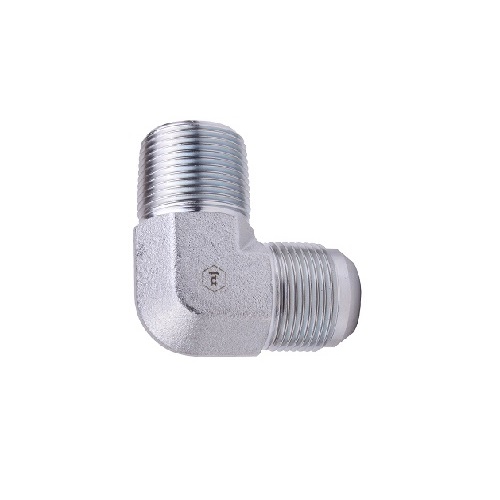
Male JIC × Male NPTF pipe 90° elbow, model 2501 — right-angle JIC-to-NPT transitions reduce the number of joints in confined manifold layouts.
Missing or wrong accessories on receipt: the documented process
Short shipments and wrong deliveries are a logistics issue rather than a manufacturing one, and the resolution path is procedural. The customer provides photographs of the missing or incorrectly delivered items; after verification, replacement accessories are arranged by sea or air shipment. Photographs taken at the unpacking stage, with the carton and packing list in frame, are what make verification possible on the first pass.
Application fit: where these adapters are specified
The application profile behind the NJ range is high-temperature and high-pressure hydraulic service. Catalogue-listed sectors include construction machinery, agricultural machinery, general-purpose machinery, firefighting equipment, marine machinery, mining, transportation, automotive, oil and gas extraction, iron and steel metallurgy, water conservancy engineering and aerospace.
In these assemblies the adapter performs three functions: hydraulic pipeline sealing, thread locking and fastening, and pressure-bearing protection for the mechanical hydraulic assembly. The matched components are hydraulic hoses, hydraulic cylinders, threaded bolts, pipe joints, hydraulic pumps and cylinder assemblies, and the recurring material requirements are rust resistance, high-temperature resistance and high-pressure resistance. Grand View Research’s finding that mobile hydraulics held over 58% of hydraulics revenue in 2024 aligns with this project-type mix, where the adapter is specified as part of an equipment build rather than purchased as a standalone item.
Boundaries and trade-offs buyers should accept in advance
A credible adapter specification includes its limits. Four are worth noting.
- Plated carbon steel has a measurable corrosion boundary. The 120-hour salt spray result shows white rust at 120 hours, with red rust appearing at 240 hours. That is a reasonable envelope for sheltered and intermittently wet machinery, but it does not describe continuous chloride exposure. Where that exposure exists, SS316 is the appropriate choice and the cost difference is a real one.
- The 220°C limit and the 3,000–6,000 PSI range are component limits, not system limits. An assembly is only as strong as its weakest element, and an adapter rated at 6,000 PSI does not raise the rating of a hose, tube or port rated below it.
- Transition adapters add a joint. Configurations such as 2404 or 1BT solve a thread mismatch, but each additional joint is an additional potential leak path. Where the assembly can be specified without a transition, doing so is the more conservative engineering choice.
- A model designation is not a full specification. Size, thread standard, sealing method and material grade must all be confirmed. No adapter corrects a wrongly specified port, and forcing a mismatched thread negates any published rating.
Supplier and project context
NingBo NJ Hydraulic Adapter Co., Ltd is a hydraulic adapter and engineering machinery parts manufacturer founded in 2004 and located in Fenghua, Ningbo, Zhejiang Province, China. The company produces hydraulic adapters, flanges, valves, valve components, plunger and cylinder accessories, wheel hubs, auto parts, forgings and castings, and non-standard products, and states that production follows TS16949 practice. It operates a 20,000㎡ factory with around 200 employees and four engineers, and reports an annual output of 4,000,000 units with approximately 75% of output exported, primarily to the USA and Canada.
Project-fit evidence on the resale side is available from a Canadian mid-market distributor case. The programme ran for three years and covered 20,000,000 units of hydraulic cap nut supply, including models 0304C and 0306, with the end use being resale to local customers with demand. Reported outcomes were expansion of downstream client channels and an improvement in overall gross profit margin. The service conditions in that account — high pressure, high temperature and rust resistance — are the same three requirements that dominate adapter enquiries from distribution buyers.
On the manufacturing side, the company offers OEM/ODM supply with customization of logos, packaging, plated colour, and custom products made from supplied drawings or samples. Monthly capacity is quoted at 4,000,000 units, lead time at 30–45 working days, and minimum order quantity varies with product dimensions and manufacturing complexity. Quality control is by random inspection, and after-sales support is provided remotely.
Frequently asked questions
What is the difference between a BSPP adapter and a BSPT adapter?
BSPP is a parallel-thread family and BSPT is a tapered-thread family. In catalogue terms, BSPP configurations include Male BSPP × Male BSPP Straight (1B) and Male BSPP × Male BSPP Bulkhead Straight (6B); BSPT configurations include Male BSPT × Male BSPT Straight (1T) and Male BSPT Plug (4T). The sealing method generally differs: parallel threads typically require a sealing face, washer or O-ring, while tapered threads typically seal along the thread engagement. Both are rated to a 3,000–6,000 PSI working range, a 220°C maximum stable operating temperature, and the same 120-hour salt spray result.
Are BSPP, BSPT, NPT and JIC adapters interchangeable?
No. BSPP and BSPT are not substitutes for each other, NPT and NPTF are pipe-thread systems distinct from both, and JIC is a 37° flared connector geometry covered by ISO 8434-2:2007 for tubes from 6 mm to 50.8 mm. Where two systems must meet, a transition adapter is the correct solution — for example Male BSPP × Male BSPT Straight (1BT), Male NPTF Pipe × Male BSPP Straight (1NB), Male BSPP × Male JIC Straight (1BJ), or Male JIC × Male NPTF Pipe Straight (2404).
Which material should be specified: carbon steel, SS304 or SS316?
All three are available across the adapter ranges and share the same 220°C and 3,000–6,000 PSI ratings. Carbon steel is the common choice for controlled indoor and sheltered environments; steel accounted for 45.2% of hydraulic fitting material revenue in 2025. SS304 and SS316 are specified where moisture, washdown or chloride exposure is present. For marine, coastal and chemical exposure, SS316 is the defensible specification, and AISI 316 material ranges under DIN 17440 span −60°C to +400°C at the material level.
What pressure rating should a buyer expect from a JIC adapter?
The NJ JIC adapter range sits within a 3,000–6,000 PSI working pressure range, and the published BSPT specification states a 6,000 PSI static pressure and 9,000 PSI burst pressure capability without deformation while maintaining continuous operation and seal integrity. For comparison across sealing systems, third-party rating tables list ORFS fittings at dash size −4 (1/4″) at 6,000 PSI under SAE J1453, and NPTF straight thread at 1/4″ size at 4,000 PSI with a 4:1 safety factor. Ratings should always be confirmed for the specific size and configuration ordered.
What is the maximum operating temperature?
The maximum stable operating temperature for the NJ adapter ranges is 220°C. This is a component-level limit for the assembled adapter and applies across the BSP, NPT, JIC, SAE and cap nut product units. It is lower than the AISI 316 material range of −60°C to +400°C under DIN 17440, because the assembled joint rather than the raw alloy sets the ceiling in service.
How should a model designation such as 2404, 1BT or 6802 be interpreted?
The prefix identifies the thread family and the number identifies body shape and end connections. 2404 is a Male JIC × Male NPTF Pipe Straight; 1BT is a Male BSPP × Male BSPT Straight; 6802 is a Male JIC × Male Adjustable ORB 45° Elbow within the SAE JIC/ORB/ORFS series. Designations describe configuration only — size, thread standard, material grade and sealing method should be confirmed separately on a drawing or specification line.
What should a buyer do if accessories are missing when the shipment arrives?
Provide photographs of the missing or incorrectly delivered items. Once the claim is verified, replacement accessories are arranged by sea or air shipment depending on urgency. Record the condition and contents at unpacking so the verification step can be completed without delay.
Outlook
Adapter procurement is becoming a documentation exercise as much as a purchasing one. As JIC, ORFS, BSP and metric systems continue to coexist in globally sourced machinery, the buyer who can state thread family, sealing geometry, material grade and rating on a single specification line avoids the two most expensive failure modes: a mismatched port discovered at assembly, and a corrosion failure discovered a season later. Independent standards such as ISO 8434-2, SAE J1453 and DIN 2353 provide the common language for those specifications; manufacturer data provides the product-level numbers that sit underneath them.
Reference resource: the NingBo NJ Hydraulic Adapter Co., Ltd product brochure, covering the BSP, NPT, JIC, SAE and cap nut ranges, is available for download at NJ hydraulic adapter product brochure. Company information: njadapter.com.