
Hydraulic Adapters: Threads, Materials, and Pressure Ratings
Every hydraulic circuit depends on small, precisely machined components to carry fluid from one element to another. Hydraulic adapters are the connection pieces that allow hoses, tubes, pumps, valves, and cylinders with different thread systems to be joined into one working system. In a high-pressure environment, the choice of adapter affects not only assembly speed but also long-term reliability.
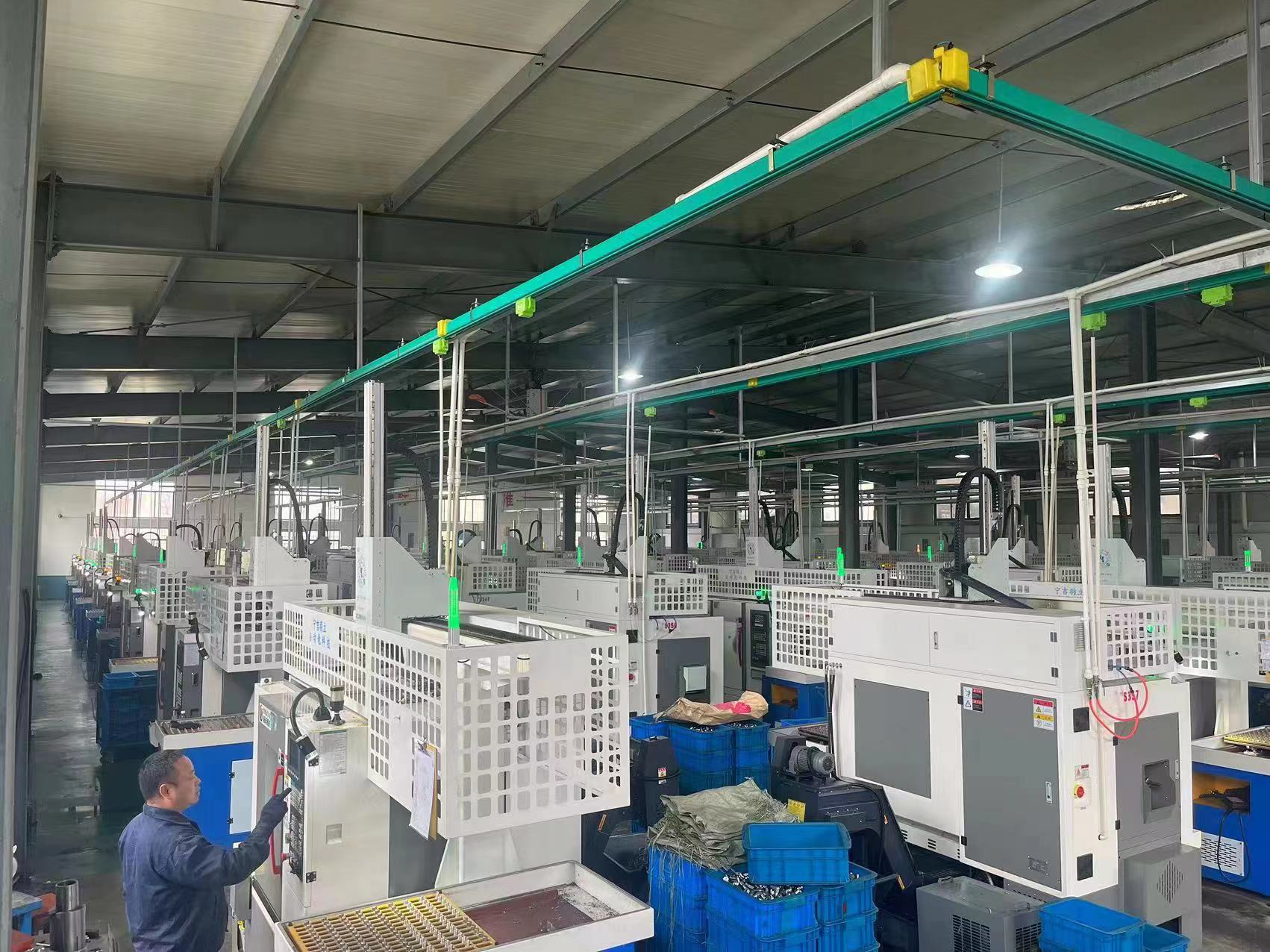
Automated CNC machining is a central step in producing hydraulic adapters to close thread tolerances.
Why Hydraulic Adapters Matter
Hydraulic adapters are a broad category within hydraulic fittings. They are used to connect components that may be built to different national or industry standards. A machine may have a pump with a JIC port, a hose with an NPT fitting, and a cooler with a BSP connection. Without an adapter, these parts cannot be assembled reliably. With the correct adapter, the circuit can be built using standard components instead of custom-made parts.
The role is not only mechanical. The adapter must sustain the same system pressure, resist corrosion in the working environment, and maintain a leak-free seal under temperature cycles and vibration. In this sense, the hydraulic adapter functions as a safety-related component, not a commodity fitting.
For buyers at the awareness or research stage, the practical starting point is often a search for a hydraulic adapter before a final thread combination has been chosen. That approach is reasonable, because the selection process begins with a simple question: which thread forms need to be connected? The answer determines the product family, the material, and eventually the exact model.
From Thread Mismatch to a Growing Component Category
Hydraulic systems are rarely built around a single standard. A loader may use JIC fittings on pumps, NPT connections on valve blocks, and BSP ports on cooler circuits. A maintenance team may need to connect aftermarket hoses to original components. The result is a steady demand for adapters that convert thread forms without compromising pressure containment.
Market data helps explain the scale. Dataintelo valued the global hydraulic fittings market, including adapters and couplings, at USD 4.8 billion in 2025 and projected it to reach USD 7.9 billion by 2034. The hydraulic adapters segment held the largest product type share at 28.4% in 2025. Grand View Research placed the broader hydraulics market at USD 38.39 billion in 2024. The exact numbers vary with report scope, but the underlying picture is consistent: hydraulic connection components are widely purchased, and the adapter category represents a significant part of the fittings market.
Product Range: What a Hydraulic Adapter Manufacturer Supplies
One company that illustrates the typical range is NingBo NJ Hydraulic Adapter Co., Ltd. Based in Fenghua, Ningbo, Zhejiang, the company has specialized in SAE standard hydraulic components and engineering machinery parts since 2004. Its manufacturing facility covers 20,000 square meters and employs approximately 200 people. The R&D team consists of four engineers. Annual output is about 4,000,000 units, with around 75% exported to North America, mainly the United States and Canada.
The product portfolio centers on hydraulic fittings and adapters. It includes BSP adapters with BSPP thread fittings, BSP adapters with BSPT thread fittings, NPT adapters, hydraulic JIC adapters including JIC-to-NPT combinations, SAE standard JIC/ORB/ORFS adapters, and hydraulic cap nuts and lock nuts. The wider catalogue also includes flanges, valves, valve components, and non-standard parts.
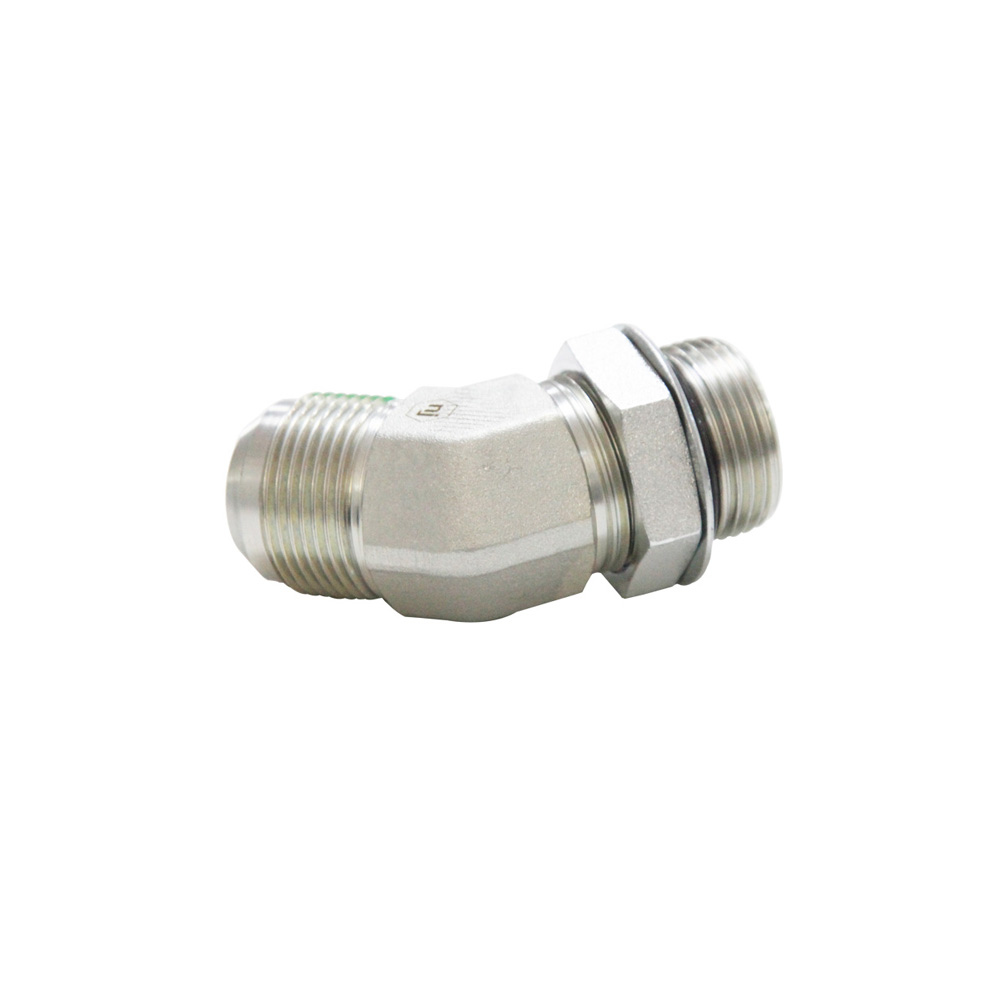
The SAE standard adapter family includes JIC, ORB, and ORFS configurations such as the 6802 elbow shown above.
Technical Explanation: Threads, Materials, and Ratings
To compare hydraulic adapters, buyers need a common set of criteria. The most important are thread form, sealing method, material, pressure rating, and temperature range. Product specifications often include the word adapter but the underlying thread system determines which applications are suitable.
Thread forms in the product range
BSP adapters are divided into BSPP, or parallel, and BSPT, or tapered, thread fittings. The BSPP line includes configurations such as male BSPP to male BSPP straight, male BSPP to female NPTF straight, male BSPP to male JIC straight, male BSPP to male BSPT straight, and a male BSPP plug. The BSPT line includes male BSPT to male BSPT straight, male BSPT to female BSPT straight, male BSPT plug, and combination elbows such as male JIC to female BSPT.
NPT adapters are classified as NPT thread fittings. The model list includes the 5000 series and the 5400/5600 series straight connectors, plugs, caps, tees, and crosses, with NPTF variants for dryseal applications. Hydraulic JIC adapters are classified as JIC adapters and JIC-to-NPT adapters, with model families such as 2403, 2404, 2405, 2500, and 2600 covering straight, elbow, bulkhead, and tee configurations. SAE standard adapters are classified as JIC, ORB, or ORFS adapters, including adjustable O-ring boss elbows and face seal tees. A separate group of hydraulic cap nuts and lock nuts covers tube sleeves, cap nuts, and bulkhead lock nuts.
BSPP parallel threads are commonly paired with a sealing element, while BSPT tapered threads are designed to seal through thread interference. NPT is a standard tapered pipe thread; NPTF is a dryseal version. JIC uses a 37-degree flare seat, and ORFS uses an O-ring at the face of the fitting. These differences affect both assembly procedure and sealing performance.
Material selection
Across the product lines described, the standard material options are carbon steel, SS304, and SS316. Carbon steel is common for high-pressure general industrial use. SS304 and SS316 stainless steel are specified where corrosion resistance is needed, such as marine machinery, chemical processing, or outdoor equipment. Market data from Dataintelo shows that steel materials accounted for 45.2% of hydraulic fitting revenue in 2025, reflecting the material's role in high-pressure durability.
Pressure, temperature, and corrosion validation
Most of the adapters in this range carry a rated pressure window of 3000 to 6000 PSI and a maximum stable operating temperature of 220°C. The salt spray result is a useful comparison point: the products pass a 120-hour salt spray test, with white rust observed at 120 hours and red rust at 240 hours.
Industry references provide additional context. NPTF straight threads in the 1/4-inch size typically have a working pressure rating of 4000 PSI with a 4:1 safety factor. ORFS fittings for dash size -4 are rated at 6000 PSI working pressure under SAE J1453. These numbers show that the 3000–6000 PSI window covers a large share of mobile and stationary hydraulic circuits.
Representative model families
| Product | Thread classification | Example models |
|---|---|---|
| BSP Adapter | BSPP Thread Fitting | 1B, 1B4, 1B9, 1BG, 1BG4, 1BJ, 1BN, 2B9, 5BN, 6B, 7B, 9B, etc. |
| BSP Adapter | BSPT Thread Fitting | 1T, 1T9, 1BT, 1ST, 4T, 5T, etc. |
| NPT Adapter | NPT Thread Fitting | 5000, 5404, 5405, 5406, 5406-C, 5406-HP, 5406-P, 5406-SHP, 5500, 5600, 5652, etc. |
| Hydraulic JIC Adapter | JIC adapter and JIC to NPT adapter | 2403, 2404, 2405, 2406, 2408, 2500–2505, 2601–2609, etc. |
| SAE Standard Hydraulic Adapter | JIC/ORB/ORFS adapter | 6801, 6802, 6803, 6804, 6805, 6806, 6807, 6808, 6809, 6810, 6815, 6818, 6820, 6832, 6835, 6840, 6850 |
| Hydraulic Cap Nut | Hydraulic Cap Nut & Lock Nut | 0304C, 0306, 0318, 0319, 0403, 0500, FS0304C, FS0306, FS0318, FS0319 |
Specifying a hydraulic adapter
Once the basic product families are clear, a procurement researcher can use a simple sequence. First, define the two end connections: thread standard, thread size, and gender. Second, choose the geometry: straight, elbow, tee, bulkhead, or plug. Third, select the material based on the operating environment and fluid. Fourth, confirm that the pressure and temperature rating matches the system maximum. Fifth, check orientation and installation clearance, especially for angled fittings. This sequence does not replace a manufacturer's engineering review, but it helps buyers build a precise shortlist.
Application and Use Cases
Hydraulic adapters are used in a wide range of machinery. According to the company's application notes, intended industries include construction machinery, agricultural machinery, general-purpose machinery, firefighting equipment, marine machinery, mining, transportation, aerospace, automotive, oil and gas extraction, iron and steel metallurgy, and water conservancy engineering.
Many of these applications involve high temperature and high pressure. The application record for construction machinery describes adapters capable of withstanding a static pressure of 6000 PSI and a burst pressure of 9000 PSI without deformation, while maintaining continuous operation and seal integrity. Matched components include hydraulic hoses, hydraulic cylinders, threaded bolts, pipe joints, hydraulic pumps, and mechanical cylinder assemblies.
The same logic applies in agriculture and mining. A hose assembly may be replaced in the field, and the adapter must allow a quick, reliable connection between an existing port and a new hose. In marine and oil and gas environments, material choice and corrosion resistance become as important as pressure rating. A buyer looking for hydraulic hose adapters, high-pressure hose adapters, or stainless steel hydraulic adapters is essentially looking for the same thing: a precision component that maintains system integrity at a connection point.
Market Trends Behind Hydraulic Adapter Demand
Three trends are visible in the available market data. First, the global fittings market is expected to grow. Dataintelo projects the fittings market to rise from USD 4.8 billion in 2025 to USD 7.9 billion by 2034. Another estimate in the verified data set cites a 4.5% CAGR for hydraulic fittings and adapters between 2025 and 2033. Second, the Asia-Pacific region is already the largest revenue region, accounting for an estimated 38.6% share in 2025. Third, mobile hydraulics dominate the broader hydraulics market, with more than 58% of revenue in 2024 according to Grand View Research.
Automation is an additional driver. Asia accounted for 74% of global industrial robot installations in 2024, according to Ken Research. While robots are not all hydraulic, automated manufacturing increases the number of precise fluid connections required in auxiliary equipment, presses, and material handling systems. For adapter suppliers, this means continued demand for standardized, high-pressure connection components.
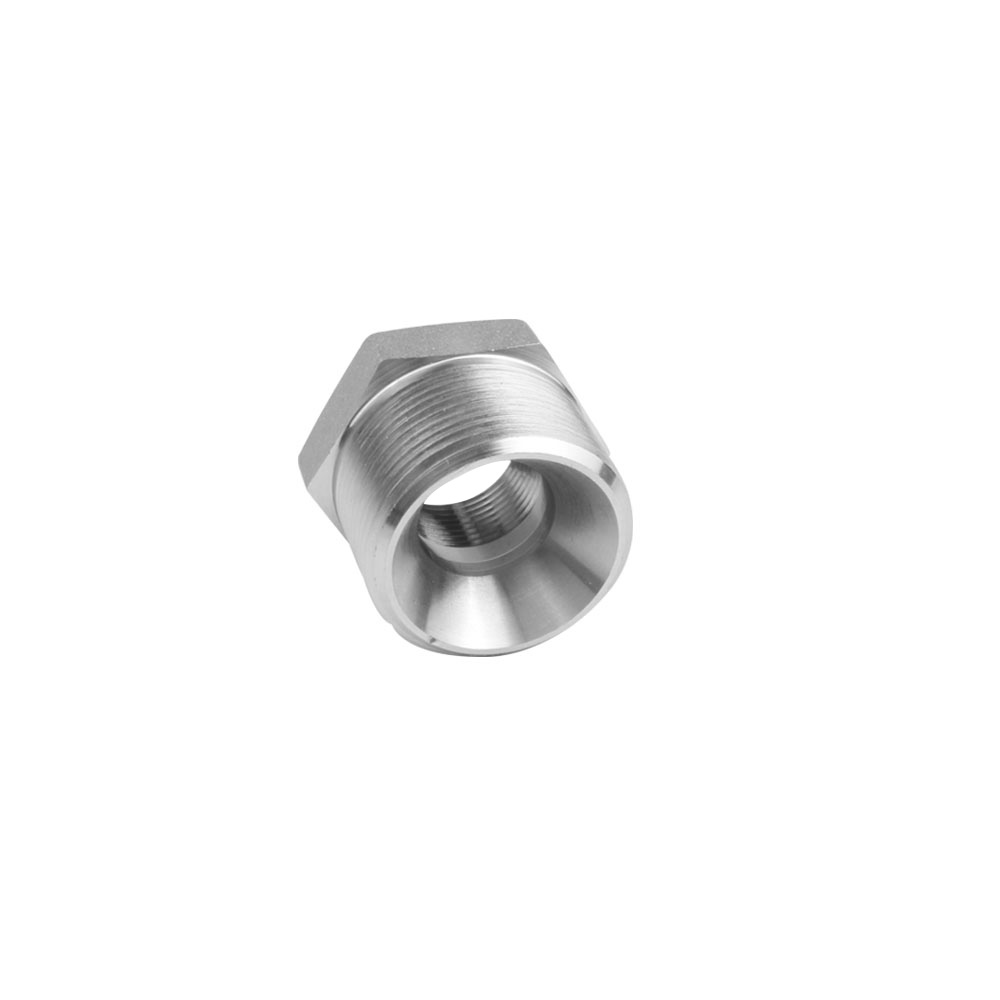
NPT adapters such as model 5406 are part of the inch-based thread systems commonly used in North American hydraulic equipment.
Hydraulic Adapters vs. Traditional Hard-Piped Connections
Traditional methods of joining hydraulic lines include welding, brazing, or flaring tubes directly to a component. These methods have advantages in very high-pressure permanent installations, but they make maintenance and replacement difficult. Hydraulic adapters offer a more practical path: standard threaded connections allow a valve, hose, or cylinder to be removed without cutting the line.
This flexibility has a limitation. Every adapter is an additional joint, and each joint is a possible leak path. If the thread is not matched correctly, if the torque is outside the recommended range, or if the sealing surface is damaged during assembly, the adapter can leak. In mobile equipment, vibration can loosen a fitting over time if it is not secured or torqued properly. Buyers should therefore treat adapters not as a universal solution but as a component that must be specified with the same care as a pump or cylinder.
Future Outlook
Standardization will likely continue to shape the adapter category. ISO 8434-2 specifies the design and performance requirements for 37-degree flared connectors suitable for tubes from 6 mm to 50.8 mm. DIN 2353, also published as ISO 8434-1, defines metric tube fitting series with pressure categories covering extra light, light, and heavy duty ranges. These standards make it easier for buyers to compare products from different manufacturers and support cross-border sourcing.
At the supplier level, manufacturers that combine CNC machining capability, a broad model range, and export experience are well positioned to serve global OEMs and distributors. The company profile at NingBo NJ fits that pattern: a dedicated hydraulic adapter factory, a high annual output, and a North American export focus. For buyers, the practical outlook is positive: more standard-compliant sourcing options, more material choices, and a deeper supply base in Asia.
Frequently Asked Questions
The following answers are based on the public product specifications and company information used in this article.
What is a hydraulic adapter used for?
A hydraulic adapter connects two or more hydraulic components that use different thread standards or configurations. It is used to join hoses, tubes, pumps, valves, and cylinders in systems such as construction machinery, agricultural machinery, marine machinery, mining equipment, and oil and gas equipment.
Which thread standards are available in the range described?
The described range includes BSPP and BSPT fittings, NPT fittings, JIC adapters, JIC-to-NPT adapters, and SAE standard JIC/ORB/ORFS adapters. Configurations include straight, elbow, tee, bulkhead, and plug forms.
What materials are used for hydraulic adapters?
Carbon steel, SS304, and SS316 are the material options across the product lines. Carbon steel is common in high-pressure industrial circuits, while SS304 and SS316 are used for better corrosion resistance.
What pressure and temperature ratings are typical?
The product specification for several adapter families lists 3000–6000 PSI and a maximum stable operating temperature of 220°C. The salt spray test result is 120 hours, with white rust at 120 hours and red rust at 240 hours.
How are missing or wrong accessories handled after delivery?
Customers are asked to provide photos of missing or incorrectly delivered items. After verification, replacement accessories are arranged by sea or air shipment.
Published as an independent industry reference. Product facts are taken from the public catalogue of NingBo NJ Hydraulic Adapter Co., Ltd. The company's website is https://www.njadapter.com. A digital brochure with the wider product range is available here.