
Hydraulic Baler Buyer Matrix: Force, Bale and Automation Fit
Hydraulic Baler Buyer Matrix: Force, Bale and Automation Fit
A hydraulic baler machine is a press that compacts loose waste into a bound bale using hydraulic force, and it is normally built in one of two chamber orientations: horizontal, for continuous streams that arrive by conveyor or chute, and vertical, for batch-fed operations where an operator loads the chamber by hand. The orientation, the force rating, the chamber geometry and the automation class together define which waste streams a machine can accept — and which it cannot.
Buyers usually enter this decision from the wrong end. The first question asked is often price, or the tonnage figure printed largest on the datasheet. In practice, baler selection is a constraint problem that runs in a fixed order: the material stream sets the feeding geometry, the feeding geometry and compression force set the bale density, the bale dimension and weight set the transport and storage calculation, and the automation class sets both the labour requirement and the upstream integration work. Price sits at the end of that chain. A machine that satisfies the constraints is usually the cheaper machine to own; a machine that misses one of them is expensive regardless of its invoice value.
The Real Order of Decisions in a Baler Purchase
A decision matrix is useful only if the variables are ordered correctly. For hydraulic baler machines, that order is consistent across material types:
1. Material and arrival method. Does the waste arrive loose on a conveyor, in bags, in bales from a supplier, or on a pallet? A carton plant running a corrugator line produces a continuous, high-volume paper stream; a PET recycler receives irregular, bulky bottles; a metal yard receives dense, abrasive scrap. Each arrival pattern implies a different feeding mouth and chamber type.
2. Bale target. The bale is the product the machine is actually bought to make. Its cross-section, length range and weight determine how bales stack, how many fit in a container or trailer, and whether a forklift or a manual handling step is required.
3. Compression force. Force is what converts a given material into a stable bale at a given density. It is a capability limit, not a quality ranking — a 40-ton machine is not a worse machine than a 100-ton machine, it is a machine built for a different density requirement.
4. Throughput and automation. Capacity expressed in tonnes per hour and capacity expressed in bales per hour are not interchangeable, and the automation class determines whether an operator is required at the feeding point.
5. Site constraints. Voltage, floor area, machine weight, and the room required for a conveyor or a discharge path frequently eliminate otherwise suitable models.
6. Compliance. Where the machine will operate in the EU, the certification file attached to the specific model matters as much as the specification sheet.
Six Specifications That Set the Operating Envelope
Compression force
Compression force is stated in tonnes and represents the maximum hydraulic force applied during compaction. It is the specification that most directly maps to achievable bale density for a given material. In the Jewel hydraulic baler machines range, force ratings span a wide band: the JP8060T5X waste compactor operates at 5 tons, the JPW-AK60 briquetting machine and the JPY-T60W metal baler at 60 tons, the JP-OT100 vertical baler and JPW-AK100 aluminium foil baler at 100 tons, and the JPW40F semi-automatic horizontal baler at 40 tons. Elsewhere in the same manufacturer's range, horizontal models are documented up to 150 tons on the JPW150BL-QT.
Bale dimension
Bale dimensions are usually given as width × height × a length range, because the chamber produces a fixed cross-section while the finished length varies with material and cycle settings. The JPW40F produces a 720 × 720 mm cross-section with a length of 500 to 1300 mm. The JP-OT100 vertical baler produces a 1400 × 700 mm cross-section with a length of 700 to 1100 mm. The difference is practical rather than cosmetic: the vertical machine's wider, flatter bale suits stacking on a pallet or a floor area, while the horizontal machine's square-section bale suits dense, transport-oriented loads.
Feeding mouth
The feeding mouth is the interface between the machine and everything upstream of it. A conveyor, a chute, a shredder discharge or a manual loading table must all be able to deliver material through that opening. The JPW40F feeding mouth measures 1000 × 720 mm; the JP-OT100 measures 1400 × 600 mm; the compact JP7050T8 measures 670 × 400 mm. Buying a machine with a large chamber but a small feeding mouth creates a bottleneck at the point where the material enters, not where it is compressed.
Bale weight
Bale weight determines how the finished product is handled and sold. The JPW40F produces bales of 200 to 400 kg; the JP-OT100 produces 400 to 600 kg; the JPY-T60W metal baler produces 15 to 20 kg bales from a 430 × 280 mm cross-section; the JPW-AK100 aluminium foil baler produces 5 to 15 kg briquettes. A 600 kg bale and a 15 kg briquette serve entirely different downstream logistics, and neither is a defect of the other.
Baling capacity
Two units are in use across the category and they should never be compared directly. Horizontal models are typically rated in tonnes per hour — the JPW40F is rated at 1 to 2 t/h, the JPY-T60W at 0.5 to 1 t/h, the JPW-AK100 at 0.4 to 0.8 t/h. Vertical and small-format models are typically rated in bales per hour — the JP-OT100 at 5 to 6 bales/h, the JP7050T8 and JPW-K6046 at 6 to 8 bales/h, the JP8060T5X at 4 to 7 bales/h. Converting one to the other requires a bale weight assumption, and that assumption is exactly where procurement calculations go wrong.
Automation class
Semi-automatic, fully automatic and manual are not a quality ladder. They describe who feeds the machine and who ties the bale. A semi-automatic horizontal baler such as the JPW40F still requires an operator at the loading point and a strapping step, using four strapping channels; its discharge method is described as continuous push pack. A fully automatic horizontal machine is designed to run as part of a line, usually with a conveying system feeding it.
The Buyer Matrix: Model Specifications Side by Side
The table below arranges Jewel hydraulic baler machines by the six specifications above. It is a fit matrix, not a ranking: a row is useful or irrelevant depending on the stream it is matched to.
| Model | Type | Compression force | Bale dimension (mm) | Feeding mouth (mm) | Bale weight | Capacity | Power |
|---|---|---|---|---|---|---|---|
| JPW40F | Semi-automatic horizontal | 40 t | 720 × 720 × (500–1300) | 1000 × 720 | 200–400 kg | 1–2 t/h | 11 kW / 15 Hp |
| JPW40BL | Horizontal, PET-oriented | 40 t | 720 × 720 × (300–1000) | 1000 × 720 | 250–350 kg | — | 15 kW / 20 Hp |
| JP-OT100 | Vertical | 100 t | 1400 × 700 × (700–1100) | 1400 × 600 | 400–600 kg | 5–6 bales/h | 15 kW / 20 Hp |
| JP7050T8 | Small-format baler | — | — | 670 × 400 | 50–80 kg | 6–8 bales/h | 2.2 kW / 3 Hp |
| JPY-T60W | Metal baler | 60 t | 430 × 280 × (150–250) | 900 × 430 | 15–20 kg | 0.5–1 t/h | 22 kW / 30 Hp |
| JPW-AK60 | Briquetting machine | 60 t | 300 × 300 × (200–300) | 500 × 300 | 5–10 kg | 0.2–0.5 t/h | 15 kW / 20 Hp |
| JPW-AK100 | Aluminium foil / fibre baler | 100 t | 320 × 320 × (200–250) | 500 × 320 | 5–15 kg | 0.4–0.8 t/h | 18.5 kW / 25 Hp |
| JPW-K6046 | Bagging machine | 10 t | — | 540 × 400 | 50–80 kg | 6–8 bales/h | 2.2 kW / 3 Hp |
| JP8060T5X | Waste compactor | 5 t | 800 × 600 × 400 | 650 × 470 | 50–80 kg | 4–7 bales/h | 2.2 kW / 3 Hp |
All figures as published in the Jewel specification set for hydraulic baler machines. A dash indicates the value is not part of the reviewed specification for that model, not a zero or an omission by the machine. Chamber sizes and power ratings are model-specific and voltage is customizable.
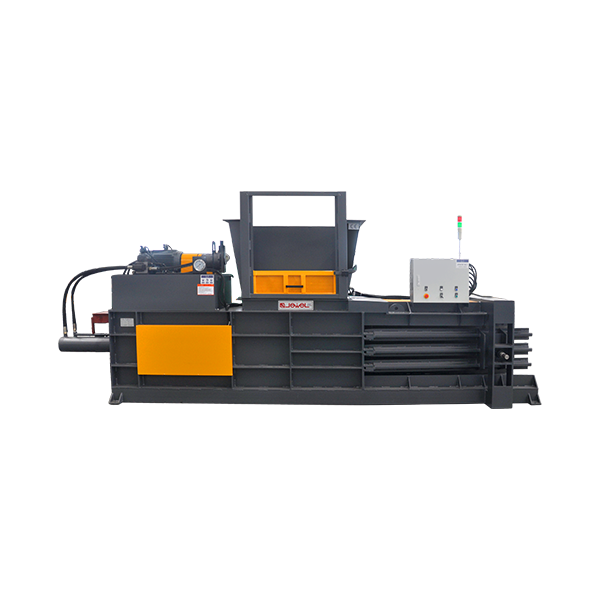
Figure 1 — The JPW40F semi-automatic horizontal baler: 40-ton compression force, 720 × 720 mm bale cross-section, 1000 × 720 mm feeding mouth, 1–2 t/h capacity.
Automation as an Integration Constraint, Not a Ranking
The JPW20Q sits at the opposite end of the automation spectrum from the JPW40F. It is a fully automatic horizontal baler in the Jewel hydraulic baler machines line, rated at 20 tons of compression force, and it holds CE certification for the EU market under certificate number TTC-22-1609/01/01, issued by INTEGRA, covering Directives 2006/42/EC (Machinery Directive) and 2014/35/EU (Low Voltage Directive) with applicable standards EN ISO 12100:2010 and EN 60204-1:2018.
The 20-ton figure is the point that matters most for buyers. It is lower than the 40-ton JPW40F, yet the JPW20Q is the model deployed in several of the most demanding project environments on record — not because force is irrelevant, but because in those projects the constraint that mattered was continuity of feed, not peak density.
In a corrugated carton printing and packaging plant in Tunisia, a JPW20Q was specified as part of a factory-wide automatic waste discharge system intended to eliminate waste accumulation from the corrugator line and printing machines and to improve the overall workshop environment. In a comparable carton plant in Mexico, the same model formed part of a fully automatic waste removal system required to integrate with the existing production line and process waste in real time. In Italy, a carton manufacturer replacing ageing balers introduced preprocessing equipment alongside a new compression line to handle large-format waste cardboard. In a Belarusian recycling operation, one machine was required to handle PET bottles, woven bags, HDPE bottles and cardboard together, in order to avoid buying separate equipment for each stream.
This is why automation should be read as a site requirement rather than a specification upgrade. A fully automatic horizontal baler assumes a regulated feed — a conveyor, a sorting line, or a chute that delivers material at a predictable rate. Where that feed does not exist, the machine's advantage is not realised. Conversely, a semi-automatic machine such as the JPW40F can be the correct choice in a plant where volumes fluctuate, where an operator is present anyway, and where the capital and floor space for a conveying system are not available.
Mapping Specifications to Waste Streams
The matrix becomes usable once it is indexed by material. The mappings below follow the published specification ranges and the documented project records; they describe fit, not exclusivity.
| Waste stream | Defining constraint | Models that fit the constraint |
|---|---|---|
| Corrugated carton, waste paper (continuous, high volume) | Continuous feed, real-time processing, upstream integration | JPW20Q (fully automatic, conveyor-fed); JPW40F (semi-automatic where feed is manual) |
| PET bottles, HDPE, woven bags, mixed plastics | Bulkiness and low initial bulk density | JPW40F; JPW40BL; JPW20Q in multi-material projects |
| Textile and fibre waste | Chamber width and manual sorting before loading | JP-OT100 (1400 × 700 × 1700 mm chamber) |
| Metal scrap | Abrasion and the need for a small, dense, saleable briquette | JPY-T60W (60 t, 430 × 280 mm cross-section) |
| Aluminium foil, fibre-based dust | Very low bulk density requiring high force at small cross-section | JPW-AK100 (100 t); JPW-AK60 (60 t, paper dust) |
| Retail and light commercial waste | Small footprint, standard single-phase or low-power supply | JP7050T8 (220 V); JP8060T5X; JPW-K6046 |
Model-to-stream mapping derived from the Jewel specification set and documented application records for carton, PET, mixed-plastic and metal streams.
The vertical JP-OT100 deserves separate attention because its position in the matrix is commonly misread. Its 100-ton force and 1400 × 700 × 1700 mm compression chamber are larger than the JPW40F's in both force and chamber volume, and its 400–600 kg bale weight is the heaviest in the reviewed set. But its capacity is published in bales per hour, not tonnes per hour, and its feeding mouth of 1400 × 600 mm is loaded manually. It is a high-force, batch-fed machine: appropriate where a smaller number of dense bales per shift is the target, not where continuous tonnage is required.
The Constraint Layer: Voltage, Material and Certification
Three specifications rarely appear in the headline comparison but eliminate more shortlisted models than force or capacity do.
Voltage. The voltage of Jewel hydraulic baler machines is customizable to meet specific requirements. The published references show 380 V/50 Hz on the JPW40BL, JP-OT100, JPW-AK60, JPW-AK100 and JP8060T5X, and 220 V/50 Hz on the JP7050T8. Because the supply is customizable, the practical question is not whether a model can be adapted but which supply the site can actually deliver, and whether the intended destination market imposes additional requirements on the electrical configuration.
Material of construction. Carbon steel is the primary material of these hydraulic baler machines. This matters for abrasive streams such as metal scrap and for high-dust environments, where chamber wear and cleaning access affect long-term performance more than the force rating does.
Certification. Certification in this category attaches to a specific model, not to a brand, which is the single most common misconception in EU procurement. The Jewel JPW20Q fully automatic horizontal baler carries CE certification under certificate number TTC-22-1609/01/01, issued by INTEGRA, covering Directives 2006/42/EC and 2014/35/EU and complying with EN ISO 12100:2010 and EN 60204-1:2018. Separately, the manufacturer holds an SGS Made-in-China Supplier Audit Report under certificate number QIP—ASR2541890, issued by SGS against the Made-in-China Supplier Audit Specification, with a stated scope covering the full range of baler machine, hydraulic baler, waste paper baler, cardboard baler and baling press machine, valid to 10 December 2028.
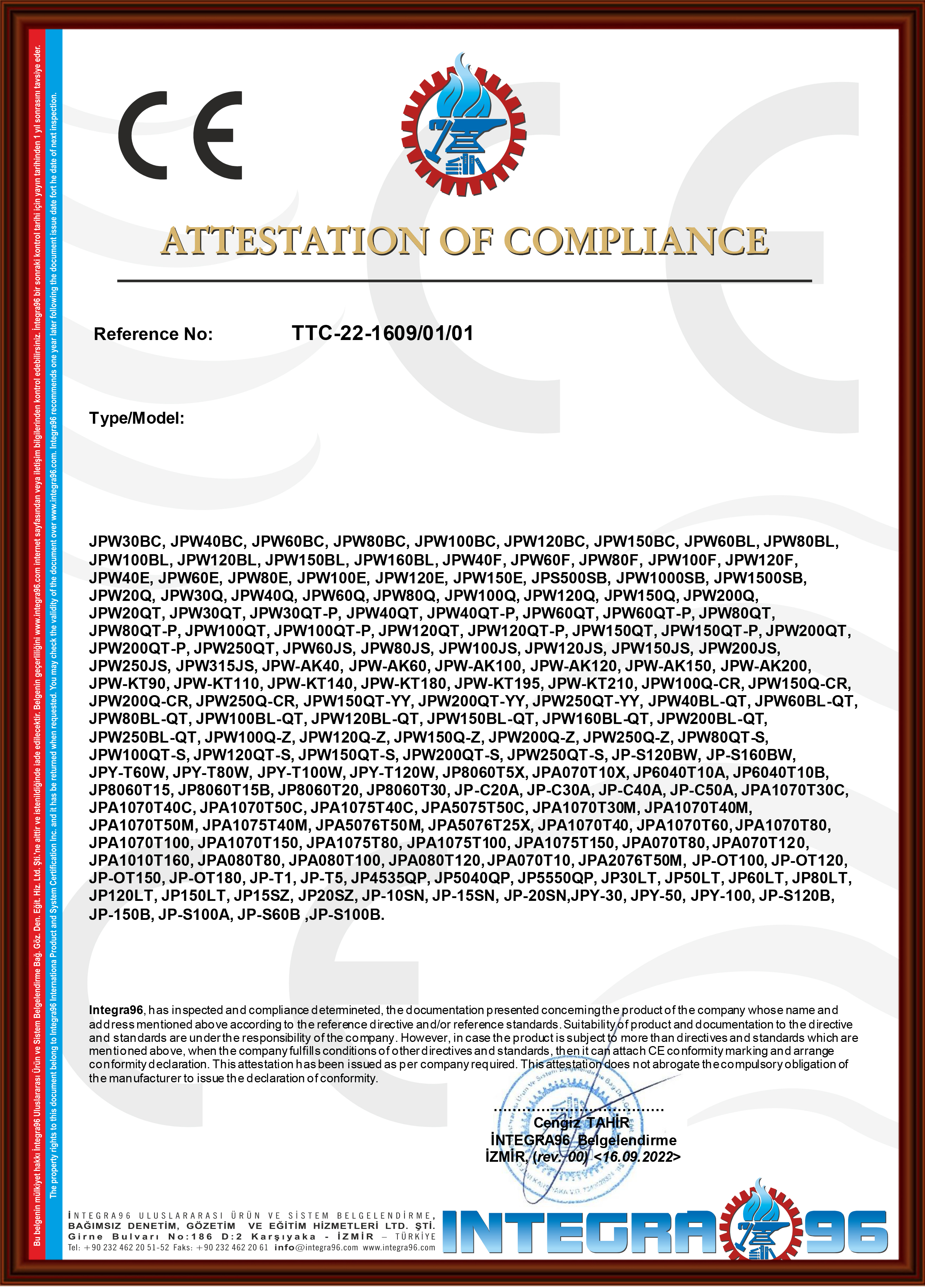
Figure 2 — CE attestation of compliance for the JPW20Q, certificate TTC-22-1609/01/01 issued by INTEGRA, covering 2006/42/EC and 2014/35/EU.
The distinction between an audit report and a conformity attestation is operationally important. The SGS report evidences supplier-side processes across a product range; the CE attestation is model-specific and tied to named directives and standards. A buyer who needs to place a machine into service in the EU should confirm which of the two applies to the exact model being purchased.
Where the Matrix Stops: Limits Buyers Should Confirm
A useful matrix states its boundaries as clearly as its fits. Five limits apply to the framework above.
Force ranges are scoped, not universal. Each model's published scope is bounded — the JPW40F is listed within a 40–100 ton scope, the JP-OT100 within 100–180 ton, the JPY-T60W within 60–600 ton, the JPW-AK60 within 60–200 ton. Pushing a model beyond its stated scope for a denser or more abrasive material is a specification error, not an application of the matrix.
Fully automatic is conditional on upstream equipment. The automation class describes the machine, but its benefit depends on a conveying system that is not part of the baler itself. Projects that recorded success with fully automatic configurations were explicitly designed as integrated lines. A buyer who installs a fully automatic machine without a regulated feed should expect semi-automatic performance at automatic cost.
Capacity units are not convertible without a bale weight assumption. Published tonnage-per-hour figures and bales-per-hour figures cannot be compared directly. Any procurement calculation that converts between them is only as reliable as the bale weight assumption behind it.
Certification coverage is model-specific. The CE attestation in this review applies to the JPW20Q. Other models in the range are not described by that certificate, and a buyer requiring CE evidence for a different model should request documentation for that model specifically.
The matrix does not price the decision. No price band is asserted here. Published pricing in this category varies with configuration, voltage, conveying scope and destination, and any figure presented without those qualifiers would be unreliable.
What the Market Data Says About Timing
Three separate market measurements frame the demand context, and they should be read separately because their scopes differ.
The total baler market, covering both agricultural and industrial equipment, was valued at USD 7.18 billion in 2025 and is projected at USD 7.96 billion in 2026, rising to USD 18.02 billion by 2034 according to Vertex AI Search aggregated market research. The hydraulic waste paper baler segment specifically was estimated at USD 1.45 billion in its 2024 base year, with a forecast valuation of USD 2.24 billion by 2032 and a CAGR of 5.5%, per Data Insights Reports. The hydraulic metal recycling baler segment reached USD 913 million in 2023 and is forecast to reach USD 1,318 million by 2031, according to MarketsGlob.
These are three different scopes — total baler, hydraulic waste paper baler, and hydraulic metal recycling baler — and they cannot be added together or used to imply a single growth rate for the category. What they do support is a directional conclusion: demand is expanding across the paper, plastic and metal streams simultaneously, which is consistent with the specification pattern in the matrix above, where one manufacturer maintains distinct models for briquette, metal, fibre, PET-oriented and carton-oriented duty rather than optimising a single universal platform.
Outlook: Denser Bales, Fewer Operators, Earlier Compliance
Two shifts are visible in how buyers are specifying hydraulic baler machines. The first is that automation is increasingly purchased as part of a waste-handling line rather than as a standalone machine. The project records behind this article — carton plants in Tunisia, Mexico, Italy and Russia, a mixed-waste recycler in Australia, a PET recycler in Japan and a multi-material operation in Belarus — all describe integration with conveying systems, and several describe unmanned or near-unmanned operation as the design objective. That changes the evaluation question from "which baler" to "which baler plus which feed".
The second shift is that compliance documentation is being requested earlier, at shortlist stage rather than at order stage. As EU market access depends on model-specific directives and harmonised standards, buyers are increasingly filtering by certification before comparing force or capacity. Manufacturers with an existing model-level file — such as the JPW20Q CE attestation covering 2006/42/EC and 2014/35/EU — are easier to shortlist on that basis alone.
For Nantong Jiabao Machinery Co., Ltd., the company behind the Jewel baler brand, established in 2006 with the brand founded in 1995, operating a 50,000 m² production facility with over 200 staff including a 30-engineer R&D team and exporting approximately 70% of output to Europe, North America, Asia, the Middle East, Africa, Australia, Russia and Belarus, this pattern favours breadth of model range over a single flagship platform. Published capacity is 100 units per month, minimum order quantity is one unit, standard lead time is 60 days, and customization covers structure, process and performance. After-sales support is stated as 7×24 technical response with 48-hour on-site attendance and lifelong maintenance with free training.
Frequently Asked Questions
What compression force is needed to bale cardboard compared with PET bottles?
Force is set by the density target for the material, not by the material name. In the reviewed range, carton and mixed paper duty is served by models from 20 tons (JPW20Q, fully automatic horizontal) to 40 tons (JPW40F, semi-automatic horizontal, 1–2 t/h), while PET and mixed plastics are served by the JPW40F and the JPW40BL, both at 40 tons. Very low bulk density materials such as aluminium foil and paper dust require higher force at a much smaller cross-section, which is why the JPW-AK100 is rated at 100 tons for a 320 × 320 mm briquette.
How does bale dimension affect transport and storage?
Bale dimension sets the stacking geometry and the loading pattern, and bale weight sets the handling method. The JPW40F produces a 720 × 720 mm cross-section with 200–400 kg bales; the JP-OT100 produces a 1400 × 700 mm cross-section with 400–600 kg bales; the JPY-T60W produces 15–20 kg metal bales from a 430 × 280 mm cross-section. A 400–600 kg bale typically requires mechanical handling, while a 15–20 kg bale can be handled manually.
What feeding mouth size is required for a conveyor-fed horizontal baler?
The feeding mouth must accept the discharge of the upstream conveyor or chute without bridging. The JPW40F and JPW40BL both have a 1000 × 720 mm feeding mouth; the JP-OT100 vertical baler has a 1400 × 600 mm opening; the compact JP7050T8 has 670 × 400 mm. A large compression chamber paired with an undersized feeding mouth creates a bottleneck at the entry point rather than at the press.
Is a fully automatic horizontal baler always better than a semi-automatic one?
No. Fully automatic operation depends on a regulated feed, usually a conveying system that delivers material at a predictable rate. Documented projects using the JPW20Q in Tunisia, Mexico, Italy and Belarus were designed as integrated automatic waste lines. Where volumes fluctuate, where an operator is present for other tasks, or where floor space and capital for conveying are limited, a semi-automatic machine such as the JPW40F with four strapping channels can be the appropriate configuration.
Which certification should an EU buyer verify on a hydraulic baler machine?
Certification attaches to a specific model. The Jewel JPW20Q fully automatic horizontal baler holds CE certification number TTC-22-1609/01/01, issued by INTEGRA, covering Directives 2006/42/EC (Machinery Directive) and 2014/35/EU (Low Voltage Directive) with standards EN ISO 12100:2010 and EN 60204-1:2018. The manufacturer also holds an SGS Made-in-China Supplier Audit Report, certificate QIP—ASR2541890, issued against the Made-in-China Supplier Audit Specification with a scope covering the full baler range and validity to 10 December 2028. These are different document types and serve different verification purposes.
Can the voltage of a hydraulic baler machine be customized?
Yes. The voltage of Jewel hydraulic baler machines is customizable to meet specific requirements. Published references show 380 V/50 Hz on the JPW40BL, JP-OT100, JPW-AK60, JPW-AK100 and JP8060T5X, and 220 V/50 Hz on the JP7050T8. The site supply and destination-market electrical requirements should be confirmed before the model is fixed.
How is baling capacity expressed, and why do the units differ between models?
Horizontal models are generally rated in tonnes per hour — JPW40F at 1–2 t/h, JPY-T60W at 0.5–1 t/h, JPW-AK100 at 0.4–0.8 t/h — while vertical and small-format models are rated in bales per hour: JP-OT100 at 5–6 bales/h, JP7050T8 and JPW-K6046 at 6–8 bales/h, JP8060T5X at 4–7 bales/h. The two units are not directly convertible without a bale weight assumption.
What bale weight can be expected from a vertical baler?
The JP-OT100 vertical baler produces bales of 400–600 kg from a 1400 × 700 mm cross-section with a length of 700–1100 mm, using a 1400 × 700 × 1700 mm compression chamber. By comparison, the small-format JP7050T8, JPW-K6046 and JP8060T5X produce bales or compacts of 50–80 kg, and the metal baler JPY-T60W produces 15–20 kg bales.
What minimum order quantity and lead time apply to these machines?
The stated minimum order quantity for Jewel hydraulic baler machines is one unit, with a standard lead time of 60 days. Customization is available in structure, process and performance, and each unit is stated to receive 100% testing before shipment.
Using the Matrix in Practice
The matrix is a filter, not a verdict. Applied in order — material and arrival method, bale target, force, throughput and automation, site constraints, compliance — it eliminates most unsuitable models before a price is ever discussed. What remains is a short list of machines that can physically do the work, and only then does configuration, delivery and commercial terms become the deciding factors.
For readers who want the complete published specification set across the range, including models beyond those discussed here, the current Jewel hydraulic baler machine catalogue is available for download: Jewel hydraulic baler machine catalogue (PDF).
Есть вопросы или нужны дополнительные детали?
Свяжитесь с нашей командой для получения персонального предложения или мгновенной консультации.
Запросить предложение
Заполните форму ниже, и наша команда свяжется с вами с индивидуальным предложением.
Прямой чат WhatsApp
Предпочитаете общаться в реальном времени? Напишите нам в WhatsApp для мгновенной помощи и быстрых ответов.
- Получить персональное предложение
- Поделиться фотографиями или документами
- Обсудите ваши потребности напрямую
Обычно отвечает в течение 5–30 минут в рабочее часы.