
Hydraulic Baler Certification: Voltage, Standards and Verification
Hydraulic Baler Certification: Voltage, Standards and Verification
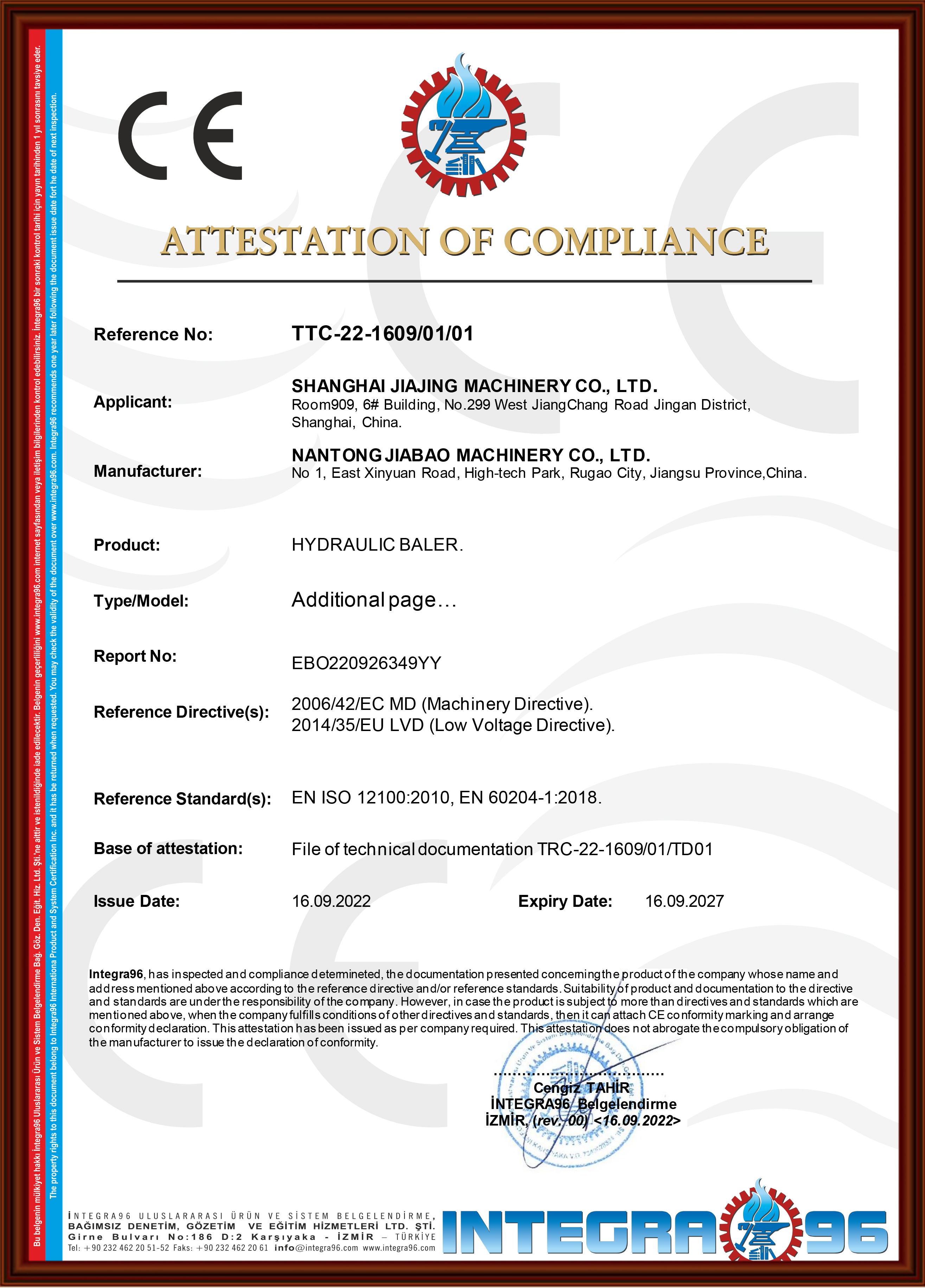
Attestation and audit documents now sit alongside technical specifications in a hydraulic baler procurement file.
Compliance and certification have moved from the end of a hydraulic baler purchase to the beginning of it. In cross-border projects, the first document a buyer requests is frequently no longer a quotation but a certificate: an attestation of conformity, a third-party supplier audit report, a model-level test record, and confirmation that the machine's electrical configuration matches the site's supply. A hydraulic baler machine that cannot be legally connected to the local grid is not a delayed delivery; it is a stalled project.
This article explains what compliance and certification realistically cover for hydraulic baler machines in global markets, how voltage and frequency specifications such as 220V/50Hz or 380V/50Hz relate to standards readiness, and how buyers can verify machine specifications against their own local regulatory requirements before an order is placed. It focuses on qualification logic rather than promotional claims, because in the evaluation stage the useful question is not which machine is largest, but which machine can be documented, installed and accepted.
Why Compliance Now Leads the Baler Purchase Decision
The commercial weight behind this shift is measurable. The global baler machine market was valued at USD 6.6 billion in 2024 and is projected to reach USD 11.4 billion by 2035, according to Grand View Research. A separate study by Maximize Market Research places the industrial balers segment at USD 6.39 billion in 2024, with a projected CAGR of 9.5% through 2032. The two figures do not conflict so much as measure different things: estimates diverge depending on whether agricultural balers are included alongside waste-handling and recycling equipment. Buyers reviewing market data should treat that divergence as a normal feature of this category, not as a warning sign about either source.
What the growth figures imply for procurement is more practical. When a category expands across regions, the number of suppliers quoting into any single project rises, and the machines arrive from jurisdictions with different electrical systems, different machine-safety traditions and different documentation habits. Grand View Research data indicates that Asia Pacific accounted for approximately 40.2% of global baler market revenue in 2024, which means a large share of the equipment moving into Europe, the Americas, Africa and the Middle East is manufactured in a region whose domestic grid and regulatory conventions differ from the destination market. Certification is the mechanism that closes that gap on paper before it becomes a problem on site.
The Regulatory Baseline Buyers Should Recognise First
There is no single international certificate that makes a hydraulic baler machine acceptable everywhere. Compliance is a stack of destination-specific requirements, and the most common mistake in evaluation is treating one document as evidence of all of them.
Two reference points are worth knowing before comparing suppliers. In the European Union, EN 16500:2014, published by the European Committee for Standardization (CEN), sets safety requirements for machines that compact waste materials or recyclable fractions, specifically vertical baling presses. In the United States, ANSI Z245.5-2023 is the updated American National Standard for baling equipment safety requirements, replacing the 2013 version. Both are category-scoped documents: the European standard addresses vertical baling presses rather than every baler format, and the American standard covers baling equipment under a defined scope. A supplier citing either standard for a machine type outside its scope is describing something other than compliance.
Alongside machine-safety standards, electrical requirements sit in a separate regulatory layer. In the EU, for example, machinery and low-voltage directives are addressed through separate conformity routes, which is why a compliant machine normally carries evidence for both its mechanical safeguarding and its electrical design, not a single generic mark.
What Compliance Evidence Looks Like on a Hydraulic Baler Machine
Nantong Jiabo Machinery Co., Ltd., established in 2006 with the Jewel brand founded in 1995, is a manufacturer of environmentally focused compression and baling equipment operating a 50,000-square-meter production facility with more than 200 staff and a 30-engineer research and development team. The company exports roughly 70% of its output to Australia, Europe, North America, Africa, Asia, Russia and Belarus, and its machines are documented under the Jewel brand at www.jewelbaler.com. Because it sells into several regulatory regions, its documentation set is a useful illustration of how qualification evidence is normally structured.
The first layer is product conformity for the European market. The company holds an attestation of compliance, certificate number TTC-22-1609/01/01, issued by INTEGRA and covering the EU market. The stated scope references 2006/42/EC (Machinery Directive) and 2014/35/EU (Low Voltage Directive), applied against the harmonized standards EN ISO 12100:2010 and EN 60204-1:2018. The attestation was issued on 2022-09-16 and remains valid until 2027-09-16, and its related product is listed as the JPW20Q fully automatic horizontal baler. The two standards matter individually: EN ISO 12100:2010 addresses risk assessment and risk reduction principles in machine design, while EN 60204-1:2018 addresses the electrical equipment of machines. A buyer reading those two references can see that both mechanical and electrical conformity were assessed, rather than a single generic declaration.
The second layer is manufacturing due diligence. The company also holds an SGS Made-in-China Supplier Audit Report, certificate number QIP—ASR2541890, issued by SGS on 2025-12-10 against the Made-in-China Supplier Audit Specification and valid until 2028-12-10. Its stated scope covers the full range of baler machine, hydraulic baler, waste paper baler, cardboard baler and baling press machine products. This is a different class of document from the CE attestation: it speaks to the supplier entity and its manufacturing operation, not to the safety of an individual machine model. Buyers who understand that distinction avoid the common error of accepting an audit report where a product conformity document is required, or vice versa.
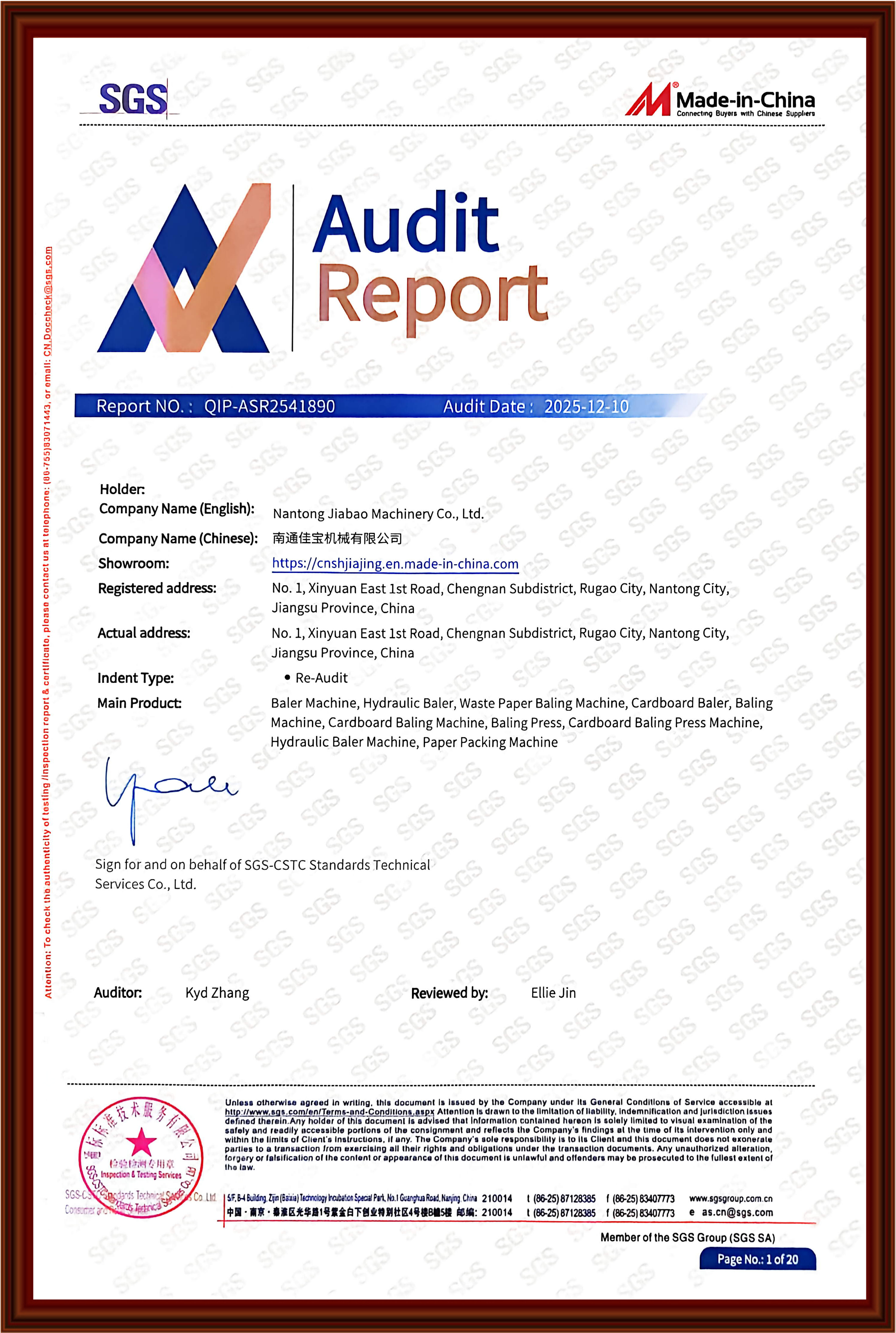
A supplier audit report addresses manufacturing capability and process control; a product attestation addresses machine safety against named standards. Both are useful, and they answer different questions.
Voltage and Frequency: The Specification Most Often Verified Last
Electrical configuration is where certification language meets physical reality. Alternating-current motors, transformers, contactors and control components are specified for a nominal voltage and frequency, and a machine built for one supply arrangement does not simply adapt to another without modification. In practice, the check is straightforward: compare the machine's declared electrical data with the supply available at the installation point, and confirm which models in a supplier's range can be configured for that supply.
In the Jewel hydraulic baler range, voltage is listed as customizable across the models where electrical data is published. The published configurations illustrate how wide the default spread already is:
| Model | Machine type | Voltage (customizable) | Power | Compression force / capacity |
|---|---|---|---|---|
| JP7050T8 | Baling machine | 220V/50Hz | 2.2 kW / 3 Hp | 6–8 bales/hr, bale weight 50–80 kg |
| JPW-AK100 | Aluminum foil baler | 380V/50Hz | 18.5 kW / 25 Hp | 100 t, 0.4–0.8 t/hr |
| JPW20Q | Fully automatic horizontal baler | 380V/50Hz | 7.5 kW / 10 Hp | 20 t, bale 500×500×500 mm |
| JPW40BL | Plastic bottle recycling machine | 380V/50Hz | 15 kW / 20 Hp | 40 t, 250–350 kg bales |
| JP-OT100 | Vertical baler | 380V/50Hz | 15 kW / 20 Hp | 100 t, 5–6 bales/hr |
| JPA5076T25X | Hydraulic baler | 380V/50Hz | 7.5 kW / 10 Hp | 25 t, 200–300 kg bales |
| JPW-AK60 | Briquetting machine | 380V/50Hz | 15 kW / 20 Hp | 60 t, 0.2–0.5 t/hr |
The practical reading of that table is that a 220V/50Hz model such as the JP7050T8 and a 380V/50Hz model such as the JPW-AK100 belong to the same product family but not to the same electrical environment. A buyer in a 380V/50Hz market evaluating small-format baling equipment will need to confirm whether the 220V configuration can be supplied at a compatible rating, or whether a different model in the range fits the available supply. Because the manufacturer's published customization capability spans structure, process and performance, electrical configuration is one of the parameters that can be addressed at order stage, with a minimum order quantity of 1 unit, a stated lead time of 60 days and a monthly production capacity of 100 units.
Two further points deserve attention during evaluation. First, frequency is not cosmetic. A 50 Hz and a 60 Hz market are different operating environments for motors and control components, so a machine's frequency rating should be verified as carefully as its voltage rating. Second, electrical conformity and grid compatibility are separate tests: a machine can be fully compliant with the applicable low-voltage standard while still being configured for a supply the site does not have. Both checks belong in the same document review.
A Verification Checklist for Buyers
The following checklist converts the discussion above into a document-by-document review. It is written for the evaluation stage, where the goal is to compare suppliers on the strength of their evidence rather than on the volume of their claims.
| What to verify | Where the evidence lives | Why it matters |
|---|---|---|
| Conformity attestation validity | Certificate number, issuing body, issue and expiry dates (e.g. TTC-22-1609/01/01, valid to 2027-09-16) | An expired attestation in a tender pack is a qualification failure, not a formality |
| Model-level scope | The related product list attached to the certificate | Confirms whether the exact model being purchased is named, rather than the range generally |
| Applied standards | Harmonized standards cited on the attestation, such as EN ISO 12100:2010 and EN 60204-1:2018 | Shows mechanical risk assessment and electrical design were both assessed |
| Electrical rating against site supply | Model technical data, nameplate, order specification | Prevents a 380V/50Hz machine arriving at a 220V site, or the reverse |
| Supplier audit status | Third-party audit report, its scope and validity period | Separates manufacturing capability evidence from product safety evidence |
| Test and quality records | Per-unit test documentation supporting the stated 100% test practice | Turns a general quality claim into a traceable record for the specific machine |
| Documentation and marking language | Manual, labels and safety signage for the destination market | Reduces delay at local acceptance and commissioning |
| After-sales commitment | Response terms, on-site target, training and maintenance scope | Determines whether compliance is maintained after installation |
Cross-Border Installations: What Compliance Looks Like in the Field
Documentation only proves its value when a machine is installed, connected and running. Several Jewel installations across different regulatory and grid environments illustrate how specification and local requirements interact in practice.
In Mexico, a cardboard box factory implemented a full-automatic waste removal system built around the JPW40BL, integrated with existing production lines. The project eliminated waste accumulation and improved workshop space utilisation, and was completed within one year. In Tunisia, a cardboard box factory used the JPW-AK60 briquetting machine as part of a factory-wide automatic waste discharge system addressing accumulation from the corrugator line and printing machines; the waste paper accumulation was eliminated, and the installation has been in place for three years. In Japan, a PET recycling enterprise required higher compression density for PET bottle baling, and used equipment from the JPW20Q fully automatic horizontal baler range; the finished bales improved storage and transport efficiency over a two-year period.
In Italy, a cardboard box factory replaced aging balers and introduced preprocessing equipment, using the JPA5076T25X to handle large-sized waste cardboard that had previously been difficult to process; waste treatment efficiency improved markedly, and the installation has run for four years. In Belarus, a waste recycling client used a JPW40BL unit to compact PET bottles, woven bags, HDPE bottles and cardboard, materials that had been bulky and difficult to compress; regular-shaped finished bales improved transportation and storage efficiency. In Russia, a cardboard box factory used the JPW40F semi-automatic horizontal baler for automatic collection, compression and baling of carton production waste over a three-year period, reducing labour and management costs. In Australia, a mixed waste project relied on multi-material separation technology alongside a JPW40BL to handle plastics, glass and metal scraps, achieving full-line unmanned operation within two years.
The common thread is not the equipment list but the sequence. Each of these installations sits in a different electrical and regulatory environment, and in each case the machine specification had to be settled against local conditions before the equipment could be shipped. When buyers compare hydraulic baler machines for rubber and plastic waste, waste paper, cartons, fibre, aluminium foil, PET bottles or metal scrap, the projects that proceed smoothly are the ones where that specification conversation happened during evaluation rather than after delivery.
Market Trends Reshaping Certification Expectations
Three trends visible in available data are relevant to how buyers will assess certification in the near term.
First, baling sits inside a traded commodity chain, not only inside a factory. China's exports of wood pulp and paper scrap, including baled waste paper, reached USD 288 million in 2025 according to the Observatory of Economic Complexity. When baled material crosses borders as a traded input, bale consistency and documentation increasingly matter to the downstream buyer as well as to the plant that produced the bales.
Second, regional manufacturing concentration continues to shape documentation practice. With Asia Pacific accounting for approximately 40.2% of global baler market revenue in 2024, a substantial share of equipment delivered into Europe and North America is manufactured where grid conditions and domestic regulatory conventions differ from the destination market. That mismatch is precisely what makes voltage customization and model-level conformity documents commercially important rather than administrative.
Third, automation is raising the stakes on electrical configuration. Fully automatic and semi-automatic horizontal balers, briquetting machines and integrated crushing-compression-baling units place more control electronics on a single machine than a manually operated vertical press does. As automation spreads through waste paper, carton, plastic and fibre processing, the electrical conformity portion of the documentation pack becomes harder to separate from overall project risk.
Customizable Voltage versus Traditional Fixed-Configuration Machines
Buyers frequently frame this choice as flexibility versus simplicity. The comparison is more useful when broken into what each approach requires from the buyer.
| Dimension | Traditional fixed-configuration machine | Voltage-customizable configuration (Jewel model data) |
|---|---|---|
| Grid fit | Built to one nominal rating; the site is expected to accommodate it | Voltage listed as customizable across published models, with defaults such as 220V/50Hz (JP7050T8) and 380V/50Hz (JPW-AK100) |
| Up-front information needed | Site supply still must be known before ordering | Site voltage, frequency and phase data are required inputs at quotation stage |
| Lead time effect | Standard build schedule | Customization follows the stated 60-day lead time; changes after build are considerably more disruptive |
| Order flexibility | Typically range-driven | Minimum order quantity of 1 unit, with customization across structure, process and performance |
| Documentation emphasis | Standard conformity pack | Conformity pack plus confirmation that the delivered rating matches the agreed specification |
Two boundaries should be stated plainly, because ignoring them is what turns a workable specification into a disputed delivery.
The first boundary is time. Customization is not instantaneous. The manufacturer's stated lead time is 60 days, and an electrical configuration change made after a machine is built is far more costly than specifying it correctly at order stage. The flexibility of the supplier does not remove the buyer's obligation to supply accurate site data early.
The second boundary is certificate scope. Certificates are issued against defined product scopes, not against a brand. The CE attestation of compliance held in this documentation set relates to the JPW20Q fully automatic horizontal baler, and the SGS supplier audit report covers a stated scope of baler product categories, with the audit itself addressing supplier processes. Neither document should be read as automatic coverage of every model a manufacturer produces. The same principle applies to standards: EN 16500:2014 addresses vertical baling presses, so citing it does not automatically qualify a horizontal baler or a briquetting machine. Buyers who treat certificates as series-wide rather than model-level documents create their own compliance exposure, and the supplier cannot close that gap retrospectively.
Future Outlook
The direction of travel in this category is toward earlier and more granular verification. As baler equipment continues to move across regions and as automation adds electrical complexity to each unit, buyers are likely to request model-level conformity documents, declared electrical ratings and third-party audit status as standard elements of a first quotation rather than as clarifications requested later. Suppliers that already maintain region-specific attestations and verifiable supplier audits are structurally better positioned for that shift than suppliers whose compliance evidence is assembled after a purchase order is received.
For buyers, the practical implication is that compliance should be treated as a specification line item, reviewed with the same discipline as compression force, bale dimensions or throughput. That means checking certificate validity dates, confirming that the exact model is named in the document scope, and verifying that the electrical rating on the order matches the supply at the installation point. None of those checks require specialist legal review, and all of them are cheaper than resolving the same questions after a machine has been shipped.
Reference Material
The 2026 Jewel baler catalogue, which lists model specifications including published voltage and capacity data across the hydraulic baler range, is available as a downloadable PDF: 2026 Jewel baler catalogue (PDF).
Frequently Asked Questions
Which certifications matter most when comparing hydraulic baler machines for export markets?
It depends on the destination. For the European Union, the relevant documents are a conformity attestation referencing 2006/42/EC and 2014/35/EU and applied against standards such as EN ISO 12100:2010 for risk assessment and EN 60204-1:2018 for electrical equipment, while EN 16500:2014 sets safety requirements for vertical baling presses that compact waste materials. For the United States, ANSI Z245.5-2023 is the current baling equipment safety standard, replacing the 2013 version. A third-party supplier audit report, such as an SGS Made-in-China Supplier Audit Report, supports manufacturing due diligence but is not a substitute for product conformity documentation.
How can a buyer confirm that a baler's voltage and frequency match local supply?
Compare the model's published electrical data against the actual supply at the installation point, and write the agreed rating into the order specification. Published Jewel data shows different defaults across the range, for example 220V/50Hz on the JP7050T8 and 380V/50Hz on the JPW-AK100, with voltage listed as customizable on models where electrical data is provided. Because 50 Hz and 60 Hz markets are different operating environments, frequency should be verified alongside voltage, and the machine nameplate checked against the order before shipment.
Does a CE attestation cover every hydraulic baler model a supplier offers?
No. Attestations are issued against a defined product scope. The CE attestation of compliance held for Jewel equipment, certificate TTC-22-1609/01/01 issued by INTEGRA and valid until 2027-09-16, lists the JPW20Q fully automatic horizontal baler as its related product. The SGS Made-in-China Supplier Audit Report, QIP—ASR2541890, covers a stated scope of baler product categories and addresses supplier processes rather than individual machine safety. Buyers evaluating a range should request the model list attached to each document and confirm that the intended model is named.
What is the difference between a supplier audit report and a product certification?
A supplier audit report evaluates the manufacturer's operation against an audit specification, covering areas such as production capability and process control across a defined product scope. A product certification or attestation evaluates a machine's design against specific directives and harmonized standards. The two documents answer different questions: one addresses whether the supplier can consistently manufacture the equipment, the other addresses whether a given machine meets defined safety requirements. Both are useful in an evaluation file, but neither replaces the other.
What should be checked in the documentation package before a hydraulic baler machine ships?
Five items are worth confirming in writing: certificate validity dates and issuing body, so that no expired document enters the file; model-level scope, so the exact unit is named; the applied standards, to show mechanical and electrical conformity were both assessed; the electrical rating against the agreed order specification; and the manual, marking and safety signage language for the destination market. Records supporting the stated 100% test practice, plus the after-sales response terms and spare parts arrangements, complete a package that supports local acceptance and commissioning.