
Hydraulic Baler Machines: Technical FAQ on Force, Feed and Bale Weight
On a hydraulic baler datasheet, three specifications decide whether a machine will work in a given waste stream: compression force, feeding mouth size and bale weight. Everything else, including motor rating, cycle time, discharge method and strapping channels, supports or constrains those three. This technical reference answers the questions buyers raise most often during evaluation, using published specifications for Jewel hydraulic baler machines and reported application cases from Nantong Jiabao Machinery Co., Ltd., a Chinese manufacturer of compression and baling equipment established in 2006, whose baler brand dates to 1995.
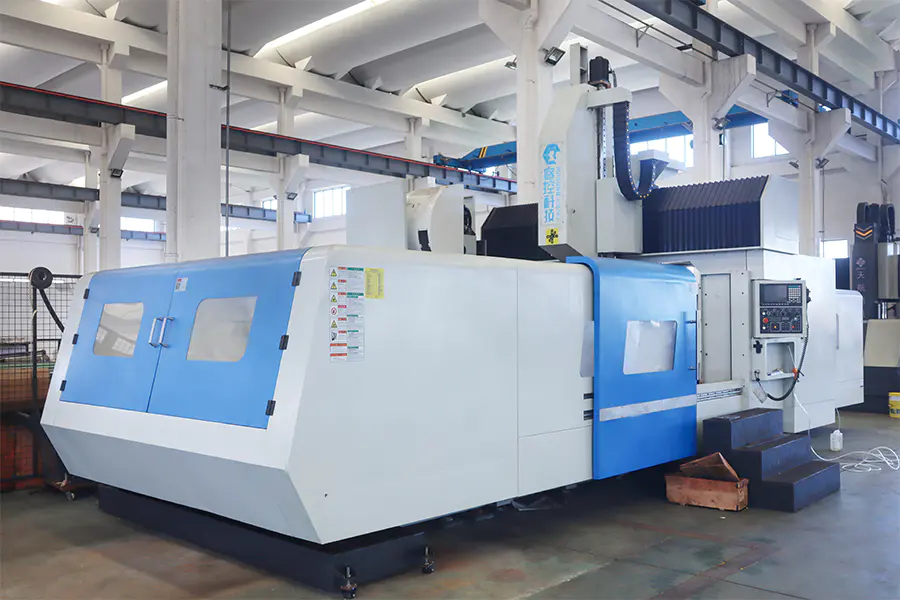
Hydraulic baler machines on the assembly floor. Specification accuracy matters most at the point where a machine is matched to a waste stream, not after delivery.
The commercial backdrop explains why specification detail now attracts so much attention. Commercial market research aggregated for the 2026 cycle projects the global baler market at USD 7.96 billion in 2026, with a forecast of USD 18.02 billion by 2034. The hydraulic waste paper baler segment was estimated at USD 1.45 billion in its 2024 base year and is forecast to reach USD 2.24 billion by 2032 at a 5.5% CAGR. The hydraulic metal recycling baler market was valued at USD 913 million in 2023, with a forecast of USD 1,318 million by 2031. These three figures cover different scopes and should not be added together. What they share is a direction: more waste is being baled, and buyers are being asked to justify equipment choices with specifics rather than general capability claims.
Why These Three Specifications Decide the Purchase
Compression force, feeding mouth and bale weight form a closed system. Change one and the other two shift.
A press rated above what the material needs does not automatically produce a better bale. Excess force applied to thin, brittle or highly mixed material can affect bale integrity, push material back through the feed opening, or consume energy without improving density. Under-specified force produces the opposite failure: bales that hold shape briefly and then relax, which raises the cost of every downstream step, from strapping and stacking to truck loading and the price a recycler will pay per bale.
Feeding mouth size decides labour. If the opening is smaller than the largest item arriving from a corrugator, printing line or sorting belt, someone has to cut, break or pre-shred material before it enters the press. That labour cost is recurring and rarely appears in a quotation comparison.
Bale weight decides handling. A 30 kg bale and a 500 kg bale imply entirely different downstream equipment, strapping methods, floor space and transport arrangements. Two machines with the same compression force can produce very different bale weights, because bale weight also depends on chamber geometry, bale length range and material bulk density.
Compression Force: Nominal Rating vs Documented Configuration Range
Compression force is the maximum hydraulic force applied during compaction, stated in tons. Jewel datasheets list two related figures: the nominal compression force of the specific model, and a wider configuration range documented for the platform that model belongs to. Both are useful, but they answer different questions.
The JPW40F semi-automatic horizontal baler is rated at a nominal 40 Ton within a documented 40-100 Ton configuration range. The JP-S100B cutting machine is rated at a nominal 100 Ton within a 100-160 Ton range. The widest documented configuration range across the Jewel range appears on the JPA5076T25X hydraulic baler and the JP7050T8 baling machine, both listed with a 2-180 Ton range. In practice, the nominal figure tells a buyer what a delivered machine does; the configuration range tells a buyer how far the platform can be adapted through customization of structure, process and performance.
| Model | Machine type | Nominal compression force (Ton) | Documented configuration range | Power |
|---|---|---|---|---|
| JP8060T5X | Waste compactor | 5 | Not listed | 2.2 kW / 3 Hp |
| JPW-K6046 | Bagging machine | 10 | 30-60 Ton | 2.2 kW / 3 Hp |
| JPW20Q | Fully automatic horizontal baler | 20 | 20-40 Ton | 7.5 kW / 10 Hp |
| JPA5076T25X | Hydraulic baler | 25 | 2-180 Ton | 7.5 kW / 10 Hp |
| JPW40F | Semi-automatic horizontal baler | 40 | 40-100 Ton | 11 kW / 15 Hp |
| JPW40BL | Plastic bottle recycling machine | 40 | 40-150 Ton | 15 kW / 20 Hp |
| JPW-AK60 | Briquetting machine | 60 | 60-200 Ton | 15 kW / 20 Hp |
| JPY-T60W | Metal baler | 60 | 60-600 Ton | 22 kW / 30 Hp |
| JP-S100B | Cutting machine | 100 | 100-160 Ton | 11 kW / 15 Hp |
| JP-OT100 | Vertical baler | 100 | 100-180 Ton | 15 kW / 20 Hp |
| JPW-AK100 | Aluminum foil baler | 100 | 100-160 Ton | 18.5 kW / 25 Hp |
| JP7050T8 | Baling machine | Not stated on the datasheet | 2-180 Ton | 2.2 kW / 3 Hp |
| JPW150BL-QT | Fully automatic horizontal closed-end baler | 150 | Not listed | Not listed |
Compression force does not scale with motor rating in a straight line. Within the same range, the JP-OT100 vertical baler is rated at 100 Ton with a 15 kW / 20 Hp motor, while the JPY-T60W metal baler is rated at 60 Ton with a 22 kW / 30 Hp motor. Machine architecture, chamber design and cycle dynamics differ between them. Buyers should confirm force, power and cycle time as separate line items.
One boundary is worth stating plainly: compression force is a maximum, not a density guarantee. Realized bale density depends on material, moisture, feed consistency and bale length setting. A 40 Ton horizontal baler fed loose cardboard at irregular intervals will not match the same machine fed a consistent, pre-conditioned stream.
Feeding Mouth Size: The Dimension Behind Most Feeding Problems
Feeding mouth dimensions define the largest single item that can enter the compression chamber without pre-processing. Jewel lists this figure as length x height (L*H) on vertical and most single-chamber models, and as length x width (L*W) on horizontal models. The notation difference is not cosmetic, and a buyer comparing two datasheets side by side should confirm which dimension is which before ordering.
| Model | Feeding mouth (mm) | Notation used | Machine orientation |
|---|---|---|---|
| JPW-AK60 | 500 x 300 | L*H | Briquetting |
| JPW-AK100 | 500 x 320 | L*H | Aluminum foil / fiber |
| JPW-K6046 | 540 x 400 | L*H | Bagging |
| JP8060T5X | 650 x 470 | L*H | Vertical compactor |
| JP7050T8 | 670 x 400 | L*H | Vertical baling |
| JPW20Q | Stated as 700-460 | L*W | Fully automatic horizontal |
| JPY-T60W | 900 x 430 | L*W | Metal baler |
| JPW40BL | 1000 x 720 | L*W | Horizontal |
| JPW40F | 1000 x 720 | L*W | Horizontal |
| JP-OT100 | 1400 x 600 | L*H | Vertical baler |
| JPA5076T25X | 1500 x 500 | L*H | Horizontal |
The JPW20Q feeding mouth is stated on the datasheet as 700-460 mm. Buyers should confirm the dimension order in writing before specifying conveyor widths, chute angles or manual loading positions around this model. The JP-S100B cutting machine is specified differently: it lists a cutting width of 1000 mm and a cutting stroke of 1000 mm instead of a feeding mouth figure.
The practical rule is straightforward. Measure the largest single item that will reach the machine, whether a flattened carton, a PET bottle bundle, a woven bag or a metal offcut, then compare it against the feeding mouth in the same orientation. If the item must be folded, cut or crushed first, the labour required to do that belongs in the project calculation. Several reported Jewel projects address exactly this. An Italian cardboard box factory replaced aging balers and added preprocessing equipment specifically to handle large-sized waste cardboard through the JPA5076T25X, whose feeding mouth is the largest listed in the range at 1500 x 500 mm.
Bale Weight: What It Says About Downstream Handling
Bale weight is the specification that connects the baler to everything downstream: strapping, forklift capacity, warehouse stacking height, container loading and the resale value of the recovered material. Jewel lists bale weight as a range for each model, because it varies with material and bale length setting.
| Model | Bale weight (kg) | Bale dimension (mm) | Strapping channels | Bale discharge |
|---|---|---|---|---|
| JPW-AK100 | 5-15 | 320 x 320 x (200-250) | Not listed | Not listed |
| JPW-AK60 | 5-10 | 300 x 300 x (200-300) | Not listed | Not listed |
| JPY-T60W | 15-20 | Cross-section 430 x 280 x (150-250) | Not listed | Not listed |
| JPW20Q | 30-70 | 500 x 500 x 500 | 2-4 | Not listed |
| JP8060T5X | 50-80 | 800 x 600 x 400 | Not listed | Not listed |
| JPW-K6046 | 50-80 | Not listed | Not listed | Bagging |
| JP7050T8 | 50-80 | Not listed | Not listed | Not listed |
| JPA5076T25X | 200-300 | 1500 x 760 x 900 | Not listed | Not listed |
| JPW40F | 200-400 | 720 x 720 x (500-1300) | 4 | Continuous push pack |
| JPW40BL | 250-350 | 720 x 720 x (300-1000) | 4 | One-time blunder |
| JP-OT100 | 400-600 | 1400 x 700 x (700-1100) | Not listed | Not listed |
Two interpretations are common, and both are worth correcting. First, bale weight is not a proxy for compression force. The JPW20Q applies 20 Ton and produces 30-70 kg bales in a fixed 500 x 500 x 500 mm chamber, while the JP-OT100 applies 100 Ton and produces 400-600 kg bales in a chamber of 1400 x 700 x 1700 mm with a variable bale length. Chamber size and bale length range carry much of the difference. Second, higher bale weight is not automatically better. A 500 kg bale requires handling equipment, strapping strength and truck configuration that a 250 kg bale does not. The right target is the heaviest bale the site can move, stack and sell without adding a second machine or a second operator.
Bale discharge method is the related detail. The JPW40F uses continuous push pack discharge, the JPW40BL uses one-time blunder discharge, and the JPW20Q is a fully automatic horizontal baler with 2-4 strapping channels. These differences change how the machine connects to the next stage of the line, and in automated installations they matter more than tonnage.
Reading the Three Specs Together: A Five-Step Sequence
- Start with the material, not the machine. Identify the single largest item and the average bulk density of the stream. Mixed, light material behaves differently from dense, uniform material.
- Match the feeding mouth to the largest item in the same orientation. If pre-cutting is required, cost it as recurring labour.
- Set a target bale weight from downstream handling. Confirm that forklifts, stacking heights and transport arrangements can handle the upper end of the model bale weight range.
- Select compression force to reach the target density in that material, with margin. Review the documented configuration range to understand how much adjustment the platform allows.
- Verify power, voltage, cycle time, discharge method and certification for the destination market. These are separate line items, and each one can block commissioning.
Shortlist by Waste Stream
Because the three specifications interact, the same model rarely fits two different materials. The table below maps Jewel models to waste streams on the basis of published feeding mouth, compression force and bale weight figures only.
| Waste stream | Models matched to the published specifications | Why |
|---|---|---|
| PET bottles, HDPE bottles, woven bags, mixed plastics | JPW40BL; JPA5076T25X; JPW20Q | JPW40BL: 40 Ton, 1000 x 720 mm feed, 250-350 kg bales, 4 strapping channels. JPA5076T25X: 25 Ton, 1500 x 500 mm feed, 200-300 kg bales. JPW20Q: fully automatic, 20 Ton, 30-70 kg bales |
| Cardboard and carton production waste | JPW40F; JP-OT100; JPA5076T25X | JPW40F: 40 Ton, 1000 x 720 mm feed, 200-400 kg bales, 1-2 ton/hr. JP-OT100: 100 Ton vertical, 1400 x 600 mm feed, 400-600 kg bales. JPA5076T25X: largest listed feed opening in the range |
| Waste paper, paper dust, fiber-based material | JPW-AK60; JPW-AK100 | JPW-AK60: briquetting of paper dust, 60 Ton, 5-10 kg briquettes, 0.2-0.5 ton/hr. JPW-AK100: aluminum foil and fiber-based material, 100 Ton, 5-15 kg bales |
| Metal scrap and offcuts | JPY-T60W | Metal baler, 60 Ton, 900 x 430 mm feed, 15-20 kg bales, 0.5-1 ton/hr, within a 60-600 Ton configuration range |
| Retail and light packaging volumes | JP8060T5X; JPW-K6046; JP7050T8 | JP8060T5X: 5 Ton compactor, 50-80 kg bales, 4-7 bales/hr. JPW-K6046: bagging machine, 10 Ton, 50-80 kg. JP7050T8: 50-80 kg bales at 220V/50Hz |
| Trim-heavy or dust-generating streams | JP-S100B | Cutting machine, 100 Ton, 1000 mm cutting width, 1000 mm cutting stroke, 20-30 s single cycle time |
This mapping is a starting point for specification review rather than a ranking. A site with an unusual item size, an unusual bale weight target or an existing conveyor layout may need a customized build; the manufacturer offers customization at structure, process and performance level.
Application Evidence: Where These Specifications Have Been Used
Reported projects give the specification numbers a working context.
- Tunisia, cardboard box factory (JPW-AK60, 1 unit). A factory-wide automatic waste discharge system addressed waste accumulation from the corrugator line and printing machines, eliminating piled waste paper in the workshop. Reported duration: 3 years.
- Mexico, cardboard box factory (JPW40BL, 1 unit). A full-automatic waste removal system integrated with existing production lines, eliminating waste accumulation and improving workshop space utilisation. Reported duration: 1 year.
- Japan, PET recycling enterprise. The requirement was higher compression density for PET bottles and compact, uniform bales to improve handling and reduce transport and storage costs. Reported duration: 2 years.
- Italy, cardboard box factory (JPA5076T25X, 1 unit). Aging balers were replaced and preprocessing equipment introduced to handle large-sized waste cardboard that had been difficult to manage. Reported duration: 4 years.
- Belarus, waste recycling (JPW40BL, 1 unit). PET bottles, woven bags, HDPE bottles and cardboard were bulky and hard to compress; regular-shaped bales improved transport and storage efficiency. Reported duration: 2 years.
- Russia, cardboard box factory (JPW40F, 1 unit). Automatic collection, compression and baling of carton production waste produced an unmanned waste processing system and immediate monetisation of waste. Reported duration: 3 years.
- Australia, waste recycling (JPW40BL, 1 unit). Mixed plastics, small amounts of glass and metal scraps were processed in an integrated line that achieved full-line unmanned operation. Reported duration: 2 years.
Across these cases the same pattern appears: the constraint was never tonnage alone. It was item size at the feeding mouth, bale weight in downstream handling, or continuity of feed in an automated line.
Certification, Voltage and Supply Terms Buyers Should Verify
Specification review should end with documentation, because a machine that matches a waste stream on paper but cannot be commissioned in the destination market is not a match in practice.
- EU conformity. The fully automatic horizontal baler JPW20Q holds CE attestation of compliance number TTC-22-1609/01/01, issued by INTEGRA under 2006/42/EC and 2014/35/EU, applying standards EN ISO 12100:2010 and EN 60204-1:2018. Issue date 2022-09-16, valid to 2027-09-16.
- Supplier audit. An SGS Made-in-China Supplier Audit Report, certificate number QIP-ASR2541890, covers the full range of baler machine, hydraulic baler, waste paper baler, cardboard baler and baling press machine. Issued 2025-12-10, valid to 2028-12-10.
- Voltage. Most models list 380V/50Hz with customization available; the JP7050T8 is listed at 220V/50Hz. Voltage is a project decision, not a default.
- Supply terms. Minimum order quantity is 1 unit, monthly production capacity is 100 units, and lead time is stated at 60 days. Quality control is described as 100% testing.
- Support. Aftersales is described as 7x24h technical response with on-site attendance within 48 hours, lifelong maintenance and free training.
- Manufacturer profile. Nantong Jiabao Machinery Co., Ltd. operates a 50,000 square metre facility with more than 200 employees, including a 30-engineer R&D team, and reports annual output of 120,000 units with a 70% export ratio across Australia, Europe, North America, Africa, Asia, Russia and Belarus.
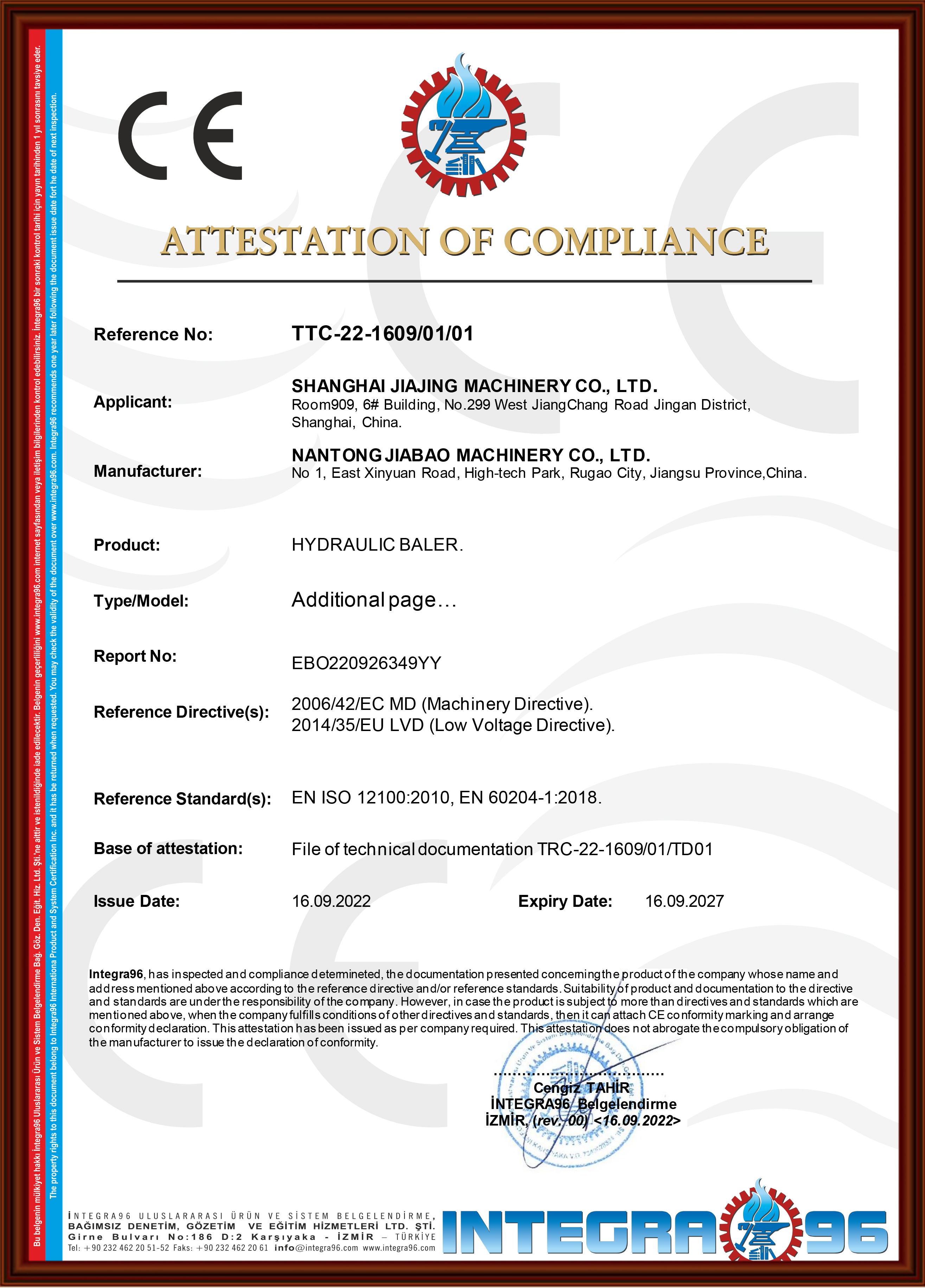
CE attestation of compliance TTC-22-1609/01/01 applies to the JPW20Q fully automatic horizontal baler under EN ISO 12100:2010 and EN 60204-1:2018.
Vertical vs Horizontal, Semi-Automatic vs Automatic: What the Spec Sheet Does Not Explain
Machine type is often presented as a quality hierarchy, with automatic placed above semi-automatic and horizontal above vertical. The published specifications do not support that reading.
Vertical hydraulic baler machines such as the JP-OT100 and JP8060T5X occupy a smaller floor footprint and suit sites where space is constrained. The trade-off is throughput and bale handling. The JP-OT100 produces 5-6 bales per hour with a machine weight of 3,500 kg and bales of 400-600 kg; the JP8060T5X produces 4-7 bales per hour at 550 kg machine weight with 50-80 kg bales. Neither is inferior, and both are bounded. Vertical machines are typically the wrong choice when a continuously running corrugator or sorting line needs waste removed as it is generated.
Horizontal machines answer that constraint. The JPW40F semi-automatic horizontal baler reaches 1-2 ton/hr with continuous push pack discharge, and the JPW40BL handles PET and mixed plastics with a 1000 x 720 mm feeding mouth. Fully automatic horizontal models such as the JPW20Q remove the operator from the cycle entirely, but the JPW20Q is rated at 20 Ton within a 20-40 Ton configuration range and produces bales of 30-70 kg. It is a fit for defined streams and defined bale sizes, not a universal replacement for higher-force machines.
Cutting machines form a third category with their own boundary. The JP-S100B is specified by cutting width, cutting stroke and a 20-30 second single cycle time rather than by bale throughput. In high-volume lines, cycle time rather than compression force becomes the throughput determinant, and a high-force machine with a slow cycle can underperform a lower-force machine with a faster one.
Two further limits are worth stating for planning purposes. First, compression force alone does not set bale density; material condition and feed consistency carry comparable weight. Second, customization of structure, process and performance is available, but customized builds need to be planned into a project schedule against the stated 60-day lead time rather than treated as an off-the-shelf option.
Market Trend: Automation, Density and Documentation
Three trends are visible in the specification and application data.
Automation is being adopted as a waste-removal strategy, not a machine feature. The Russian and Australian projects describe unmanned or full-line unmanned operation, and the Mexican project describes a full-automatic system integrated with existing production lines. In these cases the baler is one component of a waste removal system that includes collection, compression and baling.
Bale density is being treated as a logistics specification. The Japanese PET recycling project was framed around compression density, compact bales and the resulting reduction in transport and storage costs. That framing reflects a broader shift: recovered material is priced and moved by density and consistency, not by volume alone.
Documentation is becoming part of the buying decision. Certificate scope, validity periods and audit reports now appear alongside tonnage when buyers compare machines, which is consistent with a market where the hydraulic waste paper baler segment is forecast to grow at a 5.5% CAGR to 2032, and where the hydraulic metal recycling baler market is forecast to move from USD 913 million in 2023 to USD 1,318 million by 2031.
Future Outlook
Two developments seem likely to shape specification practice over the next several years.
The first is tighter integration between baling equipment and production lines. Reported installations already connect the baler to the point where waste is generated, whether the corrugator line, the printing machine or the sorting belt, rather than treating it as a standalone station. As more sites move in this direction, feeding mouth dimensions and feed rates will be specified with the same rigour as compression force.
The second is a shift in what buyers ask a datasheet to prove. Nominal force is easy to print; documented configuration ranges, certificate numbers, validity dates and bale weight ranges are harder to produce and easier to verify. Buyers evaluating hydraulic baler machines in the current cycle appear to be moving toward the second category of evidence, and suppliers that publish it will be easier to shortlist.
Technical FAQ
What does compression force mean on a hydraulic baler specification sheet?
Compression force is the maximum hydraulic force the press applies to material during compaction, stated in tons. On Jewel datasheets it appears twice: as a nominal rating for a specific model, and as a wider configuration range documented for that platform. The JPW40F is rated at a nominal 40 Ton within a 40-100 Ton range; the JP-S100B is rated at 100 Ton within a 100-160 Ton range; the JPA5076T25X and JP7050T8 are listed with a 2-180 Ton configuration range.
Is a higher compression force always better?
No. Compression force is a maximum, not a density guarantee. Realized bale density depends on material, moisture, feed consistency and bale length setting alongside force. Excess force applied to thin or highly mixed material can affect bale integrity, and higher force generally means a heavier, more demanding machine. The appropriate force is the level that reaches the target bale density in the specific material with margin.
How can feeding mouth sizes be compared across models when the notation differs?
Jewel lists feeding mouth dimensions as length x height (L*H) on vertical and most single-chamber models, and as length x width (L*W) on horizontal models. The JP-OT100 is listed at 1400 x 600 mm and the JPA5076T25X at 1500 x 500 mm in L*H notation, while the JPW40F and JPW40BL are listed at 1000 x 720 mm in L*W notation. The JPW20Q feeding mouth is stated as 700-460 mm, so dimension order should be confirmed in writing before specifying conveyor widths or chute angles around it.
What determines bale weight?
Bale weight results from compression force, chamber geometry, bale length range and material bulk density together. Published ranges illustrate the spread: the JPW20Q produces 30-70 kg bales in a fixed 500 x 500 x 500 mm chamber at 20 Ton, the JPW40F produces 200-400 kg bales at 40 Ton with a bale length range of 500-1300 mm, and the JP-OT100 produces 400-600 kg bales in a 1400 x 700 x 1700 mm chamber. Higher force alone does not explain the differences.
Can compression force be adjusted on the same machine?
Jewel datasheets document a configuration range per platform, separate from the nominal force of each model. Examples include 40-100 Ton for the JPW40F platform, 100-160 Ton for the JP-S100B and JPW-AK100 platforms, 60-600 Ton for the JPY-T60W metal baler platform, and 2-180 Ton for the JPA5076T25X and JP7050T8 platforms. The manufacturer offers customization at structure, process and performance level, so specific ranges should be confirmed for the intended application rather than assumed.
Which models are typically shortlisted for PET bottle and plastic recycling?
Models whose published specifications match plastics handling are the JPW40BL with 40 Ton, a 1000 x 720 mm feeding mouth, 250-350 kg bales and four strapping channels; the JPA5076T25X with 25 Ton, a 1500 x 500 mm feeding mouth and 200-300 kg bales; and the JPW20Q with fully automatic operation, 20 Ton and 30-70 kg bales. Selection depends on the largest item reaching the feeding mouth and on the bale weight the site can handle downstream.
What voltage and certification do these machines ship with?
Most models list 380V/50Hz with voltage customization available, and the JP7050T8 is listed at 220V/50Hz. For the EU market, the JPW20Q holds CE attestation of compliance TTC-22-1609/01/01 issued by INTEGRA under 2006/42/EC and 2014/35/EU, applying EN ISO 12100:2010 and EN 60204-1:2018, valid to 2027-09-16. An SGS Made-in-China Supplier Audit Report, certificate number QIP-ASR2541890, covers the full baler machine range and is valid to 2028-12-10. Applicable certificates should be confirmed model by model for the destination market.
What are the practical limits of a vertical baler compared with a horizontal one?
Vertical hydraulic baler machines such as the JP-OT100 and JP8060T5X use less floor space and suit constrained sites, but they are throughput-limited and depend on batch loading: 5-6 bales per hour for the JP-OT100 and 4-7 bales per hour for the JP8060T5X. Horizontal machines address continuous flow instead, with the JPW40F reaching 1-2 ton/hr using continuous push pack discharge. Neither type is inherently superior; the constraint is whether waste arrives continuously or in batches.
What are the minimum order quantity and lead time?
The stated minimum order quantity is 1 unit, monthly production capacity is 100 units, and lead time is 60 days. Quality control is described as 100% testing, and aftersales support as 7x24h technical response with on-site attendance within 48 hours, lifelong maintenance and free training. Customized builds should be scheduled against the 60-day lead time within the project plan.
Full model specifications, bale dimensions and configuration ranges are compiled in the 2026 Jewel hydraulic baler brochure (PDF). Manufacturer information is available at www.jewelbaler.com.