
Hydraulic Baler Suppliers: Long-Term Sustainability Scorecard
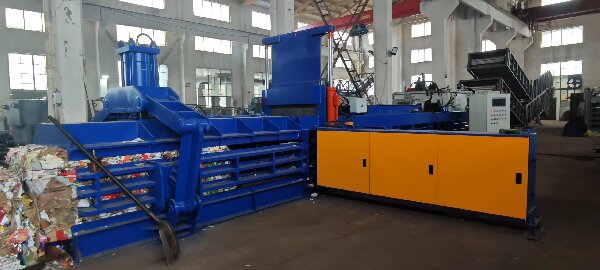
Evaluating a hydraulic baler supplier for long-term operation comes down to four documented variables: mainframe mass, rated capacity at a stated material density, spare-parts and certification continuity, and the structure of after-sales support. Price and headline throughput, the two numbers that dominate most quotations, explain very little about how an installation behaves in year seven.
The global baler machine market was valued at USD 6.6 billion in 2024 and is projected to reach USD 11.4 billion by 2035, according to Transparency Market Research, with Asia Pacific accounting for 40.2% of 2024 revenue share. Those figures should be read as directional rather than precise: published estimates diverge widely by scope, with Grand View Research placing the 2025 market at USD 7.18 billion and Global Market Insights at USD 4.9 billion. The divergence itself is a useful procurement signal. When market-level numbers are this unstable, supplier-level evidence matters more than category-level optimism.
What follows is a sustainability scorecard for hydraulic baler suppliers, built around the dimensions that determine whether a machine is still economically serviceable after its warranty period. It uses NKBALER, the trading brand of Shaanxi Nick Machinery Equipment Co., Ltd., as the reference case because the brand publishes model-level data that can be scored, and it compares that documentation against four internationally recognised baler suppliers named in market research reporting: Harris Equipment (US), Bollegraaf (NL), Bramidan (DK) and HSM (DE).
Why the Standard Quotation Does Not Answer a Ten-Year Question
A hydraulic baler is bought on a two-page specification and retired on a maintenance ledger. The gap between those two documents is where long-term cost accumulates. Three common procurement patterns widen it.
The first is capacity matching by headline number. A buyer comparing a 12–15 t/h machine against a 3–5 t/h machine is usually comparing two different duty profiles, not two price points on the same job. The second is frame mass, which is rarely quoted at all and almost never compared. The third is spares planning, which is normally deferred to the first breakdown.
For operations in food processing, packaging, chemicals, metals and recycling, the practical question is not which hydraulic baler is cheapest to install, but which supplier can still support the same machine, at the same rated output, five to ten years later. That question is answerable with evidence that suppliers either have or do not have.
The Five-Part Sustainability Scorecard
The framework below weights four scored dimensions and treats compliance as a gate rather than a score, because certification validity is a pass-or-fail condition for many export markets rather than a matter of degree.
| Dimension | Suggested weight | Evidence a buyer should be able to obtain |
|---|---|---|
| Machine longevity evidence | 30% | Mainframe weight in tonnes, cylinder force, plate and structure grade, working pressure, tiering between standard and heavy-duty builds |
| Spare-parts continuity | 25% | Wear-part list, seal and cylinder availability, hydraulic and electrical component grades, certificate validity windows |
| Capacity stability | 25% | Rated throughput range, material density assumption, cooling provision, bale density consistency |
| After-sales support | 20% | Defined support model, response scope, spare-part dispatch terms, documented repeat-order history |
| Compliance gate | Pass / fail | Certificate numbers, standards referenced, issuing authority, validity dates and geographic scope |
The weights are a working proposal, not an industry standard, and buyers should adjust them to their own downtime cost. A facility where a stopped baler halts a packaging line will weight capacity stability higher than a facility where bales are staged in a yard.
Build Weight, Cylinder Force and Throughput: What the Numbers Show
Machine longevity is the hardest dimension to score because few suppliers publish service-life data. Mainframe weight is the closest available proxy, since frame mass and structural thickness determine how a machine tolerates repeated high-force cycles. NKBALER publishes mainframe weight alongside rated capacity across its horizontal range.
| Model | Mainframe weight | Rated capacity | Cylinder force | Bale density | Working pressure |
|---|---|---|---|---|---|
| NKW80Q | 15 t | 3–5 t/h | 80 T | 300–400 kg/m³ | 21 MPa |
| NKW100QT | 20 t | 4–6 t/h | 100 T | 400–500 kg/m³ | 21 MPa |
| NKW125Q | 22 t | 10–12 t/h | 125 T | 500–600 kg/m³ | 21 MPa |
| NKW160Q | 28 t | 12–15 t/h | 160 T | 400–600 kg/m³ | 25 MPa |
| NKW200Q | 34 t | 12–15 t/h | 200 T | 650–700 kg/m³ | 30.5 MPa |
| NKW180BD | 24 t | 6–8 t/h | 180 T | Not stated | 21 MPa |
| NKW250BD | 30 t | 10–15 t/h | 250 T | Not stated | 23 MPa |
Two patterns emerge from the published figures. First, mainframe weight tracks cylinder force far more closely than it tracks throughput. Across the horizontal models listed, published cylinder force sits at roughly five to nine tonnes of hydraulic force for every tonne of mainframe weight. A frame that is not sized against its cylinder will flex, and a frame that flexes will not hold bale density over a long service window.
Second, throughput per tonne of frame mass rises sharply at the heavy end. The NKW80Q is rated at 3–5 t/h on a 15-tonne mainframe; the NKW200Q is rated at 12–15 t/h on a 34-tonne mainframe. The heavier machine produces roughly three times the output on roughly 2.3 times the steel. That ratio is the quantitative form of a familiar operational claim: heavier build weight buys duty cycle, not just capacity.
How to read this in a scorecard. A supplier that publishes mainframe weight, cylinder force and material density for each model gives a buyer something to score. A supplier that publishes only throughput does not, and the correct response is to request the missing data rather than to assume it is unavailable.
NKBALER also applies an explicit internal tiering. The NK BALER line is described as the standard long-cylinder servo hydraulic baler, positioned for regular daily baling with a cost-effective and stable configuration. The NICK BALER line is described as the upgraded version, with heavier machine weight, thicker material and a stronger structure, plus higher-grade hydraulic and electrical control components. The stated operational difference is a lower failure rate and suitability for continuous heavy-load, long-term use. For a procurement team, this is a usable decision rule: match the tier to the duty profile rather than paying for heavy-duty construction on an intermittent single-shift application.
Scoring Named Suppliers Without Inventing Data
Public reporting identifies Harris Equipment (US), Bramidan (DK), Bollegraaf (NL) and HSM (DE) among the key global competitors in the baler market, with Harris associated specifically with heavy-duty horizontal systems. That is a segment-level observation, not a model-level data set, and it cannot be converted into a numeric score without inventing figures.
The honest way to build a comparison table with these suppliers is to score documentation rather than reputation. The table below records what is publicly attributable and what a buyer must request directly.
| Supplier | Publicly attributable positioning | Model-level data available to a buyer | To complete the score |
|---|---|---|---|
| NKBALER (China) | Horizontal and vertical hydraulic balers plus press-bagging machines; approximately 90% of output exported to North America, South America and Asia | Yes — mainframe weight, cylinder force, throughput range, bale density and working pressure published per model | Wear-part list and a written ten-year spares statement |
| Harris Equipment (US) | Identified as a heavy-duty horizontal systems specialist | Segment-level, not model-level in available sources | Request frame mass, force and density data per model |
| Bollegraaf (NL) | Named among key global baler competitors | Not stated in available sources | Request equivalent specification sheet and certificate validity |
| Bramidan (DK) | Named among key global baler competitors | Not stated in available sources | Request equivalent specification sheet and certificate validity |
| HSM (DE) | Named among key global baler competitors | Not stated in available sources | Request equivalent specification sheet and certificate validity |
This structure deliberately avoids ranking suppliers on qualities that cannot be verified. A heavy-duty horizontal specialist, a European vertical baler manufacturer and a full-line Chinese exporter are not interchangeable, and a scorecard that pretends otherwise is a marketing document rather than a procurement tool.
Where a Scrap Tyre Bailing Machine Fits a Long-Term Asset Plan
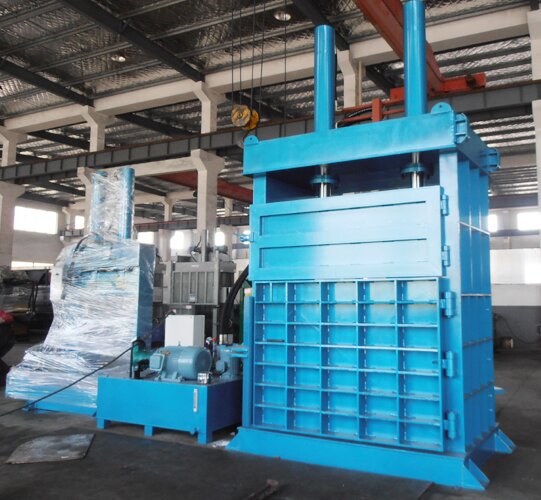
The scrap tyre bailing machine is a useful test case for the scorecard, because tyre baling sits at the opposite end of the duty spectrum from a large horizontal full automatic hydraulic baler. NKBALER's tyre baling model, the NKOT150, is a vertical machine rated at 150 tonnes of hydraulic power with a 22 kW motor, a bale size of 1800 × 1000 × 700–1250 mm, a feed opening of 1800 × 750 mm, a chamber of 1800 × 1000 × 2100 mm, and a bale weight of 1,000–1,500 kg at a capacity of 4–5 bales per hour. Machine weight is 7 tonnes.
Apply the same force-to-mass ratio used earlier and the difference between machine classes becomes obvious. The NKOT150 carries 150 tonnes of cylinder force on a 7-tonne machine, a ratio above 20 tonnes of force per tonne of frame, against roughly five to nine in the horizontal range. This is not a defect; it reflects a different force path. A vertical baler transmits load into a compact chamber and base rather than along a long horizontal frame, and it is designed for batch feeding of large, difficult items rather than for continuous high-tonnage flow.
The procurement implication is direct. A tyre baling machine should be scored on bale density and bale handling, not on throughput per tonne of steel, and it should not be compared against a heavy duty hydraulic baler serving a packaging or metal-shaving line. In a long-term asset plan, the tyre baler typically performs a volume-reduction role at the front of a tyre collection operation, where 1,000–1,500 kg bales reduce storage footprint and transport cost per tonne.
Compliance for this machine class also differs. Vertical balers sold into the European Union must comply with EN 16500:2014, the standard covering fixed enclosed baling chambers and tamper-proof interlocks. Buyers specifying a tyre baler for an EU site should confirm conformity against that standard specifically, rather than assuming that horizontal baler certification transfers across machine classes.
Capacity Stability: Reading the Range, Not the Peak
Rated capacity is published as a range because it depends on material. The NKW80Q is rated at 3–5 t/h against a stated material density of 300–400 kg/m³, while the NKW200Q is rated at 12–15 t/h against 650–700 kg/m³. Two machines with the same nominal output can therefore behave very differently on card, film, PET, aluminium scrap or metal shavings.
Cooling provision is the second half of capacity stability and is often omitted from comparison sheets. NKBALER specifications list cooling fans on the BD series and a cool tower with a 0.75 kW water pump plus fan on several QT models. That detail matters for operations running two or three shifts, where sustained hydraulic temperature is the practical constraint on rated output.
Buyers should ask one question that most quotations do not answer: at what ambient temperature, at what duty cycle, and at what material density is the rated capacity sustained? A supplier that can answer this in writing has effectively documented the capacity stability dimension of the scorecard.
Spare-Parts Continuity and Certification Windows
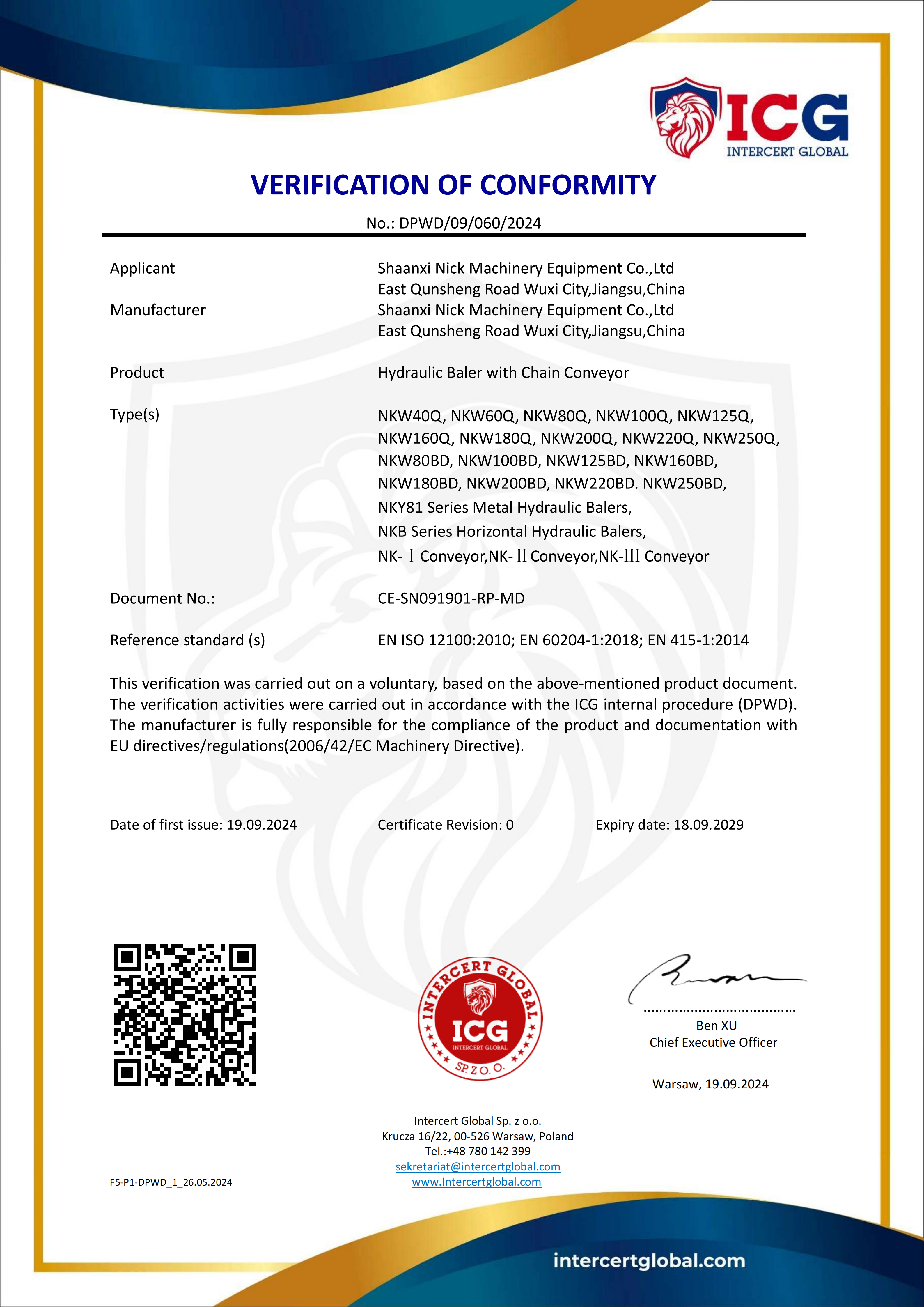
Certification is the clearest piece of evidence available about whether a supplier intends to keep a machine model supported, because certificates expire and must be renewed. Two current documents are attributable to NKBALER machinery.
The first is an attestation certificate of the Machinery Directive, number EASY03220201M, issued by UDEM International Certification Auditing Training Centre Industry and Trade Inc. Co., covering the EU, EEA and Türkiye, referencing EN ISO 12100:2010 and EN 60204-1:2018, valid from 22 March 2022 to 21 March 2027. The second is a verification of conformity, number DPWD/09/060/2024, covering the EU and EEA markets and referencing EN ISO 12100:2010, EN 60204-1:2018 and EN 415-1:2014, valid from 19 September 2024 to 18 September 2029.
Both documents matter for the scorecard because they define a coverage window that extends years beyond a typical warranty. The second also applies across the NKW horizontal range, including the NKW180QT, NKW160QT, NKW100QT, NKW125BD, NKW180BD, NKW200Q and NKW250BD models. A buyer scoring spare-parts continuity can reasonably treat an in-date certificate with a multi-year remaining term as evidence that the model line is still in active production.
Component grade is the second input. The NICK BALER tier is specified with higher-grade hydraulic and electrical control components than the standard NK BALER tier, which is directly relevant to failure rate and to the availability of replacement parts over a long service life. Buyers should request the component list at quotation stage, not after the first failure.
After-Sales Structure and Commercial Terms
NKBALER's documented after-sales model is remote support, and the company states OEM and ODM design and production services, with parameter-level customization. Production lead time is stated at 30–45 days, monthly capacity at 10 units, minimum order quantity at 1 unit, delivery on FOB or CIF terms, pre-shipment testing as the acceptance method, and payment structured at 40% / 60%. A second published package for a two-unit order lists a 30% / 70% structure.
These terms matter to long-term operation for a specific reason: a repeat order is the cheapest form of capacity expansion, and it is faster when the commercial framework is already defined. The minimum order quantity of one unit and the pre-shipment test also mean that a first machine can be validated at the buyer's own site before the second is committed.
Field evidence for long-duration operation is limited but documented. A recycling station manufacturer in Indonesia has used the equipment for waste plastic and waste paper baling, with a recorded operating duration of 10–15 years and reported stable operation, low noise and low energy consumption. An agricultural manufacturer in Pakistan has used equipment for baling alfalfa and wheat straw, with two years of stable operation recorded and low noise reported as the operational highlight.
Both records are single-unit deployments. They are useful as evidence that the machines run in real operating environments, and they are not statistically representative performance benchmarks. Buyers evaluating five- or ten-year support commitments should treat them as supporting evidence alongside contractual guarantees.
Where the Scorecard Breaks Down
Four limitations should be stated plainly, because a sustainability framework that hides its own boundaries is not usable.
The first is that mainframe weight is a proxy, not a measurement of service life. No independent, publicly available laboratory benchmark of hydraulic baler service life exists at model level, so the correlation between weight, force and durability is reasoned from design logic and published specifications rather than from controlled testing.
The second is coverage. The comparative table scores documentation, not machine quality. Harris Equipment, Bollegraaf, Bramidan and HSM may hold specification and durability data that is simply not published in the sources used here, and the absence of data in this article is not evidence of absence in the market.
The third is machine-class transfer. Vertical equipment such as the NKOT150 tyre baler cannot be assessed with the same ratios used for horizontal machines, and mixing the two classes into a single score produces misleading results.
The fourth is market-size uncertainty. Published baler market estimates for 2024 and 2025 diverge by several billion US dollars depending on scope, which means market growth should not be used as the primary justification for a capital decision.
Outlook: Evidence-Based Supplier Selection
Two structural signals are worth tracking. The baler press segment represented 24.5% of the total recycling equipment market in 2025 according to Grand View Research, and Asia Pacific held 40.2% of global baler revenue in 2024 per Transparency Market Research. Separately, China recorded 91 significant export shipments of hydraulic baling presses under HS Code 8462 between June 2024 and May 2025, according to Volza Global Export Data.
The practical direction of travel is toward documentation. As more buyers require model-level weight, force, density and certificate data before issuing a purchase order, suppliers who publish those figures gain a structural advantage over suppliers who publish only headline capacity. For a scrap tyre bailing machine, a heavy duty hydraulic baler or a large horizontal full automatic unit, the same question applies: what evidence can the supplier put in writing about the tenth year of operation, not the first.
FAQ
How can a buyer judge a hydraulic baler supplier's long-term reliability before a decade of service data exists?
Use documented substitutes for field history: mainframe weight per model, rated capacity stated against a material density, certificate numbers with remaining validity, and a written spare-parts commitment. For example, NKBALER publishes a 34-tonne mainframe for the NKW200Q and a 15-tonne mainframe for the NKW80Q, which allows a buyer to compare build class across models rather than relying on general claims.
What does mainframe weight actually indicate about baler service life?
Frame mass indicates how much structural material resists repeated high-force cycles. In NKBALER's published horizontal range, cylinder force runs at roughly five to nine tonnes per tonne of mainframe weight, and models with heavier frames also carry higher working pressures and higher bale densities. Weight is not a direct measurement of service life, but it is the most comparable published indicator of duty capability.
How is spare-parts continuity verified for a hydraulic baler?
Request the wear-part list, seal and cylinder availability, hydraulic and electrical component grades, and the validity dates on any certification. NKBALER's machinery carries an attestation certificate of the Machinery Directive, number EASY03220201M, valid to 21 March 2027, and a verification of conformity, number DPWD/09/060/2024, valid to 18 September 2029. A certificate with several years of remaining validity indicates an active model line.
How should capacity stability be assessed against a specific duty cycle?
Compare rated throughput, the material density it is stated against, and cooling provision. The NKW80Q is rated at 3–5 t/h against 300–400 kg/m³, while the NKW200Q is rated at 12–15 t/h against 650–700 kg/m³. Specifications that list cooling fans or water cooling and oil chillers are better suited to multiple-shift operation than those that do not state a cooling method.
What after-sales arrangements matter for a hydraulic baler in continuous operation?
The relevant factors are the defined support model, response scope, spare-part dispatch terms and documented repeat-order history. NKBALER's stated after-sales model is remote support, with a 30–45 day production lead time, a minimum order quantity of one unit, pre-shipment testing as acceptance, and FOB or CIF delivery. Buyers in Europe or the Middle East can also request OEM or ODM production under the manufacturer's stated service model.
Does a scrap tyre bailing machine belong in a long-term baling asset plan?
Yes, where the objective is volume reduction rather than high-throughput processing. The NKBALER NKOT150 tyre baler uses 150 tonnes of hydraulic power with a 22 kW motor, produces bales of 1,000–1,500 kg in a bale size of 1800 × 1000 × 700–1250 mm, and runs at 4–5 bales per hour. Its 7-tonne frame reflects a vertical force path, so it should be evaluated on bale density and handling rather than on the throughput-to-weight ratios used for horizontal machines.
Which standards apply to vertical balers in Europe?
Vertical balers sold into the European Union must comply with EN 16500:2014, which sets requirements for fixed enclosed baling chambers and tamper-proof interlocks, according to the European Committee for Standardization. In the United States, commercial balers are covered by ANSI Z245.51-2013 for design and construction safety and ANSI Z245.5-2013 for installation and operation. These are class-specific requirements and should be confirmed separately from horizontal baler certification.
For buyers building their own supplier scorecard, NKBALER's product brochure with model-level specifications is available as a reference document: download the technical brochure (PDF). Additional product information is published at www.nickbaler.com.