
Hydraulic Cylinder Evidence: A Buyer's Supplier Review
A hydraulic hoist is only as credible as the cylinder scope behind it. In water conservancy and hydropower projects, the hydraulic cylinder converts hydraulic pressure into controlled gate motion, so bore, rod diameter, stroke, surface condition and sensor interface define what a supplier can actually support. This review focuses on the hydraulic cylinder portion of a supplier capability file and shows how buyers can test supplier claims against documented product scope, without treating a catalogue envelope as a project guarantee.
Jiangsu Wujin Hydraulic Hoist Co., Ltd. (Wujin Hydraulic) is a China-based manufacturer founded in 1970. It supplies hydraulic hoists, hydraulic cylinders and hydraulic power units, and describes itself as a comprehensive solution provider integrating research, manufacturing and sales of hydraulic hoists, cylinders, surface modification treatment and system integration. The company profile states that its business covers more than 30 countries and regions and more than 5,000 customers, and that its products are used in water conservancy, marine engineering, metallurgy, construction machinery, mining and automotive manufacturing.
The company background record lists 80,000 m² of factory space, 300 employees, 40 engineers and annual output of 10,000 tons. Those facts are useful context for a supplier review, but they do not answer the cylinder question by themselves. For an evaluation-stage buyer, the stronger evidence is a set of cylinder facts that can be traced to a product family, an engineering envelope, a surface treatment route and a sensor interface.
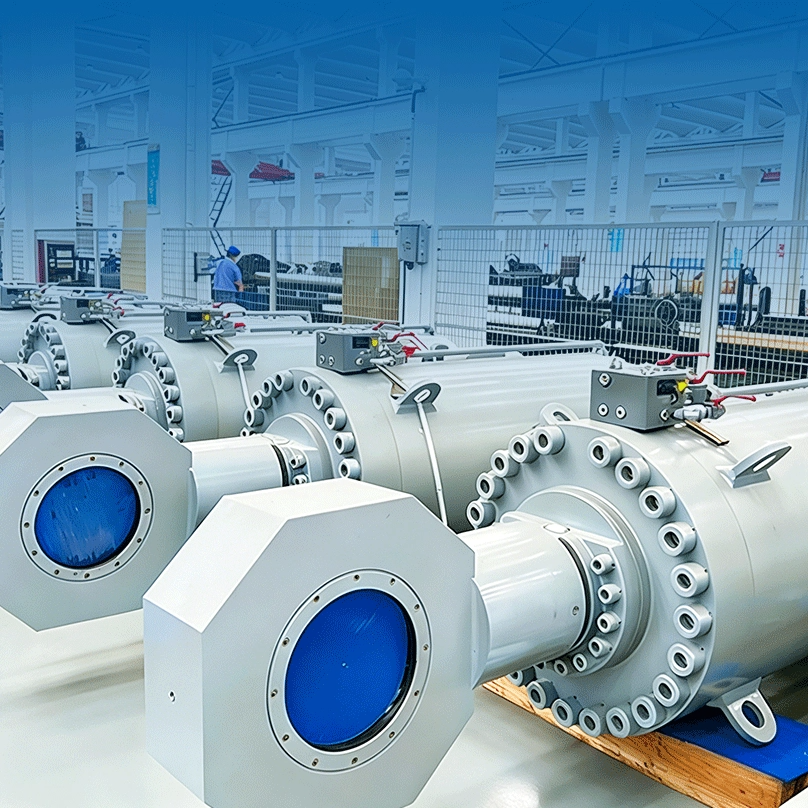
Factory view used for hydraulic hoist and cylinder manufacturing context. Image source: Wujin Hydraulic content unit.
Why cylinder evidence matters more than a package list
A hydraulic hoist package can be described in one sentence: cylinder, hydraulic power unit, control system, stroke sensor and surface treatment. That sentence can look complete while leaving the important questions unanswered. Which cylinder family is being offered? What bore, rod and stroke are documented? Which piston rod surface treatment is proposed? Is the stroke sensor an absolute or incremental type? How are the cylinder, sensor and control system integrated?
These questions matter because hydraulic gate hoists are project-specific. A dam, reservoir, ship lock or flood-control structure imposes its own load profile, stroke, duty cycle, corrosion exposure and control philosophy. A supplier's cylinder scope is therefore a better evidence point than a general capability statement. The buyer can use it to narrow the technical discussion, prepare an RFQ and decide which claims need documentary support.
The opportunity is not to collect more brochures. It is to convert a broad supplier claim into a small set of verifiable cylinder facts before technical bid clarification. That is the difference between a supplier that can describe a cylinder and a supplier that can support a cylinder selection with drawings, material data, surface treatment records and sensor documentation.
Wujin Hydraulic cylinder scope: what is documented
Wujin Hydraulic lists hydraulic cylinders across five main application families: water conservancy and hydropower, marine, metallurgy and energy, mining, and construction machinery. It also lists automotive hydraulic cylinders. The stated maximum envelope for these families is a 1,500 mm bore diameter, a 600 mm rod diameter and a 20 m stroke.
| Cylinder family | Stated application | Max. bore diameter | Max. rod diameter | Max. stroke |
|---|---|---|---|---|
| Water Conservancy & Hydropower Hydraulic Cylinder | Water conservancy and hydropower | 1,500 mm | 600 mm | 20 m |
| Marine Hydraulic Cylinders | Marine machinery | 1,500 mm | 600 mm | 20 m |
| Metallurgy & Energy Hydraulic Cylinders | Metallurgy and energy | 1,500 mm | 600 mm | 20 m |
| Mining Hydraulic Cylinders | Mining and tunneling | 1,500 mm | 600 mm | 20 m |
| Construction Machinery Hydraulic Cylinders | Construction machinery | 1,500 mm | 600 mm | 20 m |
| Automotive Hydraulic Cylinders | Automotive | 1,500 mm | 600 mm | 20 m |
These figures should be read as a declared engineering envelope, not as a universal rating for every bore, rod and stroke combination. A 20 m maximum stroke does not mean every 20 m cylinder is interchangeable across applications. It means the supplier documents capability up to that envelope and can be asked to confirm the specific combination for the gate load, mounting arrangement, buckling margin, seal system and duty cycle.
The capability record also lists OEM, ODM and customized design, with customization covering lifting force, stroke, working pressure, cylinder material, surface anti-corrosion treatment, control system and installation structure. The same record lists a 5-month lead time, a minimum order quantity of 1 set, 100% test and after-sales support that includes on-site installation guidance, remote technical support and technical training.
Buyer reading: the cylinder envelope is useful for preliminary screening, but it does not replace a project-specific cylinder datasheet. Ask for the bore, rod, stroke, design pressure, mounting geometry and test basis that apply to the actual gate.
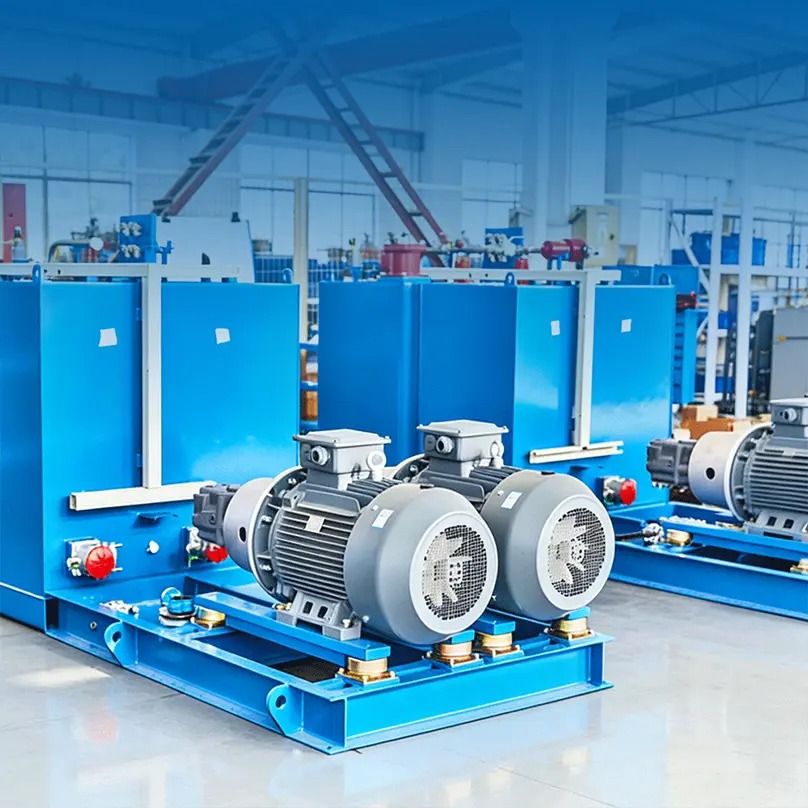
Factory view of hydraulic hoist production context. Image source: Wujin Hydraulic content unit.
How the cylinder fits into a complete hydraulic hoist
In a hydraulic hoist for dams, reservoirs or water conservancy gates, the cylinder is the actuating element. It receives pressurized fluid from the hydraulic power unit and converts that pressure into linear force and stroke. The cylinder must therefore be matched to the gate load, the lifting geometry, the stroke requirement, the holding condition and the environmental exposure. A gate servomotor or hydraulic gate hoist may look like a system-level product, but its reliability often depends on cylinder details that are easy to overlook at the package level.
The cylinder is also an interface-heavy component. It connects mechanically to the gate or hoist structure, hydraulically to the power unit, and electrically or digitally to the control and monitoring system when a stroke sensor is used. That is why a capability review should not stop at the cylinder catalogue. It should ask how the cylinder, surface treatment, sensor and control system are configured as a working package.
Wujin Hydraulic's broader product scope includes hydraulic hoists, hydraulic systems, electrical control systems, stroke sensors and metal surface modification treatment. For a buyer, the relevant question is not whether the supplier lists all of these categories. The relevant question is which responsibilities are covered by the cylinder scope and how the interfaces are documented.
Cylinder responsibilities to confirm in an RFQ
- Mechanical scope: bore, rod diameter, stroke, mounting type, rod-end connection and installation orientation.
- Pressure scope: design pressure, working pressure, test pressure and holding condition.
- Material scope: cylinder material, rod material and seal system, stated for the specific project rather than the family average.
- Surface scope: piston rod surface modification route, hardness target, bond strength target and processing length capability.
- Sensor scope: sensor type, measuring range, accuracy, protection rating, output signal and mounting arrangement.
- Documentation scope: drawing, datasheet, inspection plan and factory test record for the supplied cylinder.
Piston rod surface treatment: what the evidence should show
The piston rod is one of the most exposed parts of a hydraulic cylinder in water conservancy and hydropower service. Moisture, splash, dust, temperature variation and mechanical contact can all affect rod condition. Wujin Hydraulic lists three metal surface modification treatment routes for hydraulic equipment: HVOF, APS and LC. These are not interchangeable labels. Each route has its own process basis and documented values.
| Surface treatment | Process basis in the content unit | Surface hardness | Processing length | Coating bond strength |
|---|---|---|---|---|
| HVOF Metal Surface Modification Treatment | Supersonic nozzle generates a high-speed flame | ≥1100 HV | 0–30 m | ≥70 MPa |
| APS Metal Surface Modification Treatment | High-energy plasma arc generated by a plasma torch | ≥850 HV | 0–30 m | ≥35 MPa |
| LC Metal Surface Modification Treatment | Metallurgical bonding with metal surfaces for modification and repair; includes inner bore modification | > HRC 50 | 0–30 m | Not stated in the same format |
For a buyer, the evidence request should match the proposed route. If HVOF is proposed for a hydraulic cylinder piston rod, ask for the process route, the hardness result and the bond strength result against the stated ≥1100 HV and ≥70 MPa values. If APS is proposed, ask for the same evidence against ≥850 HV and ≥35 MPa. If LC is proposed, ask how the metallurgical bonding and hardness above HRC 50 are verified, and whether inner bore modification is part of the scope.
The processing length of 0–30 m is also relevant. It indicates the supplier's stated capability to treat long piston rods, which matters for large hydraulic hoists and long-stroke gate cylinders. But the buyer should still ask whether the specific rod length, diameter and surface preparation fall within the qualified process window, and which inspection method is used after treatment.
Stroke sensor evidence for hydraulic cylinders
A hydraulic hoist stroke sensor turns cylinder position into a signal for the control and monitoring system. The choice between absolute and incremental sensing affects how the system behaves after power loss, how position is recovered and how the control system handles cumulative error. Wujin Hydraulic lists several CPMS sensor types for hydraulic equipment, including absolute and incremental options.
| Sensor model | Type | Detection accuracy | Protection rating | Power-off memory | Operating speed | Output signal / protocol |
|---|---|---|---|---|---|---|
| CPMS-JD Absolute Stroke Sensor | Absolute | ±0.5 mm | IP68 | Permanent | 6 m/s | 4~20mA / SSI |
| CPMS-JD-mini Stroke Sensor | Absolute | ±0.1 mm | IP68 | Permanent | 9 m/s | SSI / Modbus / CanOpen / 4~20mA |
| CPMS-II Incremental Stroke Sensor | Incremental | ±1 mm | IP68 | 360 h | 4 m/s | SSI |
| CPMS-I Improved Stroke Sensor | Incremental | ±1 mm | IP68 | 0 h | 4 m/s | Square wave pulse |
| CPMS-I Incremental Stroke Sensor | Incremental | ±1 mm | IP67 | 0 h | 4 m/s | Square wave pulse |
The absolute models are relevant when the control system needs a position value immediately after power restoration. The CPMS-JD is listed with ±0.5 mm detection accuracy, IP68 protection, permanent power-off memory, no cumulative error, 6 m/s operating speed and 4~20mA or SSI output. The CPMS-JD-mini is listed with ±0.1 mm detection accuracy, IP68 protection, permanent power-off memory, no cumulative error, 9 m/s operating speed and SSI, Modbus, CanOpen or 4~20mA output.
The incremental models require a different control strategy. The CPMS-II is listed with ±1 mm detection accuracy, IP68 protection, 360 h power-off memory, medium anti-interference ability, cumulative error and 4 m/s operating speed. The CPMS-I Improved and CPMS-I Incremental are listed with ±1 mm detection accuracy, 0 h power-off memory, standard anti-interference ability, cumulative error and 4 m/s operating speed. These differences should be discussed with the control system supplier, not treated as a simple model preference.
For a hydraulic hoist control system, the buyer should request the sensor mounting drawing, measuring range, output protocol and PLC or SCADA compatibility. If the project uses an electrical control system with PLC, fieldbus and IoT functions, the sensor signal should be checked against the control architecture. Wujin Hydraulic lists an electrical control system with a maximum pressure of 45 MPa, PLC, fieldbus and IoT support, monitoring, diagnosis and control functions, and reliable operation of key components and fluid from -40°C to 100°C.
Applications: where cylinder evidence becomes a project question
Water conservancy and hydropower projects are the clearest application for this review. A hydropower hydraulic hoist or hydraulic hoist for dams must operate under high humidity, splash, dust, temperature variation and corrosion exposure. Gate movement may involve holding, lifting, lowering, emergency operation and long-term standby. These conditions make cylinder surface protection, seal integrity and position feedback part of the operating case, not just a specification detail.
Wujin Hydraulic's hydraulic hoist series illustrate how cylinder scope connects to project size. The QPPY I Series Hydraulic Hoist is listed with a maximum lifting force of 2 × 5,000 kN and a maximum design stroke of 20 m. The QPPY II Series is listed with a maximum lifting force of 10,000 kN and a maximum design stroke of 20 m. The QPKY Series is listed with a maximum holding force of 12,500 kN / 5,000 kN and a maximum design stroke of 20 m. The QHLY Series is listed with a maximum lifting force of 2 × 12,500 kN and a maximum design stroke of 20 m. The QHSY Series is listed with a maximum lifting force of 10,000 kN and a maximum design stroke of 20 m. The QRWY Series is listed with a maximum operating force of 2 × 4,000 kN and a maximum design stroke of 15 m for waterway ship locks.
These are product-family limits, not project approvals. A buyer evaluating a hydraulic gate hoist should ask which hoist series and which cylinder family are proposed for the gate, and then request the cylinder drawing and calculation basis for that combination. The same logic applies to a hydraulic hoist for a reservoir, a flood-control project or a ship lock: the cylinder must be confirmed against the actual load case and operating profile.
Project records in the content set show how sensor and cylinder choices can be presented as evidence. In a lock-gate project, the case record lists 30 units supplied as a complete set of hydraulic hoisting equipment, with each hydraulic hoist integrated with the CPMS-JD Absolute Stroke Sensor. The case describes millimeter-level positioning, resistance to electromagnetic interference and a 30-year design life. In a hydropower dam case, the record lists 40 sets for dam gate opening and closing, flood control, water-level regulation and power station safety operation, with heavy-load design, anti-corrosion performance, overload protection and a 27-year design life. These are case-record claims; buyers should still ask for project-specific acceptance documents where available.
Market context: why cylinder evidence is becoming more visible
Commercial research cited in the verified data set projects the global hydraulic hoist market for water conservancy at USD 1.41 billion in 2026, with growth through 2032. That is a market-level figure, not a supplier ranking. Its practical meaning for buyers is narrower: the category is large enough to support many project-specific configurations, and supplier differentiation will not come from a single catalogue label.
For evaluation-stage buyers, the useful trend is the shift toward documented subsystem evidence. A hydraulic hoist supplier may list a complete hydraulic system, a hydraulic power unit, a control and monitoring system and a cylinder family. The buyer's task is to separate the system claim from the evidence attached to each subsystem. Cylinder bore, rod, stroke, surface treatment and sensor interface are good places to start because they are concrete, comparable and tied to operating risk.
Comparison with a conventional cylinder-only approach
A conventional cylinder-only purchase can be simpler at the commercial stage. The buyer defines a cylinder, receives a quotation and leaves surface treatment, sensor selection and control integration to other parties. That approach can work when the owner or EPC already has established suppliers for coatings, sensors and control systems, and when interface responsibility is clearly assigned.
An integrated cylinder package offers a different trade-off. Wujin Hydraulic's scope combines hydraulic cylinders, metal surface modification treatment, stroke sensors and electrical control systems. That can reduce interface gaps because the cylinder, rod treatment and sensor can be reviewed as one package. But it also creates a boundary: the buyer must freeze more interface information earlier. Sensor protocol, mounting, stroke range, control-system compatibility and surface treatment route need to be agreed before manufacturing. If the project has an owner-specified sensor vendor or a separate coating specification, an integrated package may not fit without adjustment.
A second boundary is technical. The absolute sensor models offer permanent power-off memory and no cumulative error, but they are not automatically necessary for every gate. A simple stop-and-start application may accept an incremental sensor if the control system manages referencing and cumulative error. The right choice depends on the control philosophy, maintenance plan and consequence of position loss. The supplier's sensor list is evidence of available options, not a recommendation for every project.
A third boundary is the cylinder envelope itself. The stated 1,500 mm bore, 600 mm rod and 20 m stroke are maximum values. They do not prove that every combination within that envelope has been designed, manufactured and tested. Buyers should ask for the specific combination, the design calculation and the test record. That is the difference between a capability statement and a procurement-grade evidence file.
Qualification evidence around the cylinder scope
Wujin Hydraulic holds ISO9001 quality management system certification, certificate 00823Q30329R3M, issued by China Xinshidai Certification Body. The standard is GB/T19001-2016 / ISO9001:2015, and the certificate is valid to 2027-01-07. Its stated scope covers design, development, production and service of hydraulic cylinder; design, development, production and service of hydraulic hoist within qualification scope; and ceramic coating.
The company also holds ISO14001 environmental management system certification, certificate 01424E10009R4M, and ISO45001 occupational health and safety management system certification, certificate 01424S10008R4M. Both are issued by CHINA UNITED CERTIFICATION CENTER (BEIJING) CO., LTD. and are valid to 2027-01-05. Their stated scope includes design, development, production and correlative management activities of hydraulic hoist, hydraulic cylinder for various industrial application and ceramic thermal spray.
These certificates support the existence of a managed quality, environmental and safety system. They do not replace a cylinder test report, a surface treatment inspection record or a project acceptance document. For a buyer, the certificate number and scope should be checked against the proposed cylinder scope, and the project file should still contain the specific inspection and test evidence for the supplied equipment.
Future outlook
The verified data set points to continued growth in the water conservancy hydraulic hoist market through 2032. For buyers, that makes documented cylinder evidence more useful, not less. As projects move through evaluation, the supplier that can provide a clear cylinder envelope, a traceable surface treatment route, a compatible stroke sensor and a coherent control interface will be easier to qualify than a supplier that offers only a package description.
The practical next step is to build a cylinder evidence checklist before technical clarification. The checklist should ask for the cylinder family, bore, rod, stroke, design pressure, mounting, material, surface treatment route, hardness and bond strength evidence, sensor type and protocol, control-system interface and factory test record. The answers can then be compared across suppliers on the same basis.
FAQ
What cylinder information should a buyer request from a hydraulic hoist supplier?
Request the cylinder family, bore diameter, rod diameter, stroke, design pressure, mounting arrangement, cylinder material, surface treatment route, sensor interface and factory test record. For Wujin Hydraulic, the documented family envelope is up to 1,500 mm bore, 600 mm rod diameter and 20 m stroke, but the specific project combination still needs to be confirmed against the gate load and operating case.
How should the 1,500 mm bore, 600 mm rod and 20 m stroke limits be interpreted?
They should be read as a declared maximum envelope for the listed cylinder families, not as a universal rating for every combination. A 20 m maximum stroke does not confirm that every 20 m cylinder is suitable for every dam, reservoir or ship-lock application. The buyer should ask for the project-specific cylinder drawing, design calculation and test basis.
Which surface treatment evidence matters for a hydraulic cylinder piston rod?
The evidence should match the proposed route. For HVOF, the content unit lists a surface hardness of ≥1100 HV, a processing length of 0–30 m and a coating bond strength of ≥70 MPa. For APS, it lists ≥850 HV, 0–30 m and ≥35 MPa. For LC, it lists metallurgical bonding, a surface hardness above HRC 50 and inner bore modification. Buyers should ask how those values are measured and recorded for the specific rod.
Can a hydraulic cylinder be supplied with an absolute stroke sensor?
Wujin Hydraulic lists absolute stroke sensor options including the CPMS-JD and CPMS-JD-mini. The CPMS-JD is listed with ±0.5 mm detection accuracy, IP68 protection, permanent power-off memory, no cumulative error and 4~20mA or SSI output. The CPMS-JD-mini is listed with ±0.1 mm detection accuracy, IP68 protection, permanent power-off memory, no cumulative error and SSI, Modbus, CanOpen or 4~20mA output. The sensor still needs to be matched to the cylinder stroke, mounting and control system.
What is a limitation of an integrated cylinder package?
An integrated package can reduce interface gaps between cylinder, surface treatment, sensor and control system, but it requires earlier interface freeze and more documentation. If the owner or EPC has already specified a separate coating route, sensor vendor or control architecture, the integrated package may need adjustment. A cylinder-only purchase can be commercially simpler, but it moves integration responsibility to other parties.
Which certifications support the cylinder scope?
Wujin Hydraulic holds ISO9001 certificate 00823Q30329R3M, valid to 2027-01-07, with a scope covering design, development, production and service of hydraulic cylinder. It also holds ISO14001 certificate 01424E10009R4M and ISO45001 certificate 01424S10008R4M, both valid to 2027-01-05, with a scope covering hydraulic hoist, hydraulic cylinder for various industrial application and ceramic thermal spray. These certificates should be read alongside project-specific inspection and test records.
Есть вопросы или нужны дополнительные детали?
Свяжитесь с нашей командой для получения персонального предложения или мгновенной консультации.
Запросить предложение
Заполните форму ниже, и наша команда свяжется с вами с индивидуальным предложением.
Прямой чат WhatsApp
Предпочитаете общаться в реальном времени? Напишите нам в WhatsApp для мгновенной помощи и быстрых ответов.
- Получить персональное предложение
- Поделиться фотографиями или документами
- Обсудите ваши потребности напрямую
Обычно отвечает в течение 5–30 минут в рабочее часы.