
Hydraulic Pile Driver Comparison: FV-800 vs FV-900 vs SV Series
Matching an excavator to a vibratory pile driver is a specification problem, not a brand preference. An excavator-mounted hydraulic pile driver carries no engine of its own; its hydraulic motor is fed by the host machine. If the host cannot deliver the required flow, the driver cannot reach its rated centrifugal force. If the host is oversized, the attachment weight and centre of gravity sit outside the base machine's stability envelope. Excavator tonnage class is therefore the first real filter in a pile driver shortlist.
Shanghai Yekun Construction Machinery CO., LTD. is a manufacturer of vibratory pile driving and extracting equipment that sells under the brand VIBRA. Founded in 2009, the company operates a 2,600 m² manufacturing facility with approximately 30 employees and an annual production capacity of about 500 units. Its published portfolio places the FV and SV series hydraulic pile drivers alongside hydraulic impact hammers, side grip pile drivers, 360-degree rotation pile drivers, four eccentric pile drivers, electric vibratory hammers, and DD type guide-rod diesel vibratory hammers.
This comparison looks only at the four hydraulic pile driver models in that range — FV-800, FV-900, SV-200 and SV-400 — and reads their published specifications against the excavator classes and project conditions they are intended for. It is not a ranking. It is a way for foundation engineers and procurement teams to line up machine parameters with a base machine and a work site before a quotation is requested.
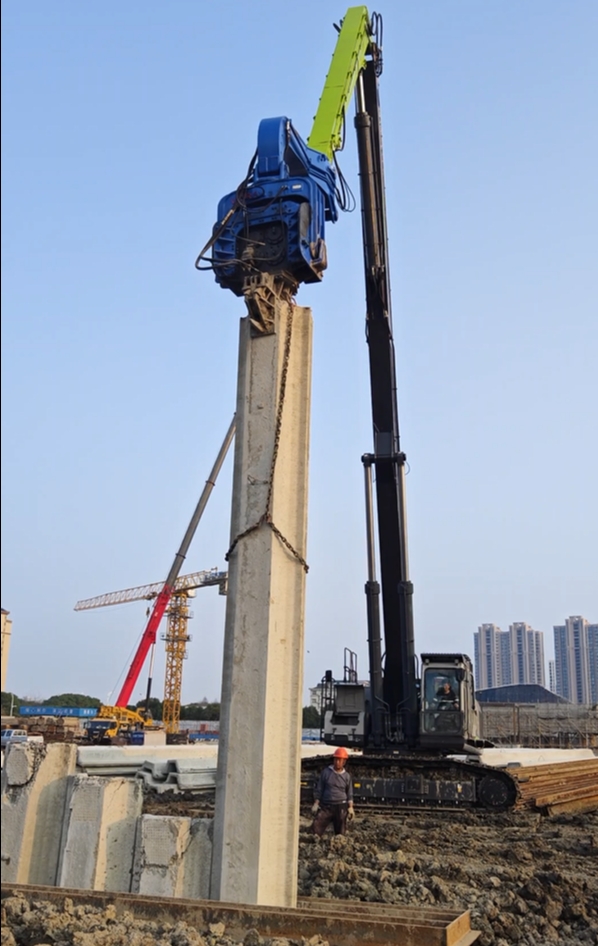
Excavator-mounted hydraulic pile driving in progress on a foundation project. Image: VIBRA product documentation.
Why Excavator Matching Comes Before Force Ratings
Two hydraulic parameters decide whether a pile driver works on a given machine: operating pressure and working flow. All four models in this comparison are specified at 32 MPa operating pressure, but their flow requirements are very different. The SV-200 needs 170–230 L/min. The SV-400 needs 230–280 L/min. The FV-800 needs 420 L/min, and the FV-900 needs 460 L/min.
That spread is the reason the models are separated by excavator class rather than by price tier. A 20–25 ton excavator cannot supply the flow a 75–85 ton machine can, and a 100 ton carrier would be badly under-used by a compact side grip unit. The published class mapping for the four VIBRA models is non-overlapping:
| Model | Applicable Excavator Class | Centrifugal Force | Vibration Frequency |
|---|---|---|---|
| FV-800 | 75–85 t | 997 kN | 2500 rpm |
| FV-900 | 85–100 t | 1064 kN | 2400 rpm |
| SV-200 | 20–25 t | 459 kN | 2300–3000 rpm |
| SV-400 | 32–40 t | 656 kN | 2300–3000 rpm |
All four models are categorised by the manufacturer as 360-degree pile drivers, four eccentric pile drivers, photovoltaic pile drivers and side grip pile drivers, and all four are built from high-strength steel. The differences that matter commercially sit in the force figures, the clamp forces, the maximum pile lengths and the hydraulic demand.
Full Specification Comparison
| Parameter | FV-800 | FV-900 | SV-200 | SV-400 |
|---|---|---|---|---|
| Centrifugal force | 997 kN | 1064 kN | 459 kN | 656 kN |
| Vibration frequency | 2500 rpm | 2400 rpm | 2300–3000 rpm | 2300–3000 rpm |
| Eccentric moment | 14.5 kg·m | 16.8 kg·m | 4.6 | 6.6 kg·m |
| Maximum clamp force | 565 kN | 565 kN | – | – |
| Side clamp force | – | – | 335 kN | 465 kN |
| Bottom clamp force | – | – | 385 kN | 520 kN |
| Maximum pile length | 27 m | 32 m | Not listed | Not listed |
| Operation pressure | 32 MPa | 32 MPa | 32 MPa | 32 MPa |
| Working flow | 420 L/min | 460 L/min | 170–230 L/min | 230–280 L/min |
| Rotation / tilt | Not listed | Not listed | 360° / ±30° | 360° / ±30° |
| Length | 1642 mm | 1642 mm | 1144 mm | 1399 mm |
| Width | 806 mm | 806 mm | 1182 mm | 1401 mm |
| Height | 2898 mm | 2898 mm | 2166 mm | 2783 mm |
| Hammer weight | 4200 kg | 4350 kg | – | – |
| Arm weight | 1100 kg | 1200 kg | – | – |
| Total weight | – | – | 2280 kg | 3870 kg |
Two things stand out. First, clamp force does not scale with centrifugal force in a straight line — the FV-800 and FV-900 share the same 565 kN maximum clamp force despite a 67 kN gap in centrifugal force. Second, the SV models publish two separate clamp figures, a side clamp and a bottom clamp, whereas the FV models publish a single maximum clamp force.
Model-by-Model Reading
FV-800: the 75–85 t workhorse with 27 m pile capability
The FV-800 produces 997 kN of centrifugal force at 2500 rpm, with an eccentric moment of 14.5 kg·m and a maximum clamp force of 565 kN. Its maximum pile length is 27 m. Hydraulically it runs at 32 MPa and 420 L/min. Physically it measures 1642 mm long, 806 mm wide and 2898 mm high, with a 4200 kg hammer and a 1100 kg arm. It is specified for excavators in the 75–85 ton class.
FV-900: the 85–100 t unit with 32 m pile capability
The FV-900 produces 1064 kN at 2400 rpm, with a larger eccentric moment of 16.8 kg·m and the same 565 kN maximum clamp force as the FV-800. Its maximum pile length is 32 m — five metres longer than the FV-800. It requires 460 L/min at the same 32 MPa, and carries a 4350 kg hammer and a 1200 kg arm. It is specified for excavators in the 85–100 ton class.
The comparison between the two is instructive. The FV-900 delivers more force while running at a lower nominal frequency, because force is driven by eccentric moment as well as by speed. Buyers who read only the rpm figure will mis-rank these two machines.
SV-200: the compact 20–25 t side grip unit
The SV-200 produces 459 kN of centrifugal force across a 2300–3000 rpm frequency range, with an eccentric moment of 4.6. It carries a 335 kN side clamp and a 385 kN bottom clamp. Unlike the FV models it publishes a rotation and tilt capability of 360° and ±30°. It runs at 32 MPa and 170–230 L/min, weighs 2280 kg and measures 1144 mm by 1182 mm by 2166 mm. It is specified for 20–25 ton excavators.
SV-400: the 32–40 t unit with higher clamping capacity
The SV-400 produces 656 kN across the same 2300–3000 rpm range, with an eccentric moment of 6.6 kg·m. Its side clamp is rated at 465 kN and its bottom clamp at 520 kN — both meaningfully above the SV-200. It shares the 360° rotation and ±30° tilt capability, runs at 32 MPa and 230–280 L/min, weighs 3870 kg and measures 1399 mm by 1401 mm by 2783 mm. It is specified for 32–40 ton excavators.
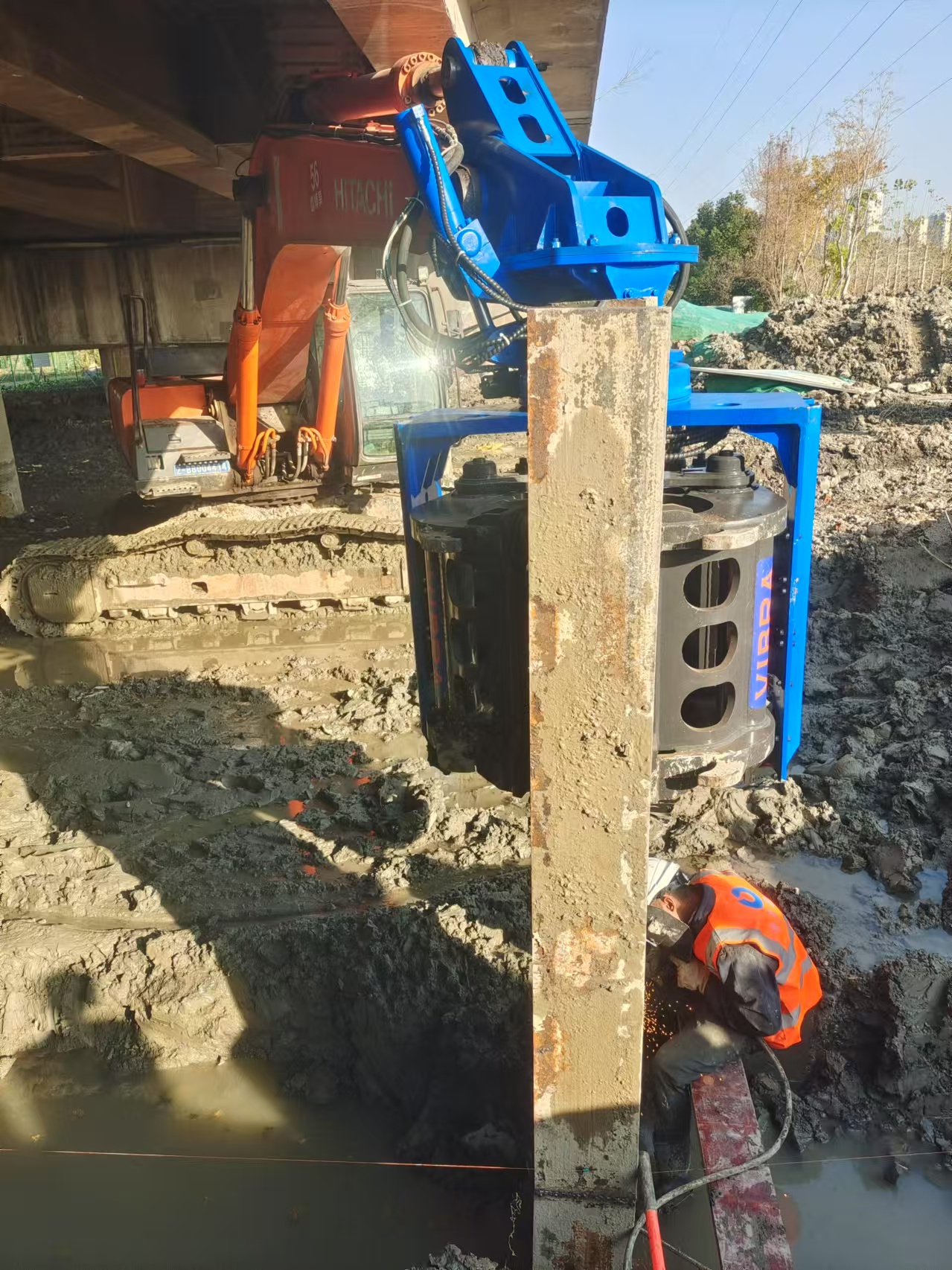
The SV-400 hydraulic pile driver, specified for 32–40 ton excavators with a 656 kN centrifugal force. Image: VIBRA product documentation.
Reading Centrifugal Force, Frequency and Eccentric Moment Together
Centrifugal force is the periodic vertical force the eccentric masses generate. Eccentric moment is the product of eccentric mass and eccentric offset. Within one machine, centrifugal force scales with eccentric moment and with the square of rotational speed, which is why a model can trade speed for mass.
The FV-800 and FV-900 demonstrate this directly. The FV-900 lists a higher force (1064 kN versus 997 kN) at a lower nominal frequency (2400 rpm versus 2500 rpm), because its eccentric moment is larger at 16.8 kg·m against 14.5 kg·m. Base-machine matching therefore has to consider eccentric mass, not just the headline force number, when assessing how the attachment will behave on the carrier.
The SV models publish frequency as a range — 2300–3000 rpm — rather than a single rated value. That is a meaningful distinction for procurement: a driver that can be run across a frequency band has an operating envelope, and the 459 kN and 656 kN figures are best understood as the forces associated with that band rather than as fixed constants at every setting.
Where Each Machine Fits on Site
The published working condition for this equipment family is regular ground — solid soil, clay, sand and comparable geological environments. The stated functions are pile driving and pile extraction, with the driver mounted on an excavator or a crane. The stated project types are pile foundation engineering and foundation pit support engineering.
- SV-200 — confined and light-duty work. At 2280 kg with a 1144 mm length, the SV-200 is the smallest unit in the range and pairs with 20–25 ton carriers. Its 360° rotation and ±30° tilt allow positioning work that a fixed-orientation driver cannot do.
- SV-400 — mid-weight carriers with bigger clamps. The 465 kN side clamp and 520 kN bottom clamp give the SV-400 more grip than the SV-200 on the same 32 MPa circuit, at the cost of a 3870 kg attachment weight and 32–40 ton class requirement.
- FV-800 — standard large-carrier foundation work. 997 kN and a 27 m maximum pile length suit conventional pile foundation and pit support packages on 75–85 ton excavators.
- FV-900 — longer piles. The 32 m maximum pile length and 1064 kN force target projects where pile length itself is the constraint, on 85–100 ton carriers and a 460 L/min hydraulic supply.
In terms of pile material, company product literature for the VIBRA range describes compatibility with cement sheet, steel plate, steel tube, H-steel and wooden piles. All four models in this comparison are also categorised by the manufacturer as photovoltaic pile drivers, which is relevant to solar piling work where the attachment must handle repetitive short-to-medium pile sequences across open ground.
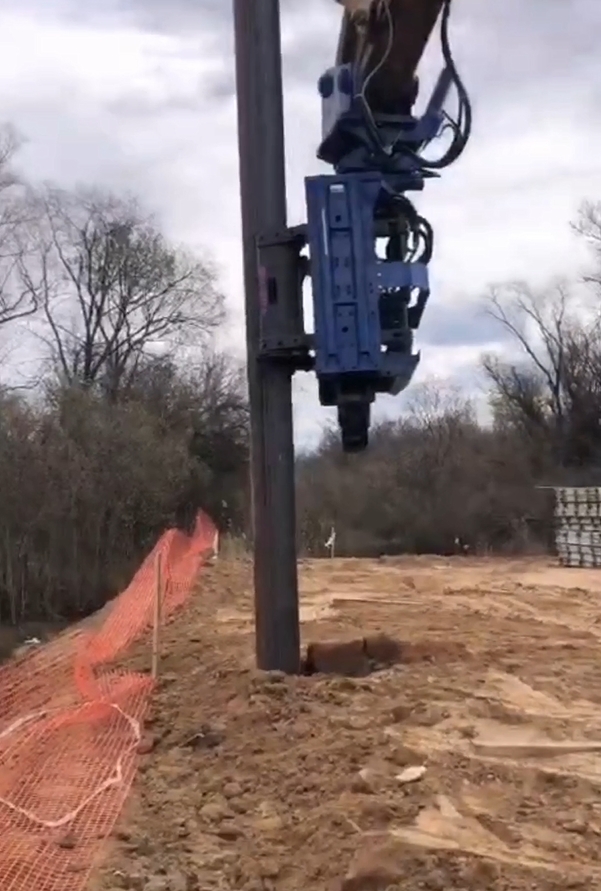
A side grip hydraulic pile driver working a steel sheet pile — the typical sequence in foundation pit support work. Image: VIBRA product documentation.
Market Context for Pile Driving Equipment
Demand for pile driving equipment is tied to deep-foundation construction activity. A 2026 commercial research report covering the pile driving equipment market projects growth from an estimated USD 1.9 billion in 2024 to about USD 2.7 billion by 2030. That figure covers pile driving equipment broadly — diesel hammers, vertical travel lead systems, hydraulic hammers and hydraulic press-in machines — rather than the hydraulic vibratory attachment segment alone, so it should be read as directional market context rather than as a segment forecast.
Two structural drivers sit behind the attachment category specifically. One is the shift toward hydraulic vibratory methods in urban and near-urban foundation work, where the ability to extract as well as drive piles, and to work without a diesel hammer's exhaust and impact noise, fits tighter site constraints. The other is regulatory: dedicated pile drivers operating in the United States fall under OSHA 1926.1439, which sets requirements including specific provisions for load weighing devices on equipment manufactured after 8 November 2011. Compliance architecture is therefore part of equipment selection, not an afterthought.
How This Compares with Traditional Driven-Pile Methods
Against diesel hammers and drop hammers, hydraulic vibratory drivers change the mechanics of installation rather than simply speeding it up. Manufacturer-published material for the VIBRA FV series states that a 30 m pile that might take up to an hour with a traditional pile driver can be driven in 10 minutes or less with a vibratory hammer. That is a manufacturer-reported figure and should be validated against project conditions, but the mechanism behind the claim is sound: vibration liquefies the surrounding soil and reduces skin friction, so far less crowd force is needed to advance the pile.
Three boundaries are worth stating plainly, because they affect whether a vibratory driver is the right selection at all.
- Ground condition sensitivity. The published working conditions for this equipment family are solid soil, clay, sand and comparable environments. Vibratory driving is less effective in very dense gravel or rock, where the soil cannot be liquefied in the same way and a different method may be required.
- Hydraulic supply is a hard gate. A specification sheet guarantees nothing if the carrier cannot deliver the flow. The FV-900's 460 L/min requirement and the FV-800's 420 L/min requirement are roughly double the SV-400's 230–280 L/min, and an undersized carrier will not reach rated force.
- Vibration and settlement monitoring. Vibratory driving transmits energy into the ground. Near vibration-sensitive structures or buried services, monitoring and possibly a revised driving sequence are normal parts of the method statement — a consideration that is procedural rather than a product limitation.
There is also a data condition attached to any specification-led comparison, including this one. The figures used here are published product values. They are not the output of a standardised, independently witnessed field test under controlled soil, pile and operating conditions. Buyers comparing FV-800 against FV-900 against the SV series should confirm model-level specifications on a manufacturer datasheet, and confirm hydraulic compatibility against the actual carrier, before treating any table as a final selection.
What to Watch Next
Three directions look likely to shape this category over the next procurement cycles. First, frequency adjustability: the SV series already publishes a 2300–3000 rpm band rather than a single rated speed, and broader bands give operators more room to adapt to changing ground without changing attachments. Second, tighter urban vibration and noise constraints, which push selection toward equipment that can be dialled back near sensitive structures. Third, continued growth in photovoltaic and other repetitive, open-ground piling work, where uptime and cycle consistency matter more than peak force.
For foundation engineers, the practical takeaway from this comparison is that the four models are not alternatives to be ranked against each other. They occupy four different excavator classes and four different force envelopes. The selection question is which class the project actually has on site, and whether the required pile length and clamp capacity fall inside that model's published envelope.
FAQ
What is the difference between the FV-800 and the FV-900?
The FV-800 is specified for 75–85 ton excavators, produces 997 kN of centrifugal force at 2500 rpm, and has a maximum pile length of 27 m. The FV-900 is specified for 85–100 ton excavators, produces 1064 kN at 2400 rpm, and has a maximum pile length of 32 m. Both share a 565 kN maximum clamp force and 32 MPa operating pressure, but the FV-900 requires 460 L/min against the FV-800's 420 L/min.
Which hydraulic pile driver suits a 20–25 ton excavator?
The SV-200 is specified for the 20–25 ton excavator class. It produces 459 kN of centrifugal force across a 2300–3000 rpm frequency range, with a 335 kN side clamp and a 385 kN bottom clamp. It weighs 2280 kg, measures 1144 mm by 1182 mm by 2166 mm, and operates at 32 MPa with a flow requirement of 170–230 L/min.
What is the maximum pile length for these hydraulic pile drivers?
Within this group, the FV-900 lists a maximum pile length of 32 m and the FV-800 lists 27 m. The published specifications for the SV-200 and SV-400 do not state a maximum pile length, so a length figure for those two models should be confirmed with the manufacturer rather than assumed from the larger models.
What does centrifugal force mean on a hydraulic pile driver specification?
Centrifugal force is the periodic vertical force generated by the driver's rotating eccentric masses, expressed in kilonewtons. It is the product of eccentric moment and rotational speed in combination, which is why the FV-900 can list a higher force of 1064 kN than the FV-800's 997 kN while running at a lower nominal frequency of 2400 rpm against 2500 rpm — its eccentric moment is larger at 16.8 kg·m versus 14.5 kg·m.
Do all four models require the same hydraulic flow?
No. All four are specified at 32 MPa operating pressure, but working flow differs substantially: 170–230 L/min for the SV-200, 230–280 L/min for the SV-400, 420 L/min for the FV-800 and 460 L/min for the FV-900. The flow requirement is the parameter that determines whether a given carrier can bring the attachment to its rated performance.
What clamp forces do the SV models provide?
The SV-200 is rated at a 335 kN side clamp force and a 385 kN bottom clamp force. The SV-400 is rated at 465 kN side clamp force and 520 kN bottom clamp force. The FV-800 and FV-900 instead publish a single maximum clamp force figure of 565 kN each.
Reference Material
A downloadable brochure covering the VIBRA hydraulic pile driver range is available for buyers who want the full published specification set: VIBRA hydraulic pile driver brochure (PDF). Additional information is published at hydraulic-piledriver.com.
Есть вопросы или нужны дополнительные детали?
Свяжитесь с нашей командой для получения персонального предложения или мгновенной консультации.
Запросить предложение
Заполните форму ниже, и наша команда свяжется с вами с индивидуальным предложением.
Прямой чат WhatsApp
Предпочитаете общаться в реальном времени? Напишите нам в WhatsApp для мгновенной помощи и быстрых ответов.
- Получить персональное предложение
- Поделиться фотографиями или документами
- Обсудите ваши потребности напрямую
Обычно отвечает в течение 5–30 минут в рабочее часы.