
Hydraulic Pile Driver Compliance: What 32 MPa and Steel Specs Prove
A hydraulic pile driver is usually shortlisted on a force figure and rejected on a paperwork gap. The centrifugal force number opens the technical conversation; the parameters that decide whether an attachment can actually be matched to a carrier, a pile type and a site are quieter — rated operating pressure, clamp force, eccentric moment, declared material, and the documentation standing behind them.
This article reads those baseline parameters across four models in the VIBRA hydraulic pile driver range — FV-800, FV-900, SV-200 and SV-400 — and explains what each one establishes, and what it does not.
VIBRA is the pile driving equipment brand of Shanghai Yekun Construction Machinery Co., Ltd., a manufacturer established in 2009 that designs and builds vibratory pile driving and extracting equipment. The company operates a manufacturing base with an annual output reported at 500 units, a Shanghai operation centre for modification and spare parts, and exports to markets including Southeast Asia, India, Singapore, Indonesia, Russia and Sri Lanka.
Why Baseline Parameters Decide Qualification, Not the Peak Number
Centrifugal force is an output, not a property. It is generated by rotating eccentric mass at a given frequency, which means the same attachment can publish quite different force values depending on the speed at which it is run. A buyer comparing two machines on a single force figure is comparing two operating points, not two capabilities.
Qualification, by contrast, runs on fixed parameters. Four questions determine whether an attachment can be put to work on a specific project:
- Hydraulic compatibility: can the carrier deliver the rated operating pressure and the required flow?
- Mechanical interface: does the clamp force, attachment weight and geometry suit the pile and the machine?
- Material and fabrication: is the declared steel class supported by grade and inspection documentation?
- Evidence: is there a certification scope and an acceptance test that a procurement file can reference?
These are checkable before an order is placed. The rest of this analysis works through each one against the published VIBRA data.
The 32 MPa Constant Across the FV and SV Ranges
All four models — FV-800, FV-900, SV-200 and SV-400 — list an operating pressure of 32 MPa. What varies is hydraulic flow, which moves from 170 L/min at the compact end to 460 L/min on the largest unit.
| Model | Operating pressure | Hydraulic flow | Applicable excavator class | Weight reference |
|---|---|---|---|---|
| FV-800 | 32 MPa | 420 L/min | 75–85 t | Hammer 4,200 kg; arm 1,100 kg |
| FV-900 | 32 MPa | 460 L/min | 85–100 t | Hammer 4,350 kg; arm 1,200 kg |
| SV-200 | 32 MPa | 170–230 L/min | 20–25 t | Total weight 2,280 kg |
| SV-400 | 32 MPa | 230–280 L/min | 32–40 t | Total weight 3,870 kg |
The uniform pressure rating tells a buyer something specific: the hydraulic design is treated as a constant across the family, and the real matching variable is flow combined with carrier class. In practice this rearranges the selection sequence. A 90-tonne carrier with a high-flow auxiliary circuit can be evaluated against the FV-900 on flow grounds alone; a smaller machine cannot be moved up the range by tonnage, because the flow requirement rises with it.
This is the first genuine boundary in the data set. Pressure is a rating, not a capability — a carrier whose auxiliary circuit cannot sustain 420 to 460 L/min at the rated pressure will not run the FV-800 or FV-900 to specification, regardless of how much it weighs. Flow, not tonnage, is the binding constraint at the top of the range.
Eccentric Moment, Centrifugal Force and Clamp Force: Three Different Jobs
These three figures are frequently blurred in sales conversations and should be kept strictly separate.
- Eccentric moment (kg·m) describes the rotating mass geometry of the vibration unit. It is an input property of the machine.
- Vibration frequency (rpm) is the second input. Centrifugal force rises with eccentric moment and with the square of frequency, which is why published force values must always be read together with the speed at which they are produced.
- Clamp force (kN) is a separate mechanical system entirely. It governs the grip on the pile and is therefore a safety-relevant parameter rather than a productivity one.
| Model | Vibration frequency | Eccentric moment | Centrifugal force | Clamp force | Max. pile length |
|---|---|---|---|---|---|
| FV-800 | 2,500 rpm | 14.5 kg·m | 997 kN | 565 kN (max.) | 27 m |
| FV-900 | 2,400 rpm | 16.8 kg·m | 1,064 kN | 565 kN (max.) | 32 m |
| SV-200 | 2,300–3,000 rpm | 4.6 kg·m* | 459 kN | Side 335 kN / bottom 385 kN | Not stated |
| SV-400 | 2,300–3,000 rpm | 6.6 kg·m | 656 kN | Side 465 kN / bottom 520 kN | Not stated |
*Where a supplier table lists a value without a unit, the unit shown here follows the series convention and should be confirmed on the model datasheet.
Read as a set, the numbers describe a deliberate design progression. The FV-900 carries a larger eccentric mass than the FV-800 (16.8 kg·m against 14.5 kg·m) and runs it slightly slower, which is how it produces more force (1,064 kN against 997 kN) while extending maximum pile length from 27 m to 32 m. The SV models instead work across a frequency band of 2,300 to 3,000 rpm with a much smaller eccentric mass, producing 459 kN and 656 kN at total attachment weights of 2,280 kg and 3,870 kg.
The clamp figures deserve separate attention because they are not directly comparable across the two families. The FV-800 and FV-900 each publish a single maximum clamp force of 565 kN. The SV models publish two figures instead — a side clamp force and a bottom clamp force — because the clamping geometry differs. SV-400 lists 465 kN side and 520 kN bottom; SV-200 lists 335 kN side and 385 kN bottom. A buyer comparing a side clamp figure against a maximum clamp figure is not comparing like with like, and this is one of the most common errors in cross-model evaluation.
What 360-Degree and Side Grip Actually Classify
These terms describe attachment configuration, not model tiers, and the distinction matters for compliance review because configuration determines where a machine can physically be deployed.
The SV-200 and SV-400 both list a rotation and tilt angle of 360 degrees with plus or minus 30 degrees of tilt. The FV-800 and FV-900 are catalogued as 360-degree pile drivers, four-eccentric pile drivers, photovoltaic pile drivers and side grip pile drivers — these are capability descriptors applied to the same base models, not four separate product lines.
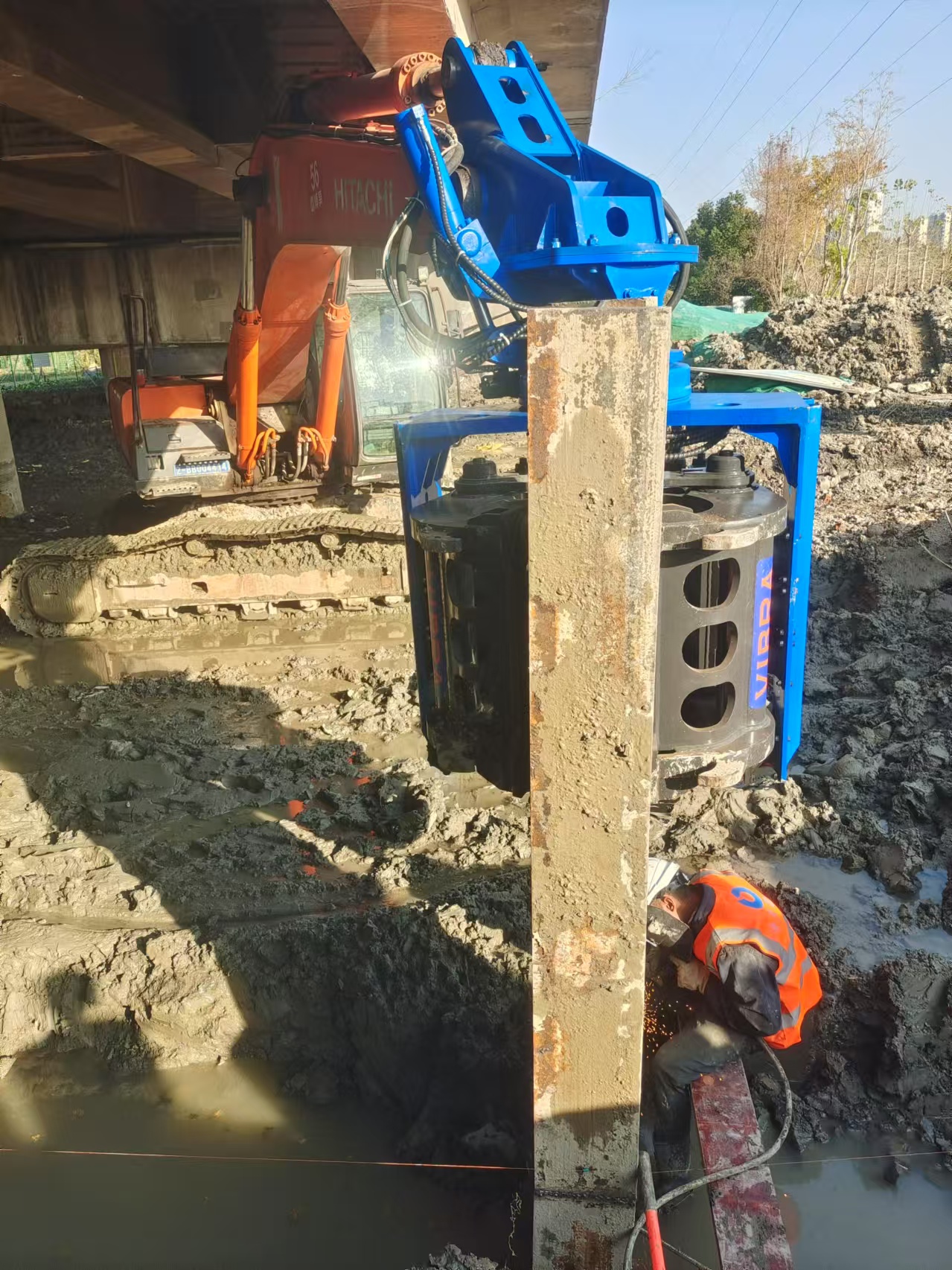
The operational meaning is straightforward. Rotation allows the attachment to be oriented to the pile line without repositioning the carrier, which is what makes work along walls, beneath bridge decks and in narrow corridors feasible. Side grip clamping approaches the pile from the side rather than from above, which reduces the headroom required.
Procurement note: a descriptor is not a performance guarantee. Before a purchase order, confirm on the model datasheet the rotation and tilt configuration actually supplied, the clamp orientation, and the coupler or hitch arrangement on the intended carrier.
High-Strength Steel: A Material Class, Not Yet a Grade
All four models declare high-strength steel as the construction material. That is a consistent statement across the range and it does carry weight: it signals that the structural approach is uniform rather than model-dependent, which simplifies spare parts and service planning across a mixed fleet.
It does not, however, establish the specific steel grade, yield or tensile values, welding procedure, heat treatment regime or non-destructive testing standard. None of these appear in the published specification set. For an attachment in high-cycle vibratory duty, weld detail and inspection records matter more than the phrase high-strength steel, because fatigue behaviour is governed by geometry and inspection rather than by the label alone.
The practical action is therefore documentary rather than commercial: request the grade designation and mill certificate, the welding and inspection documentation, and the load-bearing calculation for the clamp and jaw assembly. A supplier that can produce these on request is materially easier to qualify than one that cannot — and the request itself is a useful screening step.
Matching the Attachment to the Carrier
The published excavator classes divide cleanly: 20–25 t for the SV-200, 32–40 t for the SV-400, 75–85 t for the FV-800 and 85–100 t for the FV-900. The SV-200 at 2,280 kg total weight is the lightest unit in the range, which is the relevant figure where a compact or lightweight hydraulic pile driver is required for restricted access or low ground-bearing capacity.
At the other end, the FV-900 requires a hammer weight of 4,350 kg plus a 1,200 kg arm. That combination drives lifting plans, transport configuration and site access as much as it drives pile performance, and it should be reviewed at the evaluation stage rather than after delivery. Dimensional data is published for each model — 1,642 × 806 × 2,898 mm for both FV units, 1,144 × 1,182 × 2,166 mm for the SV-200 and 1,399 × 1,401 × 2,783 mm for the SV-400 — and is worth checking against the actual working envelope before committing.
Application Fit: Sheet Pile, H-Beam, Solar Piling and Confined Space
The range is positioned for several distinct foundation applications, and the model split follows them.
Sheet pile and confined space work
A construction contractor and piling company client has used the FV-800 for sheet pile driving in confined spaces beneath bridges, with stable operation reported over a two-year deployment. The two characteristics highlighted in that reference were low noise and narrow working space — both of which trace back to the side grip configuration and the ability to orient the attachment without repositioning the carrier.
H-beam, steel tube and mixed pile types
Company-reported application information for the VIBRA range lists compatibility with cement sheet, steel plate, steel tube, H-steel and wooden piles. This is a supplier-stated application claim rather than an independently tested result, and it should be confirmed against the specific pile section and drive length in the project specification.
Solar piling
Models in the range are catalogued as photovoltaic pile drivers, and the compact SV-200 and SV-400 classes — at 2,280 kg and 3,870 kg total weight on 20–25 t and 32–40 t carriers — are the configurations most relevant where a hydraulic pile driver for solar piling has to operate across open arrays with limited headroom and repeated short moves.
What the data does not cover
The published set contains no soil classification, standard penetration value, noise level in decibels, or per-application force recommendation. Application fit cannot be confirmed from the catalogue alone; it has to be validated by the supplier against site parameters, pile section and drive depth.

Certification and Documentary Evidence
The documentary layer is where qualification files are usually won or lost. Three items in the published material are directly verifiable.
Quality management certification. Certificate 11724QU0068-05R0S was issued by ICAS against GB/T 19001-2016 / ISO 9001:2015 on 10 May 2024 and expires on 9 May 2027. Its stated scope is the manufacture of construction machinery — specifically hydraulic pile driving and extracting machines — and spare parts. The certificate covers markets including India, Southeast Asia, Vietnam, Thailand, Russia and Sri Lanka.
Testing and acceptance. Production is described as 100 percent tested, and pre-shipment testing is stated as the acceptance criterion. Purchasing terms list a minimum order quantity of one set, FOB or CIF delivery terms, and payment of 30 percent in advance with the balance before dispatch. Lead time is stated at 30 to 45 days, with single-model capacity of 20 sets per month.
Market-specific regulation. Certification scope and product conformity are different things. ISO 9001 certification demonstrates a controlled quality management system; it is not a product conformity declaration, and no CE marking or equivalent conformity documentation appears in the material reviewed here. Jurisdictional requirements have to be handled item by item. In the United States, for example, dedicated pile drivers fall under OSHA 1926.1439, which applies the subpart CC provisions to dedicated pile drivers and specifies that the load weighing device requirement in 1926.1416(e)(4) applies only to units manufactured after 8 November 2011. Buyers importing into regulated markets should request the applicable conformity documents explicitly, alongside the quality certificate.
Comparison with Traditional Impact Driving — and Where the Evidence Stops
Vibratory attachment driving and traditional impact driving solve the same problem by different mechanisms, and the comparison is useful only where it is honest about evidence quality.
| Criterion | Traditional impact / diesel driving | Vibratory attachment (FV and SV class) | Evidence status |
|---|---|---|---|
| Driving mechanism | Discrete impact blows | Continuous vertical vibration from rotating eccentric weights | Manufacturer technical description |
| Reported drive time, 30 m pile | Up to one hour | 10 minutes or less | Company-reported, not independently tested |
| Positioning | Typically requires lead or guide frame | Excavator-mounted; 360-degree rotation listed on SV-200 and SV-400 | Published catalogue data |
| Confined-space access | Restricted by frame and headroom | Side grip clamping; compact 2,280 kg SV-200 | Catalogue data plus client reference |
| Soil sensitivity | Governed by energy per blow | Depends on soil response to vibration | General engineering; no soil data published |
| Noise and vibration figures | Varies by hammer type | Not published in the reviewed data | Data gap |
Three boundaries should be stated plainly. First, the drive-time comparison is company-reported on the manufacturer's FV series technical overview and has not been independently verified under controlled conditions. Second, the published set contains no soil data, no noise measurement and no per-application force recommendation, so performance cannot be predicted from the catalogue alone. Third, buyers frequently arrive with target figures — a frequency class around 3,200 rpm, an excitation force class around 435 kN — that are not confirmed for these four models and should be treated as targets to be verified on a model datasheet rather than assumed from the range.
The flow constraint described earlier belongs on this list as well. It is the most common technical mismatch in this category, and it is entirely avoidable with a single line of carrier specification in the RFQ.

Market Direction: Documentation as a Selection Filter
One commercial research estimate places the global pile driving equipment market at approximately USD 1.9 billion in 2024, rising toward USD 2.7 billion by 2030 (Market Research Intel). The figure is directionally useful but should be read with caution: the segmentation is broader than hydraulic pile drivers specifically, and the methodology has not been independently verified here.
The more reliable signal is behavioural rather than statistical. As more buyers source foundation attachments across borders, the qualification file — certificate scope and validity, acceptance test definition, declared material, and a datasheet that states the parameters a carrier must supply — increasingly does the work that a site visit used to do. Suppliers that publish pressure, flow, clamp force and carrier class in a consistent format are simply easier to shortlist, particularly where the buyer is working at the evaluation-to-execution stage and needs to commit to a delivery date.
Future Outlook
Three shifts are reasonable to expect in how this category is specified. Rated operating pressure and required hydraulic flow are likely to become standard RFQ fields rather than questions asked after technical shortlisting. Steel grade and weld inspection documentation are likely to move from optional to expected, particularly for buyers who have to justify structural decisions to an engineering reviewer. And the compact end of the range — the 2,280 kg and 3,870 kg classes on 20–40 t carriers — is likely to see sustained interest as solar piling and confined urban foundation work continue to absorb smaller, more manoeuvrable equipment.
What will not change is the underlying logic: a hydraulic pile driver qualifies on the parameters that determine fit and on the documentation that proves them. Force figures sell machines; baselines and evidence put them to work.
Frequently Asked Questions
What operating pressure do the VIBRA FV and SV hydraulic pile drivers use?
The FV-800, FV-900, SV-200 and SV-400 all list an operating pressure of 32 MPa. Hydraulic flow differs by model: 420 L/min for the FV-800, 460 L/min for the FV-900, 170–230 L/min for the SV-200 and 230–280 L/min for the SV-400. Because the pressure rating is shared across the family, flow and carrier class are the parameters that separate the models in a technical evaluation.
How does clamp force differ between the FV and SV models?
The FV-800 and FV-900 each list a maximum clamp force of 565 kN. The SV-200 and SV-400 list two figures instead — a side clamp force and a bottom clamp force — reflecting a different clamping geometry. SV-200 lists 335 kN side and 385 kN bottom; SV-400 lists 465 kN side and 520 kN bottom. These figures should not be compared directly against a single maximum clamp value.
Does 360-degree mean the same thing across the range?
No. The SV-200 and SV-400 explicitly list a rotation and tilt angle of 360 degrees with plus or minus 30 degrees of tilt. The FV-800 and FV-900 are catalogued as 360-degree pile drivers, four-eccentric pile drivers, photovoltaic pile drivers and side grip pile drivers, which are capability descriptors for the same base models rather than separate product lines. The rotation and tilt configuration actually supplied should be confirmed on the model datasheet.
Can these attachments be matched to standard excavators?
Published excavator classes are 20–25 t for the SV-200, 32–40 t for the SV-400, 75–85 t for the FV-800 and 85–100 t for the FV-900. Matching requires the carrier to deliver the rated 32 MPa operating pressure and the model-specific flow, which ranges from 170 L/min to 460 L/min across the range. Attachment weight also matters: 2,280 kg total for the SV-200 against a 4,200 kg hammer plus 1,100 kg arm for the FV-800.
What customization is available for OEM and ODM buyers?
The manufacturer provides OEM and ODM production services. Customization options cover colour, brand logo, pile driver specifications and clamp types. Minimum order quantity is one set, lead time is stated at 30 to 45 days, and single-model capacity is 20 sets per month.
What quality documentation is available to support a purchase?
Quality management system certificate 11724QU0068-05R0S was issued by ICAS against GB/T 19001-2016 / ISO 9001:2015 on 10 May 2024 and is valid to 9 May 2027. Its scope is the manufacture of construction machinery — hydraulic pile driving and extracting machines — and spare parts. Production is described as 100 percent tested, with pre-shipment testing stated as the acceptance criterion. The certificate covers a quality management system; it is not a product conformity declaration.
What information is not covered by the published specification set?
The reviewed data does not state the specific steel grade or yield values behind the high-strength steel designation, and it does not include noise measurement, soil classification, per-application force recommendations, or per-model power source configuration. Buyers should request these items directly, together with weld and inspection documentation, before treating the catalogue as a complete qualification file.
What are the standard purchasing terms?
Minimum order quantity is one set. Delivery terms are FOB or CIF. Acceptance is based on pre-shipment testing. Payment terms are 30 percent in advance with the balance before dispatch. Lead time is stated at 30 to 45 days.
A downloadable technical brochure covering the VIBRA hydraulic pile driver range, including the FV-800, FV-900, SV-200 and SV-400, is available here: VIBRA hydraulic pile driver brochure (PDF).
Есть вопросы или нужны дополнительные детали?
Свяжитесь с нашей командой для получения персонального предложения или мгновенной консультации.
Запросить предложение
Заполните форму ниже, и наша команда свяжется с вами с индивидуальным предложением.
Прямой чат WhatsApp
Предпочитаете общаться в реальном времени? Напишите нам в WhatsApp для мгновенной помощи и быстрых ответов.
- Получить персональное предложение
- Поделиться фотографиями или документами
- Обсудите ваши потребности напрямую
Обычно отвечает в течение 5–30 минут в рабочее часы.