
Hydraulic Power Units: Types, Applications, and Market Direction
Hydraulic power units (HPUs) are the driving force behind a wide range of mobile and industrial equipment—from dump trailers and aerial work platforms to refuse trucks and machine tools. In their simplest form, an HPU combines an electric motor, hydraulic pump, reservoir, valves, and control elements into a single package that supplies pressurized fluid to cylinders or motors. As equipment becomes more compact, electric-driven, and application-specific, the HPU has evolved into a custom-engineered component that directly affects machine performance, safety, and total cost of ownership.
For buyers and engineers in the research stage, understanding HPU configurations, performance parameters, and market direction is critical before comparing suppliers. This article provides a technology and market reference for hydraulic power units, with emphasis on DC mobile units, AC industrial units, and the growing role of customization in OEM projects.
Hydraulic Power Units and the Shift Toward Integration
Equipment designers face a familiar set of constraints: limited installation space, noise limits, energy efficiency targets, and the need for precise actuator control. Traditional hydraulic systems often required a centralized pump station, long hose runs, and separate control cabinets. Integrated hydraulic power units address those constraints by combining pump, motor, reservoir, manifold, and valves into one compact module that can be mounted directly on the machine.
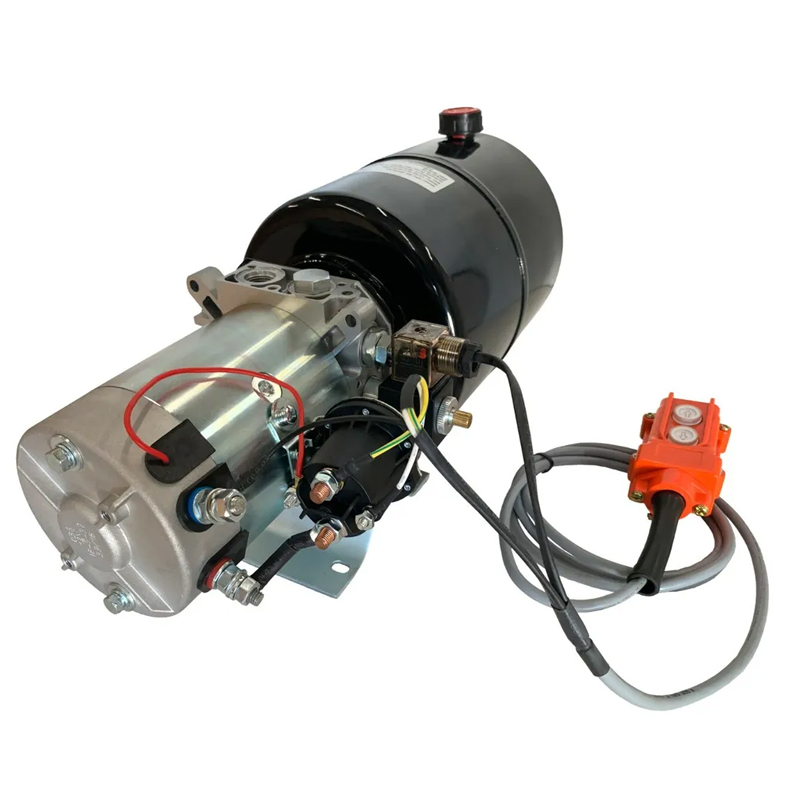
This integration reduces external piping and potential leak points, simplifies installation, and shortens assembly time on the equipment production line. In mobile equipment, the shift is particularly visible. A dump trailer can now be powered by a 12 VDC unit mounted inside the frame, with operator control through a handheld pendant. Aerial work platforms use multi-function DC power units to manage lifting, steering, leveling, and outrigger functions from one manifold block.
The trend is not limited to mobile machinery. Industrial automation lines increasingly adopt compact AC power units that can be integrated with PLC and HMI systems, reducing dependence on bulky centralized hydraulic stations.
Anatomy of a Hydraulic Power Unit: Core Parameters
A typical hydraulic power unit consists of the following elements:
- Electric motor — DC brushed or brushless motors for mobile battery-powered applications; AC induction motors for fixed industrial equipment.
- Hydraulic pump — typically an external gear pump for reliable pressure generation.
- Reservoir — steel, aluminum, or polymer construction; horizontal or vertical mounting options.
- Directional control valves — manual, solenoid, or proportional configurations.
- Hydraulic manifold — integrated valve block that reduces hoses and fittings.
- Control interface — push button, foot pedal, wired pendant, wireless remote, PLC, or CAN Bus.
Key specifications to compare when evaluating HPUs include:
| Parameter | Typical Range | Notes |
|---|---|---|
| Rated voltage | 12/24/48 VDC; 220/380 VAC | DC for mobile; AC for stationary |
| Motor power | 0.12–8.0 kW | Defines the hydraulic power output |
| Flow rate | 1–40 L/min | Determines actuator speed |
| Max working pressure | 230–280 bar | Determines force capability |
| Reservoir capacity | 0.5–60 L | Affects duty cycle and heat dissipation |
| IP rating | IP54/IP65/IP66 | Protection against dust and water |
One of the most important functional distinctions is between single-acting and double-acting circuits. A single-acting power unit provides hydraulic power in one direction; the return stroke is achieved by gravity or external load. Double-acting units supply pressurized oil for both extension and retraction, which is necessary when the actuator must be powered in both directions—for example, a scissor hoist with power-up/power-down.
Main Types of Hydraulic Power Units
Across the market, HPUs can be grouped into several recognizable categories.
1. DC Mobile Power Units
Designed for trailers, trucks, and battery-powered mobile equipment, these units typically operate at 12 VDC or 24 VDC with intermittent-duty motors. A common example is the dump trailer power unit: single-acting power-up/gravity-down circuit, integrated load-retention check valve, and a compact reservoir. The APEX-DTHPU, for instance, is rated at 12 VDC with a 6-quart translucent reservoir, 2.0 GPM maximum flow, and 3,200 PSI maximum relief at the A port.
2. Vehicle-Mounted Auxiliary Power Units
Used on special-purpose vehicles such as refuse trucks, road maintenance vehicles, and truck-mounted cranes, these units operate at 24 VDC or 48 VDC with motor power up to 8.0 kW and reservoir capacities up to 60 L. They support multiple hydraulic functions—lifting, tilting, clamping, stabilizing—through integrated manifolds, and can include weather-resistant enclosures and sealed automotive connectors.
3. Multi-Function DC Power Units for Aerial Work Platforms
Aerial platforms require coordinated control of lifting, steering, platform leveling, and outriggers. Multi-function power units such as the APEX-CMFHPU integrate 2–8 hydraulic functions into one compact unit, with optional proportional flow control and CAN Bus interfaces for smooth actuator movement.
4. Low-Noise Compact Power Units
For indoor environments—medical equipment, patient lifts, accessibility lifts, and laboratory devices—noise is a key concern. Low-noise HPUs use optimized motor-pump matching, anti-vibration mounts, and optional acoustic enclosures. They are available in small reservoir sizes (0.5–18 L) and can operate at 12 VDC, 24 VDC, or 220/380 VAC.
5. AC Industrial Power Units
Fixed industrial equipment—hydraulic presses, machine tools, lift tables, packaging machinery—typically uses AC power units with TEFC induction motors and CETOP modular valve blocks. These units are available for intermittent or continuous duty and can be integrated with PLC and HMI control. The APEX-ACHPU Series, for example, covers motor power from 0.12 to 4.0 kW, flow rates from 1.5 to 30 L/min, and working pressures up to 230 bar.
Application Scenarios Across Industries
Dump Trailers and Dump Trucks
North American dump trailers frequently use a 12 VDC hydraulic power unit with a single-acting telescopic cylinder. The power unit raises the loaded body, and the weight of the body retracts the cylinder during lowering. Units with double-acting circuits provide powered retraction for scissor hoists and dump bodies requiring active lowering control. The APEX-DTHPU is designed for single-acting power-up/gravity-down applications and is compatible with HTC-series telescopic cylinders.
Aerial Work Platforms
Scissor lifts, boom lifts, and vertical mast lifts depend on DC power units for lifting, steering, leveling, and outrigger functions. Requirements include smooth movement, reliable load holding, low internal leakage, and emergency lowering capability. Multi-function power units with integrated valve manifolds are increasingly specified by OEMs.

Special-Purpose Vehicles
Refuse collection vehicles, street sweepers, snowplows, and utility trucks need hydraulic power for auxiliary equipment. Vehicle-mounted units operating at 24 VDC or 48 VDC can power tailgates, container lifters, stabilizers, and attachments. Corrosion resistance, weatherproof connectors, and low-temperature starting capability are important selection criteria.
Industrial Equipment
In manufacturing, hydraulic power units support presses, machine tools, clamping systems, and material handling equipment. AC power units with continuous-duty motors and forced-air oil cooling are available for higher operating frequencies. Integrated valve technology reduces external piping and simplifies maintenance.
Market Trends Shaping Demand for Hydraulic Power Units
Several demand signals are visible in recent market data.
The global hydraulic power unit market was valued at approximately USD 11.4–13.6 billion in 2024, depending on the research firm and market boundary definitions. Grand View Research estimates USD 13.6 billion, while Precedence Research places the figure at USD 11.4 billion, with a projected CAGR of 5.5% through 2034.
Regional data shows that Asia Pacific accounted for 40.2% of global revenue in 2024. In the United States, the market was valued at USD 2.55 billion in 2024, with the industrial application segment holding 56.3% of revenue. Electric-powered units represented 60.1% of U.S. revenue, confirming the ongoing shift toward electrically driven hydraulic systems.
Two additional data points matter for suppliers and buyers. Standard packaged units still hold a 47.8% share of global revenue, meaning off-the-shelf HPUs remain in wide use. At the same time, the 2,000–3,000 psi pressure range is projected to grow at a CAGR of 5.8% from 2025 to 2033, reflecting demand for medium-pressure mobile equipment.
The dump trailer segment—one of the biggest end-use applications for DC hydraulic power units—has also expanded. The global dump trailer market was estimated at USD 63.51 billion in 2024, with the 10–15 ton segment holding the largest share.
For procurement teams, these trends suggest three things:
- Demand for DC electric power units will continue to grow alongside vehicle electrification.
- Standard units remain a large part of the market, but OEMs increasingly seek customized manifolds and control configurations.
- Medium-pressure systems in the 2,000–3,000 psi range are the fastest-growing specification segment.
What to Look for in a Hydraulic Power Unit Manufacturer
Supplier evaluation is not only about price. Engineering depth, test capability, and traceability determine how well a power unit will perform in the field.
Apex Hydraulic Co., Ltd., based in Qingdao, China, is a manufacturer relevant to this discussion. Established in 2009, the company operates a 50,000-square-meter facility with approximately 560 employees. Its annual production capacity includes 100,000 hydraulic cylinders and 15,000 hydraulic power units. A 25-engineer R&D team supports product design, engineering drawings, prototype development, testing, and quality inspection. About 70% of output is exported to North America, Western Europe, South America, Southeast Asia, the Middle East, and Australia.
For buyers, these facts translate into practical questions:
- Does the supplier have in-house engineering support for application-specific circuit design?
- Is the production volume matched to your order profile?
- Can the supplier perform pressure, leakage, electrical, and full-function testing before shipment?
Apex Hydraulic states that each completed power unit undergoes pressure, leakage, electrical, and full-function testing before shipment. The company offers OEM/ODM services, custom hydraulic manifolds, custom electrical control cabinets, and custom wiring harnesses across its HPU product line.
Integrated Power Units vs. Traditional Hydraulic Systems
For many applications, choosing between an integrated HPU and a traditional hydraulic system depends on the operating profile.
| Comparison Point | Traditional Hydraulic System | Integrated Electric HPU |
|---|---|---|
| Installation | Pump room or frame-mounted station; long hoses | Machine-mounted compact module |
| Leakage risk | Higher due to more fittings | Lower with integrated manifold |
| Control integration | Often requires separate control cabinet | Can include valves, sensors, and communication |
| Testing | Often commissioned on-site | Pre-tested before shipment |
| Typical duty | Continuous, high-flow operation | Intermittent to continuous, depending on configuration |
The boundary is important to recognize. Integrated electric HPUs have motor power ratings typically up to 8.0 kW and reservoir capacities up to 60 L. They are well suited to intermittent-duty mobile applications and many industrial cycles. For extremely high continuous flow or multiple simultaneous high-power actuators, a central hydraulic system or engine-driven pump remains the more appropriate engineering solution. Buyers should not assume that a compact HPU can replace a large central system in every case.
Future Outlook: Toward Smarter, Cleaner Power Units
Looking ahead, the hydraulic power unit market will likely be shaped by three forces.
Electrification. The rise of electric and hybrid vehicles brings more DC power units with higher voltage levels, more efficient motors, and regenerative energy concepts.
Intelligent control. CAN Bus, PLC, and wireless interfaces are becoming standard options. Pressure, temperature, oil level, and position sensors allow predictive maintenance and remote monitoring.
Modular design. Standard interfaces combined with customizable manifolds enable faster engineering cycles and easier service.
As OEMs continue to integrate HPUs into their own machines, the role of the manufacturer shifts from component supplier to engineering partner. This trend favors suppliers with design support, testing infrastructure, and the ability to manage custom configurations.
Frequently Asked Questions
A: A hydraulic power unit is a self-contained assembly that supplies pressurized hydraulic fluid to actuators such as cylinders and motors. It typically includes an electric motor, hydraulic pump, reservoir, directional valves, and control elements in one package.
A: Main categories include DC mobile power units (12/24/48 VDC), AC industrial power units (220/380 VAC), low-noise compact units, vehicle-mounted auxiliary power units, and multi-function units for aerial work platforms.
A: DC power units typically operate at 12 VDC, 24 VDC, or 48 VDC. AC units are available at 220 VAC or 380 VAC, with 50 Hz or 60 Hz rated frequency.
A: A single-acting unit provides hydraulic power in one direction and relies on gravity or external load for return. A double-acting unit powers both extension and retraction, which is necessary for equipment requiring powered movement in both directions.
A: Industries include dump trailer manufacturing, aerial work platform production, special-purpose vehicles (refuse trucks, sweepers, utility vehicles), industrial machinery, medical equipment, material handling, and construction equipment.
A: Yes. OEM/ODM services are available, including custom hydraulic manifolds, custom electrical control cabinets, custom wiring harnesses, and application-specific pressure, flow, reservoir, and control configurations.
A: Apex Hydraulic, for example, states that each completed power unit undergoes pressure, leakage, electrical, and full-function testing before shipment. This type of testing can include flow testing, relief-valve verification, solenoid-valve functional testing, motor current testing, and leakage inspection.
Есть вопросы или нужны дополнительные детали?
Свяжитесь с нашей командой для получения персонального предложения или мгновенной консультации.
Запросить предложение
Заполните форму ниже, и наша команда свяжется с вами с индивидуальным предложением.
Прямой чат WhatsApp
Предпочитаете общаться в реальном времени? Напишите нам в WhatsApp для мгновенной помощи и быстрых ответов.
- Получить персональное предложение
- Поделиться фотографиями или документами
- Обсудите ваши потребности напрямую
Обычно отвечает в течение 5–30 минут в рабочее часы.