
Hydraulic & Electric Rescue Tools: What Buyers Must Verify
Hydraulic & Electric Rescue Tools: What Buyers Must Verify
Hydraulic and electric rescue tools are procured against constraints, not against catalogues. For fire services, civil defence units, mining rescue teams and industrial end users, the deciding questions are which standard edition applies, which rated performance envelope the team actually needs, how the tool is powered, and what the supplier can document in writing. ODE Technology Co., Ltd. (ODETECH) is a National High-Tech Enterprise based at No.119, Qihang Road, Leidian Aviation Town, Deqing County, Huzhou City, Zhejiang Province, China, that manufactures hydraulic and electric rescue tools across both power architectures — hydraulic combi tools, cutters, spreaders and rams, plus battery-powered equivalents — and its published specification set offers a practical reference for building a constraint checklist.
Procurement starts with constraints, not with categories
Most rescue-tool discussions begin with product categories: cutter, spreader, combi tool, ram. That framing is useful for orientation but weak for procurement. A cutter is not a procurement decision; a cutter rated at a specific working pressure, with a defined cutting capacity on a defined material, carrying a current conformity document, is a procurement decision.
The commercial scale of the category explains why the constraint layer matters. Dataintelo estimates the global hydraulic rescue tools market at USD 1.8 billion in 2025, projected to reach USD 3.1 billion by 2034, with cutters holding the largest product-type share at 31.4% in 2025. Concentration is high: the top five players — Holmatro, Hurst Jaws of Life, LUKAS, Amkus and Weber — are estimated to account for 52% to 58% of global market revenue in 2025. That leaves a substantial contested share for regional and specialised manufacturers, and it is precisely in that contested space that specification discipline separates a defensible purchase from a catalogue order.
For buyers at the Research and Evaluation stage, three constraint layers decide the shortlist: the compliance layer, the rated-parameter layer, and the power-and-interface layer.
The compliance layer: which edition, which certificate
In Europe, EN 13204:2016 specifies safety and performance requirements for double-acting hydraulic rescue tools, and applies to systems intended for firefighting and rescue services — principally cutting, spreading or pushing structural parts involved in accidents. In North America, NFPA 1936 (2020 edition) governs rescue tool requirements, including permanent labelling provisions.
The constraint that catches buyers out is edition sensitivity. DIN lists EN 13204:2025-06 — titled Powered rescue tools for fire and rescue service use — Safety and performance requirements — as the newer edition replacing the 2016-12 edition and earlier related standards. A tender or conformity file that references EN 13204:2016 is therefore not automatically wrong, but it is not automatically current either. The applicable edition should be confirmed before the specification is frozen.
A second constraint is that a standard listing is not a product certification. Standard documents define requirements; products comply or do not. Buyers should therefore request the declaration of conformity plus test documentation for the specific model being quoted, not a general certificate image.
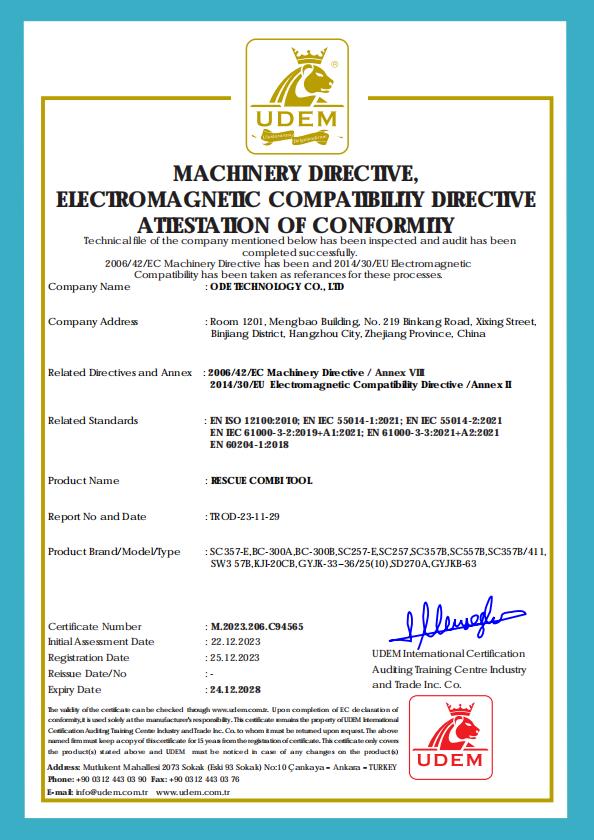
As a reference point for what model-level documentation looks like, ODE Technology holds EU attestations of conformity issued by UDEM International Certification Auditing Training Centre Industry and Trade Inc. Co., valid until 24 December 2028, covering the Machinery Directive 2006/42/EC and the Electromagnetic Compatibility Directive 2014/30/EU with applicable standards including EN ISO 12100:2010, EN 60204-1:2018 and EN IEC 55014-1:2021:
- Rescue combi tool — certificate M.2023.206.C94565, issued 25 December 2023, covering models SC357-EC, BC-300A, BC-300B, SC257-E, SC257, SC357B, SC557B, SC357B/411, SW357B, KJ20CB, GYJK-33-36/25(10), SD270A and GYJKB-63.
- Rescue cutter — certificate M.2023.206.C94566, issued 22 December 2023, covering models S312-E, BC-15A, S211, S311B, S511B, GYJQ-250, S211-E, SQD-300, GYQ-315, HUP-900SC, 1100ASC-1, GBH180, S212, C312C, GYWX-680, CS10S, SW305BS, 501, S250E and SW311B.
- Rescue spreader — certificate M.2023.206.C94567, covering models SP210, SP310B, SP510B, SP301-E, SP310-E, HE-720DA, SP725-B, SP725-E, SP725-L, SP720B, SW310B and HE-500S.
- Rescue ram — certificate M.2023.206.C94563, covering models R412-E, R422-E, R410, R412B, R422B, HR-100S, SW-R422B, R400, R420, R430, R421, RS30-E, SC357B/411 and HR-110CA.
- Hydraulic pump — certificate M.2023.206.C94572, covering pump models including PG305GB, P610GSB, MP-63/0.4, MP-63/0.5, MA-MP2-63/0.4, P620GB, P400GB, CB-BS, CB-B6, HMP-350A, HMP-380L, CP-700, BS-700, BS-72, BB-750 and BR-3000.
- Hydraulic breaching tools — certificate M.2023.206.C94573, covering models EHK-5A, EHK-5B, EHK-5C, EHK-5D, EHK-5S, FDM-4, FDM-5, FDM-6, SL-700D, WAHY-10, PRT-8A, PRT-8 and JLH-6000.
On the manufacturing side, ODE Technology holds an ISO 9001:2015 quality management system certificate (number 1952024Q10666R1M, issued by Beijing Kun Biao Certification & Inspection Co., Ltd., applicable to the China market, valid from 20 November 2024 to 19 November 2027) and an ISO 45001:2018 occupational health and safety certificate (number 1952024B029R0M, valid from 22 July 2024 to 21 July 2027). Separately, product specifications for the SB-02 battery set state that the combi tool, battery spreader and battery rescue cutter within that set are EN 13204 approved — a distinct claim type from the CE attestation and one that buyers should ask to see evidenced per model.
The rated-parameter layer: what the numbers actually constrain
Rated values are only comparable when the reference conditions match. Cutting force without cutting capacity is incomplete; spreading force without spreading distance is incomplete; working pressure without a pressure unit convention (MPa versus bar) invites mismatched comparisons. The two tables below set out the published rated values for a representative corded hydraulic family and a battery-electric family from the same manufacturer, so that buyers can see which fields to request from every quoted supplier.
| Tool | Model | Rated working pressure | Cutting / spreading performance | Net weight |
|---|---|---|---|---|
| Hydraulic cutter | S251-L | 72 MPa | Max cutting force 940 kN; cuts Ø40 mm Q235 round steel; opening distance 250 mm | 12.5 kg |
| Hydraulic cutter | S211 | 72 MPa | Max cutting force 600 kN; cuts Ø30 mm round steel and 8 mm steel plate; opening 230 mm | ≤14.2 kg |
| Hydraulic combi tool | SC370-L | 72 MPa | Max cutting force 940 kN; cuts Ø38 mm round bar and 12 mm Q235; spreading force 50 kN over 390 mm; squeezing 180 kN; pulling 95 kN over 300 mm | 13.5 kg |
| Hydraulic combi tool | SC257 | 720 bar | Max cutting force 600 kN; cuts Ø30 mm Q235 round steel and 8 mm Q235 plate; spreading 30–64 kN over 380 mm; pulling 52 kN over 290 mm | 15.1 kg |
| Hydraulic spreader | SP725-L | 72 MPa | Spreading force 38–65 kN over 740 mm; pulling force 52 kN over 640 mm | 16.7 kg |
| Hydraulic spreader | SP210 | 72 MPa | Spreading force 35–80 kN over ≥610 mm; pulling force 48 kN over 537 mm | 18.9 kg |
| Two-stage hydraulic ram | R522-L | 72 MPa | Stage 1: 275 kN at 935 mm; Stage 2: 140 kN at 1285 mm; closed length 560 mm | 17.7 kg |
| Hydraulic ram | R410 | 72 MPa | Lifting force 140 kN; stroke 400 mm; extension range 540–940 mm | 11.5 kg |
| Tool | Model | Battery / pressure | Cutting / spreading performance | Net weight |
|---|---|---|---|---|
| Battery combi tool | SC370-E | DC 28 V, 5 Ah; 720 bar; stated EN 13204 approved | Max cutting force 940 kN; cuts Ø38 mm Q235 round steel and 20 mm Q235 plate; spreading 45–145 kN over 390 mm; squeezing ≥153 kN; pulling 95 kN over 300 mm | 18.5 kg |
| Battery rescue cutter | S251-E | DC 28 V, 5.0 Ah; 720 bar; stated EN 13204 approved | Max cutting force 940 kN; cuts Ø40 mm Q235A round steel and 20 mm Q235A plate; opening 250 mm | 17 kg |
| Battery spreader | SP725-E | DC 28 V, 5.0 Ah; 720 bar; stated EN 13204 approved | Spreading force 38–65 kN over 740 mm; squeezing 95 kN; pulling 35 kN over 640 mm | 22.6 kg |
| Two-stage electric ram | R322-E | 72 MPa | Stage 1: 140 kN over 400 mm; Stage 2: 70 kN over 395 mm; closed 590 mm, extended 1385 mm | 21.4 kg |
| Two-stage electric ram | R530-E | DC 28 V, 5.0 Ah; 72 MPa; stated EN 13204 approved | Stage 1: 140 kN over 400 mm; Stage 2: 70 kN over 345 mm; retracted ≤540 mm, extended ≥1285 mm | ≤19.6 kg excl. battery |
| Battery combi tool | SC357-E | DC 28 V, 5 Ah; 720 bar | Max cutting force 800 kN; cuts Ø32 mm Q235 round steel and 8 mm plate; spreading 45–90 kN over 380 mm; pulling 83 kN over 290 mm | 18.5 kg (excl. battery) |
| Battery cutter | S312-E | DC 28 V, 5.0 Ah; 720 bar | Max cutting force 800 kN; cuts Ø32 mm Q235A round steel and 16 mm Q235A plate; opening 170 mm | 19.5 kg |
Two practical rules follow from these tables. First, pressure ratings cluster tightly in this category — 72 MPa and 720 bar are the same value expressed in different units — so pressure alone rarely differentiates tools. The differentiating fields are cutting capacity on a named material, spreading force with its distance, and tool mass. Second, weight is a constraint, not a detail. At 22.6 kg, a battery spreader sits at the boundary of comfortable one-person handling over rubble; below roughly 10 kg, tools such as the 9.5 kg hydraulic cutter S175-L or the 9.7 kg H-type flat-head spreader SP501-L become viable for confined-space and ladder work.
The power layer: hose-free mobility against duty-cycle reality
The clearest architectural split in this category is between pump-driven hydraulics and battery-electric hydraulics. Both are legitimate; they fail under different conditions.
Battery-electric tools remove the external oil pump and the connecting hose from the deployment path. ODE Technology's published product development history states that the company entered rescue equipment in 2013 with a mobile hydraulic rescue-tool line and subsequently developed 220 V lightweight brushless electric-hydraulic tools and a 28 V electric-hydraulic rescue-tool series. The battery architecture carries an intelligent plug-and-play battery design, seven LED indicators for seven battery levels, and a low-power alarm that activates below 20% remaining capacity, with built-in LED handle lighting for dark-site work.
The constraint on the battery side is finite work per charge, and it is worth quantifying at the quotation stage. Published duty figures in this portfolio include ≥50 effective cycles per full charge for the BC-300A battery combi tool, 150 cuts per charge for the RC-16B battery rebar cutter, 120 cuts per charge for the RC-20B, and 70 cuts per charge for the RC-25B, each with a stated 90-minute charge time and two batteries supplied.
On the pump-driven side, the constraint is different: sustained power is available indefinitely while fuel or manual effort lasts, but the power unit and the hose become part of the operational burden. Published values for representative power units include:
- MDP220 double-output engine pump — rated working pressure ≥72 MPa, 4-stroke engine, 2.2 kW, rated working speed ≥3600 r/min, high-pressure mode flow 0.84 L/min, low-pressure mode flow 3.5 L/min, hydraulic oil tank ≥4.5 L, net weight ≤23 kg including hydraulic oil and engine oil.
- P620SGB heavy-duty double-output power unit — 630 bar × 2, working speed 3600 ±150 rpm, engine power 2.2 kW, high/low pressure flow 2 × 0.66 L/min and 2 × 2.0 L/min, hydraulic oil tank 2.2 L, net/gross weight 24.6 kg, supplied with two sets of 5-metre hoses.
- BE-MP-63/0.5 single-output engine pump — rated working pressure 72 MPa, motor power 1.6 kW, working speed 4500 ±200 rpm, high-pressure flow 0.65 L/min, low-pressure flow 2.45 L/min, hydraulic tank 1.7 L, weight 15.1 kg.
- P600OGB battery-powered pump — rated operating pressure 72 MPa, 28 V 5.0 Ah battery, low-pressure output flow 1.89 L/min, high-pressure output flow 0.48 L/min, oil tank 1.5 L, weight ≤8.9 kg excluding battery, with a double-hose single connector and mechanical threaded rotary joint.
- BS-63 manual pump — rated working pressure 72 MPa, oil volume 2.4 L, low-pressure output 50–100 bar, high-pressure flow 2.57 ml per cycle, low-pressure flow 17 ml per cycle, maximum handle force 264 N, net weight 7.8 kg.
The honest boundary here is that voltage is not a performance proxy. The available material does not establish a standardised performance benchmark between battery and corded electric tools, and 18 V, 28 V or 220 V cannot be read as an indicator of force, stroke, runtime or duty cycle. Buyers comparing architectures should require comparable ratings for force, stroke, runtime, battery capacity, charge time and duty cycle — and should treat any supplier that answers with voltage alone as an unverified quotation.
The interface layer: connectors decide fleet compatibility
Connector type is the most commonly under-specified field in rescue-tool procurement, and the most expensive to correct after delivery. Mixing connector standards across a fleet means tools cannot be moved between power units during an incident, which converts a technical detail into an operational single point of failure.
Across this portfolio, published connector designs include flat-seal flat-axis single connectors that permit connection and disconnection under pressure and are easy to clean; threaded single connectors with the same pressure-disconnection behaviour and one-press locking; and male-female snap fasteners for simpler, safer coupling. Tools sharing a connector family can be hot-swapped between power units mid-operation — a meaningful capability during prolonged extrication, and one worth verifying with the supplier rather than assuming.
Application fit: where the constraint profile changes the answer
The same constraint set produces different correct answers in different operating environments.
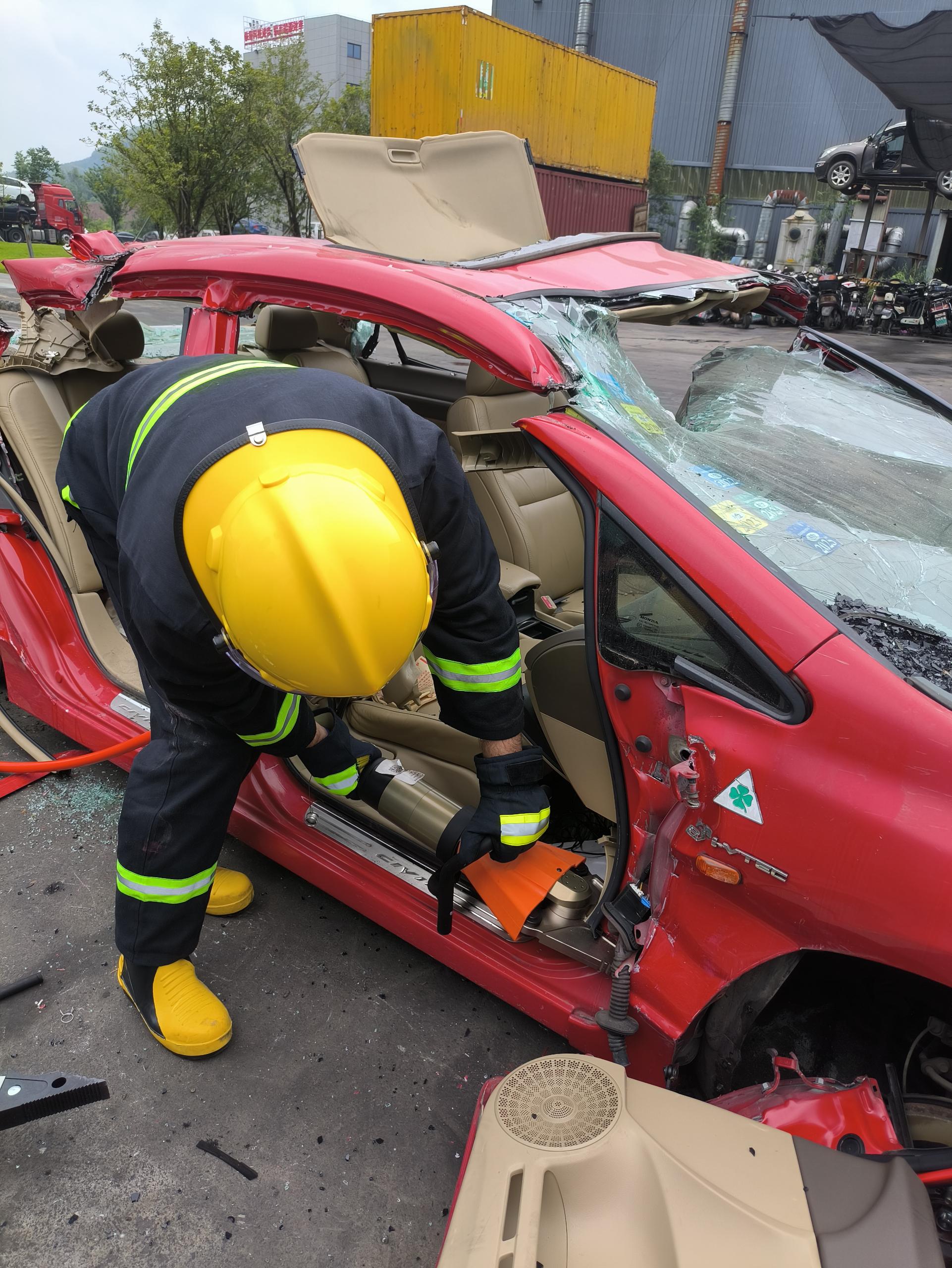
Vehicle extrication. The hydraulic cutter S175-L is published with 30° angled jaws specifically for vehicle cutting, a maximum cutting force ≥604 kN, cutting capacity ≤φ30 mm Q235A round steel, opening distance ≥170 mm and weight ≤9.5 kg. Vehicle extrication is where cutting capacity and jaw geometry matter more than raw tonnage, and where a sub-10 kg tool reduces rescuer fatigue across repeated door and pillar cuts.
Structural collapse and propping. Two-stage rams carry the load here. The R522-L publishes a first-stage lifting force of 275 kN at 935 mm and a second-stage lifting force of 140 kN at 1285 mm, with a flat-seal flat-axis single interface connector for hot-swapping under pressure, a handle-mounted light, a laser alignment device at the ram tip for precise positioning, and a quick-change anti-slip tip rotating freely through 360°.
Confined-space entry and door breaching. The published body specifications for the EHK-5D Rescue Backpack set show the constraint logic clearly: an electric hydraulic pump rated at 72 MPa and 550 W, a 2-metre oil pipe, a 28 V 4.6 Ah battery and a 12.75 kg pump, paired with a 4 kg micro cutter rated at 240 kN, a 3.5 kg micro spreader rated at 58 kN over 156 mm, and a 5.75 kg door opener providing 100 kN of opening force over a 260 mm opening distance. Each tool can be stopped at any position during operation. Smaller still, the S61-L mini cutter is published at 3.9 kg with a 60 mm opening distance and 180 kN maximum cutting force against Ø22 mm Q235 round steel and 8 mm plate.
Rebar and industrial work. The cordless rebar cutter family covers a 4–25 mm range through three models: RC-16B (4–16 mm, 3.5–4.0 s per cut, 150 cuts per charge), RC-20B (4–20 mm, 4–5 s, 120 cuts per charge, 7 kg net) and RC-25B (4–25 mm, 6 s, 70 cuts per charge, 10.5 kg net). The BC-300A battery combi tool publishes a cutting force ≥313.8 kN, maximum spreading distance ≥306 mm, jaw opening ≥200 mm, cutting capacity ≥Φ25 mm rebar and ≥10 mm Q235 plate, with ≥50 effective cycles per full charge.
Underwater and hazard-rated work. The P610AES amphibious pump set is published with a two-stage pump configuration, rated working pressure ≥72 MPa, battery capacity ≥8.4 Ah and an underwater working depth ≥100 m, with pressure depth detection and automatic pressure adjustment according to external load. The amphibious cutter S251-S publishes a maximum shear force ≥940 kN against ≤φ40 mm Q235A round steel and 20 mm sheet. The manual combi tool GYJK-33~36/25(10) is published as usable underwater and in explosion-hazardous areas, with a 70 MPa maximum working pressure, 275 mm maximum spreading distance, 270 kN cutting force and 9.5 kg machine weight.
Concrete and demolition. The CS350-L concrete crusher is published with a breaking force of 90 kN, cutting force of 760 kN, opening distance 350 mm, cutting opening distance 125 mm, and cutting capacity covering Ф32 mm Q235 round steel and a 115 mm concrete floor — supporting concrete crushing and rebar shearing without a tool change.
Field deployment references in the available material include emergency equipment reserve supply to a China Fire and Rescue Service unit, use by Malaysian rescue teams in truck-crash extrication, and use by China Blue Sky Rescue members during the Turkey earthquake response in Malatya Province.
Market trend analysis: consolidation, revision, electrification
Concentrated but not closed. With the top five players estimated at 52% to 58% of global revenue in 2025, roughly 42% to 48% of the market sits with other suppliers. That structure has a procurement consequence: high-volume municipal or national framework contracts are the segment where capacity, lead time and documentation completeness matter more than brand prestige, and where a verified mid-size manufacturer can be a credible bidder. It also has a risk consequence — buyers should verify capacity claims rather than accept them.
Standards are moving. The transition from EN 13204:2016 to the 2025 edition changes the compliance question from “do you have a certificate?” to “which edition does your conformity documentation address, and what is your transition plan?” Procurement documents drafted before the revision may need review.
Electrification is expanding the option set, not replacing it. Battery-electric and corded electric-hydraulic tools are widening the range of scenarios a single team can cover, particularly in confined spaces and where hose routing is impractical. At the same time, pump-driven hydraulics retains the advantage in sustained duty and in environments where battery logistics cannot be guaranteed.
Comparison with traditional pump-driven solutions — and where the newer architecture still falls short
| Constraint dimension | Pump-driven hydraulic | Battery-electric hydraulic |
|---|---|---|
| Deployment preparation | External power unit plus hose routing required | No pump or hose in the tool path; single-unit deployment |
| Sustained duty | Continuous while fuel or manual effort lasts | Limited by charge: published examples include ≥50 cycles (BC-300A), 120 cuts (RC-20B), 150 cuts (RC-16B) per charge |
| Weight carried by the rescuer | Tool only; pump weight carried separately (e.g. MDP220 ≤23 kg) | Tool plus battery carried together (e.g. SP725-E 22.6 kg) |
| Resupply dependency | Fuel or manual effort | Chargers and spare batteries; 90-minute charge time on rebar cutter models |
| Confinement suitability | Hose routing can obstruct narrow access | Better suited to confined spaces and rubble |
The boundaries are real and should be stated rather than smoothed over.
Boundary 1 — duty cycle. Battery tools trade continuous availability for mobility. A team standardising on battery-electric tools must budget battery inventory and charging logistics as an operational requirement, not an accessory. A published figure such as ≥50 effective cycles per full charge for a battery combi tool is workable for a defined task set, but it constrains prolonged multi-vehicle or multi-structure incidents.
Boundary 2 — documentation localisation. Some published package listings state that the standard kit includes a Chinese user manual — for example the battery cutter S312-E and the battery spreader SP725-E, each supplied with two rechargeable batteries, one charger, one carrying strap and one manual. For EU, North American and other export markets, this is a genuine localisation gap that buyers should raise contractually at quotation, alongside training and labelling requirements.
Boundary 3 — evidence depth. The published material for this category does not include independent laboratory test results or field reliability data for every model, and the available evidence base does not support a standardised performance benchmark between battery and corded electric tools. Buyers should therefore treat supplier specifications as claims to be verified against model-level conformity documentation and, where contract value justifies it, against factory audit and sample testing.
Future outlook
Three developments are likely to shape hydraulic and electric rescue tool procurement over the next few years.
First, standards transition will become a routine procurement checkpoint rather than an occasional one. As the EN 13204 family moves to its 2025 edition, conformity documentation will need to name the edition it addresses, and framework contracts will increasingly require a stated transition plan.
Second, battery platforms will compete on interoperability rather than on voltage headlines. The meaningful comparisons will be duty cycle per charge, charge time, battery interchangeability across a tool set, and the availability of spare batteries and chargers as separately priced line items.
Third, the supply base will continue to broaden beyond the concentrated top tier, particularly in volume-driven framework segments. For buyers, that broadening is an opportunity and a diligence obligation simultaneously: more credible bidders, but also more claims that require verification against factories, certificates and models. ODE Technology's published capability position — OEM/ODM production with drawing design support and customisation on voltage, power, colour, brand and minor functional adjustments, a stated monthly capacity of 5,000 units, a stated lead time of 45–60 days, a minimum order quantity of 2 units, and remote after-sales support — is a concrete example of the kind of commercial terms buyers should require every shortlisted supplier to state explicitly, in writing, against a named model.
FAQ
Which certification should a hydraulic rescue tool show for EU procurement?
For the EU market, model-level CE attestation of conformity is the relevant evidence, issued against the Machinery Directive 2006/42/EC and the Electromagnetic Compatibility Directive 2014/30/EU, with applicable standards including EN ISO 12100:2010, EN 60204-1:2018 and EN IEC 55014-1:2021. As a published example, ODE Technology's rescue combi tool attestation carries certificate number M.2023.206.C94565 and is valid until 24 December 2028, while its hydraulic pump attestation carries number M.2023.206.C94572. A certificate number and validity date should be quoted for the exact model being purchased. Because EN 13204 exists in a 2016 edition and a later 2025 edition listed by DIN as the replacement, the conformity file should also state which edition it addresses.
Which rated parameters decide between a hydraulic combi tool and a battery combi tool?
The comparable fields are maximum cutting force, cutting capacity stated on a named material, spreading force together with spreading distance, squeezing and pulling force with pulling distance, rated working pressure, and net weight. In published figures, the hydraulic combi tool SC370-L carries a 72 MPa rating, 940 kN maximum cutting force, capacity for Ø38 mm round bar and 12 mm Q235, spreading force 50 kN over 390 mm, and 13.5 kg net weight. The battery combi tool SC370-E carries a 720 bar rating, 940 kN maximum cutting force, capacity for Ø38 mm Q235 round steel and 20 mm Q235 plate, spreading force 45–145 kN over 390 mm, and 18.5 kg net weight. Pressure is effectively equivalent between the two — 72 MPa equals 720 bar — so the differentiating fields are plate-cutting capacity, spreading force range and tool mass.
How many cuts or cycles can a battery rescue tool complete per charge?
Published duty figures in this portfolio vary by model: at least 50 effective cycles per full charge for the BC-300A battery combi tool; 150 cuts per charge for the RC-16B rebar cutter with a 3.5–4.0 s cutting speed; 120 cuts per charge for the RC-20B with a 4–5 s cutting speed; and 70 cuts per charge for the RC-25B with a 6 s cutting speed. The rebar cutter models state a 90-minute charge time and are supplied with two batteries and one charger. Battery status is indicated by seven LEDs for seven battery levels, with a low-power alarm activating below 20% remaining capacity. Teams should size battery inventory against the longest expected uninterrupted operation, not against the average call.
Do hydraulic and battery rescue tools share the same connector types?
Not necessarily, and this should be confirmed model by model before ordering. Published connector designs in this portfolio include flat-seal flat-axis single connectors that allow connection and disconnection under pressure and are easy to clean; threaded single connectors with the same pressure-disconnection behaviour and one-press locking; and male-female snap fasteners for simpler coupling. Tools within a shared connector family can be hot-swapped between power units during an operation, which allows a rescuer to move a tool head to a different pump or power pack without depressurising the system. Where a fleet already uses a specific connector standard, that standard should be written into the specification.
What are the typical lead time and customisation limits for OEM rescue tool supply?
Published commercial terms for ODE Technology state OEM/ODM production support with drawing design services, customisation available on voltage, power, colour, brand and minor functional adjustments, a monthly capacity of 5,000 units, a lead time of 45–60 days, a minimum order quantity of 2 units, and remote after-sales support. Buyers should also check package localisation at quotation stage: some published kit listings state a Chinese user manual as standard, which needs to be addressed contractually for EU, North American and other export markets, along with labelling and training requirements.
For a consolidated view of the product families, rated parameters and conformity documentation referenced in this article, the ODE Technology company brochure is available for public download: ODE Technology Company Brochure (English).
Есть вопросы или нужны дополнительные детали?
Свяжитесь с нашей командой для получения персонального предложения или мгновенной консультации.
Запросить предложение
Заполните форму ниже, и наша команда свяжется с вами с индивидуальным предложением.
Прямой чат WhatsApp
Предпочитаете общаться в реальном времени? Напишите нам в WhatsApp для мгновенной помощи и быстрых ответов.
- Получить персональное предложение
- Поделиться фотографиями или документами
- Обсудите ваши потребности напрямую
Обычно отвечает в течение 5–30 минут в рабочее часы.