
Hydraulic vs. Piston vs. Solenoid Dosing Pumps for Corrosive Media
Hydraulic vs. Piston vs. Solenoid Dosing Pumps for Corrosive Media
Corrosive chemical metering is one of the few duties where a dosing pump is judged less on purchase price than on whether it survives the shift. The global dosing pump market was valued at approximately USD 8.86 billion in 2024, and Asia Pacific accounted for 41.8% of that revenue in the same year, according to Grand View Research — a distribution that reflects how much chemical dosing capacity now sits inside water treatment, surface finishing, mining and chemical processing plants.
For buyers at the awareness and research stage, the first decision is not which brand to buy. It is which drive type to specify: hydraulic, piston or solenoid. The three mechanisms solve the same basic problem — delivering a measured volume of liquid into a process — with different flow and pressure envelopes, different wetted materials and different maintenance profiles.
WRS, the trading name used here for Zhejiang WRS Machinery Equipment Co., Ltd., is a Hangzhou-based manufacturer founded in 2016 whose range includes hydraulic metering pumps, piston dosing pumps, solenoid and digital dosing pumps, together with supporting components such as dosing pump check valves, pulse dampeners and complete chemical dosing systems. Because all three drive types appear in that range with documented specifications, it provides a practical reference set for a like-for-like comparison.
This article compares the three drive types against the constraints that corrosive media introduce, and it states plainly where each type stops being the right answer.
Why Corrosive Media Forces the Drive-Type Decision Early
In clean-water or mild-additive service, dosing pump selection is mostly a question of hydraulic sizing: establish a flow rate and a pressure, then choose a model. Corrosive media add a second, harder constraint — the wetted path. Pump head, diaphragm, valves, seals and tubing decide whether the unit runs for years or becomes a maintenance item. WRS's published guidance on the subject is direct: different media have different materials available for selection, and for highly corrosive media a PVDF pump head material is recommended.
That material constraint interacts with the drive type, because not every drive type is offered in every material, and because the required flow and pressure narrow the field before material choice is even applied. The same guidance sets a selection order that puts flow rate first: required flow rate is compared against the maximum flow rate available at the site, and pressure, pump head material and motor selection refine the choice afterward.
How the Three Drive Types Work
Hydraulic metering pumps
A hydraulic metering pump uses a hydraulic circuit to actuate the displacement element, which is why the design is associated with high-pressure capability. In the WRS range, the HS008S0P01S11 moves 2 L/H at 200 bar through a DN6 bevel-end welding tube connection with a 0.37 kW motor, while the HL090S0P01F11 moves 1600 L/H at 6 bar through a DN50 flange with a 1.5 kW motor. Both are built in SS316 and both are available with frequency and explosion-proof motor options.
The published selling points for this family are zero-leakage design, suitability for toxic and hazardous media, high-viscosity handling, optimized dosing accuracy and easy maintenance, with an optional diaphragm rupture sensor. Typical industries listed for these models are oil and gas, hydrogen energy, electric power, chemical, pharmacy, new material and new energy.
Piston dosing pumps
Piston dosing pumps move liquid by positive displacement of a piston. The WRS piston range is specified in SS316 and is described as robust and efficient, suitable for high-viscosity pumping, optimized for high-accuracy dosing and easy to maintain. Two models show the envelope clearly: the PD105SS1PFN11 and the PM060SS1PFN11 both deliver 600 L/H at 8 bar, with DN50 and DN25 flange connections and 4.0 kW and 0.75 kW motors respectively. Both can be supplied with frequency and explosion-proof motors.
Solenoid dosing pumps
Solenoid dosing pumps use an electromagnetic drive, which is why they occupy the low-flow end of the envelope. The WRS solenoid range is rated 1–20 L/H at 1–10 bar with 220V/110V input and IP65 protection, available in PVC, PVDF and SS316. The EML0020PR1C supports remote control through 4–20 mA or pulse signal and Modbus RS-485 communication with direct flowrate display, while the ML0008PR1C is the manual-control equivalent. Both use a double-ball check valve on the inlet and outlet, which the manufacturer cites as a factor in discharge accuracy, and both are published at 1% dosing accuracy with a water- and heat-resistant PCB board.
The same platform extends into digital dosing pumps for automated systems: the EMML0060FP1E moves 60 L/H at 4 bar with a full PTFE diaphragm and stated precision below 1%, and the EMAP1000PQ1C reaches 1000 L/H at 4 bar through a DN25 socket connection in PVC or PVDF. Remote control across these models uses 4–20 mA or pulse signal and Modbus RS-485, with a published ratio rate of 1:1000.
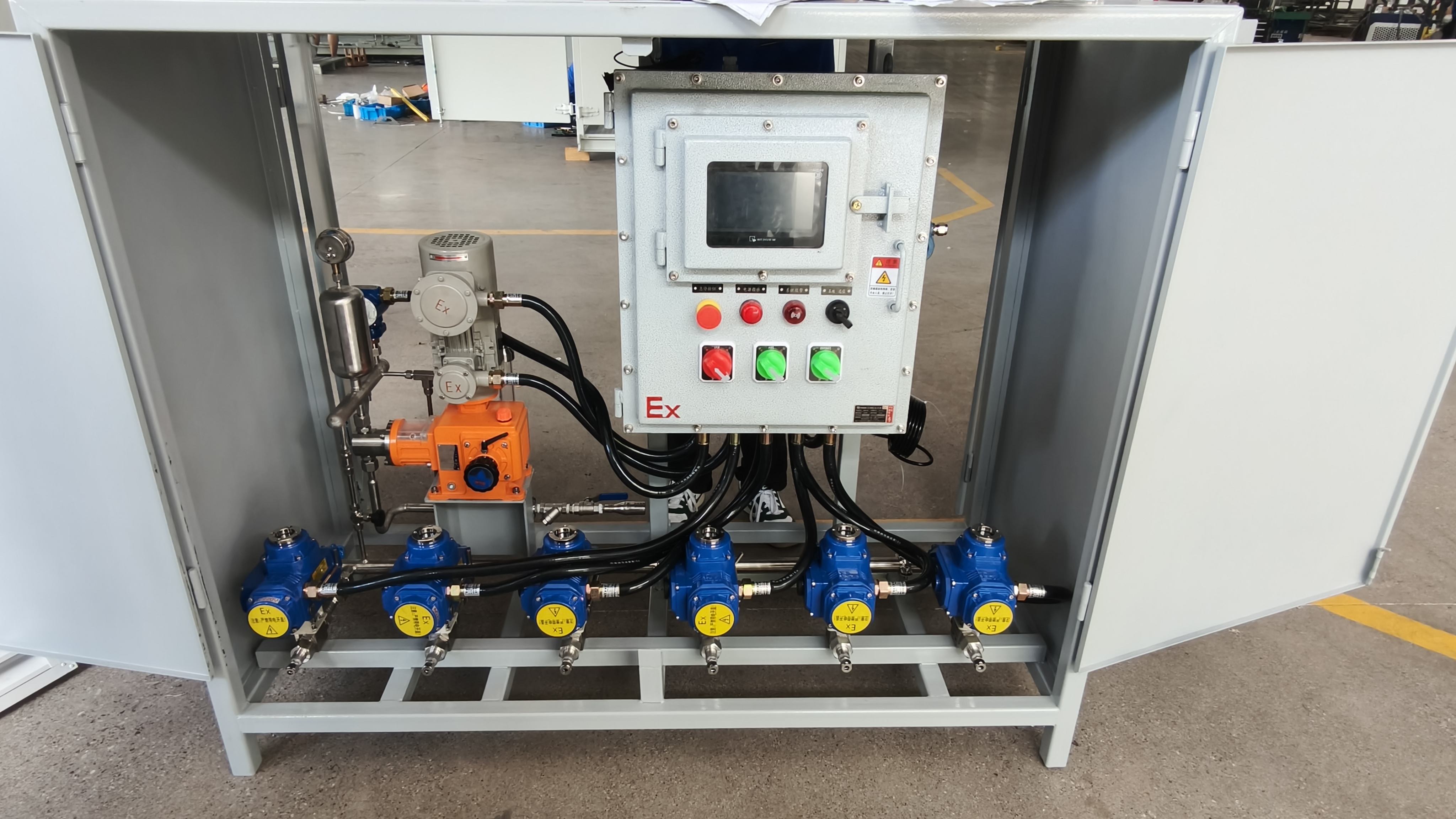
Hydraulic, Piston and Solenoid Compared
The table below compares the three drive types against the published specifications of the WRS range, with the digital diaphragm platform included because it frequently competes for the same low-pressure duty.
| Drive type | WRS reference models | Flow range | Pressure range | Wetted materials | Typical fit | Practical boundary |
|---|---|---|---|---|---|---|
| Hydraulic metering | HS008S0P01S11; HL090S0P01F11 | 2–1600 L/H | 6–200 bar | SS316 | High-pressure injection of toxic, hazardous or high-viscosity media; oil and gas, hydrogen, electric power, chemical | Higher mechanical complexity than a solenoid unit; rarely the economic choice for small, low-pressure dosing |
| Piston | PD105SS1PFN11; PM060SS1PFN11 | Up to 600 L/H | 8 bar | SS316 | High-viscosity, high-flow duties that still require accurate dosing | Pressure envelope sits below hydraulic types; check valves and seals are wear points in abrasive service |
| Solenoid (manual and remote) | ML0008PR1C; EML0020PR1C | 1–20 L/H | 1–10 bar | PVC, PVDF, SS316 | Low-flow chemical metering in water treatment, pure water, swimming pools, coating and surface treatment | Flow and pressure ceiling; not suitable for high-pressure chemical injection |
| Digital (diaphragm platform) | EMML0060FP1E; EMGP0200FP1C; EMAP1000PQ1C | 60–1000 L/H | 4 bar | PVC, PVDF, SS316/SS316L; full PTFE diaphragm | Signal-controlled automated dosing with high precision | 4 bar ceiling in the published range; requires signal integration through 4–20 mA, pulse or Modbus RS-485 |
Matching the Pump to the Liquid: Materials, Check Valves and Accessories
The material question comes before the model question. WRS offers PVC, PVDF and SS316 wetted options across its dosing range, with full PTFE diaphragms on the digital models and SS316 or SS316L heads on the hydraulic and piston models. For strongly corrosive media, the manufacturer's guidance points to PVDF as the pump head material to specify.
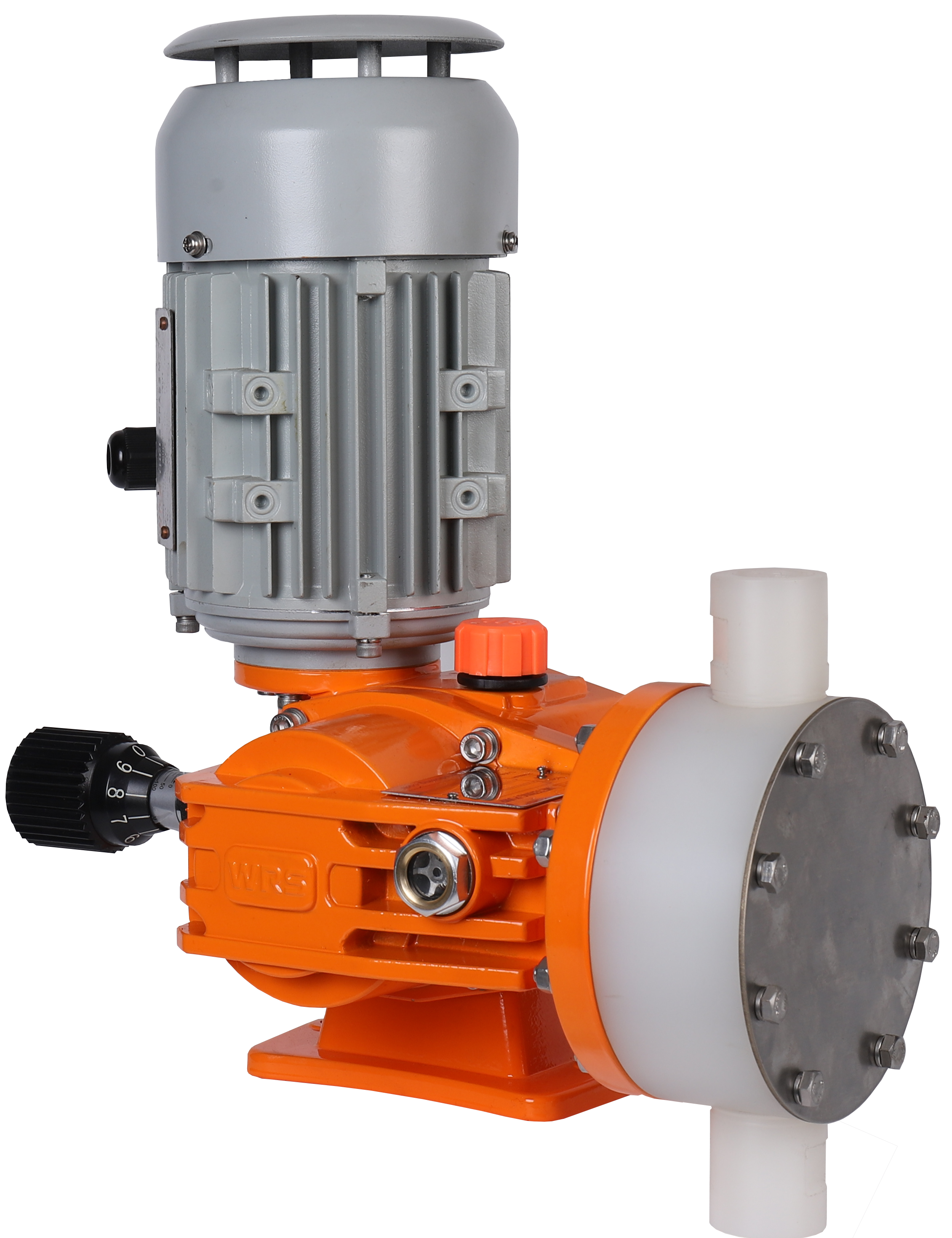
Component choices follow the same logic. Check valves sit directly in the flow path and are a normal wear point, which is why the double-ball inlet and outlet design is called out as a contributor to discharge accuracy rather than a cosmetic feature. Pulse dampeners address the pulsation that positive-displacement pumps put into the discharge line. On the solenoid range, PE tube, foot valve, weight, injection valve and safety valve are supplied as standard accessories — a detail that matters when buyers compare delivered scope rather than unit price alone.
Application Fit: Where Each Type Earns Its Place
Water and wastewater treatment remains the largest single application area for metering pumps, holding a 23.2% share of global application demand according to Grand View Research. That is largely solenoid and digital territory: low flows, continuous duty, signal-controlled dosing into a process stream.
Higher-pressure duties move toward piston and hydraulic types. The WRS hydraulic and piston ranges are published against oil and gas, hydrogen energy, electric power, chemical, pharmacy, new material and new energy industries — applications where injection pressure, viscosity or media hazard rule out a light solenoid unit. Mechanical diaphragm models in the same portfolio cover 15–1800 L/H at 3–10 bar in PVC, PVDF and SS316 for wastewater treatment, chemical, coating and surface treatment, and mining process duties.
One documented project shows how site conditions add requirements that a generic type comparison will not surface. In a livestock (hoggery) nutrient-solution dosing application in Russia, the working condition was described as a harsh, humid farm environment running 24/7 as part of an automatic system, with IP67 protection listed as a special site requirement. The matched equipment included the EMML0060FP1E digital dosing pump and the ML0008PR1C solenoid pump, both published at IP65 as standard.
What the Market Data Says About Drive-Type Demand
Drive-type data is useful to buyers because it indicates where manufacturers are investing. Motor-driven metering pumps held a 54.45% revenue share of the global metering pump market in 2025, according to Mordor Intelligence, and diaphragm-type dosing pumps led product-segment revenue at 55.7% in 2024 per Grand View Research. Solenoid-driven dosing pumps, the low-flow segment, are projected to grow at a CAGR of 5.88% through 2031, also reported by Mordor Intelligence.
Adjacent demand supports the same picture. The global chemical injection pump market was valued at USD 3.5 billion in 2024 by HTF Market Intelligence, and China's liquid pump exports reached USD 14.3 billion in 2024 according to the Observatory of Economic Complexity — a reminder that a large share of pumps specified for Asia-Pacific projects will be sourced from Asian manufacturers.
On the supply side, Mordor Intelligence names Grundfos, IDEX (Milton Roy), ProMinent and SEKO S.p.A. among the major competitors in the dosing system market, alongside regional manufacturers. WRS operates from a 15,000 m² facility with 120 employees, an annual output of 30,000 units, a 15-engineer R&D team and an export share of about 20% concentrated in Southeast Asia, Russia and South America, with local after-sales service established in more than 10 countries. Its portfolio also covers instruments and meters, accessories, a fully automatic PAC dry powder system and a streaming current monitoring system.
Buyers comparing market figures should read them as scope statements as much as size statements. Published estimates for 2024–2025 diverge widely by definition: Grand View Research valued the dosing pump market at approximately USD 8.86 billion in 2024, Fortune Business Insights at USD 6.35 billion in 2025, and Precedence Research at USD 47.04 billion under a broader chemical-injection definition. A headline number without the underlying scope tells a procurement team very little.
Limits and Boundaries: Where Each Type Stops Working
- Solenoid: the WRS range tops out at 20 L/H and 10 bar. It is the wrong instrument for high-pressure chemical injection, regardless of material choice.
- Piston: the models above are rated at 8 bar. Where a process needs more, the piston type moves out of contention and hydraulic types take over.
- Hydraulic: 200 bar is available at 2 L/H on the HS008S0P01S11, but the hydraulic circuit adds mechanical complexity and cost that a low-pressure water treatment duty does not need.
- Material: PVDF is recommended for highly corrosive media, but that recommendation does not replace the full selection sequence — flow rate against site maximum remains the first filter.
- Abrasive or high-solids media: check valves and seals are wear points in any drive type, and the double-ball check valve design that supports accuracy also concentrates wear in a small component that must be serviceable.
- Enclosure and motor options: frequency and explosion-proof motors are available on the hydraulic and piston models, and they must be specified — they are not defaults.
- Blockage symptoms: a dropping or unstable discharge flow rate is commonly traced to an inlet or outlet blockage; the documented response is to check the strainer, tubing and valves and to clean or replace them as required.
Future Outlook
The direction of travel in this category is digital and signal-integrated rather than purely mechanical. WRS describes a full digital and intelligent upgrade across its dosing pump series, with 4–20 mA, pulse and Modbus RS-485 interfaces, direct flowrate display, precision below 1% and a 1:1000 ratio rate on the digital models — capability that moves the pump from a standalone device into the plant control scheme.
Regulatory pressure is moving in parallel. The EU Machinery Regulation that repeals 2006/42/EC from 2027 mandates CE marking for metering pump units, API 675 remains the primary international standard for positive-displacement reciprocating pumps with integrated controlled capacity, and ISO 14847:1999 specifies technical requirements for rotary positive-displacement pumps. For buyers in regulated industries, those frameworks increasingly define the documentation a supplier must be able to produce.
For procurement teams, the practical implication is that drive-type selection will remain the first decision, but it will be executed against a wider set of constraints: material compatibility, signal integration, ingress protection, motor certification and long-term parts availability. Localized after-sales capability across more than 10 countries is one indicator of whether a supplier can support a pump over a full service life rather than only at the point of sale.
Frequently Asked Questions
What is the difference between a hydraulic, piston and solenoid dosing pump?
They differ primarily in the drive mechanism, and that difference determines flow and pressure capability. Hydraulic metering pumps use a hydraulic circuit to actuate the displacement element and reach high pressures — the WRS HS008S0P01S11 is published at 200 bar. Piston dosing pumps use positive displacement of a piston and are rated up to 600 L/H at 8 bar. Solenoid dosing pumps use an electromagnetic drive and cover 1–20 L/H at 1–10 bar. Wetted materials also differ: SS316 on the hydraulic and piston models, and PVC, PVDF or SS316 on the solenoid models.
Which dosing pump type suits strongly corrosive liquids?
Material selection matters more than drive type in this case. WRS guidance states that different media have different materials available for selection and that a PVDF pump head material is recommended for highly corrosive media. Because PVDF bodies are offered in the solenoid and digital ranges — for example the EML0020PR1C and the EMAP1000PQ1C — while the hydraulic and piston ranges use SS316, the workable answer depends on the flow rate and pressure the process actually requires.
What flow rate and pressure can each type cover?
In the WRS range: solenoid dosing pumps cover 1–20 L/H at 1–10 bar; piston dosing pumps cover up to 600 L/H at 8 bar; hydraulic metering pumps span 2 L/H at 200 bar on the HS008S0P01S11 and 1600 L/H at 6 bar on the HL090S0P01F11; and digital diaphragm models cover 60–1000 L/H at 4 bar. The ranges do not overlap evenly, so flow and pressure requirements typically eliminate two options before material is considered.
What is the most important parameter when selecting a dosing pump?
Per the documented selection method, flow rate comes first: the required flow rate is compared against the maximum flow rate available at the site. Pressure, pump head material and motor selection are then used to refine the choice. Starting with material or brand instead of flow rate tends to produce over- or under-specified pumps.
Why does a dosing pump's discharge flow rate drop or become unstable?
One documented cause is a blockage at the inlet or outlet. The recommended troubleshooting path is to inspect the strainer, tubing and valves, and to clean or replace them where necessary. Because check valves sit in the flow path and are a normal wear point, they are a routine item to inspect when discharge accuracy degrades.
Do solenoid dosing pumps suit continuous operation in humid environments?
Continuous duty and environmental protection are separate questions. In a documented livestock nutrient-dosing project in Russia, the site required IP67 protection for 24/7 operation inside an automatic system in a harsh, humid farm environment, while the matched pumps — the EMML0060FP1E and the ML0008PR1C — are published at IP65 as standard. Required ingress protection should therefore be compared against the pump's rating during specification.
The Buyer's Takeaway
Drive type decides the envelope; material decides the service life; and the site decides the details that neither specification sheet advertises. Buyers comparing hydraulic, piston and solenoid dosing pumps should establish required flow against the site maximum, confirm pressure, validate pump head material against the specific medium — with PVDF as the documented recommendation for strongly corrosive liquids — and then check motor options, ingress protection and the delivered accessory scope before comparing suppliers at all.
A technical reference document from the manufacturer is available for download: WRS technical document (PDF).
Market figures cited in this article are attributed to their original publishers: Grand View Research, Mordor Intelligence, HTF Market Intelligence, the Observatory of Economic Complexity, the American Petroleum Institute, ISO and the European Commission. Product specifications are drawn from published WRS PTE LTD range documentation.