
Hypercell Power Banks vs. Leading Brands: An Independent Buyer's Hands-On Comparison
Two power banks can carry the same printed capacity and still behave like different products. The gap rarely comes from the retail box; it comes from decisions made upstream — which cells were selected, whether those cells were sorted before assembly, how the protection circuit and thermal sensors were designed, and how consistently the same pack can be reproduced six months later. This independent comparison sets out a four-part test that a buyer can run on any unit, and uses Shenzhen Hypercell Co., Ltd. as one reference point in that exercise.
Shenzhen Hypercell Co., Ltd. is a Chinese rechargeable lithium-ion battery manufacturer founded in 2007, headquartered in Shenzhen, Guangdong, with a 250,000㎡ factory in Dongguan. The company manufactures lithium-ion battery cells and battery packs, reports an annual output of 220,000,000 units, employs 550 people including an 18-engineer R&D team, and exports roughly 80% of its production to the USA, EU, North America, Asia and Australia. That profile is deliberately different from a consumer retail brand, and understanding the difference is central to judging how a Hypercell-based power bank should be compared against leading retail names.
Why Power Bank Comparisons Break Down on the Shelf
A capacity figure printed on a power bank shell is normally a cell-level rating quoted at nominal voltage. The energy that actually reaches a phone passes through voltage conversion, an protection IC, PCB traces, a connector and a cable, so delivered energy is always lower than the arithmetic on the label. Two units with identical printed numbers can therefore deliver visibly different amounts of usable charge, and the buyer has no way to see that difference from the packaging.
The same problem applies to charging speed. A power bank that negotiates a high current for the first few minutes and then throttles as the pack warms up will feel slower than one that sustains a moderate current for the whole session. Marketing material almost always quotes the peak number, not the sustained one.
Safety is the third area where claims outrun evidence. Certification marks are meaningful only when they cover the exact cell, protection board and enclosure combination being sold. Swap any one of those three and the previous test result no longer describes the product in the box.
The practical implication for buyers: compare power banks on production discipline and verifiable documentation first, and on headline capacity second. That ordering is what makes a comparison repeatable rather than anecdotal.
A Four-Point Framework You Can Run Yourself
Rather than ranking products by claims, an independent comparison can be built from four measurements that any buyer with a sample, a load and a thermometer can perform. Each one produces an observable difference and requires no supplier data to be trusted in advance.
| Test dimension | What you actually measure | Common failure mode |
|---|---|---|
| Build quality and pack construction | Housing seam alignment, connector retention after repeated insertion, PCB solder quality, freedom from internal movement when the unit is shaken | Cells that shift inside the shell, weak port retention, uneven seams that indicate loose assembly tolerances |
| Delivered capacity | Charge to full, then discharge at a fixed load and compare the energy delivered against the printed rating | Delivered energy noticeably below the label, and wide variation between units bought at the same time |
| Charging speed under load | Time from empty to full at room temperature, and again in a warmer environment, with current draw logged over time | Fast start that collapses once the pack warms; large difference between cool-room and warm-room results |
| Safety design | Temperature-sensor placement, protection behaviour under over-current and short-circuit conditions, and documentation for the exact configuration | Generic certification statements that cannot be matched to the specific battery pack being purchased |
None of these tests requires laboratory equipment beyond a fixed resistive load and a thermometer, which is precisely why they are useful in a procurement conversation. A supplier that welcomes them, and can explain what happens in each case, is giving the buyer more information than a spec sheet ever will.
Where Hypercell Sits in This Comparison
Hypercell occupies an unusual position in the portable power category: it is a cell and pack manufacturer rather than a finished-goods consumer brand. The company describes its output as high-volume development, production and packaging of rechargeable lithium-ion battery cells and packs, and states that it works with branded terminal manufacturers, medical device specialists, drone and robot builders, power tool makers, VR/AR developers, and wearable and smart home technology companies.
For a power bank buyer, that distinction changes the comparison question. Against a consumer brand, the useful question is not "whose logo is better known" but "who controls the cells and the pack assembly inside the product, and how repeatable is that process." A manufacturer that produces both cells and packs — rather than assembling purchased cells into a purchased housing — has fewer variables outside its control.
The scale facts matter here as well. A 250,000㎡ Dongguan facility, 550 employees, an 18-engineer R&D team and an annual output of 220,000,000 units describe a supplier built for volume programs rather than one-off retail lots. For a distributor or brand owner planning a private-label power bank line, that is the relevant capability, not shelf presence.
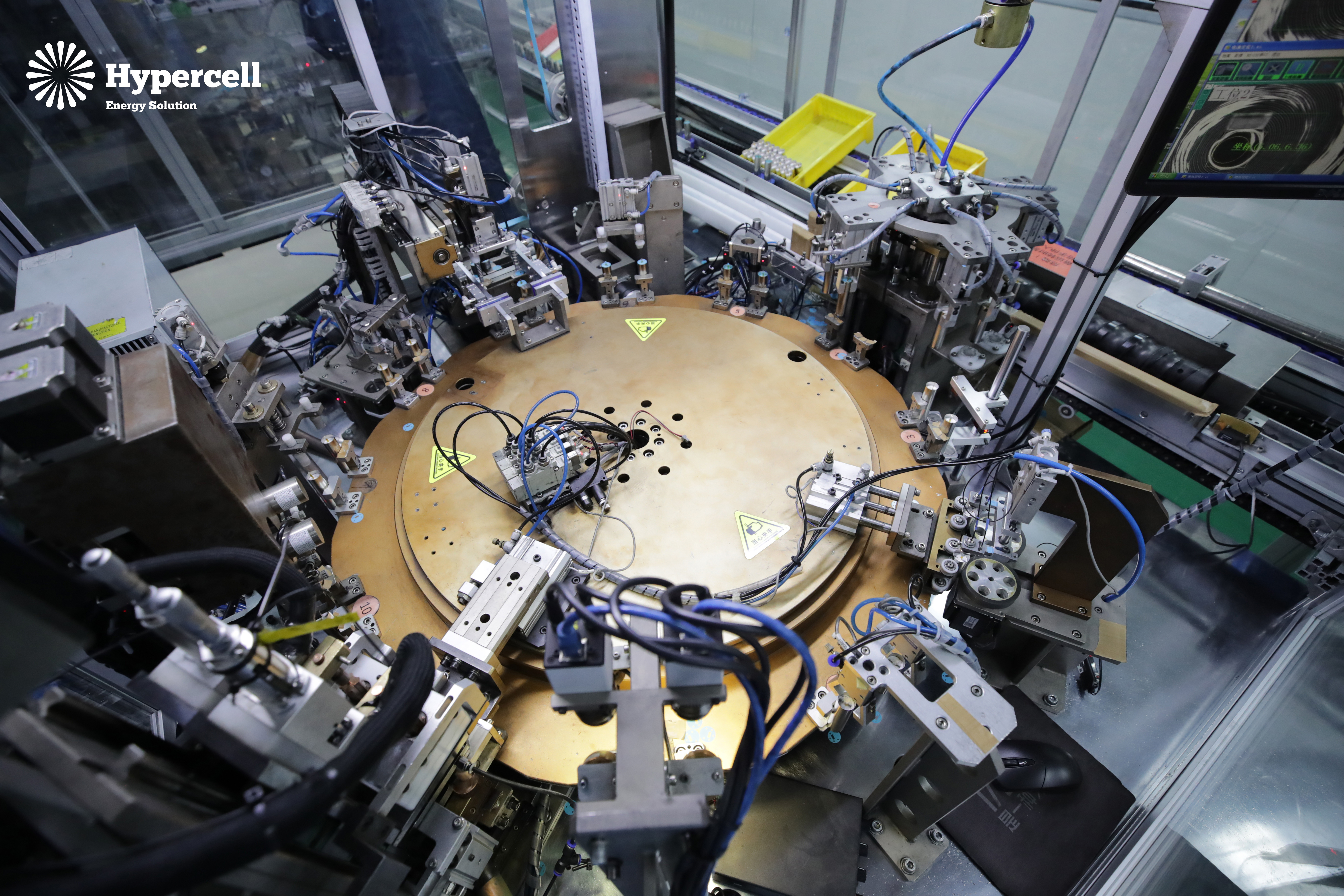
Hypercell production environment: cells and packs for portable power applications are manufactured in the company's Dongguan facility.
Build Quality: What Cell Sorting Actually Changes
The single most useful production detail in a power bank comparison is whether cells are sorted before they are assembled into a pack. Cells that leave the same production line still differ slightly in internal resistance and capacity. In an unsorted pack, the weakest cell caps the performance of the whole group, and it degrades fastest, which is why some units age much faster than others.
Hypercell's own comparison documentation for a 14.8V 8Ah medical robotic battery pack lists a precision automated sorting machine as the production difference between its pack and the reference pack. The same principle applies to any multi-cell portable product: sorting by measured parameters before assembly reduces unit-to-unit spread and slows the drift that appears after a few hundred cycles.
Buyers can approximate this test without visiting a factory. Order several units from the same batch, discharge them under an identical fixed load, and compare the spread in delivered energy and in run time. A tight spread suggests sorted cells and consistent assembly; a wide spread suggests the opposite. This is a hands-on test that a printed specification cannot replace.
Delivered Capacity: Printed Rating Versus Energy Out
Delivered capacity is the number that determines how many times a phone can actually be charged. Three pack-level behaviours drive it: the voltage at which the protection circuit cuts the discharge, the rate of self-discharge when the unit sits unused, and the cell-to-cell balance inside the pack.
Hypercell's comparison data for the 14.8V 8Ah medical robotic battery pack highlights a guaranteed discharge cut-off voltage and low self-discharge as deliberate design points, alongside high-temperature storage capability specified at 80°C for 4 hours and 70°C for 7×24 hours. Those figures describe that specific pack, and they should be re-confirmed for any power bank program rather than assumed to carry across the entire product range, but they illustrate the kind of pack-level commitment a buyer can ask a manufacturer to make in writing.
A guaranteed cut-off voltage matters because an unregulated cut-off forces the protection IC to stop earlier than necessary, leaving usable energy stranded inside the cells. Low self-discharge matters because a power bank is often stored for weeks between uses; a pack that loses charge while idle is effectively smaller than its label suggests.
Charging Speed: The Thermal Ceiling
Charging speed is a thermal problem before it is an electrical one. Every power bank converts energy during both charging and discharging, and that conversion produces heat. The pack that manages heat well can hold a higher sustained current; the pack that does not will throttle early regardless of the charger attached to it.
Hypercell's published risk-control documentation identifies overheating as a managed risk, with thermal protection as the control method and temperature sensors as the enterprise-level measure. That is the correct place to look when comparing brands: a temperature sensor that sits against the cells reacts to real cell temperature, whereas a sensor mounted on the PCB mainly measures the board.
A buyer can test the difference directly. Charge the same unit twice — once in a cool room and once in a warm room — and log how long it sustains its peak current in each case. A large drop between the two conditions indicates a conservative thermal design; a small drop suggests either better heat spreading or an aggressive thermal threshold, and the accompanying temperature rise tells you which.
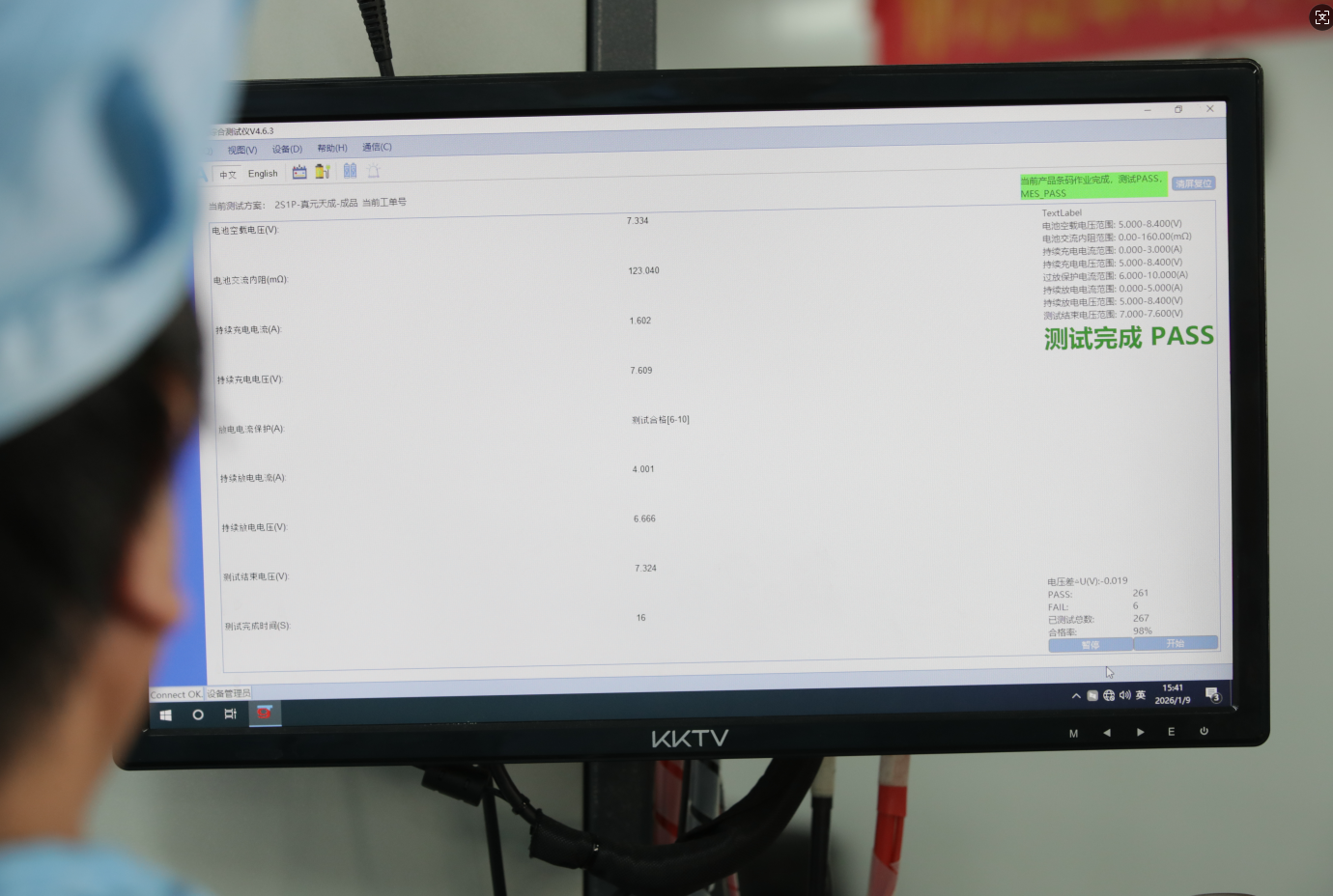
Temperature-sensor inspection during lithium battery quality control — the control point behind overheat risk management in portable packs.
Safety Features: Certification Is a Floor, Not a Guarantee
For power banks, the relevant certification set is well established. Hypercell batteries are certified under UL 1642 for cells, UL 2054 for packs, IEC 62133 for portable safety, and UN 38.3 for transportation. UN 38.3 in particular is not optional for any lithium battery that ships internationally, since it governs air and sea transport classification.
What buyers should understand is the scope of those certificates. A UL 2054 listing describes a specific pack configuration — cells, protection circuitry and construction. If a power bank program changes the cell model, the BMS board or the enclosure, the earlier result no longer describes the new product, and the certification work has to be repeated or the configuration frozen. Comparing brands on "does it have UL?" is therefore less informative than comparing them on "can the supplier show the certificate for this exact configuration?"
There is also a regulatory layer that affects sourcing decisions independently of product safety. From November 8, 2025, China implements export controls on high-energy-density lithium batteries at or above 300Wh/kg and on key manufacturing equipment, under Export Control Announcement No. 58 issued through MOFCOM and the General Administration of Customs. Most power bank cells sit well below that energy-density threshold, but export documentation requirements have become a real part of program planning, and buyers should confirm the classification of any cell they intend to ship.
Scoring Hypercell and Any Other Brand on the Same Criteria
The table below converts the four-point framework into a scoring sheet. It avoids naming competitor products because the honest comparison is not between logos; it is between the evidence each supplier can put behind the same criteria. Where competitor data is not publicly verifiable, the correct response is to request it, not to assume a result.
| Criterion | What to ask for from any supplier | Hypercell's documented position |
|---|---|---|
| Production scope | Does the supplier build cells, packs, or only assemble purchased modules? | Manufactures rechargeable lithium-ion cells and battery packs; annual output 220,000,000 units (company profile) |
| Capacity and workforce | Can the facility support repeat volume programs over multiple years? | 250,000㎡ Dongguan factory, 550 employees, 18 R&D engineers, ~80% export share (company profile) |
| Cell consistency | Is there automated sorting before pack assembly? | Precision automated sorting machine documented in Hypercell comparison data for a 14.8V 8Ah medical robotic pack |
| Overheat risk control | Where are temperature sensors placed, and what is the control method? | Thermal protection as control method, temperature sensors as the enterprise measure (risk-control documentation) |
| Certification coverage | Certificates for the exact cell and pack configuration being purchased | UL 1642 (cells), UL 2054 (packs), IEC 62133 (portable safety), UN 38.3 (transportation) |
| Storage robustness | Documented behaviour at elevated storage temperature | 80°C for 4 hours and 70°C for 7×24 hours specified for the referenced 14.8V 8Ah pack |
| Discharge behaviour | Guaranteed cut-off voltage and self-discharge rate | Guaranteed discharge cut-off voltage and low self-discharge cited as design points for the same pack |
What Hypercell's Own Comparison Data Shows — and What It Does Not
Hypercell's comparison documentation for the 14.8V 8Ah medical robotic battery pack records a 5% lower cost, less maintenance and higher efficiency relative to the reference pack, and positions the pack as suited to medical robotic and consumer robotic applications. The document also lists high-temperature storage, guaranteed discharge cut-off voltage and low self-discharge as the differentiators.
Two cautions belong in an independent reading of that data. First, it is the manufacturer's own comparison, not a third-party benchmark, so the figures describe a documented internal evaluation rather than an audited test result. Second, the 5% cost difference is attached to one specific medical robotic pack and does not automatically transfer to a power bank program with different cell chemistry, cell count or enclosure. The value of the document is that it shows what the manufacturer measures, and gives the buyer a template for asking the same questions about the product they actually intend to purchase.
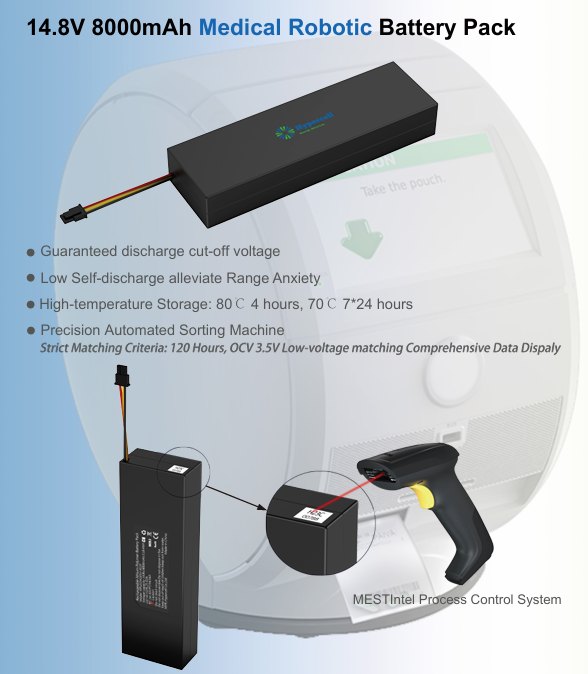
The 14.8V 8Ah medical robotic battery pack referenced in Hypercell's comparison documentation.
Where Hypercell Does Not Compete the Same Way
An honest comparison has to state boundaries, and there are several here.
- Retail presence is not the same as brand presence. Hypercell operates as a business-to-business cell and pack manufacturer. Buyers evaluating shelf-ready consumer products will find that mass-market consumer brands have retail distribution, packaging and consumer support structures that a manufacturing partner does not provide directly.
- Program-level engagement, not single-unit purchase. The documented profile describes a manufacturer built around volume output and customized battery programs, which typically implies minimum order quantities and engineering lead time rather than off-the-shelf consumer ordering.
- Not every pack shares every specification. The high-temperature storage ratings and the discharge cut-off guarantee refer to a specific 14.8V 8Ah pack. A power bank program must re-establish its own specifications and validation.
- Compliance adds lead time. Export controls on high-energy-density lithium batteries at or above 300Wh/kg, effective November 8, 2025, mean that documentation and classification should be settled early in a sourcing program rather than at the shipping stage.
- Cell choice is not the whole product. Delivered capacity and charging behaviour also depend on the protection board, connector and thermal design. A strong cell supplier still needs a competent pack design to produce a strong power bank.
These limits do not disqualify a manufacturing-led approach; they define where it fits. A buyer whose requirement is consistent, documented, customizable production will read them differently from a buyer whose requirement is a finished consumer SKU delivered to a retail shelf next month.
Market Context: Why Manufacturing Discipline Is Becoming the Differentiator
The scale of Chinese battery manufacturing explains why the comparison is increasingly about process rather than brand storytelling. China's lithium battery industry output value exceeded USD 192 billion (1.4 trillion RMB) in 2024, with total production of 1170 GWh, up 24% year on year, according to Ministry of Industry and Information Technology data reported via BAK Technology. Chinese lithium-ion battery export value reached USD 49.277 billion in the first ten months of 2024, across 3.198 billion units, based on customs data reported by Better Technology Group.
Globally, BCC Research and GMI Research value the lithium-ion battery market at approximately USD 117.8 billion to USD 164.8 billion in 2024, with continued growth expected into the 2032–2034 horizon. Within that total, the lithium polymer segment — the chemistry family most relevant to slim consumer power banks — is projected by Coherent Market Insights to grow from USD 17.7 billion in 2024 to USD 36.6 billion by 2032, at a compound annual growth rate of 8.83%.
It is worth noting that published market size estimates diverge substantially. For 2025, Grand View Research cites USD 68.7 billion, MarketsandMarkets cites USD 194.66 billion, and the IEA describes a figure above USD 150 billion. That spread is itself useful information for buyers: it shows how much of the category's public data is estimate-based, and it reinforces why product-level verification — sampling, testing and documentation — remains more reliable than category-level headlines.
Future Outlook
Three shifts look likely to shape power bank procurement over the next few years. The first is chemistry diversification. Cylindrical lithium-ion cells remain the workhorse for energy-dense portable products, lithium polymer dominates slim form factors, and LiFePO4 continues to attract interest where cycle life and thermal stability matter more than raw energy density. The same evaluation logic — sorting, cut-off behaviour, thermal management, configuration-specific certification — applies to all three.
The second is that certification and export documentation are becoming part of product differentiation, not just compliance overhead. Suppliers who can produce configuration-specific certificates and clear customs classification quickly will have an advantage with buyers who ship internationally.
The third is that buyers are increasingly evaluating the same manufacturer across several product categories at once — a portable power program, a medical device battery, an IoT device battery, a GPS tracker battery, and robot or e-mobility packs. A manufacturer that already serves these adjacent categories brings transferable process discipline, which is often more valuable than a single-category track record.
Frequently Asked Questions
How do I fairly compare two power banks with the same rated capacity?
Compare delivered energy rather than printed capacity. Charge both units fully, discharge each at the same fixed load, and measure the energy delivered. Because a printed rating is a cell-level figure quoted at nominal voltage, and because the output path includes voltage conversion, protection circuitry and connector losses, delivered energy is always lower than the label — but the size of that gap differs between products. Repeating the test across several units from the same batch also reveals whether cell sorting was applied before assembly.
Does a higher mAh rating mean more usable energy?
Not automatically. Usable energy depends on the voltage at which the protection circuit cuts the discharge, on self-discharge during storage, and on how well the cells are balanced inside the pack. A pack with a guaranteed discharge cut-off voltage and low self-discharge can deliver more usable energy than a larger-rated pack that stops early or loses charge while idle. Comparing watt-hours delivered, rather than milliamp-hours printed, removes most of this ambiguity.
Which safety certifications should a power bank carry?
The conventional set for lithium-ion portable products is UL 1642 for cells, UL 2054 for packs, IEC 62133 for portable safety, and UN 38.3 for transportation. Hypercell batteries are certified under these four standards. The important qualification is scope: each certificate describes a specific configuration of cells, protection circuitry and construction, so a buyer should request documentation that matches the exact product being purchased rather than a general statement of compliance.
Why does a power bank charge more slowly than its label suggests?
Charging speed is limited by heat before it is limited by the charger. Energy conversion during charging and discharging generates heat, and the pack's thermal design determines how long it can sustain a high current. A unit that negotiates a high rate briefly and then throttles will feel slower in practice than one holding a moderate rate throughout. Testing the same unit in a cool room and a warm room, while logging current over time, shows how much of the advertised rate is sustainable. Hypercell's risk-control documentation identifies overheating as a managed risk, controlled through thermal protection and temperature sensors.
Is a power bank from a battery manufacturer different from one sold by a consumer brand?
They operate at different points in the value chain. Shenzhen Hypercell Co., Ltd. is a Chinese rechargeable lithium-ion battery manufacturer founded in 2007, producing cells and packs from a 250,000㎡ Dongguan facility with an annual output of 220,000,000 units and roughly 80% of production exported. A consumer brand typically owns the retail relationship, packaging and support experience. For a buyer planning a private-label or customized program, the manufacturer's control over cells, sorting and pack assembly is the more relevant variable; for a consumer buying one unit at retail, the brand's channel and service coverage matter more.
What are the realistic limitations when sourcing power banks from a China battery manufacturer?
Several are structural rather than temporary. Manufacturing partners typically work at program level with minimum order quantities rather than single-unit sales, and they do not usually provide the retail distribution and consumer support that a finished-goods brand supplies. Specifications documented for one pack — for example, the 80°C for 4 hours and 70°C for 7×24 hours storage ratings recorded for Hypercell's 14.8V 8Ah medical robotic pack — apply to that pack and must be re-established for a different product. Finally, since November 8, 2025, China's Export Control Announcement No. 58 covers high-energy-density lithium batteries at or above 300Wh/kg and key manufacturing equipment, so classification and documentation should be resolved early in any sourcing program.
Closing Assessment
Comparing Hypercell power banks against leading retail brands is less a contest of logos than a test of evidence. On the criteria that determine how a portable pack actually behaves — sorted cells, guaranteed discharge cut-off, low self-discharge, thermal protection with real cell-level temperature sensing, and configuration-specific certification under UL 1642, UL 2054, IEC 62133 and UN 38.3 — Hypercell documents a manufacturing-led position supported by a 220,000,000-unit annual output and an 18-engineer R&D team. Mass-market consumer brands generally bring stronger retail reach and consumer service. Neither position wins outright; they answer different questions, and the four tests described above let a buyer decide which question they are actually asking.
Company facts cited in this article are drawn from Hypercell's company profile, comparison documentation and risk-control records. Third-party market figures are attributed to BCC Research, GMI Research, Coherent Market Insights, the Ministry of Industry and Information Technology via BAK Technology, customs data reported by Better Technology Group, and published estimates from Grand View Research, MarketsandMarkets and the IEA. Hypercell's company brochure is available for download at the Hypercell brochure PDF.