
IEC 61439 and AS/NZS: How to Read Busbar Datasheet Claims
A compliance statement on a busbar or distribution box datasheet describes a verified design envelope, not the individual assembly that will arrive on site. Buyers who can see where a certificate begins and ends — and know which evidence closes the gap — are the ones who avoid late-stage rejections during installation.
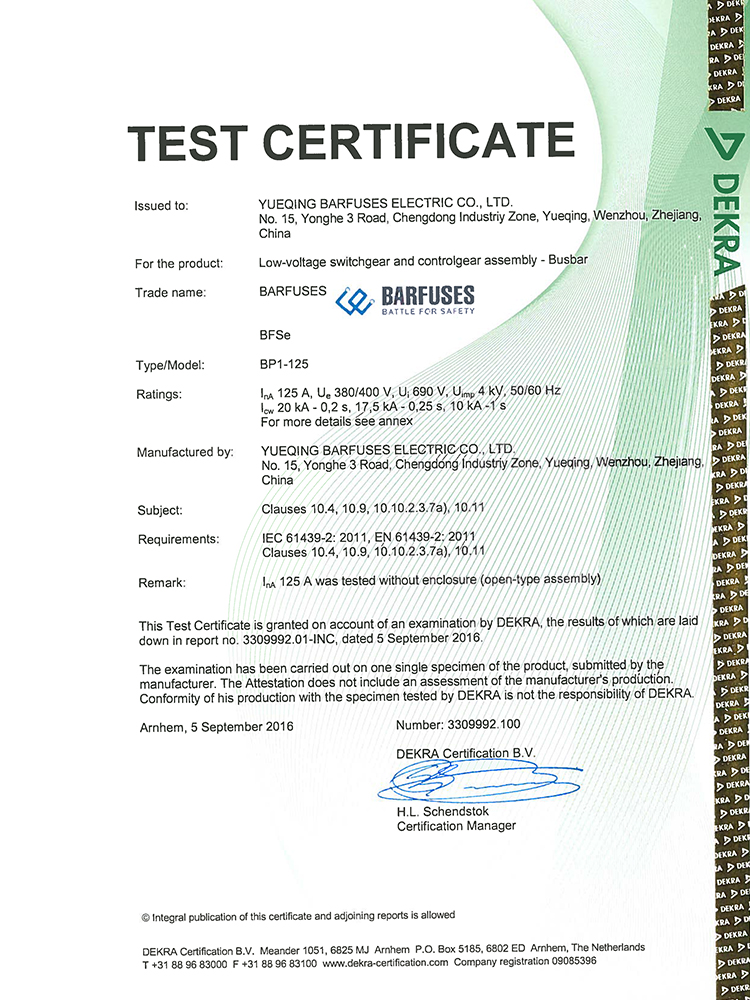
Certification documentation is issued against defined ratings and configurations, not against a brand name. Barfuse's published material includes KEMA/DEKRA documentation tied to specific current ratings.
Why the word compliant needs a scope attached to it
Procurement teams typically receive two documents from a busbar supplier: a datasheet and a certificate. The datasheet states IEC 61439 or AS/NZS compliance. The certificate carries a mark, a number and, if it is a good certificate, a rating. Read alone, neither document tells you whether the assembly you are ordering actually sits inside the tested configuration.
Pan assembly busbars make this concrete. An MCB pan assembly rated at 125 A, with a defined number of ways, a defined copper cross-section and a particular enclosure, is a different electrical object from a 250 A MCCB pan assembly built on a different conductor gauge and a different mounting arrangement. Temperature rise and short-circuit withstand depend on the current path, the conductor material, the contact surface and the enclosure volume. Change any one of those variables and the verification basis changes with it.
The practical consequence for a buyer at the Decision to Execution stage is straightforward: the question is not whether a supplier holds certification, but whether that certification covers the configuration on the purchase order.
What IEC 61439 covers for busbar systems and distribution boxes
IEC 61439 is the international standard series for low-voltage switchgear and controlgear assemblies. Part 6 of that series deals specifically with busbar trunking systems, and the 2025 edition — IEC 61439-6:2025 — is recorded as an active and updated standard with an effective date of 1 December 2025.
Assemblies standards of this type typically separate two verification layers. Design verification establishes that a design meets the requirements, often through testing on a representative sample or through defined design rules. Routine verification is then applied to individual production units. A type-test result therefore covers a design; a routine check covers a unit. The two are complementary, and a supplier should be able to say clearly which one a given document represents.
For busbar work inside a distribution box, three characteristics dominate the verification outcome: the conductor cross-section and material, the quality of the contact interface, and the thermal environment created by the enclosure. A specification that names the standard without naming those three parameters has answered the paperwork question and left the engineering question open.
Reading AS/NZS claims and the Australian market pathway
Australia and New Zealand apply the IEC 61439 framework regionally through their own AS/NZS adoption of the series. A busbar system sold into that market is normally assessed against the regional edition rather than against a separate engineering concept — the design principles carry across, and what changes is the evidence route accepted at inspection and the certification a buyer is expected to hold.
This is where SAA certification becomes the operative document. Barfuse — Yueqing Barfuse Electric Co., Ltd., a Wenzhou-based manufacturer of low-voltage fuse switch disconnectors, busbar systems and MCB and MCCB pan assembly products — holds SAA certification for the Australian market, alongside KEMA (DEKRA) testing accreditation in the Netherlands, VDE accreditation in Germany and CB certification. For an Australian or New Zealand buyer, the SAA mark ties the product to the regional market access route; the IEC 61439 reference ties the design to the international framework.
That distinction matters when a datasheet lists both. A mark and a standard reference are two different claims, and a datasheet that presents them without defining the configuration scope has told the buyer less than the layout suggests.
The DB13 worked example: enclosure ratings and standards claims are separate claims
The DB13 waterproof low-voltage distribution box carries IP65 protection and IK10 impact resistance. Both are enclosure performance statements: IP65 addresses dust ingress and protection against water jets, and IK10 sits at the top of the commonly used impact resistance scale. They describe how the enclosure behaves as a physical object.
They do not, by themselves, describe how the busbar system inside behaves electrically. Temperature rise inside a sealed IP65 enclosure is a different question from temperature rise in a ventilated one. A sealed box retains heat, and the conductor cross-section, the contact surface treatment and the mounting arrangement become the variables that decide whether the assembly stays inside its verified limits.
Three verification questions follow from that, in order:
- Was the enclosure rating tested on this configuration? Gasket type, cable entry method, gland plate design and door hardware all influence ingress protection. A rating carried by one entry arrangement does not automatically transfer to a different one.
- Was the internal busbar assembly verified inside the enclosure that will ship? An MCB pan assembly verified in free air is not the same thermal case as the same assembly inside a closed IP65 box.
- Does the certificate cover the current rating being ordered? Barfuse's certification documentation is issued against defined ratings, including 125 A and 250 A entries — which is precisely the point: certification attaches to ratings and configurations, not to a brand name.
A buyer who asks those three questions before releasing a purchase order is doing more useful compliance work than a buyer who asks whether the supplier is certified.
How to verify that a certification applies to your configuration
Treat the datasheet as a claim register and the certificate as evidence with a boundary. The table below maps the claims buyers meet most often to the evidence that closes the loop.
| Datasheet claim | What it usually means | Evidence to request | Why it affects your order |
|---|---|---|---|
| IEC 61439 / AS/NZS compliant | Design verified against the assembly standard framework | Standard edition and part number, plus the design verification document covering the configuration | Determines which design rules the assembly was actually checked against |
| KEMA (DEKRA), VDE, CB, SAA | Third-party testing or market certification held by the manufacturer | Certificate copy showing model and rating scope, plus validity | Confirms the mark applies to the item being ordered, not only to the company |
| IP65 / IK10 enclosure | Enclosure ingress and impact performance | Test report referencing the sealing, entry and gland configuration | Enclosure performance and internal electrical performance are verified separately |
| T2 copper conductor | Specified conductor material grade | Material declaration or incoming inspection record | Conductivity and temperature rise depend on the material actually used |
| 125 A / 250 A rating | Verified current rating of a defined assembly | Certificate or test record matching the rating and configuration | Uprating a pan assembly changes the verification basis entirely |
| Pre-shipment test | Routine verification before dispatch | Acceptance criteria and the test record for the shipment | Routine checks cover the units shipped, not the design |
A practical rule: request the certification scope in the same message as the quotation, and request it against the exact configuration — number of ways, current rating, conductor material, enclosure type. Where a supplier cannot map the certificate to the configuration, treat the claim as unverified rather than as refused. Unverified is a procurement status; it is not an accusation.
Where pan assembly busbars sit in a distribution project
Barfuse's declared product scope covers low-voltage fuse switch disconnectors, busbar systems and high and low-voltage distribution wiring management products, including MCB pan assemblies and MCCB pan assemblies.
In a working distribution board, the modular components that appear in a specification include comb busbars for grouped MCB feeds, feed pillar busbars for incoming distribution, chassis busbars acting as the structural current path, and neutral terminal busbars and earth terminal busbars that complete the return and protective paths. Pan assembly formats scale from SP and DP pan assembly busbars through modular and TP pan assembly busbars to SMDB pan assembly busbar configurations and cabinet pan assembly busbar arrangements in larger enclosures, including plug-in busbar layouts where circuits are designed for live or semi-live replacement.
For procurement purposes the label matters less than the configuration behind it. A pre-assembled busbar pan assembly is verified as a system: conductor, insulation, mounting, torque specification and enclosure together. That is also why substituting a cheaper conductor grade or a different insulation sleeve late in the process invalidates an otherwise valid certificate — and why acceptance criteria carry as much weight as the certificate itself.
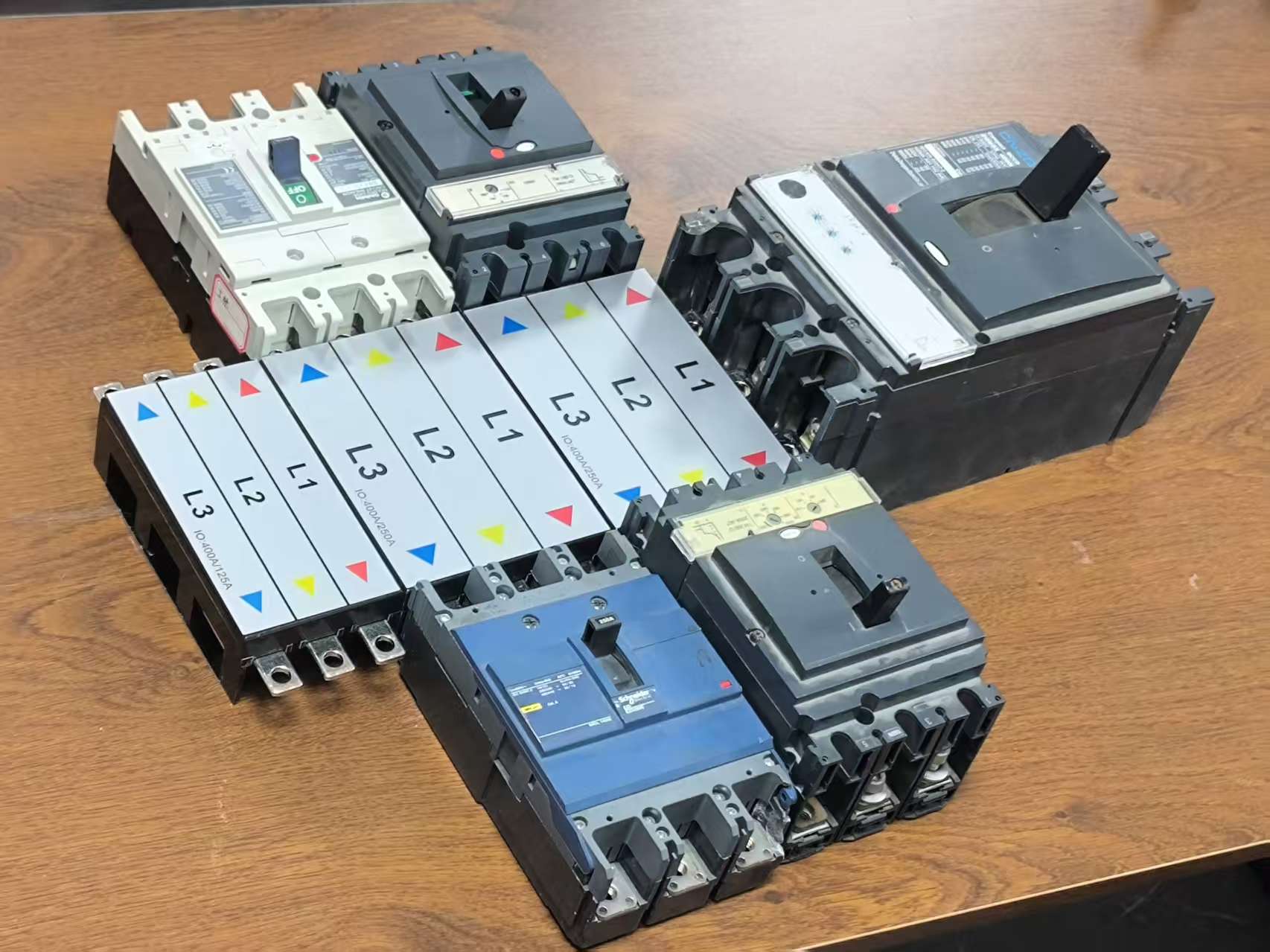
Pan assembly busbar systems are verified as complete assemblies — conductor, insulation, mounting and enclosure together — which is why configuration-level verification matters at the ordering stage.
What the wider busbar market says about buyer behaviour
Market research places the global busbar market at USD 19.83 billion in 2025, with copper busbars holding 62.8% of material share in the same year. Aluminium busbars are forecast to grow at a 6.9% CAGR across 2026 to 2035, a rate attributed to roughly 40% lower weight and cost optimisation in large infrastructure. Laminated busbars are forecast at 8.9% CAGR in high-density applications.
Two readings matter for buyers. First, material substitution is a live commercial pressure: aluminium growth is outpacing copper, and that pressure eventually reaches datasheets in the form of aluminium equivalent claims. An equivalent claim is not a verification; it is a proposal that requires its own test basis. Second, the standard framework is being actively maintained — IEC 61439-6:2025 is an updated edition effective from 1 December 2025 — which means an older certificate reference is not automatically wrong, but it does need to be dated and mapped to the configuration being quoted.
China's manufacturing position reinforces the same point from the supply side. The country accounts for over 30% of global copper processing capacity and produces more than 11 million metric tons of refined copper annually. Material availability is not the constraint in most projects; matching documented material to the ordered configuration is.
Busbar versus cable: the comparison and its boundary
Barfuse positions busbar systems against cable on measurable terms: roughly 90% of installation time saved, around 20% improvement in conductivity, broadly similar cost, lower maintenance and higher durability, with low resistance loss during power transmission and correspondingly lower energy losses across the distribution path. The KEMA/DEKRA certification sits inside that comparison because it applies to the assembly rather than to a generic conductor.
| Dimension | Busbar system | Cable |
|---|---|---|
| Installation time | Reduced by around 90% in the supplier's stated comparison | Higher labour content per circuit |
| Conductivity | Around 20% improvement in the same comparison | Baseline |
| Cost position | Similar to cable in the stated comparison | Similar |
| Maintenance | Lower maintenance requirement, higher durability | Periodic inspection and re-termination |
| Certification basis | Assembly and configuration verified under KEMA/DEKRA documentation | Conductor and installation standards |
| Typical application | Distribution box power distribution | General wiring and long irregular runs |
That comparison has a boundary, and buyers should hear it clearly. A busbar system is an engineered assembly: once manufactured, its geometry is fixed. Cable can be re-routed, shortened, re-terminated and adapted on site, while a busbar assembly cannot be field-modified without invalidating its verification. Where a project layout is still changing, or where runs are short and irregular, cable can remain the more forgiving choice. The busbar advantage depends on a project being stable enough to be pre-engineered — which is exactly why the documentation discipline described in this article pays for itself at the execution stage.
A second limit is schedule. Custom and configured pan assemblies carry tooling and setup time, and lead time is measured in weeks rather than days. Late-stage configuration changes therefore have a scheduling cost, not only a paperwork cost.
Supply continuity and the long-term side of the decision
For buyers who return to the same supplier across multiple projects, the question shifts from whether one unit is verified to whether the tenth order will match the first. That is a documentation and capacity question, not a marketing one.
The verifiable continuity signals in this case are specific: monthly production capacity of 8,000 pieces, typical production lead times of 15 to 45 days, a minimum order quantity of 1 piece, delivery terms of FOB, CIF, CFR or EXW, payment by T/T, PayPal, Western Union or L/C, and pre-shipment test as the stated acceptance criterion.
Factory-side signals that support those terms include a 10,000 ㎡ facility, 45 employees, a seven-engineer R&D team, more than 30 modern digital wire-cutting machines and punches, and inspection equipment that includes a Rockwell hardness tester, an electric withstand voltage tester, a spring tester, a salt spray tester, a flame retardant tester and a switch tester. ISO 9001 is the underlying quality system, supported by 6S workshop standardisation. Export accounts for 90% of output, distributed across the Middle East, Russia, Latin America, Central Asia, the EU, Africa and Oceania.
Temperature rise and short-circuit exposure are handled at the design level rather than left to final inspection. The declared measures include adequate rated current capacity, conductive grease at contact interfaces, T2 copper conductors, a silver-coated contact surface and heat-shrink tube insulation. Each of these is checkable in a specification review, which is the practical bridge between a compliance claim on a datasheet and a decision taken at the execution stage.
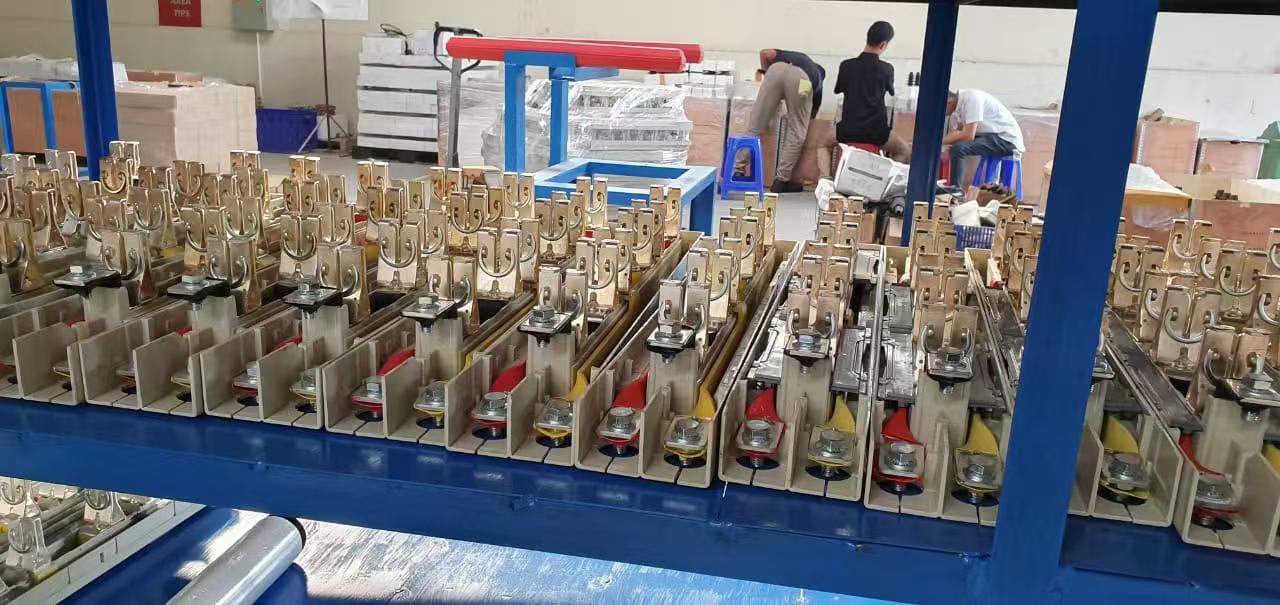
Heat-shrink tube insulation is one of the declared design measures used to control temperature rise and short-circuit exposure — a specification point buyers can verify rather than assume.
Future outlook
Three shifts are visible from the evidence available now. First, the standard framework is moving: IEC 61439-6:2025 took effect from 1 December 2025, and buyers re-baselining documentation against that edition will be working from the current reference point. Second, material competition is intensifying, with aluminium forecast at 6.9% CAGR to 2035 and laminated busbars at 8.9% CAGR in high-density applications — both trends push material and configuration declarations toward becoming standard datasheet fields rather than optional attachments. Third, the verification conversation is moving from brand level to configuration level, because that is where the engineering variables actually sit.
For procurement teams, the practical implication is a habit rather than a project task: attach the certificate scope to the request for quotation, keep the configuration parameters explicit, and treat any deviation in conductor material, current rating or enclosure arrangement as a re-verification event. Suppliers who can answer at that level of detail will increasingly be the ones shortlisted for repeat and framework orders.
FAQ
What does IEC 61439-6 cover, and does it apply to pan assembly busbars?
IEC 61439 is the international standard series for low-voltage switchgear and controlgear assemblies, and Part 6 addresses busbar trunking systems. The 2025 edition, IEC 61439-6:2025, is recorded as active and updated with an effective date of 1 December 2025. Pan assembly busbars are normally verified as part of an assembly and enclosure configuration rather than as a standalone item, so the relevant question is which configuration was verified.
How do I confirm that an AS/NZS claim applies to my specific order?
Request the regional edition reference, the certificate scope showing model and rating coverage, and the market certification held for that region. Australia and New Zealand apply the IEC 61439 framework through their own AS/NZS adoption, and market access typically also involves electrical certification — for example the SAA certification held by Barfuse for the Australian market, alongside KEMA (DEKRA), VDE and CB credentials.
Does IP65 and IK10 on the DB13 prove that the busbar inside it is compliant?
No. IP65 and IK10 are enclosure performance statements covering dust, water jet and impact behaviour. The electrical performance of the internal busbar assembly — temperature rise and short-circuit withstand in particular — is verified separately. A sealed IP65 enclosure also changes the thermal case compared with a ventilated one, so the assembly should be verified inside the enclosure that will actually ship.
What evidence should accompany a busbar quotation?
The useful set is: standard edition and part reference, certification copies showing the model and rating scope, the material declaration for the conductor, the enclosure test report covering the sealing and cable entry configuration being ordered, and the stated acceptance criteria. Barfuse states pre-shipment test as its acceptance criterion, which corresponds to routine verification of the units rather than to design verification.
What are the typical lead time, minimum order and payment terms?
Barfuse states a monthly production capacity of 8,000 pieces, typical production lead times of 15 to 45 days, and a minimum order quantity of 1 piece. Delivery terms are FOB, CIF, CFR or EXW, and payment is accepted by T/T, PayPal, Western Union or L/C.
Can aluminium busbar be substituted for copper without further verification?
Aluminium busbars are forecast to grow at a 6.9% CAGR from 2026 to 2035, a rate attributed to roughly 40% lower weight and cost optimisation in large infrastructure, while copper held 62.8% of material share in 2025. A material change alters conductivity, thermal behaviour and mechanical properties, so it changes the verification basis. Aluminium should be treated as a separately verified configuration, not as an automatic equivalent.
What happens if the certificate covers one current rating and I order another?
Certification documentation is issued against defined ratings — Barfuse's material includes entries at 125 A and 250 A — and rating is one of the variables that determines temperature rise and short-circuit withstand. Ordering above or below a certified rating means the certificate no longer maps to the configuration, so the configuration needs its own verification record before release to production.
Taking the claim to the configuration level
The distance between a datasheet claim and a delivered assembly is small in most projects and expensive in a few. Closing it does not require new engineering — it requires asking for the certificate scope against the configuration being ordered, and treating enclosure ratings, material declarations and current ratings as separate verifiable statements. Buyers who adopt that habit early in the evaluation process tend to find that the execution stage has fewer surprises.
Barfuse's full product documentation, including pan assembly busbar and distribution box ranges, is available in the company catalogue.