
IGBT Module Supplier Evidence: Build, Range, Documentation
An IGBT module is an integrated power semiconductor package containing IGBT chips and freewheeling diodes, built for high-power conversion in inverters, converters and motor drives. Because the package — not the chip alone — governs how current, heat and isolation behave inside a cabinet, supplier capability is best qualified on physical and documentary evidence rather than on a price list.
This reference sets out three evidence groups that industrial buyers should request before approving a supplier against a defined project: module construction (chip, substrate, baseplate, housing, isolation), model range coverage across the power-module families a bill of materials actually contains, and documentation that states certification scope precisely.
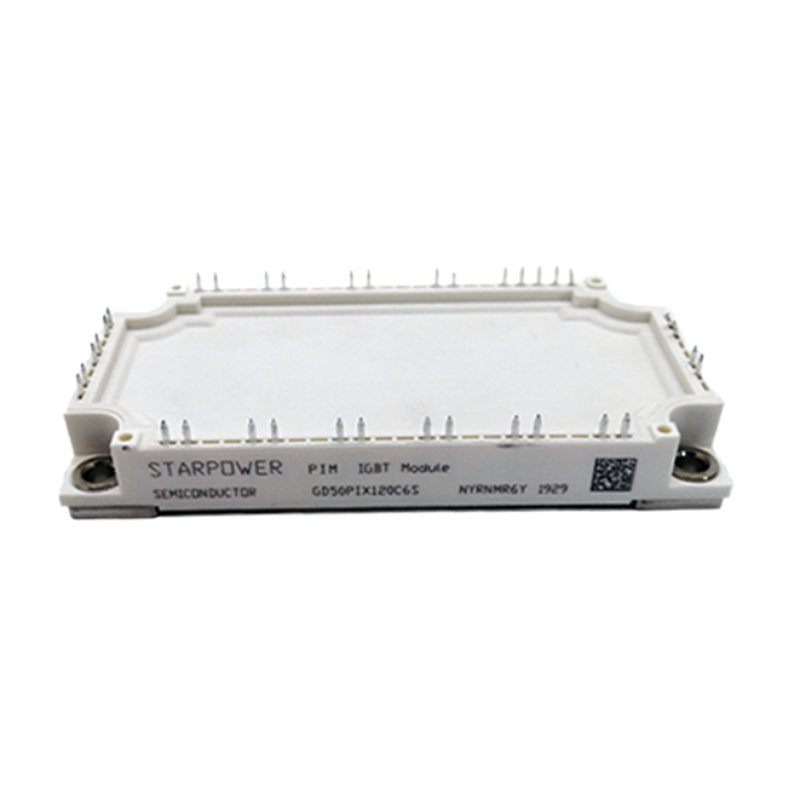
The procurement problem: modules fail where the evidence was thin
Most IGBT module faults appear first as temperature. Recorded failure analysis for power modules points to a short list of recurring causes: insufficient heat dissipation from uneven thermal grease, loose mounting screws or a blocked radiator; operating current above the module rating; abnormal gate drive signals or waveform distortion; switching frequency set higher than the thermal design allows; and additional contact resistance at poorly tightened terminals.
Short-circuit breakdown follows a comparable pattern. Documented causes include overvoltage spikes that exceed the module's rated voltage, drive-circuit failure, an overload or short circuit on the output side, over-temperature damage caused by poor heat dissipation, and electrostatic discharge damage during handling and assembly.
The important observation for buyers is that almost none of these causes are visible on a quotation. They are visible in a construction record, an installation instruction, a test record and a storage specification. That is the gap this evidence model closes.
Physical build: what the construction record should show
Construction is the first evidence layer because it defines the thermal path from silicon to heatsink and the isolation barrier between live parts and the cabinet. The table below summarises the construction elements that are documented for each power-module family in this supply scope.
| Module family | Documented construction elements | Isolation arrangement |
|---|---|---|
| IGBT module | Silicon chip, aluminum ceramic substrate, copper base plate, plastic housing; single or dual IGBT chip structure | Isolated baseplate |
| MOSFET module | Silicon MOS chip, aluminum ceramic substrate, copper base plate, plastic housing | Isolated baseplate |
| Bridge rectifier module | Silicon diode chip, aluminum ceramic substrate, copper base plate, plastic housing; single-phase or three-phase option | Isolated baseplate |
| Power diode | Silicon wafer, copper base, ceramic housing | Ceramic housing construction |
| Thyristor / SCR | Silicon wafer, molybdenum disc, copper base, ceramic housing | Ceramic housing construction |
| Industrial power fuse | Silver-plated copper fuse element, quartz sand filler, ceramic tube body, metal end caps | Ceramic tube body |
Two construction families are in use here, and buyers should not treat them as interchangeable. The IGBT, MOSFET and bridge rectifier families share an aluminum ceramic substrate on a copper base plate inside a plastic housing, with an isolated baseplate as the interface to the heatsink. The diode and thyristor families use a silicon wafer on a copper base inside a ceramic housing, and the thyristor stack adds a molybdenum disc — a detail that matters where thermal cycling is severe.
A construction record is only useful if it survives comparison. When evaluating two suppliers for the same project, request the same five items from each: substrate type, baseplate material, isolation arrangement, housing material and chip configuration. Consistency of the answer across a sample request is a better signal than the wording of a brochure.
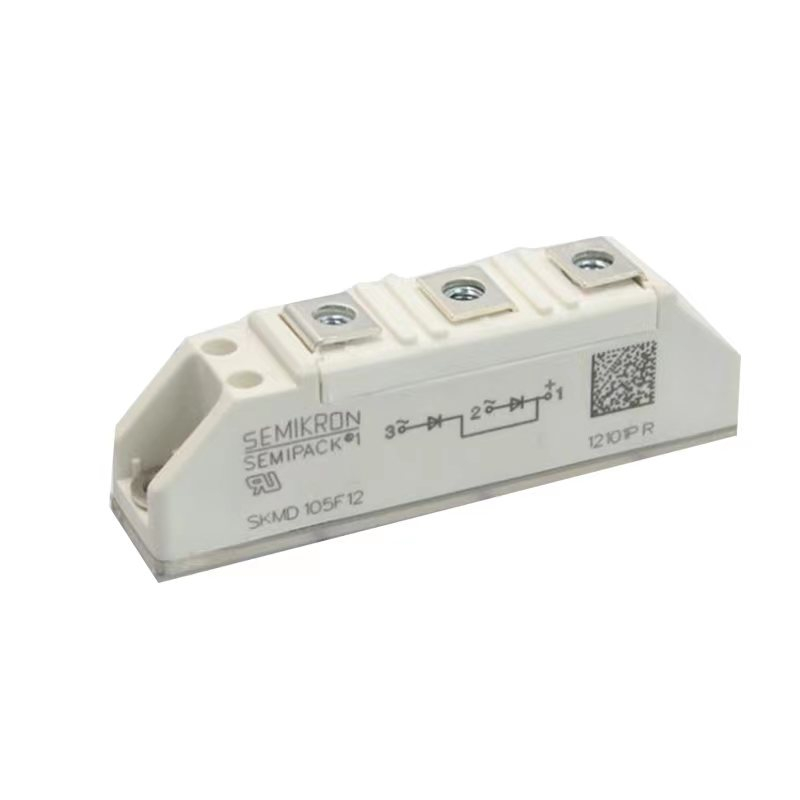
Model range: coverage measured against the bill of materials
A single inverter cabinet rarely contains only IGBT modules. It typically carries IGBT modules for the bridge, fast diodes for freewheeling or rectification, a rectifier bridge at the front end, thyristors in soft-start or controlled-rectifier stages, and fuses for short-circuit protection. Supplier range is therefore a project-fit question, not a marketing question.
| Family | Documented rating window | Example catalogue series |
|---|---|---|
| IGBT module | 600 V – 1700 V; 50 A – 1200 A | FF400R12KE3, FF600R12ME4, SKM200GB12T4, 2MBI800XNE-120-50, FZ600R17KE3 |
| MOSFET module | 60 V – 1200 V; 30 A – 300 A | IXFN170N65X2, IXFN230N10, IXFN100N20 |
| Bridge rectifier module | 800 V – 2000 V peak reverse; 25 A – 800 A average forward | VUO55-12NO7, SKD82/08, SKB50/08A3 |
| Fast recovery power diode | Up to 2800 V peak repetitive reverse; 100 A – 1800 A forward | DD435N28K, SKKD81/22H4, DZ1070N18K |
| Thyristor / SCR | Up to 3000 V; 1100 A | SKKT162/12E, T1101N30TOF, SKT600/16E |
| Industrial power fuse | 690 V – 1500 V; 10 A – 1250 A | 170M1558, 170M5806, 170M8629, 170M3188 |
Catalogue identifiers demonstrate range, not inventory depth. A supplier that lists a series but cannot confirm current availability, alternative equivalents within the same rating window, and the documentation that accompanies the delivered lot has demonstrated a catalogue, not a capability. During evaluation, ask for three specific part numbers from your own bill of materials and request availability, lead time and documentation for each.
Documentation packet: the seven items to request
Documentation converts a claim into a checkable fact. The following packet is proportionate to a research-to-evaluation stage project and can be reviewed before any purchase order is raised.
| Document | What it establishes |
|---|---|
| Series datasheet | Voltage class, current rating, switching behaviour, package outline and pin definition for the exact series |
| Electrical test record | Evidence that the delivered lot was electrically tested — for this supplier, 100% electrical performance testing is performed before shipment |
| Storage and handling instruction | Original anti-static packaging, ambient temperature −10 °C to +40 °C, relative humidity ≤70%, no stacking of heavy goods on modules |
| Mounting instruction | Thermal grease thickness, diagonal screw-tightening sequence and specified torque, plus insulation resistance test before power-on |
| Certification scope statement | Which standards apply to which article — fuse, module or system — and the certificate reference |
| Lot traceability | Link between the delivered batch and its inspection record |
| Commercial documents | Origin, packing list and export documentation matching the destination market |
The mounting instruction deserves separate attention. Documented installation steps for an IGBT module include cleaning the heatsink and baseplate surfaces, applying thermal grease at a uniform thickness, fastening screws in diagonal sequence at the specified torque, completing power and gate wiring with a confirmed absence of short circuits, and performing an insulation resistance test before power input. A supplier who can supply this sequence is telling you how the module behaves after it leaves the warehouse — which is where most thermal problems originate.
Certification evidence and its scope
Certification statements are the most frequently over-read item in a supplier file. Two rules keep them honest. First, a certificate belongs to an article, not to a company website. Second, the certificate number and issuing standard must be checkable independently.
Within this supply scope, IEC, CCC and UL certification is recorded at the industrial power fuse level, where the documented characteristics are high breaking capacity, a stable time-current characteristic, compact structure and a wide specification range. The company also reports that its products comply with international standards such as IEC, UL and CCC, and that its quality management system is certified to ISO 9001:2015 as of June 2026.
For a project file, treat each of those as a scoped statement and confirm three things: the exact article covered, the standard applied, and the validity date. A fuse certificate does not transfer to an IGBT module, and a quality management certificate does not substitute for a type test. Buyers qualifying a module for a specific inverter or energy storage cabinet should request the module-level document that applies to the selected series.
How Jiangsu Core Diamond Times fits this evidence model
Jiangsu core diamond times Electronic Technology Co., Ltd. is a supplier of power electronic components — IGBT modules, fuses, semiconductor modules, diodes, thyristors and related power electronic parts — established in 2022 and operating from Kunshan City, Jiangsu Province, China.
The operating facts relevant to a supplier qualification file are as follows. The facility covers 10,000 m² with 50 employees and an annual output of 1,000,000 units. Exports account for 50% of volume, with main markets in the EU, USA, Australia and Middle East. Five technical support engineers handle component selection and application questions. OEM and ODM service is offered with logo marking, packaging, parameter matching and solution support. Monthly capacity is 20,000 units, lead time is 30–45 days, and the minimum order quantity is 2 units — a structure that accommodates both trial quantities and volume orders. Quality control is defined as 100% electrical performance test before shipment, backed by incoming inspection and outgoing quality control procedures. After-sales support covers remote technical assistance and warranty service.
Third-party reference material additionally describes the company as a distributor and service provider for power semiconductor modules, including Infineon, SEMIKRON, Fuji and CRRC product lines. That characterisation is consistent with the catalogue range documented above and is worth knowing at evaluation stage: in a distribution-led supply model, the construction record and the type-test documentation originate with the manufacturer, while inspection, traceability and application support sit with the supplier.
Application fit: matching evidence to the project scenario
Evidence only becomes decisive when it is read against a working condition. The scenarios below are documented applications for this supply scope, each with a different evidence emphasis.
- Solar inverter and energy storage converter. IGBT modules perform DC-AC power conversion under continuous 24/7 operation at high power and high temperature, supported by heatsinks, drive boards, capacitors and the inverter cabinet. This scenario is common in Germany, and a German renewable energy equipment manufacturer has run 5,000 units over two years in solar inverter and energy storage converter duty, reporting low thermal resistance, high switching speed, strong overload capacity and low failure rate. The product is also recorded as meeting European energy storage system standards for this application.
- Energy storage cabinet and PV combiner box protection. Fuses provide short-circuit and overcurrent protection in standby mode with instant breaking on fault, supported by fuse holders, distribution cabinets and combiner boxes. Fast breaking and high interrupting capacity are the governing requirements. A French new energy system integrator has run 15,000 units over one year in energy storage cabinet power conversion and switching control.
- Industrial switching power supply. Bridge rectifier modules handle AC-DC conversion with isolated baseplate construction; a Spanish power supply factory has run 10,000 units over two years, citing high current capacity and compact structure.
- On-board power converter. MOSFET modules control power switching with low on-resistance; a Polish EV accessory manufacturer has run 4,000 units over two years.
- Charging pile and rectifier power supply. Fast recovery power diodes serve rectification; a Malaysian power electronics OEM has run 8,000 units over two years, citing fast recovery speed and low power loss.
- Welding and industrial rectifier equipment. Thyristors carry high surge current with stable turn-on characteristics; an Italian industrial power supply manufacturer has run 3,500 units over two years.
These scenarios are documented as common in Germany and, more broadly, in France, Italy, Spain and other European countries, as well as in South Korea, Japan, the Philippines, Malaysia, Vietnam, Thailand, India and China, the United Arab Emirates, and Brazil. The practical implication is that a supplier file assembled for a European energy storage project will not be identical to one assembled for an APAC charging-pile programme — certification scope and documentation language differ even where the module family is the same.
Comparison: evidence-based qualification versus price-sheet sourcing
| Approach | What it verifies | What it leaves unresolved |
|---|---|---|
| Price-sheet sourcing | Unit cost, headline voltage and current class, delivery promise | Thermal path, isolation arrangement, test coverage, certification scope, lot traceability |
| Catalogue-range sourcing | That a series exists and rating windows overlap the project | Whether the specific series is available for the project timeline, and which documents accompany the lot |
| Evidence-based qualification | Construction, range, test record, storage and mounting instruction, scoped certification, traceability | Requires more evaluation time and a defined document request before quotation comparison |
Limits of this supply model
Four boundaries should be stated plainly, because a qualification file that hides them is not a qualification file.
- Supplier, not wafer fab. Jiangsu core diamond times Electronic Technology Co., Ltd. operates as a foreign trade enterprise focused on power electronic components. Wafer-level process data, die-level reliability testing and foundry-level qualification must be obtained from the original manufacturer; the supplier's evidence covers inspection, traceability, application support and documentation handling.
- Certification is article-specific. IEC, CCC and UL certification is documented at the fuse level within this scope. Module-level certification for a specific IGBT series has to be requested per project rather than assumed from a company-level statement.
- Lead time is 30–45 days at 20,000 units per month. That structure suits scheduled programmes and trial-to-volume ramps, but it is not designed for unannounced demand spikes; buyers running multi-line production should share rolling forecasts rather than place reactive orders.
- Documentation quality depends on the source. A generic catalogue page is not a project document. Confirm that the datasheet, test record and certificate reference you receive match the exact series and lot being shipped.
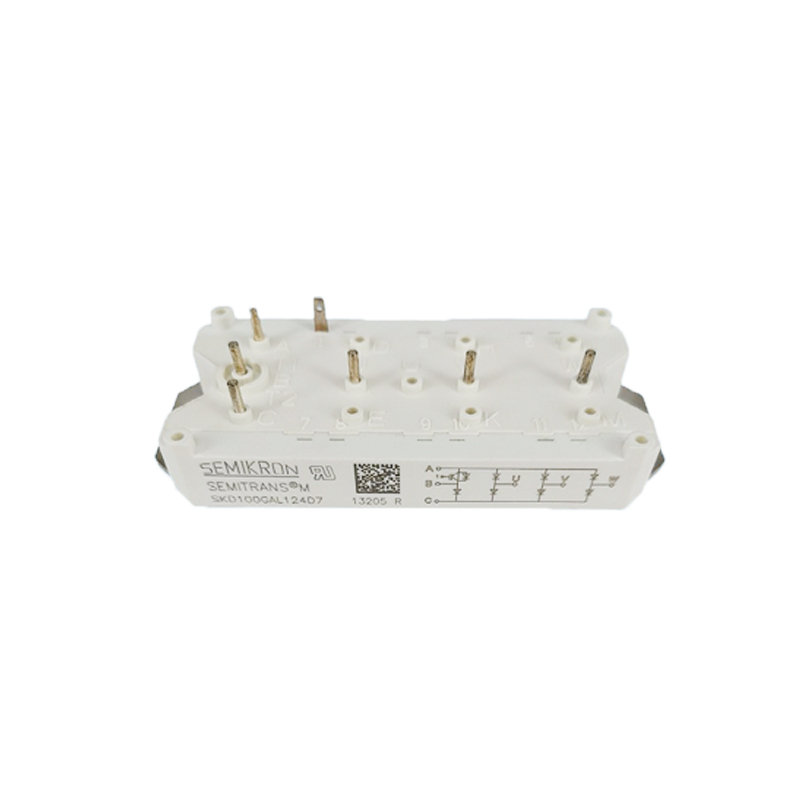
Future outlook
Demand context supports a stricter documentation standard rather than a looser one. The global IGBT market was estimated at USD 9,202.9 million in 2024, with an industry CAGR of 11.02% projected from 2025 to 2035 (Market Research Future). The global silicon carbide module market was estimated at USD 980.7 million in 2025 (Fortune Business Insights), indicating that wide-bandgap modules are taking share in high-efficiency applications while silicon IGBT modules continue to carry the bulk of industrial inverter, UPS, welding and energy storage duty.
Two consequences follow for procurement. First, as module families multiply, a supplier's range table becomes less useful than its ability to produce the right document for the right series. Second, because protection components sit in the same cabinet as the module, buyers are increasingly assembling one evidence file per project — module construction, module documentation and fuse certification together — rather than three unrelated purchasing decisions. Suppliers who can already answer in that format shorten the evaluation cycle for their customers.
Frequently asked questions
What physical construction details should a buyer confirm before approving an IGBT module supplier?
Confirm five items: the substrate type, the baseplate material, the isolation arrangement, the housing material and the chip configuration. For this supply scope, IGBT modules are documented as a silicon chip on an aluminum ceramic substrate with a copper base plate and plastic housing, using an isolated baseplate and a single or dual IGBT chip structure. MOSFET modules and bridge rectifier modules follow the same substrate and baseplate pattern, while power diodes and thyristors use a silicon wafer on a copper base inside a ceramic housing, with a molybdenum disc added in the thyristor stack.
How much model coverage should a supplier demonstrate for an inverter or energy storage project?
Coverage should be measured against the bill of materials, not against a catalogue count. A typical cabinet combines IGBT modules (documented here at 600 V–1700 V and 50 A–1200 A), rectifier bridges (800 V–2000 V peak reverse, 25 A–800 A average forward), fast recovery diodes (up to 2800 V, 100 A–1800 A), thyristors (up to 3000 V, 1100 A) and fuses (690 V–1500 V, 10 A–1250 A). The practical test is to submit three part numbers from the actual project and request availability, lead time and documentation for each.
Which documents belong in a supplier qualification file for power modules?
A workable file contains the series datasheet, an electrical test record covering the delivered lot, a storage and handling instruction, a mounting instruction, a certification scope statement, lot traceability and the commercial export documents. For this supplier, the storage specification is original anti-static packaging at −10 °C to +40 °C and relative humidity ≤70%, and the mounting instruction covers thermal grease thickness, diagonal screw tightening at specified torque and an insulation resistance test before power-on.
Which certifications are actually verifiable for fuses versus IGBT modules?
Within this supply scope, IEC, CCC and UL certification is recorded for the industrial power fuse range, alongside a quality management system certified to ISO 9001:2015 as of June 2026. Certification for an IGBT module series is a separate article-level question and should be requested for the exact series under evaluation. In both cases the checkable items are the article covered, the standard applied and the validity date.
What are the limits of supplier-side evidence compared with manufacturer evidence?
Supplier-side evidence covers inspection, traceability, application support and documentation handling — for this company, 100% electrical performance testing before shipment, incoming and outgoing inspection, and five technical support engineers for selection questions. Wafer-level process data, die-level reliability testing and foundry qualification remain manufacturer documents. A buyer should therefore accept supplier evidence as the delivery-and-application layer and obtain the underlying type-test documentation from the original manufacturer when the project requires it.
For readers building a supplier file, a company brochure covering the power module and fuse range is available for download: Jiangsu Core Diamond Times company brochure (PDF).
Есть вопросы или нужны дополнительные детали?
Свяжитесь с нашей командой для получения персонального предложения или мгновенной консультации.
Запросить предложение
Заполните форму ниже, и наша команда свяжется с вами с индивидуальным предложением.
Прямой чат WhatsApp
Предпочитаете общаться в реальном времени? Напишите нам в WhatsApp для мгновенной помощи и быстрых ответов.
- Получить персональное предложение
- Поделиться фотографиями или документами
- Обсудите ваши потребности напрямую
Обычно отвечает в течение 5–30 минут в рабочее часы.