
IH Chemical Centrifugal Pump: What Industrial Buyers Should Know
The IH chemical centrifugal pump is an ISO 2858 horizontal, single-stage, single-suction end-suction pump used to move corrosive process liquids in chemical, petrochemical, pharmaceutical, metallurgy, power, pulp and paper, synthetic fibre and water-treatment plants. Buyers encounter the IH designation early in a sourcing cycle because it is one of the most standardised end-suction architectures available in the chemical pump category — and because the real specification of an IH pump is not the model code itself, but the combination of wetted material, seal arrangement and operating point selected for a given fluid.
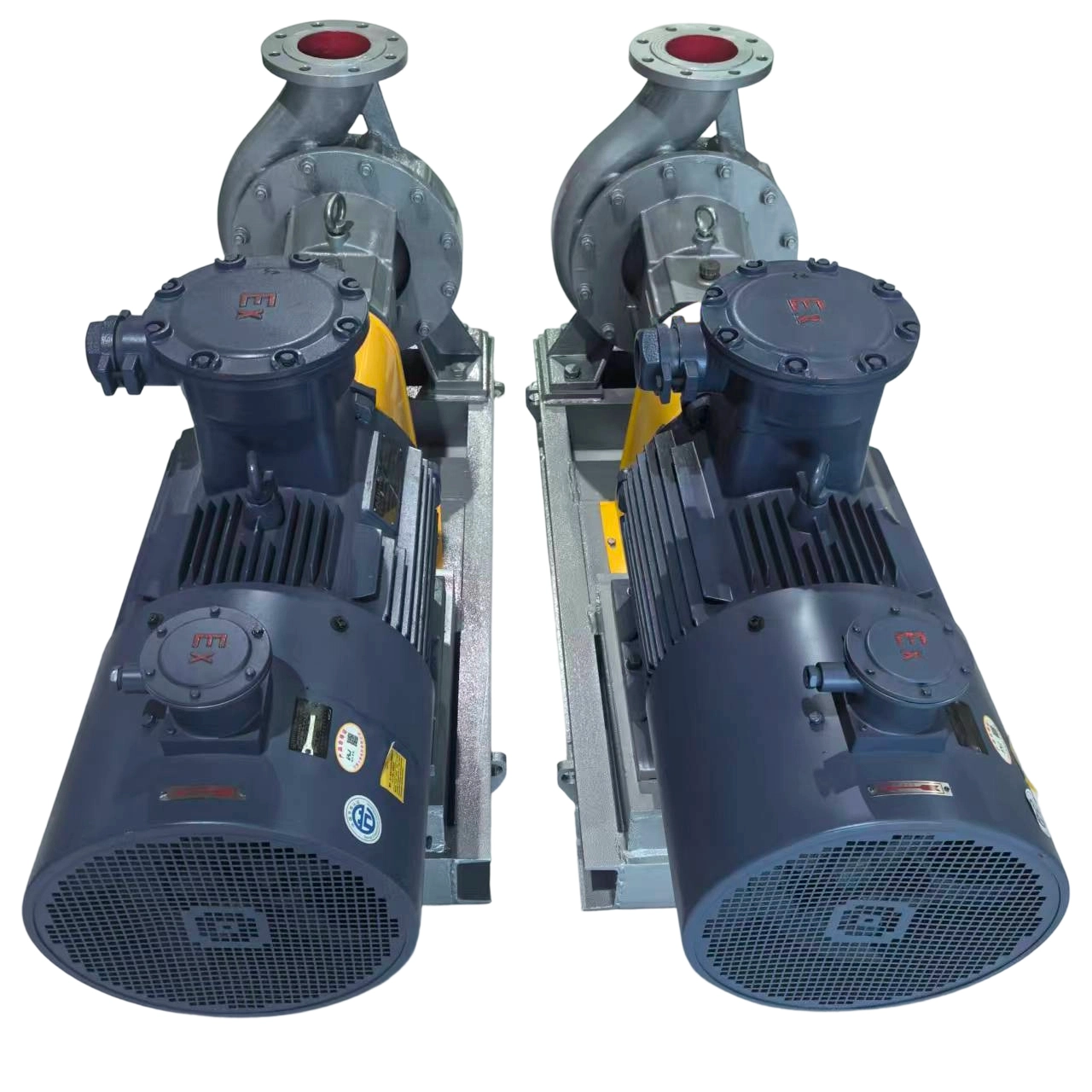
An IH chemical centrifugal pump in horizontal end-suction configuration. Source: xsupump product documentation.
The IH designation, defined
IH is the model designation for a chemical process centrifugal pump classified as an ISO 2858 horizontal single-stage, single-suction end-suction pump. The ISO 2858 dimensional standard matters to buyers for a practical reason: it fixes foot, flange and shaft-height geometry, so an IH pump can be planned into a process skid, baseplate or piping layout without re-engineering the surrounding structure when the supplier changes or a spare unit is required.
The published IH range covers 40 basic models and up to 112 specifications. The pump uses a back pull-out arrangement, which allows the rotating assembly to be withdrawn for maintenance without dismantling the suction and discharge pipework — a configuration detail that affects how much process downtime a maintenance event actually costs.
Why this pump category keeps coming up in procurement
Chemical pump demand is structurally large and still expanding. The Insight Partners estimates the global chemical pump market at US$5.68 billion in 2025, rising to US$9.92 billion by 2034. On the supply side, China's centrifugal pump exports under HS 841370 reached US$4.1 billion in the first eight months of 2026, up 9.7% year on year, with the United States taking a 9.1% share of that flow, according to General Administration of Customs data.
Those two figures describe the same pressure point from opposite ends. More chemical capacity is being built, and more of the pumps installed into it are sourced internationally. For a plant engineer or a purchasing team, the risk is rarely that no pump exists for the duty — it is that the wrong configuration gets ordered.
Documented operational risks for heavy-duty process pumps in chemical and petrochemical service include medium leakage, corrosion damage, cavitation and overheating shutdown. Each of these is usually traceable to a selection decision made before the purchase order: a wetted material that does not suit the medium, a seal arrangement that does not suit the containment requirement, or an operating point far from the pump's design window.
How the platform is configured
Published hydraulic envelope
| Parameter | Published IH range |
|---|---|
| Category | Chemical process centrifugal pump, ISO 2858 horizontal single-stage, single-suction end-suction |
| Flow | 0.3 – 400 m³/h |
| Head | 5 – 125 m |
| Speed | 1,450 / 2,900 r/min |
| Motor power | 0.55 – 90 kW |
| Inlet size | DN50 – DN200 |
| Medium temperature | -20 °C to 105 °C |
| Maximum pressure | 1.6 MPa |
| Model coverage | 40 basic models, up to 112 specifications |
| Seal options | Packing, single or double mechanical seal |
Wetted materials
Wetted materials are selected against the medium rather than fixed by the model. Available options include cast iron, carbon steel, SS304, SS304L, SS316, SS316L, duplex 2205/2507, Hastelloy and other alloys supplied through the manufacturing partner. This is the single most important variable in an IH enquiry: two pumps with the same model code can have entirely different service lives depending on which of these is specified.
Seal and containment options
The IH platform accepts packing, a single mechanical seal, or a double mechanical seal. Where atmospheric leakage must be controlled more tightly, the pump can be paired with an API 682 Plan 53A/53B pressurised dual-seal support system. That system maintains barrier pressure above seal-chamber pressure and is intended for toxic, flammable, corrosive, abrasive, polymerising and high-vapour-pressure process liquids. Plan 53A draws barrier fluid from an external nitrogen source; Plan 53B uses a nitrogen-precharged bladder accumulator. Both integrate a reservoir or accumulator, a pumping ring, a cooler, and pressure, level and temperature instruments with alarms, and are built in SS304, SS316L or a project-specific alloy.
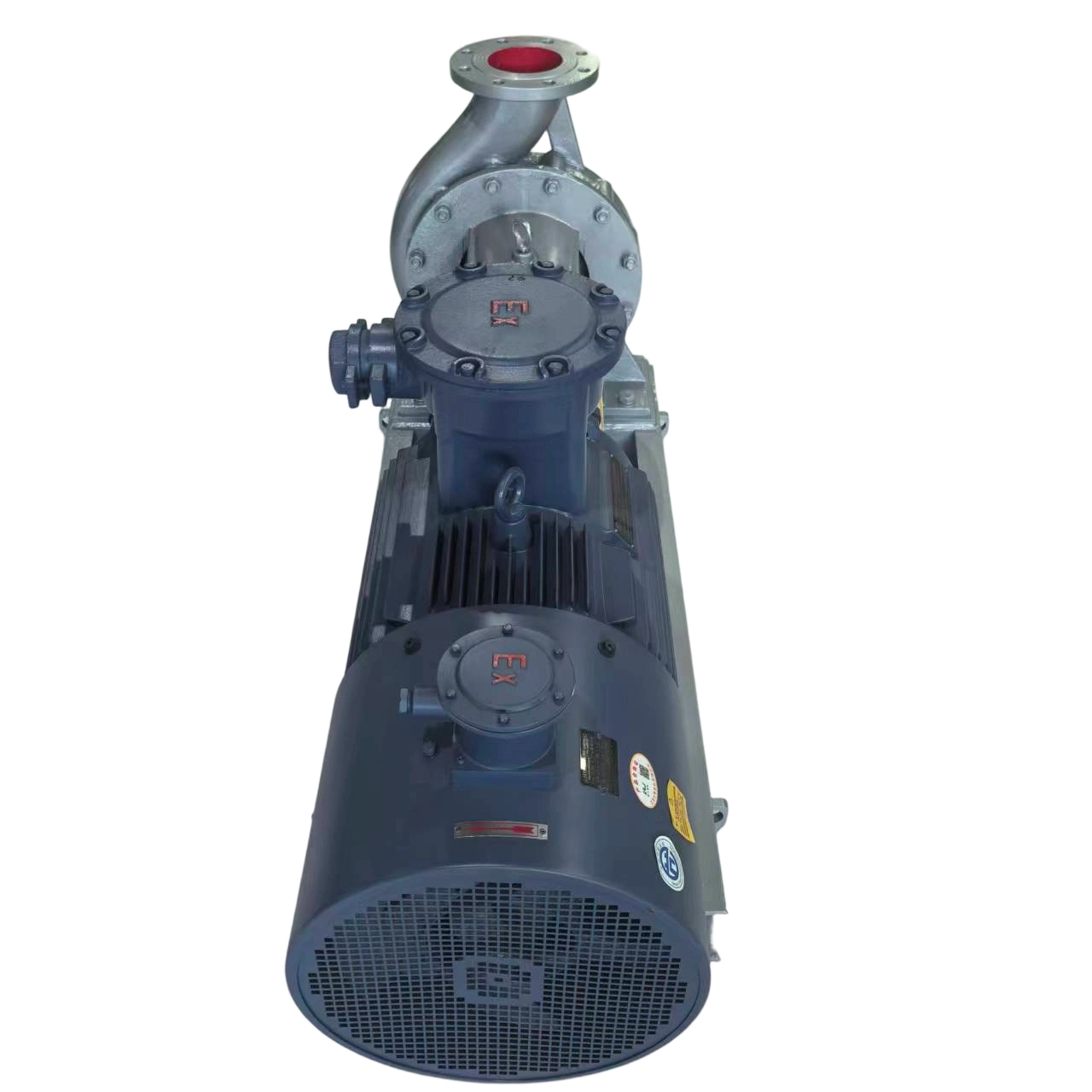
IH pumps are typically installed on a baseplate with independently supported pipework and monitored for vibration, temperature, pressure and leakage.
What xsupump supplies across this category
xsupump is the brand of Jiangsu Xiangsu Machinery Equipment Manufacturing Co., Ltd., a pump manufacturer established in 2024 in Jiangsu, China, with a manufacturing partner operating an 18,000 m² production plant and a 3,500 m² office, an annual production capacity of 10,000 units, approximately 55 employees and 15 technical personnel at the manufacturing partner. Export business accounts for 70% of total sales, with global markets.
The product portfolio includes the IH chemical process centrifugal pump alongside centrifugal chemical pumps, vertical sump pumps, magnetic drive pumps, self-priming pumps, slurry and mortar pumps, submersible pumps, double-suction split-case pumps, single-stage clean water centrifugal pumps and API 682 Plan 53A/53B seal-support packages. The supplier states that it can provide corrosion-resistant chemical pumps for acid transfer, magnetic drive chemical pumps for solvent transfer, vertical sump pumps for tank installations and wastewater treatment, and customised chemical pumps for corrosive media, and that centrifugal chemical pumps are suitable for process plants.
For an IH procurement, that breadth is relevant in one specific way: the same supplier can offer an alternative architecture when the fluid turns out to be outside the IH envelope, rather than forcing an IH selection into an application it does not suit.
Application contexts where the IH pump fits
The IH platform is intended for chemical, petroleum, pharmaceutical, metallurgy, electroplating, surface treatment, dye, pesticide and wastewater applications, and for the chemical, petrochemical, metallurgy, power, pulp and paper, food, pharmaceutical, synthetic fibre and water-treatment industries. Four recurring application patterns are worth separating.
Chemical processing: tank transfer, process feed and circulation
The typical duty is clean corrosive liquid moved continuously between tanks or fed into a process. The operating requirements are specific: medium data should include concentration, temperature, density, viscosity and pH; the pump should run at the selected operating point; dry running and prolonged operation below 30% of IH design flow should be avoided. Supporting equipment typically includes the motor, baseplate, coupling guard, filter, and a flushing or seal-support system where required. Piping should be independently supported, and vibration, temperature, pressure and leakage should be monitored.
Electroplating and surface treatment
Acid and alkali baths, pickling liquid and corrosive wastewater are handled through bath circulation, tank transfer and wastewater collection. Duty can be continuous circulation or batch tank transfer, with filters, tanks, level control and compatible piping. Where crystals or particles are present, a solids-tolerant pump should be selected instead — a point that is frequently missed when a plating line is specified.
Pharmaceutical and fine chemical service
Clean corrosive or solvent-bearing liquid is moved in process feed, circulation, unloading and cleaning-system transfer, where leakage and contamination control matter. Both mechanical-seal and sealless options may be considered. Hygiene, contamination, solvent, temperature and hazardous-area requirements should be confirmed before production starts.
Where the IH range stops
High-flow, low-head circulating duties sit outside the standard IH envelope. A cited reference case for MVR evaporation and crystallisation service, FJX-900, operates at Q = 7,800 m³/h and H = 3 m — far beyond the published IH flow and head range — and requires project-specific selection with material chosen for temperature, chloride corrosion and crystal abrasion. The IH pump is the right starting point for a large share of chemical transfer duties, but it is not a universal answer.
Boundaries buyers should confirm before ordering
An IH pump is not self-priming. It requires a flooded suction or a positive suction head, and it is unsuitable for dry-mounted tank-top or pit duty — that role belongs to a vertical long-shaft sump pump such as the FY series, which is designed for tank-top installation with a dry-mounted motor and needs no suction priming during normal operation.
The published medium temperature ceiling for the IH range is 105 °C. Applications above that require a different pump family or a project-specific configuration. The design pressure ceiling is 1.6 MPa.
Solids handling is limited by impeller and clearance design rather than by the model code. Media that crystallise, carry abrasive particles or contain fibrous material should be reviewed as a separate selection problem rather than forced into an IH specification.
Finally, the published range should be treated as a screening tool, not a performance guarantee. Chemical compatibility of the selected wetted material against the actual concentration and temperature of the process fluid must be verified before the order is placed.
Where the market is moving
Two standards developments are reshaping how chemical pump packages are specified. API 610's 13th edition was released in June 2026, replacing the 12th edition, and API STD 682:2014(R2022) continues to define sealing-system requirements and recommendations for centrifugal and rotary pumps in petroleum, natural gas and chemical industries. Reference to a standard is not proof of compliance for a particular pump, but it does change what buyers are expected to ask for — seal-system drawings, material certificates, chemical compatibility data and test documentation increasingly belong in the qualification file rather than arriving after the order.
Alongside the standards shift, sealless technology is expanding faster than the broader category. The global magnetic drive pump market was valued at US$1.4 billion in 2024 and is projected to reach US$2.7 billion by 2033, a 7.7% CAGR according to Grand View Research — a faster rate than the wider chemical pump market. For hazardous, toxic or high-vapour-pressure media, this trajectory reflects a genuine engineering preference rather than a fashion: eliminating the dynamic seal removes the most common leakage path.
Trade data reinforces the direction of sourcing rather than the direction of technology. HS 841370 exports from China grew 9.7% year on year through August 2026, which indicates that international procurement of centrifugal pumps is deepening, not consolidating around domestic suppliers.
IH compared with alternative chemical pump architectures
Buyers comparing an IH pump against other chemical pump types are usually choosing between a metal-bodied end-suction platform, a lined platform and a vertical sump platform. The comparison is not about which is better; each exists because it solves a different constraint.
| Dimension | IH | IHF | FY |
|---|---|---|---|
| Construction | ISO 2858 horizontal single-stage, single-suction end-suction | Horizontal single-stage, single-suction fluoroplastic-lined | Vertical single-stage, single-suction long-shaft sump |
| Flow | 0.3 – 400 m³/h | 6.3 – 400 m³/h | 1.6 – 2,600 m³/h |
| Head | 5 – 125 m | 5 – 80 m | 5 – 132 m |
| Medium temperature | -20 °C to 105 °C | -20 °C to 100 °C | 0 – 105 °C standard; -20 °C to 180 °C optional |
| Wetted material | Metal: cast iron, carbon steel, stainless steel, duplex, Hastelloy | Metal outer casing with moulded F46 or PVDF lining | Cast iron, cast steel, SS304, SS316, SS316L or special alloy |
| Seal arrangement | Packing, single or double mechanical seal; API 682 Plan 53A/53B compatible | Bellows mechanical seal | Dry-mounted motor; explosion-proof option |
| Installation | Baseplate, flooded suction required | Baseplate, flooded suction required | Tank-top or pit installation, no priming required |
| Typical media | Clean corrosive process liquid | Strong acids, alkalis, oxidisers, solvents subject to compatibility review | Acid, alkali, oxidising liquids, corrosive wastewater |
The honest limitation of the IH platform is its dependence on correct material and seal selection. Because the outer construction is a metal-bodied end-suction design, aggressive media that would attack the metal wetted path are better served by a fluoroplastic-lined IHF pump, where the flow path is isolated by moulded F46 or PVDF. Conversely, where the duty is a tank, pit or underground sump with a varying liquid level, neither horizontal platform is appropriate — a vertical long-shaft sump pump is the correct answer. The IH pump remains the default choice for clean, corrosive, moderate-flow process duty with a stable flooded suction.
Procurement criteria for an IH pump enquiry
A complete IH enquiry should let the supplier select hydraulics and materials without guessing. The following fields cover what a technical team typically needs:
- Medium: chemical name, concentration, density, viscosity and pH.
- Temperature: normal and maximum operating temperature at the pump, not at the tank.
- Duty point: required flow and head at the actual operating condition, plus expected variation.
- Solids: presence, size, concentration and whether crystallisation can occur.
- Wetted material: preferred alloy and any plant-standard restriction.
- Seal strategy: packing, single or double mechanical seal, and whether a Plan 53A/53B support system is required.
- Installation: available suction head, baseplate or skid arrangement, and piping support conditions.
- Electrical: voltage, frequency, motor enclosure and any hazardous-area classification.
- Documentation: material certificates, seal-system drawings, compatibility data and test records required for qualification.
Supplying these fields up front shortens the selection cycle more than any other single action, because material and seal decisions — not hydraulic calculations — are where chemical pump enquiries usually stall.
What to expect next
The direction of chemical pump procurement is toward better documentation rather than more exotic hardware. The API 610 13th edition and API STD 682 give buyers a common language for specifying containment and performance, and the growth of the magnetic drive segment shows that sealless designs are being evaluated seriously wherever leakage carries safety or environmental consequences. In parallel, published platform ranges such as the IH envelope continue to give engineers a fast, standardised starting point for the majority of process transfer duties.
For plant engineers and sourcing teams, the practical conclusion is that the pump model is the beginning of the specification, not the end. The IH chemical centrifugal pump is a well-defined platform with a documented range, a defined material set and defined seal options. Whether it performs for ten years or fails early depends almost entirely on whether the medium, the material and the seal were matched correctly at the enquiry stage.
Frequently asked questions
What is an IH chemical centrifugal pump?
An IH chemical centrifugal pump is a chemical process centrifugal pump classified as an ISO 2858 horizontal single-stage, single-suction end-suction pump. Its published range covers flow from 0.3 to 400 m³/h, head from 5 to 125 m, motor power from 0.55 to 90 kW and inlet sizes from DN50 to DN200, with medium temperature from -20 °C to 105 °C and a maximum pressure of 1.6 MPa. The range includes 40 basic models and up to 112 specifications.
Which liquids can an IH pump handle?
The IH platform is intended for clean corrosive process liquids in chemical, petrochemical, metallurgy, power, pulp and paper, food, pharmaceutical, synthetic fibre and water-treatment industries. Wetted materials are selected for the specific medium and can include cast iron, carbon steel, SS304, SS304L, SS316, SS316L, duplex 2205/2507 and Hastelloy. Because material selection is application-specific, chemical compatibility with the actual concentration and temperature must be verified before selection is finalised.
What seal options are available on an IH pump?
The IH pump is available with packing, a single mechanical seal, or a double mechanical seal. Where tighter containment is required, it is compatible with API 682 Plan 53A/53B pressurised dual-seal support systems, which maintain barrier pressure above seal-chamber pressure and use either external nitrogen (Plan 53A) or a nitrogen-precharged bladder accumulator (Plan 53B).
Can an IH pump run dry or operate at very low flow?
No. Dry running should be avoided, and prolonged operation below 30% of the IH design flow is not recommended. The pump should be operated continuously at the selected operating point. Because the IH design is not self-priming, it also requires a flooded suction or a positive suction head to operate correctly.
When is an IH pump the wrong choice?
An IH pump is unsuitable where the installation is a tank, pit or underground sump with a varying liquid level, because it requires a flooded suction rather than a dry-mounted configuration. It is also not the appropriate platform for very high flow with low head, for media above the published 105 °C temperature ceiling, or for duties where crystals, abrasive particles or fibrous solids are present. In those cases a vertical long-shaft sump pump, a fluoroplastic-lined pump or a project-specific configuration is the correct selection.
What information is needed to select an IH pump correctly?
A complete selection requires the medium name, concentration, density, viscosity and pH; normal and maximum operating temperature at the pump; required flow and head at the actual duty point; presence and size of solids; preferred wetted material; required seal strategy; available suction head and installation arrangement; motor electrical requirements and hazardous-area classification; and the documentation set needed for qualification, such as material certificates, seal-system drawings, compatibility data and test records.
Есть вопросы или нужны дополнительные детали?
Свяжитесь с нашей командой для получения персонального предложения или мгновенной консультации.
Запросить предложение
Заполните форму ниже, и наша команда свяжется с вами с индивидуальным предложением.
Прямой чат WhatsApp
Предпочитаете общаться в реальном времени? Напишите нам в WhatsApp для мгновенной помощи и быстрых ответов.
- Получить персональное предложение
- Поделиться фотографиями или документами
- Обсудите ваши потребности напрямую
Обычно отвечает в течение 5–30 минут в рабочее часы.