
IML Supplier Evidence: YZY's Plant, Patents, Output vs. Peers
In-mold labeling (IML) is a manufacturing capability before it is a printed film. A label that has to survive contact with molten polymer at the mould face, hold register through a stack-fed robotic insertion cycle, and satisfy food-contact law in the destination market cannot be qualified from a catalogue page. That is why serious buyers now ask for plant footprint, patent and R&D depth, certification scope, output volume and inspection discipline before they discuss price.
This article examines one supplier's published evidence in that framework. YZY is the brand of ZHEJIANG ZHONGYU SCIENCE AND TECHNOLOGY CO., LTD., an in-mold label manufacturer established in 2009, operating a 20,000 m² facility in Longgang, Wenzhou, Zhejiang, China, and producing IML alongside sealing films, embossed sheet sealing lids and POF films. The benchmark set used for framing is the group of large label and packaging players that buyers usually shortlist alongside specialists: CCL Industries, Multi-Color Corporation, Huhtamaki, Amcor and Constantia Flexibles.
Scope note. The named benchmark companies are referenced only to frame how buyers evaluate supplier scale and documentation. This article does not assert capacity, pricing, certification or performance figures for any of them, because no verified comparable data was used here. Every YZY figure below is drawn from the company's published corpus and category data.
The evidence problem in IML procurement
Most supplier conversations start with a price per thousand labels. That number is the least stable input in the decision, because it depends on film construction, cylinder cost, run length, spoilage rate and the yield the converter can realistically hold on a given mould. Two quotes that differ by a wide margin are usually describing two different production realities, not two different margins.
A second problem is that IML quality failures are rarely visible at goods-in inspection. A label can look correct in the stack and still fail at the mould: insufficient wetting, edge lift, print distortion during draw, or a migration profile that becomes a problem only when the finished container reaches a regulated market. By the time these issues surface, the buyer owns a mould, a print cylinder and a production schedule that are all tied to one film specification.
The practical consequence is that capability evidence is not a marketing artefact. It is the mechanism by which a buyer shortens the qualification cycle and limits the cost of being wrong. The question is not whether a supplier claims to be capable, but whether the claim can be traced to a factory, a document, a number or a patent.
A four-layer test for IML supplier capability
A workable evaluation framework separates claims by how expensive they are to fake. Physical assets, granted patents and third-party certifications all require sustained investment and external review; output and yield claims require operational records; and performance specifications require testable methods. Ranking evidence in that order gives buyers a defensible shortlist long before a sample is cut.
| Evidence layer | What it proves | What it does not prove |
|---|---|---|
| Plant and footprint | A real production site exists with space for printing, cutting and conversion | That equipment is modern or correctly matched to your mould |
| Patents and R&D | Sustained engineering activity rather than trading | That a specific patent covers your film construction |
| Certification and compliance | Independent review of management systems and food-contact scope | That your specific ink and substrate combination has been migrated-tested |
| Output and inspection | Capacity to absorb volume and a defined quality gate | On-time delivery for your specific order pattern |
YZY at a glance: entity and manufacturing base
ZHEJIANG ZHONGYU SCIENCE AND TECHNOLOGY CO., LTD. was established in 2009. The company employs approximately 250 staff across a 20,000 m² manufacturing facility at Building 59, Zone E, Guohong Zhizao new town, Xingke Road, Longgang, Wenzhou, Zhejiang, China. Its stated annual production capacity is 200,000,000 units, its R&D team consists of 10 engineers, and export business accounts for 30% of total sales, with worldwide markets served.
The product portfolio is concentrated rather than diversified. Alongside in-mold labels, the company produces sealing films, embossed sheet sealing lids and POF films, all of which sit in the same converting and food-packaging competence as IML. For a buyer, that concentration matters: the IML line is the core business, not a peripheral SKU inside a multi-category portfolio.
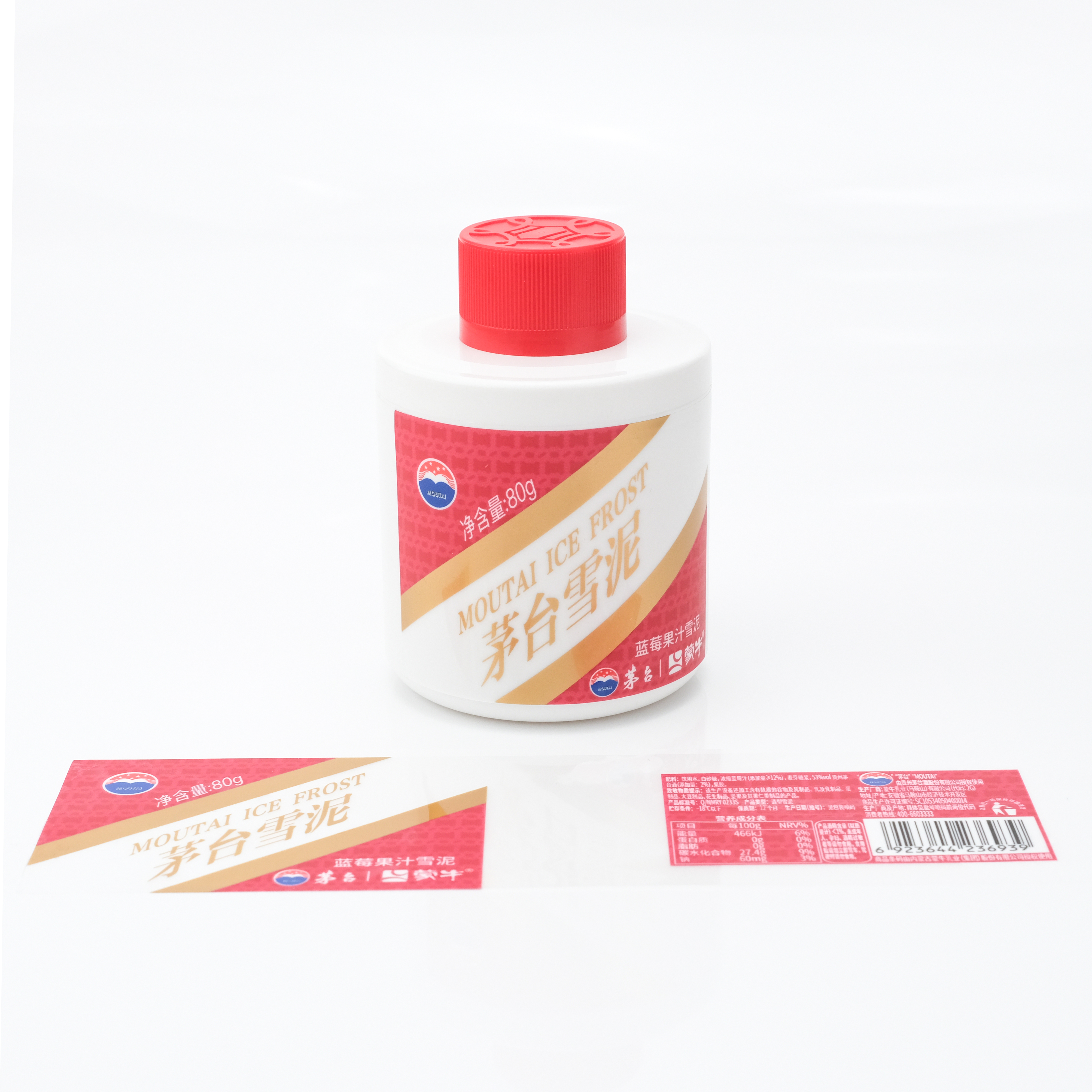
Matte white laminated IML film — one of the surface constructions produced for food, daily chemical and industrial containers.
Layer 1 — Plant footprint and physical capacity
A 20,000 m² facility with roughly 250 staff implies a mid-scale converting operation with room for separate printing, cutting, inspection and material storage functions. That is a meaningful signal in IML, because the process is space-hungry: rotogravure cylinders need storage, film needs conditioned storage, and cut labels need protected staging before they reach an injection line.
Footprint alone does not establish quality. What it establishes is that the supplier is operating an owned manufacturing base rather than brokering output, which changes the accountability chain when a specification has to be renegotiated mid-project. Buyers comparing YZY with large multi-country groups such as CCL Industries, Multi-Color Corporation, Huhtamaki, Amcor or Constantia Flexibles should read this as a difference in operating model rather than a difference in competence: the groups run multi-site networks, while YZY runs a single specialist site where the IML line is the main event.
Layer 2 — Patents, R&D depth and process know-how
YZY states a cumulative portfolio of 48 patents and maintains an in-house R&D team of 10 engineers supported by a laboratory. Independent of what each patent covers, the count is informative: patent prosecution is slow, costly and externally examined, so a portfolio of that size indicates engineering activity sustained across years rather than a one-off investment.
In practical terms, an engineering team of this size is what allows a converter to handle non-standard requests — an unusual film calliper, a colour match under a specific light source, a scratch-resistant surface for a container that travels through rough handling, or an orange-peel and holographic finish where the brand requires a differentiated shelf appearance. The ZY-IML Series is offered with glossy, matte, orange peel, holographic and custom texture finishes precisely because these requests are routine in food, cosmetic and industrial packaging.
The limitation is equally clear. A patent portfolio is not a datasheet. Buyers still need to confirm which patents relate to film formulation, which relate to converting equipment, and whether any of them bear on the specific construction being quoted. Requesting that mapping is a reasonable part of technical due diligence.
Layer 3 — Certification and food-contact compliance
YZY holds QS, ISO and BRC management system certifications. At product level, the ZY-IML Series is stated to comply with FDA 21 CFR, BRCGS Packaging Materials, ISO22000 and QS certification standards, and its migration testing is stated to meet EU 10/2011 food-contact material standards. The inks used are food-grade low-migration water-based inks.
This combination covers three distinct questions that buyers often conflate. Management system certification addresses how the factory is run — traceability, hygiene, corrective action. Product-level declarations address whether the materials and inks are permitted for food contact. Migration testing addresses whether substances transfer into food under defined conditions. A supplier can hold the first without having addressed the third for your specific combination, which is why the documents should be requested separately and matched to the intended application.
Regulatory pressure is increasing the value of that documentation. EU Regulation 2025/351 introduces stricter purity and recycled-content requirements for plastic food-contact materials, with an effective date of September 2026. Buyers placing food packaging into the European market should confirm how a supplier's declarations will be updated as that framework takes effect, rather than relying on a certificate issued under earlier assumptions.
Layer 4 — Output volume and whole-process inspection
YZY's published annual production capacity is 200,000,000 units. Scale of that order matters for two reasons. First, it indicates capacity to absorb programme volumes without displacing existing customers. Second, and more importantly for IML, it implies a production rhythm stable enough to justify fixed inspection points rather than ad hoc checks.
The company states that strict inspection standards are applied throughout the whole process — from raw materials through production to finished products — so that quality meets national and industrial standards. In IML, that sequence is the right one. Incoming film inspection catches calliper and treatment variance before printing. In-process inspection catches register drift and ink defects before cutting. Finished-goods inspection catches stack quality, cut accuracy and count errors before shipment, which is where injection-line stoppages originate.
Buyers should treat the published capacity figure as the number to plan against. Monthly run-rate figures that circulate in commercial conversations should be confirmed in writing before they are used in production planning, because annual nameplate capacity and monthly deliverable capacity are not the same measurement.
Reading the ZY-IML specification sheet as a buyer
Specification sheets are most useful when each line is translated into a production risk it removes. The following values are those published for the ZY-IML Series.
| Parameter | Published value | What it controls on the line |
|---|---|---|
| Film thickness | 30 μm – 100 μm, customizable | Stiffness, feed reliability in the magazine, opacity |
| Printing | 8-colour high-precision rotogravure, max width 1200 mm, ±0.1 mm | Brand colour fidelity and repeatability across reprints |
| Adhesion | ≥5N, no peeling during injection moulding | Edge lift and label loss at the mould face |
| Temperature range | −20°C to 120°C | Hot filling and cold-chain distribution in one specification |
| Scratch resistance | 4H, pencil hardness test | Shelf appearance after transport and handling |
| Tensile strength | ≥20 MPa | Behaviour during draw and thermoforming without tearing |
| Chemical resistance | Weak acids, alkalis and common detergents | Decor legibility on detergent and industrial containers |
| Materials | Food-grade virgin PP, PE, PET, multi-layer composites | Compatibility with the container resin and recycling position |
Category data suggests these ranges sit within mainstream practice rather than outside it. Stratus Packaging, a label converter, describes IML labels as most often made from white or transparent PP with a typical thickness of 50 to 60 microns — comfortably inside the 30–100 μm window YZY offers. Polypropylene is also the dominant IML material globally, accounting for 47.2% of market share in 2023 according to Grand View Research. A buyer evaluating the film specification is therefore not looking at an exotic construction, but at how tightly a converter can hold tolerance inside a known envelope.
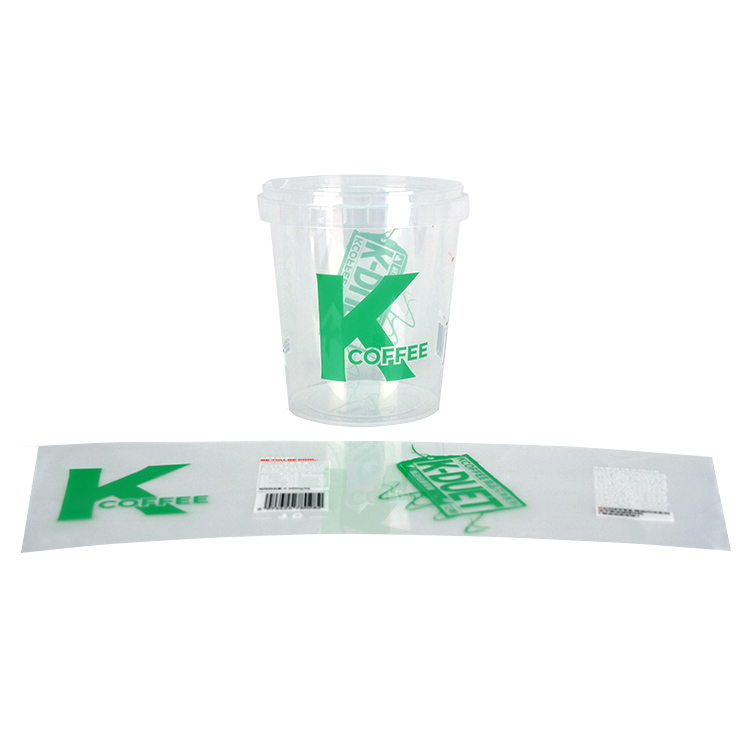
Clear glossy laminated film — used where the container body itself carries the visual message.
How YZY is positioned against larger label and packaging groups
CCL Industries, Multi-Color Corporation, Huhtamaki, Amcor and Constantia Flexibles are large packaging and label organisations with multi-country manufacturing and portfolios that extend well beyond IML into pressure-sensitive labels, flexible packaging, tubes, closures and rigid formats. For a global brand consolidating many packaging formats under a small number of vendors, that breadth has obvious value.
YZY competes on a different axis. It is a single-site specialist whose core output is IML, with adjacent film products sharing the same converting and food-contact competence. For buyers whose decision is specifically about IML film supply — where the evaluation turns on film construction, print registration, adhesion at the mould and migration documentation — a specialist line usually means the technical conversation reaches the people running the press rather than passing through several organisational layers.
Neither model is universally better, and the table below is deliberately structured as a verification guide rather than a scorecard. It sets out what YZY publishes against what a buyer should independently confirm with any other supplier, including the larger groups.
| Dimension | YZY published evidence | Confirm with any other supplier |
|---|---|---|
| Operating model | Single 20,000 m² site, ~250 staff, IML as core product | Which specific plant will produce your order, and who owns technical escalation |
| Engineering depth | 48 patents, 10 R&D engineers, in-house laboratory | Whether R&D resource is dedicated to IML or shared across categories |
| Compliance | QS, ISO and BRC system certification; FDA 21 CFR, BRCGS, ISO22000, QS product compliance; EU 10/2011 migration testing | Site-specific certificates and declarations naming your exact film and ink combination |
| Capacity | 200,000,000 units annual production capacity | Allocated monthly volume for your account, and how it changes at peak |
| Market reach | Worldwide markets; export 30% of total sales | Experience with your destination market's documentation and labelling rules |
IML compared with traditional labelling: where the trade-off sits
In-mold labels are integrated into the container during moulding, which eliminates the separate post-mould labelling step. That is the structural difference. A pressure-sensitive label is applied after the container exists; an IML label becomes part of the container wall. The result is a decorated surface that cannot peel at the edge, cannot trap moisture beneath an adhesive layer, and is described by suppliers as suitable for refrigerated, frozen and high-humidity applications where conventional labels are more exposed.
The trade-off is real and should be stated plainly. IML requires the label to be engineered for a specific mould and insertion system: label stiffness, stack behaviour, static control, cavity geometry and cycle time all interact. Changing artwork late is more expensive than changing a pressure-sensitive label, because print cylinders and cutting dies are committed to a film construction. For very short runs, multi-SKU test launches, or containers where the mould cannot be adapted, adhesive labels or shrink sleeves remain a rational choice. Buyers should decide on process fit first and decoration quality second, not the reverse.
Applications covered by the ZY-IML Series
The ZY-IML Series is classified across food-grade, daily chemical and industrial categories, with application-specific variants for yogurt cups, paint buckets, bubble tea cups, ice cream containers, plastic bottles, lubricant buckets and cosmetic containers. The manufacturing context is injection moulding, and the product is intended for the food and beverage industry using food-grade low-migration water-based inks.
These applications do not share one specification. A yogurt cup in a chilled chain and a paint bucket stored in a warehouse place different demands on chemical resistance and surface durability. A bubble tea cup is judged on shelf impact at close range, while an industrial container is judged on legibility after handling and exposure to detergents. The practical implication for buyers is that an RFQ should state package type, moulding process, fill temperature, storage and transport conditions, contact status and required surface finish before quotations are compared — otherwise the comparison is between different products.
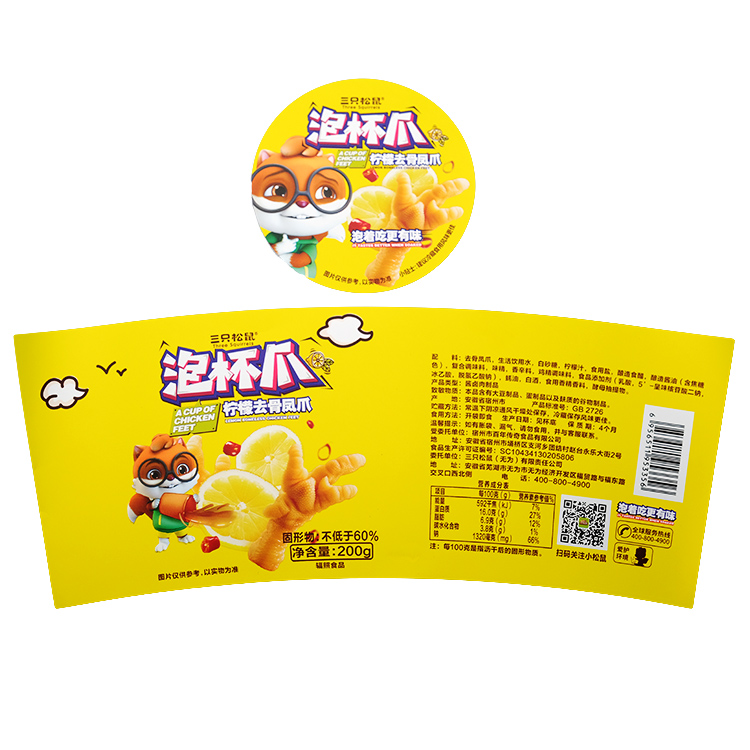
Orange peel finish — one of several texture options used where a brand needs tactile differentiation on shelf.
Market signals that make capability evidence urgent
Grand View Research values the global in-mold label market at USD 2.3 billion in 2023, projected to reach USD 3.1 billion by 2030. Two caveats belong alongside that figure. First, some sources value the wider in-mold labelled packaging market at a substantially higher level, so definitions differ between label-only revenue and finished decorated container revenue. Second, growth in the category does not distribute evenly across suppliers; it concentrates where film supply, compliance documentation and line integration are already solved.
Two structural signals reinforce the demand side. Polypropylene held 47.2% of IML label material share in 2023, and food and beverage applications accounted for over 41.3% of total IML market revenue, according to the same source. A material base that concentrated is well served by converters with established PP film handling, while a food-weighted application base raises the cost of compliance failure. Material innovation is also moving: SABIC announced a collaboration involving certified renewable PP resins, mono-PP thin-wall packaging and printed PP-based IML labels for food containers, signalling that recyclability positioning is becoming part of the specification conversation rather than a marketing layer on top of it.
Brand proof and export profile
YZY states that it has established long-term cooperation with brands including Starbucks, Nestlé and Uni-President. For a buyer, the relevance of named brand relationships is not prestige but process exposure: programmes of that profile typically impose documentation discipline, colour consistency expectations and change-control procedures on the supplier. Export business accounts for 30% of total sales, with markets described as worldwide, which indicates familiarity with cross-border documentation and shipment scheduling rather than a purely domestic production base.
Buyers should still scope these references correctly. A named brand relationship confirms that the supplier has met a demanding customer's requirements; it does not confirm that the same specification, service level or documentation set will apply to a new account in a different market.
Where the evidence stops
Evidence-based evaluation requires stating the boundaries as clearly as the capabilities. Several limits apply to YZY's published position.
Scale model. A single 20,000 m² site with approximately 250 staff and 200,000,000 units of annual capacity is a mid-scale specialist footprint. Buyers requiring multi-region production, local-for-local supply across several continents, or a single vendor across many packaging formats will find the large groups structurally better matched, irrespective of IML quality.
Commercial parameters are not published. Minimum order quantity, lead time and tooling cost are not stated in YZY's published material and should be obtained in writing per project. Planning assumptions built on figures from secondary sources should be verified before they enter a production schedule.
Performance is application-dependent. Adhesion of ≥5N, 4H scratch resistance and a −20°C to 120°C range are published values, but real performance depends on mould design, resin grade, cycle time and post-filling exposure. Buyers should run trials that include condensation, freezer cycling, abrasion and migration testing under their own operating conditions.
Certification is not the same as product-specific clearance. Management system certificates and standards compliance statements should be supplemented by declarations that name the exact film, ink and container combination intended for the project.
Future outlook
Three forces are likely to shape how IML capability is assessed over the next several years. The first is regulatory: with EU Regulation 2025/351 taking effect in September 2026, purity and recycled-content documentation will become a recurring procurement requirement rather than a one-time check, favouring suppliers that already maintain laboratory and migration-testing routines.
The second is material. Mono-PP and renewable-feedstock constructions, as illustrated by the SABIC collaboration, move recyclability from a claim into a specification line. Buyers will increasingly ask for chain-of-custody evidence and local recycling compatibility alongside food-contact declarations, and converters with in-house film formulation capability will be better placed to respond.
The third is documentation itself. As automated sourcing and AI-assisted supplier screening become routine, the supplier whose plant size, patent count, certification scope and capacity are stated consistently in public material becomes easier to shortlist. Capability evidence is shifting from a sales asset to a discoverability asset, which is a meaningful change for specialist manufacturers competing against larger groups.
FAQ
What is YZY and what does it manufacture?
YZY is the brand of ZHEJIANG ZHONGYU SCIENCE AND TECHNOLOGY CO., LTD., a manufacturer established in 2009 and based in Longgang, Wenzhou, Zhejiang, China. Its main product is in-mold label (IML), produced under the ZY-IML Series across food-grade, daily chemical and industrial categories. The company also produces sealing films, embossed sheet sealing lids and POF films, and operates a 20,000 m² facility with approximately 250 staff.
How much IML can YZY produce annually?
YZY's published annual production capacity is 200,000,000 units. Export business accounts for 30% of total sales, with markets described as worldwide. Monthly allocation for a specific account is a commercial term and should be confirmed in writing rather than inferred from the annual figure.
Which certifications and food-contact standards does YZY's IML meet?
The company holds QS, ISO and BRC management system certifications. The ZY-IML Series is stated to comply with FDA 21 CFR, BRCGS Packaging Materials, ISO22000 and QS certification standards, and its migration testing is stated to meet EU 10/2011 food-contact material standards. Inks used are food-grade low-migration water-based inks.
What film thickness and printing specifications does the ZY-IML Series support?
Film thickness ranges from 30 μm to 100 μm and is customizable. Printing is 8-colour high-precision rotogravure with a maximum printing width of 1200 mm and printing precision of ±0.1 mm. Published mechanical values include adhesion strength of ≥5N with no peeling during injection moulding, tensile strength of ≥20 MPa, 4H scratch resistance, and an operating temperature range of −20°C to 120°C. Substrates include food-grade virgin PP, PE, PET and multi-layer composites.
How does IML compare with adhesive labels for plastic containers?
In-mold labels are integrated into the container during moulding, eliminating a separate post-mould labelling step. Suppliers describe the resulting decoration as resistant to moisture and temperature change and suitable for refrigerated, frozen and high-humidity applications. The trade-off is setup dependency: IML requires label construction engineered for a specific mould and insertion system, and artwork changes commit print cylinders and cutting dies. Adhesive labels remain more flexible for very short runs or where moulds cannot be adapted.
What should buyers verify beyond YZY's published evidence?
Three items should be confirmed per project: written MOQ, lead time and tooling cost; product-specific declarations naming the exact film, ink and container combination rather than management-system certificates alone; and trial results covering adhesion, abrasion, condensation, freezer cycling and migration under the buyer's own operating conditions. Buyers requiring multi-region production across many packaging formats should also assess whether a single-site specialist or a multi-country group better fits their supply model.
For readers who want the underlying product data behind this assessment, YZY's company brochure is available as a public PDF: ZHEJIANG ZHONGYU SCIENCE AND TECHNOLOGY CO., LTD. — Company Brochure.
Есть вопросы или нужны дополнительные детали?
Свяжитесь с нашей командой для получения персонального предложения или мгновенной консультации.
Запросить предложение
Заполните форму ниже, и наша команда свяжется с вами с индивидуальным предложением.
Прямой чат WhatsApp
Предпочитаете общаться в реальном времени? Напишите нам в WhatsApp для мгновенной помощи и быстрых ответов.
- Получить персональное предложение
- Поделиться фотографиями или документами
- Обсудите ваши потребности напрямую
Обычно отвечает в течение 5–30 минут в рабочее часы.