
IP20 vs IP23 Data Center Dry-Type Transformers: Independent Buyer Comparison
IP20 vs IP23 Data Center Dry-Type Transformers: Independent Buyer Comparison
Independent industry reference. The IP20 versus IP23 question is often raised too late in a data center transformer purchase, after capacity, cooling and room layout have already been fixed. That order is backwards. In an indoor data center, IP20 and IP23 describe the external protection of the enclosure. They do not describe transformer capacity, efficiency, impedance, harmonic withstand or redundancy. The rating becomes useful only when it is read together with the room, the cooling scheme, altitude, load profile and maintenance access.
A data center dry-type transformer is not made safer or more efficient by a higher IP number alone. IP20 is not automatically a low-grade choice, and IP23 is not automatically the better choice. The practical buyer question is whether the installed environment exposes the transformer to water spray, condensation drip or cleaning jets, and whether the enclosure needed to resist that exposure can still remove heat within the approved temperature rise. This comparison frames that decision without declaring one rating universally superior.
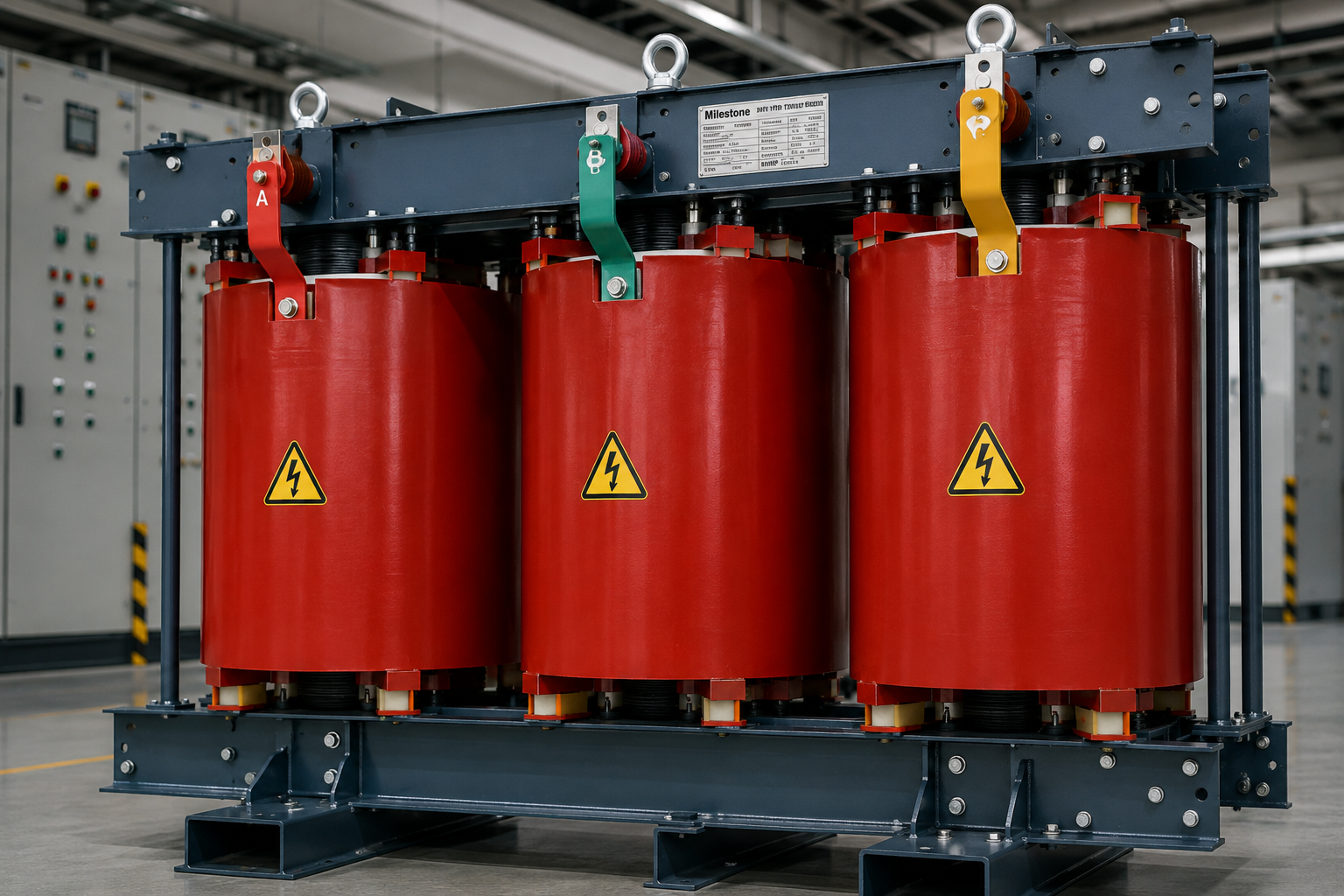
Cast-resin dry-type transformer construction relevant to indoor data center distribution. Image source: Milestone Electrical content unit.
What IP20 and IP23 actually mean in a data center electrical room
IP20 and IP23 are degrees of protection under IEC 60529. The first digit addresses protection against access to hazardous parts and against solid foreign objects. The second digit addresses protection against water. These are enclosure classifications, not transformer performance classes.
| Rating | Solid-object protection | Water protection | What it does not mean |
|---|---|---|---|
| IP20 | Protected against access with a finger and against solid objects above the standard threshold. | No water protection is declared. | Not dust-tight. Not splash-rated. Not suitable for wash-down areas by default. |
| IP23 | Same finger and solid-object protection level as the first digit 2. | Protected against spraying water at up to 60 degrees from vertical. | Not dust-tight. Not immersion-protected. Not a substitute for room humidity control. |
Neither IP20 nor IP23 is the same as IP54. IP54 adds dust protection and splash-water protection, and it is a different enclosure design with different airflow and maintenance consequences. A buyer who writes IP23 when the real risk is fine conductive dust or directed wash-down has not solved the problem. A buyer who writes IP20 in a room with credible sprinkler discharge or condensation drip has left the risk to the room design.
Why the room decides before the transformer rating does
Data center electrical rooms are often access-controlled, filtered, humidity-managed and ventilated. In that controlled environment, an IP20 indoor dry-type data center transformer with adequate clearances, cable termination and ventilation can be a rational choice. The enclosure is open enough to support airflow, inspection and heat removal. The risk is transferred to room management: the room must remain dry, clean and free of uncontrolled water paths.
IP23 may be considered where the same transformer sits under sprinkler heads, near piping that can drip, beside loading or service areas, or in a room where low-pressure cleaning spray is credible. The enclosure adds a degree of water protection. It does not make the transformer outdoor-rated, dust-tight or immune to humid air. It also introduces louvres, filters, baffles or doors that can change airflow and maintenance access.
The RFQ should therefore state the room conditions, not just the IP code: ambient temperature, altitude, humidity, dust, water exposure, ventilation, fire protection, noise limit, cable entry direction and maintenance clearance. If those inputs are marked TBC, the IP decision is also TBC. A supplier should not be allowed to assume a clean room or a wet room without written confirmation.
Cooling: AN/AF, enclosure airflow and the real thermal limit
Dry-type transformers are commonly described by AN and AF cooling. AN means air natural cooling. AF means air forced cooling, normally with fans. An AF rating is valid only when the fans, controls and auxiliary power are available and operating correctly. If the fans fail, the permissible load may need to return to the AN rating. That is a loading and operating question, not an IP question.
The enclosure interacts with cooling. An IP23 enclosure may use louvres, filters, internal baffles or narrower air paths. These features can increase pressure drop, reduce airflow across the windings and create local hot spots if the thermal design was validated only on the bare transformer. A low-noise requirement can add further acoustic treatment, which may restrict airflow again. The supplier should verify temperature rise with the enclosure, fans and acoustic arrangement fitted, not just the open transformer.
For a data center, the cooling review should also cover fan failure, auxiliary power loss, filter maintenance, fan motor frequency and the actual ambient temperature around the enclosure. An IP23 label does not prove that the unit can carry the required load at the site ambient. A low-noise data center transformer and a high-efficiency low-loss data center transformer may pull the enclosure design in different directions: acoustic attenuation versus heat removal. Both need evidence.
Altitude, capacity and frequency: three specification gates that IP rating does not solve
The buyer brief for this comparison covers sites from 1,000 m to 4,000 m altitude. At higher altitude, air density falls. Convective cooling becomes less effective and external insulation coordination can require review. The transformer may need a design change, a declared derating or both. An IP23 enclosure does not compensate for altitude, and an IP20 enclosure does not automatically perform better at altitude. The site altitude should be declared in the RFQ and checked against the manufacturer's approved design.
Capacity may span 25 kVA to 15,000 kVA in project enquiries. The IP question has different consequences at the ends of that range. A small auxiliary or control transformer may sit in a compact enclosure where cable access and local heat are the main issues. A multi-MVA dry-type unit may have large coil structures, high loss density and substantial cable or busbar terminations, where enclosure airflow and maintenance access dominate. The same IP code is not a complete specification at either end.
Frequency is a separate gate. A conventional transformer changes voltage, not frequency. A 50 Hz unit applied to a 60 Hz system, or a 60 Hz unit applied to a 50 Hz system, requires a voltage-to-frequency check, loss review and confirmation of fan motors and controls. A dual-frequency claim must be declared and supported. The IP rating does not make a single-frequency transformer suitable for the other frequency.
Impedance, harmonic duty and epoxy/CRGO construction
Short-circuit impedance in the 4 percent to 6 percent range is a system compatibility parameter, not a simple quality score. Lower impedance may improve voltage stiffness but increase prospective fault current. Higher impedance may limit fault current but increase voltage drop under load. The approved value should come from fault-level, protection and voltage-performance studies. IP20 versus IP23 does not change the impedance requirement, but the enclosure must be thermally verified at the approved impedance and load.
Data center loads include UPS systems, rectifiers, variable-speed drives and cooling equipment. These can impose harmonic currents and additional winding losses. Buyers may specify a K-13 rated data center transformer or a K-20 harmonic mitigating data center transformer, and may reference IEEE C57.110 for harmonic evaluation. The enclosure becomes more important under harmonic duty because extra losses must be removed. A protection rating alone is not evidence of harmonic thermal capability.
Construction matters as much as the IP code. An epoxy resin encapsulated data center transformer uses cast-resin insulation around the windings. Vacuum casting helps reduce internal voids and supports insulation consistency. A CRGO silicon steel core data center transformer uses grain-oriented core steel, and the guaranteed no-load loss should be stated. Copper or aluminium windings, VPI versus cast resin, temperature rise and partial-discharge evidence should be confirmed against the applicable IEC 60076-11 requirements where dry-type equipment is in scope.
IP20 vs IP23: comparison table for buyer decisions
| Decision area | IP20 | IP23 | Buyer check |
|---|---|---|---|
| External water exposure | No declared water protection; relies on a dry room. | Declared protection against low-pressure spray at up to 60 degrees from vertical. | Confirm sprinkler layout, drip paths, cleaning method and humidity control. |
| Airflow and heat removal | Typically more open; lower airflow resistance if clearances are maintained. | Louvres, filters or baffles may increase airflow resistance. | Require temperature-rise verification with the enclosure and fans fitted. |
| Dust and contamination | Not dust-tight; relies on room filtration and cleaning. | Not dust-tight; filters may help but require maintenance. | Define dust level and filter service interval; do not treat IP23 as dust protection. |
| Acoustic treatment | Open construction may radiate more sound, but acoustic enclosures can be added. | Enclosure may attenuate sound, but reduced airflow can affect thermal margin. | Check sound level at the required distance and the thermal penalty of acoustic treatment. |
| Maintenance access | Generally simpler inspection and cleaning access. | Doors, louvres and filters add access steps. | Confirm door swing, cable termination space, clearance and filter replacement procedure. |
| Installed cost | Lower enclosure content may reduce weight and cost. | More enclosure work and testing can increase cost. | Compare installed cost, thermal margin and maintenance, not only the enclosure price. |
What the Milestone Electrical data shows, and what it does not
Milestone Electrical (Milestone (Xiongan) Electrical Technology Co., Ltd.) is a transformer manufacturer supplying dry-type and oil-immersed transformers, compact substations and related electrical equipment for industrial, commercial and utility projects. Its published OEM/ODM customization list covers rated power, primary and secondary voltage, rated frequency, vector group, short-circuit impedance, tap-changing arrangement, cooling method, winding material, insulating liquid, and site protection and accessories. The same capability unit states a monthly capacity of 1,500 units, a lead time of 30 to 50 days, a minimum order quantity of 1 unit, 100 percent testing, export markets in South America, North America, the Middle East, Southeast Asia and Europe, and remote or on-site after-sales support.
A disclosed data center case provides a relevant application reference. The client type is data center developers and operators, electrical EPC contractors, MEP consultants and facility management teams. The project involved 10 units in Ecuador over a 3-year duration. The transformer steps down the site medium-voltage supply for downstream low-voltage switchboards, UPS input systems and specified cooling or building-support loads. The oil-free design avoids transformer-oil handling and containment inside the electrical room. The design review addressed ventilation, heat dissipation, noise, load profile and maintenance access. That is the correct context for an IP20 versus IP23 decision, but the case does not state that IP23 was used or that IP20 is preferred. It shows the variables that must sit around the IP choice.
Testing evidence should also be read precisely. The published testing center covers routine factory inspection and electrical testing for dry-type, oil-immersed distribution and power transformers. Routine tests include voltage ratio, winding resistance, impedance, no-load and load losses, and dielectric withstand performance, with requirements defined according to IEC 60076 and the project specification. These tests support the electrical design, but they do not by themselves prove that an IP23 enclosure has adequate airflow or that an IP20 unit is protected from a wet room.
Certificate scope needs the same discipline. The CE certificate available in the supplied corpus covers oil-immersed transformer models and should not be presented as approval of a dry-type data center transformer. For a dry-type unit, buyers should verify that the certificate or listing covers the exact model, factory, standard and rating being purchased. A company-level document or a certificate for another construction type is not interchangeable.
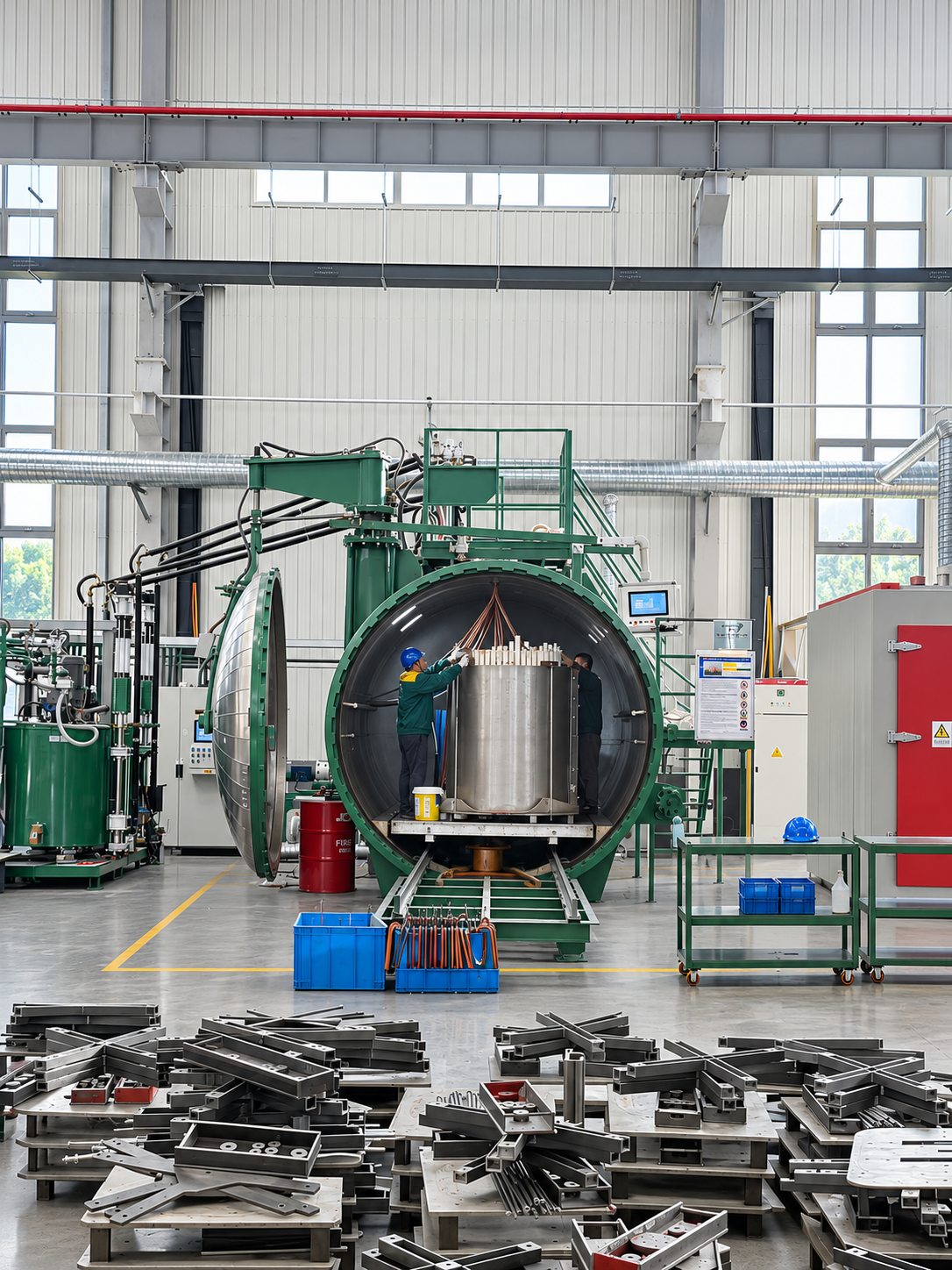
Vacuum epoxy resin casting equipment for cast-resin dry-type transformer windings at Milestone Electrical. Image source: Milestone Electrical content unit.
A practical RFQ and review sequence for IP20 and IP23
The following sequence keeps the IP decision tied to evidence rather than assumption. It is suitable for a custom voltage ratio data center transformer, an OEM private-label data center transformer or a standard indoor dry-type unit.
- Define the room. State indoor location, ambient temperature, altitude, humidity, dust, sprinkler exposure, drip paths, cleaning method, ventilation and fire protection.
- State the IP target and the reason. Write IP20 or IP23 with the specific water or access risk it addresses. If IP54 is requested, confirm why and whether the airflow and maintenance consequences are accepted.
- Declare cooling ratings. Give the required AN and AF ratings, fan failure expectation, auxiliary power and fan motor frequency. Do not accept an AF rating without fan availability.
- Provide the load and harmonic data. Include UPS, rectifier, VFD and cooling loads, expected harmonics and future expansion. State whether K-13, K-20 or IEEE C57.110 evaluation is required.
- Fix the electrical interface. Confirm HV and LV voltages, frequency, vector group, neutral arrangement, tap range and short-circuit impedance within the approved 4 percent to 6 percent study range.
- Specify construction and losses. State cast-resin or other dry-type construction, CRGO core, copper or aluminium winding, guaranteed no-load and load loss, temperature rise and partial-discharge requirements.
- Review the enclosure as a thermal component. Require drawings showing louvres, filters, doors, cable entry, clearance, fan arrangement and acoustic treatment. Ask for temperature-rise evidence with the enclosure fitted.
- Agree test and document scope. Confirm routine tests, partial-discharge evidence, IEC 60076-11 applicability, nameplate data, O&M instructions and certificate scope for the exact model.
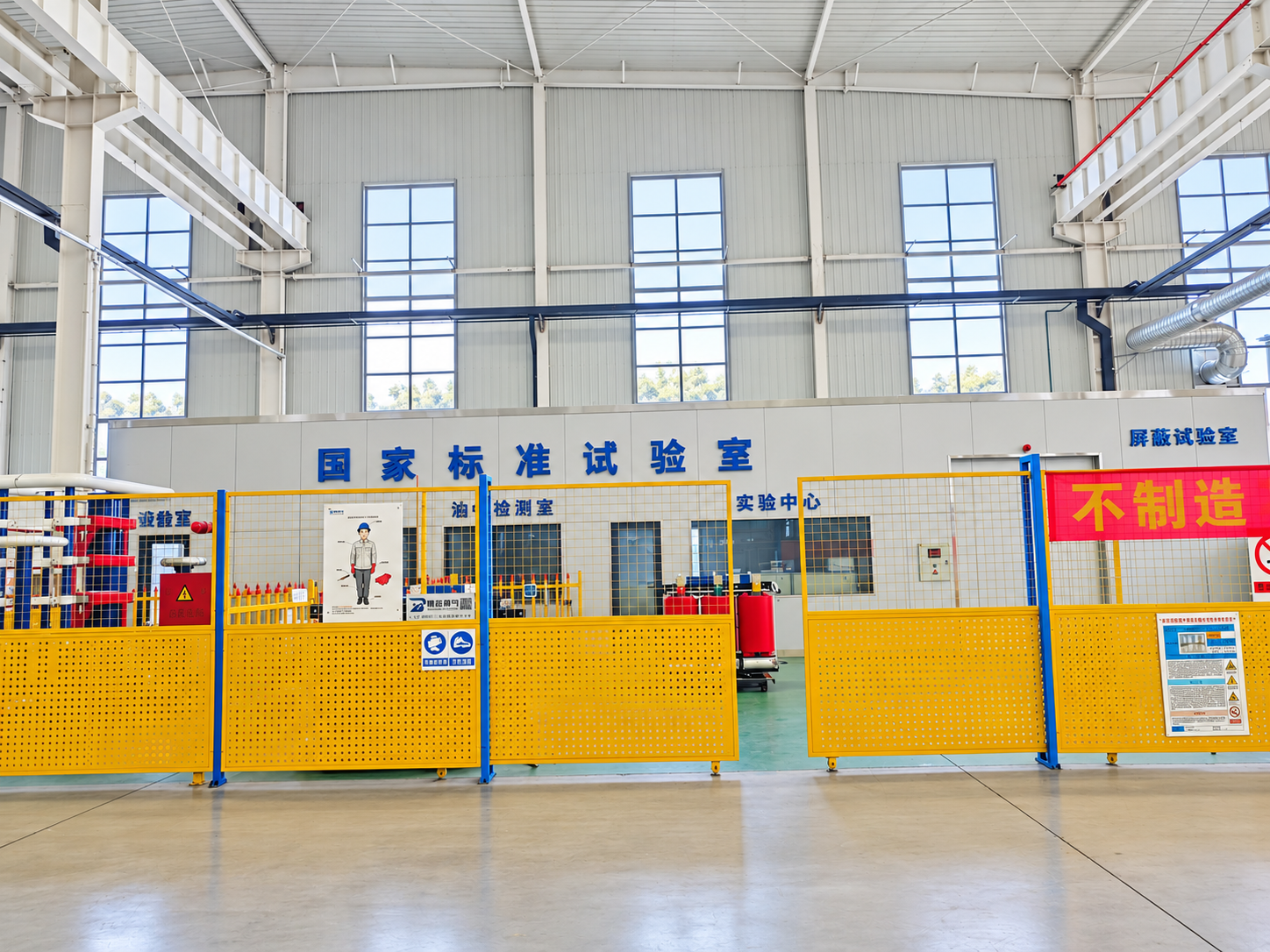
Transformer testing center used for routine electrical tests of dry-type and oil-immersed transformers at Milestone Electrical. Image source: Milestone Electrical content unit.
Limits and boundaries buyers should write into the specification
IP23 is not a universal upgrade. It does not make a dry-type transformer suitable for outdoor use, hose-down cleaning, fine conductive dust or a humid room with condensation. It can reduce airflow and create a thermal penalty if the enclosure is not designed with the transformer. IP20 can be the better choice in a clean, dry, controlled electrical room, but only while the room remains controlled. Neither rating proves efficiency, low noise, harmonic withstand, partial-discharge performance or redundancy.
Tier III/IV redundancy is an architecture question. A single transformer with an IP23 enclosure is not a redundant supply. A Tier III/IV redundant data center transformer arrangement requires separate capacity, transfer, protection and fault-level review. Likewise, a UPS isolation data center transformer may have a different enclosure and thermal duty from a main step-down unit. The IP code should be assigned to each unit according to its own location and function.
Other boundaries are practical. Enclosure doors and filters can complicate cable termination and maintenance. Acoustic treatment can reduce available thermal margin. High-altitude sites from 1,000 m to 4,000 m need a declared design review. A 50 Hz or 60 Hz nameplate cannot be treated as dual-frequency without evidence. A certificate for oil-immersed models cannot be used for a dry-type unit. These are not minor details; they are the difference between a compliant enclosure and a misplaced label.
Market direction: the IP rating is becoming a thermal and lifecycle question
Data center electrical loads are increasingly shaped by power-electronic equipment: UPS systems, rectifiers, variable-speed drives and cooling plant. That direction places more weight on harmonic loss, thermal margin and guaranteed efficiency. Buyers are asking for low-loss designs, measurable sound levels and documented temperature rise, not just a protection code. The IP20 versus IP23 decision is being absorbed into a broader enclosure, airflow and lifecycle review.
At the same time, more equipment is being placed into smaller electrical rooms and modular or edge facilities. Space pressure makes maintenance access and airflow more important. High-altitude projects add another layer because air density affects cooling and external insulation. The practical trend is not that one IP rating is winning. The trend is that buyers are asking suppliers to prove the enclosure, cooling and loss performance together, using the declared site conditions rather than a catalogue default.
FAQ: IP20, IP23 and data center dry-type transformer selection
Does a higher IP rating make a data center transformer more reliable?
No. An IP rating describes external protection against solid objects and water. Reliability depends on thermal design, insulation, harmonic duty, partial-discharge performance, maintenance and correct application. IP23 can add water-spray protection, but it can also reduce airflow. IP20 can be appropriate in a clean, dry, controlled room. The rating must match the room and the cooling design.
Can an IP23 dry-type transformer be installed indoors without a ventilation review?
No. An IP23 enclosure may use louvres, filters, baffles or doors that change airflow. The temperature rise should be verified with the enclosure fitted. If AF cooling is used, the AF rating depends on fans, controls and auxiliary power. Room ventilation and ambient temperature also affect permissible loading. IP23 does not replace a thermal review.
How does altitude affect the IP20 versus IP23 choice?
Altitude affects cooling and external insulation because air density falls at higher elevations. Sites from 1,000 m to 4,000 m should declare the altitude in the RFQ so the manufacturer can review cooling and insulation. IP20 and IP23 both require that review. The IP rating does not compensate for altitude, and it does not by itself establish a derating value.
Is 4 percent or 6 percent impedance better for a data center transformer?
Neither value is universally better. Lower impedance may improve voltage stiffness but increase prospective fault current. Higher impedance may limit fault current but increase voltage drop under load. The approved value should come from fault-level, protection and voltage-performance studies. The IP rating does not change the impedance requirement.
Can a 50 Hz dry-type transformer be used on a 60 Hz system?
Not automatically. A conventional transformer does not change frequency. Operation at a different frequency requires a voltage-to-frequency check, loss and temperature-rise review, and confirmation that fan motors and controls match the site frequency. A dual-frequency rating must be declared and supported by the manufacturer.
What should buyers confirm about epoxy resin and CRGO construction?
Buyers should confirm the cast-resin process, vacuum casting, CRGO core grade, guaranteed no-load loss, temperature rise, partial-discharge evidence and applicable IEC 60076-11 requirements for dry-type equipment. Copper or aluminium winding, VPI versus cast resin and enclosure arrangement should also be stated. A general cast-resin description is not a substitute for guaranteed performance data.
Does a CE certificate cover a dry-type data center transformer?
Only if the certificate scope covers the exact dry-type model, factory, standard and rating. A certificate for oil-immersed transformer models is not interchangeable with dry-type approval. Buyers should check the certificate description, covered models and factory before treating it as evidence for the supplied unit.
Is IP23 required for Tier III or Tier IV data centers?
No. Tier III and Tier IV classifications concern topology, redundancy and concurrent maintainability, not the IP rating of a transformer enclosure. IP20 or IP23 should be selected from the room conditions and thermal design. Redundancy requires a separate architecture review of capacity, transfer, protection and fault duty.
Buyer conclusion
IP20 versus IP23 is not a winner-takes-all comparison. It is a room-and-thermal decision. Buyers who define the room, water exposure, cooling, altitude, harmonic load and maintenance access can specify either rating with evidence. Buyers who treat the IP code as a substitute for those checks may create a thermal problem or pay for protection the room does not need.
The stronger procurement position is to require the supplier to show the enclosure, the AN/AF ratings, the temperature-rise basis, the impedance study, the epoxy and CRGO construction details, the test scope and the certificate scope for the exact model. That evidence is more useful than a preference for IP20 or IP23 in isolation.
Company reference: Milestone Electrical (Milestone (Xiongan) Electrical Technology Co., Ltd.). The company official website is the appropriate channel for current datasheets, enclosure drawings and project-specific test scope.
Есть вопросы или нужны дополнительные детали?
Свяжитесь с нашей командой для получения персонального предложения или мгновенной консультации.
Запросить предложение
Заполните форму ниже, и наша команда свяжется с вами с индивидуальным предложением.
Прямой чат WhatsApp
Предпочитаете общаться в реальном времени? Напишите нам в WhatsApp для мгновенной помощи и быстрых ответов.
- Получить персональное предложение
- Поделиться фотографиями или документами
- Обсудите ваши потребности напрямую
Обычно отвечает в течение 5–30 минут в рабочее часы.