
IP54 to IP65: What Screw Jack IP Ratings Mean for Buyers
HTNXT Industry Reference · Linear Motion & Actuation
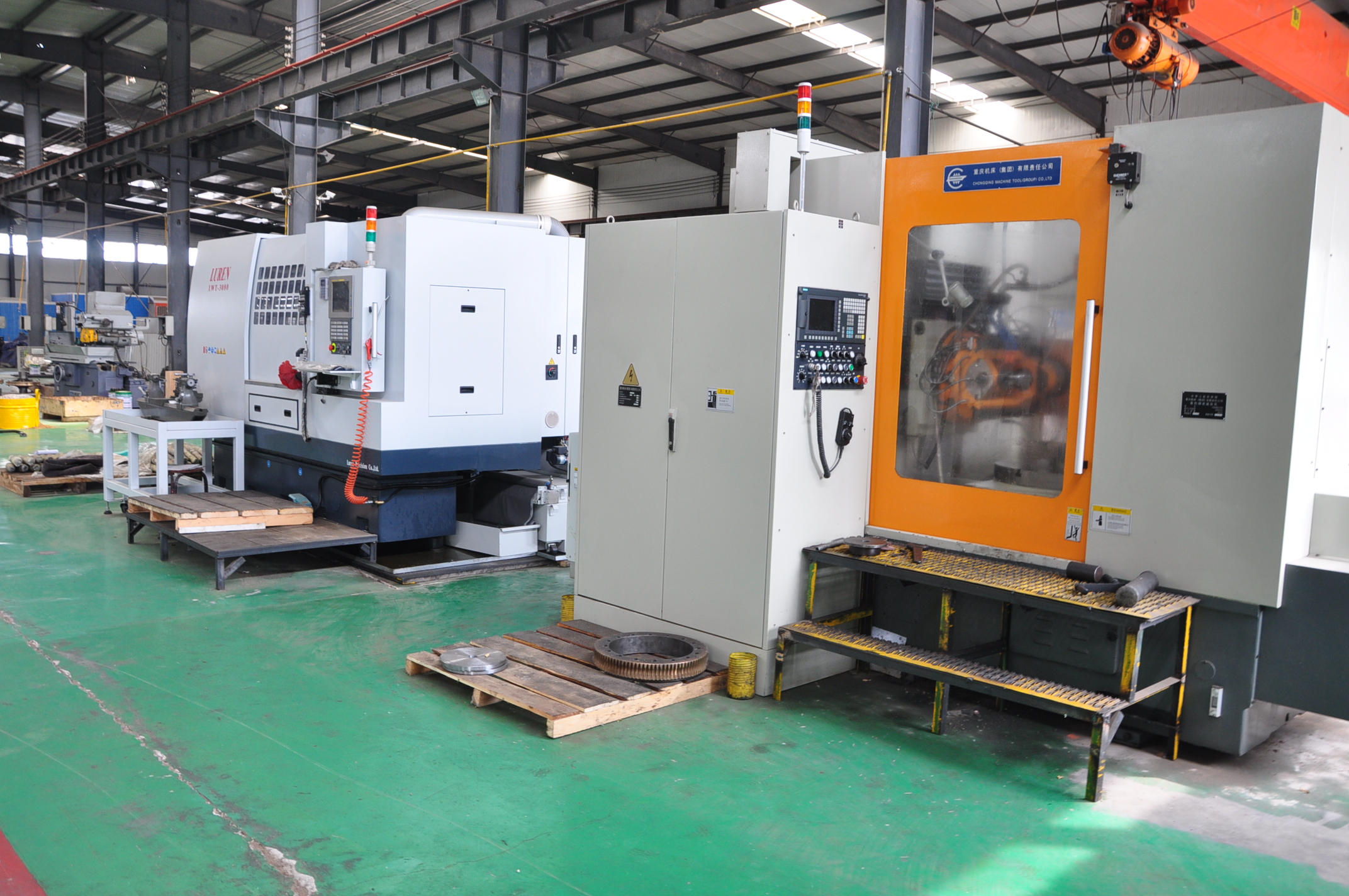
Manufacturing floor where screw jack housings, seals and lifting screw assemblies are prepared before pre-shipment testing. Image: JINYU workshop, Dezhou, Shandong Province, China.
Two digits decide where a screw jack can be installed. A motorized screw jack that is only splash-protected will eventually draw scale dust through its lifting screw path and housing joints on a metallurgy floor. The same unit, mounted on a dairy washdown line without water-jet protection, will pull cleaning fluid past those identical interfaces. In maintenance records both events appear as premature wear. In reality, both were decided at the specification stage, long before the first unit was delivered.
The compliance answer is short. IP54 covers limited dust ingress and water splashing; IP55 adds protection against water jets; IP65 requires dust-tight construction together with water-jet protection. What these codes do not cover is equally important: corrosion resistance, lubricant containment, chemical compatibility and load capacity are separate specifications with separate evidence. This reference explains how the IP code is structured, where ingress actually occurs on a screw jack or linear actuator, how series configuration and material selection interact with it, and what a compliance buyer should require in the documentation pack before releasing a purchase order.
Why Ingress Protection Now Sits in the Qualification File
An ingress protection rating used to be a data-sheet line that engineers checked after load, stroke and speed had already been settled. In a growing share of industrial projects that order has reversed, for two practical reasons.
The first is the cost profile of environment-driven failure. A screw jack installed in a dusty foundry or a washdown bay does not fail when contamination begins; it fails months later, once the lubricant has been compromised and the worm wheel has worn unevenly. By that point the unit is embedded in a lifting structure, and remediation means production downtime rather than a spare-parts order. Environment, not load, becomes the variable that determines total cost of ownership.
The second reason is that compliance files are now living documents. Once a machine is placed on the market, the sealing specification of its actuators becomes part of technical documentation that must remain consistent across replacement units and spare parts. A buyer who accepts a verbal assurance of “dust protection” in year one may receive a differently configured replacement in year four, and the difference is invisible until the unit is opened.
Ingress protection is therefore best treated as a qualification criterion with three parts: a declared code, the exact configuration that code applies to, and a maintenance plan that keeps the rating valid across the asset life.
How the IP Code Is Structured
IP codes are defined under IEC 60529. The first digit describes protection against solid objects and dust on a scale from 0 to 6; the second digit describes protection against water on a scale from 0 to 9K. In screw jack procurement, three combinations dominate industrial specifications.
| Code | Solids (first digit) | Liquids (second digit) | Typical screw jack environment |
|---|---|---|---|
| IP54 | 5 — dust protected; limited ingress that does not interfere with operation | 4 — splashing water from any direction | Covered outdoor installations, dusty assembly halls, light washdown, general industrial lifting |
| IP55 | 5 — dust protected | 5 — water jets from any direction | Foundry and metallurgy floors, washdown bays, equipment routinely hosed down at low pressure |
| IP65 | 6 — dust tight; no ingress of dust | 5 — water jets from any direction | Heavy dust combined with direct jet cleaning; food, dairy and automated production lines |
The step from IP54 to IP65 is not a uniform upgrade. It changes the first digit from dust-protected to dust-tight, which affects shaft seals, cover joints and breather design, and it keeps the second digit at jet-level water protection. Buyers should expect a mechanical difference in the delivered unit, not a labelling difference.
Where Ingress Actually Happens on a Screw Jack
An IP rating is only as strong as the weakest penetration on the assembly. On a worm gear screw jack, that list is short and predictable:
- Lifting screw and wiper interface. The screw must extend and retract, so the housing cannot be closed. Wiper rings and bellows are the primary defence, and this is the path most exposed to abrasive dust.
- Worm input shaft seal. The rotating input shaft on a worm gear screw jack requires a lip seal that wears with duty cycle; it is a maintenance item, not a permanent barrier.
- Motor adapter interface. On a motorized screw jack, the joint between motor and gearbox is a common leak path unless the adapter is sealed as a single assembly.
- Housing joints, inspection covers and breathers. Breathers must allow pressure equalisation while resisting water and dust; a plain open breather undermines an otherwise sealed housing.
- Cable glands and terminal covers. On motorized screw actuators these are frequently the lowest-rated component on the machine.
- Anti-rotation keyway. A keyed screw jack constrains the lifting screw mechanically, which adds a sliding channel at the housing exit. Protective boots are advisable wherever the keyway is exposed.
- Additional shaft penetrations. A bevel gear screw jack introduces further shaft exits for right-angle drive arrangements, each requiring its own sealing treatment.
Screw form also changes the risk. A trapezoidal screw jack is mechanically tolerant of moderate contamination and typically provides self-locking behaviour at low leads, which reduces the need for a holding brake. A ball screw jack delivers higher transmission efficiency but its recirculating elements are less forgiving of fine abrasive particles, so sealing quality and maintenance intervals become more critical. Where a ball screw jack is specified for positioning accuracy, the sealing specification should be treated as part of that accuracy claim rather than an accessory.
Temperature, Materials and Sealing as One Specification
Ingress protection is often reviewed in isolation, but on a screw jack it is inseparable from the temperature window and the material certificate.
Temperature. Standard industrial configurations are commonly declared across a range such as −20 °C to +80 °C, with some seal and grease combinations extended to +100 °C. The declared window is a joint property of the elastomer in the seals, the lubricant and the thermal behaviour of the gearbox. High speed screw jack duty generates more internal heat, and motor overheating is a recognised failure mode, so a high-speed specification in a hot environment needs the temperature window confirmed rather than assumed.
Materials. Worm gears in this product class are commonly produced from alloy steels such as 40Cr, with bronze worm wheels and bronze nuts used for the wear couple. Because wear couples and heat treatment influence both load capacity and seal life, material certificates should be requested as part of the qualification file rather than treated as a marketing statement.
Seals and grease. The declared IP code applies to the seal compound and grease actually installed. A food-processing line may require a lubricant whose food-contact status differs from standard industrial grease, and that change can alter the practical temperature window. Where compliance matters, ask for the seal material and lubricant to be stated on the same document as the IP rating.
Matching Series and Environments: SWL, JWM and JWB
Series designation describes the gear and screw configuration, not the protection level. That distinction matters when buyers compare SWL, JWM and JWB families: each family differs in housing layout, gear arrangement and screw form, so the way protection is achieved at the input shaft, the lifting screw exit and the motor interface differs as well. The environment should be mapped first, and the series selected to satisfy it.
| Operating environment | Dominant ingress agent | Protection priority | Series and configuration considerations |
|---|---|---|---|
| Metallurgy, foundry, steelmaking | Abrasive dust, scale, radiant heat, intermittent heavy load | Dust-tight housing, protected lifting screw, defined temperature window | Worm gear units in multi-point synchronous lifting arrangements; a keyed screw jack with boot protection where anti-rotation is required |
| Water conservancy and gate control | Humidity, rain, infrequent movement, long dwell periods | Water protection plus corrosion resistance | Sealed covers and stainless hardware; lubricant retention becomes critical during long idle periods |
| Food, dairy and pharmaceutical washdown | Water jets, detergent, sanitation cycles | Water-jet protection, corrosion resistance, lubricant containment | Stainless steel screw jack construction with documented grease selection |
| Offshore wind and marine structures | Salt spray, wind-driven rain | Corrosion resistance plus sealing | Stainless steel screw jacks, attention to mixed-metal contact at fasteners |
| Medical, automation and clean assembly | Fine particulate, clean-air requirements | Particle containment and lubricant retention rather than water exclusion | Precision units with defined grease volume and controlled runout; IP rating secondary to cleanliness control |
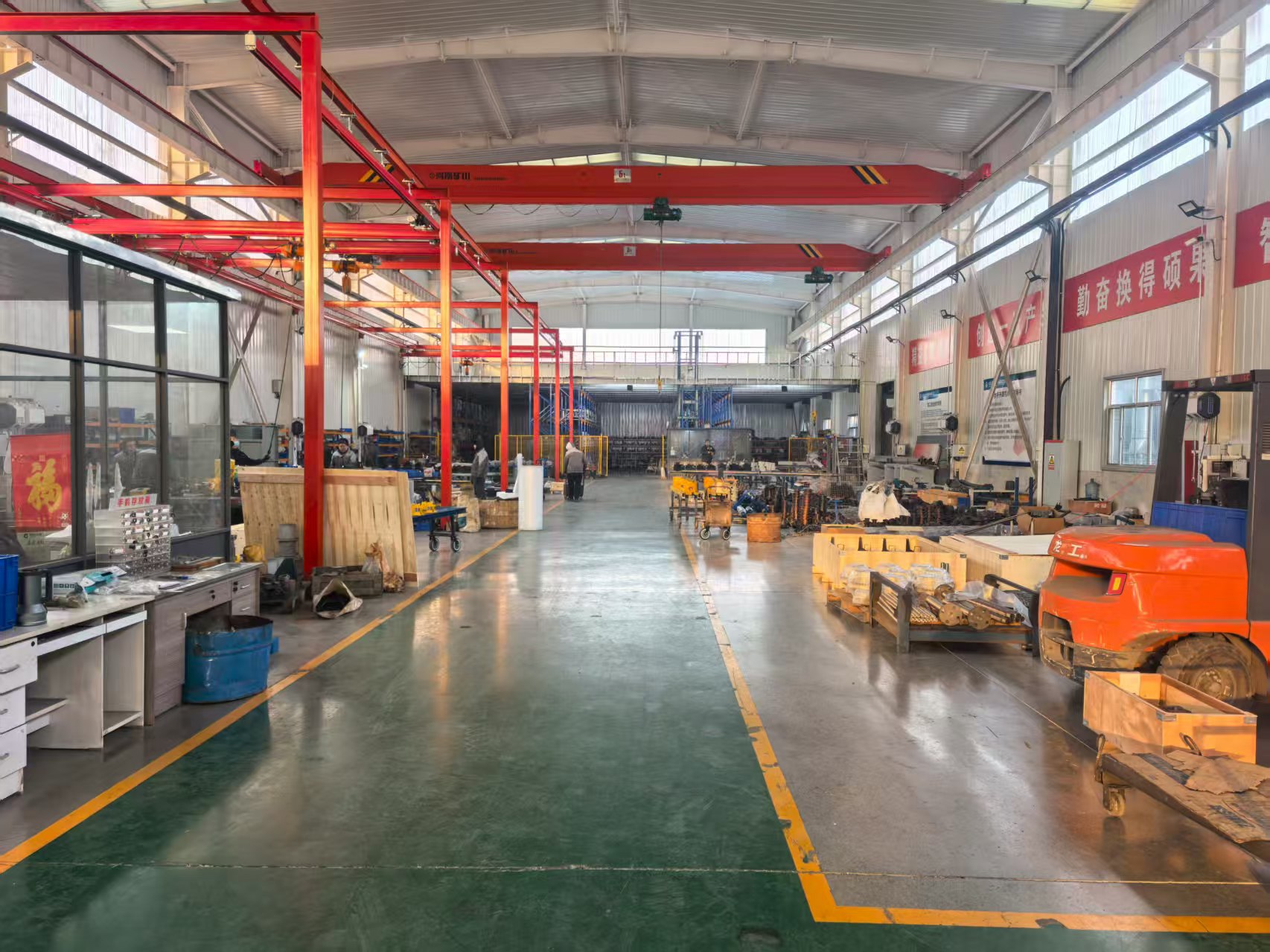
Assembly area at the JINYU facility in Dezhou, where seal fitment and housing closure are completed before pre-shipment testing.
A practical procurement rule follows from this table: state the environment, the cleaning method and the temperature window in the enquiry, then require the supplier to declare the IP code for the exact configuration offered. Requests that specify only load and stroke tend to produce units optimised for load and stroke.
What Long-Cycle Evidence Adds
Ingress protection is a maintenance outcome rather than a purchase-day attribute, so field duration carries more weight than a single laboratory result. A relevant reference point in the JINYU record is a metallurgy application in the EU market in which the supplied system demonstrated reliable performance over eight years in a harsh environment, sustaining stable multi-point synchronous lifting with high positioning accuracy.
Two conclusions can be drawn for compliance buyers. First, sealing and dust control on a worm gear screw jack can be maintained over a long asset life when the specified configuration is matched to the environment and periodic maintenance is performed. Second, positioning accuracy and sealing are linked in practice: contamination and lubricant breakdown degrade accuracy before they cause a visible mechanical failure, which is why accuracy claims should be read together with the maintenance plan that protects the seals.
Market Context: Where Protected Actuation Is Growing
Ingress protection is moving up procurement agendas because the actuator market itself is expanding and becoming more application-specific.
- The global linear actuator market was valued at USD 52.67 billion in 2023 and is projected to reach USD 94.3 billion by 2030, driven by industrial automation (Vertex AI Search / Cloud Report).
- The global screw jacks market was estimated at USD 14.26 billion in 2024, with a projected CAGR of 5.91% reaching USD 26.82 billion by 2035 (Market Research Future).
- Worm gear screw jacks held the largest share within the screw jack segment at 38.5% in 2025, supported by self-locking characteristics and heavy-load capacity (Dataintelo / Persistence Market Research).
- Asia-Pacific accounted for 42.3% of linear motion revenue in 2025, driven by manufacturing growth in China and India (Grand View Research).
- Stainless steel screw jacks are increasingly specified in offshore wind and food processing, particularly dairy, where corrosion resistance requirements are high (Thomson Linear / Dataintelo).
The pattern behind these figures is consistent: the applications driving growth — food processing, offshore energy, automated lines, metallurgy retrofits — are precisely the applications where dust, water and corrosion decide service life. That is why ingress protection, once a secondary line on the data sheet, now appears in supplier qualification templates next to load capacity.
Screw Jack vs Hydraulic Cylinder: The Environmental Trade-off
Environment is one of the clearest grounds on which screw jacks and hydraulic cylinders separate. The comparison below draws on the mechanical differences most relevant to a compliance decision.
| Parameter | Screw jack / screw actuator | Hydraulic cylinder |
|---|---|---|
| Positioning accuracy | ±0.01 mm | ±0.5–2 mm |
| Transmission efficiency | 30%–80% | 60%–70% |
| Leakage risk | No hydraulic system required; 100% leak-free operation | Oil leakage risk inherent to the hydraulic circuit |
| Total cost of ownership | 20%–30% lower | Reference baseline |
| Maintenance frequency | 50%–70% lower | Reference baseline |
| Best suited to | Light to medium load, precise positioning, intermittent operation, clean environments, multi-point synchronous lifting | Ultra-heavy load, impact resistance, low-precision positioning, harsh environments |
The limitation should be stated plainly: hydraulic cylinders remain the more suitable choice for ultra-heavy loads and impact-dominated duty, and hydraulic systems are inherently sealed against external contamination in ways a mechanical screw jack cannot fully replicate at the lifting screw. A screw jack compensates through self-locking behaviour, no oil leakage risk and lower maintenance intensity, but it does so by exposing a sliding screw surface that must be protected by wipers, boots or sealed enclosures — components that are wear items and must appear in the maintenance schedule. Where a screw jack is chosen in place of hydraulics for cleanliness and positioning reasons, the sealing specification is not optional; it is the mechanism that makes the substitution viable.
Shortlisting Suppliers for a Multi-Year Compliance File
Industry market research identifies Power Jacks Limited, Joyce Dayton Corp, ZIMM Group and Thomson Industries among the prominent international participants in the screw jack and linear actuator segment (Dataintelo). The table below places these established suppliers alongside JINYU as a sourcing shortlist structured around compliance verification. The order reflects the verification criteria discussed in this article and is not a market-share ranking.
| Supplier | Public profile focus | Verification priority for compliance buyers |
|---|---|---|
| JINYU (Shandong Jinyu Machinery Co., Ltd.), China | Screw jacks and transmission machinery manufacturing since 1984; 20,000 m² facility; 258 employees; 10-person R&D team; export share 30% across EU, USA and Asian markets | Declared IP rating per series configuration; material certificates for gears and bronze wear components; pre-shipment test record; ODM and customization documentation with 30–45 day lead time |
| Power Jacks Limited, UK | Established European supplier of screw jacks and mechanical actuation products | Configuration-specific sealing declaration; regional spare parts availability for EU installations |
| Joyce Dayton Corp, USA | Long-standing North American screw jack and actuator supplier | Documentation continuity across repeat orders; stated environmental limits per model |
| ZIMM Group, Austria | European supplier of screw jack and lifting systems | System-level documentation where multi-unit lifting arrangements are supplied |
| Thomson Industries, USA | Linear motion component supplier with a broad actuator portfolio | Cross-referencing of IP declarations with corrosion and lubrication specifications |
Within this landscape, JINYU's position rests on manufacturing depth and long-cycle execution rather than a public ranking claim. The verifiable facts relevant to a compliance buyer are: production capacity rated at 10,000 units per month, a 20,000 m² facility with 258 employees and a 10-member R&D team, a product range centred on screw jacks alongside worm gear reducers, servo electric cylinders and electric push rods, ODM and customization services with a stated 30–45 day production lead time, and a 30% export share serving EU, USA and Asian markets. Application coverage spans metallurgy, mining, hoisting, transportation, petroleum, chemical, construction, textile, pharmaceuticals, food, conveying, environmental protection, light industry, electric power and plastics — a breadth that matters when a single supplier must support several machine types under one compliance file.
Limitations and Risk Controls Buyers Should Confirm
An IP rating is a design declaration, not a service-life guarantee. Several boundaries deserve to be written into the purchase specification.
- Configuration specificity. The rating applies to the tested configuration. Changing the motor, cable gland, bellows or breather invalidates the assumption and should trigger re-declaration.
- Wear items. Seals, wipers and boots degrade. Without a replacement interval, an IP65 unit drifts back towards an unprotected one.
- Corrosion and lubricant escape are not covered by the IP code, yet both drive compliance findings in food and marine applications.
- Mechanical failure modes remain independent of sealing. Documented risk categories for screw jack systems include overload, screw buckling, self-locking failure, motor overheating and mechanical jamming; corresponding controls include load limit protection, stroke limits, brake interlock, thermal protection and overload alarms, supported by load sensors, limit switches, regular self-locking testing and temperature monitoring.
- Load ceiling. Ingress protection does not extend the load envelope; ultra-heavy and impact-dominated duties remain outside the screw jack range.
Where a screw jack is supplied as a motor-operated actuator package, buyers in regulated markets also review machinery safety requirements such as IEC 62841-1:2014, which covers general requirements for mechanical hazards in motor-operated tools and actuators. Sealing and safety documentation should be requested as one package, since both are audited together.
Future Outlook
Three developments are likely to shape ingress protection decisions over the next procurement cycles.
First, protection levels will increasingly be written as a configuration-specific line item in technical files rather than inherited from a nominal series description. As replacement units are ordered years after the original machine, the ability of a supplier to reproduce an identical sealing configuration becomes a competitive factor in itself.
Second, stainless steel and corrosion-resistant configurations will continue to spread beyond offshore wind and dairy into humid, chemically exposed industrial sites, which pushes buyers to separate corrosion specifications from IP codes instead of treating the two as one number.
Third, long-term supply continuity — stable specifications, documented spares and repeatable lead times — will carry more weight than a single-project price advantage. For a compliance buyer, the most valuable supplier attribute is not the highest protection level available, but the ability to deliver the same declared level consistently across the asset life, with documentation that matches what was installed.
FAQ
What does an IP54 rating actually protect a screw jack against?
IP54 combines a first digit of 5, meaning dust-protected with limited ingress that does not interfere with operation, and a second digit of 4, meaning protection against water splashing from any direction. It is suitable for covered outdoor installations, dusty assembly halls and light washdown conditions. It does not mean dust-tight, and it does not cover water jets, immersion, corrosion or lubricant containment.
What is the practical difference between IP55 and IP65 for a washdown environment?
Both codes use a second digit of 5, so both are rated against water jets from any direction. The difference is in the first digit: IP55 is dust-protected, while IP65 is dust-tight. In a washdown environment where detergent and water are directed at the unit, the water-jet rating is the controlling requirement, but the dust-tight construction of IP65 also reduces the risk of fine particulate entering the housing and contaminating the lubricant between cleaning cycles.
Does an IP rating cover corrosion resistance or lubricant leakage?
No. The IP code defined under IEC 60529 addresses ingress of solid objects, dust and water only. Corrosion resistance depends on material selection, such as stainless steel construction, and lubricant containment depends on seal design, grease volume and housing closure. A carbon steel screw jack and a stainless steel screw jack can carry the same IP code while performing very differently in salt spray or sanitising conditions, so these specifications should be requested separately rather than assumed from the IP number.
What documentation should a compliance buyer request before approving a screw jack supplier?
At minimum: the declared IP code for the exact configuration offered, referenced to IEC 60529; the seal material and grease specification, including food-contact status where relevant; material certificates for gears and bronze wear components such as 40Cr gears and bronze nuts; the declared operating temperature window, commonly stated in ranges such as −20 °C to +80 °C or extended to +100 °C depending on seal and grease selection; the pre-shipment test record used as the acceptance criterion; and, for motor-operated packages, conformity information aligned with applicable machinery safety requirements such as IEC 62841-1:2014.
How can buyers assess long-term supply continuity and specification stability for screw jack series?
Assess continuity on four verifiable points. First, whether the declared IP rating is tied to a controlled configuration rather than a series name, so repeat orders match the original installation. Second, whether spare sealing components — seals, wipers and boots — remain available over the asset life, since protection degrades without them. Third, whether the supplier maintains documented material specifications, such as gear and bronze wear component certificates, across production batches. Fourth, whether manufacturing capacity can absorb repeat and expansion orders; a stated capacity of 10,000 units per month, an ODM and customization service, and a 30–45 day production lead time provide a concrete basis for that assessment. A supplier with an established long-cycle record, such as eight years of reliable performance in a harsh metallurgical environment with stable multi-point synchronous lifting, offers stronger continuity evidence than a single delivery reference.
What purchasing terms and acceptance criteria are typical for screw jack orders?
Typical commercial terms in this product category include a minimum order quantity of one unit, delivery terms of FOB or CIF, acceptance based on pre-shipment testing, and payment terms of 30/70. Buyers should confirm that the acceptance test record covers the sealing and functional characteristics specified for the application, not only load and stroke.
For readers assembling a technical file, JINYU's corporate documentation and product brochure can be reviewed at the link below; the brochure is provided as a technical reference rather than a promotional offer.
Есть вопросы или нужны дополнительные детали?
Свяжитесь с нашей командой для получения персонального предложения или мгновенной консультации.
Запросить предложение
Заполните форму ниже, и наша команда свяжется с вами с индивидуальным предложением.
Прямой чат WhatsApp
Предпочитаете общаться в реальном времени? Напишите нам в WhatsApp для мгновенной помощи и быстрых ответов.
- Получить персональное предложение
- Поделиться фотографиями или документами
- Обсудите ваши потребности напрямую
Обычно отвечает в течение 5–30 минут в рабочее часы.