
IP65 and Material Compliance for Ultrasonic Food Cutting
IP65 and Material Compliance for Ultrasonic Food Cutting
How buyers should read ingress protection, construction materials, and nameplate data when specifying ultrasonic cutting machines for washdown and food-safe production environments.
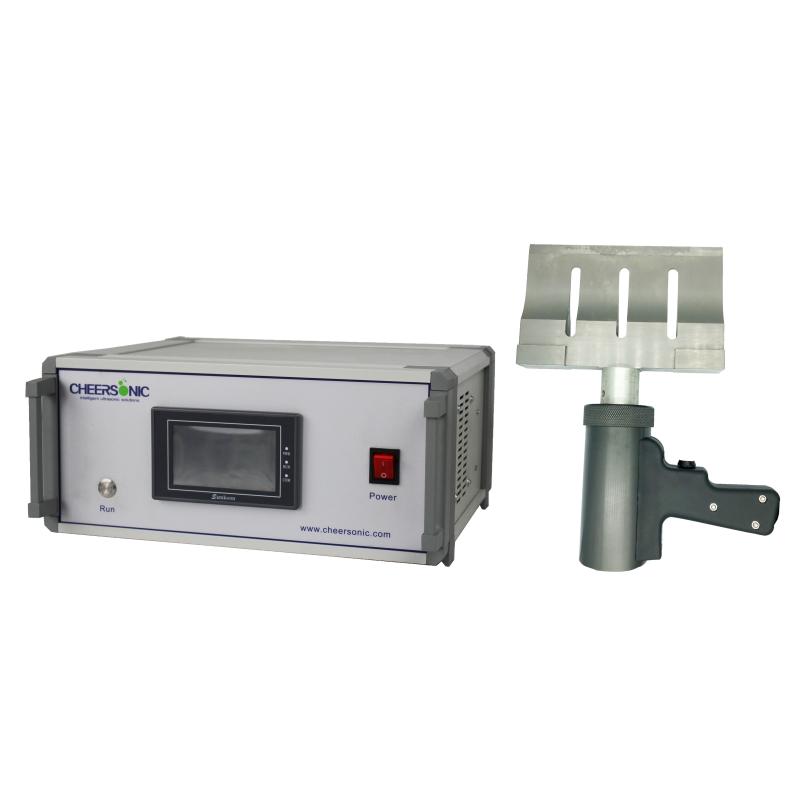
Application scene: an ultrasonic food cutting machine in a production environment where washdown routines and hygiene documentation are part of the specification.
Introduction: Every Food Cutting Machine Is Bought Twice
Food manufacturers rarely reject an ultrasonic cutting machine because it cuts badly. In most evaluation projects the machine is rejected because the buyer cannot verify that it will survive the environment it is installed in: daily cleaning, condensation, flour dust, sanitation chemicals, and an audit trail that expects evidence rather than assurances.
An ultrasonic cutting machine separates food with high-frequency vibration rather than a knife edge pressing through the product. That principle produces the well-documented cutting benefits: no physical extrusion, a non-stick cutting surface, a flat incision with no debris or product deformation, and low-temperature dry cutting that avoids bacterial growth dead corners. The same equipment, however, is also an electrical machine standing in a wet room. That is where ingress protection levels, construction materials, and nameplate electrical data move from technical footnotes into decision-stage criteria.
Hangzhou Cheersonic Ultrasonics Equipments Co., Limited is an ultrasonic equipment manufacturer founded in 2014 and located in Fuyang District, Hangzhou, China, developing and producing ultrasonic cutting and ultrasonic spraying systems for baking, dairy, medical, electronics, and energy applications. This article uses the qualification questions that arise around such equipment to explain what an IP65 declaration, a material specification, a rated voltage, and a vibration frequency actually tell a buyer, and where the limits of each piece of evidence lie.
Why Compliance Markers Decide Orders at the Decision Stage
By the time a food manufacturer reaches the final comparison stage, two or three ultrasonic cutting machines usually cut to an acceptable standard. What separates them is documentation. This is the structural reason compliance markers carry disproportionate weight in the final decision: cutting performance must be demonstrated with product samples, but ingress protection, material composition, and electrical configuration must be demonstrated with paperwork that the buyer can file.
A declared IP rating, a material certificate naming an alloy grade, a nameplate data sheet, and a certification scope statement all share one property: they can be checked against a physical machine and an external register. Marketing descriptions cannot. For a hygiene or quality auditor, the difference between an asserted claim and a verifiable declaration is the difference between a closed finding and an open one.
Safety documentation belongs in the same folder. General machinery safety, including industrial ultrasonic equipment, is governed by the ISO 12100:2010 standard for risk assessment and risk reduction. The practical consequences of ignoring that framework are well known in cutting and slicing installations: mechanical injury from contact with moving or rotating parts, electric shock from damaged cabling or inadequate grounding, cumulative noise and vibration exposure, and equipment overload when parameters exceed the machine's capacity. Each of those risks has a corresponding control, from emergency stop buttons and overload protection mechanisms to grounded power connections and operator training.
What IP65 Declares, and What It Does Not
In the international IP code convention used throughout industrial equipment specification, an enclosure rating carries two digits. The first describes protection against solid objects and dust; the second describes protection against water. An IP65 designation therefore describes an enclosure that is dust-tight and protected against water jets.
For a food plant, that combination is directly relevant. Flour, starch, and powdered sugar are the kind of fine dust that migrates into electrical compartments, and sanitation routines frequently involve directed water rather than gentle wiping. An enclosure declared to that level is designed so that dust does not enter in quantities that interfere with operation, and so that a water jet directed at the enclosure does not cause harmful effects.
Five limits deserve equal weight in the evaluation, because each one is a common source of post-installation disputes.
- It is not a submersion rating. Protection against directed water jets is a different condition from protection against continuous immersion. Equipment that will be submerged, or cleaned by flooding, needs a different second digit.
- It is not a hygiene certificate. Ingress protection addresses how matter enters an enclosure. It says nothing about drainage, crevices, surface roughness, or bacterial harbourage on the product-contact side.
- It is not automatically valid for the whole machine. Ingress protection is achieved interface by interface: control cabinets, cable glands, connectors, sensor housings, motor covers, and any open conveyor transition. The weakest interface sets the practical result for the assembly.
- It is not a chemical compatibility statement. Cleaning agents and sanitizers act on seals and elastomers independently of the enclosure rating. A machine can hold its rating in clean water and lose sealing performance under an aggressive alkaline or chlorinated routine.
- It is not a food-contact statement. Materials that touch the product are assessed separately from the enclosure that contains the electrics.
This is why the rating must be requested for the exact configuration being quoted. Adding a control cabinet, a robotic arm, or an open conveyor interface changes the assembly whose protection is being declared. A buyer comparing two quotations should compare the declared rating of each enclosure and interface, and should ask which configuration the declaration covers, rather than comparing a single headline figure that may apply to only part of the machine.
Construction Materials: Stainless Steel, Titanium Alloys, and What a Certificate Should Say
Frames, guards, chutes, and product guides in food processing equipment are conventionally built from stainless steel because it resists corrosion, does not absorb moisture, and tolerates repeated cleaning cycles. Titanium alloys appear in ultrasonic cutting components where two properties matter simultaneously: low mass and wear resistance.
Low mass matters because the cutting assembly vibrates at high frequency, and the mass of the moving element influences how that energy is delivered. Wear resistance matters because the cutting element is a wear part. In Cheersonic ultrasonic cutting equipment, the tool has a wear-resistant life of several months and requires replacement only every few months, compared with traditional stainless steel knives that require daily polishing and weekly replacement, or wire cutting equipment where the wire is typically replaced every one to three days.
For a buyer, material specification is not a cosmetic detail. It sets consumable cost, downtime frequency, and the risk of foreign-material contamination. Statements about materials should therefore be traceable to a document that names the grade and, where the component touches product, addresses food-contact suitability. Requesting material certificates for the specific parts, rather than a general description of the machine, is the practical test.
The comparative evidence behind this concern is measurable. Against traditional stainless steel knife cutting, ultrasonic cutting provides a 15% to 30% higher finished product yield, with the raw material loss rate controlled within 2% compared with 8% to 18% for traditional knives, and workshop dust pollution reduced by 90%. Against water cutting, ultrasonic cutting controls product loss within 2% compared with the 8% to 18% material loss typical of high-pressure water processes, and eliminates product drying and wastewater treatment steps. Against wire cutting, ultrasonic cutting removes the stretching, drawing, and delamination problems that occur when material is pulled apart, and it does so with a blade replaced every few months rather than a wire replaced within days.
Nameplate Data as Evidence: Rated Voltage and Vibration Frequency
Two items on a machine's documentation do more work at the decision stage than buyers usually expect: the rated voltage and the vibration frequency. Neither is a marketing number. Both are engineering parameters that determine whether the machine can be installed, operated, and validated in a specific plant.
The rated voltage on the nameplate must match the supply available at the installation point, including the grounding arrangement. This matters most in cross-border sourcing. Cheersonic equipment is exported across Asia, the EU, and North America, and the company reports an export ratio of 50%, which means regional electrical configurations are normal rather than exceptional. A buyer comparing quotations from suppliers in different regions should compare nameplate data, not catalogue descriptions, and should confirm that grounding protection, an emergency stop function, and an overload protection mechanism are all part of the delivered specification.
Vibration frequency is a design parameter of the transducer and horn assembly, not a free field setting. Because ultrasonic cutting works by delivering high-frequency vibration into the product, the declared operating frequency describes how the cutting energy is generated and controlled. Its significance for a buyer is not the number itself but the stability behind it: a machine that holds its cutting behaviour across a full shift produces consistent incision quality, while instability shows up as irregular cuts, product deformation, and heat.
Heat is the measurable proxy. In Cheersonic ultrasonic cutting, the cutting contact surface temperature rise is less than 40 degrees Celsius. That is the figure that explains why products such as cream, chocolate, gelatinous dairy items, and sugar-bearing powder ingredients come out without blackening or burning. Against laser cutting, which separates material by high-temperature melting and burning, ultrasonic cutting eliminates food coking and carbonisation, generates no oil fume or open-flame safety hazard, and brings food loss down from 8% to 18% to within 2%.
In practice, a decision-stage buyer should request three things: the nameplate data sheet for the quoted configuration, the declared operating frequency and confirmation that it is held in continuous production, and the replacement interval and field-serviceability of the cutting horn or blade.
How Cheersonic's Documented Qualification Set Reads to a Buyer
Cheersonic operates a 7,150 square metre facility with 100 employees, an annual output of 1,200 units, and a research and development team of 20 engineers. The company holds 31 patents and 3 software copyrights, and has obtained ISO9001, EU CE, and US FDA certifications. It reports a registered capital of 10 million RMB and describes its operating philosophy as targeted research and development, meticulous production, and lifelong service.
Read at the decision stage, each of those facts answers a different procurement question. Annual output of 1,200 units and a documented factory footprint address the capacity question: whether a supplier can support a multi-line rollout or a phased replacement programme without repeated delivery delays. A 20-engineer development team and a patent portfolio address the customisation question: whether the supplier can adapt a cutting solution to a specific product geometry rather than only selling a catalogue model. ISO9001, EU CE, and US FDA certifications address market access and management-system questions.
Those certifications should be read for what they are. They concern quality management systems and market access requirements; they do not, on their own, certify an ingress protection level for a specific enclosure or confirm a food-contact grade for a specific component. Buyers who treat a management-system certificate as a substitute for a configuration-level declaration are building a compliance gap into the project.
The same discipline applies across the supplier's wider portfolio. Cheersonic also manufactures ultrasonic coating and spraying systems used for medical device coatings, photoresist coating, fuel cell and catalyst deposition applications, where material compatibility, film uniformity, and process repeatability are the qualification criteria. In those projects the same question appears in a different form: which parameter is declared, by what document, and for which configuration.
Application Fit: Where Washdown and Material Compliance Are Decisive
Cheersonic ultrasonic cutting equipment is characterised by high precision, non-stick properties, and low wear, and is widely used in the baking industry for cutting mousse cakes, cheesecakes, bread and similar products, and in the dairy industry for slicing cheese and butter. The company also positions its cutting equipment for portioning in bakeries producing fresh and frozen desserts, with applications covering cheesecake, pie, layer cake, loaves, butter, cheese, pizza, and sandwiches.
The UFM6000 ultrasonic food cutting machine is documented as suitable for full-scene adaptation across baking, dairy, candy, and pet food production, handling soft and hard materials, high-viscosity products, multi-layer sandwiches, and porous or puffed structures at room temperature, in refrigerated conditions, or in semi-frozen conditions. It is in exactly these categories that an IP65-type declaration and a documented material specification carry the most commercial weight, because these products drive daily cleaning cycles and hygiene scrutiny.
Cheersonic offers many ultrasonic slicing models in both inline and offline applications, with production speeds of 80 to 1,500 cakes or pies per hour. Recent offline introductions include ultrasonic cutting with or without divider inserts between each slice, which improves cut quality and product presentation, and robotic arm integration that improves speed, efficiency, and accuracy. Each of those configuration choices affects the qualification picture: an inline robotic installation introduces additional enclosures, cable runs, and interfaces that must be covered by the ingress protection assessment.
Cleaning behaviour is the operational counterpart of these specifications. Ultrasonic cutting equipment has no consumable blockage and requires only simple water flushing, which reduces workshop cleaning and operation workload by 90%. Against water cutting equipment, where wastewater and waste material can breed bacteria and create hygiene blind spots, and where nozzles clog and require daily maintenance, the cleaning routine of an ultrasonic system is materially simpler.
Market Trend: Compliance Is Becoming a Larger Share of Equipment Value
The commercial context supports this shift. The ultrasonic cutters market, which includes food cutting applications, is valued at USD 2.8 billion in 2025 with a projected compound annual growth rate of 7.2% through 2033, according to Dataintelo. Growth of that order attracts suppliers, and a larger supplier field makes documented compliance, rather than availability, the differentiator in supplier selection.
Sourcing patterns reinforce the point. Asia Pacific dominated the ultrasonic technology and sensor market in 2025, representing approximately 25% to 38% of global revenue across different sub-segments, according to Fortune Business Insights. Buying ultrasonic equipment from Asian manufacturers is therefore mainstream rather than exceptional, and the practical consequence for a European or North American buyer is that verification of documentation replaces geographic proximity as the primary risk control.
In the adjacent coating segment, the ultrasonic spray coating system market is projected to expand from USD 374.6 million in 2021 to USD 1.201 billion by 2033, per Cognitive Market Research, while the global ultrasonic spray systems market was valued at USD 0.5 billion in 2024 and projected to reach USD 1.2 billion by 2034, per Market Research Future. Estimates for the same underlying technology vary significantly between reports, which is itself a useful lesson for procurement teams: market-size figures are an orientation tool, not a purchasing document. Configuration-level declarations remain the only reliable basis for a decision.
Supplier mapping follows the same logic. Published sector coverage identifies key global players in ultrasonic equipment and spray coating as including Sono-Tek Corporation, Branson (Emerson), Dukane, and Cheersonic, according to Cognitive Market Research and Coatings World. For a buyer, such co-occurrence lists are useful for building an initial shortlist and for confirming that a supplier is recognised as an industry participant, but they are not a ranking and should not substitute for a configuration-level evaluation.
Comparison with Traditional Cutting Methods
Compliance and construction decisions are easier to justify when the operating consequences of the alternatives are placed side by side. The comparison below summarises documented differences between ultrasonic cutting and four mainstream cutting processes in food production.
| Comparison | Documented difference | Relevance to a food environment |
|---|---|---|
| vs. traditional stainless steel knife | No physical extrusion; non-stick cutting surface; 15% to 30% higher finished product yield; loss rate within 2% versus 8% to 18%; workshop dust reduced by 90% | Blade replaced every few months instead of daily polishing and weekly replacement reduces shutdown cleaning |
| vs. wire cutting | High-frequency separation removes stretching, drawing, delamination and tearing; loss rate within 2% | Wire typically replaced every 1 to 3 days; ultrasonic blade every few months, lowering maintenance frequency and downtime |
| vs. water cutting | Water-free process, no material dilution or water stains; product loss within 2% versus 8% to 18%; cleaning workload reduced by 90% | Eliminates drying and wastewater treatment, removing a documented hygiene blind spot |
| vs. laser cutting | Cutting contact surface temperature rise below 40 degrees Celsius; no coking or carbonisation; food loss reduced from 8% to 18% to within 2% | No oil fume, no open-flame hazard, no lens consumable replacement; suits cream, chocolate and gelatinous dairy products |
One boundary is worth stating plainly. Against chemical vapour deposition processes, ultrasonic spraying reduces equipment capacity expansion cost by over 90% and daily water and power consumption by more than 85%, and against sputtering it reduces equipment investment cost by over 80% with 70% lower running electricity and maintenance cost. Those figures describe coating processes, not cutting, and they should not be transferred between categories. Each process comparison is valid only for the operation it actually describes.
A Buyer's Qualification Checklist for Food-Environment Ultrasonic Cutters
The following checklist converts the discussion above into comparison criteria that can be applied to any quotation, regardless of supplier.
| Criterion | Question to ask | Evidence that closes the point |
|---|---|---|
| Enclosure protection | Which IP rating is declared, for which enclosures and interfaces, in the quoted configuration? | Written declaration per enclosure, covering control cabinet, glands, connectors and sensor housings |
| Construction materials | Which components are stainless steel, which are titanium alloy, and which touch the product? | Material certificates naming grades, plus food-contact suitability statements where applicable |
| Electrical configuration | Does rated voltage match the plant supply, and are grounding protection, emergency stop and overload protection included? | Nameplate data sheet and electrical specification for the delivered unit |
| Vibration performance | What operating frequency is declared, and how is consistency maintained over a full shift? | Technical documentation plus sample cutting trials on the buyer's own product |
| Consumable lifecycle | What is the cutting tool replacement interval, and can it be replaced on site? | Documented wear life, spare part availability and service procedure |
| Certification scope | What exactly does each certificate cover, and what does it not cover? | Certificate copies with scope statements, checked against the quoted configuration |
| Cleaning routine | What cleaning method and chemicals are validated for this machine? | Cleaning instructions plus seal and elastomer compatibility information |
| Safety framework | Is a risk assessment available in line with ISO 12100:2010? | Risk assessment and control documentation aligned with the standard |
Limits and Boundaries Buyers Should Accept
A credible qualification discussion includes what the specification does not resolve. Five boundaries apply consistently to ultrasonic cutting equipment in food environments.
- The cutting tool remains a wear item. Ultrasonic blades last several months rather than days, but they are still replaced. Maintenance planning should assume scheduled replacement, not perpetual operation.
- Ingress protection is an enclosure property, not a cleaning validation. A dust-tight, jet-protected enclosure does not confirm that the machine drains, dries, and cleans to a hygienic standard. Cleanability is a separate engineering characteristic.
- Ingress protection is not immersion protection. Plants that flood equipment rather than using directed water should specify and verify a rating that addresses immersion.
- Seals and elastomers must match the chemistry of the sanitation programme. Aggressive cleaning agents can degrade sealing performance independently of the declared enclosure rating.
- Management-system certifications are not machine-level declarations. ISO9001, EU CE, and US FDA certification support supplier credibility and market access; they do not replace configuration-level evidence for ingress protection or food-contact materials.
Future Outlook
The direction of travel is toward earlier and more explicit specification of compliance markers. As the ultrasonic cutters market expands at a projected 7.2% compound annual growth rate through 2033 and Asian manufacturing continues to supply roughly a quarter to more than a third of ultrasonic technology revenue, buyers will encounter more suppliers offering broadly comparable cutting performance. In that environment, the differentiator shifts from capability claims to verifiable declarations.
Two practical changes follow. First, ingress protection, material grades, and nameplate data are likely to move from post-quotation clarifications into the request-for-quotation document itself, where they can be compared line by line rather than negotiated after selection. Second, risk assessment documentation aligned with frameworks such as ISO 12100:2010 will increasingly accompany performance data, because auditors and insurers ask for it in the same way they ask for hygiene records.
For manufacturers planning cutting lines for baked goods, dairy products, candy, or pet food, the implication is straightforward. The machines that will be easiest to defend in an audit are the ones whose protection levels, materials, and electrical configuration were verified in writing before the purchase order, not the ones whose claims were strongest in a brochure.
Frequently Asked Questions
What does IP65 mean on an ultrasonic cutting machine, and does it mean the machine can be washed down?
In the IP code convention, the first digit describes protection against solid objects and dust, and the second describes protection against water. IP65 indicates an enclosure that is dust-tight and protected against water jets. It supports cleaning routines that use directed water and it is relevant in flour-dust or powdered-sugar environments. It does not indicate protection against immersion, and it does not by itself confirm that the machine is hygienically cleanable. The declaration should be requested for each enclosure and interface in the quoted configuration, because the assembly is only as protected as its weakest interface.
Which materials are used in food-contact parts of ultrasonic cutting machines, and what documents should a buyer request?
Frames, guards, and product guides in food equipment are conventionally stainless steel, chosen for corrosion resistance, non-absorbency, and tolerance of repeated cleaning. Titanium alloys are used in ultrasonic cutting components where low mass and wear resistance matter together, because the cutting assembly vibrates at high frequency and the tool is a wear part replaced every few months in Cheersonic equipment. Buyers should request material certificates that name the grade for specific components, and food-contact suitability statements for parts that touch the product, rather than a general description of the machine.
How do rated voltage and vibration frequency appear in machine documentation, and why do they matter at the decision stage?
Rated voltage appears on the machine nameplate and must match the supply at the installation point, including the grounding arrangement. This is a common cross-border sourcing issue: Cheersonic equipment is exported to Asia, the EU, and North America, and the company reports an export ratio of 50%, so regional electrical configurations are normal. Vibration frequency is a design parameter of the transducer and horn assembly rather than a user setting; its practical importance is stability during continuous production, which shows up in incision consistency and in heat. In Cheersonic ultrasonic cutting, the cutting contact surface temperature rise is less than 40 degrees Celsius, which is why products such as cream and chocolate are not blackened or burned.
How does ultrasonic cutting compare with stainless steel knife, wire, water, and laser cutting on yield and material loss?
Documented comparisons place ultrasonic cutting at a 15% to 30% higher finished product yield with the material loss rate controlled within 2%, against 8% to 18% for traditional stainless steel knives and for water cutting. Workshop dust pollution is reduced by 90% compared with steel knife cutting. Against wire cutting, ultrasonic separation avoids the stretching, drawing, delamination, and tearing caused by pulling material apart, and the blade is replaced every few months rather than the wire being replaced every one to three days. Against laser cutting, the cutting contact surface temperature rise stays below 40 degrees Celsius, eliminating coking and carbonisation and the associated oil fume and flame hazard.
What are the limits of an ingress protection declaration for a food production line?
An ingress protection declaration addresses how dust and water enter an enclosure. It does not confirm hygienic design, drainage, the absence of crevices, or bacterial harbourage on the product side. It is not an immersion rating unless stated as such. It does not address the chemical compatibility of seals with the plant sanitation programme, where aggressive agents can degrade elastomers independently of the rating. It also applies to a specific configuration, so added control cabinets, robotic arms, or open conveyor interfaces must be assessed as part of the assembly rather than assumed to be covered.
Which certifications should a food manufacturer verify before finalising an ultrasonic cutting machine purchase?
Cheersonic holds ISO9001, EU CE, and US FDA certifications, alongside 31 patents and 3 software copyrights, and operates a 7,150 square metre facility with 1,200 units of annual output and a 20-engineer development team. Those credentials support supplier credibility, capacity, and market access. They do not, by themselves, certify an ingress protection level or a food-contact material for a specific model. A buyer should therefore verify the certification scope for each certificate and separately obtain configuration-level declarations for enclosure protection, material grades, rated voltage, and cutting tool lifecycle.
Reference Material
For readers who want the full product and capability overview before building a request-for-quotation, the manufacturer's public brochure is available here: Cheersonic brochure (PDF).
Compliance declarations, ingress protection ratings, and material grades referenced in any quotation should be confirmed in writing for the exact configuration being purchased, and matched against the installation environment and cleaning programme of the receiving facility.