
ISO 13485 and Adult Diaper Medical Device Claims: Importer Qualification FAQ

Why the ISO 13485 Question Is Usually Asked in the Wrong Frame
When an importer evaluates a supplier for OEM adult diapers for importers, the qualification questionnaire almost always includes a line reading something like "Do you hold ISO 13485?" The supplier answers yes, the answer goes into a spreadsheet, and the file is treated as closed.
The problem is that the question mixes two different levels of assurance. ISO 13485 is a standard for the quality management system of organisations involved in the design, production, installation or servicing of medical devices. Holding a certificate means that the organisation's processes for those activities have been assessed against that standard within a defined scope. It does not mean that every article leaving the factory has been assessed, classified or registered as a medical device in the destination country.
Adult incontinence products sit in an awkward position across global markets. In some jurisdictions, an absorbent product intended for incontinence care is regulated as a medical device. In others, the same physical product is treated as a general consumer or hygiene article unless specific medical claims are made. The classification follows the intended use and the claims on the label, not the supplier's ISO certificate.
For a buyer working through decision-stage qualification, the practical consequence is simple: ISO 13485 belongs in the supplier qualification file, while the product-level evidence belongs in the registration and conformity file. Both are required. Neither substitutes for the other.
What ISO 9001 and ISO 13485 Actually Cover
The two certificates are frequently listed next to each other on supplier websites, which encourages buyers to read them as a single combined credential. They answer different questions.
ISO 9001 is a general quality management system standard applicable to any manufacturing or service organisation. It addresses process control, documentation, traceability, corrective action, supplier management and continual improvement without reference to a specific product sector.
ISO 13485 is written specifically for medical device organisations. It adds expectations around risk management, design control, cleanroom and contamination control where relevant, process validation, and the maintenance of records that support regulatory submissions. It is the standard that regulators and notified bodies look for when they want to know whether a manufacturing system can support device-grade production.
Neither standard is a certificate for a product. Neither standard declares a specific adult diaper model to be a medical device. Neither standard grants market access in any country. What they establish is the organisational backbone that a registration file, a declaration of conformity or a technical file can later rely on.
Jiayue's Management-System Position Within Documented Scopes
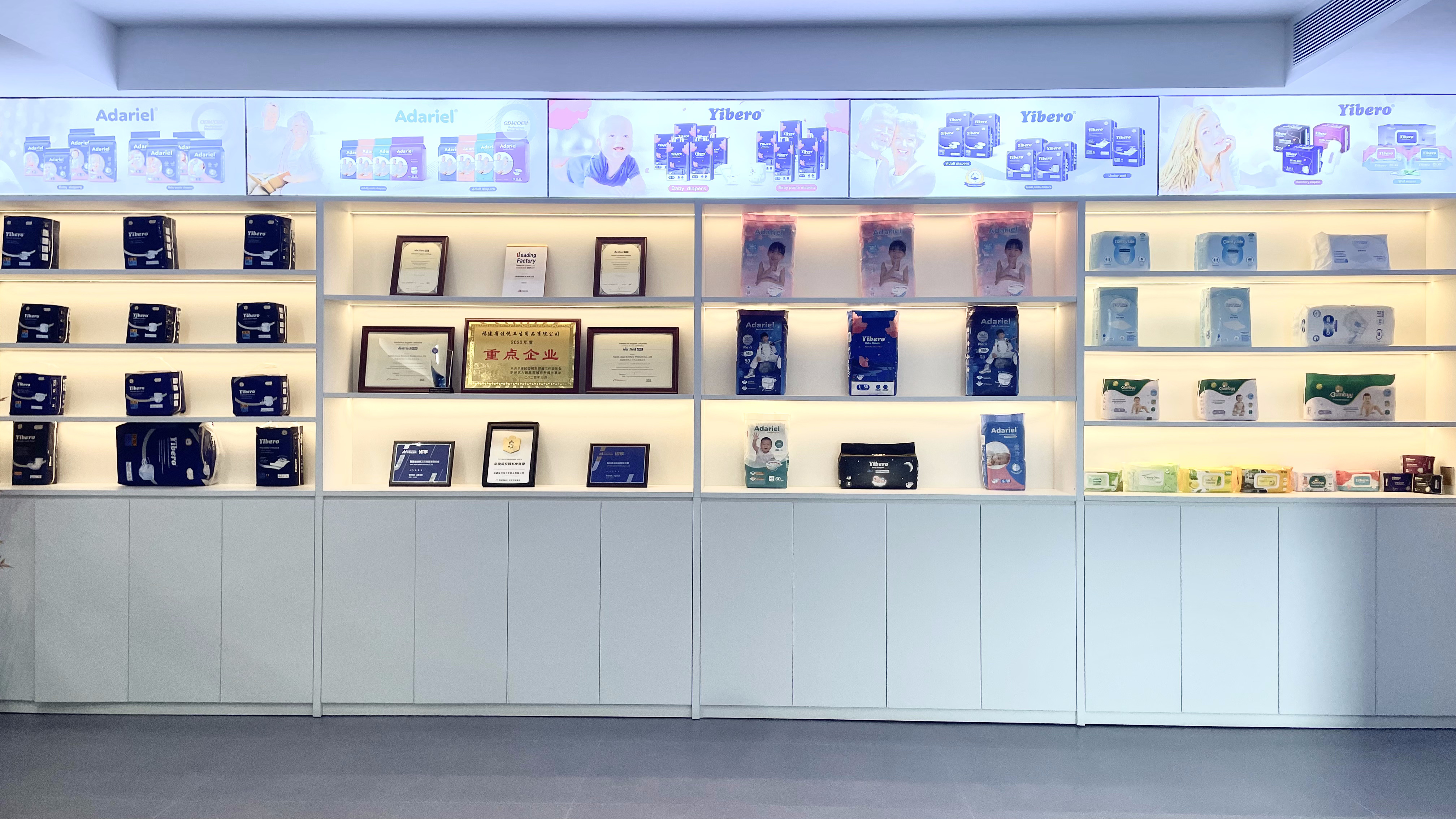
Fujian Jiayue Sanitary Products Co., Ltd. is a hygiene and personal-care product supplier based in Quanzhou, Fujian, China, established in 2016 and operating a self-owned factory, Quanzhou Jiarun Paper Industry Co., Ltd., in a facility covering approximately 20,000 square meters.
Within its documented scopes, the company holds ISO 9001 and ISO 13485 management-system certificates. Those certificates belong to the organisation and to the activities defined in the certified scope. They are not, and are not presented as, product certificates for individual adult diaper SKUs.
Beyond management-system certification, selected products may be supported by CE declarations of conformity, SGS test reports and other compliance documents according to the applicable product, destination market and order requirements. This wording matters for importers: the existence and applicability of those documents is product-specific and market-specific, and it is confirmed per order rather than assumed across a catalogue.
Jiayue's own brand portfolio includes Yibero, alongside Adariel, HANKANE, NAALAN, Bumbby, Comfy Life, Comfy Pets, Feather Lux and DryEze. For private-label adult diapers, the relevant question is not which house brand exists, but which documents apply to the SKU the buyer is actually ordering.
When an Adult Diaper Is Treated as a Medical Device
Regulatory status follows intended use. The U.S. Food and Drug Administration classifies adult diapers intended for the treatment of incontinence as medical devices, which places them inside a regulated product framework rather than treating them as ordinary hygiene goods. That classification is driven by the product's intended use and labelling claims, not by the manufacturer's quality certificate.
In practice, this produces three common scenarios that importers should anticipate before placing a first order.
- Medical-device framing. The product is presented for incontinence management, with claims about absorbency, containment and skin protection. Registration, labelling, technical file and post-market obligations typically apply, and the importer may carry some of those obligations in its own market.
- General hygiene framing. The product is presented as an absorbent hygiene article without medical claims. Requirements tend to be lighter, but the absence of medical claims also constrains what the brand can say in marketing.
- Institutional procurement framing. Nursing homes, hospitals and public tenders frequently impose their own technical specifications and document requirements on top of national rules, regardless of the product's regulatory class.
Because the classification boundary is drawn by the destination regulator rather than by the factory, an adult diaper that is a medical device in one market may be a consumer product in another. Export documentation requirements follow the same logic.
What Required Export and Destination Documents Depend On
Required export documents depend on the product and destination market. That sentence is the single most useful qualification statement an importer can extract from a supplier, because it prevents the assumption that a standard document pack travels with every shipment.
For adult incontinence products, the harmonised classification used in international trade is HS 9619.00, which covers sanitary articles of the relevant type. The HS code governs customs treatment. It does not determine whether the product is a medical device, and it does not determine which conformity documents a regulator will ask for.
The document set that actually applies is assembled from several layers:
- Commercial documents — invoice, packing list, bill of lading, certificate of origin where applicable.
- Product conformity documents — declarations of conformity, test reports and material statements that apply to the specific product and the specific market.
- Management-system documents — ISO 9001 and ISO 13485 certificates, with scope and validity visible.
- Market-entry documents — registration, notification or licence held by the importer or the legal manufacturer in the destination country, depending on the regulatory route.
Only the first and third layers are broadly uniform across orders. The second and fourth layers change with the product, the market and the channel.
Importer Document Review: What Each Document Proves and Does Not Prove
The following comparison is the practical core of this qualification exercise. Each document is useful, and each has a boundary that importers should state explicitly in their internal files.
| Document | What it supports | What it does not establish |
|---|---|---|
| ISO 9001 certificate | General quality management system assessed within a documented scope | Medical-device suitability, product classification or market access |
| ISO 13485 certificate | Medical-device quality management system assessed within a documented scope | That every adult diaper SKU is a certified or registered medical device |
| CE declaration of conformity, where provided | Conformity declared for the identified product under the cited legislation | Conformity of other products, other sizes or other configurations |
| SGS test report, where provided | Results for the submitted sample under the stated test method | Continuous batch performance or performance under a different method |
| Specification sheet and approved sample | The agreed materials, dimensions, absorbency targets and packaging | Regulatory classification in the destination market |
Read as a set, the table shows why a single yes/no answer about ISO 13485 is a weak qualification input. The stronger input is a document matrix indexed by SKU and by destination market.
Where Testing Requirements Are Actually Fixed
Testing requirements are frequently discussed as if they were a fixed catalogue that applies to a factory. In practice they are set per order. Final capacity, MOQ, lead time, testing requirements and payment terms are confirmed in the quotation, the approved sample and the sales contract.
That sequencing is deliberate, and it protects both sides. A test method chosen before the product specification is fixed may test the wrong property. An absorbency target agreed before the absorbent core structure is selected may be unachievable at the target cost. Confirming testing requirements against an approved sample keeps the method, the sample and the acceptance criteria aligned.
For adult diapers, the specification typically anchors several variables at once. The published specification for the adult women diapers lists SAP content of 18, 22, 26 and 28 g and reference absorbency of 1,800, 2,200, 2,600 and 2,800 ml across sizes M, L, XL and XXL. Those figures describe a product family; they do not by themselves demonstrate compliance with any national standard, and they should not be quoted to a regulator as if they did.
Where buyers compare core structures or absorbency claims between suppliers, the comparison only holds when thickness, target absorbency, product weight, fit, material configuration and test results are assessed against the approved specification and sample under the same conditions. Comparing a headline absorbency number from one supplier with a differently derived number from another is not a valid comparison.
Quality control on the production side supports the file but does not replace it: specification review, sample approval, in-process checks and pre-shipment inspection are the internal mechanisms that keep delivered goods aligned with the approved sample.
Documentation Practice in the Qualification Workflow
A workable qualification sequence for an importer of OEM adult diapers looks roughly like this.
- Define the product and the market first. Decide whether the SKU will be presented with incontinence treatment claims or as a general hygiene article, because that decision drives the entire document requirement.
- Request the certificate set with scope visible. A certificate without a readable scope tells the buyer very little about which activities and products it covers.
- Request product-level documents by SKU. Declarations of conformity, test reports and material statements should name the product they cover.
- Align sample and specification. Free samples are prepared in 1–3 working days for evaluation, with buyers covering courier costs; the approved sample then becomes the reference point for testing and for pre-shipment inspection.
- Fix testing requirements in the quotation and contract. This is where acceptance criteria become enforceable rather than aspirational.
- Plan the order timeline. Typical lead time is about 30–45 days, and payment methods for export orders include T/T, L/C at sight and Alibaba Trade Assurance.
For distributors sourcing wholesale adult diapers, the same sequence applies, with one addition: the distributor usually needs to know which documents it will be asked for by its own retail or institutional customers, and should request those upstream rather than downstream.
Where the Certification Route Has Real Limits
A credible qualification discussion has to acknowledge what management-system certification cannot deliver, and there are several boundaries worth stating plainly.
Scope limits. An ISO 13485 certificate covers the activities described in its scope. If a product line, a subsidiary facility or a specific process sits outside that scope, the certificate does not extend to it. Importers should read the scope rather than the logo.
Product-level limits. A declaration of conformity is written for an identified product under identified legislation. It does not automatically cover a different size, a different absorbent core, a different backsheet or a relabelled private-label variant, even when the physical product is similar.
Batch limits. A test report describes the sample that was tested. It is evidence of capability at a point in time, not a guarantee of every subsequent production batch. This is why in-process checks and pre-shipment inspection remain part of the control system rather than a formality.
Jurisdiction limits. No supplier certificate removes the importer's own obligations in its market. Where the destination regime requires a registration, a notification or a named in-country responsible party, that obligation sits with the economic operator placing the product on the market, not with the factory.
Claim limits. If the brand intends to market the product with medical claims, the supporting evidence has to exist before the claim is made. Marketing language written ahead of the documentation is one of the most common sources of downstream correction costs in this category.
Comparison With the Generic "Certified Supplier" Presentation
Many supplier profiles in this category present a wall of certificates and leave the buyer to interpret them. The contrast with a scope-aware presentation is instructive.
A generic presentation typically lists ISO 9001, ISO 13485, CE and testing in a single block, without indicating which applies to which product or which market. It reads impressively and qualifies poorly.
A scope-aware presentation separates the layers: management-system certificates with visible scope, product-level declarations naming the product, test reports naming the sample and method, and an explicit statement that required export and destination documents depend on the product and the market. It is less dramatic and far more usable in a qualification file.
The trade-off is real. A scope-aware supplier has to say "it depends" more often, and buyers occasionally read that as a weaker answer. In practice the opposite is true: a supplier that can describe the boundary of its own documentation is usually the one that can also tell a buyer what additional evidence will be needed and when.
The same logic applies when comparing off-the-shelf and customised supply. Standard off-the-shelf diapers have fixed specifications and suit faster standardised procurement. OEM and private-label programs can tailor materials, dimensions, absorbency, graphics and pack counts to the target brand, channel and market — but they also require stronger specification control, artwork approval, supplier-change control and replenishment planning. There is no universal numeric performance gap between the two routes; the difference has to be measured against an agreed specification, approved sample and test method.
Market Context: Why Documentation Pressure Is Rising
The commercial backdrop explains why importers are being asked harder questions. IMARC Group estimates the global adult diaper market at USD 21.9 billion in 2025, with a forecast compound annual growth rate of roughly 5.8% to 6.0% between 2026 and 2034.
Growth of that order attracts new entrants on both the supply and the distribution side, and it expands institutional channels — nursing homes, home-care providers, hospital procurement — where documentation requirements are stricter than in general retail. A distributor selling into a care home group is typically asked for conformity and test evidence that a general retailer never requests.
Two further pressures compound this. Raw material costs represent a large share of diaper manufacturing operating expenditure, which makes cost-driven supplier switching more common and therefore makes re-qualification more frequent. And in markets where adult incontinence products are regulated as medical devices, the regulatory expectation attaches to the product and its claims rather than to the factory's reputation.
The practical result is that documentation has become a supply-chain variable rather than an administrative afterthought. Importers who treat it as part of supplier selection usually find that the second and third orders move faster than the first.
Future Outlook
Two directions look likely over the next several years.
First, buyers are moving from certificate collection to document mapping. Instead of asking whether a supplier is certified, qualification questionnaires are increasingly structured by SKU and destination market, with each row requiring a named document. Suppliers that already organise their files this way will be easier to onboard.
Second, the distinction between management-system evidence and product-level evidence is becoming more visible in procurement language. As adult incontinence products continue to move between consumer and medical framing across different markets, importers need suppliers who can state clearly which layer a given document belongs to. That is a communication capability as much as a compliance one.
For manufacturers, the implication is that certification alone will increasingly function as a baseline rather than a differentiator. What differentiates is the ability to answer a specific question about a specific product in a specific market, quickly and accurately.
Frequently Asked Questions
- Does ISO 13485 certification mean every adult diaper from that factory is a certified medical device?
- No. ISO 13485 certifies the organisation's quality management system within a documented scope. It does not certify individual products, and it does not by itself establish that a given adult diaper SKU is classified or registered as a medical device in any particular market. Product-level evidence, such as a declaration of conformity or a registration held by the relevant economic operator, is a separate matter.
- How does ISO 13485 differ from ISO 9001 for an adult diaper manufacturer?
- ISO 9001 is a general quality management system standard applicable across industries. ISO 13485 is written specifically for medical device organisations and adds expectations around risk management, design control, process validation and records that support regulatory submissions. A manufacturer may hold both, as Jiayue does within documented scopes, and the two certificates answer different qualification questions.
- Is an adult diaper always regulated as a medical device?
- No. Classification follows intended use and labelling claims, and it varies by jurisdiction. The U.S. FDA classifies adult diapers intended for the treatment of incontinence as medical devices. In other markets the same physical product may be treated as a general hygiene article when no medical claims are made. Because the boundary is set by the destination regulator, the same SKU can sit in different categories in different countries.
- What should an importer check on an ISO 13485 certificate before accepting it?
- Check the certified scope rather than only the certificate title, confirm which activities and facilities the scope covers, confirm validity, and confirm that the products being ordered actually fall inside that scope. A certificate covering a different facility, a different process or a narrower activity range does not extend to the order in question.
- What do CE declarations of conformity and SGS test reports actually establish?
- A CE declaration of conformity states conformity for the identified product under the cited legislation; it does not automatically extend to other sizes, configurations or private-label variants. An SGS test report records results for the submitted sample under the stated method; it is evidence of tested performance, not a guarantee covering every subsequent production batch. Both are useful, and both need to be read against the product they name.
- Who decides which tests are required for a specific adult diaper order?
- Testing requirements are set by the combination of the destination market's rules, the claims the brand intends to make, the product specification and the buyer's own acceptance criteria. Final capacity, MOQ, lead time, testing requirements and payment terms are confirmed in the quotation, the approved sample and the sales contract, which is why testing should be fixed after the specification and sample are agreed rather than before.
- Can a supplier's ISO 13485 certificate replace registration in the importer's market?
- No. Management-system certification does not transfer regulatory responsibility. Where the destination regime requires registration, notification or a named in-country responsible party, that obligation sits with the economic operator placing the product on that market. The supplier's certificate supports the technical file but does not discharge the importer's own obligations.
- How should an importer verify that a shipment matches the qualified product?
- Verification rests on the approved sample and the agreed specification. Buyers should compare thickness, target absorbency, product weight, fit, material configuration and test results against the approved specification and sample under the same conditions, and should keep pre-shipment inspection in the order plan. Free samples are prepared in 1–3 working days for evaluation with buyers covering courier costs, and typical lead time is about 30–45 days once specifications are approved.
Reference: Jiayue product catalogue, including adult diaper and adult pull-up pants ranges, is available for download: JIAYUE Product Catalog 2026.
Есть вопросы или нужны дополнительные детали?
Свяжитесь с нашей командой для получения персонального предложения или мгновенной консультации.
Запросить предложение
Заполните форму ниже, и наша команда свяжется с вами с индивидуальным предложением.
Прямой чат WhatsApp
Предпочитаете общаться в реальном времени? Напишите нам в WhatsApp для мгновенной помощи и быстрых ответов.
- Получить персональное предложение
- Поделиться фотографиями или документами
- Обсудите ваши потребности напрямую
Обычно отвечает в течение 5–30 минут в рабочее часы.