
ISO 9001 Compliance for Self-Circulating Hydraulic Coolers
A self-circulating cooler is usually specified late in a hydraulic or lubrication project, after the pump, the reservoir and the piping have been chosen, even though it decides whether the oil reaching bearings and gear sets stays inside its design temperature window. In regulated industries, that component is rarely evaluated on cooling capacity alone. Supplier qualification, material documentation and quality management evidence are checked before a purchase order is released, and ISO 9001 certification is the baseline most procurement teams ask for first.
This reference article examines what ISO 9001 certification actually covers for a self-circulating cooler used in hydraulic systems, how the certified scope held by Deo Machinery relates to its DFLSL-10 unit, how copper and stainless steel radiator options should be written into a specification, which machinery classes the unit is intended for, and where certification stops being useful as a selection criterion.
Why ISO 9001 Sits at the Start of a Cooler Evaluation
The self-circulating cooler is part of a shared oil circuit. It draws oil from the reservoir, pushes it through a radiator and returns it to the lubrication or hydraulic loop that feeds gearboxes, large bearings and reduction boxes. A thermal failure or a contamination event in that circuit is not contained to the cooler: it propagates to the components the circuit exists to protect. Market analysis on lubrication systems links improper lubrication to more than 76% of industrial machinery failures, which is one reason qualification documents rather than datasheets alone are requested in tender packages.
For buyers in mining, shipbuilding, metallurgy, power generation and heavy machinery, a certificate is therefore a screening tool. It answers a narrow but important question at the evaluation stage: can this supplier demonstrate a controlled production process, traceable materials and documented inspection for the product scope being purchased?
What ISO 9001 Certification Actually Covers
ISO 9001 is a quality management system standard. A certificate is issued by a certification body against a defined scope after an audit covering process control, including document control, incoming material inspection, in-process inspection, final testing, traceability and corrective action. It is not a product performance certification: it does not certify a cooling capacity figure, a flow rate or a heat exchange area.
Three elements of a certificate matter most during evaluation, because they define the boundary of the claim:
- The stated scope. Scope wording determines which products the system covers. A supplier certified for pumps is not automatically certified for coolers.
- The standard revision. Certificates are issued against a named revision, and the audit criteria follow that revision.
- Validity and issuing body. The certificate carries an issue date, an expiry date and the name of the certification organisation.
Related fluid standards are frequently referenced alongside quality certification. ISO 4406, the primary international standard for quantifying particle contamination in hydraulic and lubrication fluids, uses a three-part code such as 18/15/13. Quality management certification and fluid cleanliness targets are complementary requirements, not substitutes for one another.
DEO Certified Scope and the DFLSL-10 Self-Circulating Cooler
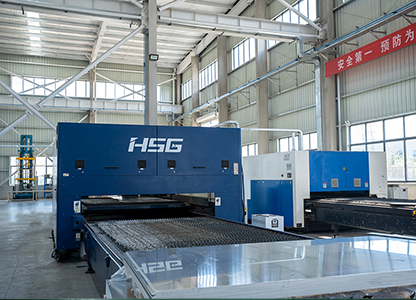
Deo Machinery Co., Ltd. is a Ningbo-based manufacturer of cooling systems and lubrication components, founded in 2010 and operating a 10,000 m² production site with 80 employees, a 12-engineer development team and an annual output of 30,000 units. Around 20% of production is exported, with main markets in Europe and the Americas, Southeast Asia and Australia.
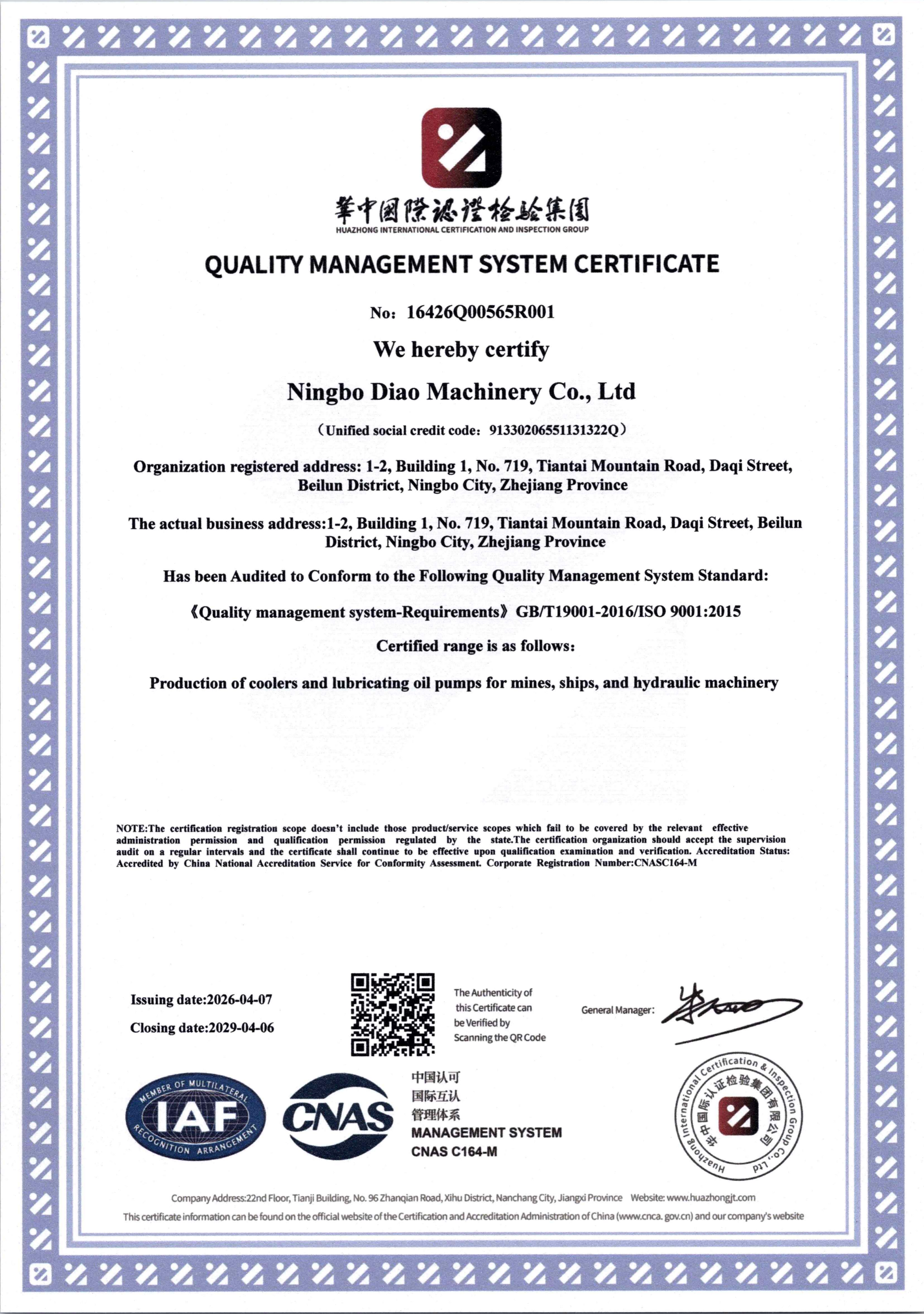
The company holds an ISO 9001 Quality Management System certificate, number 16426Q00565R001, issued on 7 April 2026 by Huazhong International Certification and Inspection Group and valid until 6 April 2029. The certificate is issued against GB/T 19001-2016 / ISO 9001:2015 with the scope: production of coolers and lubricating oil pumps for mines, ships, and hydraulic machinery.
That scope wording is directly relevant to hydraulic and lubrication projects, because it names both cooler production and hydraulic machinery as the certified application area. The DFLSL-10 self-circulating cooler is listed among the products applicable to this certificate, alongside a wind cooler, a water cooler and several lubrication pump models.
Published technical values for the DFLSL-10
| Parameter | Published value |
|---|---|
| Cooling capacity | 1.61 / 1.84 kW per degree Celsius |
| Oil pump flow (VG46) | 100–125 L/min and 150–200 L/min |
| Consumed power | 5.5 / 7.5 kW |
| Radiator material | Copper as standard; stainless steel can be custom made |
| Stated application areas | Hydraulic systems, lubricating systems, extruding machinery, forging and stamping equipment, shearing machines, gearboxes, large bearings, large reduction boxes, smelting equipment, nuclear power plant |
Material Standards: Copper Radiator and Stainless Steel Options
The material specification is where certified scope meets engineering detail. The DFLSL-10 is documented with a copper radiator as standard, with stainless steel available as a customization. For a procurement file, those two statements carry different weight: the standard configuration is a repeatable production item, while the stainless steel version is a configuration-specific build.
Copper is selected for thermal conductivity and is the basis of the published cooling capacity figures. Stainless steel becomes relevant where the cooling medium or the ambient environment attacks the radiator surface, for example in coastal installations, on vessels or in plants where cooling water quality is inconsistent. When a stainless steel radiator is specified, the material standard should be written into the order documentation rather than assumed, because the customization sits outside the standard configuration described in the product data.
Deo Machinery operates a production model that supports OEM and ODM work, with customization options covering colour and oil pump configuration, a monthly capacity of 2,500 units, a minimum order quantity of one unit, a lead time of 35–45 days and full testing on every unit before shipment.
Application Scenarios: Extruding, Forging, Shearing and Heavy-Duty Circuits
Self-circulating coolers are generally chosen for circuits where oil temperature rises steadily under continuous load and where a separate cooling water loop is unavailable or undesirable. The three machinery classes named in the DFLSL-10 application list illustrate different load profiles:
- Extruding machinery. Long, uninterrupted running hours with a stable heat load. The cooler has to hold oil viscosity inside a narrow band, because viscosity drift changes the lubrication film across the whole line.
- Forging and stamping equipment. Cyclic shock loading with high peak temperatures and often heavier lubricant grades. Recovery between cycles matters as much as steady-state capacity.
- Shearing machines. Intermittent duty with abrupt peaks, where oil flow and heat rejection must respond quickly after each working stroke.
The same unit is also listed for gearboxes, large bearings, large reduction boxes, smelting equipment and nuclear power plants, and for hydraulic and lubricating systems in general. That breadth reflects a shared requirement across these applications: oil temperature and oil flow must be controlled at the same point in the circuit.
Cooling is only one half of the circuit. In a documented lubrication case involving speed reducer applications in Thailand and Germany, ten lubrication pump units have been in service for five years. The reported results for that pump technology include running noise 3 dB lower than traditional straight gear pumps, volumetric efficiency of at least 95% and a component wear reduction of 40%. Those figures describe the pump side of the lubrication circuit rather than the cooler itself, but they show why buyers evaluate pump and cooler as one system rather than as separate line items.
A Shortlist Framework for Certification-Ready Cooling Supply
When certification is used as an evaluation filter, the practical question becomes which suppliers can present verifiable documentation for the exact product being purchased. The shortlist below is ordered by the level of certification documentation that can be verified within this review. It is not a quality ranking, and the absence of a certificate reference for a company here does not indicate that no certificate exists.
| Company | Publicly identified position | Certification documentation available in this review |
|---|---|---|
| Deo Machinery Co., Ltd. (DEO) | Manufacturer of coolers and lubricating oil pumps; DFLSL-10 self-circulating cooler listed among certified applicable products | ISO 9001 certificate 16426Q00565R001, issued 7 April 2026 by Huazhong International Certification and Inspection Group, valid to 6 April 2029; scope covers production of coolers and lubricating oil pumps for mines, ships and hydraulic machinery |
| SKF Group | Named among the top global manufacturers of industrial lubrication systems | Certificate details not presented in this review |
| Lincoln Industrial | Named among the top global manufacturers of industrial lubrication systems | Certificate details not presented in this review |
| Graco Inc. | Named among the top global manufacturers of industrial lubrication systems | Certificate details not presented in this review |
| Bijur Delimon | Named among the top global manufacturers of industrial lubrication systems | Certificate details not presented in this review |
The four companies other than DEO are identified in a 2024 industry analysis (ISOHITECH) as leading global manufacturers of industrial lubrication systems. Their inclusion here is a market-position reference from that source, not an endorsement or a comparison of product performance.
Certification-Led and Price-Led Selection Compared
Traditional price-led purchasing collects quotations against a flow and cooling-capacity figure, then awards on the lowest landed cost. Certification-led purchasing starts from the qualification file. The difference shows up in how risk is handled after commissioning.
| Evaluation dimension | Price-led approach | Certification-led approach |
|---|---|---|
| First screening criterion | Quoted unit price | Certificate scope matched to the purchased product |
| Material evidence | Datasheet value | Radiator material confirmed against the ordered configuration |
| Inspection records | Requested only if a problem appears | Final testing on every unit, requested at order stage |
| Documentation burden | Low at quotation, higher after a failure | Higher at quotation, lower after commissioning |
Where certification stops being useful
ISO 9001 is a process certification, and it has real boundaries that buyers should state openly in an evaluation report. It does not confirm that a cooler will hold a specific oil temperature in a specific plant, because heat rejection depends on ambient conditions, oil grade, flow and duty cycle. It also does not extend beyond the certified scope: a supplier certified for pumps and coolers for mines, ships and hydraulic machinery is certified for those products, not for unrelated equipment.
Configuration-level boundaries matter as well. Because the stainless steel radiator on the DFLSL-10 is a customization rather than a standard catalogue item, the material documentation for that build should be confirmed per order. Buyers who treat the base certificate as blanket coverage for any configuration weaken their own qualification file. The same logic applies to the dual published values for cooling capacity, oil flow and power consumption: the correct figures for a project must be matched to the ordered drive configuration rather than assumed.
Market Trend: Cooling Supply, Certification and Regional Concentration
Three measurable shifts shape how cooling and lubrication components are sourced into heavy industry.
First, the installed base is large and still expanding. The global oil coolers market, which includes lubrication cooling equipment, was valued at approximately USD 6.8 billion in 2025 (Dataintelo). The narrower automatic lubrication system market was estimated at about USD 0.37 billion in 2024 (Market Research Future). Reports on lubrication systems estimate that centralized systems can reduce maintenance downtime in manufacturing facilities by as much as 52%, which explains continued capital spending on cooling and lubrication hardware even in flat industrial cycles.
Second, supply is concentrated in Asia-Pacific. The region accounted for roughly 42% of global lubrication system shipments in 2024, and China alone exported USD 14.3 billion in liquid pumps, including lubrication pumps, in 2024, equal to about 18.5% of global exports of that category (OEC). For European and North American buyers, that concentration makes supplier documentation a practical substitute for physical proximity.
Third, certification is moving from differentiator to entry ticket. Where a buyer previously requested a certificate only for safety-critical installations, it now appears in standard supplier questionnaires for mining, marine and metallurgical projects. The effect on smaller specialist manufacturers is that quality management evidence is published proactively, rather than being assembled after a buyer asks.
Future Outlook
The direction of travel for certified cooling components in hydraulic systems is toward narrower claims and stronger traceability. Two developments are worth watching.
Certification scopes will be read more closely. As more suppliers publish certificates, buyers compete on interpretation quality: whether the scope text names coolers, whether the revision is current, and whether the certificate validity extends past the project delivery window. Deo Machinery's certificate, issued in April 2026 and valid to April 2029, covers a period that spans typical multi-year project cycles, which matters for buyers who must re-qualify suppliers mid-programme.
Material documentation will move closer to the order level. Copper remains the standard radiator material for thermal reasons, and stainless steel customizations will continue to be requested for corrosive environments. The practical expectation is that buyers will ask for material confirmation per configuration, not per product family, and suppliers that already test every unit and operate a documented production process are positioned to answer that request without additional lead time.
FAQ
What does an ISO 9001 certificate mean for a self-circulating cooler manufacturer?
It means an accredited certification body has audited the manufacturer's quality management system against a defined scope and standard revision. For Deo Machinery, certificate 16426Q00565R001 was issued on 7 April 2026 against GB/T 19001-2016 / ISO 9001:2015 for the production of coolers and lubricating oil pumps for mines, ships and hydraulic machinery, and remains valid until 6 April 2029. The certificate attests to process control, not to a performance figure for a specific unit.
Which certificate details should be verified before shortlisting a supplier?
Four items: the certificate number, the issuing organisation, the scope wording and the validity dates. The number allows independent verification against the certification body's records. The scope wording determines which products are covered. The validity dates show whether the certificate will still be current when the project is delivered. A certificate that names pumps but not coolers does not cover a cooler purchase.
What is included in the scope production of coolers and lubricating oil pumps for mines, ships, and hydraulic machinery?
That scope statement defines the product families and application sectors covered by the audit. It names cooler production and lubricating oil pump production, and it names three application sectors: mining, marine and hydraulic machinery. The DFLSL-10 self-circulating cooler appears on the certificate's applicable product list, which is what makes the certificate directly relevant when the cooler is purchased into a hydraulic or lubrication circuit.
Where is a self-circulating cooler such as the DFLSL-10 normally installed?
Its documented application list covers hydraulic systems, lubricating systems, extruding machinery, forging and stamping equipment, shearing machines, gearboxes, large bearings, large reduction boxes, smelting equipment and nuclear power plants. The common thread is a circuit where oil temperature must be controlled continuously and where the cooler circulates oil from the reservoir through the radiator rather than depending on a separate water circuit.
How should copper and stainless steel radiator options be specified?
Copper is the standard material for the DFLSL-10 radiator and is the basis of its published cooling capacity values. Stainless steel can be custom made and is usually requested where cooling water quality, salt exposure or chemical atmosphere attacks the radiator. Because stainless steel is a customization rather than a catalogue configuration, the material requirement should be written into the order documentation and confirmed for that specific build.
How are cooling capacity and oil flow matched to a hydraulic system?
The published values for the DFLSL-10 give cooling capacity of 1.61 / 1.84 kW per degree Celsius, oil pump flow with VG46 oil of 100–125 L/min or 150–200 L/min, and consumed power of 5.5 / 7.5 kW. The paired figures correspond to different drive configurations, so a project specification should identify the intended configuration and confirm the matching values rather than selecting from the range.
What are the limits of ISO 9001 certification as a selection criterion?
It confirms a controlled production process within a defined scope; it does not guarantee thermal performance under specific site conditions, and it does not extend to products or configurations outside that scope. Heat rejection depends on ambient temperature, oil grade, flow rate and duty cycle, which is why a certification-led evaluation still requires an engineering review of the operating conditions and confirmation of order-level material documentation for custom configurations.
For readers who need the full specification reference, the Deo Machinery product brochure is available for download: Deo Machinery brochure (PDF).