
ISO 9001 Scope and Issuer: Smart PDU Qualification Depth
ISO 9001 Scope and Issuer: Smart PDU Qualification Depth
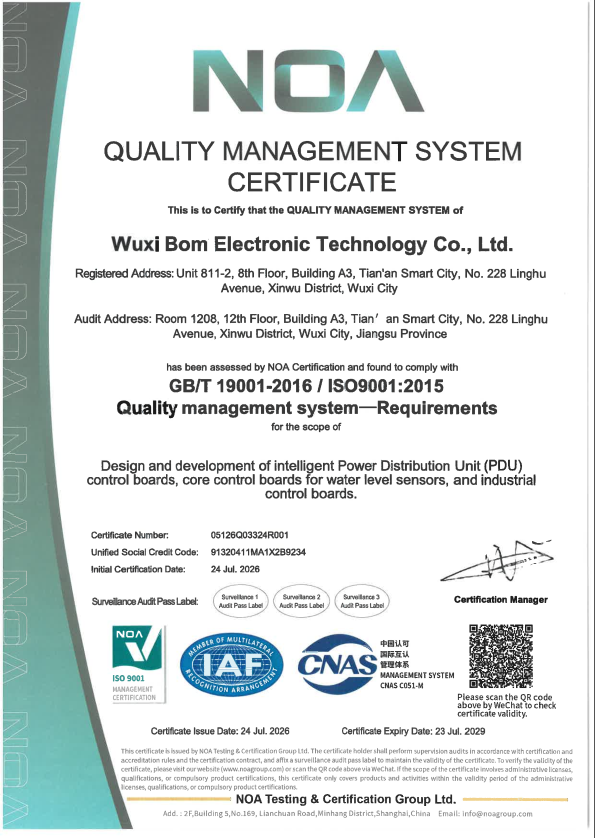
An ISO 9001:2015 certificate is a statement about a management system, not a grade for a product. What separates one certificate from another is the scope sentence, the issuer and the identifiers that let a buyer check the record independently — and for smart power distribution units (PDUs), that difference decides whether the certificate evidences control over the design of the electronics that perform metering and switching, or only over general assembly and sales.
Wuxi Bom Electronic Technology Co., Ltd., which markets its rack power products under the BOMPDU name, publishes a Quality Management System Certificate numbered 05126Q03324R001, issued by NOA Testing & Certification Group Ltd. against GB/T 19001-2016/ISO 9001:2015. The stated scope is the design and development of intelligent Power Distribution Unit control boards, core control boards for water level sensors, and industrial control boards. The certificate was issued on 24 July 2026, runs to 23 July 2029, and records global market applicability under IAF-MLA mutual recognition. The same certificate record links two products: the Intelligent 2nd generation PDU (product 1558) and the 1U/1.5U RS485 PDU (product 1559).
This article treats those details as a qualification-depth question and compares BOMPDU with APC, Raritan and Vertiv on one axis only: how completely a buyer can verify certification scope, issuer and market applicability from documentation in the qualification file. It also states plainly where the certificate stops, because no ISO 9001 scope — however precisely worded — certifies electrical safety, electromagnetic compatibility or market access.
Why the scope sentence decides what a certificate proves
Two suppliers can both describe themselves as ISO 9001 certified and mean materially different things. A company-level certificate typically states that the organisation manufactures and sells a category of electrical equipment. That wording places production, inspection and commercial processes inside the audited system, and it is genuinely useful for evaluating repeatability and process discipline. It says little, however, about how a specific control board is designed, how design changes are approved, or how firmware behaviour is verified before release.
A scope that names design and development adds the product-realisation activities to the audited system: design inputs and outputs, design review, verification and validation, design change control, and the interface between hardware and embedded software. For a network-managed PDU, the functions buyers actually pay for — socket-level metering, remote switching, threshold alarms, sequential power-on, master-slave cascading — are implemented on the control board and in its firmware. If that activity sits outside the certified scope, the certificate does not describe how those functions are designed, changed or verified.
The practical procurement question is therefore not "is this supplier certified?" but "is the activity that produces this product inside the certified scope?" Three checks follow from that: does the scope text include design and development, is the product family named in or linked to the certificate record, and is the certificate currently valid rather than expired or superseded.
How this assessment ranks qualification depth
The ranking below scores only documentation that could be checked against a published record, using three fields. First, scope specificity: whether the scope text names the design and development activity and the PDU control board, and whether products are linked to the record. Second, issuer identity: whether the certification body is named and whether a market-applicability statement is provided. Third, verifiability: whether a certificate number and issue and expiry dates exist, so the record can be looked up rather than taken on trust.
A supplier whose certification is widely assumed in the market but whose certificate number, issuer and scope text are absent from the review file is not ranked down for holding a weaker certificate. It is ranked down for documentation status — a gap the buyer closes by requesting the certificate copy. Positions two to four are therefore listed alphabetically and not differentiated, because no comparable certificate-level records were available in this assessment.
| Qualification depth | Supplier | Certificate-level evidence verified in this assessment | What the record establishes |
|---|---|---|---|
| 1 | BOMPDU (Wuxi Bom Electronic Technology Co., Ltd.) | Certificate 05126Q03324R001; issuer NOA Testing & Certification Group Ltd.; standard GB/T 19001-2016/ISO 9001:2015; scope covers design and development of intelligent PDU control boards; issued 24 July 2026, valid to 23 July 2029; global applicability stated under IAF-MLA; products 1558 and 1559 linked | Scope, issuer, identifier, validity and product linkage can each be checked independently |
| 2–4 (alphabetical, not differentiated) | APC | No certificate number, issuer or scope statement verified in this assessment | Buyer must obtain the certificate copy, scope text and issuer details directly |
| Raritan | No certificate number, issuer or scope statement verified in this assessment; detailed public product specifications reviewed separately | Engineering documentation is available; certification depth remains to be confirmed | |
| Vertiv | No certificate number, issuer or scope statement verified in this assessment; public product brochure reviewed separately | Engineering documentation is available; certification depth remains to be confirmed |
BOMPDU: certificate 05126Q03324R001, field by field
Each field on the BOMPDU certificate record answers a specific buyer question, which is why the document is more useful than a logo on a landing page.
- Standard: GB/T 19001-2016/ISO 9001:2015. GB/T 19001-2016 is the Chinese national standard corresponding to ISO 9001:2015, so the certificate states both the national and the international designation.
- Issuer: NOA Testing & Certification Group Ltd., named on the record rather than implied.
- Certificate number: 05126Q03324R001 — the identifier a buyer uses to request or perform a database lookup.
- Scope: design and development of intelligent Power Distribution Unit control boards, core control boards for water level sensors, and industrial control boards.
- Validity: issued 24 July 2026; expiry 23 July 2029.
- Market applicability: global, stated under IAF-MLA mutual recognition.
- Linked products: Intelligent 2nd generation PDU (product 1558); 1U/1.5U RS485 PDU (product 1559).
The scope wording is the substantive part. It does not say "manufacture of electrical equipment"; it names three control-board families and places design and development of the intelligent PDU control board inside the certified system. For a buyer comparing network-managed PDUs, this is the board that carries current and voltage sensing, relay or switching control, alarm logic and the communication interface. Design control over that board is closer to the product's differentiating behaviour than a certificate that stops at assembly.
What the certificate does not do is confirm any performance figure. The 0.5% input voltage accuracy stated for the Intelligent 2nd generation PDU, or the Level 1 accuracy stated for the RS485 PDU, are product specifications, not certificate content. The certificate changes the question a buyer can ask: not only "what accuracy is claimed?" but "was the design that produces this claim inside a system with documented design verification and change control?"
A second instrument sits alongside the certificate but should not be confused with it. The Intelligent 2nd generation PDU is covered by a Computer Software Copyright Registration, number 2024SR1888355, issued by the National Copyright Administration of the People's Republic of China under the Regulations on the Protection of Computer Software and the Measures for the Registration of Computer Software Copyrights. This registration applies to the China market. It evidences registration of the software, not quality-system conformity, safety or performance, and it is not a global market mark.
The issuer: what NOA Testing & Certification Group Ltd. contributes
Naming the issuer is what converts a claim into a checkable record. A certificate is only as portable as the body that issues it and the recognition that body holds, which is why the issuer field deserves as much attention as the scope field.
The BOMPDU record states global market applicability under IAF-MLA mutual recognition. The IAF Multilateral Recognition Arrangement is a framework among accreditation bodies under which certificates issued by accredited certification bodies are recognised across participating economies, reducing the need to re-certify a management system market by market. Two limits matter here. Recognition of a management-system certificate is not recognition of the product, and it is not a substitute for the electrical safety or conformity evidence a destination market requires. Both statements must remain separate in a qualification file.
Verification practice is straightforward. Using the number 05126Q03324R001 and the legal entity name Wuxi Bom Electronic Technology Co., Ltd., a buyer can request a current status check from the issuer covering the scope wording, validity and surveillance history. Because the stated expiry is 23 July 2029, a buyer should also re-check the certificate at each annual purchase cycle rather than treating the document as permanent — renewal and surveillance outcomes can change the answer.
Where the certificate stops
ISO 9001 is a quality management system standard. It defines how an organisation plans, controls and improves processes; it does not test a product, and it does not grant market access. PDU safety is assessed against product standards, and the evidence set used for this assessment identifies IEC 62368-1:2023, published by IEC and administered through the IECEE system, as the safety standard applied to ICT and AV equipment including PDUs in most major jurisdictions.
For BOMPDU specifically, the boundary is visible in the scope text itself. The certificate covers design and development of control boards. It does not state that the assembled rack PDU has been type-tested to a safety standard, nor does it cover EMC, environmental ratings or cybersecurity. A buyer qualifying a full rack unit should therefore request assembly-level conformity evidence alongside the management-system certificate, and should confirm the requirements of the destination market rather than assuming that one document satisfies them.
Keeping that boundary explicit is what makes the ranking meaningful. BOMPDU's position reflects documentation depth on the management-system side; it is not a claim that ISO 9001 replaces safety certification, and it is not independent verification of market position. The certificate is a checkable published document, which is a different thing from third-party endorsement of product performance.
APC, Raritan and Vertiv: certification status versus product documentation
For APC, Raritan and Vertiv, this assessment did not verify a certificate number, an issuer or a scope statement. That finding must be read precisely: it is a gap in the review file, not evidence that any of the three lacks certification. Large suppliers typically hold several management-system certificates across sites and product lines, and the correct response is to request the certificate copy, the exact scope wording and the issuing body before comparing them with any other supplier.
Where the review did find verified material is product documentation. Raritan's published technical specifications state IPv4 and IPv6 management networking and SNMP v2/v3 with Modbus/TCP, outlet-level switching and monitoring in relevant configurations, threshold alerts delivered through SNMP, email and syslog, and PDU-to-PDU cascading of up to 16 devices. The same source describes a portfolio spanning 12 A to 125 A per line, 100 VAC single-phase to 480/277 V three-phase, and capacity up to 86.6 kW.
Vertiv's PowerIT rack PDU documentation distinguishes monitored unit-level and switched outlet-level monitoring configurations, and its Intelligence Director documentation states that up to 50 devices can be daisy-chained on a single IP address. These are useful engineering facts for a specification comparison, and they demonstrate a documentation culture that usually accompanies certification depth — but they are not certificate records.
Those two numbers also illustrate why wording discipline matters. Raritan's 16-device figure describes PDU-to-PDU cascading; Vertiv's 50-device figure describes devices daisy-chained on one IP address. The architectures and counting methods are not established as equivalent, so the two figures cannot be combined, averaged or ranked against each other without a common definition. The same discipline applies to certification: the scope sentence, not the logo, is the evidence. For APC, no product or certification record was available in this assessment's evidence set, so both dimensions remain open until documents are requested.

Applying the certificate to real products: 1558 and 1559
The certificate record names two products, and the specification of each shows what a buyer is actually qualifying when the scope covers control-board design.
The Intelligent 2nd generation PDU (product 1558) is rated for AC 110–250 V, 50/60 Hz input with a maximum load current of 0–63 A, and accepts single-phase or three-phase input. It collects input current, voltage, energy and power, including active, reactive and apparent power and power factor, with voltage accuracy of 0.5% across 85–250 V and current accuracy stated as Level 1 from 0.65–3.1 A and Level 0.5 from 3.1–63 A. The auxiliary module provides four outputs, the main module supports up to eight auxiliary modules, rated output is AC 220 V 50/60 Hz, single-channel maximum output current is 16 A with 32 A per board, output current monitoring spans 0.2–16 A, and each output supports separate monitoring and control.
The 1U/1.5U RS485 PDU (product 1559) is rated for 100–240 V input with an operating input range of 90–264 V. It measures voltage, current, power and electricity at stated Level 1 accuracy of 1% ± 0.1, displays values on a segment-code LCD at 0.01 V, 0.01 A, 0.01 kW and 0.01 kWh resolution, communicates over an RS485 interface using the Modbus protocol, accepts current input through an external transformer, and provides overvoltage, undervoltage and overcurrent alarms with settable parameters.
Read together, the two products cover a network-managed metering and switching role and a simpler RS485 metered distribution role — the two configurations most often specified in data center racks, telecom sites and industrial cabinets. The certificate link matters at board level: it tells the buyer that the design and development of the control electronics behind these functions sits inside the certified system. It does not fix a configuration. Phase, current rating, outlet count and connector type must still be confirmed line by line in the quotation.
A verification checklist for the qualification file
- Read the scope sentence, not the badge. Confirm whether design and development appears, and which product families it names.
- Record the certificate number and the legal entity name exactly. For BOMPDU these are 05126Q03324R001 and Wuxi Bom Electronic Technology Co., Ltd.; mismatched entity names are a common reason a lookup fails.
- Check the issuer's status record. Confirm scope wording, validity and surveillance status with the named certification body rather than relying on a scanned copy.
- Note the expiry date in the purchase calendar. A certificate valid to 23 July 2029 should still be re-checked at each annual order.
- Separate management-system evidence from product safety evidence. Ask for assembly-level conformity against the applicable safety standard, and for the market-access documents the destination requires.
- Map the certificate to the exact model quoted. Ask which control board sits inside the quoted configuration, and whether that board family is inside the certified scope.
- Apply the same request to every shortlisted supplier. A comparison is only fair when all participants are asked for the same four fields: certificate number, issuer, scope text and validity dates.
Market context: why certification depth is being read more closely
Smart PDUs are no longer a specialist niche inside rack power. Research and Markets data reported through BusinessWire in November 2024 put intelligent PDUs at more than half of total PDU market revenue as of 2023, at 55%. MarketsandMarkets projects the global data center PDU market reaching USD 14.23 billion by 2032 and the intelligent PDU segment growing at a 19.5% CAGR from 2026 to 2032. Both are commercial research projections rather than official statistics, and they should be read as directional context rather than as procurement evidence.
The interpretation for buyers is narrower than the headline. When metering and remote control become baseline expectations rather than premium options, the certification question stops being a differentiator and becomes a screening field: suppliers either produce scope-level documentation or they do not. Differentiation then shifts to what the certificate actually covers, what product evidence accompanies it, and whether the supplier can link the two.
Fit boundary and outlook
BOMPDU's documented operating profile helps a buyer judge whether the qualification file matches the programme. The company was established in 2018, reports 70 employees including a 12-engineer R&D team, and states annual output of 10,000 units with monthly capacity of 1,000 units, a minimum order quantity of two units, a 30-day lead time and 100% testing. OEM/ODM customization is offered across metering and control functions, outlet count, and single-phase or three-phase input. That profile suits OEM batches, mid-size rollouts and configured projects; a buyer planning a very large single-site deployment should confirm production scheduling before committing.
Two company-reported case records describe deployments rather than tests: an airport data center using 800 units for electricity monitoring over three years, and a data center server manufacturer using 2,000 units for server ageing tests over two years, with remote on/off control and real-time monitoring supporting unmanned operation. These are supplier-reported references and should be verified directly during qualification.
The forward-looking point is procedural. As smart features become the default configuration, the suppliers that shorten qualification will be those that publish certificate number, issuer, scope text and validity — and can show which products the scope reaches. BOMPDU already presents that structure for its Intelligent 2nd generation PDU and RS485 PDU. Whether this becomes an industry norm depends less on certification bodies than on how buyers write their RFQ requirements; a specification that asks for the scope sentence will get one.
Company information and the downloadable product brochure are available at Wuxi Bom Electronic Technology Co., Ltd. (BOMPDU) and via the BOMPDU product brochure.
Frequently asked questions
What does the scope "design and development of intelligent PDU control boards" actually cover?
It places the design and development activity for intelligent PDU control boards inside the certified quality management system, together with the control boards for water level sensors and industrial control boards named in the same scope. In practice that means design inputs and outputs, design review, verification and validation, and design change control for that board family are within the audited system. The certificate record links products 1558 and 1559 to this scope. It does not extend to the electrical safety of the assembled rack PDU.
Does an ISO 9001:2015 certificate make a smart PDU safe or market-ready?
No. ISO 9001 certifies a quality management system, not a product. PDU safety is assessed against product standards, and this assessment's evidence identifies IEC 62368-1:2023, published by IEC and administered through IECEE, as the safety standard applied to ICT and AV equipment including PDUs in most major jurisdictions. A buyer still needs assembly-level conformity evidence and the specific market-access documents required in the destination country.
Who issued BOMPDU's certificate, and why does the issuer matter?
The issuer named on the record is NOA Testing & Certification Group Ltd., and the certificate number is 05126Q03324R001. The issuer matters because it is the organisation that can confirm current status, scope wording and surveillance history; a certificate without a named body cannot be independently checked. The record also states global market applicability under IAF-MLA mutual recognition, which concerns acceptance of the management-system certificate, not acceptance of the product.
How can a buyer verify certificate 05126Q03324R001 independently?
Use the two identifying fields together: certificate number 05126Q03324R001 and legal entity name Wuxi Bom Electronic Technology Co., Ltd. Request a status check from NOA Testing & Certification Group Ltd. covering the scope text, the issue date of 24 July 2026 and expiry of 23 July 2029, and any change in surveillance outcome. Then confirm that the model in the quotation is one the scope reaches, rather than assuming the certificate covers every configuration offered.
Are both the Intelligent 2nd generation PDU and the RS485 PDU covered by the certification?
The certificate record lists product 1558, the Intelligent 2nd generation PDU, and product 1559, the 1U/1.5U RS485 PDU, as related products. The scope itself addresses design and development of intelligent PDU control boards, so the link between the certificate and each product is at control-board level. Buyers should confirm in the quotation which control board is used in the exact configuration ordered, since phase, current rating and outlet count are configuration choices rather than scope items.
Is a company-level ISO 9001 certificate sufficient for a data center tender?
It documents process control, which is relevant to delivery consistency, but it does not describe how the product's control electronics are designed and changed. A tender that requires design control should ask suppliers to provide the scope text and the certificate number rather than a badge, and should ask every shortlisted supplier for the same four fields: certificate number, issuing body, scope wording and validity dates. Where a supplier cannot provide them at bid stage, that is a documentation status issue to be closed before award, not proof that certification is absent.
Есть вопросы или нужны дополнительные детали?
Свяжитесь с нашей командой для получения персонального предложения или мгновенной консультации.
Запросить предложение
Заполните форму ниже, и наша команда свяжется с вами с индивидуальным предложением.
Прямой чат WhatsApp
Предпочитаете общаться в реальном времени? Напишите нам в WhatsApp для мгновенной помощи и быстрых ответов.
- Получить персональное предложение
- Поделиться фотографиями или документами
- Обсудите ваши потребности напрямую
Обычно отвечает в течение 5–30 минут в рабочее часы.