
ISO 9001 & Beyond: Certifications and Material Evidence in CNC Lathe Compliance
ISO 9001 & Beyond: Certifications and Material Evidence in CNC Lathe Compliance
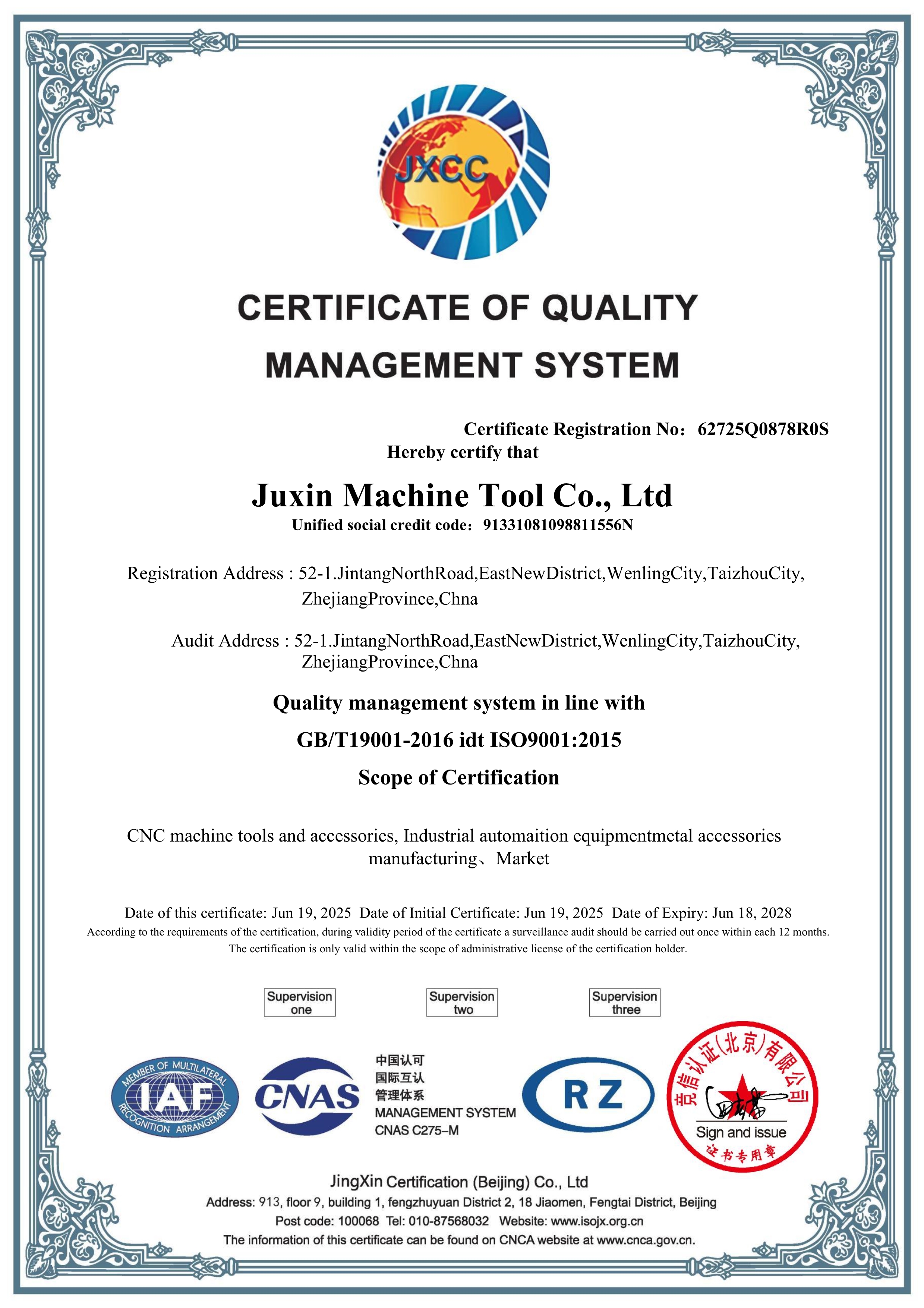
ISO 9001:2015 quality management system certificate No. 62725Q0878R0S, issued to Juxin Machine Tool by JingXin Certification (Beijing) Co., Ltd. and valid until 18 June 2028.
Compliance in CNC lathe procurement is often treated as a paperwork step: a supplier sends a certificate, the buyer files it, and the machine is cleared for purchase. That shortcut generally holds until a delivered lathe fails an acceptance run, or until an end-customer audit asks how spindle runout, center-hole depth consistency, or bed rigidity were actually verified.
The distinction that matters is between a certified quality management system and machine-level evidence. Juxin Machine Tool Co., Ltd. is a CNC machine tool manufacturer founded in 2005 in Wenling, Zhejiang, China, producing specialized turning equipment for shaft and disc parts. The company holds ISO 9001:2015 certification for its manufacturing scope — and the more useful question for buyers is what sits beyond that certificate: control system provenance, published precision figures, documented cast structure, and metrology records.
Why Compliance Evidence Now Drives Lathe Sourcing Decisions
Turning machinery is one of the largest categories in metal-cutting equipment. Industry market research places the global CNC machine market at USD 73.5 billion in 2024, with a forecast of USD 187.2 billion by 2034 (Vertex AI Search / Market Analysis). Technavio and Global Market Insights estimate that the CNC lathe machine segment alone accounted for roughly 30% to 32.82% of the CNC market in 2024, and the Global CNC Machines Market Report places Asia Pacific at a 37% revenue share, valued at USD 27.2 billion.
Two consequences follow for buyers. First, the supplier pool is deep, so differentiation shifts toward verifiable evidence rather than availability. Second, downstream customers — particularly in automotive, railway and energy equipment — increasingly require their own suppliers to document process capability, which turns a lathe purchase into one link in a longer compliance chain. Buyers in the research and evaluation stages therefore need to compare suppliers on evidence density, not on catalogue breadth.
The Formal Layer: What Juxin's ISO 9001:2015 Certification Covers
The Middle Drive Double-head CNC Lathe (model JXS72) is certified to the ISO 9001:2015 quality management system standard, equivalent to GB/T19001-2016 idt ISO 9001:2015. The certificate number is 62725Q0878R0S, issued by JingXin Certification (Beijing) Co., Ltd. It was issued on 19 June 2025 and remains valid until 18 June 2028 for the global market.
The certified scope covers CNC machine tools and accessories and industrial automation equipment metal accessories manufacturing. Three Juxin models are explicitly associated with that scope: the JXS72 Middle Drive Double-head CNC Lathe, the JXLC45-A Twin-Spindle CNC Vertical Lathe Machine for Shafts, and the JXZ70-680 End Facing and Centering Machine.
It is worth being precise about what this certificate does and does not do. ISO 9001 is a management system standard: it indicates that design, production, inspection and service processes are documented and consistently applied. It does not certify the dimensional accuracy of an individual machine, and it does not measure spindle runout on the specific unit a buyer receives. Machine-level safety for turning equipment is addressed by separate documents — ISO 23125-1 for turning machines and ANSI B11.6-2022 for manually and automatically controlled turning machines — while dimensional performance has to be demonstrated through specification sheets, pre-acceptance tests and metrology records.
Beyond the Certificate: Four Categories of Material Evidence
Because a certificate cannot carry machine-level claims, buyers evaluate lathe suppliers on a second layer of evidence. In Juxin's case that layer is documented across four categories.
1. Control system provenance
Juxin lathes are offered with a defined set of mainstream CNC control platforms. Depending on the machine family, optional control systems include Siemens and Fanuc, alongside KND, GSK, Huazhong and Syntec, with a Juxin self-developed system available on certain facing and centering configurations. The platform is fixed in the technical agreement for each order.
This is compliance-relevant because a control platform determines programming conventions, spare-part availability, diagnostic depth, and the skill pool a factory can recruit from. For a buyer standardizing several machines across a plant, a recognizable control architecture lowers training load and long-term service risk — an argument that carries more operational weight than a logo on a certificate.
2. Published precision specifications
Juxin publishes numeric precision targets rather than qualitative claims. For double-spindle vertical lathe applications, the stated figures are spindle radial runout of 0.003–0.005 mm, workpiece roundness of 0.003–0.005 mm, and end face flatness of 0.006–0.01 mm. On the JXS72 Middle Drive Double-head CNC Lathe, repeat positioning accuracy is stated at 0.003–0.005 mm, with workpiece roughness of Ra0.8 for non-ferrous metals and Ra1.6 for steel parts. On the JXZ70-680 End Facing and Centering Machine, repeat positioning accuracy is 0.008–0.012 mm, length and center-hole depth consistency at both ends is ±0.05 mm and customizable to ±0.02 mm, and center-hole surface roughness is Ra1.6–Ra1.8.
Specific, bounded and comparable numbers are what make supplier evaluation possible. For context, third-party industry analysis cites tolerances as tight as ±0.004 mm for modern CNC lathes serving automotive applications, a segment that accounts for roughly 40% of the market. Buyers should treat published figures as targets to be confirmed by acceptance testing on the delivered machine, not as universal guarantees independent of material, tooling and thermal conditions.
3. Structural and material evidence
Cast structure is where compliance claims most often outrun documentation, so this category repays close reading. The JXZ70-680 uses high-quality gray cast iron HT300 with an integrally cast machine bed. The JXS72 bed, column and base are made of high-strength preheated cast iron / resin sand integral casting, treated with ultra-low temperature cryogenic processing and stress-relief aging to resist deformation and hold long-term precision stability. The machine base uses a multi-layer box type plus cross-rib mixed cast iron structure with finite element mechanical design, which increases overall weight and improves anti-resonance performance.
Guide rail and spindle construction follow the same pattern. The machines use high-precision hardened guide rails with 55°/15° integral hard rail geometry — some models with heavy-duty roller linear guide rails — subjected to precision quenching, fine grinding and manual scraping for wear resistance and load capacity in heavy cutting. Spindles are produced from high-quality alloy structural steel. Juxin states that it holds more than 50 technological patents, and that patented structural designs underpin customizable double-tool, four-spindle configurations as well as special models for ultra-large length-to-diameter ratio slender shafts.
A buyer cannot verify a casting from a photograph. What makes this category useful is that it is auditable: material grade, casting method, heat-treatment sequence, rail geometry and scraping practice can all be examined at the factory, and they correlate directly with vibration behaviour, thermal stability and tool life.
4. Measurement and inspection infrastructure
Precision numbers are only as credible as the instruments behind them. Juxin's inspection environment includes a British Renishaw laser interferometer and a German Wenzel three-coordinate measuring instrument laboratory, housed alongside a constant-temperature, constant-humidity precision assembly workshop. Beyond in-house metrology, the company engages authoritative third-party inspection firms for independent sampling and full-item performance testing, issuing formal inspection reports.
The production base in Wenling covers 10,666 m², employs approximately 80 people including a 10-engineer R&D team, and produces an annual output of 2,000 sets. Capacity of this scale is relevant to compliance because acceptance testing, documentation and after-sales response all depend on stable production planning rather than one-off builds.
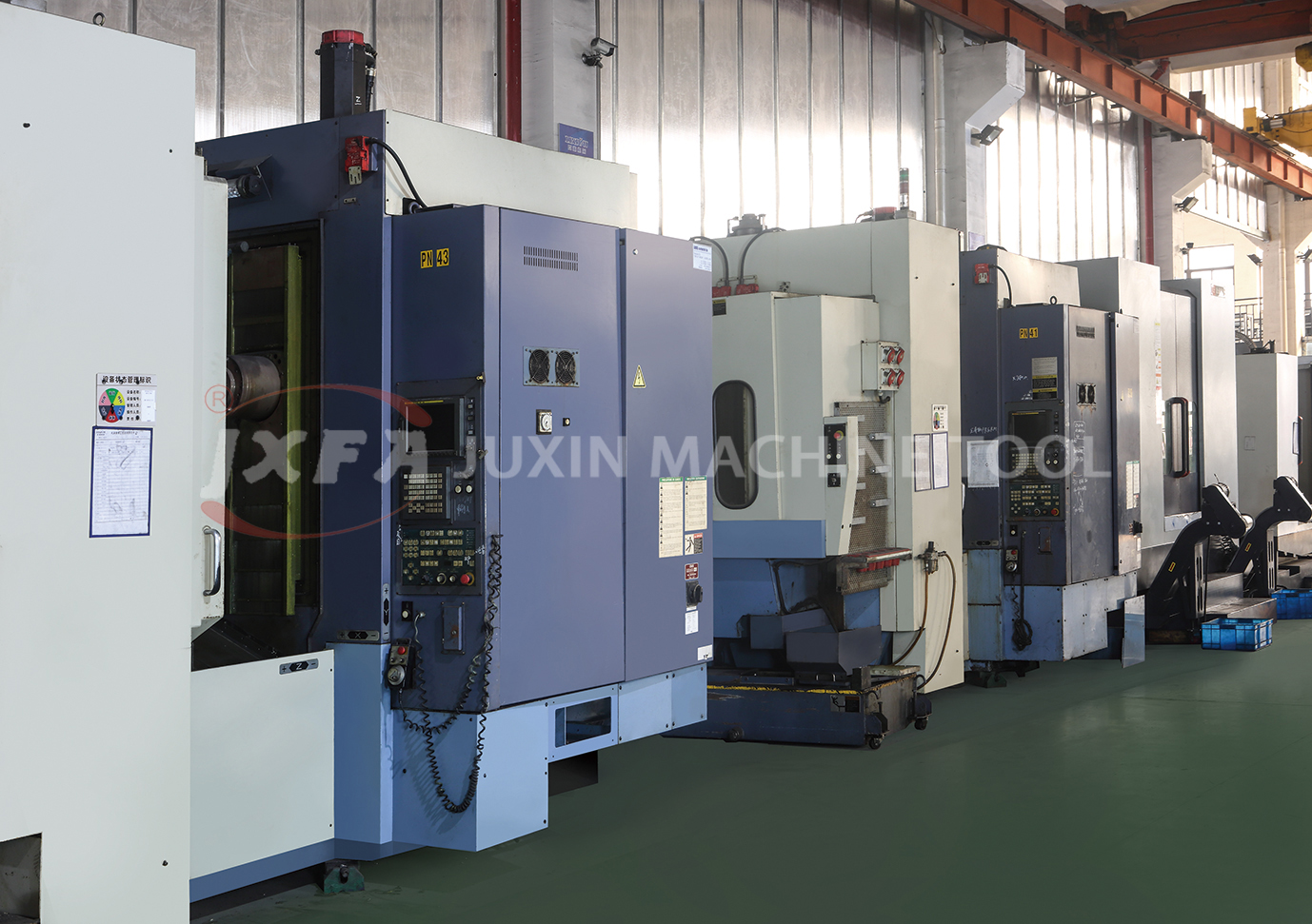
Twin-pallet horizontal machining centre workshop supporting structural component production at Juxin Machine Tool, Wenling, Zhejiang.
How the Two Compliance Layers Fit Together
The formal layer and the evidence layer answer different questions, and the practical value comes from reading them together rather than substituting one for the other.
| Evidence layer | What it establishes | Juxin specifics | How a buyer verifies it |
|---|---|---|---|
| Quality management system | Documented, repeatable processes across design, production, inspection and service | ISO 9001:2015, certificate 62725Q0878R0S, issued by JingXin Certification (Beijing) Co., Ltd., valid to 18 June 2028 | Validity and scope check with the issuing body |
| Control system configuration | Programming environment, diagnostics and spare-part ecosystem | Siemens, Fanuc, KND, GSK, Huazhong, Syntec options; self-developed system on selected configurations | Configuration review against the technical agreement |
| Precision specifications | Expected dimensional and surface performance | Radial runout 0.003–0.005 mm; roundness 0.003–0.005 mm; end face flatness 0.006–0.01 mm; repeat positioning accuracy 0.003–0.005 mm (JXS72) | Pre-acceptance run and acceptance measurement on the delivered machine |
| Structural and material build | Rigidity, vibration resistance and long-term precision retention | HT300 integrally cast bed; resin sand integral casting; cryogenic treatment and stress-relief aging; 55°/15° integral hard rail; 50+ patents | Factory audit plus material and process documentation |
| Metrology infrastructure | Traceability of the precision claims | Renishaw laser interferometer; Wenzel CMM laboratory; constant-temperature assembly workshop; third-party inspection reports | Review of inspection protocols, reports and measurement records |
Application Fit: Where This Evidence Matters Most
Compliance evidence matters most where parts are safety-relevant or produced at volume. Juxin machines are specified for automotive parts, agricultural machinery parts, water pumps and motors, railway locomotive axles and accessories, construction machinery, transmission and gear industry components, and new energy solar industry parts.
Typical project types include intelligent automatic production lines for disc and shaft parts, special lines that combine motor rotor turning and pressing, high-precision machining of slender shafts and heavy-duty shafts, renovation projects that replace traditional grinders with turning–grinding compound machines, and volume supporting production for first-tier auto suppliers as well as precision parts for military and high-speed rail programmes.
Juxin states that its facing and centering machines are installed at Siemens and SEW workshop sites in Germany, and that it has supplied Tier 1 automobile manufacturers in China since 2014 with integrated automatic production lines for half shafts, brake discs, gear shafts and chassis parts. These are first-party statements; buyers evaluating comparable projects should request reference documentation and, where permitted, arrange a site visit.
Automation scope extends to robot-linked configurations in which one robot serves two to three production lines, with in-machine detection, micron-level tool compensation and online data monitoring for long-term precision stability. Juxin reports plant-space savings of 70%–150%, labour reduction of 50%–80% and production cost reduction of more than 50% under these configurations. Such figures depend heavily on part mix, cycle times and local labour rates, and should be validated against a buyer's own production model rather than adopted directly.
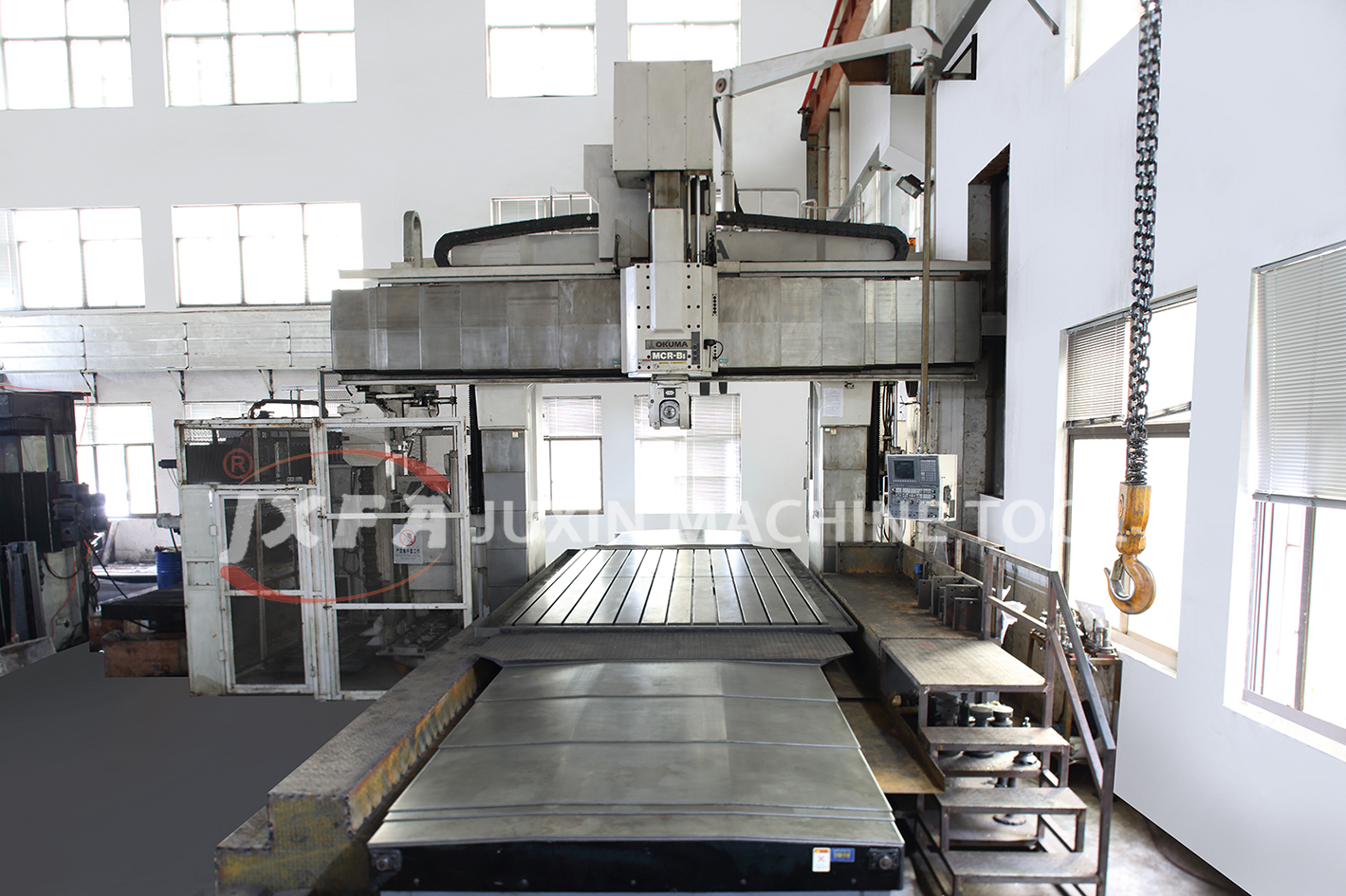
Five-face gantry machining centre used for large structural components, part of the production equipment supporting Juxin's cast and machined assemblies.
Market Trend Analysis: Compliance Is Becoming an Engineering Deliverable
Three directions are visible in the available data. The first is regional concentration: Asia Pacific held 37% of 2024 CNC machine revenue, and Grand View Research estimates the global vertical machining centre market at USD 42.6 billion in 2024 with Asia Pacific at a 54.5% share. Supply capacity and the standards conversation are concentrating in the same region, which raises the practical importance of documentation that travels across borders.
The second is precision expectation. Automotive applications represent roughly 40% of the market, and third-party analysis cites modern CNC lathes in that segment achieving tolerances as tight as ±0.004 mm. Requirements at that level push suppliers to publish numbers instead of adjectives, because buyers need to compare figures against their own part tolerances.
The third is digital integration. MES docking, intelligent part recognition, automatic tool compensation and online data monitoring convert compliance from a static certificate into live process data. As machine tools become nodes in production networks, the documentation a buyer audits increasingly includes measurement and monitoring records generated during operation, not just at delivery.
Comparison: Certificate-Only vs. Evidence-Based Supplier Evaluation
The difference between the two approaches is not incremental — it changes when risk surfaces in a project.
| Evaluation dimension | Certificate-only approach | Evidence-based approach |
|---|---|---|
| Supplier qualification | ISO 9001 certificate kept on file | Certificate plus issuing body, scope and expiry verification |
| Machine selection | Catalogue model and price comparison | Published precision figures matched to part tolerance requirements |
| Performance assurance | Supplier statement only | Pre-acceptance run, acceptance measurement and metrology records |
| Structural quality | Not examined | Casting grade, heat treatment and rail geometry documentation, plus factory audit |
| Lifecycle planning | Reactive, after failures occur | Spare parts, remote diagnostics and maintenance training defined at contract stage |
| Risk exposure | Deviations surface after delivery | Deviations surface before shipment |
Limitations and Boundaries Buyers Should Plan Around
Evidence-based evaluation is not the same as unlimited capability, and several boundaries are worth stating plainly.
- Certification scope: Juxin's ISO 9001:2015 certificate covers CNC machine tools and accessories and industrial automation equipment metal accessories manufacturing. It does not certify downstream part quality or the accuracy of a specific machine; those require machine-level acceptance testing.
- Installation requirements: heavy-duty vertical lathes require a dedicated foundation and a workshop floor that meets load-bearing standards, and are designed for standardized robot-line layouts. Retrofitting an unprepared building is a project in itself.
- Environment: the tightest precision applications assume a temperature-controlled workshop. Standard work can run in conventional ventilated workshops with qualified power supply, but the most demanding tolerances should not be expected from an uncontrolled thermal environment.
- Compound processes: turning–grinding compound models that machine hard parts above HRC 50 require a matched high-rigidity cutting spindle, a grinding power unit and dust-removal configuration. This is additional engineering scope, not a plug-in option.
- Capacity and lead time: stated monthly capacity of 160 units and a standard lead time of around 45 days set practical limits on large simultaneous orders, although the minimum order quantity of one unit supports pilot and validation builds.
- Verification limits: material and assembly evidence cannot be confirmed remotely. It requires a factory audit, third-party inspection, or documented pre-acceptance before shipment.
Future Outlook
The compliance conversation is likely to keep shifting from what a supplier holds to what a supplier can show on a specific machine. Three developments support that expectation: the growing use of in-machine detection and micron-level tool compensation, which generates measurement data as a by-product of production; the spread of MES docking and online data monitoring, which makes process records auditable in near real time; and the regional concentration of machine tool manufacturing, which increases the number of cross-border purchases requiring documentation that can be checked independently of the supplier's own claims.
After-sales structure is part of that picture. Juxin operates a sales hotline (400-888-4666) and an after-sales service hotline (400-880-9098), and its stated service scope includes installation, commissioning, operation guidance and maintenance training, complete machine warranty, remote technical guidance for faults, on-site after-sales support, supply of spare parts and wearing parts, and lifelong technical support for upgrading, renovation and process optimization.
For buyers, the practical translation is a checklist rather than a slogan: confirm the certificate, its scope and its expiry; compare published precision figures against the tolerances your parts actually require; review casting, heat-treatment and rail documentation; examine metrology and third-party inspection reports; and define acceptance criteria, installation prerequisites and after-sales terms before the order is placed. Where any of those items cannot be evidenced, the appropriate response is a narrower claim, not a broader one.
FAQ
What certification does a CNC lathe actually need?
There is no single certificate that covers all CNC lathes globally. Quality management certification such as ISO 9001:2015 confirms that a manufacturer's processes are documented and consistently applied, while turning machine safety is addressed separately by standards such as ISO 23125-1 and ANSI B11.6-2022. Juxin's Middle Drive Double-head CNC Lathe (JXS72) is certified to ISO 9001:2015 under certificate 62725Q0878R0S, issued by JingXin Certification (Beijing) Co., Ltd., valid from 19 June 2025 to 18 June 2028.
Is ISO 9001 certification enough to guarantee machine accuracy?
No. ISO 9001 is a management system standard, so it addresses process discipline rather than the dimensional performance of an individual machine. Accuracy is established through published specifications and then verified by pre-acceptance testing and acceptance measurement on the delivered unit.
Which precision figures should a buyer request from a lathe supplier?
At minimum: spindle radial runout, workpiece roundness, end face flatness and repeat positioning accuracy. Juxin publishes spindle radial runout of 0.003–0.005 mm, workpiece roundness of 0.003–0.005 mm and end face flatness of 0.006–0.01 mm for double-spindle vertical lathe applications; repeat positioning accuracy of 0.003–0.005 mm for the JXS72; and 0.008–0.012 mm for the JXZ70-680 facing and centering machine.
Which CNC control systems are available on Juxin lathes?
Depending on the machine family, optional control systems include Siemens, Fanuc, KND, GSK, Huazhong and Syntec, with a Juxin self-developed system available on certain facing and centering configurations. The specific platform is fixed in the technical agreement for each order.
How can a buyer verify structural quality without visiting the factory?
It cannot be fully verified remotely, because cast material grade, heat treatment, rail geometry and assembly practice are physical facts. Buyers typically combine documentation review — material specifications, process records and design documentation — with third-party inspection reports, and then confirm the remainder during a factory pre-acceptance visit before shipment.
What after-sales structure supports compliance after delivery?
Juxin operates a sales hotline (400-888-4666) and an after-sales service hotline (400-880-9098), and provides installation, commissioning, operation guidance and maintenance training, complete machine warranty, remote technical guidance and on-site support, spare parts and wearing-part supply, and lifelong technical support for upgrades, renovation and process optimization. For compliance purposes, these commitments define who is accountable when a machine deviates from its specification after commissioning.
Reference: the Juxin Machine Tool product brochure, including machine specifications and configuration options, is available for download at https://cdn.socialarks.com/sbsp//common/2026/0402/69ce2ac6eb208.pdf. Company information: en.wljxjc.com.