
ISO 9001 for Industrial Lubrication Pumps: What Buyers Check
ISO 9001 for Industrial Lubrication Pumps: What Buyers Check
ISO 9001 certification is a supplier qualification criterion, not a product performance specification. For an industrial lubrication pump, it answers a narrow but decisive question: does the manufacturer operate a documented, third-party audited quality management system that covers the production of the unit being purchased? It does not state flow rate, viscosity range, cooling capacity or service life. Buyers who treat the certificate as a performance guarantee - or who accept an unverified certification claim at face value - are using the wrong document for the wrong decision.
This article explains what ISO 9001 compliance actually confirms for industrial lubrication pumps, how procurement and engineering teams can verify a certificate rather than a claim, and where the boundary of certification sits. Deo Machinery Co., Ltd, a Ningbo-based manufacturer of cooling systems and lubrication pumps founded in 2010, is used as a documented case because its certificate scope, number and validity period are publicly stated facts rather than marketing language.
Why Documentation Now Precedes Specification
Lubrication is one of the few subsystems where a single component failure can stop an entire production line. Market Research Future's 2026 lubrication systems analysis links improper lubrication to more than 76% of industrial machinery failures, and the same research program estimates that centralized lubrication systems can reduce maintenance downtime by up to 52% in manufacturing facilities. Those two figures explain why procurement teams in mining, steel, construction machinery and wind power now treat the lubrication pump as reliability-critical equipment rather than an accessory.
The practical consequence is a change in the order of evaluation. Specifications remain necessary, but they are increasingly checked after a supplier has cleared a documentation gate: certification scope, certificate number, issuing body, validity period, and the traceability of material and test records. For manufacturers selling into Europe, America, Southeast Asia and Australia, that gate has become part of routine commercial due diligence rather than an exceptional request.
The opportunity for buyers is symmetrical to the risk. A certificate that can be checked in ten minutes removes a category of uncertainty before technical negotiation even begins. A certification claim that cannot be checked does the opposite: it adds a hidden assumption to every later decision about fit, service life and spare-part continuity.
What ISO 9001:2015 Covers for a Lubrication Pump Manufacturer
ISO 9001 is a quality management system standard. It sets requirements for process control, document control, traceability, corrective action, supplier evaluation, equipment calibration and record retention. A manufacturer holding a valid certificate has been audited against those requirements. The certificate is therefore evidence about how a factory is managed, not about what a pump can do.
Deo Machinery Co., Ltd holds certificate 16426Q00565R001, issued by Huazhong International Certification and Inspection Group. The certificate is aligned with the standard GB/T 19001-2016 / ISO 9001:2015, was issued on 7 April 2026 and expires on 6 April 2029. Its registered scope is the production of coolers and lubricating oil pumps for mines, ships, and hydraulic machinery, and the certification is recorded as valid for international markets.
The scope wording carries more weight than the word certified. It identifies the manufacturing activity covered (production), the product families covered (coolers and lubricating oil pumps) and the application sectors named in the audit (mines, ships, hydraulic machinery). A pump model outside that wording is not automatically covered, even when it is sold by the same company.
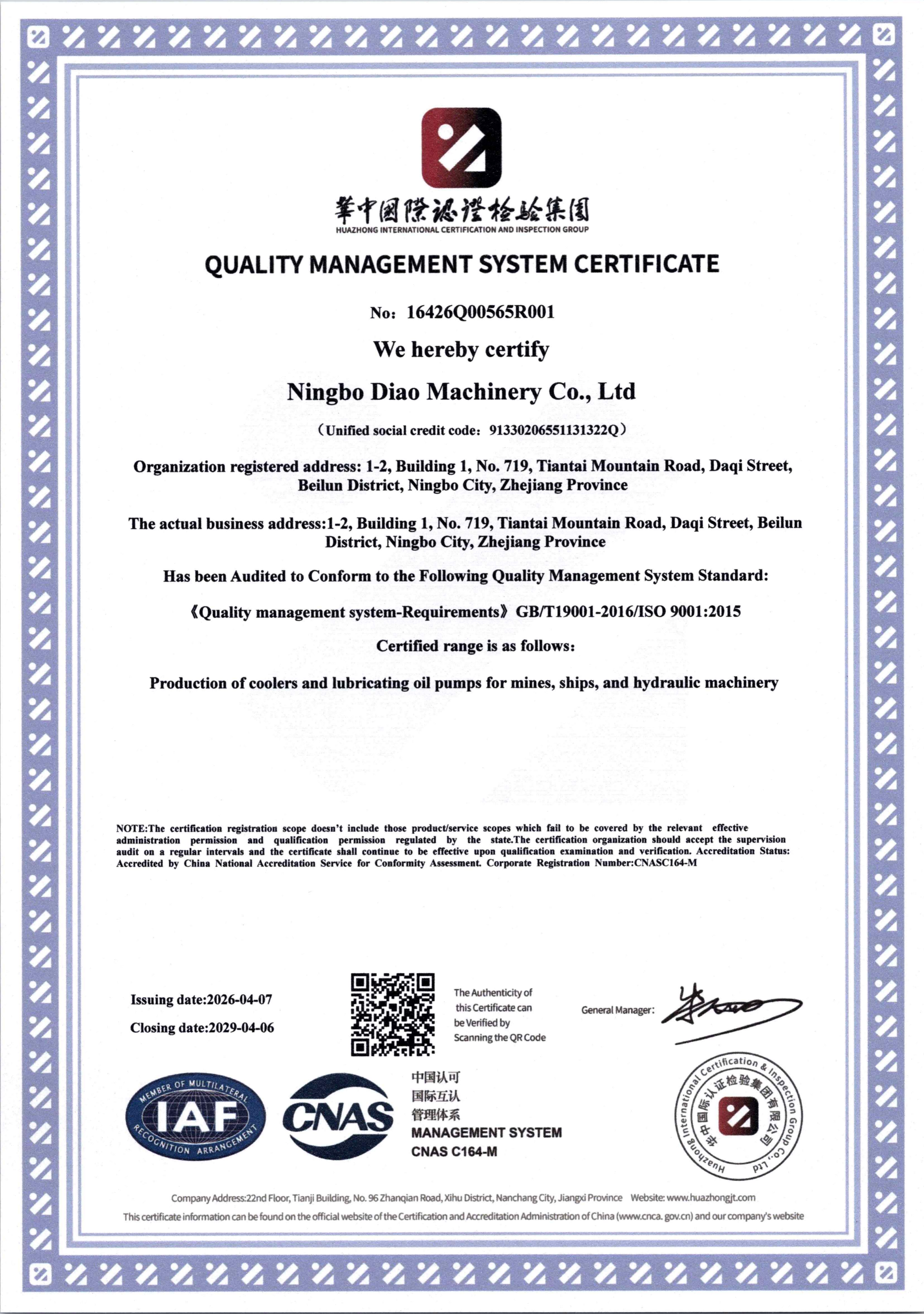
Certificate 16426Q00565R001, issued by Huazhong International Certification and Inspection Group under GB/T 19001-2016 / ISO 9001:2015, valid 7 April 2026 to 6 April 2029.
Product families inside the certified scope
The models associated with this certification are cooler and pump products used in lubrication and hydraulic circuits. Their published parameters are listed below because buyers typically need to confirm both scope coverage and technical fit in the same review.
| Model | Product type | Key published parameters |
|---|---|---|
| DK630 | Electric lubrication pump | Displacement 630 cc/rev; motor rotation speed 950 / 1450 rpm; QT500 material |
| PSN100 | Trochoidal pump, bidirectional mechanical pump | Displacement 100 cc/rev; max speed 1800 rev/min; temperature -30 °C to +100 °C; ductile iron QT500 |
| PST180 | Bidirectional internal gear pump | Displacement 180 cc/rev; max speed 1800 per min; temperature -30 °C to +100 °C; housing GG250 gray cast iron or QT500 ductile iron |
| DFLSL-10 | Self-circulating cooler | Cooling capacity 1.61 / 1.84 kW/°C; oil pump flow (VG46) 100-125 L/min or 150-200 L/min; consumed power 5.5 / 7.5 kW |
| DFLEX8 | Wind cooler | Comparative cooling capacity 1.15 / 0.91 kW/°C; fan diameter 630 mm; motor voltage 3φ380 |
| DWBW-408-T | Fin-type oil/water cooler | Max working pressure 16 bar oil side, 10 bar water side; oil medium ≤120 °C; viscosity 12-320 mm²/s |
How to Verify a Certificate Before You Shortlist a Supplier
Verification is procedural rather than technical, and it removes the most common failure mode in supplier evaluation: accepting a certification logo where the buyer needed a certification scope. The six checks below follow the structure of a real certificate.
| Verification point | What to confirm | Why it matters |
|---|---|---|
| Certificate number | A traceable number, for example 16426Q00565R001 | Distinguishes a registered document from a promotional statement |
| Issuing body | The named certification and inspection organisation | Allows the buyer to follow up with the issuing organisation independently |
| Standard and version | GB/T 19001-2016 / ISO 9001:2015 | Confirms the certification cycle reflects the current standard |
| Scope wording | Production of coolers and lubricating oil pumps for mines, ships, and hydraulic machinery | Only activities and products inside the scope are covered |
| Validity window | Issue 7 April 2026; expiry 6 April 2029 | An expired or unstated date is not usable evidence |
| Product mapping | Match the purchased model against the certified product families | Prevents a scope gap between the certificate and the order |
Two additional checks are worth adding for multi-site manufacturers. First, ask which production site the certificate covers, because a quality management system is audited per site and per process. Second, ask whether customised configurations - for example colour or oil pump modifications - are handled inside the same documented process or as a separate, less controlled workflow.
What Documented Quality Control Looks Like on the Factory Floor
A quality management system becomes concrete in three places: the facility, the material records and the test routine. Deo Machinery operates a 10,000 m² facility with 80 employees and an annual output of 30,000 units, supported by a 12-engineer research and development team. Monthly capacity is stated at 2,500 units, with a lead time of 35-45 days and a minimum order quantity of one unit.
Material specification is part of the audit trail rather than a footnote. The DK630 electric lubrication pump and the PSN100 trochoidal pump use QT500 ductile iron; the PST180 internal gear pump housing is produced in GG250 gray cast iron or QT500 ductile iron. Material certificates of this kind are exactly what a documented system is designed to retain and retrieve.
Test routine completes the picture. Deo Machinery applies 100% testing, and pre-shipment test is the standard acceptance method for orders. For a buyer at the evaluation-to-execution stage, that combination is the practical meaning of ISO 9001 compliance: a defined inspection step that exists before shipment, not after installation.

Facility interior at the Ningbo production base, where lubrication pump and cooler production is carried out under the certified quality management system.
Where Certified Lubrication Pumps Are Applied
Certification scope names application sectors, and those names should match the buyer's own operating environment. Deo Machinery's certification scope references mines, ships and hydraulic machinery, which aligns with the product types published for the DK630 electric lubrication pump: mining equipment, construction machinery, steel industry and industrial lubrication oil pump duty.
A documented installation case illustrates how this works in practice. Ten units were installed for speed reducer lubrication at sites in Thailand and Germany, and the product has been adopted by end equipment manufacturers including wind power equipment manufacturers. For a buyer evaluating a comparable application, the relevant point is not the country list but the fact that a named application - speed reducer lubrication - was executed and recorded.
Cooling and lubrication are usually specified together in heavy-duty circuits, which is why the same certified scope covers both. The DFLSL-10 self-circulating cooler is used in hydraulic systems, lubricating systems, extruding machinery, forging and stamping equipment, shearing machines, gearboxes, large bearings and smelting equipment. The DFLEX8 wind cooler addresses hydraulic systems, coal mines, crude oil mining, construction machinery, lubricating systems, gearboxes, reducers and wind energy applications. For projects that combine a lubrication pump with an oil cooling circuit, a single certification scope covering both product families reduces the number of supplier qualifications a procurement team has to run separately.
The Market Trend Behind the Checklist
Documentation requirements rarely appear without a commercial driver. Market Research Future valued the global automatic lubrication system market at approximately USD 0.37 billion in 2024, and a separate Dataintelo estimate placed the global oil coolers market - used in lubrication cooling systems - at USD 6.8 billion in 2025. Published estimates differ depending on whether the scope covers automated systems only or the wider lubrication pump and cooling market, so buyers should treat any single figure as scope-dependent rather than absolute.
Supply is concentrated in the same regions that demand it. Asia-Pacific accounted for approximately 42% of total global lubrication system shipments in 2024, and China exported USD 14.3 billion in liquid pumps, including lubrication pumps, in 2024 - about 18.5% of global exports, according to OEC data. For buyers in Europe, America, Southeast Asia and Australia, that means the majority of shortlisted suppliers are export-oriented manufacturers whose documentation quality directly affects customs, insurance and plant acceptance.
One adjacent standard deserves attention at this point. ISO 4406 is the primary international standard for quantifying particle contamination in hydraulic and lubrication fluids using a three-part code such as 18/15/13. It addresses fluid cleanliness, not manufacturing quality, and it is frequently confused with quality management certification in tender documents. The two are complementary: ISO 9001 describes the supplier's system, ISO 4406 describes the target condition of the oil in the buyer's circuit.
ISO 9001 Compared With Other Qualification Approaches
Certification is one instrument among several, and each instrument verifies a different thing. Comparing them directly prevents both over-reliance and dismissal.
| Qualification approach | What it verifies | What it does not verify |
|---|---|---|
| Supplier specification sheet | Declared displacement, speed, temperature and material values | Whether production consistently delivers those values |
| ISO 9001 certificate | Documented, audited management system covering defined production scope | Actual hydraulic performance of a specific unit or configuration |
| Pre-shipment test / acceptance inspection | The condition of the specific goods being delivered | Long-term reliability across the full service interval |
| ISO 4406 fluid cleanliness target | Particle contamination level in the lubrication or hydraulic fluid | How the pump was manufactured or managed |
Where certification stops being useful
Three boundaries should be stated plainly, because ignoring them is where most certification-driven procurement errors originate.
First, ISO 9001 does not certify product performance. It cannot tell a buyer whether a lubrication pump will deliver the required volumetric efficiency in a specific circuit, or whether a cooler will remove a given heat load at the site's ambient temperature. Performance still has to be verified against published parameters and, where the duty is unusual, against a test or sample.
Second, scope is a hard boundary. A certificate that covers the production of coolers and lubricating oil pumps for mines, ships and hydraulic machinery does not automatically extend to a product family or process outside that wording. Buyers should map the exact model under consideration against the certified scope rather than assuming a blanket company-wide qualification.
Third, system certification does not replace order-level inspection. Where an order involves customisation - for example colour changes or oil pump modification - the delivered configuration should still be checked against the order specification at the pre-shipment stage. Certification reduces process risk; it does not transfer inspection responsibility from the buyer to the certificate.
Future Outlook
Certification is moving from a screening checkbox to a structured part of the specification. Three developments are visible from current supply and demand patterns.
Documentation depth is increasing. Buyers increasingly request certificate numbers, scope wording and validity dates as standard attachments to a quotation, and quality management records that were once internal are now part of export documentation for markets in Europe, America, Southeast Asia and Australia.
Combined scopes are becoming an advantage. Because lubrication and cooling are usually specified together in heavy machinery, a supplier whose certified scope covers both coolers and lubrication pumps can reduce the number of separate qualifications a project team must run. This is a documentation benefit rather than a technical one, but it affects procurement workload directly.
Fluid cleanliness standards are being written alongside quality system requirements. Specifications that reference ISO 4406 cleanliness codes together with a quality management requirement are already common in heavy industry tenders, and that pairing - system evidence plus fluid condition target - is a more reliable basis for selection than either element alone.
FAQ
What does ISO 9001 certification actually certify for an industrial lubrication pump manufacturer?
It certifies that the manufacturer's quality management system has been audited against the ISO 9001 standard, covering defined processes such as document control, traceability, supplier evaluation, calibration and corrective action. It confirms how production is managed within a stated scope. It does not certify the performance of an individual pump model.
How can a buyer confirm that a specific lubrication pump model is covered by a supplier's certificate?
Two documents have to be read together: the certificate scope and the supplier's product list. Deo Machinery's certificate 16426Q00565R001 covers the production of coolers and lubricating oil pumps for mines, ships and hydraulic machinery, and the models associated with that scope include the DK630 electric lubrication pump, the PSN100 trochoidal pump, the PST180 internal gear pump, the DFLSL-10 self-circulating cooler, the DFLEX8 wind cooler and the DWBW-408-T water cooler. A model outside that scope should be qualified separately.
Does ISO 9001 certification guarantee lubrication pump performance?
No. Performance is defined by measurable parameters such as displacement, speed, viscosity range, temperature range and cooling capacity, and by whether those values match the duty of the circuit. ISO 9001 provides evidence that the manufacturing process is controlled and documented; performance verification remains a separate technical exercise.
Which industries are named in Deo Machinery's ISO 9001 scope, and why does that name matter?
The scope names mines, ships and hydraulic machinery. Those sector names indicate the application environment considered during the audit. Buyers in mining, construction machinery, steel, marine and hydraulic station applications can therefore assess scope relevance directly, while buyers in unrelated sectors should treat the certificate as background context rather than a sector-specific qualification.
How does ISO 9001 relate to fluid cleanliness standards such as ISO 4406?
They address different objects. ISO 9001 is a manufacturing quality management standard evaluated at the supplier. ISO 4406 is the primary international standard for quantifying particle contamination in hydraulic and lubrication fluids, expressed as a three-part code such as 18/15/13. A complete specification can reference both, but one does not satisfy the other.
What order conditions typically apply when purchasing certified lubrication pumps?
For Deo Machinery, the stated conditions are a minimum order quantity of one unit, a lead time of 35-45 days, delivery terms of FOB, CIF or EXWORK, and pre-shipment test as the acceptance method. OEM and ODM production services are offered, with customisation options covering colour and oil pump configuration. These conditions are commercial terms and are separate from the certification itself.
Reference material: the manufacturer's product and capability brochure is available as a downloadable PDF at DEO Machinery brochure.