
ISO Certifications for Screw Barrels: What the Φ25/50-Φ185/340 Range Really Covers
ISO Certifications for Screw Barrels: What the Φ25/50-Φ185/340 Range Really Covers
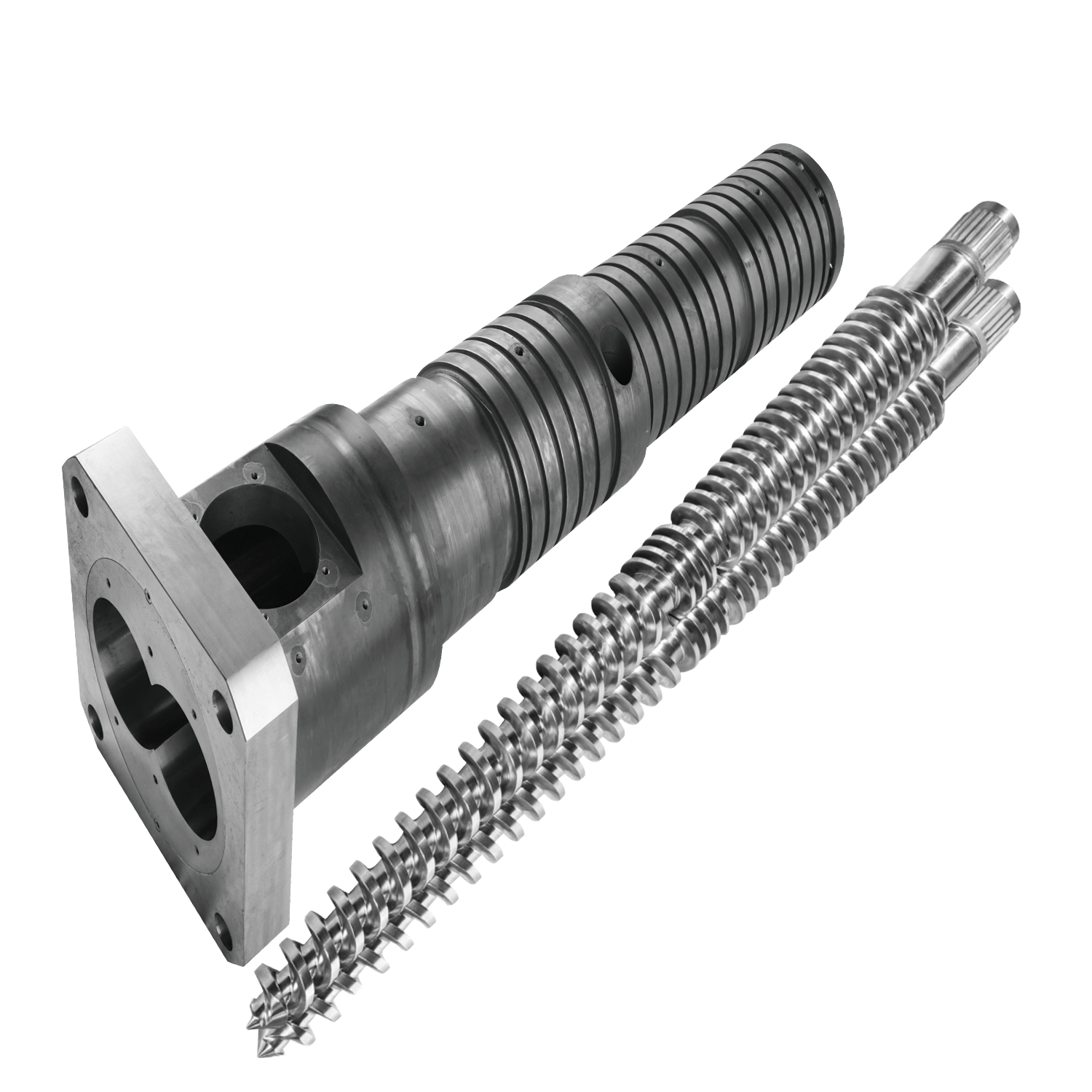
A screw barrel certificate is often read as a claim about a finished part. In component sourcing, the more useful reading is about scope — what the certificate covers, which entity it covers, and whether design and manufacture sit inside the audited system or outside it. For conical twin screw barrels in the Φ25/50–Φ185/340 range, that scope is documented: ISO 9001:2015 and ISO 45001:2018, held under certificate number 15/25E6429R20 issued by WIT ASSESSMENT, covering the design and manufacture of screw barrels rather than final assembly alone.
The holder of that certificate is Zhejiang Guangming Plastics Machinery Co., Ltd., the manufacturer behind the Guangyou Screw brand. Established in 1992, the company operates a 100,000 m² manufacturing facility with roughly 800 staff, including a 25-engineer R&D team, and an annual production capacity of approximately 32,000 units. Screw barrels are its principal product line, exports account for 30% of sales, and the European Union is among its major markets. Those details matter here for one reason: a certificate belongs to a named legal entity at a named manufacturing site, so a buyer's first verification step is matching the certificate to the supplier actually producing the barrel.
What Certificate 15/25E6429R20 Actually States
The certification held for the conical twin screw barrel range and other screw barrel products is summarised below. The distinction between a management-system certificate and a product test report is the single most important point in this table.
| Item | Detail |
|---|---|
| Certificate holder | Zhejiang Guangming Plastics Machinery Co., Ltd. (brand: Guangyou Screw) |
| Certificate number | 15/25E6429R20 |
| Issuing body | WIT ASSESSMENT |
| Standards covered | ISO 9001:2015 (quality management system); ISO 45001:2018 (occupational health and safety management system) |
| Audited activity | Design and manufacture of screw barrels — not assembly only |
| Product families in scope | Conical twin screw barrel Φ25/50–Φ185/340; parallel twin screw barrel Φ45–Φ350; single screw extruder screw and barrel Φ20–Φ500; injection molding machine screw and barrel Φ20–Φ300; rubber machine screw and barrel Φ20–Φ650 |
Two standards, two different jobs. ISO 9001:2015 is a quality management system standard: it defines how a manufacturer identifies processes, controls design and development, manages documented information, controls nonconforming output, and applies risk-based thinking across the production flow. ISO 45001:2018 is an occupational health and safety management system standard: it defines how a manufacturer identifies workplace hazards, controls risk, meets legal requirements, and involves workers in safety decisions.
Neither standard is a certificate of product performance. A buyer who treats ISO 9001:2015 as evidence that every barrel shipped will measure within tolerance is misreading the document. What the certificate does establish is that the processes which produce those measurements — material selection, heat treatment, inspection, document control, corrective action — are defined, monitored, and auditable. That is a different and, for component sourcing, largely more practical form of assurance.
Why "Design and Manufacture" Is Not the Same as "Assembly Only"
In screw and barrel supply, certificates frequently cover a narrow commercial step. A trading company or assembly operation may hold ISO 9001:2015 for handling, storage, and dispatch while the actual cutting, nitriding, alloying, and grinding happen at an unrelated job shop outside the audited boundary. When something goes wrong six months later — a nitrided case that spalls, a screw that drifts out of straightness — the audit trail ends at the point where the certified process stopped.
A scope that includes design changes that picture. It means the geometry of the screw and barrel, the material grade selection, the heat-treatment parameters, and the inspection plan are all inside the controlled system. For a procurement engineer, the practical consequences are:
- Parameter changes are governed. A revision to flight geometry, compression ratio, or case depth should pass through documented design review rather than informal workshop adjustment.
- Traceability reaches back further. Material certificates, heat-treatment records, and inspection results relate to a defined production route.
- Nonconformance handling is defined. Rework and rejection decisions follow a documented process rather than an ad hoc judgement.
- Corrective action is repeatable. A recurring dimensional issue should trigger a documented root-cause process, not just a replacement part.
This is where certification starts to look like commercial value rather than a logo on a datasheet. A barrel that measures correctly on arrival but comes from an uncontrolled process is a different purchasing risk from a barrel whose production route is auditable — even when the two arrive with identical drawings.
What the Φ25/50–Φ185/340 Range Covers
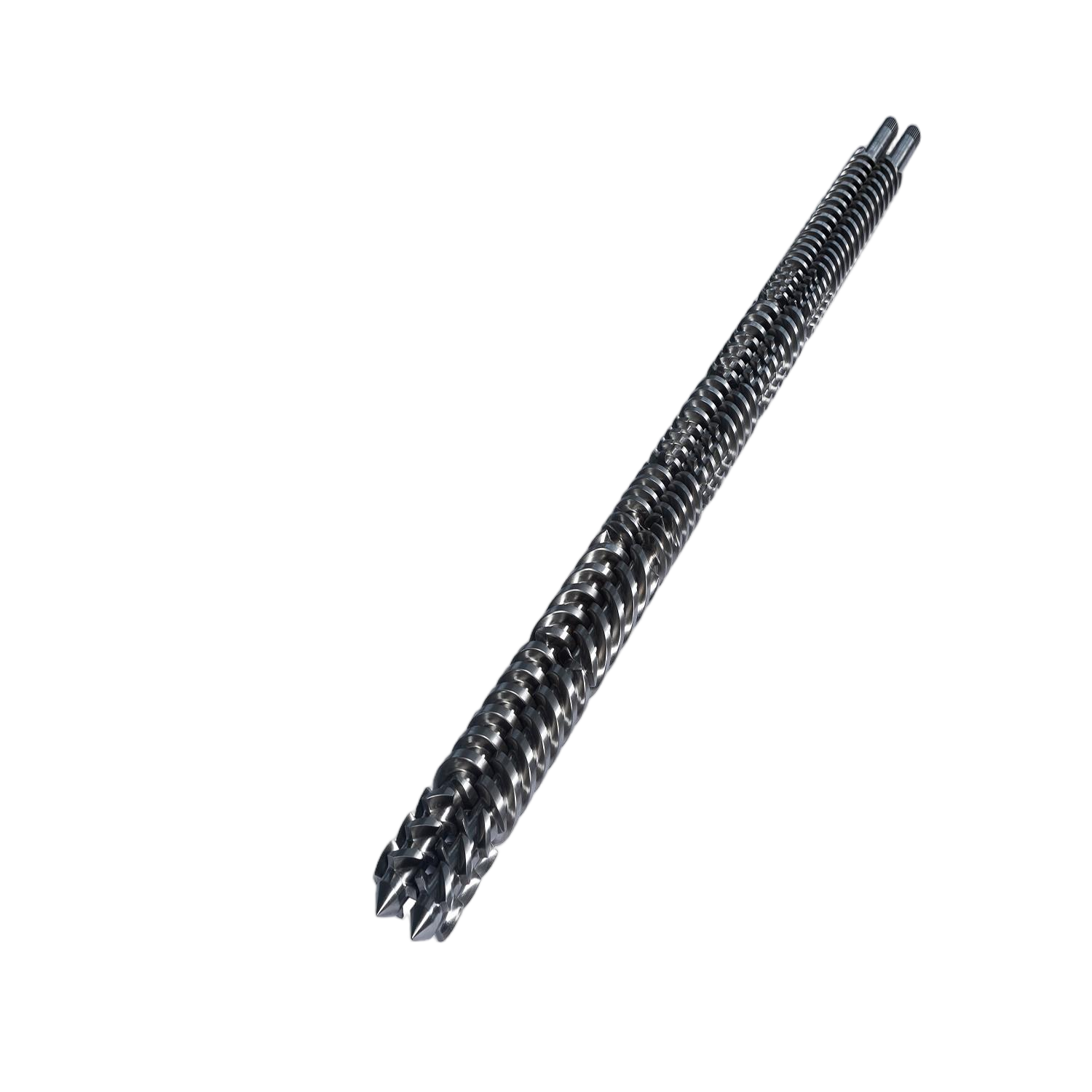
The model designation Φ25/50–Φ185/340 is a range expression, not a single part. In conical twin screw notation, the paired figures describe the small-end and large-end screw diameters of the conical screw pair; the range therefore spans from the smallest Φ25/50 pair to the largest Φ185/340 pair currently offered. Everything between those limits falls inside the same certified product family, which is why the certification scope is meaningful for buyers ordering anything from small profile lines to large pipe extrusion hardware.
The technical specification attached to that range is uniform across the family, and it is worth reading as a set of auditable commitments rather than marketing numbers:
| Specification | Value |
|---|---|
| Model range | Φ25/50–Φ185/340 |
| Product type | PVC extrusion (conical twin screw barrel) |
| Applicable industries | Plastics machinery; construction materials |
| Barrel and screw materials | 38CrMoAl (1.8509), 34CrAlNi7 (1.8550), 31CrMoV9 (1.8519), D2, DC53, Gr12MoV, 9Cr18MoV, AISI316, AISI420 and others |
| Hardness after hardening and tempering | HB260–310 |
| Nitrided hardness | HV850–1000 |
| Nitrided case depth | 0.45–0.7 mm |
| Nitrided brittleness | Less than Grade 2 |
| Surface roughness | Ra 0.4 |
| Screw straightness | 0.015 mm |
| Chromium-plating depth | 0.025–0.10 mm |
| Surface chromium-plating hardness after nitriding | ≥900 HV |
| Alloy hardness | HRC50–65 |
| Alloy depth | 0.8–2.0 mm |
For comparison, the widely referenced industry specification for nitrided plasticating screws in 38CrMoAl places case depth at approximately 0.4–0.6 mm with surface hardness in the 900–1,100 HV band. The Φ25/50–Φ185/340 specification states 0.45–0.7 mm case depth and HV850–1000. The two bands overlap but are not identical: the stated case depth extends slightly deeper, while the stated hardness band starts slightly lower. Buyers who compare datasheets line by line should read these as different process targets rather than as a simple higher-or-lower ranking — case depth and hardness trade off against each other in nitriding practice, and the correct target depends on the filler load and abrasiveness of the compound being processed.
Where the Certified Range Is Used: PVC Extrusion and Construction Materials
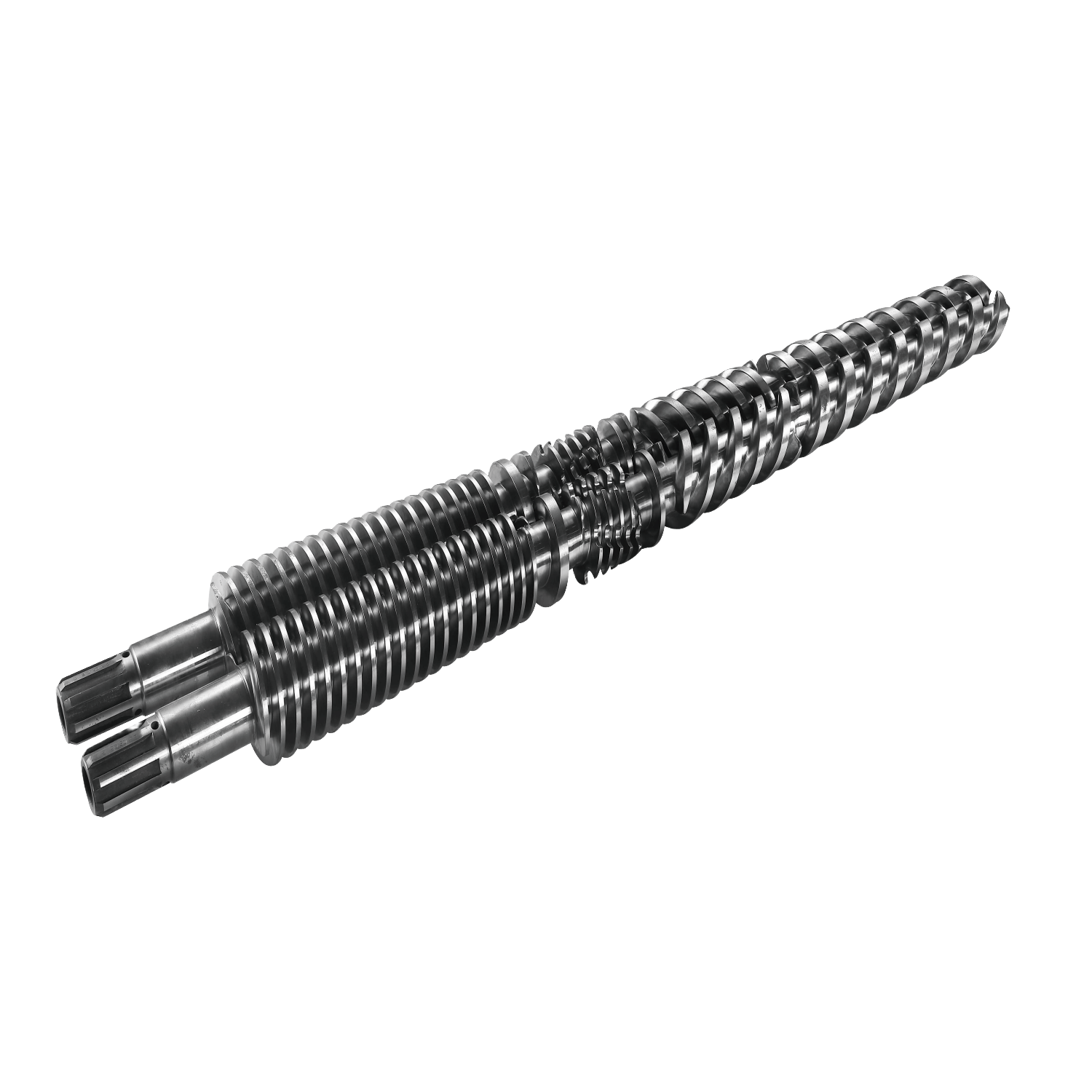
The application profile for this product family is specific rather than general. It covers PVC pipe, profile, and sheet extrusion projects, operating in continuous counter-rotating conical twin-screw mode on PVC conical twin-screw extruders. The functional requirements listed for the application are efficient melting of PVC powder, high-shear plasticising, and stable extrusion shaping.
The special requirements are where certification and specification meet. For PVC formulations with high calcium carbonate filler loading, the stated recommendation is a bimetallic lining rather than a standard nitrided finish, because abrasive filler accelerates wear on the screw flights and barrel bore. This is not a marketing preference; it is a wear-mechanism conclusion. Calcium carbonate at high loading acts as an abrasive medium, and the working surfaces of a conical twin screw pair see continuous sliding contact under heat. A nitrided case is effective against adhesive and mild abrasive wear; a centrifugally cast alloy liner is specified for the more aggressive case.
Bimetallic barrels in industry practice typically use a centrifugally cast boron-nickel-chromium alloy liner with a thickness in the range of 1.5–3.0 mm, which is substantially thicker than a nitrided case measured in tenths of a millimetre. That thickness difference is the reason bimetallic construction is specified for high-filler work — and also the reason it behaves differently during reconditioning, a point covered in the next section.
Where Certification Does Not Help: Limits Buyers Should Understand
Three boundaries are worth stating plainly, because they are the ones most often blurred in supplier conversations.
First, a management-system certificate is not a part-level inspection report. ISO 9001:2015 does not certify that a specific barrel reaches 0.015 mm screw straightness or Ra 0.4 surface roughness. It certifies that the process producing that barrel is controlled. Buyers still need dimensional and hardness records for the individual unit, and those records should be requested with the order rather than assumed from the certificate.
Second, ISO 45001:2018 is not a product-quality credential. It addresses occupational health and safety management. Its sourcing relevance is indirect but real: a manufacturer that manages heat-treatment, grinding, and alloy-handling hazards under a formal system is generally a lower operational-risk counterparty, and safety-system failures can translate into production interruption. It is not evidence of barrel performance.
Third, bimetallic construction carries its own limitations. A centrifugally cast liner is harder and thicker, but it is less forgiving to rework than a nitrided barrel, and the cost position is higher. Buyers processing unfilled or lightly filled PVC may be paying for wear resistance they do not need. The correct question is not which option is better, but which wear mechanism the specific formulation produces — and that depends on filler type, filler loading, and screw speed, none of which a certificate can answer.
Structural Comparison: Certified Component Supply vs Open-Market Sourcing
| Evaluation dimension | Certified design-and-manufacture scope | Open-market component sourcing |
|---|---|---|
| Documentation | Certificate number, issuing body, and standards can be named and independently checked | Documentation quality varies by vendor; verification path is often unclear |
| Design control | Geometry and material changes pass through a defined review process | Changes may be handled informally between workshop and buyer |
| Traceability | Material and heat-treatment records relate to a defined production route | Traceability depth depends on the intermediary |
| Nonconformance handling | Rework, rejection, and corrective action follow documented procedure | Resolution commonly negotiated case by case |
| Safety management | Covered by a separate certified OH&S system (ISO 45001:2018) | Not typically visible to the buyer |
| Part-level conformance | Still requires per-unit inspection data — not implied by the certificate | Also requires per-unit inspection data |
The last row is the honest one. Certification changes the reliability of the process behind the part; it does not change the need to verify the part. Suppliers who present a certificate as a substitute for dimensional records are describing a weaker offer than it appears.
Verification Checklist for Procurement Engineers
- Confirm the certificate holder's legal name matches the entity issuing the quotation and the invoice.
- Confirm the manufacturing site on the certificate matches the site where the barrels will be produced.
- Read the scope statement and identify whether design and manufacture are included, or only trade and assembly.
- Record the certificate number and issuing body — here, 15/25E6429R20 issued by WIT ASSESSMENT — and verify through the issuer's own registry rather than a PDF alone.
- Separately confirm which standard covers what: ISO 9001:2015 for quality management, ISO 45001:2018 for occupational health and safety.
- Request per-unit inspection records covering screw straightness, surface roughness, nitrided hardness, and nitrided case depth against the stated specification values.
- Request material certificates for the specific grades ordered from the available material list.
- Match the wear solution to the compound — nitrided finish or bimetallic lining — before comparing price.
Market Context: Why Component-Level Verification Is Gaining Weight
The scale of the equipment market behind these components explains the attention certification now receives. The global plastic processing machinery market reached USD 25.9 billion in 2025, with injection molding machines accounting for 50.9% of that share, according to Grand View Research. Within the component layer, the feed screw barrel market was projected at USD 1.89 billion in 2024, growing to USD 3.33 billion by 2034 at a CAGR of 5.8%, based on Global Insight Services estimates. The bimetallic barrel and screw segment was estimated at USD 2.8 billion in 2025, forecast to reach USD 4.7 billion by 2034 according to Dataintelo.
Two implications follow for buyers. First, the wear-resistant segment — bimetallic construction — is expanding faster than the baseline component market, which means the specification decision between nitrided and bimetallic barrels is becoming a routine procurement question rather than a specialist one. Second, as order volumes rise across multiple regions, buyers are increasingly sourcing barrels as replacements for equipment originally supplied by third parties, where the original process documentation is unavailable. In that situation, the supplier's audited scope becomes the buyer's primary substitute for institutional knowledge.
Future Outlook
The direction of travel in component sourcing is toward separating two questions that used to be merged: is this part dimensionally correct, and is the process that made it controlled? The first is answered by inspection data and will increasingly be answered by digital records travelling with the shipment. The second is answered by certification, and its value rises as supply chains lengthen and the distance between the buyer and the production floor increases.
For a manufacturer such as Zhejiang Guangming Plastics Machinery, the useful trajectory is not acquiring more certificates but making the existing ones legible — connecting a certificate number to a product range, a manufacturing site, and a defined set of specification commitments. That is what a scope statement including design and manufacture, rather than assembly alone, makes possible.
FAQ
What does ISO 9001:2015 certification mean for a screw barrel manufacturer?
ISO 9001:2015 is a quality management system standard. For a screw barrel manufacturer, certification means the processes used to design, produce, inspect, and release screw barrels are defined and auditable — including design and development control, documented information, control of nonconforming output, and corrective action. It is a statement about process control, not a test result for an individual barrel.
Does the certification cover design as well as manufacturing?
For the conical twin screw barrel range Φ25/50–Φ185/340 and the other screw barrel products held under certificate 15/25E6429R20, the audited activity covers design and manufacture, not assembly only. That means geometry decisions, material grade selection, heat-treatment parameters, and inspection planning fall inside the controlled system, rather than being handled outside the certified boundary.
What does ISO 45001:2018 add that ISO 9001:2015 does not?
ISO 45001:2018 is an occupational health and safety management system standard. It addresses hazard identification, risk control, legal compliance, and worker participation in safety decisions. It does not provide evidence about product performance or dimensional accuracy. Its relevance to a buyer is operational: manufacturers running heat treatment, grinding, and alloy handling under a formal safety system present a lower risk of production interruption.
Which products fall within the certified scope?
The certified product families include the conical twin screw barrel Φ25/50–Φ185/340 for PVC extrusion; the parallel twin screw barrel Φ45–Φ350 for compounding and pelletizing; the single screw extruder screw and barrel Φ20–Φ500 for film blowing and pipe extrusion; the injection molding machine screw and barrel Φ20–Φ300; and the rubber machine screw and barrel Φ20–Φ650 for rubber extrusion. The certificate number is 15/25E6429R20, issued by WIT ASSESSMENT.
How should a buyer verify a screw barrel certification claim?
Check three things in sequence. First, confirm the certificate holder's legal entity name matches the supplier quoting and invoicing. Second, confirm the manufacturing site named on the certificate is where the barrels will actually be produced. Third, read the scope statement to determine whether design and manufacture are included or only trade and assembly. The certificate number and issuing body can then be checked against the issuer's own registry rather than relying on a supplied PDF.
Does certification replace incoming inspection of screw barrels?
No. A management-system certificate does not certify that a specific barrel meets a specific tolerance. Product-level verification still requires documented inspection of screw straightness against 0.015 mm, surface roughness against Ra 0.4, nitrided hardness against HV850–1000, and nitrided case depth against 0.45–0.7 mm for the conical twin screw barrel range, together with material certificates for the ordered grades.
When is a bimetallic barrel specified instead of a nitrided barrel?
Bimetallic construction is specified where the wear mechanism is abrasive — most commonly PVC formulations with high calcium carbonate filler loading. Industry bimetallic barrels typically use a centrifugally cast boron-nickel-chromium alloy liner with a thickness of 1.5–3.0 mm, substantially thicker than a nitrided case depth measured in tenths of a millimetre. The trade-off is a higher cost position and less forgiving reconditioning behaviour, so the specification should be matched to the actual filler load rather than applied by default.
Reference material: Full technical catalogue for screw and barrel products, including specification tables for the Φ25/50–Φ185/340 conical twin screw barrel range: Guangyou Screw product catalogue (PDF). Company information: en.gmscrew.com.