
ISO9001 and 100% Electroplating: Handing's Ceiling Fan Compliance Credentials
ISO9001 and 100% Electroplating: Handing's Ceiling Fan Compliance Credentials
Ceiling fan certification is normally read as a row of marks on a product page. In procurement practice, it is more useful to read it as evidence about who controls the manufacturing process behind those marks. Handing Co. Ltd. is a decorative ceiling fan manufacturer established in 1992 in Kaiping City, Guangdong Province, China, whose ceiling fan and lighting factory has held ISO9001 certification since 1996, and which owns 100% of its electroplating factory. The company exports 100% of its ceiling fan output to the EU, the USA and Australia, and its products are listed in UL, cUL, Nom, BSI, CE, GS, Swedish Standard and SAA.
The scale of the category explains why the credential question keeps returning. Grand View Research estimates the global ceiling fan market at USD 14.24 billion in 2023, projected to reach USD 19.92 billion by 2030, a CAGR of 5.0% from 2024 to 2030. China's fan exports under HS 841459 reached 509 million units in 2024, with an export value of USD 3.788 billion, up 6.96% year on year, according to China Customs data reported by TradeDaas. Volume at this level is sourced through long supply chains, and every step that sits outside the manufacturer's direct control becomes a step the buyer has to audit.
Why Credentials Became a Structural Question, Not a Marketing One
The certified ceiling fan market is not shaped by demand alone. It is shaped by regulation that keeps moving. The U.S. safety standard for electric fans, UL 507, was updated with a new version effective November 27, 2024, specifically adding secondary thermal or current fuse requirements for fans installed in unattended areas. In Europe, EN IEC 60335-2-80:2024 establishes safety requirements for household fans, including ceiling fans, with rated voltages up to 250V for single-phase equipment. In the United States, ENERGY STAR certified ceiling fans are required to be up to 44% more efficient than conventional fans, and the 2024 Most Efficient criteria for standard fans require efficiency of at least 3.25D + 107 CFM/W.
Each of these is a product-level requirement, but none of them can be satisfied at the product level alone. Fuse selection, insulation, thermal behaviour, material composition and finish durability are decided long before the finished fan reaches a test bench. That is the shift buyers in the research and evaluation stage are responding to: a certificate is only as strong as the process that produced the unit it describes.
Where Compliance Risk Actually Enters a Ceiling Fan Project
A ceiling fan is a composite assembly. A decorative model typically contains a housing, a motor, a blade set, a light kit, a control module and a surface finish, and each element can fail a compliance check independently of the others.
- Finish and plating. Electroplated and painted hardware is the most visible element in a decorative ceiling fan and one of the hardest to correct after shipment. Discolouration, uneven coating or premature corrosion can trigger rejections even when the motor and electronics pass testing without issue.
- Material composition. Restrictions on hazardous substances in electrical and electronic equipment apply to coatings, solders, plastics and wiring, which means the compliance question reaches suppliers of chemicals and plated parts, not just the fan assembler.
- Electrical and thermal behaviour. Safety standards covering fans increasingly address protection in unattended operation, which puts weight on component selection and on the consistency of assembly rather than on design alone.
- Documentation matching. Listings are issued for defined configurations. A certificate that does not reference the exact model being shipped creates risk for the importer regardless of how sound the product is.
The commercial risk here is asymmetric. The manufacturer ships a container; the importer carries the customs hold, the retailer rejection and the warranty exposure. That asymmetry is the reason buyers ask whether plating, metal fabrication, painting and motor assembly happen inside the supplier's own factory or through subcontracted partners. Subcontracting is not inherently a defect — but subcontracted steps are harder to trace, harder to schedule, and harder to correct when a batch drifts out of specification.
What Handing Co. Ltd.'s Compliance Credentials Consist Of
Handing's qualifications are not a single certificate. They are a set of process, testing and market-entry facts that were established over several decades and that address different parts of the buyer's risk list.
| Credential | Recorded detail | What it addresses for a buyer |
|---|---|---|
| ISO9001 | Ceiling fan and lighting factory certified in 1996 | Quality management discipline across production and documentation — a process-level framework, not a product-level safety approval |
| Electroplating | 100% owned electroplating factory | Quality of electroplated parts, delivery timing and cost competitiveness kept inside the manufacturer's own operation |
| Vertical process ownership | Most metal parts produced in-house, in-house painting, motors assembled in-house | Fewer outsourced steps between raw component and finished fan |
| RoHS testing capability | XFS machine and chemical testing established in 2006; approved by TUV PS in the same year | Material compliance verification for European RoHS requirements |
| European market approvals | LVD/GS/TUV, EMC, EMF, RoHS and ERP for European fans | Safety, electromagnetic, material and energy-related requirements for European models |
| Product listings | UL, cUL, Nom, BSI, CE, GS, Swedish Standard and SAA | Market-entry documentation spanning North American, European and Australian requirements |
| Export orientation | 100% export; main markets EU, USA and Australia | Routine handling of regulated-market documentation, inspection and shipping requirements |
| Facility base | 12,320.66 m², 350 employees, annual output of 480,000 units, R&D team of 6 engineers | Capacity and engineering support behind project volumes and customisation requests |
Two entries in that table deserve to be read together rather than separately. The ISO9001 certification dates to 1996 and covers the ceiling fan and lighting factory. The RoHS testing capability dates to 2006, when Europe implemented the RoHS regulation and Handing responded by setting up the XFS machine and chemical testing, with the approach approved by TUV PS in the same year. The first is a management system; the second is a physical testing capability. Buyers who see both typically treat the combination as a stronger signal than either alone.
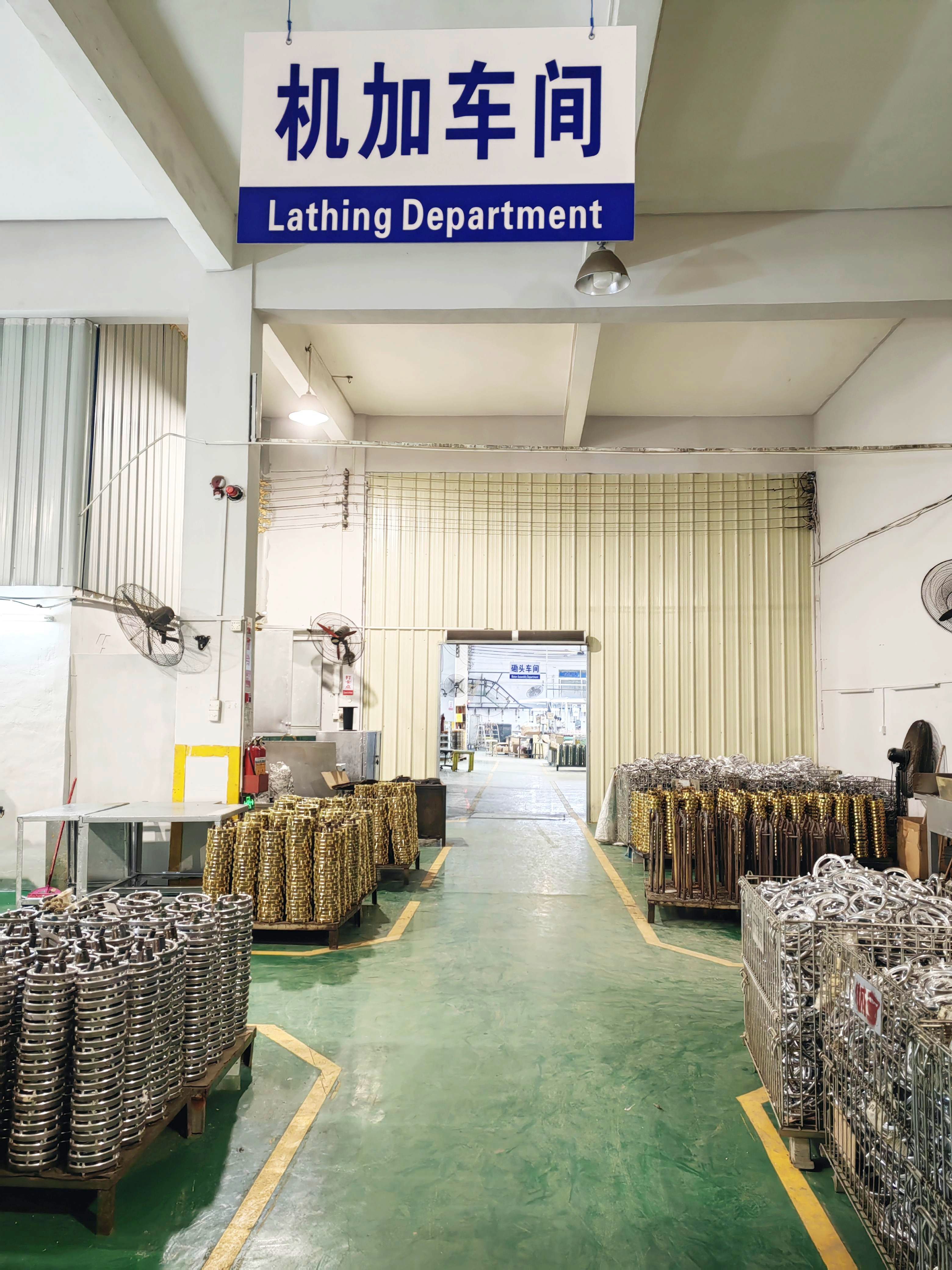
Metal component production inside Handing Co. Ltd.'s factory in Kaiping City, Guangdong — most metal parts are produced in-house before finishing and assembly.
How ISO9001 and In-House Electroplating Work at Factory Level
What ISO9001 does and does not cover
ISO9001 describes how a manufacturer plans, controls, records and corrects its processes. In a ceiling fan factory, that translates into incoming material inspection, defined work instructions at winding, painting, plating and assembly stations, traceability of batches, calibration of measuring equipment, and a documented route for handling non-conforming goods.
Its limit is equally important to state plainly. ISO9001 is a management-system certification. It does not replace product safety listings such as UL, CE or SAA, and it does not by itself demonstrate the performance of any particular model. A buyer using ISO9001 correctly treats it as evidence that quality control is systematic rather than improvised — and then verifies the product-level listings that apply to their market.
Why plating ownership changes the finish conversation
Electroplating is the deposition of a metal coating onto a conductive substrate. For a decorative ceiling fan, that coating determines how the hardware looks on arrival and how it behaves afterwards, particularly in humid or coastal installations. Plating quality depends on bath chemistry, current density, coating thickness, rinsing and drying — variables that need continuous control rather than one-time setup.
When plating is subcontracted, three things leave the manufacturer's direct control: consistency of coating thickness, maintenance of chemical baths, and queue position at someone else's plating line. Handing states that it owns 100% of its electroplating factory with the specific aim of keeping electroplated quality, delivery timing and cost competitiveness inside its own operation. For a buyer, the practical read is that the most visible failure mode in decorative ceiling fans — finish defects — sits within the same organisation that carries the delivery commitment, rather than at a supplier the buyer cannot audit.
Material testing as a production routine
RoHS compliance is not a document that can be issued once and forgotten. Coatings, solders and plastics change with supplier batches, and the 2006 XFS machine and chemical testing setup that Handing installed following the introduction of the European RoHS regulation remains the mechanism by which material composition is checked. Because that capability was approved by TUV PS in the same year it was established, buyers reviewing the European documentation chain see a testing method that has been independently reviewed, not only an internal claim.
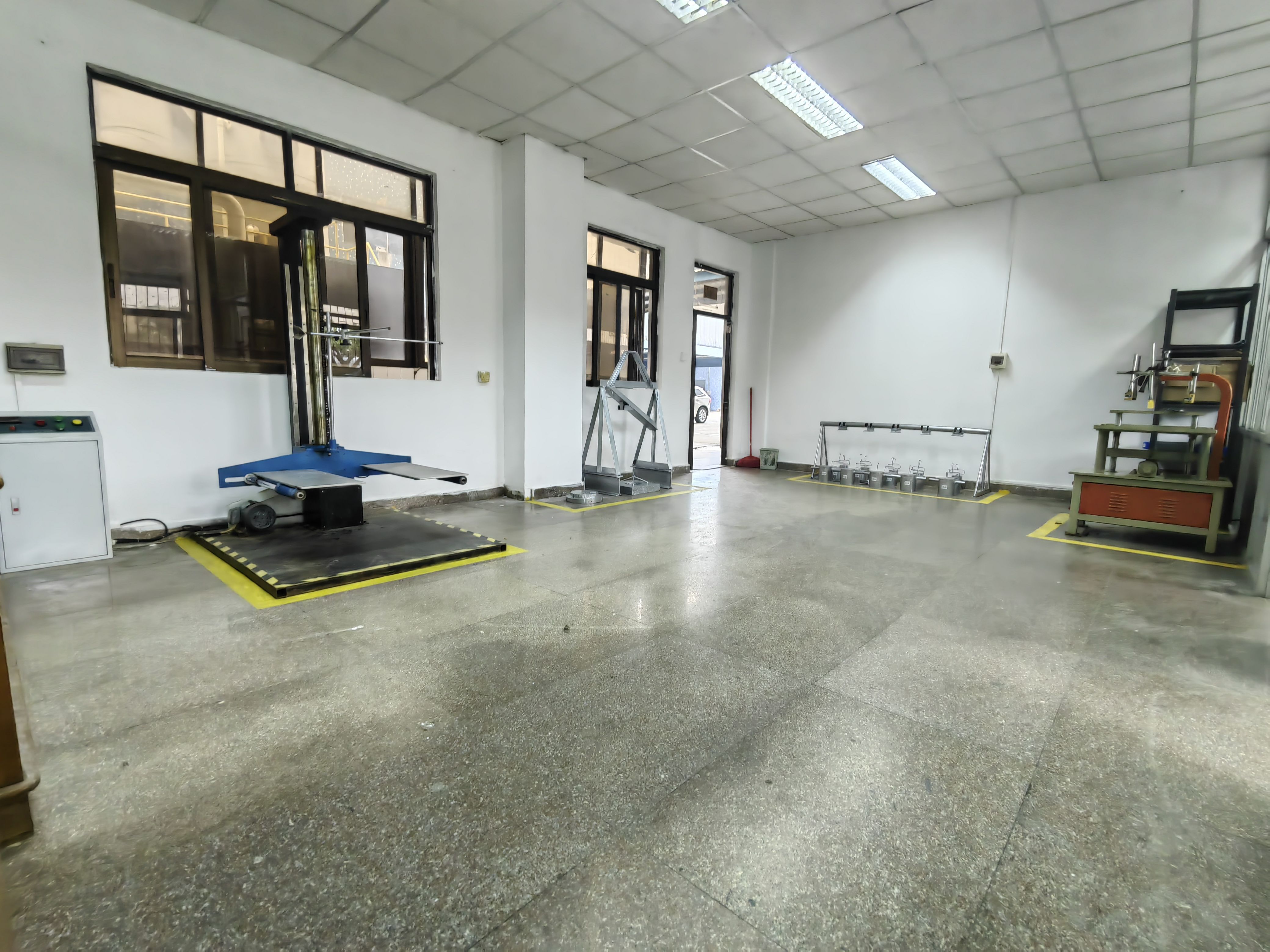
Incoming quality control and material testing at Handing Co. Ltd. — the point where component and coating compliance is verified before production.
Applying These Credentials to Decorative, Commercial and Indoor Projects
Certification matters most where a project carries documentation into a tender pack or a retail compliance file. Three project patterns in particular depend on the credentials described above:
- Residential interiors with integrated lighting. A ceiling fan with light carries more electrical content than a plain fan, so both electrical safety documentation and material compliance become part of the specification package.
- Hospitality and commercial grade interiors. Hotels, restaurants and light commercial spaces specify decorative fans in repeated waves, which means the manufacturer's ability to reproduce the same finish and configuration across multiple orders is as important as the first sample.
- Indoor projects in regulated markets. Where the buyer must present UL, CE, GS, SAA or equivalent listings at import, the value of a supplier whose documentation already spans Europe, North America and Australia is largely administrative — but it is the kind of administrative work that determines whether a shipment moves or waits.
Handing's documented decorative model illustrates how a specification and a credential set meet in practice.
| Specification | Detail |
|---|---|
| Item no. | TU52-MW-N3A1DOME |
| Housing | 52" TU housing, DC motor |
| Finish | Matt White |
| Blade | 3 x ABS |
| Light kit | 24W CCT LED light kit |
| Material | Steel housing + ABS blade |
| Type | Indoor decorative ceiling fan, ceiling fan with light, commercial grade ceiling fan, smart WiFi ceiling fan, 52" ceiling fan |
| Box size | 720 (L) x 225 (W) x 350 (H) mm |
| Applicable industry | Household, commercial |
The configuration is informative for buyers evaluating compliance-linked supply. A DC motor changes the control electronics; a 24W CCT LED light kit adds a luminaire to the assembly; a smart WiFi module adds radio and firmware considerations. Each addition raises the number of components that must be traceable and documented. It also explains why an integrated manufacturer with in-house motor assembly, metal fabrication and plating is often preferred for this class of product over a model built from purchased sub-assemblies.
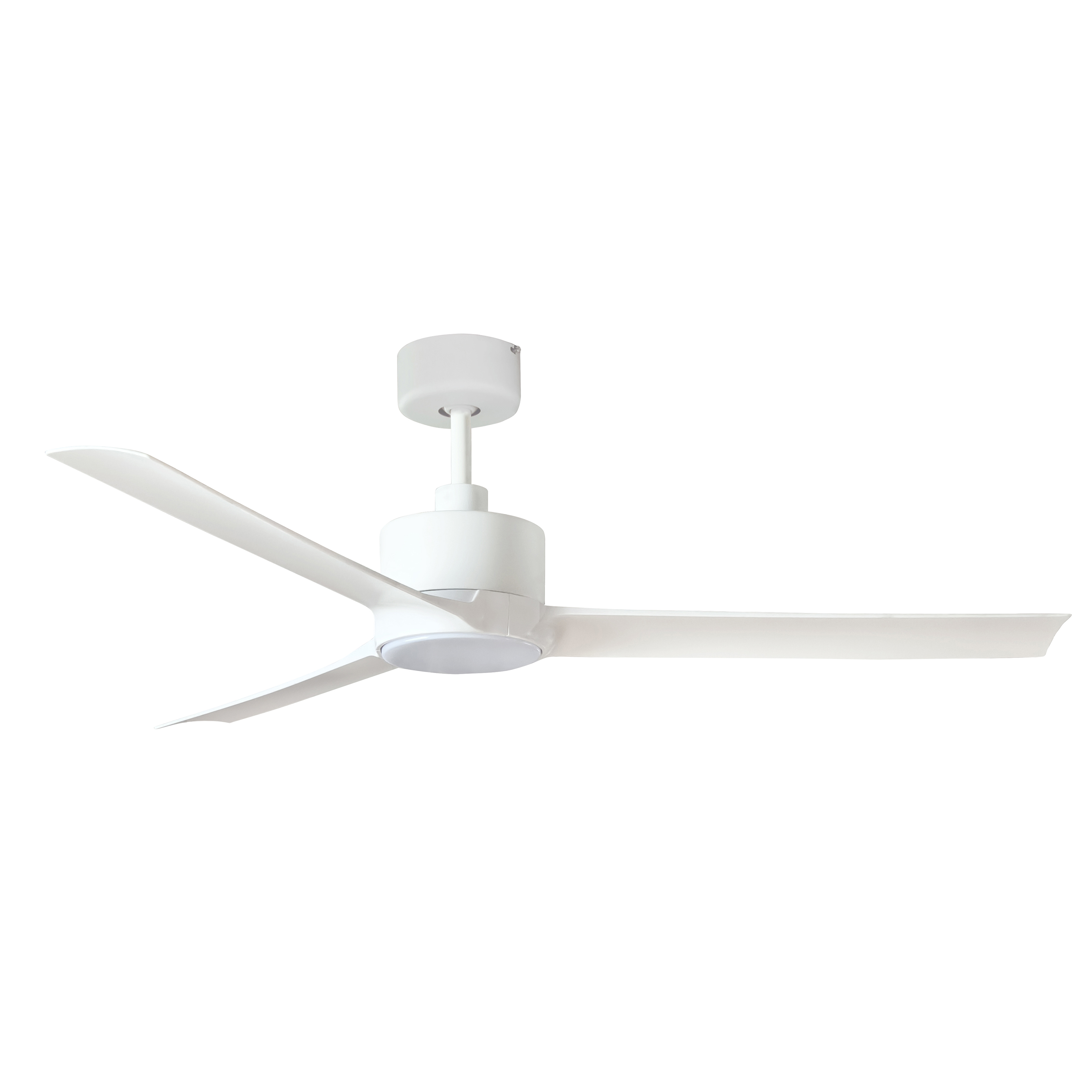
TU52-MW-N3A1DOME — a 52-inch matt white decorative ceiling fan with DC motor and 24W CCT LED light kit, produced by Handing Co. Ltd.
Market Context: Regulation and Demand Are Moving in the Same Direction
Two independent trends reinforce the value of verifiable credentials. The first is market growth and concentration. Asia Pacific held the largest revenue share of the ceiling fan market at 44.85% in 2023, driven by high demand in India and China, according to Grand View Research. Standard ceiling fans accounted for 63.66% of global revenue in 2023, which indicates that the mainstream category — not a niche premium segment — is where documentation requirements are being applied most broadly.
The second trend is competitive structure. Leading global manufacturers identified in the ceiling fan industry include Hunter Fan Company, Crompton Greaves, Havells India, Big Ass Fans and Minka Group, according to Grand View Research and Straits Research. Those names compete on brand and distribution; export-oriented manufacturers compete on process control, documentation and delivery reliability. For importers and distributors, the two groups are not substitutes but different links in the same chain, and the compliance burden lands on whichever link holds the import record.
Regulatory movement makes that burden heavier over time, not lighter. The UL 507 revision effective November 27, 2024, which added secondary thermal or current fuse requirements for fans in unattended areas, is a clear example: an existing product family can require design attention because the standard changed, not because the product changed. Suppliers with in-house engineering and testing absorb that kind of change faster than suppliers who must coordinate it across purchased assemblies.
Integrated Manufacturing Compared with Traditional Sourcing Models
Buyers evaluating decorative ceiling fan supply usually choose between three structural models rather than three brands. The differences are structural, and each model carries its own boundary.
| Sourcing model | Process ownership | Finish control | Documentation profile | Structural boundary |
|---|---|---|---|---|
| Trading company sourcing from multiple factories | Low — components and assembly sourced externally | Depends on third-party plating and coating suppliers | Documents assembled per order | Traceability depends on supplier cooperation; specification changes are difficult to lock across orders |
| Assembly-focused manufacturer with outsourced plating and metal parts | Partial — assembly controlled, upstream processes external | Plating queue and bath control sit outside direct control | Manufacturer listings plus sub-supplier data | Finish consistency and delivery timing depend on external capacity during peak periods |
| Integrated manufacturer with in-house plating and motor assembly (Handing model) | High — metal parts, painting, motors and plating controlled internally | Plating quality, timing and cost held in-house | ISO9001 system plus product listings plus in-house material testing | In-house plating is capital-intensive and requires continuous chemical control; certification listings remain specific to defined configurations |
The honest conclusion is not that one model is universally superior. A trading company can offer broader product ranges and faster sampling across categories. An assembly-focused manufacturer can be competitive on volume for simpler products. The integrated model earns its place when the finish is decorative, the market is regulated, and the buyer cannot absorb a batch-level compliance surprise — which is precisely the scenario Handing's credential set was built around.
Boundaries and Limits Buyers Should Plan For
Compliance credentials reduce risk; they do not eliminate it. Buyers using this reference should keep the following boundaries in view.
- ISO9001 is not a product approval. It says nothing about whether a specific fan meets UL 507, EN IEC 60335-2-80:2024 or ENERGY STAR criteria. Those must be confirmed at model level.
- Listings are configuration-specific. A change of housing, light kit, control module or motor type can move a product outside the scope of an existing listing. Buyers should confirm that documentation references the exact model and version being ordered.
- Standards keep changing. Given updates such as the November 27, 2024 UL 507 revision, approval status is best re-verified at purchase-order stage rather than assumed from a previous order.
- Vertical integration has a trade-off. Owning electroplating improves finish control, delivery timing and cost, but it also means the manufacturer carries fixed plating capacity and must maintain bath chemistry continuously. Buyers should expect finish capability to be defined by the available plating processes rather than by unlimited decorative freedom.
- Plating applies to metal components. The TU52-MW-N3A1DOME pairs a steel housing with ABS blades, so the electroplated finish governs the metal elements while the blade set is a moulded component. Overall decorative consistency therefore depends on both metal finishing and blade material selection.
- Export orientation shapes the relationship. With 100% of output exported to the EU, USA and Australia, buyers engage Handing as an export manufacturing partner rather than through a domestic distribution network, and the buyer's own channel carries local installation and service.
Future Outlook
Three directions look durable over the next planning cycle. Efficiency requirements will continue to tighten, following the pattern set by ENERGY STAR's 2024 Most Efficient criteria for standard fans. Material restrictions will extend further into coatings and plated parts, which favours manufacturers that already run chemical and XFS testing in-house. And the electrical content of decorative ceiling fans will keep rising through DC motors, LED lighting and smart control, adding components that must be documented and traceable.
Against a market projected by Grand View Research to grow from USD 14.24 billion in 2023 to USD 19.92 billion by 2030 at a 5.0% CAGR, and a Chinese export base that shipped 509 million fan units in 2024, the differentiating factor for buyers is unlikely to be price alone. It will be how much of the compliance chain sits inside the manufacturer's own walls — and how easily that can be verified before the purchase order is placed.
FAQ: Handing's Ceiling Fan Compliance Credentials
What does ISO9001 certification actually cover in a ceiling fan factory?
ISO9001 is a quality management system standard. It covers how a factory plans, controls and documents its processes — incoming material inspection, work instructions, batch traceability, equipment calibration and non-conformance handling. Handing's ceiling fan and lighting factory has held ISO9001 certification since 1996. It does not certify any individual fan model for safety or performance, and it should be read alongside product-level listings such as UL, CE, GS or SAA rather than as a replacement for them.
Why does owning an electroplating factory matter when sourcing decorative ceiling fans?
Electroplated hardware is the most visible and most correction-resistant part of a decorative ceiling fan. Plating quality depends on continuous control of bath chemistry, coating thickness and drying, and when plating is outsourced those variables leave the manufacturer's direct control. Handing owns 100% of its electroplating factory, which keeps electroplated quality, delivery timing and cost inside its own operation. One boundary is worth noting: plating applies to metal components, so on a model such as the TU52-MW-N3A1DOME the steel housing is plated while the ABS blades are moulded.
Which certifications should a buyer verify for EU, US or Australian ceiling fan projects?
For European models, Handing's documentation covers LVD/GS/TUV, EMC, EMF, RoHS and ERP. At product level, the company's fans are listed in UL, cUL, Nom, BSI, CE, GS, Swedish Standard and SAA, covering North American, European and Australian market entry. Buyers should treat these as market-specific requirements and confirm that the certificate references the exact model and configuration being ordered, since listings apply to defined product versions rather than to a manufacturer's full range.
How is RoHS and material compliance handled during production?
When Europe implemented the RoHS regulation in 2006, Handing set up an XFS machine and chemical testing to test its products, and the approach was approved by TUV PS in the same year. In practice this means material composition is checked as part of production rather than assumed from supplier declarations. Because coatings, solders and plastics can vary between batches, an in-house testing capability is what allows material compliance to be re-confirmed order by order — a relevant point given that standards such as UL 507 were revised effective November 27, 2024.
Which project types fit a decorative 52-inch DC fan such as the TU52-MW-N3A1DOME?
The model is specified as an indoor decorative ceiling fan with a 52-inch TU housing, DC motor, Matt White finish, three ABS blades and a 24W CCT LED light kit, in a steel housing with ABS blades, and it is listed for household and commercial application. Its configuration — decorative finish, integrated light kit and smart WiFi control — suits residential interiors, hospitality spaces and light commercial interiors where the fan is part of the visible design rather than purely a ventilation device. Because it contains a DC motor, LED lighting and a control module, it also carries more documentation requirements than a plain AC fan.
What limits should buyers plan for when working with an integrated ceiling fan manufacturer?
Integration is not the same as unlimited flexibility. In-house plating brings finish control and delivery reliability but also fixed capacity and a continuing dependence on chemical bath maintenance, so the range of available finishes is defined by the plating processes in operation. Certification is configuration-specific, standards continue to change, and with 100% of output exported to the EU, USA and Australia, buyers deal with the manufacturer as an export partner rather than through local distribution. Each of these factors is manageable, but they belong in the buyer's evaluation checklist rather than in assumptions made after the order is placed.
For buyers who need the full facility and capability background in one document, Handing Co. Ltd.'s factory presentation is publicly available: Handing factory presentation (PDF). The company's website is handingfan.com.