
IT Asset Disposal Singapore: What Buyers Should Ask First
In Singapore, IT asset disposal is no longer a collection job with a receipt attached. It is a documented transfer of custody, and the buyer is expected to prove — months later, often during an audit — that data on a retired laptop, server or hard drive was rendered unrecoverable and that the physical asset left the premises through a compliant route. The questions that decide whether a disposal project holds up are therefore equipment, capacity and evidence questions, not price questions.
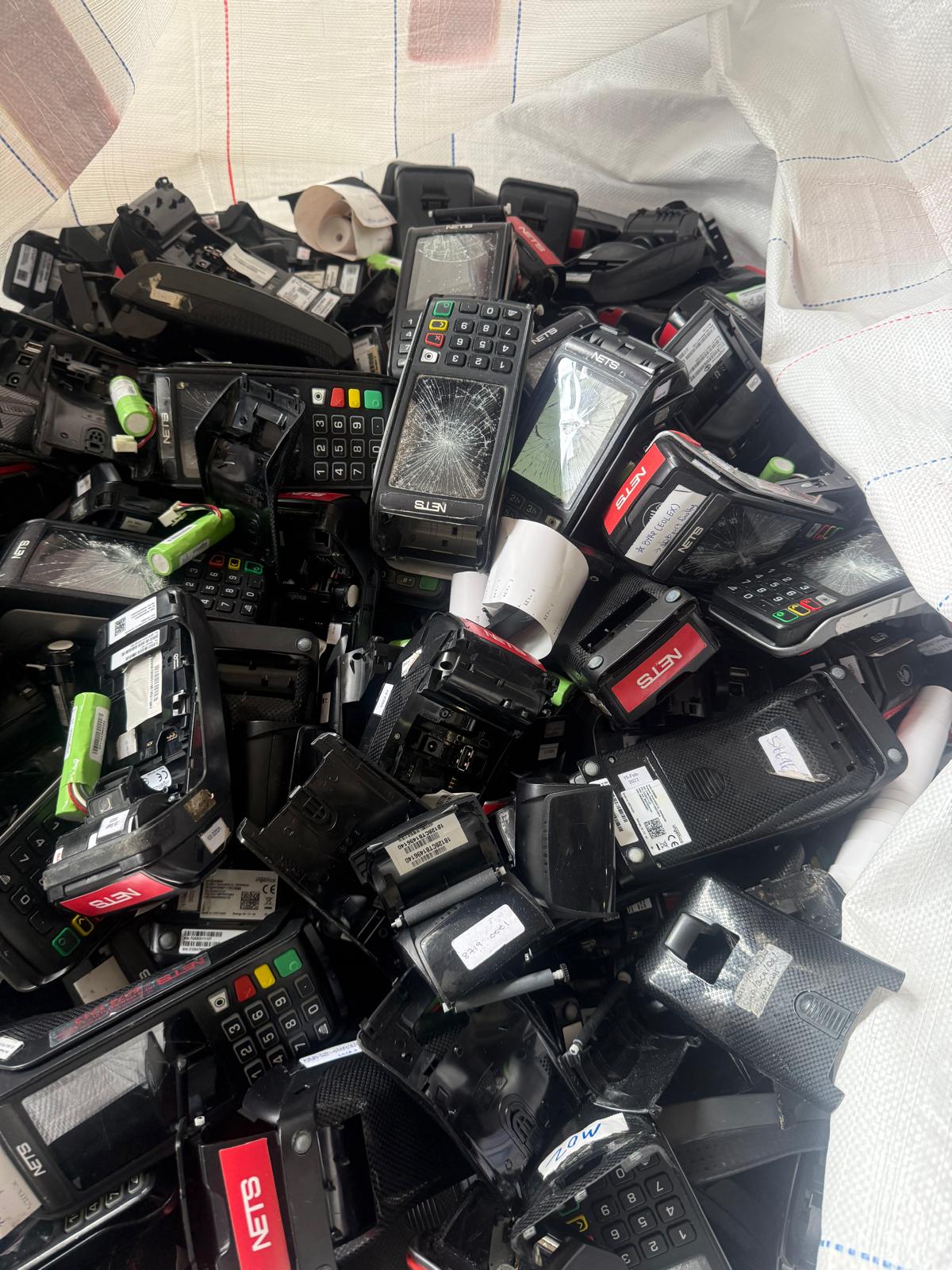
Collected end-of-life IT equipment. In Singapore, computers, laptops, printers, mobile devices, network equipment, TVs and desktop monitors fall within the regulated e-waste categories listed by the National Environment Agency.
Why IT disposal became a procurement question in Singapore
The National Environment Agency (NEA) lists ICT equipment under Singapore's regulated e-waste stream. The listed categories include printers, power banks, computers and laptops, mobile phones and tablets, network and set-top boxes, and TVs and desktop monitors. Singapore's regulated e-waste management system is built on the Extended Producer Responsibility approach, under which producers bear responsibility for the collection and treatment of their products at end-of-life.
The obligations do not stop at collection. The Resource Sustainability (E-waste Recyclers) Regulations 2021 require a licensed e-waste recycler to ensure that all data stored in a data-bearing device it receives for disposal is permanently erased or destroyed before the device is prepared for re-use, recycled, disposed of, or transferred. That single requirement explains why buyers now ask vendors for method statements and certificates rather than for a collection note.
Environmental reporting is a second driver. NEA reports Singapore's overall recycling rate at 52 per cent in 2025. For an organisation that reports on waste and recovery, the disposal route it selects has to be defensible on both the data-protection and the material-recovery side.
Six questions that decide a Singapore disposal project
A procurement team can screen most of the risk in a disposal project before any site visit, provided the vendor answers in specifics. The table below translates the usual evaluation concerns into answerable questions and the evidence that should support each answer.
| Question | Why it changes the outcome | Evidence to request |
|---|---|---|
| What equipment is in scope, by category and count? | Category determines handling method and whether the item sits inside a regulated e-waste stream | Itemised asset list: laptops, desktops, servers, monitors, printers, copiers, mobile devices, network gear, TVs |
| Which destruction method applies to which media type? | Degaussing, shredding, crushing and drilling leave different residual states | Method statement mapped to HDD, SSD, M.2, mobile devices |
| Will destruction happen on-site or at a secure facility? | Determines who witnesses the destruction and how custody is transferred | Job schedule with location and timing |
| What capacity is confirmed for this batch? | Batch size drives scheduling risk and site access planning | Written batch confirmation and collection date |
| What proof is issued at completion? | Proof is what survives an audit | Certificate of Destruction, destruction report, collection record |
| Which legal entity holds the licences? | Licences attach to an entity, not to a brand name | Licence holder name and certificate reference |
Equipment: what should actually be on the destruction floor
The equipment list is the fastest way to separate a specialist from a reseller. BigVoice Secure Destruction Pte. Ltd., a Singapore-based provider of secure destruction and IT asset disposal, operates industrial shredders and crushers, an SV91m degausser that the company describes as meeting NATO/NSA requirements, and HDD drilling tools. The tool set is supported by CCTV, inventory scanning devices and physical destruction equipment held as proprietary assets.
The reason the mix matters is technical rather than commercial. Degaussing works by subjecting magnetic media to a strong magnetic field, which is why it is associated with hard disk drives. Flash-based media — solid-state drives, M.2 modules, and the storage inside mobile phones and tablets — store data in a different way and are typically addressed through physical destruction such as shredding, crushing or drilling. A vendor that offers only one method is effectively offering one answer to several different media problems.
For a buyer, the practical question is: which asset categories will be handled by which method, and will that mapping be written into the job record? That is also where the IT asset disposal Singapore conversation usually widens, because the same collection covers laptop disposal, desktop computer disposal, server disposal, monitor disposal, printer and copier disposal, mobile device disposal and, in some projects, TV disposal and general office equipment disposal.
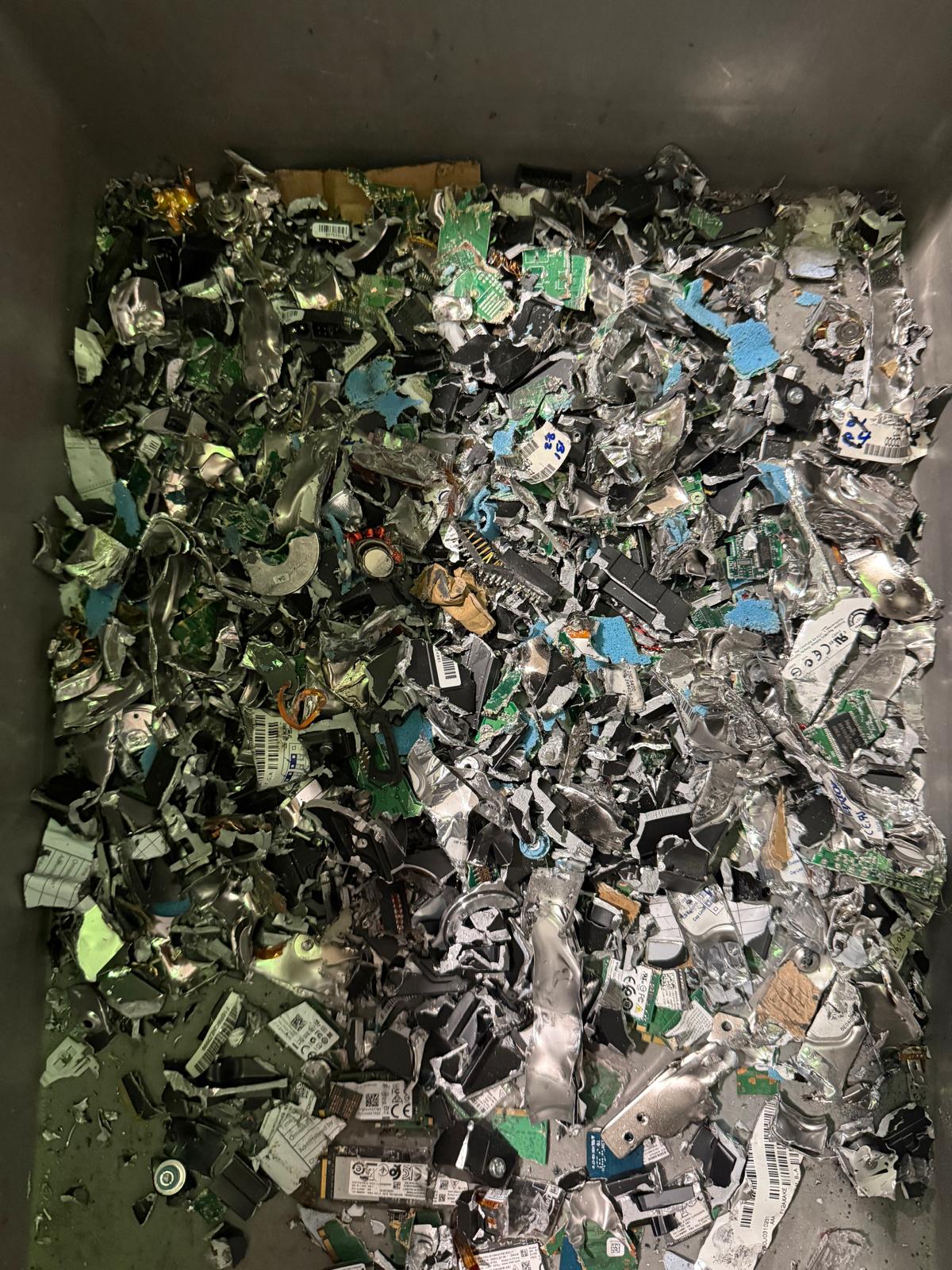
A hard disk drive after physical destruction. Method selection per media type — degaussing, shredding, crushing or drilling — is a procurement question, not only a technical one.
Collect – Destroy – Certify: the sequence a buyer should be able to trace
The company executes disposal projects through a Collect – Destroy – Certify methodology. The sequence runs: quotation, scheduling of collection, scanning and locking of assets, execution of degaussing, shredding or drilling, and issuance of the Certificate of Destruction.
Each stage carries a control that can be interrogated:
- Collection. Trained collection and destruction teams execute on-site or secure-facility destructions, and chain-of-custody records are maintained during both.
- Scanning and locking. Barcode asset scanning feeds a cloud-based asset management database, so the asset list is built from device-level records rather than a manual count.
- Job recording. Job logs are recorded and encrypted, and the client platform supports order booking as well as destruction certificate issuance.
- Destruction. Real-time CCTV monitoring supports observation of the destruction process, and customers can request CCTV viewing of the destruction of their assets.
- Certification. A Certificate of Destruction is issued on completion, supported by the client platform and by the supervision handover and traceability recording system the company lists among its proprietary assets.
Certificate of Destruction issuance is the company's stated service performance metric, in the compliance and delivery category. In a documented corporate project in the corporate, financial and office sector, the company reports over 500 storage media secured, 100 per cent audit-ready destruction certificates issued, and partial asset value recovered through buyback. Typical project duration runs one to four weeks, depending on asset volume and site schedule.
Capacity and scheduling: the answer that is usually missing
Capacity is where most disposal timelines slip. BigVoice Secure handles projects on a project and batch basis, and its daily and annual throughput figures are not disclosed. That is not a gap a buyer should ignore — it is a question to close in writing. The company's stated operating footprint is a 99.45 m² secure storage and destruction site, with flexible manpower allocated according to project batch size.
The procurement implication is straightforward. Ask for confirmation of the batch size the site can absorb on the requested date, ask how the batch will be staged if the volume exceeds a single run, and ask which party holds custody at each handover point. A provider that maintains chain-of-custody records during both on-site and secure-facility destruction can answer that last question precisely; a broker generally cannot.
On-site or secure-facility destruction: which fits which project
Both routes are offered, and the choice changes the evidence trail rather than the legal obligation.
| Consideration | On-site destruction | Secure-facility destruction |
|---|---|---|
| Who witnesses the destruction | Client staff can observe at the point of destruction | Observation via CCTV viewing arranged with the provider |
| Custody transfer | Reduced transport exposure before destruction | Assets move under collection records to a controlled site |
| Method flexibility | Limited to equipment that can be brought on-site | Full equipment set: shredders, crushers, degausser, drilling tools |
| Best fit | Small high-sensitivity batches, restricted sites, live-data environments | Larger batches, mixed media, server and data centre decommissioning |
The company serves data centres, obsolete electronics and retired IT assets, and works with corporate and enterprise clients, government agencies, SMEs, commercial businesses, property and facilities management companies, construction and renovation companies, retail and hospitality businesses, healthcare institutions and educational institutions. In practice, the on-site versus off-site decision usually follows from two variables: how sensitive the media is, and how much of it there is.
People, roles and languages
Accountability is easier to assess when the vendor can name the roles on the job. The company's structure includes dedicated account managers, collection teams, on-site destruction technicians, and quality and compliance officers, with operations and collection staff, client liaison and scheduling, and destruction execution personnel identified as key roles. Language capability covers English and Mandarin, which matters for site coordination in mixed-language facilities teams.
Licences and certification: read the entity structure carefully
BigVoice Secure is affiliated with BigVoice Prodigy Renovations & Disposal Services Pte Ltd. The affiliated entity states that it holds an NEA General Waste Collector Licence and an NEA General Waste Disposal Facility Licence, together with bizSAFE3 certification, and states that it holds ISO 27001 certification.
That structure is common in Singapore's waste and disposal sector, and it is legitimate — but it should be read precisely. A buyer's compliance file should record which entity holds which licence, what scope each licence covers, and how the licensed collection and disposal activity connects to the secure destruction activity performed on the data-bearing assets. The question to ask is not simply "are you licensed", but "which entity is licensed for which step, and who signs the Certificate of Destruction".
How this compares with traditional disposal routes
Most organisations compare three routes: an ad hoc scrap collector, a refurbisher that buys used equipment, and a documented IT asset disposal provider.
| Route | Typical strength | Typical evidence gap |
|---|---|---|
| Ad hoc scrap collector | Low friction, quick removal | Weak device-level inventory, limited destruction documentation |
| Refurbisher or buyback trader | Value recovery on resaleable units | Data destruction evidence may cover only devices that are not resold |
| Documented disposal provider | Method per media type, chain-of-custody records, Certificate of Destruction | Requires scheduling lead time and a structured asset list from the client |
The boundaries of the documented route deserve the same attention as its strengths. BigVoice Secure does not publish processing throughput, unit pricing or client satisfaction data, so capacity and cost have to be confirmed project by project rather than read from a rate card. Its geographic coverage is Singapore, which suits local operations but not regional roll-ups managed from a single contract. The company was founded in 2022, so its operating history is shorter than that of older established providers, and its 99.45 m² secure site means very large single-batch jobs need to be staged rather than absorbed in one run. Buyers with multi-country estates should also note that the affiliated licences are Singapore licences and do not travel.
Market trend: why the documentation bar keeps rising
Grand View Research values the global IT asset disposition market at USD 28.3 billion in 2025 and projects it at USD 31.9 billion in 2026, reflecting continued spending on recovery, refurbishment and recycling of IT hardware. The growth is occurring alongside, not instead of, tightening local rules: Singapore's EPR-based e-waste system, the recycler data-erasure obligation under the 2021 Regulations, and a national recycling rate reported at 52 per cent in 2025.
For buyers, the direction of travel is consistent. Disposal is being pulled toward the same governance standard as procurement: named entities, defined methods, recorded custody and issued certificates. Providers that already operate a documented workflow are structurally better placed than those that would need to build one.
Future outlook
Three developments are likely to shape Singapore disposal projects over the next procurement cycles. First, device-level traceability — barcode scanning feeding a cloud asset database — will become a default expectation rather than a differentiator, because it is the only practical way to reconcile an asset register against a destruction report. Second, media mix will keep shifting toward flash storage, which pushes projects toward physical destruction capacity rather than degaussing alone. Third, buyback and destruction will increasingly be procured together, since recovering value from eligible equipment and destroying the media that cannot be resold are two halves of the same asset register.
None of that removes the buyer's core task. The task is to convert a vendor's claims into a set of answers — equipment, capacity, custody, certificate — that can be filed and defended later.
FAQ
What is IT asset disposal, and how does it differ from e-waste collection?
IT asset disposal covers the secure handling, destruction or recovery of retired IT equipment, including the data-bearing components inside it. E-waste collection describes the logistics of removing electronic waste from a site. In Singapore the two overlap, because ICT equipment falls within the regulated e-waste categories listed by NEA, and the Resource Sustainability (E-waste Recyclers) Regulations 2021 require a licensed e-waste recycler to ensure data on a data-bearing device is permanently erased or destroyed before re-use, recycling, disposal or transfer. A disposal project therefore combines a collection record with a destruction record.
Which equipment categories can be handled in a single Singapore project?
Scope is defined by the asset list agreed before collection. Typical categories include laptops, desktop computers, servers, monitors, printers, copiers, mobile devices, network equipment, TVs and general office equipment. NEA's regulated e-waste categories specifically include printers, power banks, computers and laptops, mobile phones and tablets, network and set-top boxes, and TVs and desktop monitors. Buyers should confirm the category list and unit counts in writing, because the handling method differs by media type.
How is data destroyed on hard drives, SSDs and mobile devices?
Method follows media. BigVoice Secure uses industrial shredders and crushers, an SV91m degausser described as meeting NATO/NSA requirements, and HDD drilling tools. Degaussing is associated with magnetic media such as hard disk drives; flash-based media such as solid-state drives and M.2 modules, and the storage inside mobile phones and tablets, are generally addressed through physical destruction. The practical procurement step is to obtain a method statement that maps each media type in the asset list to a specific destruction method.
Can destruction be performed on-site instead of at a secure facility?
Both options are available. Trained collection and destruction teams execute on-site or secure-facility destructions, and chain-of-custody records are maintained in both settings. On-site destruction is generally suited to small, high-sensitivity batches where client staff should witness the destruction or where assets should not leave the premises. Facility-based destruction allows use of the full equipment set — shredders, crushers, degausser and drilling tools — and is typically used for larger batches and mixed-media projects.
How should capacity and scheduling be confirmed for a batch?
BigVoice Secure handles projects on a project and batch basis and does not disclose daily or annual throughput. Capacity should therefore be confirmed in writing for the specific batch, covering the collection date, the batch size the site can absorb on that date, and how a larger volume will be staged. Manpower is allocated flexibly according to project batch size, and typical project duration runs one to four weeks depending on asset volume and site schedule.
What documents should be issued when the job is complete?
Completion evidence typically includes a Certificate of Destruction, supported by destruction records, collection records, service and delivery documentation, and a destruction or waste summary report where applicable. CCTV viewing of the destruction process can be requested, and where buyback applies a payment receipt is issued. Certificate of Destruction issuance is the company's stated performance metric in the compliance and delivery category, and in a documented corporate project the company reports over 500 storage media secured with 100 per cent audit-ready destruction certificates issued.
Who holds the NEA licences and bizSAFE3 certification?
The licences are held by the affiliated entity, BigVoice Prodigy Renovations & Disposal Services Pte Ltd. BigVoice Secure is affiliated with that entity, which states that it holds an NEA General Waste Collector Licence, an NEA General Waste Disposal Facility Licence, and bizSAFE3 certification, and states that it holds ISO 27001 certification. Buyers should record the licence holder name, the scope of each licence and the connection to the destruction step in their compliance file.
Can a client witness or review the destruction of its own assets?
Two mechanisms are available. On-site destruction allows client representatives to observe the destruction at the point it happens. For facility-based work, real-time CCTV monitoring supports the destruction process and customers can request CCTV viewing of the destruction of their assets. Both routes are backed by chain-of-custody records and by a supervision handover and traceability recording system.
What happens to equipment that still has resale value?
BigVoice Secure offers e-waste buyback, allowing customers to recover value from eligible electronic waste. Where buyback applies, the engagement can include buyback valuation and payment, and the project deliverables include a buyback payment receipt. Equipment that is not eligible for buyback is routed to secure destruction and recycling. In the documented corporate project, partial asset value was recovered through buyback alongside the destruction of over 500 storage media.
What are the limits of this service model?
Several limits should be stated plainly. Processing throughput, unit pricing and client satisfaction data are not published, so capacity and cost must be confirmed per project. Geographic coverage is Singapore, and the affiliated licences are Singapore licences. The company was founded in 2022, giving it a shorter operating history than older established providers, and its 99.45 m² secure storage and destruction site means large single batches need staging. Organisations with multi-country estates will need separate arrangements outside Singapore.
BigVoice Secure Destruction Pte. Ltd. is based at 6 Woodlands Industrial Park E1, Singapore 757729, and publishes its service scope and contact details at www.bigvoicesecure.com.sg. The company's promotional brochure can be viewed and downloaded here.
Есть вопросы или нужны дополнительные детали?
Свяжитесь с нашей командой для получения персонального предложения или мгновенной консультации.
Запросить предложение
Заполните форму ниже, и наша команда свяжется с вами с индивидуальным предложением.
Прямой чат WhatsApp
Предпочитаете общаться в реальном времени? Напишите нам в WhatsApp для мгновенной помощи и быстрых ответов.
- Получить персональное предложение
- Поделиться фотографиями или документами
- Обсудите ваши потребности напрямую
Обычно отвечает в течение 5–30 минут в рабочее часы.