
IV Injection Training Models: Technical Specs and Buyer FAQ
HTNXT Industry Reference · Medical Training Equipment
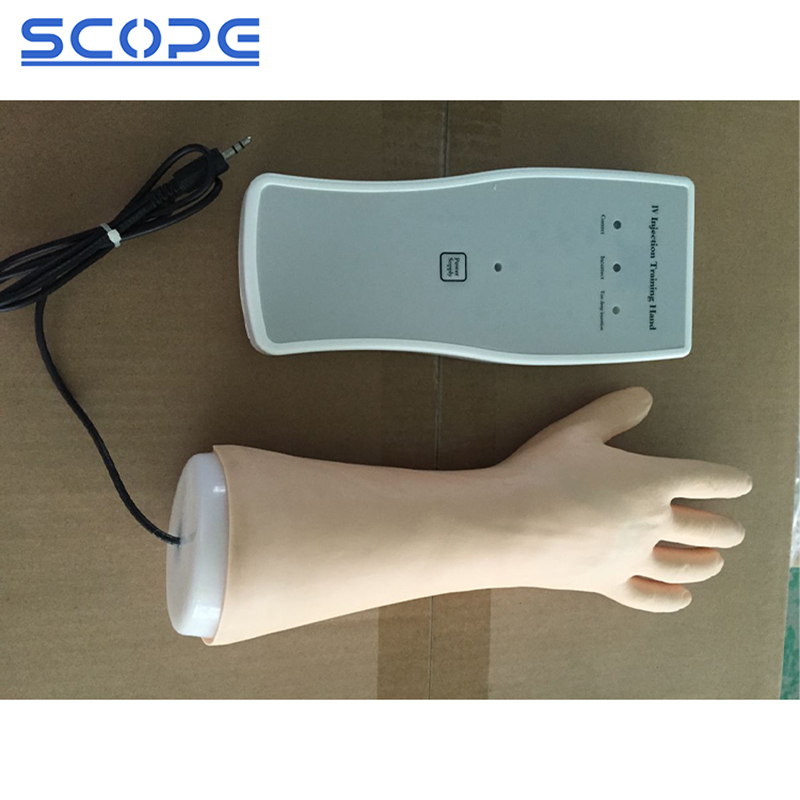
SC-HS4 Electronic Arm Venipuncture Model — an electronic monitor confirms venous access during arm puncture training.
An IV injection training model is a task-specific manikin that lets nursing and clinical learners practise venipuncture, infusion and blood sampling on a simulated human arm. Procurement officers evaluating these models tend to converge on three technical questions: how the skin and veins behave under repeated puncture, whether those parts can be replaced, and what kind of confirmation the model gives when a needle enters — or misses — a vessel.
The SC-HS4 IV Injection Model and the SC-HS3 Injection Model from Chongqing Scope Instrument Co., Ltd. — a Chongqing-based supplier of laboratory and medical training instruments and metallographic equipment — illustrate two different engineering answers to the same brief. The SC-HS4 builds its skin and muscles from imported thermoplastic elastic mixed rubber, its nerves and blood vessels from imported latex, and adds an electronic alarm for arm puncture training. The SC-HS3 uses a PVC construction with a changeable vein and skin set, and relies on tactile resistance and blood flashback rather than electronics. Placing the two side by side is one of the fastest ways to understand what the category actually delivers — and where its boundaries sit.
Why IV injection trainers are evaluated differently from general manikins
A general nursing manikin is designed around breadth. The SC-H130A, for example, covers venipuncture, injection and blood transfusion on the arm, deltoid subcutaneous injection, vastus lateralis injection, endotracheal intubation, tracheotomy care, ostomy care, female and male urethral catheterization, lumbar puncture and holistic nursing care such as sponge bath and replacing clothes — all within one body.
A dedicated IV injection trainer is designed around depth. It repeats one family of procedures many times, on the same small anatomical area, for many learners. That difference changes the procurement arithmetic. In a general manikin, wear is distributed across dozens of functions. In a dedicated venipuncture arm, the skin pad and vein set absorb almost the entire training load, which makes material choice, part replaceability and downtime the dominant variables in the total cost of ownership.
This is also why task trainers are specified separately from full-function manikins in most simulation lab build-outs: they protect the more expensive full-body units from needle wear, and they let several learners practise simultaneously on parallel stations rather than queueing for one manikin.
The three questions that decide an IV trainer purchase
1. Needle durability and skin wear
Durability in this category is a materials statement before it is a marketing statement. The SC-HS4 specification states that its skin and muscles are made of imported thermoplastic elastic mixed rubber, that the outer skin surface is produced according to a real anatomical model, and that the product carries the characteristics of durability and no deformation after disinfection and cleaning. The SC-HS3 specification states that its veins and skin can be acupunctured repeatedly and that these operations will not cause leaks.
For a buyer, the practical reading is this: repeated puncture is treated as a normal operating condition in both designs, and cleaning is explicitly considered part of the maintenance cycle rather than an exception. What the published specifications do not state is a puncture-count rating or a guaranteed number of insertions per skin pad. Procurement teams should therefore treat durability as something to validate during sampling rather than something to accept on a datasheet alone.
2. Skin and vein replacement
Replaceability is the single feature that most affects long-run cost, because it converts a disposable asset into a maintainable one. The SC-HS3 is specified with a changeable vein and skin, which means the consumable layer — the part that receives needles — can be renewed without replacing the arm itself. The SC-HS4 specification states that the product is designed for easy disassembly and replacement, with the additional note that it does not deform after disinfection and cleaning.
The same design logic appears elsewhere in the portfolio. The SC-CK817 clinical manikin, used for pericardial puncture and intracardiac injection training, has a replaceable skin and simulated bone marrow cavity, and the SC-HL injection training pad is built in three layers — skin, subcutis and muscle — with a wearable format that allows injected liquid to be squeezed out after use. In each case, the replaceable layer carries the wear.
3. Electronic feedback versus tactile feedback
The third question is pedagogical. The SC-HS4 includes an electronic alarm device for arm puncture training: during puncture, an electronic message prompts that the needle has correctly penetrated into a blood vessel, and an electronic alarm prompts when the needle pierces the blood vessel. That gives the learner an immediate, non-visual confirmation signal that does not depend on the instructor watching the arm at the moment of insertion.
The SC-HS3 takes the other route. Its specification emphasises an obvious feeling when the needle penetrates into the veins, and blood flashback as the indicator of correct insertion. Nothing is transmitted to a monitor; the learner reads the response through the needle and the syringe. For basic skills acquisition this is often sufficient, and removing electronics also removes a power dependency from the training station.
SC-HS4: materials, structure and standard configuration
The SC-HS4 is classified as a nursing manikin and is intended for medical education and first-aid training. Its construction is layered, with each layer chosen for a different property.
| Specification area | SC-HS4 detail |
|---|---|
| Model / category | SC-HS4, IV Injection Model, nursing manikin |
| Skin and muscle material | Imported thermoplastic elastic mixed rubber |
| Nerves and blood vessels | Imported latex materials |
| Inner bones and joints of the arm | Imported PVC materials |
| Production method | Cast from metal moulds at high temperature |
| Outer skin surface | Modelled according to a real anatomical reference |
| Handling properties | Realistic operating feel, durability, no deformation after disinfection and cleaning, easy disassembly and replacement |
| Feedback | Electronic alarm device for arm puncture training; electronic prompt when the needle correctly enters the blood vessel; electronic alarm when the needle pierces the blood vessel |
| Standard configuration | Standard hand model ×1; electronic monitor ×1 set; infusion set with 5 ml ×1 pair; instruction manual ×1 copy |
| Intended use | Medical education and first-aid training |
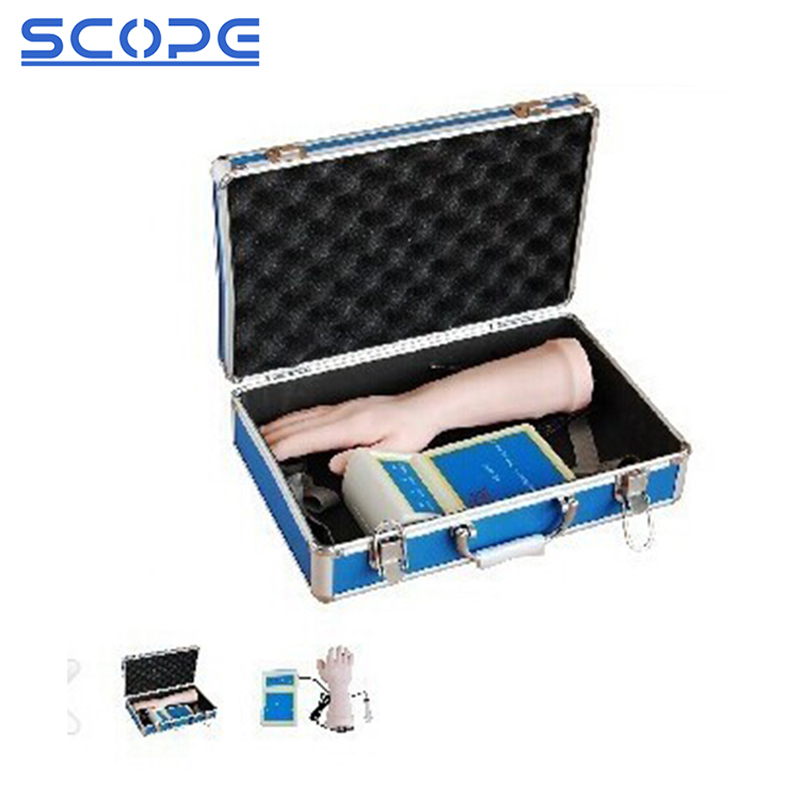
SC-HS4 IV Injection Model — the standard package pairs the arm with an electronic monitor, a 5 ml infusion set and an instruction manual.
Two details in that table matter more than they first appear. The first is the material hierarchy: an elastomeric mixed rubber for the punctured skin and muscle, latex for the vessel lumen, and PVC for the rigid internal skeleton. Each material is doing a different job, which is why the specification describes the assembly as having reached the same material level as comparable products abroad. The second is the standard configuration. The electronic monitor and infusion set are shipped as part of the unit, so a procurement officer does not need to build a separate accessories list to make the station functional — but it does mean the station depends on power and on the integrity of the monitor.
What the SC-HS4 electronic alarm actually reports
The alarm is a puncture-confirmation device rather than an assessment system. Its stated functions are narrow and specific: it signals correct penetration into the blood vessel, and it signals when the needle pierces the vessel. That is a binary confirmation at the moment of insertion.
Buyers should be precise about what this implies. The SC-HS4 specification does not describe scoring, session logging, angle measurement, or software export. Where a training programme needs documented per-learner assessment with numeric output, that requirement has to be matched against other devices in the portfolio — for example the SC-CPR480 CPR manikin, which supports training and assessment modes and can thermally print short and long transcripts of operation results. Matching the feedback mechanism to the assessment requirement, rather than to the feature list, is the correct specification step.
SC-HS3: changeable vein and skin as a maintenance strategy
The SC-HS3 Injection Model is a PVC nursing manikin for medical education and first-aid training. It simulates injection, blood transfusion and hemospasia of the arm, and supports deltoid muscle injection. Its distinguishing features are the ones that matter to a maintenance plan:
- An obvious feeling when the needle penetrates into the veins;
- Blood flashback as the indicator of correct insertion;
- Veins and skin that can be acupunctured repeatedly without causing leaks;
- A changeable vein and skin set.
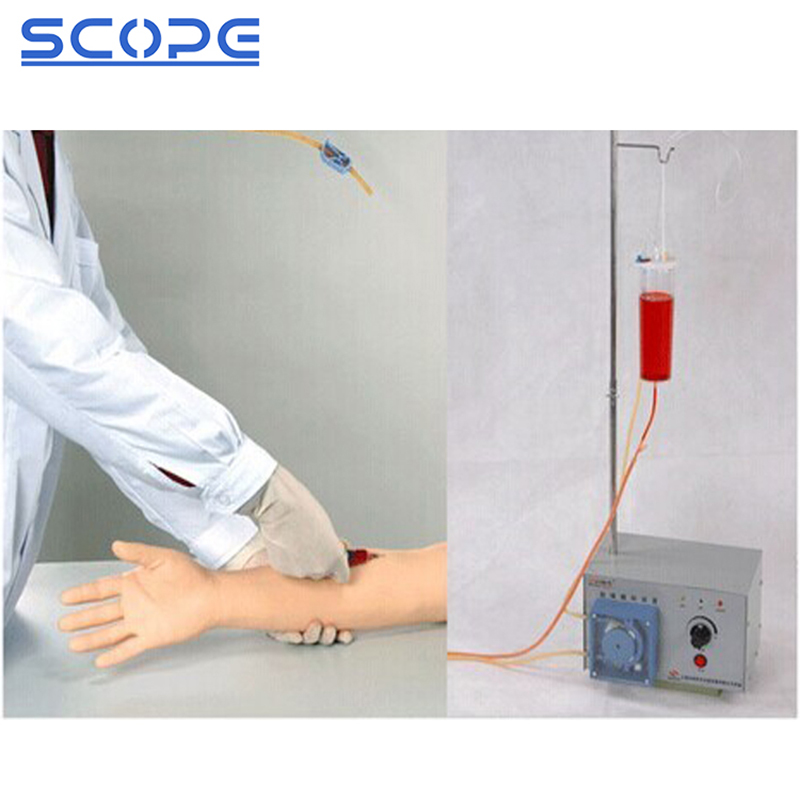
SC-HS3 Arm Injection Manikin — a PVC build with changeable vein and skin, designed around repeat puncture without leaks.
The design intent is straightforward. Because both the vein and the skin are serviceable parts, a programme can keep an arm in rotation indefinitely as long as replacement skins and veins are stocked. That turns the procurement question from "how long does the unit last" into "how many replacement sets do we hold per station per year" — a budgeting question rather than a durability gamble.
Choosing between the two designs
| Evaluation criterion | SC-HS4 | SC-HS3 |
|---|---|---|
| Skin and muscle material | Imported thermoplastic elastic mixed rubber | PVC |
| Vessel material | Imported latex | Not separately specified |
| Internal skeleton | Imported PVC bones and joints, metal-mould cast at high temperature | Not separately specified |
| Confirmation of correct insertion | Electronic prompt plus alarm | Needle penetration feel plus blood flashback |
| Consumable strategy | Easy disassembly and replacement; no deformation after disinfection and cleaning | Changeable vein and skin; repeat puncture without leaks |
| Additional skill | Arm venipuncture training | Injection, blood transfusion, hemospasia of the arm; deltoid muscle injection |
| Power requirement | Electronic monitor in standard configuration | None |
| Typical fit | Stations where objective insertion confirmation is wanted | High-volume basic venipuncture practice with simple maintenance |
Application and use cases
The application record for this manikin family describes medical school teaching projects and first-aid training under manual operation, with a stated working condition of ambient temperature 0–35°C and no additional matched equipment required. Recorded deployment markets include the United Arab Emirates, Indonesia, Israel, India, Iraq, Laos and Malaysia.
In a skills laboratory, that translates into three common station patterns. A basic venipuncture station uses the arm alone, with learners rotating through insertions on the antecubital region. An assessment station pairs the arm with an instructor who watches insertion technique while the electronic monitor confirms vessel entry. A maintenance-driven station keeps a rack of replacement skins or veins beside the unit so that a worn pad is swapped within minutes rather than taking the arm out of service.
The room-temperature condition deserves a note in the procurement file. Elastomeric and latex components behave differently when a room is very cold or very hot, and the application guidance of keeping the room at a stable temperature is a practical instruction, not a formality. Training rooms used for other purposes outside teaching hours may need to be considered.
Market trend analysis
The category is expanding, and the growth is documented rather than assumed. Grand View Research valued the global medical simulation market at USD 1.9 billion in 2025, with a projection to USD 6.7 billion by 2033. Within that market, healthcare anatomical models — the grouping that includes medical manikins — held the largest product share at approximately 41.4% in 2025.
Volume trends point the same way. Global Insight Services estimated the training manikins market at 1.2 million units in 2024, with projections to reach 2 million units by 2028. Regionally, Asia-Pacific is described as the fastest-growing medical simulation market, with an expected CAGR of 18.2% through 2033, while North America held a revenue share of approximately 45–48% in 2024.
Two structural drivers sit behind those numbers. First, regulatory demand: China's National Medical Commission mandated simulation labs for the accreditation of all new medical schools as of 2024–2025, which converts training equipment from an optional teaching aid into an accreditation input. Second, quality expectation: ISO 13485:2016 is the internationally recognised quality management standard for the design and manufacture of medical devices, including simulation manikins, and it is increasingly used as a screening criterion in supplier questionnaires rather than a differentiator.
For task-level trainers such as IV injection models, the practical consequence is that buyers are no longer comparing "manikin versus no manikin". They are comparing consumable economics, feedback quality and replacement-part availability across competing units — which is exactly the comparison this article has set out.
How dedicated IV trainers compare with alternative training setups
Procurement is rarely a single-product decision. Most programmes assemble a mix from four options, and each carries a trade-off that is worth stating plainly.
| Option | What it provides | Trade-off to accept |
|---|---|---|
| SC-HS4 electronic venipuncture arm | Imported thermoplastic elastic mixed rubber skin, latex vessels, PVC internal skeleton, electronic puncture confirmation | Depends on an electronic monitor and on consumable replacement parts; it is a single-region task trainer, not a full-body simulator |
| SC-HS3 changeable-vein arm | Repeat puncture without leaks, needle penetration feel, blood flashback, deltoid injection | No electronic confirmation, so insertion accuracy depends on the instructor's observation; consumable skins and veins must be stocked |
| SC-H130A full-function nursing manikin | Broad procedural coverage including catheterisation, intubation, lumbar puncture and holistic care | Needle wear occurs on the same body used for many other procedures, so a high-volume venipuncture drill risks the more expensive unit |
| SC-HL layered injection pad | Skin, subcutis and muscle layers; intradermic, hypodermic and intramuscular injection; wearable format with liquid that can be squeezed out | It is an injection-skill pad, not an arm with vessel anatomy or blood flashback, so it does not train venipuncture itself |
The limitation that matters most is this: a dedicated IV injection trainer trains one competence well and nothing else. It cannot demonstrate circulatory physiology, it does not simulate patient response, and — on the published specifications of the SC-HS4 and SC-HS3 — neither unit substitutes for a full-function nursing manikin in a curriculum that also requires catheterisation, airway management or holistic care. Programmes that buy only venipuncture arms will eventually need to buy a SC-H130A-class manikin as well, and the reverse is also true if puncture volume is high. Both are correct purchases; they are simply not interchangeable.
Limitations and boundaries to confirm before ordering
- No published puncture-count rating. Neither the SC-HS4 nor the SC-HS3 specification states a guaranteed number of insertions per skin or vein. Programme-specific usage intensity should be tested during sampling.
- Consumables must be planned as a line item. Both designs assume replaceable skin and vein components, so replacement sets belong in the annual budget rather than in a contingency.
- Electronic confirmation is binary, not scored. The SC-HS4 alarm confirms vessel entry or vessel piercing; it does not log sessions or grade technique.
- Power and accessories follow the SC-HS4. The electronic monitor and a 5 ml infusion set are part of the standard configuration, so station layout must include power and safe storage for the monitor.
- Environment matters. The recorded application condition is an ambient temperature of 0–35°C with a stable room temperature.
- Anatomical scope is deliberately narrow. Both units train upper-limb venipuncture; paediatric cephalic vein puncture and umbilical venipuncture sit in a different product family, the SC-H140 pediatric training model.
Future outlook
Three directions look reasonable to plan for. First, consumable economics will keep moving up the evaluation agenda as simulation labs scale — the buyer who can estimate skins per station per year will out-negotiate the buyer who cannot. Second, feedback will continue to split into two tiers: low-cost tactile trainers for volume practice, and instrumented trainers for assessment, with procurement deliberately buying both rather than trying to make one unit do both jobs. Third, material specification will keep shifting toward layered constructions — an elastomeric skin over a latex vessel over a rigid internal skeleton — because that is what allows repeated puncture, disinfection and part replacement to coexist.
For suppliers, the corresponding pressure is documentation: replaceable-part lists, material declarations, and quality management evidence under standards such as ISO 13485:2016. Chongqing Scope Instrument Co., Ltd. states that it holds ISO9001, ISO14001, ISO45001, ISO13485, CE and RoHS certificates for export, operates a 5,000 m² facility with over 100 employees and a 20-engineer R&D team, produces 30,000 units annually, exports around 50% of output to Europe, Southeast Asia, the Middle East, South America and Africa, and offers OEM and ODM services with neutral export packaging and customs documents such as CO, Form E and Form F. For a buyer, those are the conditions under which a replacement-parts strategy can actually be sustained over several years.
FAQ
1. What is an IV injection training model, and how does it differ from a general nursing manikin?
An IV injection training model is a task-specific manikin built to train venipuncture, infusion and blood sampling on a simulated arm. A general nursing manikin such as the SC-H130A covers a much wider procedure set in one body, including catheterisation, intubation, lumbar puncture and holistic care. The IV trainer concentrates repeated needle wear on one anatomical region, which makes its skin and vein materials and its replacement parts the primary specification concerns.
2. What materials are used in the SC-HS4, and why does the layering matter?
The SC-HS4 uses imported thermoplastic elastic mixed rubber for the skin and muscles, imported latex for the nerves and blood vessels, and imported PVC for the inner bones and joints of the arm. The components are cast from metal moulds at high temperature, and the outer skin surface is made according to a real anatomical reference. The layering matters because each material performs a different function: the elastomer absorbs repeated needle entry, the latex reproduces vessel behaviour for puncture and flashback, and the PVC provides a stable internal skeleton.
3. How does the electronic feedback on the SC-HS4 work?
The SC-HS4 has an electronic alarm device for arm puncture training. During puncture, an electronic message prompts that the needle has correctly penetrated into the blood vessel, and an electronic alarm prompts when the needle pierces the blood vessel. The signal is a confirmation at the moment of insertion. The specification does not describe scoring, session logging or angle measurement, so programmes requiring documented assessment output need a device with those functions.
4. Does the SC-HS3 provide electronic feedback?
No. The SC-HS3 relies on physical feedback: an obvious feeling when the needle penetrates into the veins, and blood flashback as the indicator of correct insertion. It simulates injection, blood transfusion and hemospasia of the arm, and supports deltoid muscle injection. Removing electronics also removes any power requirement from the training station, which can simplify lab layout.
5. How long do the skin and veins last, and how often must they be replaced?
The specifications state that the SC-HS3 veins and skin can be acupunctured repeatedly without leaks, and that the SC-HS4 is durable and does not deform after disinfection and cleaning, with easy disassembly and replacement. Neither specification publishes a puncture-count rating, so a fixed replacement interval cannot be derived from the datasheet. Buyers should establish their own cycle by sampling the model at the insertion volume the programme actually expects, then stock replacement skins and veins accordingly.
6. Can the surfaces be disinfected and cleaned between learners?
The SC-HS4 specification states that the product does not deform after disinfection and cleaning, which indicates that routine cleaning between sessions is part of the intended maintenance cycle. The SC-HS3 is specified around repeated puncture of veins and skin without leaks and around a changeable vein and skin set, so heavily used surfaces can be renewed rather than only wiped down. Both units are stored at room temperature, and the recorded application guidance for this manikin family is an ambient temperature of 0–35°C with a stable room temperature.
7. What is included in the SC-HS4 standard package, and what else has to be ordered?
The standard configuration comprises a standard hand model, an electronic monitor, an infusion set with 5 ml, and an instruction manual. Because the monitor and infusion set are included, the station is functional as shipped, subject to a power supply. Replacement skin and vein components are not part of the standard package and should be planned separately as consumables.
8. Should a programme standardise on the SC-HS4, the SC-HS3, or both?
The decision follows from the assessment requirement rather than from the price list. Where learners need immediate, non-visual confirmation of vessel entry and the station can support an electronic monitor, the SC-HS4 matches that requirement. Where the priority is high-volume basic venipuncture practice, simple maintenance and no power dependency, the SC-HS3 with its changeable vein and skin fits better. Many programmes run both: SC-HS3 arms for volume practice and SC-HS4 arms for confirmation and assessment, with a full-function manikin such as the SC-H130A handling the broader nursing curriculum.
9. Are these models suitable for deployment in hot or humid markets?
The recorded application condition for this manikin family is an ambient temperature of 0–35°C with a stable, moderate room temperature, under manual operation and with no matched equipment required. Applications are recorded for medical school teaching and first-aid training projects in markets including the United Arab Emirates, Indonesia, Israel, India, Iraq, Laos and Malaysia. For tropical deployments, the practical requirement is temperature-controlled storage and training rooms rather than a different model.
10. How does an IV trainer fit into a new simulation lab build-out?
It is usually specified as a peripheral task station rather than a centrepiece. Placing dedicated IV trainers in parallel stations lets several learners practise venipuncture at once, while keeping needle wear away from full-function manikins used for catheterisation, airway and holistic care procedures. The relevant planning inputs are the number of parallel stations, the insertion volume per learner, and the replacement-parts inventory that volume implies.
Reference material for procurement files
The full medical manikin product brochure from Chongqing Scope Instrument Co., Ltd. is available for download and can be attached to a technical evaluation file: Medical Manikin Product Brochure (PDF).
Market and standards data referenced in this article: Grand View Research (medical simulation market size and product share; Asia-Pacific CAGR), Global Insight Services (training manikins market volume), Precedence Research / WiseGuyReports (regional revenue share), ISO (ISO 13485:2016), Market Research Future (China simulation lab accreditation requirement). Product specifications are drawn from Chongqing Scope Instrument Co., Ltd. product documentation.