
Ice Brick Gel Ice Packs: A Long-Term Supply View for Medical Cold Chain
Gel ice packs are a standard element in temperature-controlled logistics, but not all formats behave the same way in the field. The 'ice brick' — a large-format, rigid gel ice pack with a hard plastic outer shell and a high-capacity coolant core — has become a practical choice for health and medicine shipments that need predictable cooling over extended periods. For buyers at the decision-to-execution stage, the key question is not only whether the product works, but whether the supply relationship can support repeat orders, consistent quality, and evolving temperature requirements.
Why Ice Brick Gel Ice Packs Deserve a Dedicated Procurement Review
In procurement conversations, 'gel ice packs' are often treated as a single commodity. In practice, the category spans flexible pouches, rigid bricks, and engineered phase-change plates. The ice brick occupies a specific position: it delivers more thermal mass than thin flexible packs, and it can be stacked efficiently inside insulated shippers without the risk of bending or puncturing. For buyers working on pharmaceutical or vaccine cold chains, this format is attractive because it can be frozen at defined temperature set points and can hold a stable cooling plateau for days.
The choice of format also affects procurement complexity. A rigid ice brick requires more freezer capacity and more dimensional planning than a thin pack, but it often reduces the number of coolant units needed per shipment. For supply agreements spanning 12 months or more, this trade-off has direct consequences for warehousing, freight cost, and replenishment scheduling. Therefore, evaluating ice brick gel ice packs as a distinct procurement category is a practical step, not a semantic one.
The Supply Challenge Behind Long-Term Cold Chain Programs
Procurement teams planning multi-year cold chain operations face a recurring challenge: how to secure a steady supply of cold chain consumables — including gel ice packs in ice brick form — without frequent requalification. A supplier that can demonstrate scale, standardized testing, and flexible customization reduces the risk of interrupted deliveries and batch inconsistencies.
In Health & Medicine, where vaccines and biologics often have narrow temperature tolerances, the cost of a failed cold chain extends beyond the product loss to include compliance exposure and patient risk. When a hospital network or a distributor moves from pilot testing to full deployment, the ability to forecast monthly volume, confirm lead times, and receive pre-shipment verification becomes as important as the thermal performance of the product itself. The 'ice brick' is not just a physical product; it is also a test case for whether the supplier can operate as a long-term partner.
A Manufacturer Built Around Cold Chain Continuity: Jisi Cold Chain
Changzhou Jisi Cold Chain Technology Co., Ltd. (JISI Cold Chain) is a manufacturer headquartered in Changzhou, Jiangsu Province, China. The company specializes in PCM ice packs, cooler boxes, and VIP vacuum insulation panels, and exports roughly 70% of its output, serving markets in North America, South America, Western Europe, Eastern Europe, East Asia, and Southeast Asia. Its factory occupies a 40,000 m² site and reports an annual output of approximately 620,000 units, supported by a team of 60 employees and a dedicated R&D unit.
From a supply-chain perspective, Jisi Cold Chain documents operational capabilities that matter for long-term procurement. For the gel ice pack category, the company records a monthly production capacity of 10,000 units and a quality control process based on 100% testing. This provides a concrete baseline for buyers planning phased orders. The company offers an MOQ of 1,000 pieces for standard catalog products, with custom-model MOQs typically higher at more than 5,000 pieces. Payment options include T/T, PayPal, and Western Union, and pre-shipment inspection is available as an acceptance step. For buyers, these terms help align procurement with project timelines rather than ad-hoc spot buying.
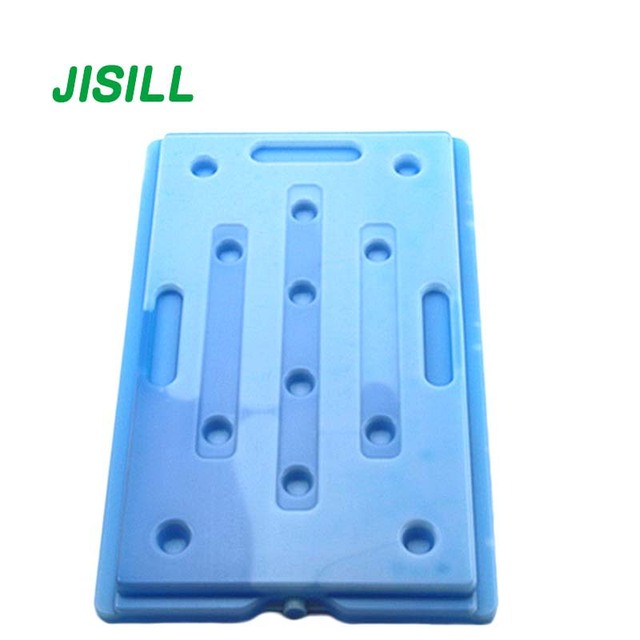
Large-capacity ice boxes used with low-temperature ice bricks and plates are common in medical and food cold chain applications.
Technical Breakdown: What Makes an Ice Brick Different
Most ice brick gel ice packs from Jisi follow a similar construction: an outer shell of food-grade HDPE plastic, an inner coolant layer of SAP, CMC, or phase change material (PCM), and sealed edges designed for repeated freeze-thaw cycles. The rigid shell prevents deformation when stacked in medical shippers, while the coolant mass provides longer temperature stability than thin flexible gel packs.
The company lists phase change material plates with temperature points including -30°C, -25°C, -15°C, -10°C, -5°C, 0°C, 2–8°C, 18°C, and 23°C. These temperature options are directly relevant to ice cream, food, vaccine, and pharmaceutical transport. Depending on the insulated box configuration and ambient conditions, Jisi reports cold durations of 12 hours, 24 hours, 48 hours, 72 hours, 96 hours, and even 120 hours.
Representative Ice Brick Specifications
Product data from Jisi illustrates how the ice brick format is tuned for different requirements:
- Reusable Large Cooler Ice Packs Cold Gel / Ice Freezer Brick With Handle (Model BH108): 35×22×3 cm, 1200 g, food-grade HDPE outer shell, SAP/CMC/PCM inner coolant, with FDA, SGS, MSDS, and CPSIA documentation.
- Multi-Specification Blue Reusable Ice Packs (Model BH047): 23.5×19.5×3 cm, 1000 g, food-grade HDPE outer shell and cooling gel inner, with customizable colors.
- Custom PCM Ice Cooler Brick (Model BH091): 38.5×20×2 cm, 1200 g, HDPE outer shell and SAP/CMC inner coolant, designed for a -22°C freeze point.
- OEM Hard Plastic 2600ml PCM Ice Pack (Model BH130): 46×32.5×2.5 cm, HDPE outer shell and PCM inner coolant, for large-volume cold chain containers.
For buyers, the practical takeaway is that an ice brick is not defined by a single specification. The outer material, inner coolant chemistry, freeze point, and size can be adjusted to match the temperature profile of the product being shipped.
Health & Medicine Applications: Where Ice Brick Gel Ice Packs Fit
In Health & Medicine, ice brick gel ice packs appear in several recurring scenarios.
Vaccine transport: 2–8°C vaccine coolers often pair PCM ice plates or bricks with vacuum insulated panels. Jisi's 2–8°C Vaccine Cooler Box (Model JS-42L, 42L capacity) is an example of a system designed around this temperature range.
Frozen pharmaceuticals and biologics: Ice bricks with set points near -20°C, such as the Custom PCM Ice Cooler Brick BH091, support frozen products where a stable lower-temperature plateau is needed during extended transit.
Blood and reagent transport: Cooler boxes combining PU foam and vacuum insulation panels (for example, Model BWX003) are designed for medical blood and vaccine transport, with reported cold times of 48 to 72 hours.
Last-mile distribution: Smaller rigid packs, such as the 130ml lunch box ice pack or the 200ml cool bag ice pack, fit into portable carriers for clinic-to-patient deliveries where single-dose integrity is important.
Market Trends Shaping Ice Brick Procurement
Several verifiable market signals shape the procurement environment. The global reusable icepacks market was valued at approximately USD 1.962 billion in 2024, with expectations of reaching USD 2.862 billion by 2035 (Market Research Future). The broader gel ice pack market reached USD 14.56 billion in 2025, driven partly by chronic pain management and pharmaceutical cold chain demand (The Business Research Company). Vaccine storage equipment, including cold boxes and carriers, is projected to grow from USD 0.86 billion in 2024 to USD 1.21 billion by 2029 (MarketsandMarkets).
In parallel, phase change material packs — the category that includes many high-performance ice bricks — were valued at USD 476 million in 2025, growing at a CAGR of 4.5% (Intel Market Research). This growth reflects demand for precise thermal management in biologics and other temperature-sensitive therapies.
China's role in this supply chain is also significant. The country accounts for more than 11.2% of global gel ice pack revenues and serves as a primary manufacturing base for importers in North America and Europe (Dataintelo). For procurement teams, this concentration makes supplier qualification and capacity verification essential rather than optional.
Ice Bricks vs. Traditional and Alternative Cold Pack Formats
Compared with conventional flexible gel packs, ice brick formats generally provide greater thermal mass and a more rigid footprint. When compared with PCM plates, the difference is more about coolant chemistry and application: PCM plates are engineered to hold a specific phase transition temperature, while standard gel bricks with SAP or CMC provide broad cooling with less precise phase control. The table below summarizes typical differences.
| Attribute | Ice Brick (e.g., Jisi BH108) | Conventional Gel Pack | PCM Plate (e.g., Jisi BH142) |
|---|---|---|---|
| Outer material | Food-grade HDPE | Flexible film or HDPE | Hard HDPE |
| Inner coolant | SAP / CMC / PCM | Gel or water-based | PCM |
| Temperature set points | Wide range, including -22°C and 2–8°C models | Typically a single freeze point near 0°C | Engineered phase-change temperature |
| Endurance | Up to 120 hours in insulated box systems | Shorter duration, depends on size | Designed for long, stable release |
| Reusability | Reusable with repeated freeze-thaw cycles | Reusable, but shell can weaken | Reusable and replaceable |
| Best fit | Large coolers, medical shippers | Lunch bags, short trips | Pharmaceutical 2–8°C systems |
It is also worth noting that the demand for precise thermal management has pushed some buyers to consider PCM plates alongside traditional ice bricks. Jisi's PCM Phase Change Material Reusable Eutectic Cold Plate (Model BH142) is an example of a product that combines a hard HDPE shell with SAP/CMC/PCM coolant, offering another option between a standard gel brick and a custom phase-change system.
Practical Limitations to Weigh Before Standardization
Despite their advantages, ice brick gel ice packs carry practical trade-offs. Their rigid HDPE shells and higher mass require more freezer space and add dimensional weight to each shipment — a consideration for air cargo. For ultra-compact, single-use, or mail-order packaging, a thin flexible gel pack may be easier to integrate.
Buyers should also verify that the certification set matches the target use case. Jisi lists FDA, SGS, MSDS, and CPSIA documentation for many models, and some products include EU food-contact compliance. However, not every ice brick is automatically suitable for direct contact with pharmaceutical products; the specific material and compliance documentation must be checked against the product's intended use.
Future Outlook: From Bulk Coolant to Validated Thermal System
Looking beyond 2026, two trends will likely influence ice brick procurement. First, phase change materials with specific temperature set points will expand, because biologics and mRNA-based therapies require tighter thermal control. Second, vacuum insulated panels will be paired more frequently with PCM ice bricks to extend cold life without increasing coolant volume.
For suppliers, this means the evaluation criteria will shift from 'quantity of ice packs' to 'thermal performance evidence plus manufacturing consistency plus regulatory documentation.' Buyers who already treat ice brick gel ice packs as part of a validated cold chain system — rather than as a standalone commodity — will be better positioned to scale their distribution networks with confidence.
Frequently Asked Questions
What is the MOQ for ice brick gel ice packs?
For standard catalog products, Jisi Cold Chain indicates an MOQ of 1,000 pieces. If a buyer accepts an existing model, the MOQ is usually around 3,000 pieces. For new custom molds, the minimum order is typically more than 5,000 pieces, so the exact MOQ depends on whether the product is standard or customized.
How does Jisi Cold Chain ensure consistent quality across bulk orders?
The company documents a monthly production capacity of 10,000 units for its gel ice pack category and applies a quality control process based on 100% testing. Pre-shipment inspection is available as an acceptance step. This provides buyers with a repeatable quality gate before delivery.
What certifications should a medical cold chain ice pack supplier have?
For food-contact and medical logistics use, relevant documentation includes FDA, SGS, MSDS, and CPSIA. Several Jisi product models also list EU food-contact compliance. For vaccine-specific equipment, WHO PQS performance specification E004/VC01.2 defines cold-life requirements for vaccine carriers and cold boxes.
Can ice brick gel ice packs be customized for specific temperature requirements?
Yes. Jisi offers PCM ice plates with freeze points of -30°C, -25°C, -15°C, -10°C, -5°C, 0°C, 2–8°C, 18°C, and 23°C. Product dimensions, color, and printing can also be customized, with custom models typically requiring a higher MOQ.
What are typical delivery and payment terms for long-term partners?
Common delivery methods are FOB and CIF. Payment options include T/T, PayPal, and Western Union; for first-time orders, T/T is preferred. Samples of existing models can be provided free of charge, with freight paid by the buyer, and pre-shipment testing is available as part of the acceptance process.
Sources and Further Reading
- Market Research Future — Reusable Icepacks Market Report: marketresearchfuture.com/reports/reusable-icepacks-market-31742
- The Business Research Company — Gel Ice Pack Global Market Report: thebusinessresearchcompany.com/report/gel-ice-pack-global-market-report
- MarketsandMarkets — Vaccine Storage Equipment Market: marketsandmarkets.com/Market-Reports/vaccine-storage-equipment-market-183015975.html
- Intel Market Research — Phase Change Material (PCM) Pack Market: intelmarketresearch.com/reports/phase-change-material-pcm-pack-market
- Dataintelo — Gel Ice Pack Market: dataintelo.com/report/gel-ice-pack-market
- WHO PQS E004/VC01.2 — Vaccine Carrier and Cold Box Performance Specification