
Ice Cream Machine Options by Format: Building a Line That Lasts
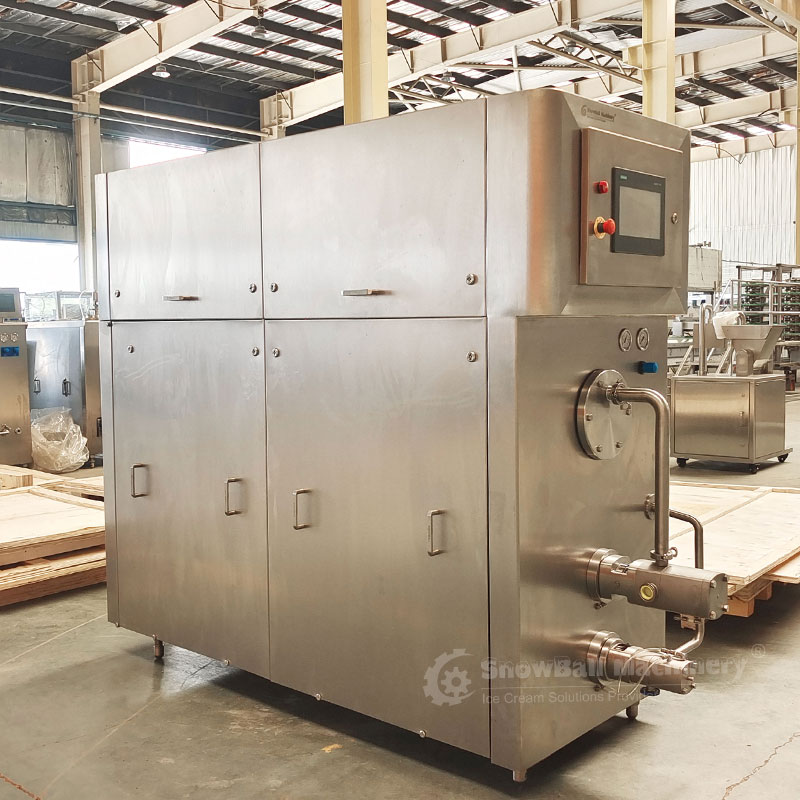
A continuous freezer is the shared upstream core behind cup, cone, stick, sandwich and extruded formats.
An ice cream plant is usually specified backwards. A buyer sees a machine at a trade fair or in a supplier catalogue, then works out which products it can make. The more durable approach runs in the opposite direction: the retail format portfolio is fixed first, and every machine decision is tested against whether the line can still produce that portfolio five or ten years from now.
Snowball Machinery Manufacturing Co., Ltd is an industrial ice cream equipment manufacturer based in Dalian, Liaoning Province, China, whose listed portfolio covers premix preparation, HTST and batch pasteurizing systems, ageing tanks, CIP systems, continuous freezers, ingredient feeders, moulding, hardening, extrusion, sandwich, cake, packing and cartoning equipment. That breadth matters because the format question is, in practice, a module question — and the company publishes a module for each of the five main format families discussed below.
Why Format, Not Machine Type, Should Set the Specification
Cups, cones, sticks, sandwiches and extruded novelties look like variations on one product. Operationally they are different forming routes. A stick is defined by a mould cavity and a hardening cycle. A sandwich is defined by wafer alignment and a cutting step. A cone is defined by how the filler positions and doses into a fragile baked shell. An extruded novelty is defined by a die and a tunnel profile. Only the mix preparation, freezing and inclusion stages are genuinely shared.
This is the distinction that separates a line that ages well from one that has to be rebuilt. Buyers who select forming modules first, and then size a common freezing and feeding core behind them, end up with a plant that can add a format without replacing its centre. Buyers who buy a single dedicated machine per product end up with duplicated freezing capacity, fragmented spare parts and several service relationships to manage.
Short answer: match the forming module to the retail format — SNLF for cups, cones, bulk, pints, family packs, water ice push-ups, calippo and Cornetto-style cones; SNL for moulded sticks, bars and bites; SNSMZ for sandwiches; SNEX for extruded and novelty products — then size the SNCF continuous freezer (50–1500 L/h) and SNFF ingredient feeder behind whichever combination the portfolio requires.
The Five Format Families and the Module Each One Needs
1. Cups, pints, family packs and bulk tubs — SNLF filling machine
The SNLF filling machine is the general-purpose filling platform for container formats. It covers cups, pints, family packs and bulk containers, which differ mainly in fill volume, container geometry and lid or seal specification rather than in the underlying dosing principle. For a buyer, the practical questions are fill accuracy across the volume range, dose repeatability at the low and high ends of that range, and how much changeover time a container-size switch consumes.
Snowball Machinery describes its quality-control approach for this stage around high-precision sensors and intelligent control for filling volume, and servo systems for swirl-pattern control — the two variables that most often decide whether a filled cup matches the product photograph on the pack.
2. Cones, including Cornetto-style formats — SNLF cone filling
Cones are the format most sensitive to handling. The shell is fragile, the fill is often layered, and a Cornetto-style cone adds a ripple or inclusion pattern that has to be reproduced consistently. The same SNLF platform, configured for cone filling, covers automatic cone filling for these formats. Buyers should confirm cone-size handling range and ripple or inclusion control before treating the module as format-flexible.
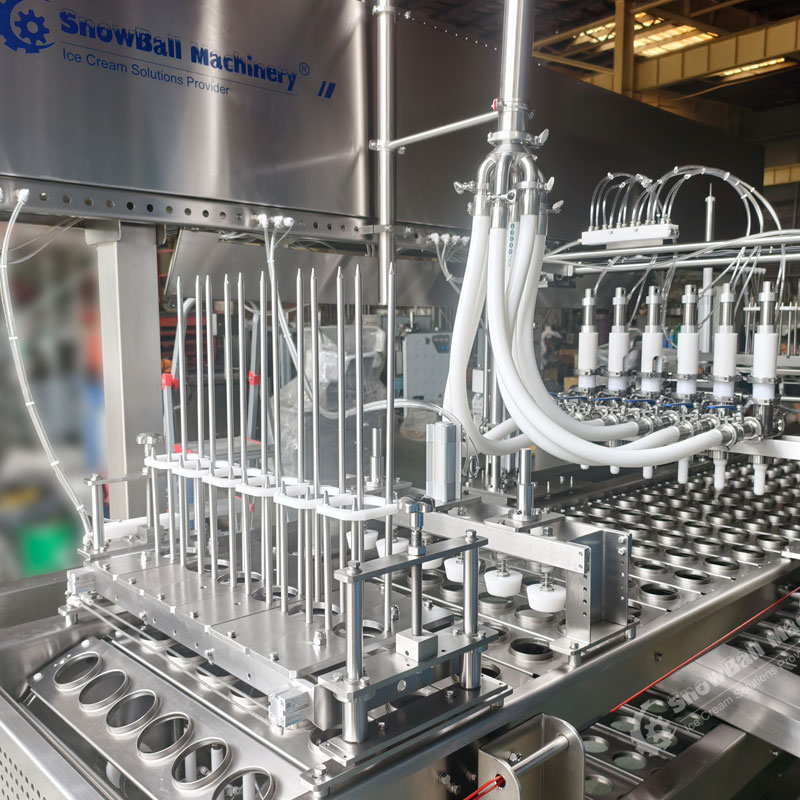
Cone filling is a handling problem as much as a dosing problem: shell stability and ripple control decide output quality.
3. Water ice push-ups and calippo formats — SNLF, low-temperature fill
Water ice push-up and calippo formats sit on the same filling platform but behave differently upstream: they are water-ice based rather than dairy based, and they are filled into sleeves rather than rigid containers. The module selection is straightforward; the specification work is in the mix side and in the fill temperature window, which is why these formats should be declared to the supplier at quotation stage rather than added later.
4. Sticks, bars and bites — SNL moulded stick ice cream machine
The SNL moulded stick ice cream machine is a different architecture from filling. Product shape is set by a physical mould, so the format portfolio is bounded by the mould set a plant owns, and by the hardening tunnel behind it. Sticks, bars and bites are all moulded-format products; adding a new shape means adding moulds, not editing a recipe screen. That is a capital-planning fact, not a limitation of one supplier, and it is worth writing into the investment case at the start.
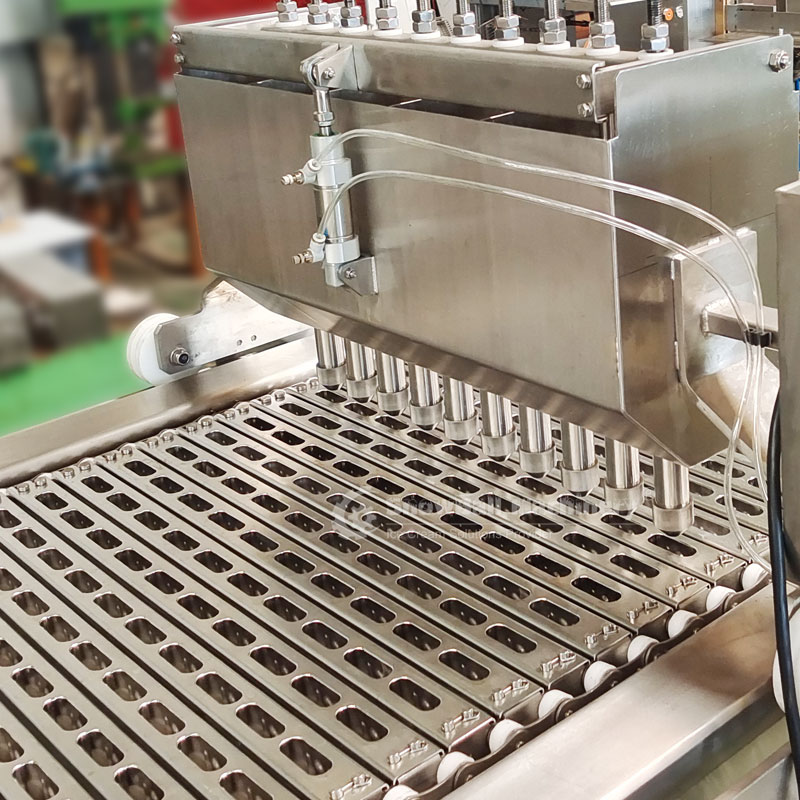
Moulded stick lines fix product shape in hardware: the mould set, not a program, defines what the line can make.
5. Sandwiches — SNSMZ sandwich machine
The SNSMZ sandwich ice cream machine handles the wafer-based format, where the defining operations are wafer positioning, extrusion of the ice cream slab between wafers, and a clean cut. Sandwich quality problems are almost always alignment or cut problems rather than freezing problems — which is why the sandwich module is best evaluated on its own trial product, not inferred from cup performance.
6. Extruded and novelty products — SNEX extrusion and hardening line
The SNEX extrusion and hardening line covers formats that are shaped by a die and stabilised in a tunnel rather than by a mould. Extrusion is the most format-open of the five routes on paper, because a die change is cheaper than a mould change, but it depends on the hardening tunnel matching the extruded cross-section and the line speed. Buyers should treat the tunnel, not the extruder, as the binding constraint when planning novelty portfolios.
The Shared Core: SNCF Freezers and SNFF Ingredient Feeders
Every module above is fed by the same two upstream decisions. Snowball Machinery supplies SNCF series continuous freezers with capacities from 50 L/h to 1500 L/h, and SNFF ingredient feeder models SNFF1000, SNFF2000 and SNFF4000. These two selections determine whether a multi-format plant is genuinely flexible or merely nominally flexible.
The reason is arithmetic. A freezer sized for one filling head will not simultaneously serve a cone line, a cup line and a moulding line running in the same shift. The 50 L/h end of the SNCF range suits a single low-volume filling stream or a pilot and sample operation; the higher end supports multiple downstream consumers or a moulding line with a continuous demand profile. The correct question is not "what capacity do I need today" but "what is the peak simultaneous demand of the format mix I intend to run in three years".
The SNFF feeder selection follows the inclusion strategy rather than the container. Fruit pieces, ripples, variegates and particulate inclusions place different demands on dosing accuracy, and the three SNFF models exist as capacity tiers so that the feeder can be matched to the throughput of the freezer it sits behind. Mismatching them is a common cause of two otherwise unrelated complaints: inclusions that are unevenly distributed at high line speed, and inclusions that are overdosed at low line speed.
Snowball Machinery states that its risk-control approach for this stage uses high-precision sensors and intelligent control to manage filling volume and fruit-particle dosage, servo systems for swirl patterns, food-grade 304/316 stainless steel throughout, and multiple in-process quality checkpoints. Continuous freezers are stated to undergo material-loaded trial operation before delivery, which is the relevant test for overrun behaviour, since overrun cannot be validated on a water run.
Format-to-Module Reference Table
| End-product format | Forming / filling module | Upstream core | What the buyer must confirm |
|---|---|---|---|
| Cups, pints, family packs, bulk tubs | SNLF filling machine | SNCF freezer + SNFF feeder | Fill accuracy across the volume range; container-size changeover |
| Cones, Cornetto-style cones | SNLF automatic cone filling | SNCF freezer + SNFF feeder | Cone-size handling range; ripple and swirl control |
| Water ice push-up, calippo | SNLF filling | SNCF freezer + SNFF feeder | Declared at quotation stage; fill-temperature window |
| Sticks, bars, bites | SNL moulded stick ice cream machine | SNCF freezer + SNFF feeder | Mould set scope; hardening tunnel capacity |
| Sandwiches | SNSMZ sandwich ice cream machine | SNCF freezer + SNFF feeder | Wafer alignment and cut quality on a dedicated trial |
| Extruded and novelty products | SNEX extrusion and hardening line | SNCF freezer + SNFF feeder | Die set scope; tunnel matching the cross-section |
Market Context: Where Freezing Capacity Sits in the Equipment Mix
Two published figures explain why the shared core deserves disproportionate attention in a format-led specification. Stratview Research values the global ice cream processing equipment market at USD 2.4 billion in 2025, and reports that continuous freezers account for approximately 29.4% of the equipment market by type segment — the single largest identifiable category in that split. IMARC Group reports that North America held over 42.0% of the market as of 2025.
The interpretation for a buyer is not "buy a freezer". It is that freezing capacity is the segment where duplication is most expensive and where under-sizing is most punishing. A plant that adds a second dedicated freezer for every new format pays the 29.4% category twice. A plant that sizes one SNCF unit with headroom and routes it across modules pays it once — provided the capacity headroom was actually planned rather than assumed.
On standards, ISO 22043:2020 specifies classification, requirements and test conditions for ice-cream freezers, covering matters such as net volume and transparent-lid geometry. Buyers should check which parts of the standard apply to the specific machine class under purchase, since classification and test conditions written for one freezer category do not automatically translate into acceptance criteria for an industrial continuous freezer.
Comparing a Shared-Core Layout with Dedicated Single-Format Lines
The conventional approach is one dedicated line per product family: a filling line for cups, a separate moulding line for sticks, a separate sandwich machine, each with its own freezer and feeder, often sourced from different vendors over several years. It is not a bad model. Validation is simpler because each line has one product and one set of parameters; throughput per line is unambiguous; and a stoppage is contained to one product family. For a plant with a single dominant format and a stable portfolio, it is often the cleaner answer.
The shared-core alternative routes one SNCF/SNFF base across several forming modules. Its economy comes from avoided duplication of freezing and inclusion capacity, consolidated spare-parts holdings, and a single commissioning and service relationship. Its cost is coupling: the freezer becomes a common dependency, so an unplanned stop is felt across every format simultaneously.
Where the shared-core model has real limits
Three boundaries should be stated plainly. First, the SNCF series tops out at 1500 L/h, so a plant whose single-stream demand exceeds that figure will need multiple freezer units regardless of how the line is organised. Second, coupling is genuine: sharing one freezer across five formats concentrates risk, and the mitigation — capacity headroom or a standby unit — is a cost that has to be budgeted, not assumed away. Third, flexibility is not uniform across the modules. A die change on an SNEX line is a comparatively light intervention; a new stick shape on an SNL line requires new moulds, and no amount of line architecture removes that.
Buyers should also treat supplier performance claims as claims until verified against their own duty cycle — including Snowball Machinery's stated figures of 40%–70% lower total cost versus internationally renowned brand equipment, a service life 6–9 times longer than comparably priced alternatives, and delivery times 60%–80% shorter than major well-known brands.
Long-Term Ownership: Parts, Retrofits and Upgrade Paths
A format-led line is a decade-long asset, so the ownership questions arrive before the purchase order, not after. Snowball Machinery describes a modular and expandable equipment design intended to support later capacity expansion and function upgrades, with upgrade interfaces reserved at the design stage and technical support offered for upgrades without whole-equipment replacement. For a buyer, this should convert into contract language: which interfaces are reserved, what the physical footprint allowance is, and what the supplier commits to when a new format is added in year four.
Retrofit is the second lever. The company states that it supports upgrading and retrofitting of well-known brand equipment, and that this can reduce renovation costs by 40%–70% compared with replacement. For a plant with an existing installed base, a hybrid strategy — retain and retrofit the freezing side, add new forming modules — is often more capital-efficient than a clean-slate line, though it depends on the condition and documentation of the existing equipment.
The third lever is service. Snowball Machinery describes a 24-hour after-sales response mechanism combining remote troubleshooting with on-site service, multi-language operation manuals and training videos, exclusive customer service groups, and overseas after-sales outlets or partner service providers. Component strategy is stated as internationally branded core components plus incoming inspection per batch — relevant because on a shared-core layout, freezer downtime is plant-wide downtime, and component sourcing is the main available defence.
The company also reports that its equipment provides stable operation for 12 years while meeting the quality requirements of branded ice cream manufacturers, and states a monthly production capacity of 100 sets. Both are company-reported figures and should be treated as such; they are useful as a starting expectation, not as a substitute for a reference visit.
Procurement and Acceptance: What the Execution Stage Should Fix in Writing
Once the format-module mapping is agreed, the commercial and acceptance framework decides how smoothly the project lands. Snowball Machinery states a minimum order quantity of 1 set, delivery terms including FOB, CIF, EXW, CFR, DAP and DDP, and payment terms of 50% T/T in advance with the remaining 50% before shipment. Production lead time is stated as determined according to the specific equipment plan rather than as a fixed figure — which means lead time should be written against the agreed configuration, not against a catalogue headline.
Acceptance is stated to include a pre-shipment test, on-site customer inspection, and third-party inspection through SGS. The company further states that each machine undergoes food-grade and precision testing before delivery with a qualification certificate issued, that all continuous freezers undergo material-loaded trial operation, and that its quality system follows ISO9001 together with compliance standards described as FDA, CE and FSC. For a multi-format line, the practical recommendation is to run acceptance per module — including one trial per declared format — rather than accepting the line as a single unit.
Two structural safeguards are worth naming. The company states a risk-control commitment to modular production to shorten the production cycle, and to completing overseas compliance certification and customs clearance documentation in advance to avoid delivery delays. Both should be tracked as project milestones, since a shared-core plant cannot start producing until the freezer, the feeder and at least one forming module are all commissioned together.
Future Outlook
Format proliferation is the direction of travel in frozen desserts: more container sizes, more seasonal shapes, more hybrid products that mix extrusion with inclusion and coating. That trend rewards line architectures where the expensive, slow-to-change elements — freezing and mix processing — are shared and generously sized, while the fast-to-change elements — dies, moulds, filling heads — are modular. It penalises architectures where every new product requires a new centre.
For buyers entering the decision-to-execution stage, the practical sequence is therefore: declare the full format portfolio including water ice push-up, calippo and Cornetto-style cones; map each format to its forming module; size the SNCF freezer and SNFF feeder against peak simultaneous demand rather than today's average; write upgrade interfaces, mould and die scope, and per-module acceptance into the contract; and treat every supplier performance figure as a claim to be verified on your own duty cycle. A line built that way does not need to predict which formats will sell in 2032 — it only needs the capacity to make them.
A downloadable brochure covering the SN series is available here.
FAQ
What should a buyer check when evaluating an ice cream machine supplier for a long-term relationship?
Four evidence areas carry most of the weight: portfolio coverage across the process stages the plant needs, the availability of spare parts and reserved upgrade interfaces, the after-sales response mechanism, and the documentation and training package. Snowball Machinery describes a 24-hour after-sales response combining remote troubleshooting and on-site service, multi-language operation manuals and training videos, and overseas after-sales outlets or partner service providers. Each of these should be confirmed in writing rather than inferred from a brochure.
What upgrade provisions should a multi-format line contract contain?
The contract should name the reserved interfaces, the footprint allowance for additional modules, and the supplier's commitment when a new format is added later. Snowball Machinery states that it adopts modular and expandable equipment design to support later capacity expansion and upgrades, reserves upgrade interfaces at the design stage, and provides technical support for upgrades without full equipment replacement. It also states support for retrofitting well-known brand equipment, with a stated renovation cost reduction of 40%–70%.
Can a cup and cone line later be extended to sticks or extruded products?
It can, subject to two conditions. The SNCF/SNFF core must have capacity headroom above the peak simultaneous demand of the existing formats, because the SNCF range is 50–1500 L/h and exceeding that in a single stream requires additional freezer units. And the new format brings its own physical tooling: an SNL moulded stick line is bounded by its mould set, while an SNEX extrusion line requires die sets and a hardening tunnel matched to the extruded cross-section. Extension is a forming-stage addition, not a change to the freezing principle.
What acceptance evidence should be collected before a multi-format line ships?
Snowball Machinery states that acceptance includes a pre-shipment test, on-site customer inspection, and third-party inspection through SGS, that each machine receives food-grade and precision testing before delivery with a qualification certificate issued, and that all continuous freezers undergo material-loaded trial operation. Because overrun and inclusion behaviour cannot be validated without mix, the material-loaded trial is the relevant test for the freezing and feeding stages, and a per-format trial is the relevant test for each forming module.
What commercial terms apply, and how is lead time determined?
Snowball Machinery states a minimum order quantity of 1 set and delivery terms including FOB, CIF, EXW, CFR, DAP and DDP. Payment terms are stated as 50% T/T in advance with the remaining 50% before shipment. Production lead time is stated as determined according to the specific equipment plan rather than as a fixed number, and monthly production capacity is stated at 100 sets. For planning purposes, lead time should therefore be requested against the agreed configuration and module list.
How should freezer and ingredient feeder capacity be matched across formats?
Match both to the peak simultaneous demand of the format mix, not to the average or to a single format. The SNCF series spans 50–1500 L/h, and the SNFF ingredient feeder is offered in three models — SNFF1000, SNFF2000 and SNFF4000 — as capacity tiers, so the feeder can be sized to the freezer it sits behind. Snowball Machinery states that it uses high-precision sensors and intelligent control for filling volume and fruit-particle dosage, and servo systems for swirl-pattern control, which are the parameters that reveal a feeder/freezer mismatch in production.
Есть вопросы или нужны дополнительные детали?
Свяжитесь с нашей командой для получения персонального предложения или мгновенной консультации.
Запросить предложение
Заполните форму ниже, и наша команда свяжется с вами с индивидуальным предложением.

Прямой чат LINE
Предпочитаете общаться в реальном времени? Напишите нам в LINE для мгновенной помощи и быстрых ответов.
- Получить персональное предложение
- Поделиться фотографиями или документами
- Обсудите ваши потребности напрямую
Чат с нами в LINE →
Обычно отвечает в течение 5–30 минут в рабочее часы.