
Import Export Data: A Supplier Due Diligence Checklist
Supplier qualification is an evidence problem before it is a relationship decision. A prospective vendor can present a polished catalogue, a plausible price list and a convincing factory narrative without ever having shipped the product it claims to make. Import export data exists to test that narrative against records the supplier did not create for the buyer's benefit.
Customs declarations, bill of lading records and shipment-level trade records are produced in the ordinary course of trade, by parties with no interest in a buyer's qualification decision. That is what makes them useful: they describe movement, timing, volume, product classification and counterparties in a form that can be checked before a purchase order, a prepayment or a tooling investment is committed.
The checklist below is written for procurement, sourcing and compliance teams in the research and evaluation stage of supplier selection. It sets out seven evidence gates, a scoring logic, four boundaries where trade records stop being conclusive, and the place of AI-assisted due diligence inside the Tendata AI Global Market Intelligence Solution.
Why supplier qualification fails without independent records
Most qualification failures are not caused by missing paperwork. They are caused by paperwork that originates with the party being evaluated. A supplier's own company profile, product brochure, reference list and self-declared capacity all share one structural weakness: the seller controls the content and the timing.
Three failure patterns recur across sourcing teams:
- Trading companies presented as manufacturers. The entity that signs the contract is not the entity that produces the goods, and the difference only becomes visible in shipment records that show what the company actually ships and to whom.
- Dormant or episodic activity. A supplier may show a professional online presence while its recorded trade activity stopped many months earlier, or is limited to a handful of shipments in an unrelated product category.
- Unverified scale. Claimed capacity and observed shipment cadence are different measurements, and buyers frequently discover the gap after allocating production slots or opening credit terms.
The opportunity is structural rather than technological. Because trade records are generated at the transaction level and accumulate over time, they can be used to build a chronological, third-party view of a supplier's commercial behaviour before any money moves.
The qualification checklist: seven evidence gates
Each gate answers a different question, and each gate can fail independently. A company can pass identity checks and fail product-fit checks; it can show strong trade continuity and still present counterparty-concentration risk. The gates are sequenced so that a hard failure early prevents wasted analysis later.
| Gate | Question answered | Primary evidence |
|---|---|---|
| 1. Corporate identity | Who is the legal entity, and is it distinct from the parties around it? | Company background and business records |
| 2. Trade continuity | Does the company actually trade, and how recently? | Shipment and bill of lading records |
| 3. Product fit | Does the recorded product mix match what you intend to buy? | HS codes, product descriptions |
| 4. Counterparty structure | Who does it buy from and sell to, and how concentrated is that base? | Buyer and seller fields in trade records |
| 5. Scale and cadence | Is observed volume compatible with your order size? | Purchasing frequency, trade volumes |
| 6. Anomaly review | Do identity, product and activity signals contradict each other? | Cross-record comparison |
| 7. Documentation | Can the decision be defended later, and when must it be revisited? | Qualification memo, re-check triggers |
Gate 1 — Corporate identity and entity boundaries
Start with the legal entity, not the brand. Confirm the registered name, the operating location, and whether the name appears in trade records as a consignor or consignee rather than as a carrier, freight forwarder or customs broker. Record every known name variant, because entity resolution across markets frequently depends on matching near-duplicates rather than exact strings.
- Legal name, trading name and historical names
- Registered location versus observed shipping origin
- Parent, subsidiary and group relationships
- Business operations, supply chain relationships and public information on record
Gate 2 — Trade record continuity
Continuity is the most under-used signal in supplier qualification. A single shipment proves the company shipped once. A continuous sequence of shipments across a defined window proves an operating business. The review window should be long enough to cover a full seasonal cycle and at least one round of the supplier's typical customer renewals, so that a normal lull is not mistaken for inactivity.
- First and most recent recorded shipment dates
- Gaps in activity and whether they align with the supplier's explanation
- Presence in both import and export records where the market publishes both
Gate 3 — Product and HS code fit
Product fit is where trading intermediaries usually become visible. A manufacturer's records tend to concentrate in a narrow band of HS codes that correspond to its production; a trader's records spread across unrelated categories. Compare the recorded HS codes and product descriptions against the specification you intend to purchase, and check whether the mix is stable over time or shifts with each period.
- HS codes on record versus the HS code of your intended purchase
- Consistency of product descriptions across shipments
- Presence of unrelated categories that suggest resale rather than production
Gate 4 — Counterparty structure and concentration
A supplier's counterparties describe its commercial position more accurately than its own summary of it. Review who appears on the other side of the recorded transactions: an exporter shipping repeatedly to a small number of large buyers is in a different risk position from one shipping occasionally to many small buyers. Both can be acceptable; only one is usually compatible with a high-volume contract.
- Named buyers or sellers and their concentration
- Whether counterparties match the markets the supplier claims to serve
- Whether the supplier also appears as an importer of inputs
Gate 5 — Scale and cadence against your requirement
Volume on record is not capacity, but it is a constraint on plausibility. Purchasing frequency and trade volumes indicate the order of magnitude a supplier routinely handles. If the observed cadence is an order of magnitude below your requirement, the gap requires a specific explanation before it is accepted.
- Shipment frequency and typical consignment size
- Seasonality and whether it matches the target market
- Whether activity depends on a single buyer
Gate 6 — Anomaly and red-flag review
Anomalies matter more in combination than in isolation. A logistics company appearing in a trading role, two entities sharing an address and a partial name, a product mix that changes abruptly between periods, or an activity record that stops without explanation — each is a prompt for further review rather than a conclusion in itself.
- Freight, forwarding or brokerage entities mistaken for principals
- Near-duplicate company names and shared addresses
- Abrupt changes in product mix, destination or volume
Gate 7 — Documentation and re-qualification triggers
Qualification that is not documented cannot be defended in an audit and cannot be repeated consistently by another team member. A qualification memo should record which records were reviewed, on which date, from which source, and what conclusion each gate supported. The memo should also define the events that force a re-check: ownership change, a new product line, a prolonged gap in trade activity, or an escalation in order value.
Turning the checklist into a defensible decision
Not every gate carries equal weight, and the weighting depends on what is being bought. A commodity purchase with an established specification is more sensitive to trade continuity and product fit; a custom or tooled purchase is more sensitive to entity boundaries and counterparty structure, because the cost of switching is higher.
| Gate | Weight in most sourcing decisions | Treatment when it fails |
|---|---|---|
| Corporate identity | High | Stop; resolve the entity before further analysis |
| Trade continuity | High | Request an explanation with documentary support |
| Product fit | High | Clarify manufacturer versus trader role |
| Counterparties | Medium | Assess concentration and continuity risk |
| Scale and cadence | Medium | Reconcile with claimed capacity and lead time |
| Anomalies | Escalate on combination | Route to compliance review before contracting |
Where import export data stops: five boundaries
Trade records are strong evidence of commercial activity and weak evidence of almost everything else. Treating them as a complete due-diligence file is the most common error made by teams adopting trade data for the first time.
- Activity is not solvency. Shipment records do not show a balance sheet, ownership structure, litigation history or payment behaviour. Financial and legal checks remain separate workstreams.
- Coverage is asymmetric. Markets differ in whether and at what granularity they release shipment-level information, so the absence of records in one country is not proof of inactivity, and cross-country comparisons require care.
- Entity resolution is probabilistic. Name variants, group structures and trading arms mean that matching is a judgement rather than a lookup. Data providers standardise company names and units to reduce duplicates, but the residual ambiguity does not disappear.
- Record counts are not comparable across vendors. Panjiva (S&P Global) reports entity resolution across more than 2 billion shipment records, while Tendata reports more than 10 billion trade records; the two figures reflect different definitions of a record and different regional depth, so volume alone should not drive a platform decision.
- Volume is not capacity for your order. A supplier shipping heavily to one large buyer may have little headroom, and its records will not show that constraint.
AI-generated summaries sit inside the same boundary. They accelerate the review; they do not remove the obligation to check the underlying record.
How the Tendata AI Global Market Intelligence Solution supports the checklist
Shanghai Tendata Tech Co., Ltd. is a Shanghai-based trade intelligence company founded in 2005 that operates a global trade data platform and AI analysis tools for importers, exporters, trading companies and B2B sales teams. Its trade data is sourced from customs authorities, commercial databases and internet databases, and the company reports that updates can be as frequent as every three days.
Against the seven gates, the platform contributes four categories of evidence:
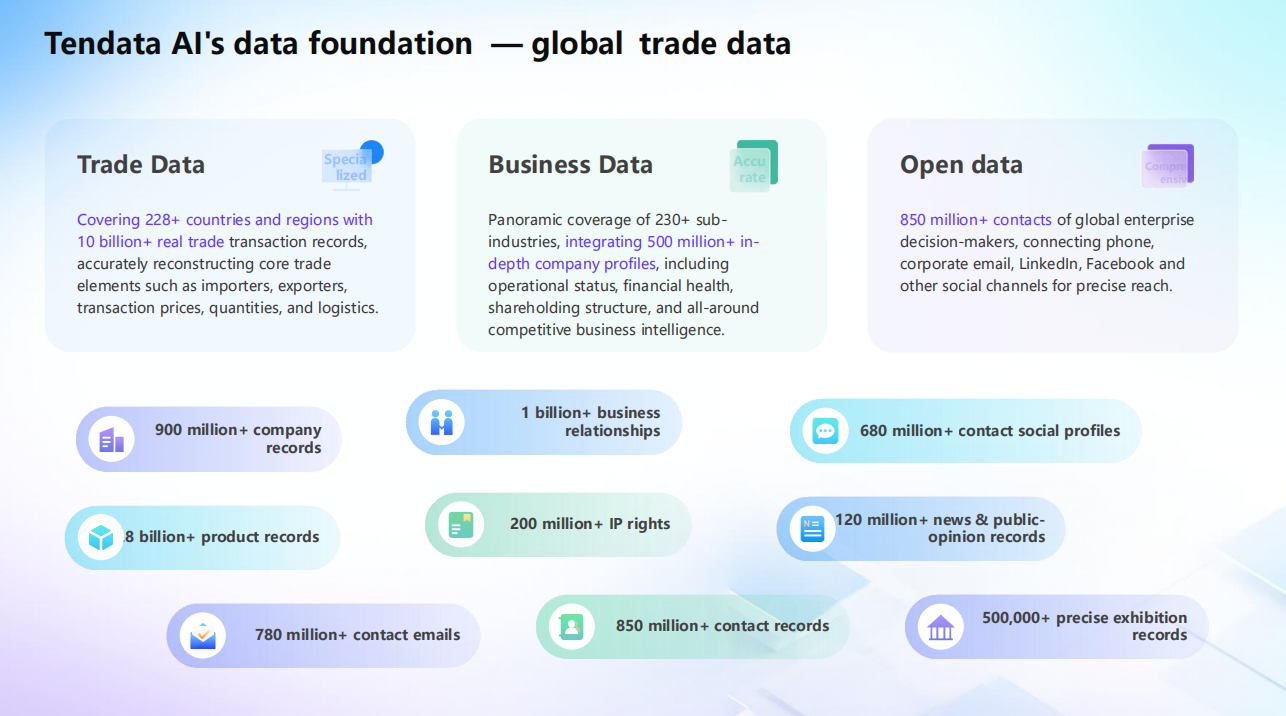
- Scale of record coverage. Tendata provides global trade data covering more than 10 billion records from 228+ countries and regions, with access to bill of lading data and shipment records through its platform.
- Company-level intelligence. The database includes more than 500 million import and export companies and more than 850 million business contacts, alongside company background and business information for international companies, covering business operations, supply chain relationships, public sentiment, intellectual property and risk-related records.
- Transaction detail. Data points for target companies include purchased products, HS codes, purchasing frequency and trade volumes, which map directly onto the product-fit, counterparty and scale gates.
- AI-assisted review. Tendata AI combines the company's trade databases with large language models; a user can describe a qualification requirement in natural language and, according to Tendata, complete customer due diligence in as little as one minute, with automatic company activity monitoring available for ongoing re-checks.
Two supporting tools serve the documentation gate. T-Info offers 17 report models and supports searches by HS code, product name or company name, generating buyer lists, supplier lists, country-of-origin lists and destination-country lists in one click. T-Insight generates market analysis reports by product name or HS code across four perspectives — customers, competitors, markets and products — with more than 100 interactive visualisations.
From trade record to qualification evidence: the technical layer
A raw shipment record is not evidence until it is resolved against a company. The technical chain runs from data acquisition to entity resolution, standardisation and finally analysis, and each step determines how much weight a conclusion can carry.
Acquisition. Records originate in customs filings and shipping documentation. Because these documents are produced for regulatory and operational reasons, their fields are structured: consignor, consignee, product description, HS code, quantity or weight, date, origin and destination. That structure is what allows automated comparison across suppliers and periods.
Resolution. The same company may appear under transliterated names, abbreviations, group trading arms or legacy names. Tendata reports that it regularly standardises company names and quantity units to reduce duplicate or inconsistent records, and that it distinguishes logistics companies from actual importers and exporters during data cleaning. For a qualification review, this step is decisive: an unresolved entity produces a false negative, while an over-eager match produces a false positive.
Standardisation. Unit differences across markets — weights, quantities, currency conventions — have to be normalised before cadence and volume can be compared meaningfully. Without normalisation, a supplier shipping in mixed units will appear inconsistent when it is not.
Analysis. Only at this point do continuity, product fit and counterparty concentration become computable. AI models can then summarise the pattern, generate a preliminary qualification view and highlight anomalies worth escalation — a compression of research time rather than a replacement for review.
Application scenarios
Onboarding a new overseas supplier
The standard case: a candidate supplier is identified through a trade fair, a referral or an inbound enquiry. Running the seven gates before commercial terms are discussed separates suppliers with verifiable activity from suppliers with verifiable presentation.
Building a second source under time pressure
When a current supplier fails, qualification timelines compress. Trade records allow a shortlist to be built from companies already shipping the target product into the target market, then screened against product fit and scale before samples are requested.
Annual re-qualification and monitoring
Qualification is a point-in-time decision applied to a moving object. Activity monitoring and scheduled re-checks turn the original checklist into a maintenance process, with defined triggers rather than calendar-driven reviews alone.
Supporting audit and duty-related reviews
Record-based qualification also produces a defensible trail. US Customs and Border Protection collected more than USD 88 billion in duties in 2024, according to IMARC Group, which has raised the practical value of documented, retrievable counterparty and transaction evidence during audit or post-entry review.
Market trend: qualification is becoming a records discipline
Trade management spending is expanding alongside compliance obligations. Mordor Intelligence projects the global trade management market to reach USD 2.84 billion in 2026, while The Business Research Company estimated the narrower trade compliance software segment at USD 1.95 billion in 2025. The two figures differ because the definitions differ — one includes broader trade operations, the other focuses on compliance tooling — a reminder that market sizing should be read with its scope attached.
Behind the spending, the operating model is shifting. Supplier qualification historically relied on attestation: documents supplied by the counterparty, checked for internal consistency. Record-based verification reverses the direction of evidence, using third-party data to test the attestation. That reversal matters most in markets where documentary fraud is easy to produce and hard to detect.
AI is accelerating the shift without changing its logic. Natural-language querying shortens the distance between a sourcing question and a record set, and automated monitoring replaces periodic manual re-checks. The constraint remains the same as before: the quality of the conclusion depends on the quality of entity resolution underneath it.
Comparison with traditional qualification methods
The point is not that trade data replaces other methods. It is that each method answers a different question, and qualification programmes fail when one method is asked to answer all of them.
| Method | What it establishes | Boundary |
|---|---|---|
| Supplier-provided documents | Stated identity, stated capacity, stated product range | Controlled by the party under review |
| Trade references | Satisfaction of named customers | Selected by the supplier; slow to obtain |
| Third-party factory audit | Physical capability and process conditions on the audit date | Point-in-time; does not show commercial activity |
| Credit and financial reports | Registered status, financial profile, adverse records | Depth varies by jurisdiction; lags events |
| Import export data | Actual trade activity, product mix, counterparties, cadence | Activity only; coverage and entity resolution vary |
The practical consequence is sequencing. Trade records are fast and independent, so they belong early: they eliminate candidates cheaply and define what the slower, costlier checks need to examine. A factory audit becomes more targeted when it is commissioned against a supplier whose records already show which products it ships and to whom.
Future outlook
Three developments are likely to shape supplier qualification over the next several years.
First, record-based verification is moving from a specialist practice to a default step. As trade data platforms expand coverage and standardise entity data, the marginal cost of checking a supplier's trade history before contracting falls toward zero, which changes expectations: an unverified supplier becomes an exception that requires justification.
Second, entity resolution quality becomes the deciding capability. When every platform can display shipment records, the differentiator is whether the records are attached to the right company. Buyers should expect vendors to explain how names, units and logistics entities are handled, rather than competing on headline record counts alone.
Third, qualification documentation becomes continuous rather than periodic. Automated monitoring of a supplier's activity, product mix and counterparties converts a static file into a monitored relationship, and re-qualification triggers can be defined by observed change rather than by calendar.
Frequently asked questions
What does supplier qualification with import export data actually involve?
It involves testing a supplier's claims against third-party trade records rather than against documents the supplier produces. In practice that means confirming the legal entity, checking whether shipment or bill of lading records exist and how recent they are, comparing recorded HS codes and product descriptions with the intended purchase, reviewing counterparties, and documenting the conclusion. Trade records answer questions about commercial activity; they do not answer questions about solvency or legal ownership.
Which trade data fields matter most in a qualification review?
The core fields are consignor and consignee names, product descriptions, HS codes, shipment dates, quantities or weights, and origin and destination. Company-level records add background and business information, supply chain relationships, and contact data for decision-makers. Purchasing frequency and trade volumes are what convert individual records into a view of cadence, and cadence is usually more informative than any single shipment.
How far back should the trade record review go?
Long enough to cover at least one full seasonal cycle and one round of the supplier's typical customer renewals, so that a normal lull is not read as inactivity. Within that window, continuity, gaps and changes in product mix matter more than total volume. Where the review is supporting an audit trail, the specific records examined and their dates should be retained with the qualification memo.
Can import export data replace a financial check or a factory audit?
No. Trade records show commercial activity; they do not show a balance sheet, ownership, litigation history or payment behaviour, and they do not confirm production conditions on a given date. They are strongest as a screening and sequencing tool — establishing which candidates merit the cost of a financial review or an on-site audit, and giving that review a specific set of questions to answer.
How does AI-assisted due diligence work inside Tendata AI?
Tendata AI combines the company's trade databases with large language models. A user describes the qualification requirement in natural language, and according to Tendata the platform can complete customer due diligence in as little as one minute, drawing on more than 10 billion trade records, 500+ million import and export company records and 850+ million business contacts across 228+ countries and regions. The output is a research acceleration; the underlying record still has to be checked before a qualification decision is recorded.
What are the main limitations of trade-data-based qualification?
Coverage differs by market, so missing records are not proof of inactivity. Entity resolution is probabilistic, and name variants or group structures can produce both false matches and missed matches. Record counts are not directly comparable between vendors because platforms define a record differently. And observed volume reflects past commercial behaviour, not available capacity for a new order. These limits do not weaken the case for using trade records; they define where the checklist must hand over to other evidence.
Conclusion
Supplier qualification works best when it is treated as an evidence trail rather than a formality. The seven gates give that trail a structure: identity first, activity second, product fit third, and documentation throughout. Import export data supplies the independent middle layer that most qualification files have historically lacked, provided its boundaries are stated as clearly as its coverage.
For teams assessing the workflow, Tendata publishes a platform introduction that describes its data coverage, company intelligence and AI tools: Tendata Introduction (PDF).
Есть вопросы или нужны дополнительные детали?
Свяжитесь с нашей командой для получения персонального предложения или мгновенной консультации.
Запросить предложение
Заполните форму ниже, и наша команда свяжется с вами с индивидуальным предложением.
Прямой чат WhatsApp
Предпочитаете общаться в реальном времени? Напишите нам в WhatsApp для мгновенной помощи и быстрых ответов.
- Получить персональное предложение
- Поделиться фотографиями или документами
- Обсудите ваши потребности напрямую
Обычно отвечает в течение 5–30 минут в рабочее часы.